Part 2: The Biker Threw an Empty Memorial Chair from the Front Row During Graduation—Then Returned with a Safer Seat for the Daughter Who Never Reached the Stage
Part 2 — The Daughter Who Made Her Father Check Everything Twice
I first met Emma Dawson during her freshman year.
She entered my office carrying a schedule covered in corrections, a yellow backpack with one broken zipper, and the fearless expression of someone accustomed to translating intimidating adults for everyone else.
Hammer stood behind her.
He wore the same leather vest and gray beard, though less silver showed then. His body filled the doorway, making our guidance secretary quietly move the emergency button closer.
Emma noticed.
“My dad fixes motorcycles,” she said. “He only looks like he eats principals.”
Hammer stared at her.
“Don’t scare the lady.”
“You’re scaring the lady.”
I laughed despite myself.
That was Emma.
She recognized tension before adults named it, then punctured it without cruelty.
She joined stage crew, woodworking club, and the student safety committee. She disliked performing but loved building things nobody noticed until they failed.
Hammer taught her to use hand tools inside his garage.
Emma taught him to read instructions.
When she assembled shelves, she checked every joint twice. When she tied equipment to a trailer, she pulled each strap before allowing Hammer to drive.
“Check what holds the weight,” she always said.
Her leukemia diagnosis arrived during sophomore year.
Treatment interrupted classes, sports, friendships, and ordinary teenage arguments. Yet Emma continued school remotely whenever her strength allowed.
Iron Mercy members drove meals to the Dawson house, but Marisol prohibited anyone from treating Emma like a club mascot.
No fundraiser used her face without permission.
No motorcycle carried her name unless she approved it.
She hated public pity.
Hammer handled illness differently.
He checked everything.
Medication lists. Appointment times. Seat belts. Wheelchair brakes. Hospital-room outlets. Every handrail between the parking garage and oncology.
His vigilance became suffocating.
Emma once called me from the hospital because Hammer refused to leave her alone long enough to shower.
“He thinks checking means loving,” she said.
“Sometimes it does.”
“Sometimes it means he doesn’t trust me to stay alive for ten minutes.”
That sentence frightened Hammer when I repeated it.
He began attending family counseling.
His past explained part of the fear.
After military service, Hammer lived through painkiller dependence, prison for assault, and years when his daughter knew him more through apologies than reliable mornings.
He became sober when Emma was nine.
From then onward, he treated consistency like a debt requiring daily payment.
Cancer created a problem effort could not repair.
He could arrive early, read every label, and inspect every chair.
He could not guarantee Emma’s graduation.
During senior year, she spent fewer days at school. Still, she joined our ceremony-planning committee through video calls.
Beckford High rented folding chairs from Franklin Valley Events, a company used for graduation, prom, and regional athletic ceremonies.
Emma disliked their equipment.
During junior prom setup, she found cracked welds and unstable legs among several rental chairs. She photographed them and sent a report to Assistant Principal Nolan Pierce.
Pierce forwarded the complaint to Franklin Valley.
The company replaced four units and blamed rough handling by students.
Emma requested a complete inspection.
Nobody ordered one.
Her message disappeared beneath scheduling, budget, and the thousand administrative demands that teach institutions to confuse delay with resolution.
Three months before graduation, Emma’s condition worsened.
Her classmates proposed reserving an empty chair if she could not attend.
She rejected the idea.
“I’m not dead yet.”
Two weeks later, she entered hospice.
Before leaving school for the final time, Emma visited the gym with Hammer. Graduation markings had not been placed, and the rental chairs had not arrived.
She stood at center court.
“Where do parents sit?” she asked.
I pointed toward the front section.
“Dad needs an aisle. His knees are older than America.”
Hammer objected.
Emma ignored him.
She then asked whether the school still used Franklin Valley Events.
When I said yes, she looked toward her father.
“Check the chairs.”
He promised.
At the time, I believed she was teasing his habits.
She was not.
Emma remembered the photographs she sent Pierce. She knew the supplier might return unsafe equipment, and she understood her father would focus entirely on whether she reached the ceremony.
She gave him something concrete to protect.
Check the chairs.
Emma died on a Monday morning.
Graduation was scheduled nineteen days later.
Her final week contained no speeches about courage. She slept, woke, complained about the hospital pudding, and asked Bear to stop whispering because his whisper sounded like a truck reversing.
Before losing strength, she wrote letters.
One for Hammer.
One for Marisol.
One for me.
One for the graduating class.
She placed them inside a wooden box beneath her bed and instructed Hammer not to open his until graduation ended.
The class voted unanimously to reserve her chair.
I did not tell Hammer because students wanted the memorial to remain a surprise.
That secrecy nearly became another mistake.
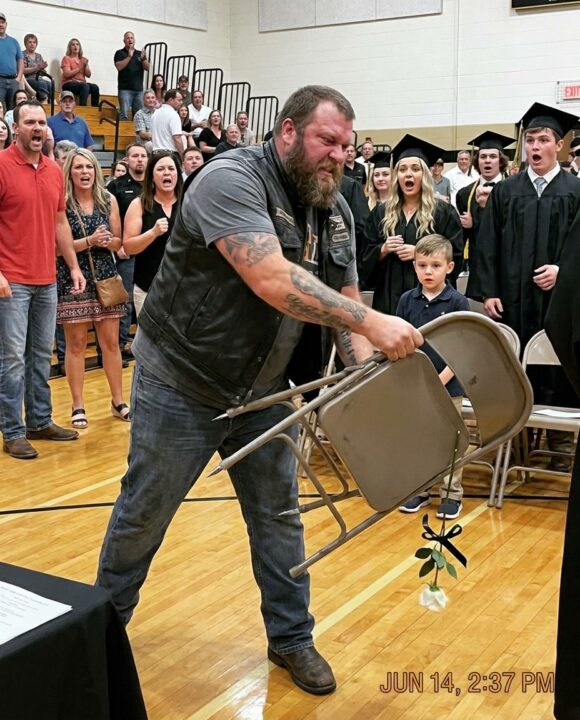
Had Hammer known the empty chair was Emma’s, grief might have slowed his response when he noticed the split leg.
Instead, he saw only danger approaching a child.
He threw first.
Grieved afterward.
Investigators photographed the upward-facing nail. Franklin Valley Events denied responsibility and produced delivery records stating every chair passed inspection.
Our custodian, Mr. Lewis, admitted repairing three chairs before the ceremony.
He claimed Assistant Principal Pierce ordered him to make the front row “look uniform” because replacement units would arrive after guests entered.
Pierce denied giving that order.
One of them was lying.
Then Emma’s original safety photographs appeared inside the wooden box.
The damaged chair she had reported a year earlier carried a small crescent scratch on its rear leg.
The memorial chair Hammer threw carried the same crescent scratch.
It was not another chair from the same batch.
The company had returned the exact chair Emma warned us about.
Part 3 — The Nine Chairs Nobody Wanted to Claim
The discovery suspended our celebration and began an investigation reaching beyond one nail.
Franklin Valley Events supplied chairs to thirty-four schools, churches, nursing facilities, and community centers across southern Ohio.
Their warehouse records claimed damaged units were destroyed.
Employees described something else.
When chairs cracked, supervisors moved them into a repair area where workers used scrap brackets, tape, screws, and nails to keep them rentable through another event.
No engineer reviewed the repairs.
No consistent inspection standard existed.
A black spray-painted dot marked damaged units, but event crews often covered those dots when repainting chipped frames.
Emma’s photographs showed black marks beneath three seats.
The chair Hammer threw had one.
Our front row contained eight more.
Franklin Valley’s owner, Gregory Shaw, blamed a former warehouse manager. The former manager produced emails showing Shaw approved temporary repairs because new inventory cost too much.
The graduation contract required structurally sound seating.
Shaw signed it personally.
Assistant Principal Pierce had received Emma’s earlier photographs and Franklin Valley’s written assurance that the affected chairs were removed.
He accepted that assurance.
On graduation morning, Mr. Lewis found one split leg while arranging the memorial chair. He notified Pierce.
Pierce told him the chair could not be removed because the students had decorated it and television reporters would film the tribute.
Lewis drove a finishing nail through the break, wrapped the leg in black tape, and returned the rose to the cushion.
Neither man examined where the nail ended.
Both convinced themselves the empty chair would remain empty.
That assumption ignored younger siblings, photographs after the ceremony, students shifting seats, and the ordinary human instinct to occupy any available space.
The chair was symbolic until a living child reached toward it.
Then it became furniture again.
Pierce resigned.
Lewis accepted responsibility but insisted he acted under pressure. Parents demanded his dismissal.
Hammer surprised everyone.
“Train him,” he said.
Several parents shouted that Mr. Lewis could have injured Noah.
Hammer did not disagree.
“Fire the man if policy says fire him. But don’t pretend he invented the pressure.”
Pierce protected appearances. Franklin Valley protected profit. The school trusted paperwork over Emma’s photographs.
Lewis held the hammer.
That made him responsible, not solitary.
The distinction angered people who wanted one villain.
Real failures rarely arrive alone.
During the investigation, a short video of Hammer throwing the chair spread online. It ended before the broken leg exposed the nail.
The caption described him as a biker attacking a memorial for his dead daughter.
Strangers accused him of rejecting Emma because illness disappointed him. Others claimed Iron Mercy opposed school events or wanted publicity.
A photograph of Hammer’s criminal record circulated.
The school district issued a cautious statement saying an attendee disrupted graduation before staff identified unsafe seating.
That wording protected the district.
It also made Hammer sound responsible for discovering a danger adults placed in the front row.
Iron Mercy wanted to respond.
Bear proposed releasing every investigation photograph immediately. Marisol insisted Noah’s family consent before video showed the child.
Angela agreed to share a cropped sequence hiding Noah’s face.
The school’s attorneys objected.
Publicly confirming the nail before the investigation ended could increase liability.
Hammer read their letter.
Then he placed it on my desk.
“They worried about the wrong chair twice.”
He refused an interview.
He did not want Emma’s death turned into a viral defense strategy. Every reporter requested hospital photographs, final letters, and details about her last days.
Hammer said no.
The club’s reputation suffered.
Two charity events canceled their participation. A sponsor paused funding for Iron Mercy’s youth programs, while anonymous callers threatened to destroy the handcrafted replacement chair.
Several younger bikers demanded a protest outside district offices.
Hammer prohibited it.
“This is graduation,” he said. “Not our rally.”
A member named Cole ignored him and posted Franklin Valley’s warehouse address. Strangers began harassing employees, including workers who had repeatedly reported unsafe practices.
Marisol suspended Cole.
The vote divided the club.
Some believed protecting warehouse employees showed weakness. Others understood public retaliation could frighten witnesses into silence.
Brotherhood faced the same test as the chair.
Would it hold weight, or only look strong from the front?
Hammer removed his president patch and placed it on the clubhouse table until members decided.
“I’m Emma’s dad,” he said. “That makes me too close.”
Bear pushed the patch back.
“That makes you accountable, not disqualified.”
The club voted to maintain the suspension and prohibit targeted harassment. Three members left.
Hammer did not chase them.
Meanwhile, graduation photographs revealed another danger.
A parent captured the moment before Hammer stood. In the background, two students rested on chairs later identified as damaged.
One seat leaned sharply.
The graduate occupying it was eighteen-year-old Tyler Brooks, who used crutches after spinal surgery.
If the leg failed, his fall could have caused significant injury.
Hammer’s intervention prompted the full inspection that removed Tyler’s chair too.
He had not protected one five-year-old.
He had interrupted a row of waiting accidents.
Tyler visited Hammer’s garage carrying his diploma.
“My mom says you saved me.”
Hammer continued tightening a bolt on his workbench.
“Your chair didn’t break.”
“Because you made them check.”
Hammer stopped.
Tyler placed the diploma beside Emma’s photograph.
“She should’ve gotten one.”
The school planned to award Emma a posthumous diploma. Hammer had refused, believing a document could not replace the stage she missed.
Tyler’s words changed something.
He called me that evening.
“Make the diploma.”
I asked what had changed.
“My girl earned it before the chair.”
We prepared a private ceremony.
Then Emma’s best friend, Jasmine Cole, opened the class letter.
Its final paragraph requested something neither Hammer nor the school expected.
Emma did not want an empty chair.
She wanted someone who believed they did not belong at graduation to sit in it.
Part 4 — Emma’s Last Instructions for the Empty Seat
Emma’s class letter began with jokes.
She thanked the cafeteria for proving pizza could become geometry, apologized for correcting teachers’ extension cords, and instructed Jasmine to stop dating boys who considered deodorant optional.
Students laughed through tears.
Then the letter changed.
Emma wrote that illness taught her how quickly people turn an absent person into a symbol. Symbols become easier to manage than complicated living people.
She did not want a chair nobody could touch.
She wanted the school to choose one person each year who believed graduation belonged to everybody else—a grieving parent, a struggling sibling, a custodian, a student returning after dropping out, or someone who never received a diploma.
“Let them sit where I couldn’t,” she wrote.
The black ribbon and white rose contradicted that request.
Jasmine admitted she had read only the first page before planning the memorial. Emma sealed the remaining pages separately and asked that they be opened after graduation.
The class created an untouchable shrine because they loved her.
Emma requested a living seat because she understood exclusion.
The broken chair transformed that wish into another question.
Who would sit first?
Hammer opened his private letter inside the empty gym.
I remained nearby because he asked me to stay, although I stood far enough away that the words belonged to him.
His hands shook while breaking the seal.
Emma wrote about the years before his sobriety, when promises arrived more frequently than he did. She remembered waiting beside windows, pretending motorcycle engines on distant roads belonged to him.
She also remembered every Tuesday after he came home from treatment.
He packed lunches poorly, attended parent conferences, and learned that apology became meaningful only after the behavior stopped requiring one.
Emma did not erase the early years.
She wrote:
“You taught me people can become safer without pretending they were always safe.”
Hammer closed his eyes.
The final lines addressed the chair.
“If they leave one empty for me, don’t guard it. Check the legs, then put somebody in it. Empty seats don’t graduate.”
Hammer looked toward the handcrafted chair he built after the ceremony.
He had reinforced every joint.
Emma would have approved the construction.
She would have rejected the photograph occupying it forever.
The school scheduled a private diploma presentation one week later. Students wore graduation clothes again, but no cameras entered without family permission.
Hammer placed Emma’s new chair in the front row.
Her photograph rested there initially.
Then he removed it.
He invited Mr. Lewis, the custodian who repaired the dangerous chair, to sit.
Parents objected.
Lewis had driven the nail.
Hammer knew.
That was precisely why he chose him.
Lewis had left high school at seventeen to support his younger siblings. He worked maintenance jobs for forty-two years without attending a graduation as a student or parent.
He accepted Pierce’s unsafe order because he feared losing medical insurance before his wife’s surgery.
That fear did not excuse the repair.
It explained the person carrying it.
Lewis cooperated with investigators, accepted discipline, and completed safety retraining. The district reassigned him away from unsupervised event setup.
When Hammer offered the chair, Lewis refused.
“I don’t deserve your daughter’s place.”
Hammer answered:
“Neither do I.”
Lewis looked toward Emma’s photograph.
Hammer continued.
“She didn’t say deserve.”
Mr. Lewis sat.
The chair held.
I called Emma Dawson’s name.
Hammer crossed the stage wearing his leather vest. He accepted her diploma, shook my hand, and returned to the front row.
He did not sit beside Lewis immediately.
Jasmine moved over.
Hammer lowered himself into the neighboring chair while Tyler rested his crutches against the aisle.
Nobody applauded until he looked up.
Then the gym rose.
The sound did not repair leukemia, return Emma, or erase the dangerous decision made during graduation setup.
It honored the living instruction she left.
Afterward, Lewis asked Hammer whether forgiveness meant they were finished discussing the nail.
“No,” Hammer said.
“Then what does it mean?”
“You get to do better while people remember.”
That became the language of our reforms.
Franklin Valley Events lost its school contracts and faced civil penalties. Gregory Shaw pleaded guilty to falsifying inspection records after investigators found altered disposal logs.
The company’s workers formed a cooperative rental service under independent safety supervision.
Several former employees joined it.
Mr. Lewis helped design a chair-inspection checklist but held no final approval authority.
Iron Mercy funded training without placing its logo on the program.
Hammer returned his president patch only after members reaffirmed their privacy and anti-harassment rules.
Cole, the suspended biker who posted the warehouse address, completed conflict training and apologized to employees who received threats.
Three former members never returned.
Brotherhood became smaller.
It also became stronger where pressure mattered.
Emma’s chair began traveling to graduations across the county.
Every school selected its occupant through a private nomination process. No one was required to disclose trauma publicly, and no seat became a social-media prop.
Before each ceremony, Hammer inspected the chair beside a qualified facilities professional.
He never signed the final form alone.
Trust required two sets of eyes.
During the first public use, the occupant was Angela, Noah’s grandmother. She had left school at sixteen after becoming pregnant and never attended graduation.
Noah sat on her lap.
Hammer watched from the aisle.
The chair held them both.
Part 5 — The Photograph Hammer Finally Took Off the Chair
Emma’s handcrafted chair spent most weeks inside the Beckford High library.
Students called it Emma’s Seat, though no plaque carried her full story. Hammer rejected any wording turning her death into a lesson for strangers.
The chair stood near the tutoring tables.
Anyone could use it.
Freshmen sat there while waiting for rides. Teachers graded papers in it. A custodian once ate lunch there and tried standing when Hammer entered.
Hammer told him to finish.
The first scratches appeared within a month.
Someone spilled chocolate milk across one arm. A backpack buckle dented the seat, and Noah colored a small green circle beneath the rear brace.
I expected Hammer to repair every mark.
He did not.
“Furniture,” he said.
That single word proved he understood Emma’s request.
The chair existed to carry living weight, not remain perfect beside her photograph.
Hammer kept the photograph inside his vest instead.
It showed Emma in her hospital bed wearing a paper graduation cap made from a blue folder. Nurses had constructed the tassel from yellow medical tape.
She looked thin.
She also looked amused.
Her handwritten diploma read MOST LIKELY TO CHECK YOUR WORK.
Hammer carried the photograph over his heart during every ride.
The school investigation concluded that Emma’s original complaint could have prevented the graduation incident if our administrators had required written closure instead of accepting Franklin Valley’s assurance.
We created a student-reported safety system.
Every submission received a tracking number, responsible staff member, documented response, and final verification.
Students could review the outcome.
No report disappeared because the person submitting it became ill, graduated, or died.
Jasmine helped build the system before leaving for college. She named it Double Check, borrowing Emma’s phrase.
The first report concerned a loose handrail near the auditorium.
Facilities repaired it within two days.
The second identified a damaged electrical cord.
The third reported a cafeteria freezer making a strange noise.
Most issues were ordinary.
That was the point.
Safety should not require tragedy to become interesting.
Hammer visited the school every Thursday to help inside the woodworking room. A certified teacher supervised while he showed students how to measure twice, identify damaged material, and stop work when something felt wrong.
He never told them fear was weakness.
He taught them that embarrassment lasts minutes while preventable injuries can reshape families.
One student named Marcus repeatedly skipped class and slept inside the library. Teachers believed he was lazy.
Hammer found him sitting in Emma’s chair after school.
The boy’s family had been evicted. He spent nights inside a crowded motel room while caring for two younger siblings.
Marcus expected punishment.
Hammer brought sandwiches.
Then he contacted the school social worker.
He did not photograph the meal.
He did not invite the club to surround the motel with motorcycles.
He provided transportation when requested and remained outside professional decisions.
Emma’s chair had done what she wanted.
It placed someone overlooked directly within Hammer’s sight.
Years later, Marcus became the first student to occupy Emma’s Seat during graduation.
He had nearly dropped out twice.
When his name was called, Hammer checked the chair legs, stepped aside, and watched the young man’s siblings climb onto his lap after the ceremony.
No nail rose beneath them.
No ribbon declared the seat untouchable.
Emma’s photograph remained inside Hammer’s vest.
Her absence did not need a permanent empty space.
It needed a habit of noticing who still stood outside the room.
The settlement from Franklin Valley funded accessibility upgrades, independent event inspections, and a scholarship for students entering skilled trades.
Hammer insisted the scholarship include custodial, rental, maintenance, stage, transportation, and facilities work.
“These are the people holding up the room,” he said.
Tyler Brooks became the first recipient.
He studied occupational safety after recovering from spinal surgery.
At his college graduation, Emma’s chair waited in the front row.
Tyler asked Hammer to sit.
Hammer refused.
“You graduated high school.”
“Barely.”
“You built the chair.”
“For her.”
Tyler shook his head.
“She built what happened after.”
Hammer sat.
For the first time, the chair carried Emma’s father during someone else’s graduation.
He remained stiff through the ceremony, hands folded across his knees and boots planted carefully on the floor.
When Tyler crossed the stage, Hammer stood first.
He applauded hard enough to hurt his scarred palms.
Part 6 — The Inspection Before Every Graduation
Every May, Hammer rolls his black Road King from the garage before sunrise and secures Emma’s chair inside a padded trailer.
He checks each strap twice.
Bear follows with coffee, while Marisol carries the inspection binder and reminds Hammer that emotional ownership does not qualify as structural certification.
At each school, a facilities professional examines the chair.
Hammer watches.
He never interferes.
After the inspection, he crouches beside one rear leg and touches the yellow shoelace Emma tied around it before entering hospice.
The lace has faded almost white.
He refuses replacement.
The chair’s occupant changes each year.
A father released from prison in time to watch his daughter graduate sat there once. So did a cafeteria worker completing an adult diploma and a grandmother who raised four grandchildren after losing her son.
One year, nobody nominated anyone.
Hammer suggested leaving it empty.
Jasmine reminded him of Emma’s instructions.
They placed the chair beside the exit for anybody needing rest.
During the ceremony, a pregnant teacher used it.
Emma’s wish remained fulfilled without a dramatic story.
That pleased Hammer most.
At Beckford High, every rental chair receives inspection before doors open. Damaged units are tagged, removed, and documented without last-minute repairs.
Students participate in setup but never carry responsibility for structural approval.
Mr. Lewis retired two years after the incident.
During his final shift, Hammer found him checking Emma’s chair.
“You trust me now?” Lewis asked.
Hammer examined the old man’s hands.
“With a checklist.”
Lewis laughed.
Fair enough.
He carried one copy into retirement.
Iron Mercy’s clubhouse keeps the original broken chair leg inside a plain evidence case. The upward nail remains visible, but no photograph of Noah appears beside it.
A child’s face was not necessary for adults to remember their failure.
Chase, who once released private funeral footage, designed the case with no transparent front until families approved its educational use.
He had learned something too.
When new prospects ask why the club displays a broken chair instead of polished motorcycle parts, Bear answers:
“Because chrome rarely tells you where men failed.”
Hammer says less.
He opens his vest, looks at Emma’s photograph, and checks the chair again.
Part 7 — The Graduation Emma Finally Attended
Ten years after Emma died, Beckford High invited Hammer to the graduation of a class whose students had been in elementary school when the chair flew across the gym.
Most knew the story only through teachers and older siblings.
Hammer arrived without the Iron Mercy Riders.
He wanted to attend as Emma’s father.
Before the ceremony, he inspected Emma’s chair beside Tyler, now a certified safety professional working for the district.
Every joint remained sound.
The yellow shoelace remained tied around one leg.
This year’s selected occupant was a twenty-eight-year-old woman named Alexis Reed.
She had left Beckford High while pregnant, earned a diploma through the district’s adult program, and planned to cross the stage beside the senior class.
Alexis refused the front-row seat at first.
“That belonged to the girl who died.”
Hammer shook his head.
“Belongs to whoever sits.”
She lowered herself carefully.
The chair held.
Her ten-year-old daughter sat beside her and photographed the stage. When Alexis’s name was called, the child screamed louder than every graduating senior.
Hammer smiled.
Afterward, families filled the gym floor. Students threw caps while teachers hugged people they had once sent to detention.
Alexis returned to Emma’s chair carrying her diploma.
She handed Hammer a small envelope.
Inside was a photograph taken during the ceremony.
It showed the chair occupied, Alexis crossing the stage, and Hammer standing in the aisle with Emma’s paper-cap photograph held against his chest.
“You should put both pictures together,” Alexis said.
Hammer looked toward the emptying gym.
“Maybe.”
That evening, he returned to his garage.
For ten years, Emma’s hospital photograph had remained alone inside the left pocket of his vest.
He placed Alexis’s graduation picture behind it.
Not covering Emma.
Continuing the stack.
The following May, another photograph joined them.
Then another.
Each showed someone sitting where Emma could not.
Years later, the leather pocket became too tight to close.
Marisol offered a larger pouch.
Hammer refused.
He carried the photographs into Beckford High and placed them beneath Emma’s chair inside the library.
Students discovered dozens of graduations hidden there—parents, workers, dropouts, veterans, grandparents, and young people who once believed important rooms had no place for them.
Hammer added Emma’s photograph last.
He rested it on top.
Then he stepped backward.
The chair was empty for only a moment.
A freshman carrying three textbooks sat down without knowing who built it.
Hammer watched the boy open his homework.
He did not explain.
Outside, the old Road King waited beneath afternoon rain. Hammer started the V-twin, listened to its familiar pulse, and looked through the library window one final time.
Emma’s chair was carrying someone.
That was graduation enough.
Leave “EMMA” below if you want the next update about Hammer and the chair that continues appearing at graduations.
Follow our page for more unforgettable biker stories about frightening misunderstandings, hidden danger, wounded parents, and love strong enough to give an empty seat away.