Part 2: An Elderly Woman Spat on a Biker’s Brand-New Harley—Then He Wore Her Dead Son’s Jacket Every Sunday So She Would Never Wait Alone Again
Part 2 — The Brown Jacket in Evelyn’s Closet
I supervised Hammer’s first visit because Cedar Ridge did not allow strangers to enter a secured memory-care unit merely because a resident had mistaken them for family.
Laura Parker met him in the reception room.
She was fifty-two, worked as a county librarian, and carried the cautious expression of a daughter who had spent years protecting her mother from confusion, opportunists, and well-meaning people who misunderstood dementia.
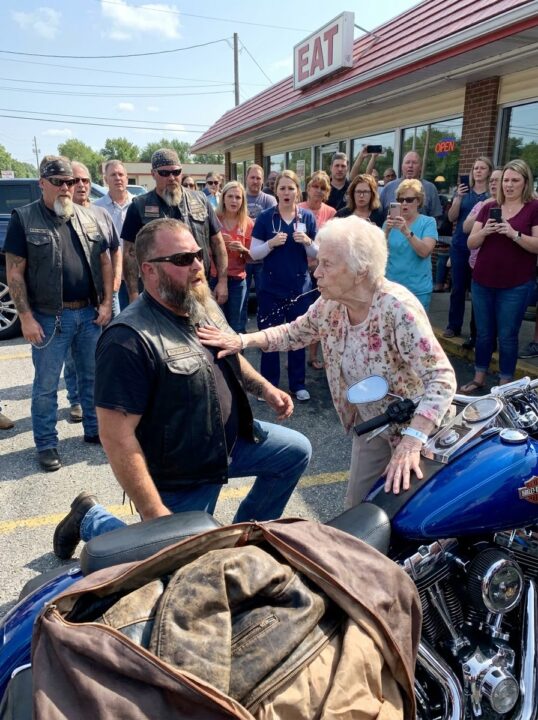
Hammer brought no flowers.
He carried his identification, a completed visitor application, references from two community organizations, and the registration documents for his motorcycle because Laura had asked whether it was truly new.
That last request confused him.
Laura explained that Evelyn’s disease sometimes turned new objects into old accusations. She wanted to know whether Hammer would resent future scratches, spilled drinks, or another incident like the one outside Mason’s.
Hammer looked at the Road King through the window.
“Paint’s cheaper than people.”
Laura did not smile.
She asked what he wanted from Evelyn.
Hammer answered, “Nothing she has to remember.”
That sentence earned him a second conversation.
Our clinical director explained that Hammer could visit as Ray Dawson, not as a replacement son. If Evelyn called him Tommy, he could respond to the feeling beneath the confusion without inventing false memories.
He would follow her lead.
He would never remove her from Cedar Ridge without authorization, promise secret outings, discuss medical decisions, or correct her aggressively when she entered another decade.
Hammer listened carefully.
He wrote the rules inside a pocket notebook.
Then Laura brought out Tommy’s jacket.
Brown leather had softened around the elbows, and years inside a cedar closet left it smelling faintly of wood, dust, and the aftershave Evelyn once gave her son every Christmas.
A pale blue crescent remained stitched above the pocket.
The right sleeve carried a repair sewn with black thread.
Hammer touched that seam with one finger.
“Tommy did this himself?”
“My mother did.”
Hammer turned the cuff inside out. Beneath Evelyn’s stitches was another line of rough gray thread, hidden where the original seam had split.
Hammer recognized it because he had sewn that line.
Twenty-four years earlier, Tommy Blue lent him the jacket outside the recovery center. Hammer tore the sleeve while falling against a fence before agreeing to enter detox.
He repaired it badly before returning it.
Tommy laughed and said his mother would fix the damage properly.
The black thread over Hammer’s gray stitches proved the connection.
Laura’s suspicion weakened.
She had found references to a man named Ray in Tommy’s recovery journals but assumed he was one of many people her brother helped. Tommy never used Hammer’s last name.
He wrote only Big Ray.
Laura allowed Hammer to wear the jacket after we confirmed Evelyn showed comfort rather than distress when seeing it. The leather barely fit his shoulders, and he could not close the zipper.
He removed his Iron Vow cut first.
That mattered more than it appeared.
A biker’s cut holds history, earned patches, club identity, and the names of people carried after death. Hammer rarely removed his except at medical examinations, funerals, and places where safety required it.
At Cedar Ridge, he left it inside a locker.
He entered wearing Tommy’s jacket.
Evelyn sat near the front window with two cups of tea. One had gone cold while she waited.
When Hammer approached, she stared at the blue crescent. Her hands tightened around the cup.
“You found it.”
Hammer sat across from her.
“Laura kept it safe.”
“Laura’s only twelve.”
Laura stood behind him, fifty-two years old and suddenly unable to speak.
Evelyn touched the repaired sleeve. For a moment, she knew exactly whose thread covered the tear.
“You broke this again.”
“Yes, ma’am.”
“Always falling into something.”
Hammer glanced at me.
She had described him more accurately than she knew.
During that first visit, Evelyn moved through four different versions of Hammer. She called him Tommy, then Ray, then a delivery driver, and finally her late husband.
Hammer corrected only what frightened her.
When she accused him of abandoning her after the funeral, he did not argue about dates. He said, “You shouldn’t have had to wait alone.”
When she asked whether Tommy was dead, Hammer answered honestly but gently.
“I think that loss hurts today.”
Evelyn turned toward the window.
Some memories cannot be repaired by facts.
They can only be accompanied.
Hammer stayed forty-two minutes. Before leaving, he folded Tommy’s jacket carefully and returned it to Laura rather than taking it home.
Evelyn became agitated.
“You’re leaving it?”
Hammer reopened the jacket.
Laura looked at me.
We agreed he could wear it until the following visit if it was signed out as a personal family item.
Hammer placed it over his arm.
“Bring it Sunday,” Evelyn ordered.
“I will.”
She pointed toward him with a trembling finger.
“Don’t make your mother wait.”
Outside, Hammer stood beside his new Road King but did not start the engine. He rested Tommy’s jacket across the seat, studying the blue crescent.
Bear Collins and Luis Ortega arrived from the Iron Vow clubhouse.
They had heard about the diner incident and expected Hammer to join a charity ride. When he explained that Sundays now belonged to Cedar Ridge, Bear objected.
“You met her yesterday.”
“Her son met me twenty-four years ago.”
“That doesn’t make you him.”
Hammer looked toward the memory-care windows.
“No. Makes me late.”
The club ride left without him.
For the first time in twelve years, Hammer missed an Iron Vow Sunday run.
The following week, he missed another.
Brotherhood began asking whether helping Evelyn required abandoning the men who had stood beside him through sobriety, jail, grief, and every hard road afterward.
Hammer offered no defense.
He simply returned to Cedar Ridge wearing Tommy’s jacket, carrying two cups of tea—one hot and one prepared exactly how Evelyn remembered her son taking it.
Too much sugar.
No milk.
She tasted it and frowned.
“You still make it wrong.”
Hammer drank the entire cup.
Part 3 — The Sunday Evelyn Disappeared
Hammer’s visits developed a rhythm nobody planned.
He arrived at ten each Sunday, pushed his Road King through the far section of the parking lot before starting or stopping the engine, and changed from his Iron Vow cut into Tommy’s jacket inside the reception room.
The residents reacted differently.
Mr. Caldwell believed Hammer repaired farm equipment and brought him clocks with no mechanical problems. Alice Freeman asked whether his tattoos washed away, while Evelyn sometimes refused to look at him.
Hammer stayed anyway.
On clear mornings, they sat in the courtyard. Evelyn described Tommy’s childhood, though details shifted between visits.
She remembered him bringing home injured birds, stealing peaches, failing algebra, and once painting a bicycle inside the kitchen because rain threatened his plans.
Some stories belonged to Tommy.
Others belonged to Laura.
Hammer never corrected ownership unless Laura asked him privately to preserve an important distinction. He wrote everything inside his notebook under two headings:
Things Evelyn Said.
Things Evelyn Needed.
The second list was shorter.
Warm tea.
A chair facing the road.
Someone who returned.
Laura noticed improvements after several weeks. Evelyn still experienced confusion, but Sunday mornings became calmer. She began eating breakfast because she believed Tommy disliked seeing untouched food.
Hammer never used that belief to force her.
He sat nearby and ate his own toast.
Sometimes she followed.
The Iron Vow remained uneasy.
Bear respected Hammer’s decision but worried the club brother was turning gratitude into punishment. Hammer had spent decades believing he owed everyone who helped him, and debts often became another form of self-destruction.
“You can’t repay Tommy by disappearing into his life,” Bear warned.
Hammer cleaned the Road King’s mirrors.
“Not disappearing.”
“You missed three rides.”
“She missed twenty-three years.”
Bear had no answer that satisfied either of them.
The conflict sharpened when the club scheduled its annual veterans’ fundraiser on a Sunday. Hammer had coordinated the event for nine years, yet he refused to leave Cedar Ridge before lunch.
Several members accused him of choosing a stranger’s confusion over his brothers’ real commitments.
Hammer removed his road-captain patch.
He placed it on the clubhouse table.
“Then pick somebody available.”
Nobody touched it.
On the morning of the fundraiser, thunderstorms moved across Williamson County. Cedar Ridge canceled courtyard activities, and the power flickered twice.
Hammer called ahead.
I told him roads near Route 31 were flooding and asked him to delay the visit until conditions improved.
He agreed.
That was my mistake.
Evelyn had watched staff place road-closure signs near the front entrance. In her memory, the storm became the night Tommy failed to return after his father’s funeral.
At 9:40, a kitchen smoke detector malfunctioned and triggered a brief evacuation alarm. Staff moved residents into designated interior areas while maintenance checked the system.
Evelyn entered a laundry alcove.
She found an unsecured service door after a contractor carried supplies through it. The alarm, storm, and broken routine combined into one clear purpose inside her mind.
Tommy was on the road.
She had to find him.
By the time we noticed, Evelyn had reached the wooded path behind Cedar Ridge wearing only a cardigan, house shoes, and her plastic sunflower bracelet.
Rain erased the light marks from her walker because she had left it behind.
We called police and activated our missing-resident protocol. Staff searched the grounds while Laura drove toward Cedar Ridge from Nashville.
I called Hammer.
The veterans’ fundraiser had already started. Thirty-six motorcycles stood beneath the clubhouse awning when he answered.
He heard three words.
“Evelyn is missing.”
Hammer left before I finished explaining.
Bear shouted that the southern road was closed. Hammer ignored him, started the Road King, and headed toward Route 31 beneath hard rain.
The club faced its choice.
They could let Hammer endanger himself, follow him blindly, or use the brotherhood’s combined knowledge to search safely.
Bear seized a county map.
Luis contacted police, while Doc called shelter volunteers who knew the wooded routes. Riders divided into teams using trucks and cars instead of motorcycles where water crossed the road.
Only Hammer continued on the Harley.
He reached Cedar Ridge soaked, parked near the service entrance, and changed into Tommy’s jacket. The brown leather absorbed rain immediately.
I showed him Evelyn’s last known direction.
Hammer asked what location existed in her oldest repeated stories.
Laura arrived and answered.
The Franklin Greyhound depot.
It had closed nineteen years earlier, but Evelyn once collected Tommy there after he ran away from home at sixteen. During confused evenings, she sometimes believed he remained on that bus.
The old depot stood nearly two miles away.
Police searched the main road. Hammer walked the abandoned rail path because Evelyn’s house shoes left faint impressions in the mud beside it.
We followed.
Rain struck leaves, runoff filled the ditches, and emergency lights reflected against wet trees. Hammer moved carefully, refusing to shout Evelyn’s name because sudden voices might drive a frightened resident farther away.
Near the old depot, he found one plastic sunflower.
Then another.
Evelyn had pulled them from her walker bracelet and dropped them along the path, perhaps as markers or perhaps because her hands needed something to do.
Hammer followed the yellow pieces.
We found her beneath the depot awning, shivering beside a boarded ticket window. She had lost one shoe and cut her ankle.
When police lights appeared, she moved toward the tracks.
Hammer stepped from the darkness wearing Tommy’s jacket.
Evelyn stopped.
Her face softened with relief and anger.
“There you are.”
Hammer did not tell her she had wandered, frightened fifty people, or waited for a man who could not return.
He removed the jacket.
He wrapped it around her shoulders.
“I’m here.”
Evelyn touched the blue crescent.
Then she looked directly into his eyes.
“Ray?”
Hammer froze.
For the first time since the diner, she said his name without being reminded.
He lowered himself beside her.
“Yes, ma’am.”
“Tommy said you’d be hard to keep.”
Before Hammer could answer, Evelyn’s eyes closed. Paramedics reached them moments later and treated her for mild hypothermia, dehydration, and the injury to her ankle.
She recovered.
Yet her brief sentence followed Hammer back to Cedar Ridge.
How could Evelyn know Tommy had said that?
Laura had never heard those words.
Neither had I.
The answer remained inside the rain-soaked jacket wrapped around Evelyn’s shoulders, where an old seam had finally begun to open.
Part 4 — The Message Hidden Beneath Evelyn’s Stitches
After Evelyn returned from the hospital, Laura took Tommy’s jacket to the Cedar Ridge laundry room so we could dry it according to the leather specialist’s instructions.
The lining had separated near the right sleeve.
A folded paper edge appeared beneath the fabric.
Laura initially assumed it was old repair material. When she opened the seam, she discovered three objects hidden inside: a recovery-meeting attendance card, a photograph, and an unsent letter.
The attendance card belonged to Ray Dawson.
It contained six signatures from Tommy Blue.
During Hammer’s first months of sobriety, participants required a peer signature after each meeting. Hammer had lost his original card and assumed it disappeared during another unstable move.
Tommy kept it.
The photograph showed Hammer at twenty-nine, sitting on the curb outside Nashville Central Recovery with Tommy’s jacket wrapped around his shoulders.
He looked thinner, bruised, and furious at whoever took the picture.
Tommy sat beside him.
The men were not smiling.
On the back, Tommy had written:
“Night Ray decided morning was worth the trouble.”
Hammer held the photograph by its edges.
His scarred fingers shook.
The unsent letter was dated eight days before Tommy’s death. It began with Evelyn’s name, but several paragraphs addressed Hammer.
Tommy intended to explain why he had stopped attending the Nashville meetings. He had accepted construction work in Franklin and moved home temporarily to help Evelyn after his father died.
He did not relapse.
He did not abandon Hammer.
He simply lacked a telephone after the move, worked twelve-hour shifts, and kept postponing the trip back to Nashville.
Tommy wrote that Evelyn was angry about the motorcycle because grief had made every departure feel permanent. He planned to sell the bike, remain with her through winter, and reconnect with Hammer after stabilizing the family.
Then came the sentence Laura remembered her mother repeating at the depot.
“Ray is hard to keep alive,” Tommy wrote, “but I think he’ll become even harder to get rid of once he realizes somebody expects him back.”
Tommy never mailed the letter.
The construction accident occurred the following week. A scaffolding support failed during morning setup, killing him and another worker.
Evelyn found the jacket among Tommy’s belongings, repaired its torn sleeve, and stored it without discovering what lay beneath the lining.
Over the years, she must have read the unfinished letter before hiding it inside the jacket, though Alzheimer’s removed the context while preserving fragments.
That was how she knew Ray’s name.
A memory had survived without its road map.
Hammer read the remaining paragraphs alone.
Tommy described him as angry, stubborn, and frightened of kindness carrying obligations. He told Evelyn that helping Ray had not been heroic; it involved sitting outside in bad weather, refusing to leave, and accepting insults from a man too ashamed to admit he needed care.
Then Tommy wrote something that changed Hammer’s visits.
“If I don’t come home one day, don’t wait at the window until waiting becomes your whole life. Let whoever arrives sit down.”
The words were not prophetic. Tommy wrote them because his father’s sudden death had left Evelyn watching every vehicle entering the street.
Still, the sentence seemed to have traveled twenty-three years toward Hammer.
Evelyn had waited at windows.
Hammer had arrived.
The letter’s final paragraph addressed Ray directly:
“You don’t owe me forever. Just stay somewhere when leaving would be easier.”
Hammer lowered the paper.
Bear stood across the room with the road-captain patch Hammer had surrendered before the fundraiser.
“You staying?” Bear asked.
Hammer looked toward Evelyn’s room.
“Sunday.”
“That all?”
“That’s when she waits.”
Bear placed the patch on the table.
The brotherhood still needed an answer. Hammer could not manage weekly memory-care visits, club responsibilities, repair-shop work, and every old debt without exhausting himself.
Laura also worried that Evelyn’s attachment might become harmful if Hammer missed a visit or if the jacket intensified her confusion.
We held a care-planning meeting.
Hammer expected to be asked to stop.
Instead, our clinical director proposed structure.
Visits would occur at consistent times but include backup volunteers, familiar staff, and activities not dependent upon Evelyn identifying Hammer as Tommy. The jacket could remain meaningful without becoming a costume used to deceive her.
Hammer would introduce himself as Ray each time.
If Evelyn called him Tommy, he could acknowledge her feeling while gently offering his identity when appropriate. He would not promise that Tommy was alive or returning.
Laura agreed.
Hammer signed the plan.
Bear then surprised everyone.
The Iron Vow offered a rotation of screened volunteers for Cedar Ridge’s broader companion program. They would complete background checks, dementia-awareness orientation, vaccination requirements, and facility training.
No club patches inside the secure unit.
No revving motorcycles near residents.
No photographing vulnerable people for social media.
Several riders objected.
They believed removing their cuts denied an identity they had earned. Others disliked being trained by nurses young enough to be their children.
Bear answered with Hammer’s surrendered road-captain patch in his hand.
“If you need leather to remember who you are, you ain’t ready to help somebody who forgets.”
Twenty-two riders completed orientation.
Some never volunteered again after discovering the work involved slow repetition rather than dramatic rescue. Others returned every week.
Luis cooked with residents.
Doc repaired walkers under maintenance supervision, while Bear read the same Western novel aloud because Mr. Caldwell forgot each chapter before the next visit.
Hammer came on Sundays.
He wore Tommy’s jacket until Evelyn recognized his face without needing the blue crescent. On some visits, she did.
On others, she looked through him.
One Sunday, Evelyn studied Hammer for nearly ten minutes and asked whether they had met.
Hammer placed Tommy’s photograph on the table.
“A man you raised helped me.”
Evelyn looked at the two younger men in the picture.
“Which one is mine?”
Hammer pointed toward Tommy.
“The one who stayed.”
Evelyn touched the other man.
“And him?”
“The one learning.”
She nodded.
Then she moved the photograph aside and divided her cookie in half.
She gave one piece to Hammer.
For the first time, he accepted something from her without treating it as debt.
Part 5 — The Sundays When She Knew His Real Name
Evelyn’s condition progressed during the following two years. Language became harder, familiar rooms occasionally frightened her, and she stopped understanding why Laura left after visits.
Hammer adjusted without demanding that she remain the woman he first met.
He stopped bringing complicated questions.
Instead, he carried objects connected to stable sensations: a smooth motorcycle glove, a small jar of engine bolts, Tommy’s blue bandanna, and postcards showing familiar Tennessee roads.
Evelyn enjoyed sorting washers by size.
She called them coins and tried paying Hammer.
He accepted the imaginary fee, then returned it inside her cardigan pocket.
Some Sundays she believed Hammer repaired her furnace. Other Sundays she called him by her husband’s name and complained about unpaid bills from 1978.
Occasionally, she knew Ray.
Those moments arrived without warning.
One morning, Hammer entered wearing Tommy’s jacket and found Evelyn seated beside the courtyard door. She looked at the blue crescent, then at his tattooed wrists extending beyond the short sleeves.
“That doesn’t fit you.”
“No, ma’am.”
“Tommy was skinnier.”
“So was I.”
Evelyn smiled.
She asked whether Hammer still drank.
His posture changed.
Nobody at Cedar Ridge had discussed his recovery with her, but fragments from Tommy’s letter remained somewhere inside her memory.
“Not for twenty-five years.”
Evelyn reached across the table and touched his scarred hand.
“Good.”
The word struck harder than any praise Hammer received from courts, employers, or club brothers. Tommy had never lived long enough to see the sober mechanic, business owner, road captain, and protector Hammer became.
Evelyn briefly did.
Then she asked whether lunch would be served soon.
The moment closed.
Hammer did not chase it.
That restraint became central to his relationship with her. He learned that recognition could not be demanded, photographed, or preserved by asking the same question twice.
It arrived.
Then it left.
Laura once asked whether the visits hurt him.
Hammer answered while repairing the loose brake on Evelyn’s walker.
“Some days.”
“Why continue?”
“Pain ain’t always a stop sign.”
Laura understood, but she also reminded him that care required rest. Hammer allowed other Iron Vow volunteers to cover one Sunday each month.
He hated the arrangement.
Evelyn barely noticed.
That fact hurt and healed him simultaneously.
The new Harley accumulated ordinary damage. A grocery cart scratched one saddlebag, rain dulled the chrome, and Evelyn left another saliva mark during a confused outing.
Hammer cleaned it later.
He never repainted the original spot where she spat outside Mason’s Diner. Under certain light, a faint cloud remained on the blue fuel tank where the cleaning cloth had altered the finish.
Bear suggested polishing it properly.
Hammer refused.
“First place she saw him.”
He meant Tommy.
He also meant himself.
Cedar Ridge installed a shaded bench near the parking area so residents could watch vehicles safely behind the secured courtyard fence. The Iron Vow built it from oak, but the facility rejected their first design because its metal skull decorations could catch clothing.
The riders complained.
Then they rebuilt it.
A small blue crescent was carved beneath one armrest where Evelyn could feel it with her fingers.
Laura donated Tommy’s old motorcycle photographs for a hallway display about residents’ lives before memory loss. She insisted the captions identify him as a son, construction worker, recovery volunteer, and amateur mechanic—not merely a dead motorcyclist.
People contain more than their most visible object.
Hammer helped select the pictures.
One showed Tommy teaching Laura to ride a bicycle. Another showed Evelyn repairing the brown jacket’s sleeve, black thread clenched between her lips.
Hammer stared at that photograph.
The jacket had always been a conversation between three kinds of repair: Hammer’s rough gray stitches, Evelyn’s careful black ones, and Tommy’s hidden letter beneath them.
None removed the original tear.
Together, they kept the sleeve attached.
The Iron Vow companion program expanded to two other care facilities, though Hammer resisted efforts to name it after Tommy or himself.
They called it The Sunday Chair Project.
Volunteers were expected to sit, listen, and return. Motorcycles remained optional, while patience did not.
The club’s reputation improved.
Hammer distrusted that benefit.
Whenever reporters requested photographs of intimidating bikers hugging elderly residents, Bear declined unless families and residents could provide meaningful consent.
The visits were not advertising.
They were relationships.
During Evelyn’s eighty-fifth birthday, Cedar Ridge arranged a small gathering in the courtyard. Laura brought cake, staff played records from the 1960s, and Hammer wore Tommy’s jacket despite the July heat.
Evelyn ignored him for most of the afternoon.
Near the end, she touched the blue crescent.
“Ray?”
He leaned closer.
“I’m here.”
“My boy liked you.”
Hammer’s eyes reddened.
“He kept me alive.”
Evelyn shook her head.
“No. He sat there. You stayed alive.”
Hammer lowered his face.
She had separated help from ownership in one clear sentence. Tommy offered a night, a jacket, and a chair, but Hammer had completed the years himself.
Evelyn’s clarity lasted perhaps thirty seconds.
Then she asked where Tommy was.
Hammer placed his hand beneath hers.
“He isn’t coming today.”
Her face tightened.
“Did he forget?”
“No.”
“Then why?”
Hammer glanced toward Laura, who nodded.
“He died a long time ago.”
Evelyn absorbed the truth as though hearing it for the first time. In a way, she was.
She cried quietly.
Hammer did not distract her or invent a comforting arrival. He remained beside her while grief became new again.
After several minutes, Evelyn wiped her face.
“Then you wear his coat.”
“If you want me to.”
“Somebody should keep it warm.”
Hammer returned the following Sunday.
The jacket was warm.
Part 6 — The Jacket That Stopped Being a Costume
By Evelyn’s fourth year at Cedar Ridge, she no longer walked without assistance. Her speech narrowed to a few repeated phrases, and she spent longer periods watching light move across the floor.
Hammer’s visits became quieter.
He sat beside her wearing Tommy’s jacket, played old country records at low volume, and placed his large hand where she could choose whether to touch it.
Some weeks she did.
Some weeks she slept.
The Iron Vow riders asked why he continued when Evelyn no longer appeared to recognize him. Hammer answered that recognition had never been the requirement.
“Showing up was.”
Laura eventually offered him permanent ownership of Tommy’s jacket. The leather had begun cracking around the shoulders because Hammer’s frame stretched it beyond its original shape.
He refused.
“It stays with her.”
Cedar Ridge kept the jacket in a ventilated garment cabinet between visits. Staff signed it out every Sunday, and Hammer signed it back before leaving.
The ritual protected more than fabric.
It reminded him that Tommy’s life belonged first to his family, not to the man he once helped.
One winter morning, snow covered Route 31 and Cedar Ridge suspended visitors. Hammer parked beyond the closed gate anyway.
He did not demand entry.
He sat on his Road King beneath falling snow while Laura video-called from Evelyn’s room. A staff member placed the phone near the window.
Evelyn could not follow the conversation.
Yet when Hammer started the engine briefly, its low rumble traveled through the glass. Evelyn lifted her head.
Her fingers moved against the blanket as though gripping an old sleeve.
Hammer shut the motorcycle down.
He remained outside for forty minutes.
After the roads reopened, Bear asked whether sitting in snow accomplished anything.
Hammer replied, “Kept the appointment.”
Bear stopped arguing.
Evelyn experienced a stroke the following spring. She survived but lost most remaining speech and required increased assistance.
Hammer visited after discharge wearing Tommy’s jacket and his own club cut folded over one arm.
Evelyn did not look at him.
He placed both jackets across neighboring chairs.
Brown leather beside black.
Tommy’s history beside Hammer’s.
After an hour, Evelyn reached toward the brown sleeve. Hammer moved the chair closer without putting the jacket onto her body.
She touched the blue crescent.
Then her hand moved to Hammer’s cut.
Her fingers rested on his road-captain patch.
She looked at him.
“Ray.”
The name emerged faintly but clearly.
Hammer leaned forward.
Evelyn pointed toward the two jackets.
“Yours.”
He understood the question.
The black cut represented the life he built after Tommy stayed beside him. The brown jacket represented the man who helped that life reach morning.
Hammer placed one hand on each.
“Both carried me.”
Evelyn closed her eyes.
That was their final fully understood conversation.
She died six weeks later with Laura beside her. Hammer had visited that morning but left before evening because Cedar Ridge called Laura when Evelyn’s breathing changed.
Laura later asked whether he regretted leaving.
Hammer shook his head.
“She had her daughter.”
He understood that love did not require occupying every final moment.
Sometimes staying meant knowing when the chair belonged to someone else.
At Evelyn’s funeral, Hammer wore his Iron Vow cut.
Tommy’s jacket rested across the empty chair beside Laura.
No motorcycle procession entered the cemetery. Evelyn disliked engine noise near graves, a preference Hammer remembered from a conversation she probably did not.
The Iron Vow parked along Route 31.
They walked the remaining distance.
Afterward, Laura handed Tommy’s jacket to Hammer.
This time, he accepted.
Inside the repaired lining, she had sewn a new piece of cloth carrying four words:
SHE KNEW YOU CAME.
Hammer ran his thumb across the stitches.
Black thread.
The same kind Evelyn used.
Part 7 — Every Sunday After Evelyn
Hammer did not stop visiting Cedar Ridge after Evelyn died.
The first Sunday without her, he parked his Road King in the usual place, changed from his club cut into Tommy’s brown jacket, and entered carrying two cups of tea.
He stood outside Evelyn’s empty room.
The bed had been stripped, her photographs removed, and the plastic sunflower walker waited for Laura to collect it.
Hammer placed one tea on the windowsill.
Then Mr. Caldwell approached with a broken clock.
The clock worked perfectly.
Hammer sat with him anyway.
That became the next Sunday.
And the next.
Tommy’s jacket remained part of the visits, but Hammer stopped wearing it every week. Some days he wore his own black vest without club patches, while other days he arrived in an ordinary work shirt.
The relationship no longer depended upon resemblance.
Cedar Ridge placed Evelyn’s courtyard bench beneath a maple tree. The blue crescent remained hidden beneath the armrest, polished by the fingers of residents who discovered it without knowing why.
Hammer touched it whenever he arrived.
The Sunday Chair Project continued growing. Iron Vow volunteers read newspapers, repaired radios, watered plants, played checkers, and listened to stories repeated in changing forms.
They were not substitute sons.
They were people who returned.
Laura visited Dawson Motorcycle Repair on the anniversary of the diner incident. Hammer’s midnight-blue Road King stood near the entrance, scratched and road-worn after four years.
The faint mark on its fuel tank remained.
Laura placed Evelyn’s plastic sunflower bracelet around the handlebar.
Hammer started to object because loose objects could interfere with safe riding. They compromised by fastening one sunflower securely inside the saddlebag lid.
Safety remained part of love.
Every year, Hammer rides to Mason’s Diner on Evelyn’s birthday. He orders grilled cheese, wraps half inside a napkin, and places it beside the second cup of tea.
He does not pretend she will arrive.
He simply allows the empty seat to hold its history.
One Sunday, I joined him.
A young family stopped near the Harley, and their son asked about the cloudy mark on the beautiful blue paint.
Hammer looked at the tank.
“Lady didn’t like my bike.”
The child asked whether Hammer became angry.
Hammer considered the question.
“Had somewhere better to put it.”
He finished his tea, carried the untouched sandwich to an outdoor refrigerator serving people without housing, and pulled Tommy’s jacket over his shoulders.
The sleeves remained too short.
The zipper still would not close.
It fit him anyway.
Outside Cedar Ridge, the Road King settled into its familiar V-twin rhythm. Hammer pushed it beyond the residents’ windows before increasing the throttle.
Inside, Mr. Caldwell waited with another working clock.
Hammer returned before lunch.
He always came on Sunday.
Follow our page and leave “HAMMER” below for more unforgettable biker stories about quiet patience, hidden history, and people who choose to return.