Sixty Terrifying Bikers Gathered Beneath a Dying Girl’s Hospital Window Every Night — But When Their Engines Suddenly Fell Silent, Her Final Request Brought Every Dragon Back
Part 2 — The Girl Who Collected Dragons
Mia Holloway entered St. Catherine Children’s Hospital carrying a green stuffed dragon and a notebook titled Field Guide to Dangerous Creatures.
She was eight then.
The first pages contained drawings of ordinary dragons: wings, fire, claws, castles. Later pages became more imaginative. One dragon sneezed bubbles. Another guarded a grocery store. A third feared heights and traveled by bus.
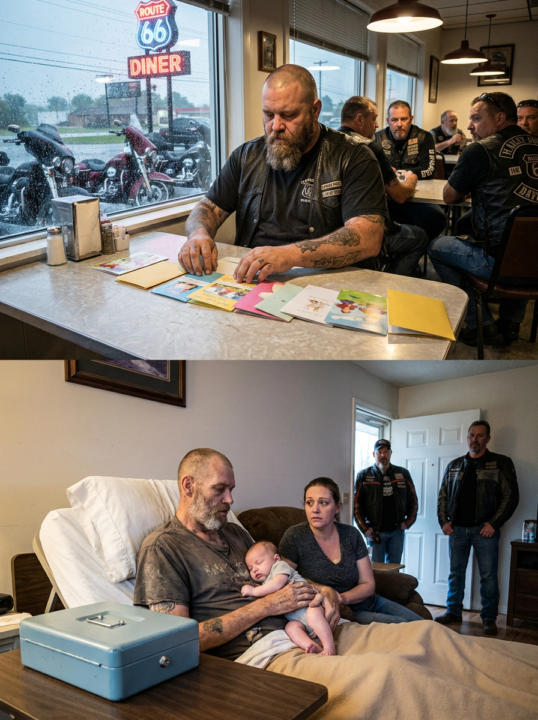
Mia believed every dragon needed one unexpected weakness.
Her own weakness began with headaches.
At first, Erin blamed school, dehydration, or the glasses Mia refused to wear. Then Mia vomited during breakfast and fell while walking toward the bathroom. An MRI revealed a diffuse midline glioma, a fast-growing tumor in a part of the brain surgeons could not safely remove.
Doctors explained radiation, clinical trials, and probabilities.
Erin heard only pieces.
Mia asked whether the machine would make her a robot.
The first treatments slowed the tumor. For a while, she returned to school. Her hair thinned, her balance changed, and other children learned not to stare when she wore the purple scarf.
The cancer continued.
By ten, Mia spent more time in the hospital than at home. Her father, Daniel, had left when the medical debt and fear became more than he could face. He called occasionally from Kentucky, promising visits that illness, work, or cowardice always delayed.
Erin stopped explaining him.
She slept in the reclining chair beside Mia and worked remotely from a laptop when she could. Her entire world narrowed to medication schedules, scan results, insurance calls, cafeteria coffee, and the small rise of a blanket over her daughter’s chest.
Mia’s world widened in another direction.
She built kingdoms.
The IV pole became a watchtower. Nurses were healers. Dr. Shah was a wizard who wore sensible shoes. The night custodian was Keeper of the Keys.
Pain became a creature that could be named.
Fear became a dragon that could sit beside her.
That was why Hammer’s motorcycle mattered.
He had not gone to St. Catherine for Mia. He was delivering a repaired wheelchair ramp to the father of a boy on the orthopedic floor. When the Harley’s battery connection loosened, he stopped beneath the south wing and worked with a small wrench beneath the seat.
The engine coughed.
Then caught.
Seven floors above, Mia pressed her face toward the glass.
The sound was deep enough to reach her despite the hearing loss caused by the tumor and treatment. More importantly, she felt the vibration against the window.
“There,” she told Erin. “Dragon.”
Erin looked down and saw Hammer: six-foot-four, 280 pounds, shaved head, black-and-gray beard, tattooed arms, plain leather vest, scarred hands moving across a machine that looked nearly as large as the man controlling it.
“That’s a motorcycle.”
“No.”
Mia smiled.
“He feeds it gasoline.”
The nurse who later approached Hammer expected him to decline the invitation. He had a reputation for avoiding children’s hospital rooms. The Iron Mesa Riders knew why, though we rarely spoke of it.
Hammer’s son, Caleb, had died at fourteen.
Not from cancer.
Caleb had been struck by a pickup while riding a bicycle outside Gallup, New Mexico. Hammer was incarcerated for assault at the time. The prison denied his first emergency request because Caleb was still alive and the paperwork was incomplete.
By the time permission came, Caleb was gone.
Hammer never reached the hospital.
He attended the funeral in shackles.
Years later, he could ride past hospitals without looking at them, but entering one tightened his throat and brought sweat beneath his gloves.
When nurse Laura told him Mia wanted to meet the rider of the black dragon, he refused.
Then she handed him the drawing.
It showed a huge dragon with wheels instead of feet. On its back sat a square man with a beard. The dragon’s chest contained a small boy holding a bicycle helmet.
Hammer stared at that detail.
Mia knew nothing about Caleb.
She had drawn the boy because, she said, every dragon carried someone it could not leave behind.
Hammer entered Room 714.
He stood near the door, too large for the space. Mia examined his beard, tattoos, boots, chain wallet, and scarred knuckles.
“You look like a villain,” she said.
Erin apologized.
Hammer shook his head. “Smart kid.”
Mia pointed toward the parking lot. “Make the dragon talk.”
He told her hospital rules prevented starting a motorcycle indoors.
She rolled her eyes.
That evening, he returned to the service lot.
At 7:40, Laura opened the blinds.
Hammer started the Harley.
Mia placed one palm against the window.
For the first time that day, the little girl stopped asking whether she was dying.
She asked if the dragon had friends.
Hammer looked at the empty parking spaces around him.
“Yeah,” he said when Laura relayed the question. “More than she can imagine.”
The next night, he brought three.
By the end of the week, there were twenty-seven.
The Iron Mesa Riders did not vote on the ritual. Hammer simply told us about Mia, showed us the drawing, and gave the time.
Men rearranged shifts.
Families changed dinner plans.
Motorcycles were repaired overnight.
Within two weeks, all sixty active members stood beneath the seventh-floor window, waiting for one small hand to signal that the dragons could begin.
Part 3 — The Night the Gate Stayed Closed
For seventeen nights, the routine worked.
The riders arrived at 7:30. Hospital security guided them through the service entrance. Ambulance routes remained clear. Engines started only after Laura flashed Mia’s bedside lamp twice.
At 7:40, the dragons woke.
At 8:00, silence returned.
Mia gave each rider a name.
Hammer became Stone Dragon because he looked impossible to move. Mack became Ancient Dragon. Denny was Scar Dragon. Reuben was Hungry Dragon because Mia once saw him eat three hospital sandwiches.
I became Crooked Dragon.
She drew our portraits on green cards. Each biker carried his card inside his vest, often beside photographs of spouses, military friends, dead parents, or children who no longer spoke to them.
Mia became weaker.
The ritual grew stronger.
Children from other rooms began watching. A boy awaiting heart surgery placed toy knights along his window. Two sisters receiving treatment for a genetic disorder made paper wings. Nurses turned the twenty minutes into a calm routine—medications first, lights lowered, curtains opened.
Not every family welcomed it.
A mother on the sixth floor said her premature infant startled when the motorcycles began. A father who had not slept properly in weeks accused the club of transforming the hospital into a rally.
He was not wrong to be angry.
His child mattered too.
Hospital administrator Helen Ward called Hammer into a conference room. I attended with him because years of road noise had damaged his hearing and official language made him suspicious.
Helen explained the complaints, the city ordinance, and the hospital’s duty to every patient.
Hammer kept his hands flat on the table.
“How do we fix it?”
That surprised her.
She expected threats, excuses, perhaps a speech about Mia’s final wish. Instead, Hammer asked for decibel readings, building plans, room locations, and an acoustic engineer.
The club paid for one.
We repositioned the motorcycles along the retaining wall and faced the exhaust away from the neonatal wing. Riders maintained a controlled low idle, adding brief synchronized increases only when the nurse signaled. The hospital moved Mia’s bed closer to the structural column carrying the strongest vibration.
It helped.
But it did not satisfy the city.
On the eighteenth night, police delivered a formal warning.
On the nineteenth, the hospital closed the service gate.
Sixty riders lined the public road.
Nobody started an engine.
Hammer stood at the front, leather gloves tucked beneath his belt. Rain darkened his vest. Police cruisers waited nearby while families watched from hospital windows.
At 7:40, nothing happened.
Upstairs, Mia touched the silent rail.
Her heart rate climbed.
Erin tried playing a recording of the motorcycles through a tablet. Mia shook her head. The small speakers produced noise but no vibration.
“Where are they?”
“They’re outside.”
“Why can’t I hear them?”
Erin told her about the complaints.
Mia looked toward the neonatal wing. She knew babies lived there. She had once sent a paper dragon to a premature girl named Hope.
“Did we scare them?”
“Maybe a little.”
Mia’s face tightened.
“Dragons aren’t supposed to scare sick babies.”
She asked for paper.
Her hands no longer worked reliably, so Erin held the green sheet while Mia dictated. The drawing showed the hospital surrounded by sixty dragons. Some faced inward. Others guarded the outer walls.
Below it, she wrote with help:
Dragons do not fight the castle. Dragons protect everyone inside.
Laura carried the picture downstairs.
Hammer read it beneath the streetlight.
Then he turned toward us.
“We leave.”
Several riders objected.
Denny said Mia might have only days. Mack said the hospital had permitted the ritual before changing its mind. Another member argued that public roads belonged to everyone.
Hammer raised his voice once.
“The kid told us what dragons do.”
Silence.
We left without starting together.
That sound—the scattered engines departing one at a time—felt worse than thunder.
The following afternoon, the hospital held a meeting. Parents from every affected floor attended. Erin joined by video from Mia’s room. Police, city officials, engineers, nurses, and club representatives crowded the conference table.
A mother from the neonatal wing spoke first.
Her daughter startled during the loudest nights, she said. But the revised arrangement had reduced the disturbance. She had also watched Mia press her hand to the glass.
“I don’t want my baby frightened,” she said. “I don’t want that child abandoned either.”
The hospital approved a controlled twenty-minute window from 7:40 to 8:00, subject to real-time sound monitoring. The club would use only thirty motorcycles in the service lot while the remaining thirty parked silently across the road.
Hammer rejected it.
“All sixty.”
Helen shook her head.
Hammer opened a map.
Thirty motorcycles could run in the lot. The other thirty would position in a lower parking structure connected to the hospital’s foundation. Their engines would remain near idle, creating vibration with less airborne noise.
The acoustic engineer tested it.
The solution worked.
On the twentieth night, sixty dragons returned in two groups.
Mia felt the first vibration through the bed rail.
Her eyes opened.
She smiled.
We believed we had won.
Four nights later, Dr. Shah told Erin that Mia’s breathing was changing. The child might have hours, perhaps a day.
At 6:12 p.m., Hammer’s phone rang.
Erin said, “Bring every dragon early.”
Then she added the sentence that left him gripping his handlebars with both hands long after the call ended.
“She wants to say goodbye while she still can.”
Part 4 — The Sixty Envelopes Inside Her Pillowcase
We arrived at 6:55.
No formation.
No polished entrance.
Men came from construction sites, kitchens, warehouses, repair shops, highways, and dinner tables. One rider still wore paint-stained work pants. Another arrived without his vest because he had forgotten it on a chair beside his sleeping grandson.
By 7:20, all sixty motorcycles were in position.
Hammer stood beneath Mia’s window.
The blinds were closed.
Upstairs, Erin helped her daughter prepare the envelopes.
Mia had started them during the first week of the ritual. Every envelope carried a biker’s dragon name. Inside was a drawing and one sentence dictated to Erin.
For Mack, Ancient Dragon:
Old dragons know where frightened people hide.
For Denny, Scar Dragon:
A scar is where the fire came out.
For Reuben, Hungry Dragon:
Please stop stealing hospital sandwiches.
For me, Crooked Dragon:
You do not have to become straight to go the right way.
Hammer’s envelope was thicker.
Mia placed all sixty beneath her pillow because she feared hospital staff might clean the drawer and lose them. She made Erin promise they would be delivered only after the final night.
At 7:31, Mia asked for the blinds opened.
Hammer saw her.
She looked smaller than she had the previous evening. Oxygen tubing framed her face. Erin supported her shoulders while Laura held a tablet near the bed.
The video call connected.
Hammer removed his gloves.
Mia whispered, “Stone Dragon.”
“I’m here.”
“You brought everybody?”
“All sixty.”
She counted the rows visible behind him, though her eyes could not focus far enough to distinguish faces.
“Are they scared?”
Hammer looked over his shoulder.
Sixty men stood beside their machines. Some had survived war, prison, addiction, poverty, accidents, and decades of carrying things they could not name.
“Yes,” he said.
Mia smiled faintly.
“Good.”
Hammer leaned closer to the phone.
“Why good?”
“Then we do scared together.”
They were the same words Gabe in another story might have used, but here they came from a ten-year-old girl who understood that courage was not the absence of terror.
She asked Hammer to promise three things.
The dragons would not frighten the babies.
They would look after Erin after Mia was gone.
And once every year, they would return for twenty minutes—not for her, but for every sick child who needed something larger than illness standing beyond the window.
Hammer agreed to the first two.
He hesitated at the third.
Mia noticed.
“You’ll forget?”
“No.”
“Then why are you quiet?”
Hammer’s beard moved as he clenched his jaw.
“Because coming back without you will hurt.”
Mia closed her eyes.
“Yes.”
One word.
No decoration.
Then she opened them again.
“Come anyway.”
Hammer lowered his head.
“I promise.”
Mia lifted a finger toward the window.
“Dragons now.”
The signal traveled downstairs.
At 7:40, thirty engines started in the service lot. A moment later, thirty more awakened beneath the parking structure. The combined vibration entered the hospital through pavement, columns, window frames, and bed rails.
No violent revving.
No chaos.
A controlled wall of thunder rose around the building.
Mia placed her hand on the rail.
Erin covered it with hers.
Her breathing had become shallow and uneven. Dr. Shah stood near the door, watching without intruding. Laura dimmed the lights. Other children gathered at their windows.
For twenty minutes, the hospital became a castle.
The neonatal rooms remained quiet enough for the babies. The oncology floor trembled gently. Parents held their children. Nurses paused in doorways.
Mia listened through her palm.
At 7:56, she asked Erin for the stuffed green dragon. Erin placed it against her chest.
At 7:58, Mia whispered something too softly for the video call.
Erin bent closer.
“Tell them I’m not afraid of the dark,” Mia said. “Dragons see in it.”
At exactly 8:00, Hammer raised his fist.
One by one, engines fell silent.
Mia’s eyes opened.
“No.”
Erin looked toward the monitor.
Mia tried to lift her hand.
“Keep going.”
Hammer saw her mouth move through the video feed. He looked toward Thomas, the security supervisor. The permit ended at eight. Police remained beyond the entrance.
Thomas pressed his radio.
“Five more minutes.”
The dragons woke again.
This time, Hammer did not watch the clock.
Mia closed her eyes while sixty engines surrounded the hospital. Her breathing slowed, not with panic but with exhaustion. Erin lay beside her and placed Mia’s hand against the vibrating rail.
At 8:07, Mia’s fingers relaxed.
Dr. Shah stepped closer.
The engines continued.
At 8:09, Mia took one small breath.
Then another.
Then none.
Erin did not scream.
She pressed her forehead against her daughter’s and listened while the dragons guarded a room they could not enter.
Hammer saw Laura lower the blinds.
He understood.
His hand moved toward the ignition.
Then Thomas received a message from Erin.
“Twenty minutes,” it said. “She asked for twenty.”
The engines remained alive until 8:20.
Not because Mia could still hear them.
Because the promise had not finished yet.
Part 5 — The Dragon Who Had Been Riding Inside Hammer’s Vest
After the engines stopped, nobody moved.
Sixty motorcycles stood beneath the hospital. Riders remained seated with boots planted on the pavement, hands resting on handlebars, faces turned toward a dark seventh-floor window.
Hammer removed his glasses.
He did not cry easily. Men often said that as if tears were proof of love, but Hammer had learned as a child that crying attracted the wrong kind of attention. His father punished weakness. Prison sharpened the lesson.
That night, his face simply collapsed.
Mack stepped beside him.
Hammer pushed him away.
Then pulled him back.
The two men stood with their foreheads touching, one six-foot-four, the other barely five-foot-eight, both shaking beneath ordinary parking-lot lights.
At 9:03, Erin came downstairs.
She carried the green stuffed dragon and a clear hospital bag containing sixty envelopes. Thomas offered to bring her a wheelchair. She refused. Every step seemed deliberate, as if walking kept her connected to the world her daughter had just left.
The riders formed two lines.
Erin moved between them.
She handed each biker an envelope. Men with grease beneath their fingernails and scars across their knuckles held those thin pieces of paper as carefully as newborn birds.
Nobody opened them yet.
Erin stopped before Hammer.
“This is yours.”
His envelope contained a drawing of a black dragon beneath a hospital window. Inside the dragon’s chest sat a boy wearing a bicycle helmet.
Caleb.
Hammer looked at Erin.
“How did she know?”
“I told her.”
Erin had learned about Caleb from Laura. Mia wanted to understand why Stone Dragon always looked afraid when he entered the hospital.
Beneath the drawing, Mia had dictated:
You thought you came because I needed a dragon. You came because the boy inside you was still waiting outside a hospital. Take him home now.
Hammer read it twice.
Then he opened the second page.
Mia had drawn herself riding beside Caleb on the dragon’s back. Both children were laughing. The dragon flew above a road with no hospital at either end.
Hammer pressed the paper to his chest.
The reverse truth settled over us.
We had believed sixty bikers came to make a dying girl feel protected. But each night, Mia had given men who carried old grief a place to bring it. The service lot became the only place Hammer could stand near a hospital without feeling shackles around his wrists.
Mia had been guarding him too.
Erin handed him the stuffed dragon.
“He goes with you.”
Hammer shook his head. “That’s hers.”
“She said Stone Dragon needs training.”
The green toy disappeared inside Hammer’s leather vest, its damaged head protruding beside his beard. Under any other circumstances, sixty bikers would have mocked him without mercy.
Nobody laughed.
The funeral took place six days later.
Mia had designed it before her speech weakened. No black motorcycles immediately outside the chapel because she did not want anyone confusing a funeral procession with the dragon ritual. The riders parked two blocks away and walked.
Sixty leather-clad men entered carrying green paper scales.
Each scale held the name of a child at St. Catherine’s. Mia had asked nurses to collect them. She wanted every dragon assigned someone to protect.
Hammer carried Hope—the premature infant whose mother first complained about the noise.
Mack carried the boy awaiting heart surgery.
I carried a seven-year-old named Luis who hated needles and liked sharks.
Mia’s casket was small, white, and surrounded by paper wings made by children from the hospital.
Hammer did not give a speech.
He placed the stuffed dragon beside Mia’s photograph, then removed his own vest. Inside the left panel, beneath the leather where no outsider could see, he had sewn a small green scale.
MIA — FIRST DRAGON KEEPER.
The letters were temporary chalk used by the seamstress to position the patch. At Erin’s request, no public insignia or recognizable club marking appeared in photographs.
After the service, the scale was stitched permanently inside.
Every rider added one.
Not to claim Mia.
To carry an assignment.
The Iron Mesa Riders established a fund for families needing hotel rooms, meals, gasoline, and help with funeral costs. Hammer refused to name it after the club.
They called it The Night Dragons Fund.
Once a month, pairs of bikers visited St. Catherine’s without motorcycles. They delivered meals, repaired wheelchairs, assembled shelves, and sat with parents who needed ten quiet minutes away from machines.
Once a year, on Mia’s birthday, all sixty returned.
The engines began at 7:40.
They stopped at 8:00.
Exactly twenty minutes.
Part 6 — The Children Who Waited at the Windows
The first annual Dragon Night happened beneath clear October skies.
Hospital administrators expected perhaps thirty riders. Sixty arrived, including two men who had sold their motorcycles and borrowed touring bikes rather than miss the promise.
The city issued a temporary permit.
An acoustic engineer monitored every floor. The neonatal wing received sound-dampening panels paid for by the club. The service lot remained clear for emergency vehicles.
At 7:35, children appeared at the windows.
Some wore masks. Some held IV poles. Some could stand only with help. Parents lifted infants against their shoulders. Nurses pressed paper dragons to the glass.
Hope, the premature baby once startled by the engines, was now a toddler visiting for follow-up care. Her mother held her near the sixth-floor window.
At 7:40, Hammer started the first motorcycle.
The others followed.
The building received the sound differently now. On lower floors, it was a muted pulse. In the parking structure, it moved through concrete like a distant storm. On the seventh floor, bed rails carried a steady vibration.
Children placed their hands against metal.
They felt the dragons.
Hammer looked toward Room 714.
Another child occupied it—a twelve-year-old boy named Isaiah recovering from a bone-marrow transplant. He knew Mia’s story only through a nurse. Still, he raised a green stuffed dragon toward the window.
Hammer raised his fist.
The ritual was no longer private.
That frightened him.
He worried the story would become spectacle, that cameras would turn a child’s last night into promotion for men in leather. When a news crew arrived, the club asked them to remain beyond the gate and film no hospital windows.
No speeches were given.
No donations were presented for applause.
At 8:00, the engines stopped.
Sixty riders placed gloved hands over their hearts.
Then they left individually, preventing the departure from becoming another roar.
Hammer remained last.
He carried Mia’s original stuffed dragon inside his vest on every Dragon Night. The toy had been repaired twice. One eye was still missing because Erin said imperfections were part of its face.
Before riding away, Hammer looked at the seventh floor.
“You were right, kid,” he whispered.
Coming back without her hurt.
He came anyway.
Part 7 — When the Last Dragon Left the Hospital
Eight years passed.
The club no longer had the same sixty men.
Mack died after a stroke. Denny moved west to care for his mother. Three riders stopped riding after injuries. Younger members joined and learned the rules before they learned the route.
No wild revving.
No blocking ambulances.
No cameras near children’s windows.
Twenty minutes means twenty minutes.
Hammer’s beard turned almost white. His knees objected whenever he mounted the Harley, but he refused a trike. Erin attended every Dragon Night, standing beside Thomas Greene near the service entrance.
On the eighth anniversary, sixty motorcycles gathered again.
Exactly sixty.
When fewer active members remained, former members rode borrowed bikes. One nurse joined on her husband’s touring Harley. Caleb’s cousin traveled from New Mexico to take Mack’s empty place.
At 7:40, the engines began.
The seventh-floor windows filled with children.
Hammer looked for Room 714.
The lights were off.
For the first time, the room was empty.
He felt relief before grief. An empty pediatric palliative-care room meant no child occupied it that night.
The dragons guarded an empty tower.
At 7:58, Hammer reached inside his vest and touched Mia’s green scale. The stuffed dragon rested in his saddlebag because its stitching had become fragile.
At 8:00, he raised his hand.
Silence traveled through the motorcycles.
Erin walked toward him carrying one of Mia’s original envelopes. She had kept it sealed for eight years because the front bore no dragon name.
“Who is it for?” Hammer asked.
“You.”
“I got mine.”
“This one says ‘When Stone Dragon gets old.’”
Hammer opened it.
Inside was a drawing of an elderly dragon with a white beard, sitting beside a road while younger dragons flew overhead. Beneath it, Mia had dictated one last sentence:
A dragon does not disappear when it stops roaring. The others remember the sound.
Hammer folded the paper.
Across the lot, a young prospect waited on a blue Harley. He was twenty-three, nervous, and had never met Mia. Inside his vest was a new green scale bearing the name of a child on the oncology floor.
Hammer walked over.
He removed the stuffed dragon from his saddlebag and placed it in the young rider’s hands.
“Keep him dry,” Hammer said.
The prospect nodded. “For how long?”
“Until another dragon needs him.”
Hammer mounted his Harley.
The club left in small groups, taillights slipping toward Route 40. He remained until everyone else had gone.
Then the old Stone Dragon started his engine.
For a moment, the low rumble moved beneath the empty hospital window. Hammer looked up, touched two fingers to the green scale inside his vest, and rode into the Nashville night.
Follow our page for more unforgettable biker stories about fierce-looking strangers who keep their promises long after the road turns silent.