A Biker Emptied a Food Bank While Hungry Families Waited in Line—Then He Crossed a Flooded Mountain Route and Returned Driving a Truck Carrying Three Times More
Part 2 — The Names Written Beside the Medicine
I had known Ray Dawson for nine years before the flood.
Knowing him did not mean understanding him.
Hammer visited our food bank every first Monday at 6:30 in the morning, always before clients arrived. His Harley’s V-twin announced him from the highway, then went silent beside our loading dock. He would remove two canvas sacks from the passenger seat, place them inside, and leave without waiting for a receipt.
The sacks usually contained canned meat, coffee, peanut butter, and dog food.
Never cheap food nobody wanted.
He bought the same brands he ate.
When I asked why he came before opening, he answered, “Quieter.”
When I asked why he donated through us instead of participating in the Iron Saints’ public charity rides, he answered, “Cans don’t need an audience.”
That was Hammer.
He did not dislike people. He disliked being watched while caring about them.
The Iron Saints knew that better than anyone. Their president, Calvin “Preacher” Brooks, once told me Hammer would ride two hundred miles to repair a stranger’s furnace, then leave before the family discovered his name. He would also argue for thirty minutes over being charged an extra dollar for coffee.
Complicated man.
Complicated past.
Hammer grew up near Miller’s Ridge, in a trailer no longer standing. His father worked in an underground coal mine until a roof collapse crushed two vertebrae. After that, the family survived on disability payments, irregular repair jobs, and whatever Hammer’s mother could earn cleaning motel rooms.
Food disappeared in stages.
First came smaller portions. Then no breakfast. Then the week his mother claimed she had already eaten every night, though thirteen-year-old Ray heard her stomach growling through the trailer wall.
He understood hunger early.
He also understood the shame wrapped around it.
His father refused charity. His mother watered soup until every bowl held more broth than food. Ray stole crackers from a gas station twice and spent the next twenty years returning boxes to that same store anonymously.
Then came the 1999 flood.
Rain fell for four days. Miller Creek climbed over its banks, covered the road, and cut off twenty-seven homes. Hammer’s father was bedridden. His baby sister had a fever. The family’s last food was one can of vegetable soup and half a bag of flour.
Ray’s mother opened the soup.
Before they ate, someone knocked.
A sixty-nine-year-old widow named Edith Boone stood on their porch holding her coat shut with both hands. Her home sat farther up the ridge. She had no food and no way to reach town.
Hammer watched his mother divide one can among five bowls.
Edith received the largest portion.
By the following evening, there was nothing.
The county promised a delivery. The truck could not cross. A rescue boat attempted the creek but turned back after debris struck its hull.
Then, near midnight, Ray heard an engine climbing the abandoned mining trail.
Not a truck.
A Harley.
The rider was Otis Bell, a broad-shouldered Black Vietnam veteran who belonged to a small motorcycle club in Lexington called the River Kings. He carried rice, canned stew, powdered milk, fever medicine, and two loaves of bread inside his saddlebags.
A grocery sack was strapped against his chest beneath his leather cut.
Otis made four trips that night.
The mining trail tore a hole through one tire and cracked an exhaust bracket. On the final trip, he walked the motorcycle across a narrow section where mud had swallowed half the path.
He reached every house.
Hammer never forgot the sound of that Harley approaching through the rain.
Otis returned after the flood. He taught the teenage Ray basic motorcycle repair and forced him to return the crackers he had stolen from the gas station. When Ray protested that the owner would call the police, Otis stood beside him.
“Then we stay while he calls.”
The owner did not call.
Otis became the first man to show Ray that accountability and mercy could occupy the same room.
Years later, Hammer rode with the River Kings before forming the Iron Saints closer to home. The patch inside his vest came from Otis: a tiny motorcycle carrying a grocery sack, stitched by hand after that 1999 flood.
Otis died in 2007.
Hammer kept the patch hidden over his left ribs.
The tattoo of the soup can came later.
None of us knew this on the morning Miller’s Ridge was isolated again.
We only saw a frightening man asking for food that belonged to other frightened people.
Hammer had learned about the trapped residents at 5:12 a.m. Edith Boone used an old ham radio maintained by Otis’s widow, Louise Bell. Cell towers were failing, but amateur radio operators carried short messages between counties.
Edith’s first message contained nine words:
Bridge gone. Forty-three here. Food almost out. Please hurry.
Hammer rode to Miller Creek before sunrise. The paved road ended beneath violent brown water. He tried the abandoned mining route on foot and found it passable in several places, but only for motorcycles narrow enough to slip between washouts and fallen trees.
At 6:20, he called a wholesale distribution center in Lexington.
The center belonged to Marcus Bell.
Otis’s son.
Hammer and Marcus had not spoken in twenty-seven years.
Their silence began with a prison sentence, an accusation of betrayal, and a promise neither man believed the other had kept.
That morning, Hammer dialed anyway.
Part 3 — The Convoy Above the Floodwater
By nine o’clock, our pantry was empty.
Hammer assigned every rider a load based on weight, suspension, and experience. Touring bikes carried water and canned goods. Lighter cruisers carried medicine, hygiene products, bread, and powdered milk. Four motorcycles towed narrow single-wheel cargo trailers.
Preacher checked the knots.
Hammer checked them again.
The remaining families stood beneath the awning, watching their food disappear into waterproof bags. Anger moved through the crowd in waves.
Jason remained closest to Hammer.
His son had asthma. His daughter had eaten cereal without milk for dinner the previous night. He had driven through water to reach us and now watched a stranger prioritize people he could not see.
“You’re gambling with my kids,” he said.
Hammer tightened a strap.
“Truck’s coming.”
“You don’t know that.”
“No.”
Jason expected an argument. Hammer gave him the truth.
“What if it gets stuck?”
Hammer placed a box of granola bars into Jason’s hands. It was the only food he had kept from the load.
“Then take my title.”
Jason looked toward the Harley.
“You think a bike feeds children?”
“Sold mine before.”
“For food?”
Hammer pulled on his gloves. “For worse.”
He did not explain.
The Iron Saints left at 9:14.
I rode in Preacher’s support pickup as far as the barricade near Miller Creek. The truck carried tools and an emergency winch but could go no farther. Beyond the barricade, the road descended beneath floodwater thick with branches, roofing material, and brown foam.
Hammer turned toward the mining trail.
It had not been maintained in decades. Trees crowded both sides. Rain had cut channels through the dirt, exposing loose stone and old rail ties. In places, the track narrowed to a shelf above the flooded creek.
The Harleys climbed single file.
No one rode fast.
This was not a dramatic charge through deep water. Hammer had forbidden anyone from entering moving floodwater. The danger came from mud, blind corners, loose rocks, falling branches, and the weight strapped behind each rider.
I followed on foot until the trail became too steep.
The engines faded into rain.
Hammer led.
Two miles in, Boone’s cargo trailer struck a buried rail tie and jumped sideways. One wheel lifted. Canned food shifted beneath the tarp. Boone planted both boots and held the motorcycle upright while Hammer dismounted and crawled beneath the trailer.
Water ran along the back of his neck.
“Axle bent,” Boone said.
Hammer examined it.
“Not enough.”
“Enough for what?”
“Complaining.”
They straightened the bracket with a tire iron and continued.
A mile later, a fallen oak blocked the trail. Its trunk was too wide to move and too low for the loaded motorcycles to pass beneath.
Preacher suggested turning back.
Hammer walked along the uphill side and found eighteen inches between the trunk and a rock wall. A motorcycle could pass if its cargo was removed and carried around separately.
The riders unloaded everything.
They pushed each Harley through one at a time while three people held it away from the drop. Then they carried seventy-six boxes by hand through mud.
A bag of rice tore open.
Mari Lopez, the club’s newest member, removed her rain jacket and wrapped it around the split sack. She rode the remaining miles in a soaked T-shirt.
The final obstacle appeared near the ridge.
Part of the mining trail had collapsed, leaving a gap nearly four feet wide. Below it, muddy water rushed through a drainage channel. The motorcycles could not jump it. There was no safe route around.
Hammer shut off his engine.
Silence replaced the V-twin rumble.
Preacher studied the gap. “That’s it.”
Hammer walked back along the trail and found two weathered steel plates abandoned beside an old equipment shed. The plates were heavy enough that four riders struggled to lift each one.
They laid them across the gap.
The first plate moved when Hammer stepped on it.
Boone drove steel stakes into the mud. Preacher anchored both plates with tow straps tied around a tree. Hammer crossed on foot, carrying a case of water.
The bridge held.
He returned.
“Bikes one at a time. Walk them. Nobody rides.”
Eleven motorcycles crossed safely.
The twelfth belonged to Tyler, a twenty-three-year-old prospect riding his first emergency run. Halfway across, his boot slipped. The Harley tilted toward the drainage channel.
Hammer caught the handlebar.
Preacher seized the rear frame. Tyler grabbed the opposite side. For several seconds, nearly nine hundred pounds of motorcycle, food, and trailer leaned above rushing water.
Hammer’s arms shook.
His boots slid.
“Let the bike go,” Tyler shouted.
“Food goes with it.”
“It’s a motorcycle!”
Hammer looked at him.
“So was Otis’s.”
He pulled.
The others joined. The Harley returned upright.
When the convoy finally reached Miller’s Ridge, Edith Boone stood beneath a porch roof holding a kitchen towel over her white hair. Behind her waited residents with walkers, oxygen tubing, blankets, and empty grocery bags.
Nobody cheered.
They were too tired.
Hammer dismounted and walked directly to Edith.
“You ate?”
She nodded.
Hammer waited.
Edith looked away.
He opened his saddlebag, removed a pull-tab can of chicken, and handed it to her.
“Eat while we unload.”
“Other people first.”
“Already heard that one.”
She tried to return the can.
Hammer crossed his arms.
At six-foot-four and nearly 285 pounds, he could be remarkably effective at ending negotiations.
Edith sat.
She ate.
The Iron Saints divided food by medical need, household size, and mobility. They delivered boxes to every door instead of forcing residents to gather at one house. Mari checked on diabetics. Doc examined Walter’s breathing. Preacher restarted two generators. Boone fed six cats, one beagle, and a goat that had wandered onto Edith’s porch.
Hammer saved the last delivery for a trailer at the far end of the ridge.
Inside lived Louise Bell, Otis’s widow.
She was eighty-six.
A ham radio occupied half her kitchen table.
When Hammer stepped inside, Louise stared at the hidden patch beneath his open vest.
“You kept it,” she said.
Hammer removed his wet gloves.
“Kept most things.”
“Except my son.”
The room changed.
Louise’s words revealed the crack running beneath everything: Hammer and Marcus Bell had not stopped speaking because of distance.
They had stopped because each believed the other had abandoned Otis when he needed them most.
The food delivery was only half the journey.
Part 4 — The Brother Hammer Called After Twenty-Seven Years
Otis Bell had two sons, though only one shared his blood.
Marcus was born in 1966.
Ray Dawson arrived much later, hungry, angry, and carrying stolen crackers in his jacket. Otis never adopted him legally, but he taught him to repair engines, confront mistakes, and return home after leaving in anger.
Marcus resented him.
At first, the resentment was small. Ray used Otis’s tools without asking. He rode on the back of Otis’s Harley. He occupied hours Marcus believed belonged to the family.
Then Otis helped Ray avoid prison.
At nineteen, Ray was arrested after a bar fight in which another man suffered a broken jaw. The man had cornered a waitress and struck her, but witnesses disappeared before court. Otis found them, paid for an attorney, and persuaded Ray to accept probation, treatment for alcohol misuse, and community service.
Marcus saw money leave the family account.
His anger deepened.
Years later, when Marcus opened a wholesale food warehouse in Lexington, Otis invested nearly everything he had saved. The business succeeded, but father and son disagreed constantly. Otis wanted surplus food donated. Marcus wanted the company stable before becoming charitable.
Ray sided with Otis.
Marcus accused him of interfering.
Then Otis developed heart disease.
During his final year, Ray was riding construction jobs across three states. Marcus managed the warehouse and his father’s medical appointments. Louise cared for Otis at home.
One night, Otis collapsed.
Marcus called Ray four times.
Ray did not answer.
His motorcycle had broken down outside Knoxville, and his phone was locked in a saddlebag being transported by a tow company. By the time he received the messages, Otis was dead.
Marcus believed Ray had chosen the road over the man who saved him.
Ray returned for the funeral. Marcus met him outside the church and told him he had no right to wear the River Kings patch.
Ray removed it.
Then Louise stopped him.
She gave him Otis’s flood patch—the motorcycle carrying a grocery sack—and said, “Your father made this for you.”
Marcus heard the word father.
He walked away.
For twenty-seven years, the two men did not speak.
Hammer kept the patch inside his Iron Saints vest where nobody could see it. Marcus expanded Bell Wholesale Foods into four counties. Louise remained on Miller’s Ridge with Otis’s ham-radio equipment and refused repeated invitations to move closer to Lexington.
The flood forced all three lives back into the same room.
At 6:20 that morning, Hammer called Marcus.
A receptionist answered. Hammer asked for him by name.
Marcus came onto the line.
“Who is this?”
Hammer looked toward the flooded bridge.
“Ray.”
Silence.
Then Marcus said, “Wrong number.”
“Your mother’s trapped on Miller’s Ridge.”
Another silence.
Longer.
Hammer explained the food shortage, the impassable road, and the families waiting at our pantry. He asked Marcus for three pallets of food and a box truck capable of reaching Cedar County by afternoon.
Marcus answered with one question.
“You calling because you need me or because she does?”
Hammer gripped the phone.
“Both.”
That word cost him.
Marcus heard it.
He agreed to release the food, but the warehouse’s drivers were already making storm deliveries. Hammer would need to collect the truck himself from a transfer depot seventy miles away.
The problem was timing.
The current food had to reach Miller’s Ridge immediately. The replacement load had to reach our pantry before the waiting families gave up. Hammer could not make both trips.
That was why he called the Iron Saints.
Brotherhood was tested before a single box left our building.
Preacher wanted Hammer to ride with the convoy. Boone argued he should retrieve the truck. Mari said the stranded elders needed the one person who knew the mining trail from the 1999 flood.
Hammer made the choice.
He delivered the first load.
Marcus sent one warehouse employee to meet a volunteer driver at the transfer depot. The driver was supposed to bring the truck to our pantry.
He never arrived.
At 12:40, rising water closed the highway between the depot and Cedar County. The driver turned back. Cell service failed before he could reach Hammer.
That was why no truck appeared at two.
When Hammer returned from Miller’s Ridge, soaked, exhausted, and bleeding from the knuckles after catching Tyler’s Harley, he found thirty-one families still waiting outside our empty building.
Nobody shouted this time.
Their silence was worse.
I held out his motorcycle title.
“Truck didn’t come.”
Hammer stared at the road.
Then he removed his helmet.
“Where is it?”
“Transfer depot.”
“Highway’s closed.”
“County opened the quarry route for emergency vehicles.”
“Truck count?”
“One. Maybe another at the warehouse.”
Preacher touched his shoulder. “Brother, you’ve been riding eight hours.”
Hammer stepped away.
“Families been waiting longer.”
He climbed back onto the Harley.
Jason approached from the line.
“You’re leaving again?”
Hammer started the engine.
“Getting your food.”
This time, Jason did not accuse him.
He pointed toward his pickup. “Bike won’t carry three pallets.”
Hammer glanced at the flooded highway.
“Then drive.”
Jason followed.
So did Preacher, Boone, and six pantry volunteers. They took the quarry road through rain, collected the first truck, then continued to an auxiliary Bell warehouse where Marcus had released another load.
Hammer drove the larger truck himself.
At the warehouse gate, Marcus was waiting.
The brothers faced each other for the first time in twenty-seven years.
Marcus had Otis’s eyes.
Hammer noticed.
He said nothing.
Marcus looked at the flood patch visible inside Hammer’s wet vest.
“You kept wearing it.”
“Inside.”
“Why?”
Hammer opened the truck door.
“Wasn’t mine to display.”
Marcus stared at him, then handed over the manifest.
Three times the food.
Canned goods. Rice. Milk. Formula. Diapers. Hygiene supplies. Pet food. Fresh bread. Bottled water. Portable coolers for insulin. Cleaning products for homes damaged by mud.
Marcus had added the second truck without charge.
Hammer signed the receipt.
Before he climbed inside, Marcus said, “How’s my mother?”
“Mean.”
Marcus almost smiled.
“Then she’s fine.”
Hammer closed the door.
The brothers had not forgiven each other.
But the road between them was open.
Part 5 — When the Truck Doors Opened
The first box truck reached our pantry at 3:17.
I recognized Hammer behind the wheel only because of the beard. Mud covered his face and black T-shirt. His leather vest lay across the passenger seat. Both hands gripped the steering wheel as though his fingers had stiffened around it.
Jason drove the second truck.
Behind them came three pickups carrying volunteers and Iron Saints.
The families stood.
Hammer parked beside the loading dock and shut off the engine. For the first time that day, there was no motorcycle rumble, no shouting, and no rain striking our awning hard enough to erase voices.
Only the diesel engine ticking as it cooled.
Hammer climbed down.
His right knee buckled.
Preacher caught his elbow. Hammer pulled away immediately, then reconsidered and allowed himself to lean for one second.
“Doors,” he said.
We opened them.
The first truck held more food than our pantry normally distributed in three weeks. The second carried coolers, diapers, cleaning supplies, blankets, portable batteries, and twenty boxes labeled for people with diabetes and kidney disease.
The crowd did not rush forward.
They simply stared.
Jason’s daughter began counting the pallets aloud. She reached five before losing track.
The woman who had accused Hammer of taking food from her toddler covered her mouth. An older man removed his cap. Three people who had filmed the morning lowered their phones.
Hammer took the motorcycle title from my desk and handed it to Jason.
Jason frowned. “Food came.”
“Late.”
“I’m not taking your bike.”
“Kids waited.”
“So did you.”
Hammer held the paper between them.
Jason pushed it back.
“Keep it.”
For a moment, neither man released the title. Then Jason folded it once and placed it inside Hammer’s vest.
No apology.
None was needed yet.
We began distributing food.
Every family received more than originally planned: two boxes of groceries, bottled water, hygiene supplies, and enough fresh bread for several days. Parents with infants received formula and diapers. Older clients received easy-open cans. Pet owners received dog or cat food without sacrificing food for themselves.
Hammer carried boxes until I saw blood soaking through the tape around his knuckles.
“Stop,” I told him.
He lifted another case.
“You’re hurt.”
“Skin.”
“You almost collapsed getting out of the truck.”
“Bad step.”
“You have done enough.”
Hammer looked through the rain at the remaining families.
“Enough is when the line’s gone.”
The line disappeared at 6:42 that evening.
After the final car left, our volunteers sat on overturned crates among shelves fuller than they had been that morning. Nobody spoke for several minutes.
Then Louise Bell’s voice came through the radio clipped to Hammer’s vest.
“Ray?”
Hammer lifted it.
“Here.”
“Marcus called.”
His expression closed.
Louise continued. “First time in three months.”
Hammer looked toward the trucks.
“What’d he want?”
“To know whether I ate.”
“Did you?”
“None of your business.”
Hammer’s beard moved.
Almost a smile.
Louise’s voice softened. “Otis would’ve liked today.”
Hammer stared at the soup-can tattoo on his forearm.
“Otis liked trouble.”
“He liked you.”
The radio hissed.
Hammer could have answered. He did not.
Instead, he unclipped the radio and placed it on my desk. Then he went outside to check every strap on every motorcycle, though none carried food anymore.
That was his language.
Bolts. Knots. Engines. Arriving.
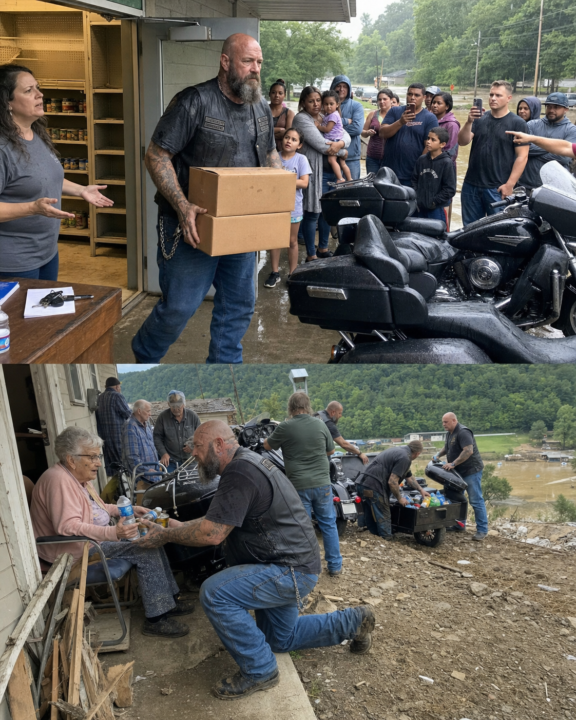
The next morning, a photograph from the pantry confrontation appeared online. It showed Hammer carrying two food boxes past families waiting beneath the awning. The caption claimed a motorcycle gang had emptied a charity pantry during a natural disaster.
It spread quickly.
The second photograph did not.
It showed Hammer kneeling on Miller’s Ridge, opening canned chicken for Edith Boone while rain ran from his beard.
The first post gathered thousands of angry reactions before the truth reached half as many people.
Preacher wanted the club to issue a statement.
Hammer refused.
“People should know what happened,” I told him.
“People got fed.”
“That isn’t the point.”
“Is to me.”
I wrote the story anyway.
I included the flood, the mining trail, the three pallets, the signed title, and the twenty-seven-year phone call. I did not call Hammer a hero. He would have hated that word.
I called him late.
He approved of that.
Marcus read the article.
Three days later, a Bell Wholesale truck arrived without notice. It contained another month of food and a commercial refrigerator to replace the one our pantry had been repairing with duct tape and prayer.
The driver handed me a note.
It contained four words:
For Otis. No receipt.
Hammer read the note and placed it inside his vest beside the flood patch.
He never told Marcus thank you.
Instead, the Iron Saints rode to the Bell warehouse the following weekend. They repaired twelve broken pallets, replaced a loading-dock light, and serviced two delivery trucks without charging labor.
Marcus watched from his office window.
At sunset, he walked outside carrying two cups of coffee.
He handed one to Hammer.
“Black,” he said.
Hammer took it.
“Remembered.”
They stood beside the loading dock without discussing the funeral, the missed calls, or the years between them.
Not yet.
Some roads reopen one lane at a time.
Part 6 — The Shelf Nobody Had to Ask For
After the flood, our pantry changed the way it prepared for emergencies.
We created a list of residents living beyond narrow bridges, low-water crossings, and unpaved mountain roads. We stored medication-friendly food separately. We added waterproof containers, hand-crank radios, pet supplies, and pull-tab cans for people with limited grip strength.
Hammer objected to one part of the plan.
We wanted to name the emergency shelf after him.
“No.”
“After Otis, then.”
He considered that.
The shelf became Bell’s First-Out Reserve, though Hammer insisted the sign remain small. It held enough food for fifty isolated residents and could be loaded onto motorcycles within twenty minutes.
Every spring, the Iron Saints practiced.
They treated it like a road drill. Riders weighed boxes, balanced cargo, secured water, tested trailers, and mapped alternate routes. New members learned never to enter moving floodwater and never to confuse speed with urgency.
Hammer taught the final lesson.
“Don’t promise what you can’t carry.”
Then he would lift two boxes at once.
Edith Boone returned to volunteering after recovering from the flood. She could no longer drive, so Hammer collected her every first Monday on a trike with a padded passenger seat.
She brought canned soup.
Always vegetable.
She placed one can on Bell’s First-Out Reserve and the rest in ordinary distribution boxes.
Marcus visited Miller’s Ridge more often. At first, he came alone. Later, Hammer rode beside his truck. They spoke little, argued about warehouse maintenance, and never used the word brother in front of anyone.
Louise used it for them.
Constantly.
When she turned eighty-eight, Marcus brought the cake and Hammer brought the food. Louise sat between them and complained that neither had chosen the correct frosting.
The flood patch remained inside Hammer’s vest.
He never moved it outside.
But he added a second small patch beneath it: a white box truck beside a black Harley. Marcus saw it during Louise’s birthday party.
“You make that?”
“Preacher’s old lady.”
“Truck’s too small.”
“Bike’s too clean.”
Marcus touched the stitching once.
Then he let the vest close.
As for the online photograph that first called Hammer a thief, someone printed it and mailed it to our pantry with a handwritten apology. Hammer found it inside the donation bin.
He did not throw it away.
He mounted it near the loading dock beside a second photograph showing both returned trucks with their doors open.
No caption explained either image.
Below them sat an old coffee can.
The can collected donations for emergency fuel.
Every time Hammer visited, he slipped money inside while pretending to tighten the lid.
Part 7 — The Engine Edith Waited to Hear
Three years later, another storm reached Cedar County.
It was smaller than the first flood, but Miller Creek rose overnight and covered the low bridge before sunrise. This time, no resident needed to send a desperate message.
At 5:40 a.m., Edith turned on her ham radio.
“Cedar Pantry, this is Miller’s Ridge.”
I answered from my kitchen.
“Go ahead.”
“We’re all fine.”
I heard something behind her voice.
A low V-twin rumble.
“You already have company?”
Edith laughed. “That fool has been here twenty minutes.”
Hammer had left before the county alert. The Iron Saints followed with waterproof boxes from Bell’s First-Out Reserve. Marcus arrived by truck at the safe side of the bridge, transferring food to motorcycles without being asked.
No pantry shelves were emptied.
No families went home hungry.
By noon, the water began falling. Hammer sat on Edith’s porch holding a bowl of vegetable soup while rain tapped the metal roof.
She watched him take one spoonful.
“Needs salt,” he said.
“So did your mother’s.”
Hammer looked toward the road.
Edith remembered the single can divided among five bowls in 1999. She remembered Otis Bell’s Harley approaching through darkness with groceries strapped against his chest. She remembered a thin, angry teenager standing barefoot on a porch, pretending he had not been afraid.
“You heard that engine before we did,” she said.
Hammer nodded.
“That why you came so fast this time?”
“No.”
“Liar.”
Hammer finished the soup.
Down the ridge, another motorcycle climbed through the wet trees. Marcus was riding it—a borrowed touring Harley loaded with two sacks of groceries.
His first motorcycle ride in nineteen years.
He parked beside Hammer and removed his helmet.
Louise had sent him with bread.
Hammer looked at the unfamiliar bike, then at his brother’s stiff posture.
“You ride like an accountant.”
Marcus set the sacks down.
“You drive a box truck like a criminal.”
Edith took the bread from them.
“Both of you come inside.”
They obeyed.
Their Harleys remained beneath the porch light while rainwater streamed from the tires. Beside them sat two empty grocery bags, folded and ready for the next run.
By evening, Miller Creek had dropped below the bridge.
Hammer started his engine and waited for Marcus to do the same. Two taillights moved down the mountain together, disappearing one bend at a time.
Edith listened until the final rumble was gone.
This time, the food arrived before fear did.
Follow our page for more powerful biker stories about misunderstood men, tested brotherhood, and the quiet deliveries that reach people everyone else forgot.