Part 2: A Nine-Year-Old Boy Spat on a Biker’s Boots in a Hospital Hallway—But the Men He Blamed for Taking His Father Had Been Fighting to Bring Him Home
Part 2 — Before the Motorcycles Came
Nate Hayes did not begin as the man who left our house with eleven bikers.
He was a warehouse mechanic, a patient father, and the kind of husband who left handwritten notes inside my lunch bag even when we had argued the night before.
He met the Iron Lanterns at twenty-seven.
Ray had stopped beside Nate’s broken pickup on U.S. Route 70. Rain was falling, traffic sprayed dirty water across the shoulder, and Nate had been trying to repair a split radiator hose with tape.
Ray parked his Harley, produced a proper repair kit, and worked without introducing himself.
Nate offered him twenty dollars.
Ray refused.
“Help the next stranded fool.”
That was their first conversation.
Within a year, Nate was helping at Dawson Iron Works on Saturdays. He did not own a motorcycle, but the Lanterns accepted him because he showed up, listened, and knew how to repair almost anything with an electric motor.
When Caleb was born, eleven motorcycles idled outside the hospital.
Ray gave him the blue toy Harley.
Tiny Ruiz delivered diapers strapped to his saddlebag. The others took turns cooking meals that ranged from tolerable to criminal.
The club looked dangerous.
Our son learned otherwise.
Then Nate injured his back beneath a warehouse conveyor.
The injury required surgery. His pain treatment began under medical care, but as months passed, dependence tightened around him. When prescriptions changed, Nate began finding drugs through other sources.
I did not recognize the shift at first.
He still went to work.
Still packed Caleb’s lunch.
Still kissed me before leaving.
But our bank balance shrank. Tools disappeared. Nate stayed awake through the night, then slept through entire Saturdays. If I asked what was wrong, he accused me of watching him.
The Lanterns noticed too.
They responded badly.
Some covered his missed shifts. Others loaned money. Tiny told me Nate was tired. Ray repaired the warehouse manager’s truck in exchange for not reporting another absence.
They called it brotherhood.
It was permission wearing a leather vest.
Ray understood that later.
At the time, he believed keeping Nate employed would keep him stable. He had spent years helping riders through divorces, injuries, arrests, and grief. He assumed the same tools would work: food, work, a spare bed, a ride home.
Substance dependence did not care about club loyalty.
Nate began avoiding rides because he feared the Lanterns would notice his condition. He sold his motorcycle before anyone could stop him. He said the money paid medical bills.
Most of it did not.
Caleb was seven when Nate missed his first birthday party.
At eight, the boy learned to inspect his father’s face before asking whether they could play. He learned that some versions of Dad said yes and forgot, while others became angry at the question.
Children become experts in weather they did not create.
Caleb stopped inviting friends home.
I considered leaving.
Then Nate would return to himself for a day—repair the kitchen faucet, read three chapters beside Caleb’s bed, apologize without being asked—and I would see the man beneath the illness.
Ray saw him too.
That delayed everything.
The breaking point came on a Sunday behind Dawson Iron Works. Ray found Nate unconscious in a parked truck after he failed to arrive for a family breakfast.
Ray called emergency services.
He administered emergency aid as directed and stayed until paramedics arrived. He did not attempt to handle a potentially fatal situation alone.
Nate survived.
At the hospital, a clinician explained the risks and treatment options. Nate refused admission.
Ray drove him home.
I barred the door.
It was the hardest thing I had done.
“You bring him inside,” I told Ray, “Caleb watches this happen again.”
Nate stood on the porch shaking.
“Sarah.”
“No.”
“I’ll stop.”
“You said that last month.”
“This time—”
“No.”
Ray looked at me.
I expected him to argue.
He nodded.
Then he turned to Nate.
“You got two roads. Hospital or street.”
Nate stared at him.
“You’d leave me outside?”
“Won’t help you die comfortable.”
Nate chose the hospital.
Ray took his phone so Caleb would not receive a confused late-night call. He gathered clean clothes from our bedroom while Nate sat in the truck.
That was the moment Caleb saw from his window.
He saw bikers taking his father.
He did not hear his mother begging them not to bring Nate back unchanged.
Part 3 — The Clubhouse Without Bottles
Treatment began with medical assessment and supervised withdrawal care.
Nothing about it was cinematic.
Nate was ill, frightened, and furious. Clinicians monitored him, adjusted his care, and explained that recovery would require more than surviving the first days.
Ray remained nearby but did not interfere.
The Iron Lanterns waited in the parking structure.
On the second night, Nate threatened to leave. He called Ray from the unit and demanded his clothes.
Ray brought them.
That surprised everyone.
“You’re not stopping me?” Nate asked.
“No.”
“Then take me home.”
“No.”
“You said I could leave.”
“You can.”
“Where am I supposed to go?”
Ray looked toward the hospital doors.
“Wherever your feet carry you.”
Nate accused him of betrayal.
Ray accepted the word.
Then Nate said something that changed the club.
“You all sit out there drinking after rides, telling stories about brothers you couldn’t save, and you think I’m the only sick man in the room.”
Ray’s face hardened.
Nate continued.
“Tiny takes pills for his knee and lies about how many. Cole drinks before noon. Mason hasn’t slept without whiskey since Afghanistan. You call mine addiction because mine got ugly first.”
Ray could have dismissed him.
Instead, he walked back to the parking garage.
Ten Iron Lanterns waited beside their motorcycles. Coffee cups, energy drinks, and two hidden flasks sat on the concrete barrier.
Ray picked up the first flask.
“Whose?”
Nobody answered.
He emptied it into a utility sink.
The owner, Cole Mercer, stepped forward.
“You don’t pour another man’s bottle.”
Ray held it out.
“Then own it.”
Cole took the empty flask.
Ray looked at every member.
“Nate says we’re lying.”
Tiny shifted his weight. “Nate says anything when cornered.”
“Is he wrong?”
Silence.
Brotherhood reached its test there.
It would have been easy to isolate Nate as the problem. The club could remove his patch, congratulate itself for enforcing standards, and return to the same habits that helped hide his illness.
Ray refused.
He contacted St. Matthew’s recovery coordinator and asked for a family-and-peer education meeting. All eleven Lanterns attended.
The counselor explained enabling, boundaries, relapse risk, and the difference between support and control. She asked each man to identify what he had ignored in Nate—and what he ignored in himself.
Tiny disclosed that his use of pain medication no longer matched his prescription plan. He requested medical review and later entered structured treatment.
Cole admitted drinking every morning.
Mason revealed years of untreated trauma, nightmares, and alcohol dependence.
Two riders claimed they had no problem and left.
Ray did not chase them.
Three days later, one returned.
The other stayed away for six months.
The club removed alcohol from its gatherings. That choice alone was not treatment, and Ray refused to pretend it was. Members received individualized evaluations. Some entered inpatient or outpatient programs. Others worked with physicians, therapists, or peer-support groups.
Ray, sober for seventeen years, resumed attending recovery meetings he had quietly stopped visiting.
“I ain’t graduated,” he said.
That became the club’s rule.
Nobody graduates from honesty.
During Nate’s residential treatment, Lanterns attended weekly family sessions. They learned not to promise a smooth road. They learned to distinguish a difficult day from an emergency and an apology from repair.
I attended twice.
The first session ended badly.
Nate apologized for taking money from Caleb’s savings jar. I asked how much.
He did not know.
I stood and left.
Ray followed me into the hallway but kept several feet between us.
“You want me to drive you home?”
“No.”
“Want me to sit?”
“No.”
He sat anyway.
I hated him for that.
The man’s patience felt like another form of pressure. I wanted permission to close the door forever, but Ray refused to tell me whether my marriage should survive.
“Your call,” he said.
“That’s all you ever say.”
“Ain’t my family.”
“You took my husband.”
“After you said don’t bring him inside.”
The truth cut.
I had asked the Lanterns to take Nate somewhere safe. Yet when the house became quiet, I resented them for succeeding.
Caleb’s anger became easier to carry than my own.
I let him believe his father was away repairing motorcycles with the club. When that explanation failed, he decided Ray had forced Nate to leave.
I did not correct him quickly enough.
Meanwhile, anonymous grocery cards arrived in our mailbox. The electricity bill was paid. A mechanic repaired my car in the school parking lot.
I assumed Ray was responsible.
He was not.
Nate had sold the last valuable motorcycle parts he owned before entering treatment. He instructed the club to use the money for us. When it ran out, the Lanterns contributed quietly.
Ray made them keep records.
“No hero envelopes,” he said. “Family finds out someday.”
On day forty-six, Nate relapsed during an approved outing.
He disclosed it immediately.
Treatment continued with his clinical team, who reassessed his plan. The setback was not hidden, celebrated, or treated as proof that everything had failed.
Nate wanted to call Caleb.
I said no.
That decision nearly ended the marriage.
“Let me tell him,” Nate begged during a supervised family call.
“He’s nine.”
“He thinks I don’t want him.”
“Then come home and prove otherwise.”
“I’m trying.”
“Try longer.”
Ray stood behind Nate but did not defend him.
After the call, Nate threw a chair against a wall.
Nobody applauded his honesty.
Nobody abandoned him either.
He cleaned the damage.
Then he returned to group.
Day forty-seven counted too.
Part 4 — The Eleven Empty Vests
The leather vest on the hospital wheelchair belonged to Nate.
Ray had removed it the night treatment began because one of the patches read RIDE OR DIE, and Nate said he no longer knew whether the club meant it literally.
The vest remained locked inside Ray’s garage for eighty-three days.
During that period, each Iron Lantern made a choice.
They removed one patch from their own vest—not club insignia, but the private patches that hid behind bravado: whiskey brands, bar names, slogans about never changing, memorials used as excuses to keep drinking.
Each removed patch went into the counselor’s cardboard box.
The gesture did not make anyone sober.
It created no medical benefit.
It was simply a visible admission that the club could not carry Nate home wearing the same lies that had helped keep him sick.
When the elevator doors opened, the empty wheelchair came first.
Caleb saw Nate’s folded vest and assumed his father had died.
He screamed.
The sound tore through the hallway.
I caught him before he reached the elevator.
“Where is he?” I demanded.
The nurse stopped the chair.
Ray moved immediately.
“He’s alive.”
“Then why is his vest—”
A man appeared behind the nurse.
Nate.
He had lost weight. His face looked older, and his hands remained unsteady. He wore plain jeans, a blue hospital discharge shirt, and the sneakers Ray brought during intake.
No leather.
No dramatic transformation.
Just my husband standing beneath harsh hospital lights.
Caleb went silent.
Nate stopped ten feet away.
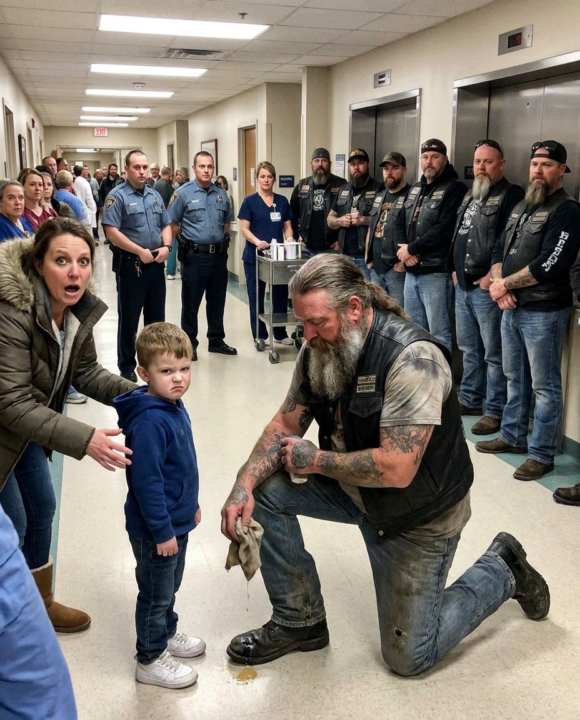
His eyes moved from our son to me, then to the spit-darkened boot beneath Ray.
“What happened?”
Caleb backed against my legs.
“You left.”
Nate’s face tightened.
“Yes.”
“They made you.”
“No.”
“You said you were going on a ride.”
“I lied.”
Caleb covered his ears.
Nate did not approach.
He had practiced this conversation with counselors, but nothing prepared him for his child refusing his voice.
“I was sick,” Nate said.
“You looked fine.”
“I worked hard to look fine.”
“Ray took you.”
“I asked him to.”
That stopped Caleb.
Nate lowered himself to the tile.
He remained outside the boy’s reach.
“I asked the Lanterns to take me somewhere I couldn’t keep lying.”
Caleb pointed at the bikers.
“They’re your family now.”
Nate looked toward the eleven men.
“No.”
Ray answered before he could continue.
“We’re road support.”
Nate looked back at Caleb.
“You and Mom are my family. But that doesn’t mean you have to let me come home today.”
I had not expected that.
Neither had Caleb.
For eighty-three days, I imagined the discharge as a finish line. Nate would complete treatment, return, apologize, and we would begin again.
The clinical team had warned us differently.
Going home required boundaries, continued care, safety planning, and consent from the people affected. Nate’s recovery did not obligate Caleb to perform happiness or me to restore trust immediately.
Ray understood.
He stepped beside Nate.
“Tell him the whole thing.”
Nate swallowed.
“The club didn’t take me from you. They stopped helping me hide from you.”
He described the hospital, treatment, therapy, and relapse in words a child could understand. He did not name substances or offer frightening details.
Then he apologized specifically.
For the missed birthday.
For the vanished money.
For every promise made while knowing he might not keep it.
Caleb listened with his face pressed against my coat.
“Are you fixed?”
“No.”
The hallway became still.
Nate could have offered comfort.
He chose truth.
“I’m getting help. I’ll keep getting help. But fixed isn’t the word.”
Caleb looked at Ray.
“Did you get sick too?”
Ray nodded.
“Long time ago.”
“Did Dad help you?”
Ray glanced at Nate.
That was the hidden reversal.
During the residential program, Ray’s old grief surfaced. Seventeen sober years had not erased the brother he lost to overdose, nor the guilt of having left him alone after an argument.
Ray had spent years rescuing other men because he could not rescue Daniel.
He called it service.
Nate called it hiding.
During a peer session, Nate confronted him.
“You keep carrying everybody so nobody asks who carries you.”
Ray walked out.
The next morning, he returned to his own counselor for the first time in six years.
Nate had entered treatment believing the Iron Lanterns were saving him.
By the end, he had pulled their road captain back into recovery too.
Ray crouched beside Caleb again.
“Your dad made us tell the truth.”
“All of you?”
“Every man willing.”
Caleb looked at the empty patches in the counselor’s box.
“Why?”
Ray rubbed one thumb across the damp stain on his boot.
“Couldn’t bring him home on the road that took him away.”
Nate removed the blue toy motorcycle from Ray’s hand.
He offered it to Caleb.
The boy hesitated, then accepted it.
The missing wheel had been repaired with hospital tape.
Caleb turned it over.
On the bottom, Nate had written eighty-three small marks—one for each day away.
Day forty-six was darker than the rest.
He had not erased it.
Caleb touched that mark.
“Was this the bad day?”
Nate nodded.
“Why did you count it?”
“Because I came back the next morning.”
Part 5 — The Ride That Followed the Car
Nate did not return to our house that afternoon.
That surprises people when they hear the story.
They expect the elevator doors to open, the family to embrace, and eleven Harley engines to escort a healed father home.
Recovery rarely respects a clean ending.
Nate moved into structured sober housing for another six weeks. His outpatient care continued. We attended family counseling, and Caleb met with a child therapist who helped him separate anger from responsibility.
Ray never told him to forgive.
The Iron Lanterns never called Nate’s absence sacrifice.
They used plain language.
He had hurt us.
He was working to change.
We were allowed to watch before trusting.
Caleb tested Nate with small promises.
“Call Tuesday at seven.”
Nate called at six fifty-nine.
“Come to soccer practice but don’t talk to my coach.”
Nate sat alone on the highest bleacher.
“Bring my red notebook.”
Nate arrived with the blue one, realized the mistake, and drove back for the correct book.
That mattered more than speeches.
Ray attended none of those meetings unless invited. He had already occupied too much of our family’s crisis.
Instead, he worked on Nate’s old motorcycle.
The bike had been sold in pieces, but the Lanterns tracked down its frame, tank, and engine through swap groups across Tennessee. They bought nothing with secret charity. Nate repaid every cost through work at Dawson Iron Works.
The rebuilt motorcycle remained in the garage.
No one presented it as a reward.
Ray said riding would wait until Nate’s treatment team, family responsibilities, finances, and judgment made room for it.
“Machine ain’t medicine,” he said.
On day 126, Caleb invited Nate home for dinner.
Not to move in.
Dinner.
I cooked spaghetti because it was cheap and familiar. Nate arrived without flowers, gifts, or a rehearsed apology. He washed dishes afterward and left at eight.
Caleb watched from the window.
“You think he’ll come back?”
“Yes,” I said.
The answer frightened me.
I had made promises for Nate before.
That night, however, I was making one about the plan rather than the man. If Nate struggled, professionals and peers would respond. If he lied, boundaries would return. If the house became unsafe, he would leave.
Love no longer had to work without tools.
Two months later, Nate came home.
The Iron Lanterns gathered at St. Matthew’s parking lot that morning. Their motorcycles lined Kingston Pike beneath a gray sky.
Caleb became anxious when he saw them.
“Are they taking him again?”
Ray heard.
He removed his helmet.
“No.”
“Then why are they here?”
“Asked your dad.”
Nate approached in plain clothes carrying one duffel bag. He did not wear his recovered vest. Its patches remained inside the counselor’s box until he chose which parts of his old identity belonged in his new life.
Our minivan waited near the entrance.
Ray opened the passenger door for Nate.
Caleb frowned.
“Dad isn’t riding with you?”
“No,” Ray said.
“Why not?”
“Home’s in that car.”
Nate sat beside me.
Caleb occupied the back seat with the blue toy motorcycle in his lap.
When we pulled from the hospital lot, the Harleys started one by one. Their V-twin rumble rolled between the buildings, deep enough to vibrate the mirrors.
Ray rode first to the exit.
Then he moved aside.
Our minivan entered Kingston Pike ahead of them.
Eleven bikers followed.
Not surrounding us.
Not leading.
Following the family home.
At our house, Nate stopped on the porch.
The last time he stood there, I had refused to let him inside. Now I held the key, but I did not open the door immediately.
“What are you promising?” I asked.
Nate looked at Caleb.
“Not forever.”
My stomach tightened.
Then he continued.
“I promise today. I’ll ask for tomorrow when it comes.”
That was enough.
I unlocked the door.
Caleb entered first.
Nate followed.
The Iron Lanterns remained beside their motorcycles at the curb. Nobody crowded the porch. Nobody filmed the reunion or claimed credit.
Ray began to leave.
Caleb ran outside.
The boy stopped before the stained black boots.
For a moment, neither moved.
Then Caleb offered Ray the clean cloth from the hospital.
“I didn’t get it all off.”
Ray looked down at the faint pale mark left by the spit.
“Leave it.”
“Why?”
Ray folded the cloth and returned it to the boy.
“Reminds me what you thought I took.”
Caleb glanced toward the open front door where Nate stood waiting.
“Did you bring him back?”
Ray shook his head.
“No, son.”
He started the Harley.
“He walked.”
Part 6 — The Boot by the Clubhouse Door
The Iron Lanterns changed after Nate’s return.
Their clubhouse refrigerator held food, coffee, and alcohol-free drinks. More importantly, the club stopped pretending environmental changes were enough.
Meeting schedules hung beside ride maps.
Emergency numbers sat near the garage phone.
Members learned when to call clinicians, emergency services, sponsors, or family—and when a leather vest did not qualify anyone to handle a medical crisis.
The cardboard box of removed patches remained near the clubhouse door.
Nobody was required to display private recovery. The box held only what members voluntarily left behind.
Nate never put his old vest back on.
Instead, he chose a plain black riding jacket with one small patch inside, invisible while worn.
It read:
ROAD HOME — DAY BY DAY.
Ray kept the hospital mark on his left boot.
The leather darkened with rain, grease, and highway dust, but a faint pale crescent remained near the toe. Caleb noticed it whenever Ray visited.
For Nate’s first full year in recovery, the family held no celebration at the clubhouse.
We went bowling.
Ray scored ninety-two and accused the lane of mechanical failure. Tiny brought a cake that leaned to one side. Caleb gave Nate a new blue toy motorcycle with both wheels attached.
Nate placed the repaired broken one beside it.
He kept both.
The difficult days continued. Nate changed jobs. He repaired financial damage slowly. Trust returned unevenly. Once, after a late shift, he failed to answer his phone for forty minutes.
I nearly locked the door again.
He arrived with a dead battery and accepted my anger without turning it against me.
We reviewed the plan.
Then we slept.
No dramatic engine convoy appeared.
Sometimes recovery looked like charging a phone and calling before fear filled the silence.
Ray came to dinner on Thursdays. Caleb eventually asked about the word tattooed across his fingers.
“Why SOBER?”
Ray studied his hand.
“So when I make a fist, I remember not to solve anything with it.”
Caleb considered that.
Then he looked at the old boot beside Ray’s chair.
“You could put SPIT on your toes.”
Ray’s beard moved with a rare smile.
“Don’t push it.”
Part 7 — What Came Through the Door
Five years after the hospital reunion, Caleb was fourteen.
He had grown tall enough to look Ray directly in the chest instead of the belt buckle. He remembered spitting on the biker’s boots, although the memory embarrassed him now.
Ray never teased him about it.
Nate remained in recovery.
Not perfectly.
Honestly.
He continued treatment and peer support, repaired relationships where possible, and accepted that some people might never trust him again.
Our marriage survived, but not because the Iron Lanterns saved it. They helped create time and structure. Nate and I decided what to build within them.
On Caleb’s fourteenth birthday, Ray arrived carrying a long cardboard box.
Inside was a pair of black motorcycle boots.
They were new, practical, and two sizes too large.
Caleb laughed.
“I can’t wear these.”
“You will.”
“When?”
“When your feet catch up to your mouth.”
Nate nearly dropped the birthday cake.
Caleb looked at the boots, then at Ray’s old pair near the door. The pale hospital mark was still visible beneath years of polish.
“Are you ever cleaning that off?”
“No.”
Caleb’s expression softened.
“I hated you.”
“Had reasons.”
“I was wrong.”
“Had wrong information.”
The distinction mattered.
Ray never demanded gratitude from a frightened child for the work adults chose to do. He accepted the anger because Caleb needed somewhere safe to put it.
Outside, eleven motorcycles waited along Kingston Pike.
Some original Iron Lanterns were gone. New riders had joined. Several members remained sober. Others did not identify as having substance problems but continued attending education sessions because brotherhood no longer meant looking away.
Nate started his rebuilt motorcycle.
Caleb climbed behind him for the first time.
Ray rode at the rear.
The family car led.
That order had become tradition.
As the motorcycles pulled away, I watched Ray’s black boots rise onto the footboards. One still carried the faint mark from a hospital hallway where a child believed a biker had stolen his father.
Ray kept it because the truth was not that simple.
The club had taken Nate away.
Treatment had held him.
Honesty had changed them all.
And when Nate was ready, his family opened the door.
Follow our page for more unforgettable biker stories about misunderstood men, hard-earned second chances, and the brotherhood that refuses to leave anyone behind.