Part 2: A Saint Bernard Carried His Blanket to Every New Dog’s Kennel — The Biker Who Called It Territorial Found His Disgraced Brother’s Name Hidden Inside
Part 2 — The Biker Who Fixed Everything Except His Past
I first met Atlas on a Tuesday in March, nine months before Juniper arrived.
Lena had called the Black Ridge Riders because the shelter’s exercise-yard gate no longer closed. The county had delayed the repair twice, and a northern Arizona windstorm had bent the lower hinge until two employees needed to lift the gate while a third forced the latch.
Our club repaired things for people who could not afford contractors. Wheelchair ramps. Porch rails. Broken furnaces. The occasional roof after a veteran discovered that insurance companies knew how to disappear faster than rainwater.
Animal shelters were new.
I brought Bear Harlan, Switch Nolan, Knuckles Reed, and five younger riders. The rumble of nine V-twins rolled along the cinder-block building and set every dog barking.
All except Atlas.
He sat behind the outer fence watching us unload welding equipment. His chest was broad enough to hide the kennel door behind him, and a thread of drool hung from one jowl.
“Horse or dog?” Bear asked.
“Dog,” Lena replied.
“County feed him or lease grazing land?”
Lena did not laugh. She had heard every large-dog joke available to the English-speaking world.
Atlas walked directly toward me when we entered the yard. Visitors usually looked at my tattoos first, my beard second, and the scar on my cheek third.
Atlas smelled my left boot.
Then he sat on it.
That became our introduction.
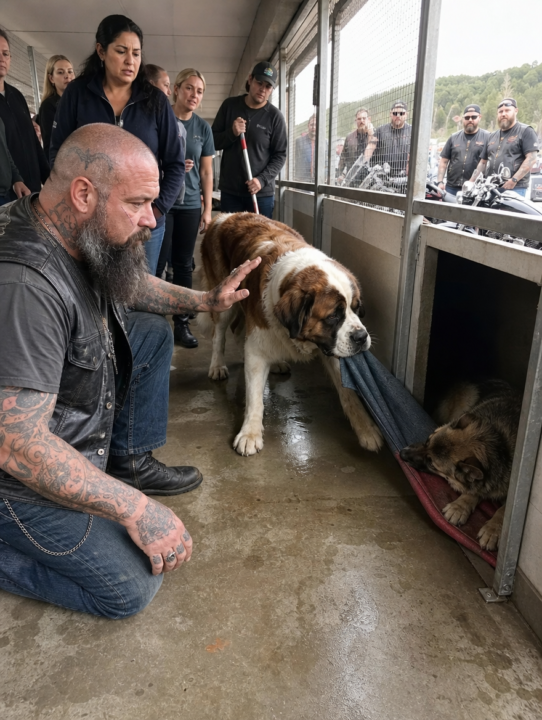
While I worked, he carried a blue-gray blanket from the covered kennel to the fence and dropped it beside my tools. I moved it away from the sparks.
He brought it back.
Three times.
On the fourth, I placed the blanket beneath a workbench where it would remain safe. Atlas lay beside it and watched my hands.
I assumed he liked the sound of tools.
The truth was that he recognized something I did not.
The blanket smelled of old leather, motor oil, motel soap, and a man whose calls I had refused to answer.
Eli Boone joined the Black Ridge Riders in 2005. We called him Sparrow because he weighed 145 pounds wearing wet boots and because he never stayed quiet when larger men were talking.
He rode a battered red Harley Sportster held together by salvage parts, wire, and disrespect for mechanical probability. The rear fender never matched the tank. The exhaust coughed on cold mornings. His left mirror was held by a bolt that belonged to a lawn mower.
Sparrow was difficult.
He was also the first brother to arrive when trouble came.
When Bear’s wife needed chemotherapy in Phoenix, Sparrow drove her there every Thursday after working a night shift. When Knuckles lost his roofing business, Sparrow stocked his freezer without mentioning it. When my garage burned, he slept on a folding chair beside the ruins because he knew I would search for tools before checking whether the roof could fall.
He loved damaged animals with the impatience of a man who believed kindness should happen faster.
That love caused fights.
Sparrow once brought an injured coyote into our clubhouse. Another time, he interrupted a club ride to carry a snapping terrier twenty miles in his jacket. We told him to stop turning every emergency into our emergency.
He answered, “Then quit riding past them.”
His other problems were less noble.
Sparrow became dependent on prescription opioids after a truck crushed his ankle at a loading dock. When the prescriptions ended, the pills did not. He borrowed money, missed rides, lied about being clean, and vanished for days.
We helped him twice.
The third time, club president Mack Dorsey said help without consequences had become permission. Sparrow lost voting privileges and entered treatment.
He returned eighteen months sober.
Some brothers welcomed him. Others counted the silverware.
I stood somewhere in the middle, which is another way of saying I wanted credit for loyalty without accepting its risk.
The winter Sparrow disappeared began with a blizzard warning on a Thursday afternoon. Temperatures were expected to fall below zero along old Route 66. The county opened two human warming centers but had no emergency plan for animals outside city limits.
Sparrow called Mack and requested $4,800 from the club’s emergency fund.
He claimed someone had abandoned dogs at a closed roadside breeding kennel near Bellemont. A roof had collapsed, water bowls were frozen, and several animals needed immediate veterinary care.
Mack refused.
The fund had been collected for Bear’s second shoulder surgery. Insurance covered most of it, but the club had promised to protect the rest.
Sparrow demanded a vote.
Mack told him to bring photographs and wait until the Sunday meeting.
The storm was due in six hours.
That night, the money vanished from the lockbox.
So did Sparrow.
Mack found the empty envelope beneath the clubhouse bar. Security footage showed Sparrow entering through the workshop door at 7:41 p.m. He used a key he should have surrendered during probation.
Nobody saw him leave.
I called him eleven times.
He answered once.
“Dogs are freezing,” he said.
“Bring the money back.”
“I can’t.”
“Then don’t wear our patch again.”
There was silence except for wind crossing his phone.
“Hammer, listen—”
I hung up.
Two days later, the club held an emergency vote. Sparrow was absent. Mack placed his folded vest on the table and accused him of theft, relapse, and betrayal.
Bear asked to postpone.
Knuckles wanted Sparrow heard.
The vote tied.
As road captain, I broke it.
Strip the patch.
Sparrow called three more times over the following month. I watched his name light my phone and let each call die.
Six weeks later, a state trooper found his motorcycle beneath a highway barrier south of Winslow. Sparrow had struck black ice while riding at night.
His body was discovered forty feet away.
No club vest. No money. No explanation.
We buried him without colors because Mack said a thief could not wear Black Ridge leather in the ground. Bear stood at the edge of the cemetery while the rest of us remained beside the motorcycles.
Nobody spoke during the ride home.
Eight years passed.
Then Atlas pushed his blanket through a kennel divider, and Sparrow’s name returned beneath my hand.
Part 3 — The Dog Beneath the Laundry Cart
Finding Sparrow’s name did not immediately make the shelter safer.
Juniper’s body temperature rose after she wrapped herself in Atlas’s blanket, but her breathing remained shallow. Lena called Dr. Priya Shah, the shelter veterinarian, who ordered fluids, bloodwork, and constant monitoring.
Atlas refused to leave the divider.
When employees tried to move him into the exercise yard, he lowered his body and pressed one shoulder against Juniper’s door. His growl returned whenever someone touched the blanket.
This time, we listened longer.
Juniper had begun chewing the wool.
A technician feared she might swallow it. Atlas was not threatening the human approaching his property; he was warning that the frightened dog would panic if the blanket vanished too quickly.
Lena opened both kennel doors and sat on the floor.
“Atlas,” she said. “Trade.”
She offered a second blanket. Atlas smelled it, picked it up, and pushed that one toward Juniper too.
The old dog had no interest in keeping either.
Dr. Shah arrived twenty minutes later. Juniper’s blood sugar was dangerously low, and the electrical cord around her neck had concealed a puncture wound. The injury was infected beneath the fur.
We moved her to treatment.
Atlas followed the laundry cart carrying his blanket. He could not see Juniper inside the treatment room, so he lowered himself beside the closed door and waited.
He stayed there for seven hours.
By evening, the shelter had closed to visitors. Snow tapped against the intake windows, and nine Black Ridge Riders stood in a corridor built for three people.
I had called Bear first.
He arrived without asking why. Knuckles followed. Switch brought the others. Mack Dorsey came last, still broad through the shoulders at sixty-four, his white beard clipped short and his club president patch faded from years of sun.
I placed the torn blanket on Lena’s desk.
Mack saw Sparrow’s name.
“No,” he said.
One word.
Heavy.
Bear touched the black leather sewn beneath the wool. It was part of the inner panel from Sparrow’s old vest. The club insignia had been cut away, but the nickname and two embroidered wings remained.
“Where did the dog come from?” Knuckles asked.
Lena retrieved the archived intake file.
Atlas arrived on January 8, eight years earlier, at 4:12 in the morning. He was underweight, frostbitten around two paws, and covered with shallow cuts. Six other dogs came with him: two hounds, a Pit Bull mother, two mixed-breed puppies, and a blind Australian Shepherd.
The person who delivered them refused to provide identification.
He paid $1,920 toward emergency treatment.
Cash.
The description read: white male, early forties, thin build, injured left leg, salt-and-pepper hair, leather riding jacket, no club insignia.
Sparrow.
Mack folded his arms.
“An anonymous intake report proves nothing about the fund.”
Bear turned toward him.
“It proves he was here.”
“It proves a man resembling him dropped off dogs.”
“He had Sparrow’s vest.”
“Pieces of it.”
The brotherhood began dividing in the same place it had split eight years earlier.
Knuckles wanted every record opened. Switch said we should contact Sparrow’s sister. Two younger members had never known him and did not understand why the old men’s voices had changed.
Mack wanted the blanket placed in an evidence bag until law enforcement reviewed it.
Atlas heard the tension.
He rose from beside the treatment-room door and walked between us. His enormous body blocked Mack from reaching the desk.
Mack stopped.
Atlas did not growl.
He simply stood there, head lowered, eyes fixed on the man who had denied Sparrow an emergency vote.
“Move the dog,” Mack said.
Nobody moved him.
I crouched beside Atlas and reached toward the torn seam. The inner layer felt thicker near the red patch. Lena brought scissors, but I could not cut it while Atlas watched.
I held out my hand.
“May I?”
The Saint Bernard smelled my fingers. Then he lifted his paw from the blanket.
Inside the double-stitched edge was a rectangular packet wrapped in cracked oilcloth. The wrapping had protected its contents through years of spot cleaning and careful repairs.
Lena opened it on the desk.
Eleven veterinary receipts lay inside, along with a motel invoice, two fuel slips, a handwritten list of dog descriptions, and $57 in folded bills.
The receipts totaled $4,743.
The motel invoice listed three rooms rented for four nights during the blizzard. In the margin, someone had written:
Room 6 — injured dogs.
Room 7 — nursing mother and puppies.
Room 8 — heaters, crates, food.
The money Sparrow stole had not purchased pills.
It had purchased time.
Mack read every amount twice. Then he found a receipt from Cinder Cone Veterinary Hospital bearing his late wife’s signature.
Her name was Anne Dorsey.
The room changed.
Anne had worked nights at Cinder Cone during that winter. She died of pancreatic cancer two years later.
Mack held the paper by its edges.
“She never told me.”
Lena unfolded the dog list. Each animal had a temporary name, injury notes, and a final line showing where it went after treatment.
Atlas appeared last.
Large Saint Bernard. Male. Would not enter heated room until every smaller dog was inside. Sleeps beside doors. Watches blankets.
Beneath the list was a message in Sparrow’s handwriting.
Hammer—if this reaches you, ask Anne why I could not bring the dogs to the clubhouse. Ask Mack why he already knew where the money went.
Mack placed the receipt down.
Bear stepped toward him.
“You knew?”
Mack’s eyes remained on Atlas.
“I knew some.”
“How much?”
“Enough.”
Knuckles slammed one palm against the wall. The sound sent barking through the kennel wing.
Atlas turned toward Juniper’s treatment-room door but did not leave.
I asked Mack the only question that mattered.
“Did Sparrow tell you?”
Mack nodded once.
The movement was almost invisible.
“After the storm.”
“And you let us bury him without his patch.”
Mack looked older than he had when he entered the shelter.
“There was more to it.”
Bear removed his club gloves and placed them on the desk.
“Then start talking.”
Before Mack could answer, metal crashed inside the treatment room.
Juniper screamed.
Atlas moved first.
He struck the door with both front paws, forcing it open before the latch fully caught. Dr. Shah shouted for help. Juniper had pulled free from an IV line and wedged herself beneath a rolling cabinet, where the cord wound around her neck had caught on a wheel.
Blood spotted the floor.
Atlas pushed past me, seized the trailing corner of his blanket from the laundry cart, and crawled toward her.
Dr. Shah told us not to grab the dog.
Atlas stopped inches from Juniper. He laid the blanket between them and backed away.
Juniper released the cord.
She bit the wool instead.
While her teeth remained closed around the fabric, Dr. Shah cut the cord from her neck and drew her from beneath the cabinet.
The crisis lasted less than a minute.
It felt longer.
When Juniper was safe, Atlas collapsed beside the laundry cart. His hips had given out beneath the strain.
I knelt and lifted his head onto my leg. He watched Dr. Shah carry Juniper back to the table, then closed his eyes.
Everyone assumed the Saint Bernard had saved her.
They were right.
But the dog had also prevented nine bikers from leaving before Mack Dorsey finished the truth.
Part 4 — What Happened in Motel Room Six
Mack did not confess in the kennel corridor.
He asked us to follow him to the clubhouse, where Sparrow’s empty hook still remained behind a locked storage cabinet. No vest had hung there for eight years, but nobody had removed the brass nameplate.
Lena refused to let the blanket leave the shelter. Bear stayed with Atlas and Juniper. The remaining riders followed Mack through light snow, our engines muted by the weather.
I rode last.
The clubhouse sat behind an abandoned tire shop west of Flagstaff. Gasoline, damp leather, and burnt coffee hung in the air. Mack unlocked the old cabinet and removed a metal cashbox.
Inside were twelve sealed envelopes addressed to the Black Ridge Riders.
All bore Sparrow’s handwriting.
Mack placed them on the table.
“Anne brought these to me after he died.”
Knuckles stared at him.
“You had his letters.”
“Yes.”
“For eight years?”
“Yes.”
I reached for the nearest envelope, but Mack covered it with his hand.
“Listen first.”
The storm began on January 7. Sparrow had discovered nineteen dogs inside an illegal breeding operation abandoned when the owner learned county investigators were coming.
The building had no electricity. Three kennel roofs had collapsed. Water froze inside the bowls. One puppy was already dead.
Sparrow called animal control. They had no vehicle capable of reaching the property until morning. He called three rescues. All were full. Then he called Mack and asked to use the emergency fund.
Mack believed Sparrow.
That was the first truth he had hidden.
He also believed the fund could not be touched because Bear’s medical deposit was due Monday. The club had promised Bear’s family that money.
Mack told Sparrow to wait.
Sparrow refused.
He entered through the workshop, removed the cash, and left an unsigned note in the box. Wind blew the note beneath a storage cabinet. Mack found it three weeks later.
By then, we had already voted.
“Why didn’t you reverse it?” I asked.
“Because he stole.”
“To save nineteen dogs.”
“He still took money entrusted to me.”
Knuckles leaned across the table.
“And when you learned why?”
Mack’s jaw tightened.
“I told him to return every dollar and request a new vote.”
Sparrow had spent nearly all of it.
After the veterinary clinic stabilized the weakest animals, he rented motel rooms because the shelter lacked space. He carried dogs two at a time on his motorcycle until Anne Dorsey found him and used the clinic van.
Motel Room Six held Atlas and three injured hounds.
Sparrow possessed one bedroll.
He placed it beneath Atlas.
The Saint Bernard immediately picked it up and pushed it against a hound puppy trembling beside the heater. Sparrow returned it. Atlas pushed it away again.
By sunrise, Sparrow understood.
He tore two motel blankets into smaller pieces and passed them through the crate doors. Atlas watched him cover each frightened animal before accepting the remaining piece beneath his own body.
That became the ritual.
Every new dog entered frightened, cold, and surrounded by unfamiliar metal. Sparrow would kneel beside the crate, slide in a blanket, and wait without touching the animal.
Atlas copied him.
On the fourth night, someone reported the motel rooms. A local television station arrived before the county, filming dogs behind doors and asking why an outlaw biker had rented rooms under false names.
Sparrow panicked.
His sobriety was intact, but his reputation was not. He believed cameras would lead police to the missing fund, the club would demand the dogs be surrendered immediately, and several would be euthanized for lack of space.
Anne helped transfer them to three shelters before sunrise.
Atlas went to Pine Hollow with Sparrow’s bedroll.
The old vest panel had been sewn inside because Sparrow used it to repair a tear after Atlas chewed through the edge. The money records went into the hem because Sparrow feared losing them while moving animals.
He intended to retrieve the blanket later.
Atlas refused to release it.
Sparrow let him keep it.
After the storm, he visited Mack and explained everything. He offered receipts and promised to repay the fund by working extra shifts.
Mack demanded the blanket, the receipts, and the remaining cash before reconsidering his status.
Sparrow told him the proof had gone with Atlas, but he did not know which shelter received the Saint Bernard. Transfers had happened during chaos, and Anne had protected the locations from the media.
Mack thought he was lying.
Then Anne admitted helping him.
Mack knew.
Not every detail. Enough.
He kept the truth from the club because acknowledging it would reveal that he had allowed us to condemn a brother after refusing an emergency vote that could have saved the animals sooner.
His pride protected his office.
Our silence buried Sparrow.
Bear’s surgery was delayed but not canceled. Anne quietly replaced the missing fund from her retirement account. Sparrow sent her weekly payments until his death.
The sealed envelopes contained money orders.
Together, they totaled $4,800.
Sparrow had repaid every dollar.
Mack opened one letter.
It was addressed to me.
Hammer,
You were right about one thing. I took what wasn’t mine. If I had another hour, maybe I would have found a better way. The dogs didn’t have another hour.
Atlas gave up his blanket before I did. Watch him if you ever meet him. He knows the difference between owning something and being responsible for it.
I called because I wanted you to come see them. Not to defend me. Just to count.
Nineteen dogs went into that building.
Eighteen came out.
That number is the only patch I need.
—Sparrow
I read it standing beneath the empty hook where his vest once hung.
No apology to the club.
No request to return.
The other letters gave adoption updates for every rescued dog. Sparrow had followed them through shelters, foster homes, and veterinary clinics. He knew which family adopted the blind Australian Shepherd, which hound became a search-and-rescue dog, and which Pit Bull mother lived with a retired schoolteacher in Prescott.
Atlas’s update was unfinished.
Large dog remains at Pine Hollow. Keeps waiting by intake corridor. I think he believes there are more coming.
The date on the letter was three days before Sparrow died.
Mack had hidden that too.
Brotherhood has rules because men are unreliable. Money must be protected. Votes must matter. A patch cannot mean whatever one man decides during a crisis.
But rules also create places for cowards to hide.
I had hidden behind my vote.
Mack had hidden behind his title.
The club had hidden behind Sparrow’s worst years because believing an addict stole for pills was easier than admitting a broken man acted before the rest of us found the courage.
Knuckles removed his vest.
He placed it on the table.
“If Sparrow stays stripped, strip me.”
Switch followed.
Then three younger riders.
Mack looked at me.
As road captain, the deciding voice had been mine before. It was mine again.
“No,” I said.
Knuckles stiffened.
I took off my vest and placed it beside his.
“We don’t strip ourselves. We restore him.”
Mack’s shoulders fell.
The president patch suddenly looked heavy.
“I’ll call the vote.”
“You don’t have to.”
I gathered Sparrow’s letters.
“This one is unanimous.”
Part 5 — Eighteen Names on the Shelter Wall
Atlas remained at Pine Hollow through the night.
Dr. Shah examined his hips and found no new injury, only severe arthritis aggravated when he forced open the treatment-room door. She gave him medication and built a padded space beside Juniper’s recovery kennel.
He refused three clean blankets.
He wanted the old one.
Lena repaired the torn corner with transparent thread, leaving Sparrow’s name visible beneath the wool. She returned the oilcloth packet to a sealed archive box, but the inner vest panel remained where Sparrow had sewn it.
Atlas smelled the patch.
Then he lay down.
Juniper woke shortly after midnight. She crawled toward the divider, pressed her back against the metal, and slept with only the wall separating them.
Atlas positioned himself on the other side.
That was how I found them the following morning.
I sat beside him without my club vest. He placed his head on my thigh and covered most of my boot with drool.
“You knew him,” I said.
His eyes opened.
Dogs do not answer the questions people most need resolved. They answer smaller ones.
Are you staying?
Is the door safe?
Does the frightened one have warmth?
I stayed.
Three days later, the Black Ridge Riders held a second memorial service for Eli “Sparrow” Boone.
The first had been a burial.
The second was an admission.
We rode eighteen motorcycles to Pine Hollow, one for every dog Sparrow brought out alive. No engines entered the shelter lot. We shut them down beside Route 66 and pushed the bikes the final hundred yards.
Mack walked in front carrying Sparrow’s restored vest.
Anne had preserved the outer shell after his death. Mack had hidden it in his garage, telling himself he kept it as evidence. The club insignia was missing because we had removed it before the funeral.
Knuckles stitched on a new one.
Below the club name, he added a narrow patch containing eighteen small white marks.
No explanation.
People who needed to know would ask.
Mack stood before the members and surrendered his president patch. Bear accepted it temporarily, though nobody celebrated the change.
Mack faced me.
“I should have told you.”
“Yes.”
“I thought protecting the club meant protecting its decision.”
“You protected yourself.”
He nodded.
Bikers expect anger to end with a fist, a shouting match, or a motorcycle leaving gravel behind. The harder consequence is sometimes being allowed to remain and do the work.
Mack stayed.
He spent the next six months contacting every surviving owner of the dogs Sparrow rescued. Thirteen were still alive. Four had died at old ages in homes that sent photographs. One family had moved without forwarding information.
We printed eighteen names on small metal plates and mounted them inside the shelter intake corridor.
Not Sparrow’s name.
The dogs’.
He had counted them. We would too.
The club reimbursed Anne’s estate for the $4,800 she used to restore Bear’s medical fund. The money went to a scholarship for veterinary technicians because Anne had no living children.
We paid for Juniper’s treatment.
Then we built something practical.
The old kennel dividers had three-inch gaps that allowed Atlas to push his blanket through, but the sharp edges could tear fabric or injure a paw. Switch designed small pass-through panels with rounded frames between selected kennels.
Lena called them comfort doors.
Every intake kennel received two washable blankets. One stayed with the new dog. The other rested in a basket outside Atlas’s kennel.
The first test came when animal control brought in a Pit Bull mother and two puppies rescued from beneath an abandoned trailer.
Atlas heard their tags.
He selected a yellow blanket from the basket and carried it to the pass-through. The mother dog backed away, lips tight, body curled around her puppies.
Atlas did not approach closer.
He pushed one corner through and lay down.
The mother watched him for twenty minutes. Then she pulled the blanket inside and covered both puppies with it.
Atlas returned for another.
Shelter employees stopped calling the behavior unusual.
They began documenting it.
Some dogs accepted the blanket immediately. Others needed hours. One terrified hound urinated on it, tore it in half, and slept with both pieces beneath his face.
Atlas never demanded one back.
Juniper took six weeks to recover. Her weight increased, the wound around her neck healed, and she began walking beside Lena through empty corridors.
Men frightened her most.
Boots frightened her more.
The first time I entered her exercise yard, she hid behind Atlas.
I sat on the ground and turned away. Atlas took the end of his blanket in his mouth, carried it to me, and dropped it across my knees.
Juniper watched.
After twelve minutes, she approached the other end.
We sat connected by the wool.
She smelled my scarred hand and retreated. The following day, she stayed longer. On the ninth day, she placed one paw on my boot.
Atlas lay between us, satisfied.
A family from Sedona eventually adopted Juniper. The father was a quiet mechanic who walked with a cane. His sixteen-year-old daughter slept on the shelter floor during their first meeting because Juniper would not approach the chairs.
When they left, Juniper carried a new blue blanket through the front door.
Atlas watched from the intake corridor.
For the first time since I met him, he did not follow a departing dog.
He turned toward the van arriving outside.
Another frightened animal was coming.
Atlas picked up the next blanket.
Part 6 — The Ride We Named for Sparrow
The Black Ridge Riders began the Blanket Run the following January.
We did not advertise it as a redemption ride. Sparrow would have hated that. Redemption makes good people sound clean and complicated people sound finished.
Neither was true.
We rode to rural shelters before the worst winter weather and delivered blankets, portable heaters, dog food, kennel panels, and prepaid veterinary vouchers. Every motorcycle carried something practical.
My left saddlebag held folded fleece.
Bear carried bowls. Knuckles carried tools. Mack carried receipts.
He kept every one.
At Pine Hollow, Atlas learned the sound of our engines. He could distinguish my Harley before I entered the lot. Lena said he rose seconds before the others heard us.
I adopted him that spring.
The paperwork required seven signatures because he belonged technically to the county, medically to the shelter, emotionally to every employee, and physically to whichever patch of floor he occupied.
My house had two bedrooms. Atlas used both.
I built him a ramp beside the porch and removed three doors because he preferred lying across thresholds. Every Tuesday, he returned to Pine Hollow and resumed his place beside the intake corridor.
He was not a therapy dog.
No certificate hung from his collar. He ignored formal commands when they conflicted with what he considered necessary.
He was simply Atlas.
At home, he slept beside my leather vest.
He never chewed it. Never dragged it away. He rested one paw across the hem where my road-captain patch had been.
I had surrendered that patch after Sparrow’s restoration vote.
Bear asked me to take it back.
I declined.
Leadership had become quieter. I fixed comfort doors, drove injured animals to night clinics, and answered calls before deciding whether the caller deserved help.
Especially then.
Mack remained with the club but never ran for office again. On every Blanket Run, he rode at the rear beside a red Sportster restored from Sparrow’s salvaged parts.
The motorcycle was imperfect.
The tank did not match the fender. The left mirror still used a lawn-mower bolt. When the engine warmed, it coughed twice before settling into rhythm.
Nobody repaired that.
Some flaws are identification.
On the eighth anniversary of Sparrow’s death, we parked eighteen motorcycles outside Pine Hollow and carried his restored vest into the intake corridor.
Atlas smelled it from twenty feet away.
His tail struck the floor once.
I placed the vest beside the old blanket. Atlas lowered his head over both objects and closed his eyes.
Mack turned away.
No speeches followed.
From Kennel Seven came the sound of a newly arrived Beagle scratching against metal. Atlas opened his eyes, lifted the blanket, and walked toward the sound.
Sparrow’s vest remained behind.
The work did not.
Part 7 — The Last Blanket at Kennel Fourteen
Atlas was eleven when his hips finally stopped carrying him through the entire shelter.
I built a low cart with thick wheels and a padded floor. Lena hated it until Atlas climbed inside without being asked.
Every Tuesday, I pulled him along the intake corridor.
He still selected the blankets himself.
Age had whitened his rust-colored face. His jowls sagged lower, his breathing grew louder, and the brass tag on his collar had worn smooth from years of striking the floor.
His eyes remained steady.
One December evening, animal control brought in a small mixed-breed puppy found beneath a highway overpass. The puppy was wet, silent, and too frightened to leave the carrier.
Atlas tried to stand.
His rear legs folded.
I reached toward the blanket basket, but he placed one paw over my hand. Then he gripped the corner of his original blue-gray blanket—the one patched with Sparrow’s vest—and looked toward the carrier.
“That one?” I asked.
Atlas pulled.
I lifted both dog and blanket from the cart. He weighed less than he once had, but he was still heavy enough to make my injured shoulder burn.
Lena opened the carrier door.
I lowered Atlas several feet away. He pushed the faded red corner forward with his nose. The puppy did not move.
We waited.
Snow tapped the intake window. The heater clicked. Somewhere outside, cooling motorcycle pipes ticked in the dark.
The puppy extended one paw.
Then another.
It crawled from the carrier, reached the blanket, and buried its face against the old wool.
Atlas released it.
He rested his head against my boot.
That was the last blanket he gave at Pine Hollow.
Atlas died at home three weeks later with Sparrow’s vest beneath one side of his body and my leather jacket beneath the other. The shelter closed the intake corridor for one hour.
Kennel Fourteen remained empty for a month.
Then a frightened Saint Bernard mix arrived from a rural seizure. Lena placed two clean blankets inside.
The dog slept on one.
The next morning, animal control brought in three puppies. The Saint Bernard mix picked up the unused blanket and carried it toward the comfort door.
Lena called me.
I arrived before sunrise with Sparrow’s red Sportster coughing beneath me. The old blue-gray blanket was folded inside my saddlebag, but I did not take it out.
It had finished its work.
Through the kennel glass, the new dog pushed a clean corner toward the puppies. One of them touched it with a paw.
Behind me, eighteen motorcycles rolled quietly into the lot.
We shut down every engine.
And waited.
Drop BLANKET in the comments and follow the page for more stories about bikers who hear what frightened animals cannot say.