Part 2: A Homeless Boy Stole a Biker’s Leather Vest and Ran Into a Dark Albuquerque Alley — Six Riders Found It Wrapped Around His Shivering Sister, Then Returned With Two Coats and a Room Key
Part 2 — The Children Behind the Copper Rail
I did not sleep after the ambulance left.
At 1:06 a.m., I locked the diner, turned off the neon sign, and found Hammer sitting alone in the booth where Mack had stolen his vest. Without the leather, he looked strangely unfinished. Road dust marked the thermal shirt stretched over his shoulders, and a thin cut along his forearm had begun to bleed where he struck a fence during the chase.
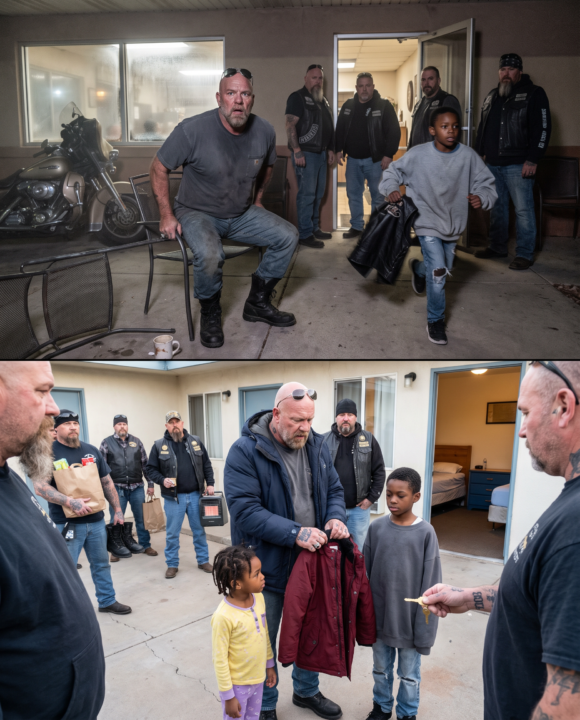
His brothers occupied the surrounding tables.
Nobody spoke about the theft.
Bear Collins, the club president, was a sixty-two-year-old Black veteran with a gray goatee and a left leg that stiffened in cold weather. He studied the one shoe beneath my counter, then set it upright beside Hammer’s coffee.
Cody remained angry.
He was twenty-seven, still a prospect, and young enough to believe loyalty required noise. The dead man’s patch inside Hammer’s vest had belonged to Sam “Rook” Mercer, an Iron Mercy rider killed by a drunk driver three winters earlier.
The patch was stitched beside the name RUTH.
“You should’ve taken the patch out,” Cody said.
Hammer looked at him.
“From around the kid?”
“You know what I mean.”
“No.”
Cody’s jaw tightened. “Rook earned that.”
“So did she.”
The argument ended there, but the test inside the brotherhood had only begun. The riders had planned to leave Albuquerque before dawn for a memorial run toward Gallup, where Rook’s ashes had been scattered along a ridge above Interstate 40.
His widow and two adult sons were expecting them.
Missing that ride felt like abandoning a brother.
Leaving Mack and Amaya felt worse.
We began by trying to understand how two children had reached the alley. I carried a flashlight behind the diner while Deacon and Lobo returned to the cardboard shelter.
They found two backpacks, an unopened can of soup, three library books, an inhaler with no medicine left, and a folded hospital discharge envelope bearing their mother’s name: Patrice Reed.
The date was nineteen days earlier.
Inside the envelope was a death certificate application, not a discharge order.
Patrice had died.
Mack had told no one.
The children had been living with their mother in a faded green minivan behind a weekly-rate motel near Louisiana Boulevard. Patrice worked housekeeping shifts at two properties and cleaned offices at night. When she collapsed during a bus ride, paramedics took her to the hospital, but the children remained with a motel neighbor.
She died of a ruptured brain aneurysm two days later.
The neighbor kept Mack and Amaya for less than a week before her landlord threatened eviction. Mack returned to the minivan, believing an aunt in Gallup would come for them.
The aunt never arrived.
Then the motel had the van towed because its registration had expired.
Mack carried what he could.
He avoided police, schools, shelters, churches, and anyone wearing an identification badge. Years earlier, he and Amaya had spent four months in separate foster homes while Patrice completed a recovery program. Mack remembered every locked door and every unanswered question from that time.
He had made his mother a promise.
If something happened, he would keep Amaya with him.
A thirteen-year-old boy had mistaken staying together for staying hidden.
I found one more item inside the backpack: a blue business card creased down the center.
MESA HOUSE FAMILY SHELTER
RUTH DAWSON, DIRECTOR
A handwritten note covered the back.
Patrice—Room 8 is being held until Friday. Bring both children. No separation during intake. Call me anytime.
The Friday mentioned on the card had passed twelve days earlier.
Hammer read it twice.
“Your sister?” Bear asked.
Hammer nodded.
None of his brothers knew much about Ruth. They knew he mailed money to someone every month and refused club rides on the first Sunday in December. They knew the name inside his vest, but many assumed it belonged to someone dead.
Hammer called her.
A woman answered before the second ring.
“Ray?”
“Got two kids.”
There was a pause.
“Where?”
“UNM Hospital. Boy’s thirteen. Girl’s six. Mother was Patrice Reed.”
Ruth stopped breathing for a moment.
“We’ve been looking for them.”
Hammer placed the phone on speaker.
Ruth explained that Patrice had contacted Mesa House three weeks earlier. A room was approved, but its heater failed during a city inspection. Ruth offered another placement, though it would have required a temporary separation because no family rooms were open elsewhere.
Patrice refused.
She intended to wait for Room Eight.
Then she died.
The shelter reported the children missing after hospital staff could not locate them, but Patrice had used a prepaid phone and listed the motel van as her address. By the time outreach workers arrived, the vehicle and children were gone.
Room Eight remained empty.
Not available.
Empty.
A corroded heat exchanger had disabled the wall unit, and the replacement would not arrive for four days. City rules prohibited occupancy without permanent heat during a cold-weather alert.
Hammer looked at Lobo.
Lobo had repaired commercial HVAC systems for thirty-two years.
“Can it be fixed safely tonight?”
“If the unit’s common enough.”
Ruth gave him the model number.
Lobo closed his eyes, calculating.
“I’ve got one in my workshop.”
His workshop was in Los Lunas, thirty miles south.
Bear looked toward the clock. The memorial ride was due to begin in less than five hours.
Rook’s family would be waiting.
Cody stood.
“We can fix the heater after Gallup.”
Hammer did not argue. He simply placed Mack’s single shoe on the table.
Cody stared at it.
The boy’s blood had dried around the torn heel.
“Damn it,” Cody whispered.
Bear divided the club. Finch and Deacon would ride to Gallup, explain the delay, and carry Rook’s memorial patch to his family. Bear, Cody, Lobo, and Hammer would remain in Albuquerque.
“But the patch is at the hospital,” Cody said.
Hammer looked at him.
“Then Rook stays with the girl.”
It was the first time Cody understood that Hammer did not view the two obligations as enemies. Honoring a dead brother did not always mean riding to the place where his ashes had fallen.
Sometimes it meant letting his name keep a freezing child warm.
At 2:15 a.m., Lobo headed south for the heater assembly. Bear and Cody searched twenty-four-hour stores for coats, socks, boots, and food. Hammer went to Mesa House with Ruth.
I drove to the hospital carrying Mack’s backpack and the shoe.
Before leaving the diner, I looked at the empty booth and noticed a second item beneath Hammer’s chair: a small red thread from the lining of his stolen vest.
It matched the cracked tag on the old motel key.
At that moment, I still believed Room Eight belonged only to the children.
I did not know it had belonged to Hammer first.
Part 3 — The Boy Who Refused the Warm Bed
UNM Hospital placed Mack and Amaya in the same examination room after Ruth called the pediatric social-work team. Amaya’s temperature had risen, though her blood sugar remained low and her breathing sounded tight from cold air and an untreated infection.
Mack sat on the floor beside her bed.
He had refused a chair, food, a blanket, and treatment for his foot. He watched every adult entering the room as though memorizing which one might close the door behind him.
Hammer stayed in the hallway.
Without his vest, his tattoos were fully visible beneath the fluorescent lights. A black crow covered one shoulder. Faded flames wrapped around his left forearm, and the word HOLD appeared across the knuckles of one hand while FAST crossed the other.
A nurse saw the lettering and requested security.
Mack noticed.
“That’s him,” he said. “He chased me.”
The security officer stepped between Hammer and the room.
Hammer backed away.
“He ain’t wrong.”
Amaya began coughing beneath the thermal blanket. Hammer’s vest still covered her legs, and her small fingers remained hooked through one armhole.
Mack watched the nurse adjust an oxygen tube.
“Is she dying?”
“No,” the nurse said. “But she needs antibiotics, warmth, fluids, and rest.”
“Can I stay?”
“We’re working on that.”
Mack understood adult phrases too well.
Working on that meant maybe.
Maybe meant no.
He rose, grabbed the backpack, and reached for Amaya’s hand.
“We’re leaving.”
The nurse tried to explain that his sister was not medically ready. Mack moved between her and the bed. His narrow shoulders shook, but he held his ground.
A hospital social worker named Joanne arrived with two police officers. She spoke gently, yet Mack saw the badges and began pulling the intravenous line from Amaya’s arm.
Everything accelerated.
The monitor alarm sounded.
Amaya cried.
One officer reached for Mack.
Hammer entered the room.
“Hands off the boy.”
Both officers turned.
The security guard gripped his radio. Cody and Bear stepped into the hallway behind Hammer, their boots and leather making the small space feel even tighter.
Joanne told everyone to stop.
Mack wrapped both arms around Amaya, trying to lift her from the bed despite the tubing. The little girl whimpered against his chest.
Hammer did not approach.
He lowered himself onto the floor six feet away.
“Mack.”
The boy refused to look at him.
“You said nobody would grab us.”
“Nobody has to.”
“They’re taking her.”
“She’s sick.”
“They took her last time.”
Hammer glanced toward Ruth.
She understood.
The foster placement had begun in a hospital too. When Patrice entered treatment, a caseworker collected both children from a pediatric clinic. Mack went north. Amaya went south.
Adults promised it would be temporary.
Four months felt permanent when you were nine.
Hammer asked the officers to wait outside. Joanne resisted at first, but Ruth identified herself, presented Mesa House’s emergency-family license, and confirmed that a private room would become available after the heater passed inspection.
The officers left the doorway.
Mack’s grip loosened slightly.
Hammer placed both hands on the floor where the boy could see them.
“When I was fifteen, I ran with my sister.”
Mack looked up.
“Why?”
“Our father hit. Our mother disappeared. State put us in different houses.”
“What happened?”
“I took her.”
“Where’d you go?”
“Bus station. Then an alley.”
Mack stared at the tattoos across Hammer’s knuckles.
“Did they catch you?”
“A trucker did.”
“What did he do?”
Hammer looked toward the vest covering Amaya.
“I stole his coat.”
The room became still.
Hammer had not told his brothers this story. Ruth stood near the window, one hand pressed against her mouth.
In December 1988, Ray Dawson escaped a foster home in Belen and found eight-year-old Ruth outside hers. They rode buses north until their money disappeared. A cold front trapped them near Central Avenue.
Ray stole a leather coat from a trucker outside the Copper Rail.
Not this Copper Rail building. The original diner had stood one block east before a fire destroyed it. My father owned it then.
The trucker chased Ray into an alley.
He found Ruth beneath the coat.
History had returned to the same street wearing different shoes.
“What happened after?” Mack asked.
“The trucker brought food. A waitress found us a room.”
“Then the state split you.”
“For one night, no. After that, people worked.”
“People always say that.”
“Yeah.”
Hammer’s agreement surprised him.
Ruth stepped closer, but she did not touch Mack.
“The room was Number Eight at the Mesa Motor Court,” she said. “The motel is Mesa House now. I run it.”
Mack looked from Ruth to Hammer.
“You’re his sister?”
“Unfortunately.”
Hammer’s beard shifted with the smallest hint of a smile.
Ruth showed Mack photographs on her phone: a modest room with two single beds, a blue dresser, a small table, and a window facing an interior courtyard. No bars. No security guard outside the door.
“The heater broke,” she said. “His friends are repairing it.”
“Why?”
“Because we held the room for your mother.”
Mack’s face changed.
“You knew her?”
“I spoke with her twice.”
“She said we’d get a place after Friday.”
“She was telling the truth.”
Mack’s anger collapsed before his body did. He sat on the floor, covered his face, and made no sound.
Hammer remained where he was.
Amaya reached from the bed and touched the top of her brother’s head. The vest slipped from her legs, revealing Rook’s memorial patch and the red-stitched pocket beneath it.
Mack noticed the patch.
“I didn’t know that belonged to somebody dead.”
Cody stood in the doorway.
“It belongs where it’s needed.”
Hammer glanced at him.
The prospect had finally learned when to speak.
Mack allowed the nurse to replace Amaya’s line. He let another nurse clean and bandage his foot. He ate half a sandwich while sitting beside the bed, though he hid the other half in his backpack until Ruth promised breakfast would come.
At 4:52 a.m., Hammer’s phone rang.
Lobo had installed the replacement assembly. A city emergency inspector was driving to Mesa House.
Room Eight might open by sunrise.
Everyone believed the crisis was over.
Then Joanne returned carrying Patrice Reed’s file.
She had found a relative.
The relative did not want both children.
Part 4 — The Old Key Sewn Inside the Leather
Patrice’s cousin lived outside Santa Fe. She agreed to take Amaya but said her apartment was too small for a teenage boy. She suggested Mack enter foster care until a second placement could be arranged.
The offer solved every legal problem except the one that mattered.
It separated them.
Joanne explained that child welfare could not simply allow two minors to live alone in a shelter room. Mesa House could keep families together when a parent, guardian, or approved kinship caregiver stayed with them, but Ruth could not admit Mack and Amaya without an adult responsible for their care.
The repaired heater changed nothing.
The key had a door but no legal hand to turn it.
Mack listened from behind the examination-room curtain. When Joanne finished speaking, he zipped the backpack and put on the borrowed hospital slippers.
Hammer saw him.
“Where you going?”
“Bathroom.”
“With the bag?”
Mack ran.
He slipped through the opposite curtain, struck a supply cart, and reached the stairwell before Cody caught the door. Hammer shouted for Cody not to grab him.
The boy flew down three flights.
Hammer followed more slowly, using the railing because an old injury stiffened his right knee. Bear took the elevator to the lobby. Ruth called security and told them to guard the exterior doors without touching Mack unless he entered traffic.
I stayed with Amaya.
She watched the doorway until the oxygen tube fogged beneath her breath.
“Is Mack bad?” she asked.
“No.”
“He stole.”
“He was cold.”
“I was cold.”
“I know.”
She pulled Hammer’s vest closer.
The old brass key slid from the hidden pocket.
The cracked red tag struck the bed rail.
Room 8.
Ruth picked it up and closed her fingers around it.
“That key shouldn’t exist,” she whispered.
Her brother had kept it for thirty-eight years.
The trucker whose coat Ray stole was named Samuel Mercer. He was Rook’s father—the same Rook whose memorial patch was now sewn inside Hammer’s vest.
Samuel chased fifteen-year-old Ray into the alley and found Ruth half-conscious beneath his leather coat. Instead of calling the police first, he carried her into my father’s diner.
My mother, Elena Torres, was the waitress working that night.
She fed them soup. Samuel paid for Room Eight at the Mesa Motor Court. He slept in his truck outside their door while my mother contacted an emergency youth advocate who fought to place Ray and Ruth together.
It took eleven days.
Samuel remained for six.
He missed deliveries, lost a shipping contract, and never told the children what it cost him.
Years later, Ray found him through a trucking union and tried to repay the motel bill. Samuel refused the money. He introduced Ray to his son, Rook, who had recently returned from the Marines and was rebuilding an old Harley in his garage.
Ray began helping with the motorcycle.
The two became brothers long before either wore a patch.
After Samuel died, Rook inherited the leather coat. When Rook was killed by a drunk driver, his widow cut a small memorial piece from the coat and gave it to Hammer.
That was the “dead man’s patch” Cody feared Mack had stolen.
The stolen vest carried three generations of one decision: Samuel’s coat, Rook’s patch, and the key to the room where Ruth survived her coldest night.
Now the same leather covered Amaya.
Ruth sat beside the bed with the key in her hand.
“My brother never told me he kept this.”
“Maybe it was waiting,” I said.
Ruth shook her head. “Ray doesn’t believe objects wait. He believes people do.”
Downstairs, Bear intercepted Mack near the main entrance. The boy changed direction, crossed the cafeteria, and slipped into a service corridor leading toward the loading dock.
Hammer found him behind a laundry cart.
Mack held another metal bar.
This time Hammer sat down before the boy could raise it.
“She can go with the cousin,” Mack said.
“You heard.”
“She’ll be inside.”
“Yeah.”
“That’s what matters.”
Hammer rested his scarred hands on his knees.
“What happens to you?”
“Doesn’t matter.”
“Wrong.”
“I’m thirteen. I can handle it.”
“No.”
“You did.”
Hammer’s voice hardened.
“I survived it. That ain’t the same.”
Mack looked toward the loading-dock exit.
“Amaya needs a bed.”
“So do you.”
“There’s only one way.”
Hammer knew what the boy meant. Mack intended to refuse placement and disappear again so the cousin would take Amaya without argument.
He was preparing to sacrifice himself with the calm logic of a child who had never been allowed to remain one.
Hammer removed his phone and called Patrice’s cousin.
Her name was Denise.
He did not threaten her. He did not shame her for living in a small apartment or fearing the cost of another child. He asked questions.
How small was the apartment? Why could she take Amaya but not Mack? What would make both possible?
Denise worked as a pharmacy technician and lived in a one-bedroom unit where her lease restricted occupants. She had applied for a larger apartment but could not afford the security deposit. Her car needed brakes. She was also caring for her father after dialysis three days a week.
She was not rejecting Mack.
She was drowning before he arrived.
Mesa House had a transitional family unit connected to Room Eight. It consisted of the bedroom, a small sitting room, and a kitchenette. Denise could stay there with both children for ninety days while Ruth helped secure kinship approval and permanent housing.
The arrangement required a background check, transportation from Santa Fe, emergency authorization, and someone to remain with the children until she arrived.
All of that could be handled.
One problem remained.
Denise believed Mack hated her because she had missed Patrice’s funeral.
There had been no funeral.
The hospital held Patrice’s remains while the county searched for relatives. Mack had told Amaya their mother was still “getting treatment” because he did not know how to explain death.
The boy had carried the truth alone for nineteen days.
Hammer placed the phone on the floor between them.
Denise’s voice came through the speaker.
“Mack?”
He stared at it.
“I’m sorry,” she said. “I didn’t know where you were. I’ve been calling every place your mama ever mentioned.”
“You only want Amaya.”
“No. I only thought Amaya was the one they would let me take.”
“Can you take both?”
“If you’ll let me try.”
Mack’s mouth tightened.
Hammer looked away, giving him privacy without leaving.
“Mom’s dead,” Mack whispered.
Denise began crying.
Mack did not. His tears seemed to have frozen somewhere during the nights behind my diner.
Hammer reached inside his thermal shirt and removed a thin chain. Another key hung from it—newer than the motel key, but worn smooth around the edges.
His motorcycle key.
He placed it beside the phone.
“Why’re you giving me that?” Mack asked.
“So you know I’m coming back.”
“You could have another.”
“Only fool owns one key to a bike.”
“You a fool?”
“Frequently.”
Mack almost smiled.
He returned upstairs.
When he entered Amaya’s room, she lifted one side of the vest. Mack climbed onto the bed and lay beside her beneath it.
The crisis ended without sirens, fists, or a biker speech.
It ended with two children sharing a coat.
Part 5 — What Six Bikers Did Before Sunrise
While Hammer stayed at the hospital, the Iron Mercy Riders divided the remaining work.
Lobo repaired the heater at Mesa House and remained until the city inspector tested the unit, checked the smoke and carbon-monoxide alarms, verified the window lock, and signed an emergency occupancy form.
No one took shortcuts.
Bear coordinated with Rook’s family in Gallup. When he explained why four riders would miss the memorial, Rook’s widow, Helen, asked one question.
“Is Ray’s vest still with the girl?”
“Yes.”
“Then Sam’s coat finally made it back to work.”
She sent a photograph of Rook as a teenager standing beside his father’s truck. Samuel wore the original leather coat. The right sleeve bore a pale scrape in the same place where Amaya’s fingers now gripped Hammer’s vest.
Finch and Deacon completed the memorial ride with Rook’s sons. At the ridge, they did not scatter more ashes. Instead, the family placed a child-sized pair of winter gloves beneath Rook’s marker.
Cody went shopping.
He had never bought clothing for a six-year-old girl or a thirteen-year-old boy. At the first store, he selected a pink coat covered in glittering stars and another so large Mack could have camped inside it.
Bear made him return both.
“Kids need warm,” Bear said. “Not costumes.”
They chose a navy insulated coat for Mack and a deep red parka for Amaya. Cody added waterproof boots, thermal socks, two hats, gloves, pajamas, and a yellow scarf because Amaya’s hospital top had been yellow.
At the register, he placed Rook’s old club card on the counter before remembering it had expired after his death.
Cody stared at the card.
The cashier waited.
Bear paid without mentioning it.
The replacement heater used nearly all the cash in the club’s emergency fund. The coats and clothing emptied most of what remained. The Iron Mercy Riders had planned to use that money to repair the motorcycle of a member injured at work.
Brotherhood was tested again.
Lobo called the injured rider, a mechanic named Pike, and explained.
Pike listened.
“Bike can wait.”
“You’ve already waited four months.”
“Bike ain’t cold.”
The matter was settled.
I reopened the Copper Rail at six. Regular customers arrived expecting breakfast and found four bikers carrying furniture through the courtyard of Mesa House next door.
Room Eight had been used for storage while the heater remained broken. We removed boxes, wiped dust from the dresser, washed bedding, and repaired a loose cabinet hinge.
Hammer’s brothers worked quietly.
Bear tightened the bed frames. Lobo inspected every outlet. Cody carried a small table from the diner and nearly dropped it when a leg collapsed.
My cook, Ernesto, brought eggs, tortillas, fruit, oatmeal, and enough coffee to keep everyone moving.
Inside the dresser, Ruth found a carved mark near the bottom drawer.
R + R
Ray and Ruth.
They had scratched it there in 1988.
Hammer had forgotten.
Ruth had not.
She explained how fifteen-year-old Ray slept on the floor between her bed and the door. Whenever footsteps passed outside, he woke with a tire iron in his hands. Samuel remained in his truck, and my mother checked the children between diner shifts.
On the fourth night, Ruth developed a fever.
Ray tried to steal medicine.
Samuel caught him at the drugstore door, took the bottle from his pocket, paid for it, then made Ray return to apologize to the clerk.
“What did Ray say?” Cody asked.
“Nothing. He was terrible at apologies.”
“Still is.”
Ruth smiled.
Samuel eventually helped Ray enter a vocational foster program that taught auto repair. Ruth entered a home with two retired teachers who agreed to maintain regular sibling visits.
They were separated by an address.
Not by abandonment.
Ray aged out at eighteen, worked in garages, joined the Army, returned with damaged hearing and a temper he did not understand, then spent three years drinking hard enough to lose nearly everything.
Ruth finished college and became a social worker.
Their paths separated.
The key did not.
When the original Mesa Motor Court closed, Ruth helped a nonprofit purchase and renovate it as a family shelter. She named Room Eight the Mercer Room after Samuel, though no sign hung on its door.
Ray donated money every month but rarely entered.
Too many memories lived behind that door.
At 7:30, Denise passed her background screening. Ruth arranged transportation from Santa Fe through a county family-response program. She would arrive by ten.
The room was ready at 7:56.
Hammer returned at 8:05, still wearing his thermal shirt. He had not slept. His beard was tangled, his forearm bandage had loosened, and one of his boots carried dried blood from Mack’s injured foot.
He entered Room Eight alone.
For several minutes, we heard nothing.
Then the bed frame creaked.
I found him sitting on the floor between the two beds, exactly where he had slept thirty-eight years earlier. The old motel key rested in one palm.
“You all right?” I asked.
“No.”
It was an honest answer.
“Want us to wait?”
He shook his head.
Hammer opened the bottom drawer and traced the scratched initials. His hand trembled once, then stopped.
“My sister used to think I saved her.”
“Didn’t you?”
“Samuel did. Your mother did. People I kept trying to run from.”
“You put the coat over her.”
“So did Mack.”
That was the part no one around him had understood.
Hammer did not see himself in the frightening biker chasing a thief.
He saw himself in the boy carrying too much.
At 8:12, the six motorcycles rolled behind the Copper Rail because Finch and Deacon had returned from Gallup. All six riders wanted to be there when the children saw the room.
Hammer carried the coats.
Cody carried the boots.
Bear carried the new brass key Ruth had cut for Room Eight.
The old key remained sewn inside the vest.
It belonged to the road that brought them there.
The new one belonged to what happened next.
Part 6 — The Door Mack Would Not Open
Amaya left the hospital shortly after nine wearing Hammer’s vest over her pajamas. The leather reached almost to her ankles.
Mack walked beside the wheelchair, one hand resting on her shoulder and the other holding Hammer’s motorcycle key.
The children arrived at Mesa House in a county van with Joanne and a pediatric nurse. When Mack saw the six bikers lined along the courtyard, he stopped.
Every rider had removed his sunglasses.
No engines ran.
No one blocked the walkway.
Hammer placed the navy coat across one forearm and the red parka across the other.
“Trade?”
Mack looked at the leather around Amaya.
“You want it back.”
“Eventually.”
“What if she gets cold?”
Hammer held up the red coat.
“This works better.”
Amaya allowed Ruth to help her into the parka, but she kept one hand on Hammer’s vest until the final moment. When the leather slipped free, Cody caught it before it touched the ground.
He brushed dust from Rook’s memorial patch.
Then he handed the vest to Mack.
The boy expected Hammer to snatch it away.
Instead, Hammer waited.
Mack studied the cracked red tag and the stitching around the old key. He touched the patch Cody had called a dead man’s.
“I’m sorry.”
Hammer accepted the vest.
“You kept her breathing.”
“I stole it.”
“Both can be true.”
Mack looked toward Room Eight.
Ruth stood beside the open door. Sunlight reached only a few feet into the room, leaving the beds and dresser in shadow.
Bear offered Mack the new key.
The boy would not take it.
“Does it lock from outside?”
“No,” Ruth said.
“Are there cameras?”
“Only in the courtyard.”
“Who can come in?”
“You, Amaya, Denise, and staff during safety checks. We knock first unless there’s an emergency.”
“Can they move us?”
“Not today.”
“That means later.”
Ruth did not lie.
“The court will decide longer-term custody. Denise wants both of you. We’ll help her ask for that.”
Mack stared at the key.
He had survived by distrusting doors. A locked door could keep danger out, but it could also keep a child inside while adults decided where he belonged.
Hammer unclipped his motorcycle key from the chain and placed it in Mack’s hand again.
“You still got mine.”
“What if I don’t open the room?”
“Then we stand here.”
“How long?”
Hammer looked at his brothers.
Bear folded his arms. Cody sat on the curb. Lobo poured coffee from a thermos.
“Looks like all day.”
Amaya climbed from the wheelchair.
The red coat made her appear twice her actual size. She shuffled toward the doorway, paused beside Mack, and slipped her hand into his.
“Mom said Room Eight,” she whispered.
Mack finally took the brass key.
It required two attempts because his fingers were shaking. The lock turned with a small metal click.
He opened the door six inches.
Warm air reached the courtyard.
Amaya entered first.
Mack followed.
Hammer remained outside.
The boy inspected beneath both beds, inside the closet, behind the shower curtain, and around the window. He tested the lock from the inside, opened it again, then looked toward the scratched initials inside the dresser.
R + R.
“Yours?” he asked.
Hammer nodded.
“You slept here?”
“On the floor.”
“Why?”
“Door duty.”
Mack looked at the space between Amaya’s bed and the entrance.
There was already a folded blanket there.
Ruth had placed it for him because she knew.
Mack sat on the nearer bed instead.
It was a small decision.
For him, it was enormous.
Denise arrived at 10:17. She was thirty-nine, exhausted, and still wearing pharmacy scrubs. Mack stood stiffly while she hugged Amaya.
Then Denise turned toward him.
She did not open her arms.
She waited.
Mack crossed the room and pressed his forehead against her shoulder.
Only then did he cry.
Hammer stepped into the courtyard and pulled the door almost closed, giving the family privacy. He slid the old Room Eight key back into the vest pocket beside Rook’s patch.
Cody noticed his hand trembling.
“You good?”
Hammer pulled on the leather.
“No.”
Cody nodded.
This time, no one tried to fix the answer.
Part 7 — Two Coats, One Key, and a Motorcycle Left Behind
Denise received emergency kinship approval three days later. She and the children remained in Room Eight for eleven weeks while Mesa House helped her secure a larger apartment, childcare assistance, school enrollment, and the survivor benefits Patrice had never known her children could receive.
The Iron Mercy Riders did not disappear after the photograph.
There was no single presentation, no oversized check, and no reporter waiting in the courtyard. Help arrived through ordinary things that would have looked dull on camera.
Bear drove Denise’s father to dialysis when her work schedule changed. Lobo repaired the brakes on her car with donated parts. Cody taught Mack how to patch a bicycle tire, then discovered the boy could rebuild a brake assembly after seeing it done once.
Finch found Amaya a yellow night-light.
Deacon replaced her inhaler spacer.
Hammer came every Thursday but rarely entered the room. He sat on the curb outside and drank diner coffee while Mack completed homework beside him.
Their conversations were short.
“You pass math?”
“Barely.”
“Counts.”
“You ever steal again?”
“Maybe.”
“Bad answer.”
“You?”
“Worse answer.”
Mack eventually asked about the words tattooed across Hammer’s knuckles.
HOLD FAST.
Samuel Mercer had used those words whenever young Ray threatened to run. They did not mean stay in one place forever. They meant do not release the person beside you simply because the road becomes difficult.
Hammer never explained it that way.
He let Mack figure it out.
The children held a small memorial for Patrice in the Mesa House courtyard. Denise brought her ashes from the county. Amaya drew a picture of three people beneath a yellow sun. Mack placed his mother’s blue shelter card beside the urn, then removed it before the service ended.
He kept the card.
Rook’s widow attended with her sons. Helen Mercer examined the scratch on Hammer’s vest where it had dragged across the alley.
“Dad would have liked this one,” she said.
“Kid stole it.”
“Dad met you the same way.”
Hammer grunted.
Helen touched Rook’s patch.
“You missed his ride.”
“No. Route changed.”
That answer satisfied her.
When Denise moved into the apartment, Ruth gave Mack the new Room Eight key. It no longer opened the door because the shelter changed locks between families, but the brass tag still carried the number.
Mack wore it around his neck.
The old motel key remained inside Hammer’s vest.
Two keys.
One for the boy who had once run.
One for the boy who finally stopped.
Four years passed.
Mack grew taller than Denise and almost as tall as Bear. He worked weekends at Lobo’s repair shop, maintained a B average, and joined Mesa House’s youth advisory board. He never became a biker, though Cody continued insisting there was time.
Amaya remembered little about the alley.
She remembered the smell of leather, the sound of Mack’s teeth chattering beside her, and a giant bearded man kneeling far enough away that she did not feel trapped.
Every November, on the first freezing night, the Iron Mercy Riders parked six motorcycles outside the Copper Rail. Mack and Amaya joined them with boxes of winter coats collected from schools, garages, churches, and motorcycle shops.
They never left clothing unattended beside dumpsters.
They worked with outreach teams, shelter staff, and emergency responders. Families were offered transportation and real placements, not promises that ended when the photograph was taken.
Room Eight remained reserved for families at risk of being separated.
Above the dresser hung no portrait of Hammer, Samuel, Rook, or the club. Ruth placed only a small frame containing a strip of worn black leather and four words.
THE COAT GOES FIRST.
On the fifth anniversary, Mack arrived late to the coat drive. He carried Hammer’s vest over one arm.
The biker had suffered a mild stroke two weeks earlier. His left hand remained weak, and doctors had forbidden him to ride until he completed rehabilitation.
Hammer hated every part of that sentence.
Mack entered the rehabilitation center with the vest, the old key, and Hammer’s motorcycle helmet.
“You stealing my stuff again?” Hammer asked.
“Borrowing.”
“For what?”
“Room Eight needs a heater.”
Hammer raised one eyebrow.
“The new unit costs three thousand,” Mack continued. “We’re doing a fundraiser ride. Bear says your bike needs someone to start it.”
“You got a license?”
“Three months ago.”
“You know the clutch bites high?”
“Cody warned me.”
“Cody’s an idiot.”
“He said you’d say that.”
Mack helped Hammer into the vest. The old leather settled across the biker’s shoulders, tighter than before but still carrying Rook’s patch, Ruth’s name, and the key that had survived two stolen coats and thirty-eight winters.
Hammer flexed his weak hand.
Mack placed the motorcycle key inside it.
“You said this meant you’d come back.”
Hammer closed his fingers around the metal.
“Looks like I did.”
The fundraiser repaired Room Eight’s heater and purchased coats for forty-three children. Hammer never rode at the front again, but he returned to the Copper Rail that winter in a sidecar attached to Bear’s Harley.
He complained the entire way.
At dusk, Mack locked the diner’s rear door and saw a boy watching the coat table from across the street. The child wore a thin sweatshirt and kept glancing toward the alley.
Mack did not chase him.
He selected the warmest coat, crossed Central Avenue, and stopped several feet away.
Behind him, six V-twins idled beneath the old Route 66 sign. Their low rumble filled the cold air but came no closer.
Mack held out the coat.
The boy took it.
No one ran.
Drop HOME in the comments and follow the page for more stories about bikers whose quiet choices keep changing lives after the engines fade.