An 82-Year-Old Woman Smashed a Biker’s Harley Headlight With Her Cane — Then One Unrepaired Crack Identified Her Dead Son’s Motorcycle After Twenty Years
Part 2 — The Man Who Left His Name Off the Title
I met Danny Mercer at a truck stop west of Indianapolis in 1999, when I was twenty-nine, drunk before noon, and trying to repair a throttle cable with electrical tape and language that frightened a family eating sandwiches inside their minivan.
Danny parked beside me on the battered black-and-cream Harley.
He was thirty-two, lean as a fence post, with brown hair curling beneath a scratched helmet, two days of beard, and a faded denim vest without a club patch. One lens of his glasses was held at the corner with clear tape.
He listened to my engine.
Then he turned it off.
“You’ll burn a valve.”
“I know what I’m doing.”
“Then you’re doing it wrong on purpose.”
That was Danny.
He carried tools in a red metal cashbox because his father had given it to him when he was twelve. Every wrench had a strip of white tape around the handle. Every strip carried a size written in Eleanor’s neat handwriting.
He fixed my cable in seven minutes.
I paid for his coffee. He slept on my garage floor that night because his motel money had gone to a couple with a broken radiator and two children. Three weeks later, he was riding beside the Black Ridge Riders.
Mack Dorsey, our president, did not trust him.
Danny avoided club politics, refused to fight for entertainment, and left group rides whenever he spotted a stranded motorist. He once made twenty-one men turn around because he saw a dog chained outside an abandoned farmhouse without water.
That behavior annoyed people until they needed him.
When Bear’s brake line failed on a Kentucky descent, Danny brought him down using hand signals and his own motorcycle as a moving barrier. When Knuckles was arrested after a bar fight he did not start, Danny drove through the night carrying security footage that cleared him.
He never called those things favors.
He called them unfinished business.
I was different then. Angry. Loud. Still carrying pieces of a prison sentence earned at twenty-one after I put a man in the hospital during a drunken fight. The club gave me structure, but structure did not make me sober.
Danny did.
He found me one winter morning asleep beside a running kerosene heater in my closed garage. Another hour and the fumes might have finished what the alcohol began.
He dragged me outside by my boots, poured every bottle into a drain, and stayed for six days while my body shook.
I hated him for three.
On the fourth, he made soup.
On the sixth, he gave me a small black recovery coin with no inscription. He had ground both sides smooth.
“No dates,” he said. “Just today.”
I carried it for twenty-seven years.
Eleanor knew none of this.
Danny rarely spoke about his mother because love and shame lived too close together in him. His father had died when Danny was nineteen. Eleanor worked in a school cafeteria, cleaned motel rooms on weekends, and paid the loan on their narrow brick house one month at a time.
Danny left after a fight.
He had used money from the red cashbox to buy a motorcycle part while the furnace payment was overdue. Eleanor called him selfish. Danny called her controlling.
Neither apologized before he rode west.
They spoke on holidays and birthdays. Sometimes.
He sent money anonymously. Eleanor thought it came from a church fund. Danny kept every card she mailed, even those containing only his name and her signature.
In October 2006, Eleanor slipped outside a pharmacy during an ice storm and fractured her hip. Danny learned from a cousin that she needed surgery and could not cover the rehabilitation deposit.
He decided to sell the Harley.
He told no one except me.
The bike was not worth enough. Danny had rebuilt it from mismatched pieces, and its title history frightened buyers. Mack offered $3,000 from the club emergency fund if Danny would sign a repayment agreement.
Danny refused.
“He’ll make her sign something,” he told me. “She won’t take it if she knows it came from me.”
I offered my savings.
He refused that too.
Then someone placed $18,000 in the club’s charity account—cash collected during three benefit rides for the widow of a mechanic killed on Interstate 70.
Two days later, $9,400 disappeared.
Mack accused Danny.
The timing looked terrible. Danny needed money. He had access to the clubhouse office. A camera showed him entering after midnight.
Danny denied taking it.
I believed him, but belief inside a brotherhood becomes expensive when evidence points the other way. Mack suspended his patch and ordered members not to ride with him until he returned the money.
I rode with him anyway.
That was why we were together on October 6.
Danny said he had proof of who took the cash. He had hidden it somewhere safe and wanted to show me before confronting Mack.
First, he needed to visit Eleanor.
He packed the signed motorcycle title inside my saddlebag. The buyer’s line remained empty.
“If something happens,” he said, “keep her running.”
“What’s supposed to happen?”
“Probably nothing.”
Danny smiled when he lied badly.
He tapped the cracked headlight.
“Don’t replace that. Mom will know.”
Those were the words I remembered for twenty years.
I had forgotten what he said next.
“When she finds the crack, break it.”
Part 3 — The Night Route 40 Went Silent
Rain began near Greenfield.
Not hard. Just enough to oil the road and lift the smell of diesel from the pavement. Danny rode ahead while my headlight filled his mirrors.
We should have stopped.
Instead, we pushed east.
A gray pickup appeared behind us outside Centerville. It followed too close, backed away, then accelerated again. Danny changed lanes.
The truck followed.
At first, I assumed the driver was impatient. Then it struck Danny’s rear saddlebag.
Metal snapped.
Danny swerved across the center line, corrected, and kicked hard at the pickup’s front fender. I dropped behind him and saw the driver.
Mack’s son, Tyler Dorsey.
Tyler was twenty-six and had been our club treasurer for six months. He possessed his father’s square jaw without his discipline. He gambled, borrowed money from prospects, and treated charity cash like temporary credit.
Danny had suspected him.
Now Tyler was trying to stop us.
The truck struck Danny again near an abandoned service station. His Harley crossed wet gravel and slammed sideways into a concrete drainage barrier. The headlight hit first.
I remember sparks.
I remember the engine screaming after the motorcycle fell.
I remember Danny rolling beneath the guardrail while the pickup disappeared east without braking.
I left my Harley in the road and climbed down.
Danny was conscious. Blood darkened his shirt beneath the left arm, and one boot pointed at an angle no boot should point. His glasses were gone.
“Truck?” he asked.
“Gone.”
“Did you see him?”
“Yes.”
“Good.”
He tried to sit. He could not.
I pressed both hands against his side and shouted for help, but that section of Route 40 carried little traffic after midnight. My phone showed one bar, then none.
Danny reached into his jacket.
The inner pocket was empty.
“He took it.”
“What?”
“The key.”
I thought he meant the Harley.
He grabbed my vest and pulled me close.
“Headlight,” he said. “When Mom finds it, break the glass.”
I told him to save his breath.
He told me to shut up.
Then headlights came around the curve.
The gray pickup was returning.
I stood in the road, convinced Tyler intended to finish what he had begun. Instead, the truck stopped forty yards away. Tyler stepped out carrying a revolver.
He was crying.
“Give me the recording.”
Danny laughed once from beneath the guardrail.
The sound was weak, but it stopped Tyler.
“You’re done,” Danny said.
Tyler aimed toward us. His hands shook so badly the barrel traced circles across my chest.
I moved between them.
Tyler fired.
The bullet struck the drainage barrier beside my leg. Stone fragments cut my cheek. I charged before he could fire again.
We hit the road together. He was smaller, faster, and terrified. I was heavy and sober for the first time during a crisis that mattered.
The revolver slid beneath the pickup.
Tyler struck my hand with a tire iron. The last joint of my left little finger disappeared between steel and pavement. I felt no pain until later.
Danny crawled uphill.
He reached Tyler’s open truck, grabbed the CB microphone, and transmitted our location across the emergency channel used by long-haul drivers.
Then Tyler kicked him.
Danny fell backward.
His head struck the chrome edge of his damaged Harley.
Two truckers heard the call. They arrived within four minutes and blocked both lanes with their rigs. Tyler ran into a cornfield but was arrested before sunrise.
Danny died during surgery at 3:17 a.m.
That became the official ending.
Tyler accepted a plea deal for vehicular manslaughter, assault with a deadly weapon, and theft from the club charity account. He admitted taking the money to cover gambling debts. Police recovered $6,100 from his apartment.
The remaining $3,300 was never found.
Mack resigned as president for eight months, then returned after members voted him back. He did not ask me to forgive Tyler. He barely spoke his son’s name.
The club restored Danny’s patch after death.
We buried his vest with him.
Eleanor reached the hospital six hours too late. Her own injury forced her to travel in a medical transport van. By the time she arrived, I was in surgery for my hand, Mack was with detectives, and Danny’s body had been moved.
Someone told her the motorcycle was destroyed.
Someone told her I had taken Danny on a club ride against his will.
Someone said I had been drinking.
That last lie reached her first and stayed longest.
When I tried to visit, Eleanor refused. When I called, a relative told me never to contact her again. I mailed Danny’s cards, his signed title, and a six-page letter explaining what happened.
The package came back unopened.
Weeks later, the salvage yard called. The insurer had declared Danny’s Harley a total loss. Because the title was signed but incomplete, nobody knew who legally owned it.
I bought the wreck at auction.
The frame was bent. The fork was twisted. The outer headlight glass carried its old blue crack plus new fractures from the crash.
Every mechanic advised me to start with another motorcycle.
I rebuilt that one.
I worked nights for eighteen months. Bear straightened the frame. Knuckles rebuilt the transmission. Switch rewired the controls. Mack offered money.
I refused his.
When the engine finally started, every tool on the garage wall trembled. The V-twin coughed smoke, settled into its old uneven rhythm, and filled the room with gasoline and burned oil.
Nobody cheered.
Danny should have heard it.
Before my first ride, Bear pointed at the broken headlight.
“That has to go.”
I remembered Danny’s words.
Don’t replace that. Mom will know.
So I built a clear protective cover over the original glass and installed a legal lamp behind it. The old crack remained visible.
What I did not remember was the final instruction.
Break the glass.
For twenty years, I preserved the door to the truth without opening it.
Part 4 — The Message Inside the Light
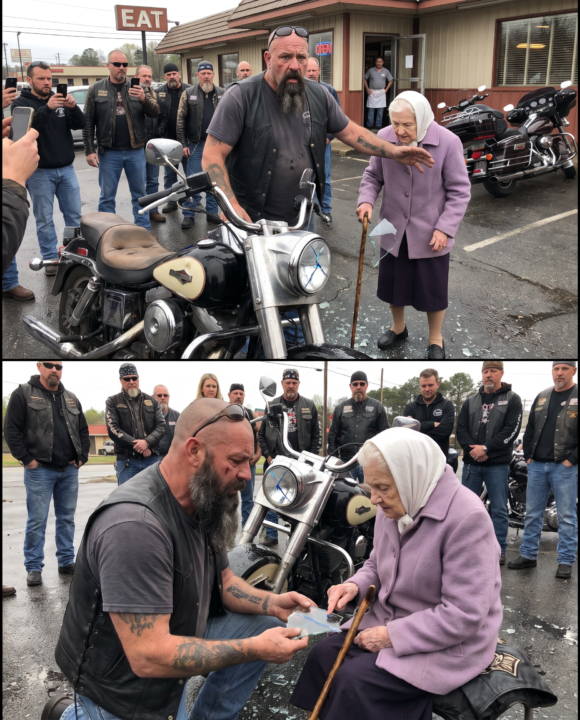
Back outside Boone’s Diner, Eleanor sat on my folded vest while Lena Boone, the owner, brought water and a damp towel. Nobody had called the police.
Or if they had, the dispatcher understood there was no crime left to stop.
The small brass key lay in my palm. Beside it rested the corroded metal tube exposed when Eleanor’s cane broke the headlight.
Mack stood behind me.
He had joined the Blanket Run without telling me. At sixty-four, he remained broad through the chest, though his beard had gone white and his knees troubled him on cold mornings.
When he saw the key, his face emptied.
“You know it,” I said.
He nodded.
“Tyler had one like it.”
Eleanor looked between us.
“Who is Tyler?”
Mack lowered himself onto the curb. Leather creaked around his shoulders.
“The man who killed your son.”
I opened the tube carefully with pliers from Danny’s red cashbox—the same box I had carried on the Harley since retrieving it from his old garage.
Inside was a strip of waterproof paper and a tiny memory card wrapped in wax.
The paper contained Danny’s handwriting.
Mom—if Hammer kept his word, you found the crack. I’m sorry I waited so long to come home. The key opens the box. The card shows who took the money. Hammer, don’t carry what belongs to Tyler. Bring me home, then take Mom wherever she asks.
There was a second note beneath it.
Shorter.
Mack knew Tyler had the cash before the vote.
The parking lot changed.
Eleven bikers turned toward our former president.
Mack did not defend himself.
He told us the truth.
Three nights before the crash, he found $3,300 beneath Tyler’s mattress. Tyler claimed it was gambling money he had won. Mack noticed bank straps from the club’s charity account.
He confronted his son.
Tyler confessed.
Mack demanded the rest of the money and promised to handle the matter inside the family before informing the club. He feared Tyler would go to prison. He also feared admitting that the son he had appointed treasurer stole from a dead mechanic’s widow.
So Mack let suspicion remain on Danny.
He believed he needed one night.
Danny discovered the truth first. A cheap security camera inside the club office had captured Tyler opening the safe. Tyler erased the main recording but did not know the system saved a second copy to a memory card.
Danny found it.
He hid the card inside the headlight because Tyler had searched his apartment, locker, and saddlebags. Nobody would look inside glass Danny refused to replace.
The brass key opened his red cashbox.
Eleanor inserted it.
A false bottom released beneath the row of taped wrenches. Inside were thirty-seven returned money orders addressed to her, receipts for her rehabilitation deposit, and letters Danny never mailed.
One envelope held $3,300.
The missing charity money.
We stared at it.
Danny had recovered the cash from Mack before the crash. Mack had surrendered it and begged him to wait until morning before exposing Tyler. Danny planned to return it to the account after visiting Eleanor.
Because the money remained in his box, police assumed Tyler had spent it.
Mack knew where it was.
He also knew Danny had died still appearing to possess some of the stolen funds.
“Why didn’t you tell us?” Bear asked.
Mack’s eyes stayed on the pavement.
“Because the box disappeared.”
“You knew Hammer had Danny’s tools.”
“I suspected.”
“You watched him carry that red box for twenty years.”
Mack nodded.
The air tightened.
Brotherhood can survive mistakes. It can survive anger, distance, prison, addiction, and funerals conducted without enough truth.
What it cannot survive easily is a man choosing his own blood over a brother he claims as family.
Knuckles removed his gloves.
Cody stepped between him and Mack.
I remained beside Eleanor.
“What did you tell my mother?” I asked Mack.
He looked at Eleanor.
“I told your niece Hammer had been drinking.”
I rose.
The movement frightened everyone except the old woman.
Mack stood too. He did not lift his hands.
I had imagined hitting Tyler’s father for twenty years without knowing it. The thought lived in my shoulders, my teeth, and the scarred bones of my hands.
Eleanor struck the pavement with her cane.
Once.
“Sit down,” she told me.
I sat.
Then she faced Mack.
“My son died stopping your boy.”
“Yes, ma’am.”
“And you made me hate the man who stayed with him.”
“Yes.”
“Why are you here?”
Mack swallowed.
“To tell the truth if the bike ever found you.”
“That took twenty years.”
“Yes.”
Eleanor studied him for a long time.
“Then you don’t get to leave after telling it.”
Mack looked confused.
“You will carry that box,” she said. “You will bring every letter into the diner. You will sit across from me while I read them. And if you lower your eyes, I’ll break something else.”
Nobody laughed.
Mack lifted the red cashbox.
For the first time in twenty years, he followed Danny’s mother instead of protecting himself.
Part 5 — Every Mile Hidden in the Red Box
We occupied the rear corner of Boone’s Diner until after sunset.
Lena turned off the jukebox. The lunch crowd departed, but she kept the coffee coming and placed a handwritten CLOSED sign on the door.
Eleanor read thirty-seven letters.
Some were only a paragraph. Others filled several pages in Danny’s narrow, slanted writing.
He described the places he rode without making the road sound romantic. A transmission failure behind a laundromat in Tulsa. Three nights sleeping beside a hospital boiler in Nashville while Bear’s wife underwent surgery. A stray Pit Bull that rode inside his jacket for fourteen miles.
He asked about Eleanor’s roses.
He remembered the names of cafeteria workers from her school.
He apologized for the furnace money six different ways without once writing the word apology.
Eleanor pressed each letter flat with both palms.
“Why didn’t he send them?”
“He thought you’d return them,” I said.
“I would have.”
“I know.”
That answer hurt her.
It hurt me too.
Inside the false bottom, we found receipts showing that Danny paid $11,700 toward Eleanor’s surgery and rehabilitation. He obtained part of it by selling tools, borrowing against his truck, and accepting money from me without telling me its purpose.
The signed Harley title was intended to cover the balance.
Danny had planned to sell the bike to me officially for $6,000. He left the buyer’s line blank because he wanted Eleanor to decide whether I deserved it if he failed to return.
The motorcycle had never simply been given to me.
For twenty years, I had ridden an unanswered question.
Eleanor read the title, then looked through the diner window at the Harley. Its broken headlight reflected the yellow parking-lot lamps.
“Did you want it?” she asked.
“Every day.”
“Because it was his?”
“At first.”
“And later?”
“Because it became mine too.”
She nodded.
Danny’s letters explained the tank dent. Eleanor had once dropped a cast-iron skillet from the garage shelf while helping him change spark plugs. Danny refused to repair the dent because she threatened to put another one in if he spent grocery money on paint.
The stitched X on the seat came from the night she used upholstery thread to repair a tear before his first ride to Sturgis.
Even the uneven left mirror had a story. Danny’s father mounted it while recovering from a stroke and refused to admit the angle was wrong.
The motorcycle was not valuable because Danny kept it perfect.
It was valuable because his family had left marks on it.
Mack sat across from Eleanor for four hours. He carried coffee cups, unfolded pages, and answered questions without protecting his reputation.
When she asked why he restored Tyler’s club membership after prison, Mack admitted he had not. Tyler moved west after release and died from an overdose in Nevada in 2021.
Mack had buried his son too.
Eleanor did not comfort him.
But she stopped calling him Mr. Dorsey and used his first name once.
Near dusk, we viewed the memory card on Lena’s old laptop. The video showed Tyler entering the club office, removing money from the safe, and placing something beneath Mack’s desk.
Then Danny appeared.
He retrieved the backup camera, looked directly into its lens, and spoke.
“If Hammer sees this, tell him the valve was fine. I just wanted him to shut up long enough to buy me coffee.”
I laughed before I could stop myself.
It came out broken.
Eleanor covered her mouth.
Danny continued.
“Mom, I’m coming home Sunday. I know I’ve said that before. This time the bike is already pointed east.”
The recording ended.
Eleanor asked to see it again.
Then again.
On the fourth viewing, she touched the screen where Danny’s face had frozen.
Mack moved away from the table to give her privacy.
I remained.
“I hated you,” she said.
“I know.”
“I prayed that you would feel what I felt.”
“I did.”
“That doesn’t make me feel better.”
“It shouldn’t.”
She turned toward me.
“Why did you keep searching?”
I looked through the window.
The clear protective shell around the headlight had been replaced six times. The cracked original remained beneath it through desert heat, Appalachian rain, lake-effect snow, and one garage fire that blistered the paint.
“Danny said you’d know.”
Eleanor lifted the small triangle of broken glass from her pocket.
“All those years, you believed one sentence?”
“He believed me first.”
That was the closest I came to explaining it.
After the diner closed, Eleanor asked me to start the Harley.
I warned her the sound might be loud.
“My son built that exhaust,” she said. “I know exactly how loud his bad decisions were.”
I rolled the motorcycle away from the windows before turning the key. The engine caught on the third attempt. Its V-twin rumble crossed the parking lot, uneven and deep.
Eleanor closed her eyes.
For several seconds, she was not eighty-two.
She was a mother hearing her son return before the kitchen door opened.
When she looked again, she placed one hand on the worn seat.
“Take me home.”
I offered to call a car.
She struck my boot with her cane.
“Did I say call a car?”
I found Danny’s old helmet in my saddlebag. I had carried it on every long ride, though nobody wore it.
Eleanor recognized the scrape near the chin.
The helmet fit loosely, so Lena folded a scarf inside. Bear helped Eleanor onto the passenger seat while I stood rigid, afraid her hip would not manage the height.
She settled behind me and gripped my vest.
Mack approached.
Eleanor pointed her cane at the red cashbox.
“You carry that.”
He strapped it to his motorcycle.
Twelve engines started, but nobody pulled ahead.
For twenty years, Danny’s Harley had searched for one passenger.
That night, it found her.
Part 6 — The Sunday Ride Back to Richmond
Eleanor lived six miles from the diner in a small assisted-living community beside an abandoned railroad line.
The ride took forty minutes.
She made me circle the long way through Richmond, passing her old school, the church where Danny was baptized, and the empty lot where their brick house once stood.
At every stop, she tapped my shoulder and named something that had disappeared.
Miller’s Hardware.
The five-cent candy counter.
Danny’s first job at the tire shop.
His father’s maple tree.
The Black Ridge Riders followed in two quiet columns. Mack rode last with the red cashbox strapped behind him.
When we reached Eleanor’s residence, several nurses ran outside. One began scolding us until Eleanor lifted her cane.
“I’m eighty-two,” she said. “If I want to come home with twelve bikers, I’ve earned the paperwork.”
She requested the common room.
We carried Danny’s letters inside. Eleanor arranged them across a long table in chronological order, placing the broken headlight glass beside the earliest one.
Then she handed me the motorcycle title.
The buyer’s line remained blank.
“Sign it.”
I could not.
“It’s yours,” she said.
“It was his.”
“It was ours. Now it’s yours.”
I signed.
Mack served as witness.
The following week, I returned to Indiana with a replacement clear shield for the headlight. Eleanor stopped me before I installed it.
The old cracked glass could no longer remain on the road. Her cane had separated it into five unstable pieces.
She placed them in a wooden frame.
Inside the headlight, we installed a new lens carrying a blue lightning-shaped line sealed beneath the surface. Eleanor painted the line herself at the residence craft table.
Her hand trembled.
The bolt came out crooked.
Perfect.
Once each month, I rode from wherever the Blanket Run took me back to Richmond. When winter made riding unsafe, I arrived in Bear’s truck with the Harley secured behind us.
Eleanor always inspected the headlight first.
Then the seat.
Then me.
Mack came too. He carried the red box every time. Eleanor made him read one of Danny’s letters aloud before coffee.
He never refused.
The club removed Mack’s retired-president patch after a unanimous vote. He remained a member, but only after accepting one condition: whenever a brother was accused, Mack would be the last voice heard—not the first.
He spent his remaining years earning his place without demanding it back.
Eleanor never formally forgave him.
She saved him a chair.
Sometimes that is the harder mercy.
Part 7 — The Light We Never Replaced Again
Eleanor rode behind me for three years.
Her doctors objected. The residence objected. Weather objected most often.
She negotiated with all three.
Our final ride came on October 6, the anniversary of Danny’s death. Eleanor was eighty-five and too weak to mount the Harley without help, so Bear built a low sidecar with a brown seat matching Danny’s original upholstery.
She disliked it immediately.
Then she noticed the hand-stitched X.
“That’s acceptable,” she said.
We rode old Route 40 at sunrise.
No speeches. No police escort. No public announcement.
Twelve Black Ridge Riders traveled behind us while Mack carried the red cashbox on Danny’s restored luggage rack.
At the drainage barrier where Danny fell, Eleanor asked us to stop. She placed the framed pieces of the original cracked glass against the concrete and sat beside them.
For twenty minutes, nobody spoke.
A truck passed, pushing warm air and road dust across our boots. The Harley’s engine ticked as it cooled.
Eleanor touched the scar on my cheek.
“He got you sober,” she said.
“Yes.”
“You kept his bike alive.”
“Yes.”
“And he brought me home on it.”
I looked at the blue line inside the new lens.
“He planned ahead.”
She smiled.
Before leaving, Eleanor removed the small black recovery coin from the chain around my neck. Danny had given it to me during my first week sober.
She pressed it into a narrow crack in the barrier.
“Now he knows you made it,” she said.
Eleanor died the following spring with Danny’s letters beside her bed and the framed headlight glass on the wall.
Her will contained one instruction for me.
Keep riding east sometimes.
I still do.
The Harley now has more than 360,000 miles. Its engine has been rebuilt again. The brown seat is mostly patches, and the dent from Eleanor’s cast-iron skillet remains beneath the fuel tank’s faded paint.
The headlight carries her crooked blue bolt.
On October 6, the Black Ridge Riders shut down our engines at the drainage barrier. Mack places the red cashbox beneath Danny’s photograph. I clean the lamp with the corner of my vest.
Then we ride to Richmond.
Not because Eleanor is waiting outside the diner.
Because she once was.
At sunset, the blue crack catches the last light and glows across the chrome like something broken that finally learned how to lead us home.
Danny was right.
His mother recognized it.
Drop HEADLIGHT in the comments and follow the page for more stories about bikers who keep promises longer than roads remember.