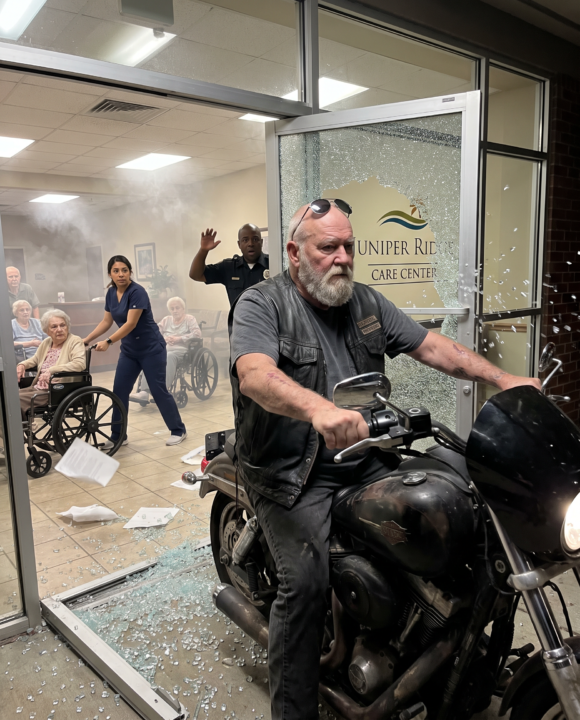
A 69-Year-Old Biker Drove His Harley Through a Nursing Home’s Glass Entrance—Then Smoke Filled the Rear Hall and the “Crash” Became Their Only Way Out
Part 2 — The Man Who Tested Every Door
Brake did not begin visiting Juniper Ridge because he trusted us.
He came because June was there.
Two strokes had weakened the left side of her body and damaged the part of her memory that connected faces to names. She remembered the yellow kitchen in their first apartment, the dog they owned in 1986, and every verse of “Ring of Fire.” She did not remember the man who had slept beside her for forty-one years.
Brake still arrived every Thursday.
He checked the tire pressure on her wheelchair before kissing her forehead. He brought cider she rarely drank, repaired whatever shook or squeaked in her room, and sat beside her even when she asked him to leave.
He never argued with the disease.
“June gets to be where she is,” he once told me. “My job is to show up there.”
Most employees knew him only as an intimidating visitor with an old Harley. I knew a little more because my father had worked beside him at the Flagstaff Fire Department.
Brake had never been a firefighter in the way people imagined. He did not carry an ax into burning houses for photographs. He was a driver-engineer and apparatus mechanic—the person responsible for making sure a thirteen-ton engine started, pumped water, held pressure, and returned home.
Machines spoke to him.
A relay clicked too slowly. A bearing changed pitch. A pump seal released one unfamiliar smell. Brake heard those details beneath sirens, radios, and shouting.
His club brothers said he could identify a sick Harley with his eyes closed.
The Iron Mercy Riders were not an outlaw club, though their appearance discouraged strangers from asking. Most were veterans, mechanics, paramedics, construction workers, and men who had reached an age when memorial rides outnumbered weddings.
Their president, Leonard “Bear” Collins, was a sixty-four-year-old Black Army veteran with a gray goatee and a left leg that stiffened in cold weather. Lobo Ramirez repaired elevators. Cody Mills, their youngest member, worked in a tire shop. Deacon Price had been a flight medic.
That Thursday, eleven riders had gathered at a diner west of Flagstaff for an annual midnight run toward Winslow. They were supposed to carry five brass bells to a roadside marker before sunrise.
Brake was meant to lead.
Instead, he stopped at Juniper Ridge first.
The names sewn inside his vest belonged to five residents killed in the Cedar Glen assisted-living fire on November 14, 1999. Brake had driven Engine Seven that night. My father rode beside him.
An overloaded extension cord ignited behind a television cabinet. Smoke entered the roof void, moved above the sprinklers, and dropped into two connected hallways. Staff tried to evacuate residents through a rear fire door.
The door jammed.
A decorative security chain installed after a burglary prevented it from opening fully. Fire crews cut it, but several residents could not survive the delay.
One of them was an eight-year-old visitor named Emily Hart.
The red mitten in Brake’s saddlebag had belonged to her.
Brake found it beneath a wheelchair after the fire. He submitted it with the incident property, but Emily’s mother asked him to keep it when the investigation ended.
“She said I was the last person who carried her daughter,” he once told Bear. “She didn’t want the last thing Emily touched placed in a box.”
The fire changed Brake.
He began inspecting every exit in every building he entered. Restaurants. Motels. Clubhouses. Hospitals. He sat facing doors and counted people who might need help.
June called it his second shadow.
At Juniper Ridge, he tested the east courtyard door almost every Thursday. He did not yank it or interfere with the hardware. He pushed the panic bar, opened it six inches, listened to the hinges, and closed it gently.
Two weeks before the fire, he told our administrator the lower hinge was dragging.
A contractor adjusted it.
Three days later, another contractor painted the metal frame. Excess paint entered the narrow gap around the hinge-side weather seal. In warm afternoon temperatures, the door worked.
During the freeze, the seal stiffened.
Brake tested it Thursday evening and felt resistance. He reported it to Mateo, who wrote the concern in the overnight maintenance log.
The door still opened.
Just not far enough to prove what would happen when heat expanded the frame.
The other thing Brake noticed was our backup generator.
Its exhaust note changed at 6:51 p.m. during an automatic exercise cycle. The engine stumbled, recovered, then carried an uneven load for nine seconds.
Brake walked outside.
The generator itself was fine. The smell came from somewhere else—hot insulation, old dust, and the sharp, bitter odor of electrical resin beginning to break down.
He followed it to the west ventilation intake.
That intake served the rear transfer room, where a battery backup unit had been installed beside the oxygen-control cabinet. One terminal had loosened. Resistance created heat. Heat charred the cable jacket behind a steel cover where no one could see it.
The alarm system should have caught the smoke.
A roof detector had been placed in test mode after repeated trouble signals. The monitoring company believed a technician was still on-site. The technician believed the panel had been returned to service.
Each mistake was small.
Together, they made silence.
Brake called Bear from the parking lot.
“Run’s off.”
Bear thought he meant his own participation.
“We’ll wait at the diner.”
“No. Bring everybody here.”
“What happened?”
“Maybe nothing.”
Bear heard the part Brake did not say.
Maybe nothing had been the last phrase Brake used before Cedar Glen.
The Iron Mercy Riders left their food untouched and started eleven engines. They were eight minutes away.
Inside Juniper Ridge, Mateo continued following policy. He had no visible fire, no full alarm, and no authority to move fragile residents into freezing air based on a visitor’s suspicion.
Brake understood the rule.
He also understood smoke.
When the first gray thread appeared behind our nurses’ station, he stopped asking permission.
Part 3 — The Door That Moved Two Inches
After the Harley came through the glass, everything happened louder than memory should allow.
The fire alarm screamed. Residents shouted over one another. The motorcycle’s cooling pipes clicked beneath the noise, and winter air poured through the destroyed entrance, pushing smoke back toward the rear wing for a few precious seconds.
Brake pointed toward the east courtyard.
“Wheelchairs first. Stay low.”
Mateo stood frozen beside the reception desk. A thin cut crossed his cheek where flying glass had touched him.
“You could’ve killed somebody.”
Brake looked once at the smoke.
“Move.”
That was all.
I sent Tasha and two aides toward memory care. Another nurse shut the main oxygen valve after moving portable cylinders away from the transfer room. Mateo called emergency services and reported an electrical fire with immobile residents trapped inside.
The dispatcher asked whether our main entrance was accessible.
Mateo stared at the Harley surrounded by broken glass.
“Accessible isn’t the word.”
We moved eleven wheelchairs into the east corridor. Brake walked beside June but did not tell her who he was. She had pulled a blanket over her mouth and kept asking why the mechanic was in the building after dark.
“I’m fixing a door,” he said.
The first residents reached the courtyard exit.
I pressed the panic bar.
The latch withdrew. The door shifted two inches, struck resistance, and stopped.
Tasha pushed beside me.
Nothing.
Mateo added his shoulder. The metal groaned but held. Heat from the rear hallway had begun expanding the frame, while cold air outside tightened the painted seal around its lower corner.
We were pushing an outward-opening door from inside.
Six employees tried together.
It did not move another inch.
Smoke descended from the ceiling, first as a gray layer and then as a black rolling shelf. The sprinkler above the transfer-room doorway activated, but water struck the closed corridor fire door and failed to reach the burning cable behind the wall.
The building still had compartments.
They were buying time.
Not enough.
Brake returned to the broken lobby and dragged the Harley backward through the glass. Its rear tire cut across the aluminum threshold. The front fender was dented, the windshield had shattered, and blood ran from a slice above his right eyebrow.
Cody and Bear arrived as he wrestled the bike onto the driveway.
Eleven Harleys entered the parking lot together, their headlights sweeping across the smoke pouring from the broken entrance. Neighbors who had come outside began recording.
From the street, it looked as though a biker gang had attacked a nursing home.
Bear saw Brake’s motorcycle.
“What did you do?”
“Made a door.”
“Earl—”
“East exit’s jammed.”
That ended the argument.
Lobo and Deacon ran inside. Cody moved toward the Harley, but Brake ordered him to bring wheelchairs through the broken lobby instead. Bear told the remaining riders to remove the sharp aluminum frame and cover glass with floor mats.
Brotherhood became work.
No one posed.
Brake rode around the building at walking speed, following the narrow service drive toward the east courtyard. A wooden fence blocked the final twenty feet. He used the Harley’s front wheel to push through one rotten section, then dismounted beside the jammed fire door.
From inside, I saw his shadow through the wired-glass panel.
He pulled the yellow recovery strap from the saddlebag.
The door had a horizontal exterior reinforcement bar installed after a storm bent the frame years earlier. Brake looped the strap around it, placed a protective sleeve over the metal edge, and connected the other end to the Harley’s frame-mounted recovery point.
Not the handlebar.
Not the rear fender.
The frame.
He had installed that recovery point after pulling Bear’s touring bike from a snowbank on Interstate 40. It was rated for far more force than they would use now.
Brake knocked on the glass.
I leaned close.
“Keep everyone back. When it moves, control it.”
“What if the glass breaks?”
“It might.”
“What if the strap snaps?”
“Stay below the window.”
June recognized his voice.
“Earl?”
He closed his eyes.
It was the first time she had said his name in eighteen months.
Smoke swirled between us. Brake pressed one gloved hand against the glass, and June lifted her fingers toward the same spot from inside.
Then he stepped away.
He straddled the Harley, started the damaged engine, and let it settle into a low V-twin thud. The recovery strap rose from the pavement and became straight.
Brake did not jerk it.
He eased forward.
The motorcycle’s rear tire slipped on frozen gravel. The strap vibrated. The doorframe groaned, but the door remained shut.
He tried again.
This time Bear and Lobo pushed from inside while Brake applied steady power outside. The lower hinge screamed. Paint cracked along the frame.
The door opened four inches.
Then the strap’s protective sleeve slipped.
A metal edge began cutting into the webbing.
“Stop!” Bear shouted.
Brake could not hear him over the engine.
I ran into the smoke, struck the wired-glass panel with my flashlight, and waved both arms. Brake saw me and released the throttle.
The strap was half cut.
We had one attempt left.
Cody found a folded fire blanket and passed it through the two-inch gap. Brake wrapped the blanket around the door bar, repositioned the strap, and moved the Harley sideways for a straighter pull.
Sirens approached from Route 66.
Smoke had reached knee level.
One resident stopped breathing.
Deacon lowered Mr. Howard to the floor and began ventilating him with a mask while Tasha held his oxygen cylinder. We could not carry him back toward the broken front entrance without crossing the thickest smoke.
Brake looked through the glass.
I held up one finger.
One more.
He nodded.
The Harley moved forward. The strap tightened. Bear pushed. Lobo drove a pry bar into the gap. The frame bowed outward with a sound like a rifle cracking.
Then the lower hinge tore free.
The door flew open.
Cold air rushed inside. Smoke lifted. Brake dropped the Harley and caught the door before it swung back against the wall.
We rolled the first wheelchair into the courtyard.
Then the second.
Then June.
She reached toward Brake as we passed, but he was holding the damaged door with both hands and could not take hers.
Twenty-three residents exited through that opening.
Twelve more went through the broken lobby.
Fire crews arrived believing the evacuation was still beginning.
It was almost finished.
We thought everyone was out.
Then the memory-care census came back one name short.
Marlene Hayes, eighty-two, had vanished from Room 207.
Her oxygen tube disappeared beneath the smoke leading toward the rear transfer room.
Brake looked at the five names sewn inside his vest.
Then he walked back inside.
Part 4 — Why Bear Tried to Stop Him
Bear caught Brake at the broken entrance.
“No.”
Brake pulled a wet bandanna over his mouth.
“Marlene’s in back.”
“Fire crew’s here.”
“She hides from helmets.”
Bear knew that was true.
Marlene Hayes had advanced dementia and a terror of uniformed strangers. She had once hidden inside a laundry cabinet during a tornado warning because an employee wore a reflective safety vest.
She also had a private connection to the Iron Mercy Riders.
Her late husband was Frank “Nails” Hayes, one of the club’s founding members.
The midnight ride to Winslow had been for him.
Nails had died exactly one year earlier after a long illness. His final months were spent in Juniper Ridge, where Brake visited him every Thursday while June slept one room away.
Before Nails died, he made Brake promise two things.
Do not let Marlene attend the funeral if it frightened her.
Do not let the club forget where she lived.
The five brass bells waiting at the diner were meant for Nails’s memorial marker. Every rider had agreed the run came first.
Then Brake canceled it.
Cody had been angry when Bear delivered the message. The prospect believed missing the anniversary dishonored the dead.
Now Nails’s widow was somewhere behind a fire door.
Bear removed his own vest.
“I’m going.”
Brake shook his head. “Your leg’s bad.”
“Still attached.”
“You don’t know the room.”
“You showed me.”
That was another thing we learned later. Brake had walked his brothers through Juniper Ridge’s public corridors months before the fire. He disguised it as a visit, but he showed them the exits, the fire compartments, June’s room, Marlene’s room, and the location of portable oxygen.
Cody thought the old man was being obsessive.
Brake was building a map.
The fire captain reached them at the entrance and ordered both men outside. Captain Nora Chen had worked under Brake early in her career. She recognized the burn scar beneath his ear before recognizing his face.
“Mercer?”
“Resident missing. Room 207.”
“My team has it.”
“She won’t answer masks.”
Nora looked toward me.
I confirmed Marlene’s behavior and pointed to the oxygen tube disappearing down the rear corridor.
Nora made a decision no incident commander enjoys. She allowed Brake to accompany a two-person search team as far as the compartment door, provided he wore an escape hood and obeyed every command.
Bear stayed behind.
He hated it.
The firefighters advanced through ankle-deep sprinkler water. Brake followed between them, one hand sliding along the wall. The electrical fire had entered the ceiling cavity above the transfer room, but the corridor doors held most of the heat.
Visibility was less than two feet.
Marlene’s oxygen tube led into the laundry room.
They found the cannula on the floor.
No Marlene.
Brake shut his eyes and listened.
Pumps hummed. Water struck ceiling tiles. Radios cracked through the breathing masks.
Beneath it came a soft metallic tapping.
Three taps.
A pause.
Three more.
Nails had used that rhythm at club meetings whenever he wanted Marlene to bring another pot of coffee from the kitchen. Years later, when words became difficult for her, she used the same pattern to tell him she was nearby.
Brake followed the sound to a linen cabinet.
Marlene had pulled herself inside and closed the door. She was tapping an oxygen-cylinder wrench against the metal wall.
When the firefighter opened the cabinet, she screamed at his mask and kicked weakly.
Brake removed his escape hood.
“Hey, Red.”
Only Nails had called her that.
Marlene stopped.
“Frank?”
“No. Brake.”
“Where’s Frank?”
“Waiting on the ride.”
It was not an answer, but it reached her.
Marlene allowed Brake to wrap a wet blanket around her. The firefighters placed her on a rescue drag and moved toward the compartment door.
Then a section of ceiling fell.
Cable, wet insulation, and burning plastic struck behind them, cutting off the direct path. The firefighters turned toward the therapy room, where a window faced the courtyard.
The window opened only four inches.
Brake used the small pry bar from his belt to remove the limiter. One firefighter broke the outer pane and cleared the frame. Club members waiting below stacked patio cushions across a low concrete planter.
Marlene went out first.
Brake followed last.
He dropped into the courtyard, landed badly, and folded over his right knee. The same leg had been crushed by a fire engine twenty-seven years earlier.
Bear reached him.
“You done?”
Brake tried to stand.
His knee failed.
“Apparently.”
The firefighters contained the electrical fire nineteen minutes later. No resident died. Mr. Howard began breathing again before the ambulance left. Marlene suffered mild smoke inhalation. June had a small cut on one hand.
Brake required fourteen stitches above his eyebrow, five in his forearm, and an examination of his knee.
He refused the ambulance until every resident was counted twice.
People watching from the road had already uploaded videos. The shortest clip showed only the Harley smashing through the glass.
Within an hour, comments called Brake drunk, senile, violent, and reckless. Someone identified him as June’s husband and claimed he had attacked the facility after she rejected him.
The full truth had not yet reached the internet.
It had not reached us either.
Fire investigators inspected the failed courtyard door and found more than frozen paint. A steel screw had been driven through the lower strike plate at an angle, preventing the frame from expanding normally.
It looked like careless repair work.
Brake recognized the screw.
He had installed it himself.
Twenty-six years earlier.
Part 5 — The Screw Brake Never Forgot
Juniper Ridge had not always been a nursing home.
In 2000, the east wing belonged to a rehabilitation hospital where Brake spent eleven months after the fire-engine accident destroyed his knee. June drove him there every morning before work and brought him home after physical therapy.
The courtyard door would not close properly in winter.
One afternoon, a maintenance supervisor asked Brake to help. Brake adjusted the strike plate and installed a longer steel screw because the original threads had stripped.
It was supposed to be temporary.
The supervisor promised to replace the frame.
No one did.
Buildings changed owners. Maintenance files disappeared. The rehabilitation hospital became an assisted-living center, then Juniper Ridge Care Center. New paint covered old repairs.
Brake forgot the screw.
Until he tested the door two weeks before the fire and felt the lower frame drag.
That was why he returned Thursday carrying the recovery strap. He intended to show our maintenance manager how much force the door required and insist that the frame be replaced.
He had not expected to use the strap during a fire.
Investigators initially feared the old repair made Brake legally responsible. He did not defend himself.
“I put it there.”
Captain Nora Chen reminded him that the screw was visible during multiple inspections and should have been replaced with the frame. The current contractor had painted over corrosion, hardened the weather seal, and signed the door as operational without testing it under load.
Responsibility had accumulated across twenty-six years.
Brake still carried his piece.
He visited Mateo in the emergency department that night. The security guard had seven stitches and a bruised shoulder from moving residents through the broken entrance.
“I kept you out,” Mateo said.
“You followed the policy you had.”
“I saw the smoke too late.”
“So did the detector.”
“You could’ve told me you were fire service.”
Brake sat beside the bed.
“Would’ve taken longer.”
That answer sounded harsh, but Mateo understood it. Brake had not needed recognition. He needed the door open.
The public story changed when a resident’s granddaughter uploaded a longer recording. Her video showed Brake shouting for an evacuation before the alarm, aiming at an empty glass panel, stopping the motorcycle safely, and ordering wheelchairs toward the courtyard.
Another clip showed the yellow strap pulling the fire door open.
Comments reversed overnight.
People called Brake a hero.
He disliked that more than being called crazy.
At the temporary evacuation center, local reporters surrounded him. He answered only questions about the residents and repeatedly named the aides, nurses, security staff, firefighters, and club members who helped.
When a reporter asked how he knew the entrance glass would break safely, Brake pointed toward the aluminum frame.
“Tempered. Center pane. No wire.”
“How did you know nobody was behind it?”
“Lena moved them.”
“What if she hadn’t?”
“I wouldn’t have gone.”
“Did you calculate all of that?”
“No.”
The reporter waited.
Brake adjusted the bandage above his eye.
“I looked.”
June sat twenty feet away beneath a donated blanket. She watched the interview without appearing to recognize him.
Then the reporter asked about the five names inside his vest.
Brake walked away.
I found him behind the evacuation center beside his damaged Harley. The windshield was gone. Glass filled the instrument housing, the front fender pressed against the tire, and one mirror hung by its wire.
He removed the red mitten from the saddlebag.
The clear bag had torn during the crash.
“I should’ve retired this thing,” he said.
“The motorcycle?”
“The mitten.”
He told me about Emily Hart and Cedar Glen. He explained the five stitched names. He also admitted something omitted from the official history.
Engine Seven had arrived quickly that night.
Brake hesitated before placing the apparatus near the rear exit because overhead electrical lines crossed the driveway. He repositioned the engine before deploying the first hose.
The move took forty-three seconds.
Investigators later determined it did not change the outcome. The trapped residents had inhaled lethal smoke before Engine Seven arrived.
Brake never accepted that.
For twenty-seven years, he imagined those forty-three seconds as a debt.
That was the meaning of the words tattooed across his knuckles.
NO SECOND CALL.
He would not wait for someone to tell him twice that a person was trapped.
Bear joined us carrying the five brass memorial bells.
“The run can still happen,” he said.
Brake looked toward Marlene, who was being examined near an ambulance.
“No.”
“Nails would understand.”
“I know.”
Bear placed one bell on the Harley’s broken seat.
Cody approached last. He had spent the evening moving wheelchairs, clearing glass, and carrying oxygen cylinders. Blood from someone else marked his flannel shirt.
“I thought you broke,” he told Brake.
“Did.”
Cody frowned.
Brake touched the broken windshield.
“Just in the right direction.”
June appeared behind us in her wheelchair. An aide had tried to stop her, but she insisted the mechanic had forgotten his coat.
Brake knelt despite his injured knee.
June touched the bandage over his eyebrow.
“You’re bleeding, Earl.”
He could not speak.
She removed the blanket from her shoulders and placed it around his.
Then she looked at the damaged Harley.
“Did you fall?”
Brake rested one scarred hand over hers.
“No, June.”
He glanced toward the nursing home where smoke still drifted above the roof.
“I arrived.”
Part 6 — Five Bells in the Courtyard
Juniper Ridge’s west wing remained closed for seven months.
The state ordered a replacement alarm panel, independent verification of every fire door, new emergency lighting, and quarterly evacuation exercises involving real wheelchairs rather than empty checklists.
Brake attended the first drill.
He did not lead it.
He stood beside the east courtyard door while Mateo opened and closed it twenty times. The entire frame had been replaced. No painted seals. No temporary screws.
Each time the latch clicked, Brake listened.
The Iron Mercy Riders never completed the original memorial run to Winslow. Instead, Bear asked Marlene where Nails would have wanted his bells.
She pointed toward the nursing-home courtyard.
Five small brass bells were mounted beside the new fire exit—one for each Cedar Glen resident whose name was sewn inside Brake’s vest. A sixth bell, darker and slightly larger, was placed beneath them for Nails.
No plaque explained them.
When wind crossed the courtyard, the bells rang against the wall.
Residents called it the motorcycle corner.
The club also created a practical fund in Nails’s name. It paid for replacement wheelchair batteries, evacuation blankets, smoke hoods for staff training, and transportation when residents needed temporary housing.
No oversized check appeared on television.
Bear preferred receipts.
Cody became the club’s unofficial safety nuisance. He tested restaurant exits, questioned extension cords, and carried two recovery straps on every ride.
Brake complained that the younger man had become obsessive.
Cody answered, “Bad teacher.”
The Harley was harder to repair than anyone expected. Its frame remained straight, but the front assembly, windshield, lighting, controls, and fuel tank required replacement.
A dealership offered Brake a new motorcycle in exchange for appearing in an advertisement.
He refused.
Lobo and Cody rebuilt the damaged bike inside Bear’s garage using donated parts and pieces from club members’ shelves. They left one shallow dent in the fuel tank.
Brake called it evidence.
June returned to Room 114 after the renovation. Some days she knew him. Most days she did not.
Every Thursday at 6:40 p.m., the repaired Harley stopped beneath the cottonwood tree. Brake carried coffee and warm cider inside, tested the courtyard door, and sat beside his wife.
When she asked whether he was the mechanic, he gave the same answer.
“Sometimes.”
Part 7 — The Last Person Through the Door
Three years after the fire, Brake’s right knee finally failed.
Doctors replaced the joint and prohibited him from riding for twelve weeks. He argued until June’s physical therapist threatened to hide his motorcycle keys.
During his recovery, Brake moved temporarily into Juniper Ridge’s rehabilitation wing.
His room faced the glass entrance he had destroyed.
The new entrance used laminated safety panels, wider automatic doors, and a concrete approach designed for emergency access. Brake studied it from his window and told everyone the curb angle was wrong.
Maintenance corrected it.
June visited him from Room 114, though she sometimes believed he was another resident. They sat together beneath one blanket while the courtyard bells moved in the winter wind.
One afternoon, the fire alarm sounded.
It was a drill.
Staff moved residents toward the exits. Mateo, now the facility’s safety coordinator, opened the east courtyard door and held it while wheelchairs passed.
June refused to move without Brake.
Brake could barely stand with a walker. He looked at her wheelchair, then at the polished Harley boots Cody had placed beneath his bed.
“Bring the chair here,” he said.
Aides positioned June beside him. Brake placed one hand on her wheelchair and the other on his walker. They moved together at the back of the line.
No one rushed them.
At the courtyard, Mateo counted every resident and announced that the building was clear.
Brake shook his head.
“Not yet.”
He pointed toward two aides returning with the evacuation records. Staff members mattered in the count too.
They crossed the threshold.
Brake looked at Mateo.
“Now.”
The drill ended.
That spring, the Iron Mercy Riders finally rode to Nails’s marker outside Winslow. Brake could not control the repaired Harley safely, so Bear attached a sidecar to his touring bike.
Brake complained for the entire seventy-mile trip.
Marlene’s brass bell traveled in his lap.
They hung it at the marker just before sunset, then stood without speeches while trucks moved along Interstate 40 below.
On the return ride, Bear stopped at Juniper Ridge.
June waited in the courtyard wearing Brake’s leather cut over her shoulders. It reached the wheels of her chair. Inside were five stitched names, one damaged red mitten, and a new patch shaped like a small yellow recovery strap.
She looked at Brake in the sidecar.
“Your motorcycle is too loud, Earl.”
Brake smiled.
“You remembered.”
June touched the patch.
“No. But I remembered waiting.”
Bear started the engine. The courtyard bells answered the low V-twin rumble, and Brake reached through the open gate to test the latch one final time.
It opened easily.
Drop BRAKE in the comments and follow the page for more stories about bikers whose quiet choices keep strangers alive.