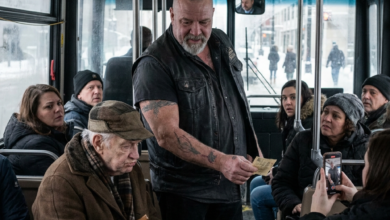
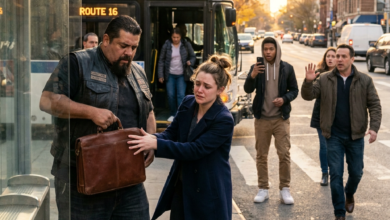
A Biker Ripped a Baby From Her Mother’s Arms at a Route 66 Gas Station — Minutes Later, the Crowd Learned Why He Had Been Watching Their Car
Part 2 — The Man Who Listened to Machines
I first learned Hammer’s full story because he remained at my gas station after everyone else left.
His brothers moved the Ford to a fenced service yard behind Red Mesa Fuel. The yard had not held a working mechanic in twelve years, but the old inspection pit remained usable, and my father’s rusted tool cabinets still stood against one wall.
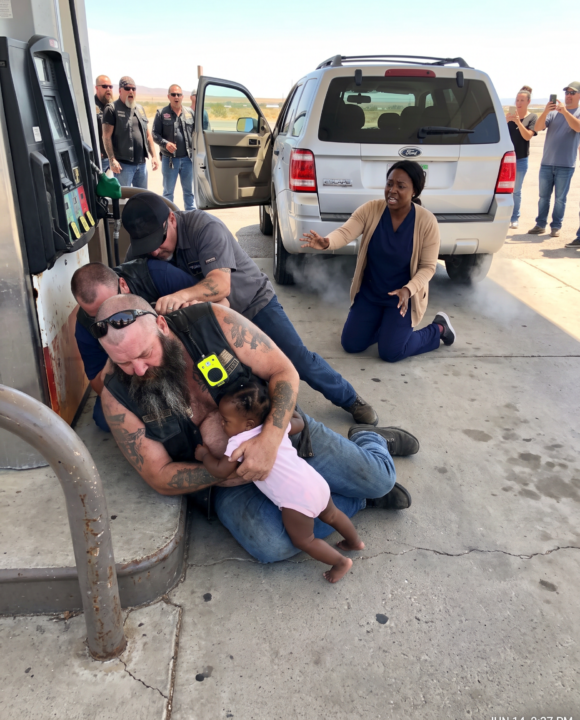
Hammer asked permission before touching anything.
That surprised me.
A man who had ripped a child from her mother without asking now waited for my approval before opening a drawer of wrenches.
“Take what you need,” I said.
He nodded once.
Hammer had spent thirty-one years repairing municipal trucks, tour buses, motorcycles, farm equipment, and the kinds of family cars that arrived at his garage held together by wire and desperate promises. He could identify a failing wheel bearing by its rhythm and a cracked manifold by the pulse of air against his knuckles.
His hearing was damaged from engines and military artillery.
His listening was not.
The six riders with him belonged to the Iron Mercy Riders, a small Arizona club made up of mechanics, veterans, nurses, and two men who had once spent more time behind bars than they cared to explain.
Bear Collins was the president. He was a sixty-two-year-old Black American veteran with a gray goatee and a left leg stiffened by a roadside explosion outside Mosul.
The youngest rider, Cody Mills, was twenty-seven and still considered a prospect. Cody had been the first brother to charge toward the men pinning Hammer.
Hammer stopped him with two words.
Stand down.
Later, Cody kicked an empty bucket across the yard.
“They were punching you.”
“They thought I had the kid.”
“You did have the kid.”
“That’s why they punched me.”
Cody looked unconvinced.
Hammer slid beneath the Ford.
“You want to help me, get that light.”
That was how he handled anger. He gave it work.
The Ford’s underside told a longer story than the dashboard mileage. The exhaust flex pipe had separated behind the catalytic converter. A previous owner had wrapped it with thin repair tape, which burned through. One rear floor plug was missing, and the weather seal around the hatch had collapsed along the lower edge.
With the windows raised and the engine idling, fumes could enter from three places.
The air-conditioning problem made everything worse. Nia kept the vehicle running for Ivy, but the weak blower fan pushed less fresh air into the cabin while exhaust collected below.
Hammer photographed every defect for the sheriff and fire department.
Then he opened the folded estimate from the passenger seat.
The repair shop in Phoenix had identified only the exhaust pipe. The quoted price included an entire assembly Nia did not need, four hours of labor, and several charges Hammer described with words I will not repeat.
Bear read the estimate over his shoulder.
“Can we patch it?”
“No.”
“She might not have eighteen hundred.”
“She doesn’t need eighteen hundred.”
“What does she need?”
“A pipe, two hangers, a floor plug, a hatch seal, blower resistor, and time.”
Bear glanced toward the dark highway.
“We have the veterans’ delivery.”
“I know.”
“If the storm reaches Flagstaff first, the pass closes.”
“I know.”
This was the moment their brotherhood was tested.
The supplies strapped to their motorcycles mattered. Thirty veterans were waiting for thermal blankets, boots, and replacement batteries for medical devices. Staying in Kingman might protect one family while delaying help for dozens of others.
Hammer would not order them to remain.
Bear would not order him to leave.
Finally, they divided the work. Three riders continued to Flagstaff with the supplies. Bear, Cody, and a retired mechanic named Lobo remained with Hammer.
Before departing, each rider removed cash from his wallet and placed it inside an upside-down hubcap.
Nobody counted it.
The V-twins faded westward beneath the darkening sky.
Hammer began removing the damaged exhaust.
At the hospital, Nia regained consciousness beneath an oxygen mask. Her first question was not about the biker.
It was about Ivy.
The baby’s blood oxygen reading improved quickly, but a test confirmed carbon monoxide exposure. Doctors kept both of them overnight for observation.
A deputy explained what happened.
Nia refused to believe him.
“The man took her.”
“He removed her from the fumes.”
“He wouldn’t give her back.”
“He gave her to a bystander while he pulled you away from the vehicle.”
Nia remembered only fragments: the alarm from the yellow detector, a leather vest, huge hands closing around Ivy, and strangers shouting.
Fear had recorded one version.
The security camera recorded another.
The deputy showed her the video.
Nia watched Hammer turn his body over Ivy as three men drove him into the concrete. She watched him catch the back of her cardigan before her head struck the ground.
Then she saw the moment that made her cover her mouth.
After handing Ivy to the paramedic, Hammer touched the baby’s bare foot with one scarred finger.
Not to wake her.
To make sure she moved.
Nia asked for his name.
The deputy told her.
“Why was he carrying a gas detector?”
Nobody at the hospital knew.
Back at the service yard, I asked the same question.
Hammer stopped turning the wrench.
A small yellow monitor rested beside his shoulder. Its plastic case had been repaired with black tape, and the date written on the back had faded almost completely.
September 14, 2007.
Beneath the date was one name.
Mia.
Hammer slid farther under the vehicle until the Ford hid his face.
“Old habit,” he said.
Bear looked at me and shook his head gently.
It was not an old habit.
It was a memorial that still had batteries.
Part 3 — Nine Minutes Inside a Blue Station Wagon
Hammer had been thirty-seven when Mia died.
He told me the story in pieces while working beneath Nia’s Ford, never delivering it as a speech and never stopping long enough to invite sympathy.
His socket wrench clicked.
His boots shifted against the concrete.
One piece emerged at a time.
Mia Dawson was seven years old, small for her age, missing one front tooth, and convinced every broken machine could be repaired if her father owned a large enough hammer.
That joke gave Ray Dawson his road name.
Before Mia, he had been called Dawson or, less politely politely, the drunk mechanic from Bay Three.
He drank during lunch, after work, and sometimes before breakfast. He could rebuild a transmission while sober and ruin the same transmission after three bourbons. His wife, Karen, left twice and returned once.
Mia never stopped waiting for him.
On September 14, 2007, Karen asked Hammer to repair the exhaust on her blue station wagon. She heard rattling beneath the floor and smelled fumes whenever she stopped at traffic lights.
Hammer promised to inspect it.
Then the club called.
One brother had been arrested after a fight in Yuma. Hammer spent the afternoon finding bail money and the evening at a bar explaining why the fight had not been the brother’s fault.
Karen called three times.
Hammer silenced the phone.
The next morning, Karen drove Mia to a pediatric clinic in Phoenix. Traffic stopped beneath an underpass after a truck overturned ahead of them. The temperature reached 102 degrees, so Karen kept the engine and air conditioner running.
The broken exhaust pipe released fumes beneath the passenger compartment.
A failed hatch seal pulled them inside.
Karen became confused first. She believed she was simply overheated. Mia complained that her head hurt, then curled against the window.
A highway patrol officer noticed the station wagon drifting forward after traffic began moving. He opened the door and found both mother and daughter unconscious.
Karen survived.
Mia did not.
Nine minutes.
That was the estimate in the fire report. Nine more minutes inside the vehicle after Mia stopped responding.
Hammer arrived at the hospital still smelling of alcohol.
Karen stood in the corridor and struck him with both hands until a nurse pulled her away. Hammer never defended himself.
He had heard the exhaust rattle two days earlier.
He had smelled the fumes.
He had known.
After the funeral, Karen placed Mia’s child-sized oxygen mask, her small red toolbox, and Hammer’s unopened bottle of bourbon on his workbench.
Then she left for the final time.
Hammer did not ride for eleven months.
He stopped drinking because Bear and Lobo took turns sleeping on his garage floor. They poured alcohol from his cabinets and kept the bathroom door unlocked when the shaking became dangerous.
On the fifth night, Hammer tried to throw them out.
Bear sat in front of the door.
“You can hate us tomorrow.”
Lobo handed Hammer water.
“Tonight, breathe.”
That word stayed.
Breathe.
When Hammer returned to work, he took every exhaust complaint first. He bought the yellow detector. He began carrying it inside his vest whenever he rode, along with Mia’s oxygen mask and a photograph of her holding a grease-covered wrench.
He also made a rule at his garage.
Any exhaust leak threatening the passenger compartment of a vehicle carrying a child would be repaired, whether the family could pay or not.
His business partner objected.
Hammer bought him out.
His accountant objected.
Hammer sold a second motorcycle.
Over nineteen years, he repaired 214 vehicles under that rule. Sometimes customers paid later. Some left groceries, handmade blankets, or thank-you cards. Many disappeared because poverty makes gratitude feel like another debt.
Hammer kept no list of what they owed.
He kept a list of their children’s names.
Ivy became number 215.
Near midnight, Nia called my gas station from the hospital. She had found the number on her fuel receipt and wanted to know whether her Ford was still there.
“It’s safe,” I told her.
“Did the police tow it?”
“A biker did.”
Silence followed.
“The same man?”
“Yes.”
“Why?”
“He says it isn’t safe to drive.”
“I know it needs work.”
“He knows too.”
Nia’s voice hardened.
“Tell him not to touch it. I can’t pay him.”
I glanced through the office window. Hammer was welding a new section of exhaust pipe while Bear shielded the fuel system with a fire-resistant blanket and kept an extinguisher within reach. The Ford had been properly moved to the service area, its battery disconnected and its fuel risk assessed before any hot work began.
“I don’t think he plans to charge you.”
“Nobody works free.”
“He does tonight.”
Nia began crying so quietly I almost missed it.
Her husband, Marcus, had died seven months earlier when a delivery truck crossed the median outside Mesa. He had handled their money, repairs, rent, and insurance. After his death, Nia discovered late bills, a nearly empty savings account, and a vehicle needing more work than its value justified.
She studied nursing at night while working as a home health aide. The Kingman interview offered stable hours and health insurance.
She could not miss it.
She could not afford the repair.
So she circled the estimate and wrote after first paycheck.
“I thought opening the windows would be enough,” she said.
Carbon monoxide had no smell, and open windows were no guarantee, especially when fumes were drawn toward a damaged hatch. Nia had smelled exhaust before but believed it was coming from traffic.
She had made a mistake.
Hammer had once made the same mistake.
The difference was that he happened to be standing at Pump Six when hers began demanding payment.
At 1:24 a.m., the new exhaust section was installed. The floor opening was sealed with the correct plug. The hatch weather strip came from a salvage yard in Bullhead City, delivered by a mechanic who had received Bear’s call and driven seventy miles after closing.
They repaired the blower circuit next.
Then Hammer placed the detector inside the Ford, closed the doors, and ran the engine outdoors under controlled test conditions.
We watched the yellow display.
The number remained low.
Hammer waited longer.
Still safe.
Cody smiled for the first time all night.
“We did it.”
Hammer opened the driver’s door.
“No.”
Cody’s face fell.
Hammer pointed toward the rear seat.
The child safety seat moved nearly four inches when he pulled it.
Its lower anchor strap was twisted. One latch connector had never locked. Nia had probably reinstalled it hurriedly after cleaning the vehicle.
Cody sighed.
“I’ll get the manual.”
Hammer nodded.
The exhaust was repaired.
The work was not finished.
Part 4 — The Envelope Under the Baby Seat
At 7:40 the next morning, Nia returned to Red Mesa Fuel in a hospital transport van with Ivy sleeping against her shoulder.
She looked smaller than she had beside the pump.
Her navy scrubs were wrinkled. A white hospital bracelet circled one wrist, and adhesive marks remained beneath her nose where the oxygen tubing had rested.
Hammer was asleep in a metal chair near the service bay.
His arms were folded across his chest. Dried blood darkened the corner of his split lip, and a purple bruise spread beneath his left eye where Paul had struck him.
Mia’s oxygen mask rested in his open palm.
Nia stopped ten feet away.
“That’s him?”
I nodded.
She handed Ivy to the van driver, walked into the yard, and slapped Hammer across the face.
The sound woke everyone.
Bear stepped forward. Cody swore under his breath. Hammer’s eyes opened, but he did not raise his hands.
Nia’s palm remained suspended between them.
“That was for taking her.”
Hammer nodded.
Then Nia covered her mouth.
“And this is for saving her.”
She leaned against him and began sobbing.
Hammer did not hug her immediately. He looked toward Bear as if the club president might provide instructions for a situation no repair manual covered.
Bear only lifted one eyebrow.
Hammer placed one arm around Nia.
His hand nearly covered her entire back.
“I’m sorry I scared you,” he said.
Nia pulled away.
“You could have said something.”
“You were falling.”
“You could have explained.”
“They were hitting me.”
That earned the smallest broken laugh from her.
Hammer took Nia to the Ford. He explained the replaced pipe, hangers, floor plug, weather seal, blower resistor, and child-seat installation. He showed her the detector readings and warned her to have the vehicle inspected again if she ever smelled exhaust, heard a new rattle, or experienced unexplained headache, nausea, dizziness, or confusion.
He did not describe the work as a permanent miracle.
He described it as a repair that needed follow-up.
Nia looked at the new parts.
“How much?”
“Nothing.”
“I can pay something next Friday.”
“No.”
“I’m not asking for charity.”
“Good. I’m not offering charity.”
“What are you offering?”
“A safe ride.”
She opened her purse anyway.
Hammer closed it with two fingers.
That was when Cody brought out the envelope.
They had found it beneath the loose child seat while cleaning the floor. It was sealed, folded twice, and addressed in handwriting different from Nia’s.
For Nia—when you finally let someone help.
She recognized Marcus’s handwriting.
Nia sat on the Ford’s rear bumper.
Her husband had hidden the envelope before his death, perhaps after noticing the vehicle’s problems. Inside were six hundred dollars, a towing-company business card, and a short letter.
Nia read silently at first.
Then her lips stopped moving.
She handed the page to me.
Marcus had written it during a period when his delivery work required frequent travel. He apologized for hiding bills and pretending their finances were better than they were. He had planned to use the money to repair the Ford, but he wanted Nia to keep it if an emergency happened first.
The last paragraph contained a name.
Ray Dawson.
Marcus wrote that if the Ford ever developed an exhaust problem and Nia could not reach him, she should call Hammer’s garage outside Phoenix.
“He won’t remember me,” Marcus had written. “But years ago, when my mother’s van broke near Gila Bend, he repaired it without charging us. I promised I would repay him when I could. He told me to help the next stranded family instead.”
Nia looked from the letter to Hammer.
“You knew Marcus?”
Hammer took the page.
His eyes moved across the handwriting twice.
Then he asked, “Tall kid? Red work boots?”
Nia nodded.
“He had a scar under his chin.”
“He fell off a loading dock when he was nine.”
Hammer remembered.
Marcus had been seventeen when his mother’s minivan lost part of its exhaust system during a summer trip. Four younger siblings were inside. Hammer repaired it under his child-safety rule, then gave the family fuel money.
Marcus tried to hand him a watch as payment.
Hammer refused.
Before they drove away, Marcus asked what he could do instead.
“Don’t pass a stopped family,” Hammer had said.
Years later, Marcus became the delivery driver who carried jumper cables, water, and a floor jack behind his seat. Nia said he had stopped so often that she sometimes accused him of searching for trouble.
After Marcus died, his employer gave Nia a box from his truck.
Inside were seven thank-you notes from stranded drivers.
Hammer folded Marcus’s letter carefully.
“I remembered the boots,” he said.
Nia stared at the repaired Ford.
“You didn’t know this was his car when you grabbed Ivy?”
“No.”
“Then why us?”
Hammer looked at the baby.
“Because she went quiet.”
The hidden envelope did not explain why he saved them.
It revealed how one repair had traveled through a family for seventeen years before returning to the same mechanic at Pump Six.
Nia tried to give Hammer the six hundred dollars.
He refused again.
She pushed the envelope against his chest.
“For the parts.”
“Parts are handled.”
“For your time.”
“Time’s handled.”
“Then for the next family.”
Hammer finally accepted it.
He opened the upside-down hubcap where his brothers had placed their money the night before and added Marcus’s six hundred dollars.
Cody looked inside.
“That’s enough for another repair.”
Hammer shook his head.
“Two, if you quit buying new parts when salvage works.”
Cody smiled.
The money had already moved forward.
Part 5 — What the Security Camera Could Not Show
By noon, the security footage had spread through Kingman.
One customer posted only the first twelve seconds: Hammer grabbing Ivy, Nia reaching for him, and three men tackling the biker beside the pump.
The caption called him a kidnapper.
It gathered thousands of views before the sheriff’s department released a statement explaining the carbon monoxide emergency. People who had condemned Hammer began deleting comments, though screenshots remained.
A local reporter arrived.
Hammer refused an interview.
She asked whether he wanted to explain why he carried the detector.
“No.”
She asked whether he wanted the men who struck him charged.
“No.”
Paul, the construction worker who threw the first punch, returned to apologize. He stood at the edge of the service yard holding a bag of ice and could not meet Hammer’s eyes.
“I thought you were taking her.”
“You thought right.”
Paul looked up.
“What?”
“I took her.”
“You saved her.”
“Both can be true for five seconds.”
Paul offered the ice.
Hammer pressed it against his cheek.
“You hit hard.”
“I’m sorry.”
“Good.”
That was all.
The security camera showed the violence clearly, but it could not show the details that mattered most.
It could not show Hammer smelling burned exhaust beneath gasoline fumes.
It could not show Nia’s confusion before she collapsed.
It could not show the moment Ivy’s crying stopped or the reason Hammer’s entire body changed when silence replaced it.
The camera also could not show Mia.
She existed inside his reaction.
Every second from 2007 returned at once: Karen’s unanswered calls, the blue station wagon, the oxygen mask, the doctor lowering his eyes, and a little girl who had trusted her father to fix broken machines.
Hammer did not confuse Ivy with his daughter.
He understood the difference.
Mia could not be rescued again.
Ivy could.
That knowledge made him move before politeness, reputation, or self-protection had time to interfere.
Bear told me Hammer had done that for years.
He once shattered the window of a locked pickup when a sleeping toddler remained inside during August heat. The parent threatened him with a tire iron until firefighters arrived.
He shut down a charter bus outside Tucson after his detector alarmed near the rear seats. The company tried to have him arrested for interfering with transportation. Mechanics later found a cracked exhaust manifold and holes in the luggage compartment seal.
He followed a family for twelve miles near Flagstaff because their minivan’s tailpipe had collapsed beneath the rear bumper. When they stopped, the father assumed the bikers wanted trouble.
Hammer handed him a detector.
The display ended the argument.
People often apologized afterward.
Hammer never made those apologies easy.
He did not say it was fine when it was not. He did not comfort people by pretending their fear had been unreasonable.
A six-foot-four tattooed stranger reaching for a child should frighten a parent.
He simply hoped the facts caught up before fists did.
Nia asked whether she could see Mia’s photograph.
Hammer removed it from inside his vest.
The picture showed a seven-year-old girl in oversized safety glasses, holding a small wrench beside the blue station wagon. Grease marked her nose. Two missing teeth interrupted her grin.
Nia studied it for a long time.
“She looks like she trusted you.”
“She did.”
“You were her father.”
“I still am.”
That was the longest sentence Hammer spoke about grief.
Nia returned the photograph, then removed Ivy’s pink sock. The hospital staff had written the child’s name and date on it after cutting off the other sock to attach a monitor.
She folded it beside Mia’s oxygen mask.
“For your vest,” she said.
Hammer shook his head.
“It belongs to her.”
“She has another one.”
“It belongs to you.”
Nia pressed the sock into his hand.
“Then carry it until another baby needs you to remember.”
Hammer looked toward Bear.
Again, Bear offered no rescue.
Hammer slipped the tiny sock into the inner pocket beside Mia’s photograph.
The contradiction would have looked absurd to anyone passing the yard: a 285-pound biker with skull rings, scarred knuckles, and neck tattoos carefully smoothing a pink baby sock inside his leather vest.
Nobody laughed.
Before Nia left, Hammer installed a carbon monoxide alarm in the Ford. He showed her how to test it and explained that the device was an extra warning, not a substitute for inspection and proper repair.
Bear placed another alarm in her diaper bag.
Cody filled the fuel tank.
Lobo checked the tires, then discovered one had exposed cord along the inner shoulder. The damage was nearly invisible from outside.
Nia closed her eyes.
“How much now?”
Lobo pointed toward the hubcap.
“Marcus already paid.”
They installed two safe used tires from a nearby shop and aligned the front end. Hammer replaced a loose battery terminal. Cody repaired the rear door latch. Bear removed a broken piece of plastic from the child-seat anchor.
Each problem had been small enough to postpone.
Together, they had made the Ford unsafe.
That was how danger often entered a struggling family’s life. Not as one dramatic failure, but as six ordinary expenses arriving before one paycheck.
At 2:15, Nia fastened Ivy into the correctly secured seat. She pulled hard on the base, exactly as Hammer had shown her.
It barely moved.
Hammer stood beside the open door.
Nia looked up at him.
“You saved both of us.”
Hammer shook his head.
“Baby warned me.”
“How?”
“She stopped crying.”
Ivy stared at his beard.
Then she reached out and grabbed it.
Hammer winced but did not pull away.
For the first time since the ambulances left, Nia laughed without breaking.
Part 6 — The Detector Beside Pump Six
Nia got the nursing-home job.
She arrived forty minutes late wearing yesterday’s scrubs, a hospital bracelet, and an explanation her interviewer initially thought was impossible. The sheriff confirmed the emergency.
She began work the following Monday.
Three weeks later, she returned to Red Mesa Fuel with Ivy and a cardboard box. Hammer was not there, so she left the box with me.
Inside were twelve portable carbon monoxide alarms, each purchased from her first paycheck. A note asked me to give them to families driving older vehicles with children.
I called Hammer.
He said, “Put one behind the counter.”
“What about the others?”
“You’ll know.”
He was right.
Within two months, we gave one to a grandfather whose van smelled of exhaust, another to a pregnant woman living temporarily in her SUV, and two to a family towing an old camper toward California.
The yellow detector stayed beside my register.
Whenever it alarmed near a vehicle, I moved people away and called trained emergency responders or mechanics. I did not crawl beneath running cars or guess at repairs.
Hammer had taught us urgency without recklessness.
The Iron Mercy Riders began stopping at Red Mesa on the first Saturday of every month. They set up folding tables in the service yard and inspected exhaust systems, tires, child-seat anchors, battery cables, and exterior lights for families referred by local shelters.
No labor charge.
Parts came from donations, salvage yards, and the upside-down hubcap.
Paul, the man who punched Hammer, became one of the volunteers. He was a welder by trade and rarely missed a Saturday. Hammer never mentioned the fight, though he occasionally handed Paul a stubborn bolt and said, “Hit this instead.”
Nia brought coffee.
Ivy brought noise.
When she learned to walk, her first destination in the yard was always Hammer’s Harley. He taught her to touch the cool leather seat but never the engine or exhaust.
At two years old, she could point to the yellow detector and say, “Breathe.”
Hammer kept her pink hospital sock inside his vest.
Mia’s oxygen mask remained beside it.
The blue station wagon photograph stayed closest to his heart.
Once a year, on September 14, Hammer parked his Harley at Pump Six and shut down the engine at 4:17 in the afternoon. Bear, Lobo, and Cody stood with him.
No speeches.
Just silence.
Then Ivy usually broke it.
Hammer never seemed bothered.
The ritual was not built for quiet.
It was built for breath.
Part 7 — The Car That Left With Two Heartbeats
Three years after the incident, Nia replaced the Ford.
The repairs Hammer and his brothers made had kept it safe, but age continued collecting its debts. The transmission began slipping, rust spread along the frame, and the air conditioner finally stopped completely.
Nia drove it to Red Mesa one last time.
She was wearing clean nursing scrubs and a supervisor’s badge. Ivy sat behind her in a newer child seat, singing to herself and kicking both shoes against the cushion.
Hammer inspected the Ford.
“It’s done,” he said.
Nia placed one hand on the hood.
“I know.”
The vehicle went to a training program at a community college, where students removed every usable safe component before recycling the frame. Nia asked for only one part back.
The old exhaust section Hammer had replaced.
She cleaned it, mounted it on a wooden board, and hung it inside the nursing home’s employee entrance with a small brass plate beneath it.
The plate did not mention heroism.
It read:
LISTEN WHEN SOMETHING CHANGES.
Hammer disliked the attention but accepted the wording.
The following September, Nia and Ivy joined the riders at Pump Six. Ivy was four, curious, loud, and completely unafraid of the enormous tattooed man whose beard she had once grabbed.
At 4:17, Hammer shut down his Harley.
The V-twin fell silent.
Traffic moved along Route 66. Wind pushed a paper cup across the concrete. Somewhere near the service yard, a loose sign tapped against its post.
Hammer removed Mia’s photograph from his vest.
Then he took out Ivy’s tiny pink sock.
The fabric had faded. The hospital ink was barely visible.
Ivy looked at the photograph.
“Is that your little girl?”
Hammer nodded.
“Where is she?”
“Not here.”
Ivy considered his answer.
Then she placed her hand inside his scarred palm.
“I’m here.”
Hammer’s jaw tightened.
He did not cry. At least, not where any of us could accuse him of it.
He crouched beside Ivy and showed her the yellow detector. She pressed the test button, and the alarm sounded beneath the gas-station canopy.
Three years earlier, that noise had been buried beneath screaming, accusations, fists, and the terror of a mother watching a stranger take her child.
Now everyone understood it.
Warning.
Memory.
A second chance arriving loudly.
When the test ended, Hammer clipped the detector back inside his vest. Nia hugged him, Ivy climbed into her safe new car, and the Iron Mercy Riders started their engines one by one.
Before leaving, Hammer checked the rear seat through the open window.
Ivy waved.
The car pulled onto Route 66 carrying a mother, a child, and two strong heartbeats that had nearly gone quiet beside Pump Six.
Hammer waited until its taillights disappeared.
Then his Harley followed.
Drop BREATH in the comments and follow the page for more stories about frightening-looking bikers who quietly protect strangers on America’s roads.