Part 2: An Elderly Woman Dropped Her Wedding Ring Into a Stranger’s Coffee—But the Biker Recognized the Burned Inscription His Brother Had Worn Forty Years Earlier
Part 2 — The Empty Stool Every October
My name is Mara Finch, and I have owned the Starlight Diner for sixteen years.
The building sits on a tired stretch of U.S. Route 40 where truck traffic thinned after the interstate opened. Our neon sign loses its second “T” whenever the weather turns cold, the booths still carry cigarette burns from the 1970s, and the coffee tastes better than the building looks.
The remains of the Hillside Motor Lodge stand across the road.
Only its stone foundation, chimney, and rusted roadside sign survived the 1985 fire. Weeds cover most of the property now, but every October, someone leaves flowers beside the cracked entrance steps.
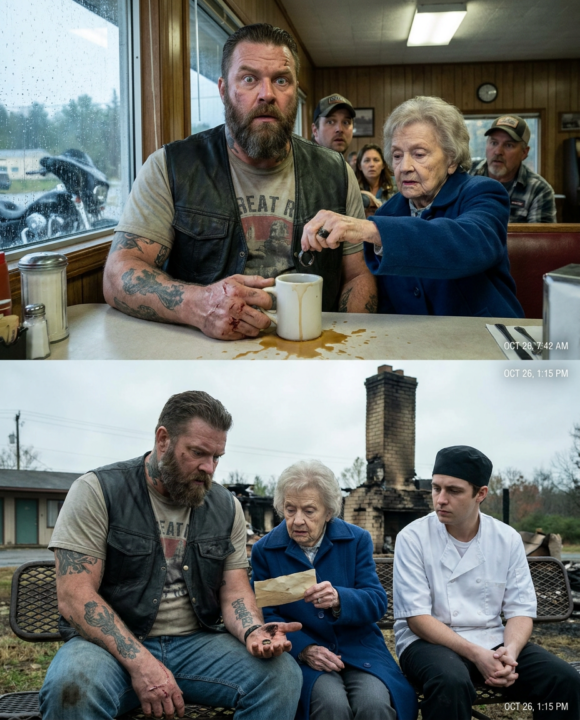
For years, I assumed Ray left them.
He did not.
Ray “Hammer” Dawson first entered my diner during a sleet storm in 2010. He wore black leather, carried no umbrella, and filled the doorway so completely that two teenage waitresses disappeared into the kitchen.
He ordered coffee.
Then he repaired our broken back-door closer without being asked.
That was how Ray moved through the world. His appearance warned people away, but his hands constantly fixed what others had stopped noticing.
He adjusted loose chairs.
He changed flat tires.
He paid for strangers’ breakfasts and threatened to deny it if thanked.
The Iron Lanterns, his riding brothers, met at the Starlight on the first Saturday of every month. They occupied three booths, drank enough coffee to poison ordinary men, and left the tables cleaner than they found them.
Every October 18, however, Ray came alone.
He sat facing the motel ruins.
At 7:26, he left.
The first time I asked about it, Tiny Ruiz, one of the Lanterns, shook his head.
“Brother date.”
I understood enough not to ask again.
Michael “Mick” Dawson was six years older than Ray. Their father disappeared when Ray was nine, leaving Mick to become brother, mechanic, protector, and whatever passed for a parent between two angry boys.
Mick taught Ray to rebuild carburetors before Ray could legally drive. At fourteen, he put Ray on the back of a 1968 Harley FLH and told him to keep his boots away from the pipes.
At sixteen, Ray stole that motorcycle.
Mick found him three towns away, sleeping beside it at a gas station. He did not hit him. He sat on the curb, handed Ray a bottle of water, and asked one question.
“You running from something or toward it?”
Ray had no answer.
Mick rode home behind him.
That became their arrangement. Ray made mistakes. Mick followed at a distance close enough to help but far enough to let his younger brother believe he was choosing the road.
When Mick married June Halpern in 1975, Ray served as best man. Their wedding cost eighty-seven dollars. June wore a secondhand dress, Mick wore motorcycle boots beneath rented pants, and both wedding bands came from a Wheeling pawnshop.
Inside Mick’s ring, June had engraved:
JUNE + MICK — ALWAYS HOME.
Ten years later, the Hillside Motor Lodge burned.
The official story appeared in newspapers across the state. Mick Dawson, off-duty volunteer firefighter and local motorcyclist, entered the second floor before emergency crews arrived. He rescued Eleanor Whitmore, a thirty-eight-year-old bookkeeper traveling home from Pittsburgh.
Witnesses said Mick returned to the building.
Nobody knew why.
The roof collapsed at 7:26 a.m.
Ray was twenty-three and living in Texas after a bitter argument with his brother. Their last conversation had ended with Mick telling him to come home.
Ray refused.
Two weeks later, he received a letter from Mick postmarked the morning before the fire. Ray never opened it.
He carried it inside his vest for thirty-nine years.
I learned that only after Eleanor dropped the ring into his coffee.
That morning, as customers quietly returned to their breakfasts, Ray remained at the table with the burned band in one hand and June’s envelope in the other.
“Open it,” Eleanor said.
“No.”
“You need to read what she wrote.”
“June had my address.”
“She sent letters.”
“I never got them.”
“You returned every one.”
Ray’s jaw tightened.
That was true.
After Mick’s funeral, Ray blamed June for accepting the official story, Eleanor for surviving, the fire department for arriving late, and himself for being eleven hundred miles away.
He returned to Texas.
When June wrote, he sent the envelopes back unopened.
Refused.
Return to sender.
Not at this address.
He spent the following decade drinking, fighting, riding, and avoiding every town where someone remembered him as Mick’s little brother.
The Iron Lanterns eventually pulled him back from that edge.
Tiny gave him work. Another rider offered a spare room. Ray stopped drinking and built Dawson Iron Works from a rented two-bay garage.
He repaired his life.
He never repaired the story.
Eleanor slid June’s letter closer.
“Your brother saved me,” she said. “But I’m not why he died.”
Ray stared through the window at the motel foundation.
“Everyone says that when they want forgiveness.”
“I’m not asking for yours.”
“Then why are you here?”
“Because I’m running out of mornings.”
That silenced him.
Eleanor was seventy-eight. Her hands trembled. Beneath her sleeve, I saw the adhesive edge of a hospital band she had tried to hide.
She had not come for absolution.
She had come because forty years was already too long.
Part 3 — Room Twelve
The fire began in the motel laundry room at 6:43 a.m.
An overloaded extension cord ignited a stack of cleaning towels. Flames climbed the wall, reached the wooden ceiling, and traveled through the roof cavity before anyone smelled smoke.
The Hillside Motor Lodge had no sprinkler system.
The smoke alarms on the second floor did not work.
Eleanor occupied room twelve.
At thirty-eight, she was married to a traveling salesman named Harold Whitmore and eight months pregnant with their first child. She had driven to Pittsburgh for a bookkeeping seminar, but freezing rain forced her to stop overnight outside Wheeling.
Harold planned to meet her for breakfast.
He never arrived.
When Eleanor woke, black smoke had filled the hallway. Heat had warped the room’s metal door. She tried the window, but paint sealed it shut.
She screamed.
Outside, Mick Dawson was riding home from a night repair shift when he saw flames pushing through the motel roof. He laid his Harley on its stand, ran across Route 40, and entered before the first fire engine arrived.
A desk clerk pointed him toward room twelve.
Mick covered his face with a wet towel, climbed the exterior stairway, and forced the door open with a tire iron from his saddlebag.
He found Eleanor on the bathroom floor.
The heat had already blistered the paint. Smoke rolled beneath the ceiling in thick waves, turning morning into darkness.
Mick wrapped Eleanor in a motel blanket and dragged her toward the stairs.
Halfway down, she fought him.
“My husband,” she kept saying.
Mick believed she was disoriented.
Then Eleanor showed him the second room key clenched in her hand.
Harold had arrived early.
He had entered the adjoining room eleven shortly before the fire spread. The connecting door between their rooms had locked behind him when he went to retrieve her luggage.
Nobody knew he was inside.
The motel register listed Eleanor alone.
Mick carried her to the parking lot.
She grabbed his leather jacket.
“Harold’s in eleven.”
Mick looked at the flames.
Sirens sounded somewhere beyond the hill, still several minutes away.
A bystander tried to hold him.
Mick broke free.
Before returning to the stairs, he removed his wedding ring.
His fingers had swollen from heat, and the band had begun cutting into the skin. He pushed it into Eleanor’s palm.
“Give this to June if I don’t walk out.”
Eleanor closed her fist around it.
Mick went back inside.
That should have been the entire story.
It was not.
The first fire engine arrived as he reached room eleven. Firefighters ordered everyone away from the building. The second-floor walkway was failing, and flames had spread beneath the roof.
Mick found Harold unconscious beside the connecting door.
He could not carry him down the burning exterior stairs.
Instead, Mick pulled him toward the rear bathroom, broke the small window, and shouted to firefighters below.
They raised a ladder.
Harold came out first.
He was alive.
Mick never reached the window.
Part of the ceiling collapsed between him and the opening. Firefighters heard him moving inside, but the room flashed over before they could climb back.
The roof came down at 7:26.
Harold survived with severe burns and smoke injuries.
Yet the official report mentioned only Eleanor.
Ray turned toward her when she reached that part.
“You’re lying.”
“No.”
“No second survivor was listed.”
“Harold asked not to be.”
“Why?”
Eleanor looked down.
Because Harold had not come to reconcile with his pregnant wife.
He came to leave her.
The luggage he entered the motel to retrieve was his own. He had spent the night in Wheeling with another woman and planned to confess before Eleanor drove home.
After the rescue, Harold begged to keep his name out of the papers. He feared the story of his betrayal would reach his employer, his family, and the married woman involved.
Eleanor was injured, pregnant, and terrified.
She agreed.
The motel clerk amended his statement. Harold claimed he had been a bystander overcome while trying to help. The volunteer fire chief simplified the report amid confusion, and newspapers repeated the cleanest version:
Biker Dies Saving Pregnant Woman.
Mick’s attempt to save Harold disappeared.
Ray struck the table with the side of his fist.
The coffee cups jumped.
Customers looked over.
“He died for a man who was abandoning you?”
Eleanor did not defend Harold.
“Yes.”
“And you protected him?”
“For two months.”
“Forty years.”
“I told June.”
Ray froze.
Eleanor returned Mick’s ring to June three days after the funeral. She also revealed Harold’s rescue and begged her to correct the public record.
June refused.
Not because she wanted Harold protected.
Because she wanted Ray protected.
Ray already blamed himself for missing Mick’s last calls. If he learned his brother had died saving a man who lied, betrayed his wife, and erased himself from the story, June feared Ray would hunt Harold down.
At twenty-three, furious and drinking, he might have.
June made Eleanor promise to remain silent until Ray was ready.
“How was she supposed to know?” Ray asked.
“She said you’d come home when anger stopped being the only thing you carried.”
Ray looked at the unopened letter inside his vest.
Forty years had passed.
He still carried it.
Eleanor touched the hospital band beneath her sleeve.
“My heart surgery is Monday,” she said. “June is gone. Harold is gone. Everyone who made that promise is dead except me.”
“Then you should’ve taken it with you.”
“I considered it.”
“Why didn’t you?”
Eleanor pointed toward the scarred ring on the napkin.
“Because Michael didn’t die saving a good man.”
Her voice hardened.
“He died because the man was still alive.”
Ray stood.
He picked up the ring, left June’s letter unopened, and walked toward the diner door.
Outside, the Road King waited beneath the rain.
Tiny Ruiz and six Iron Lanterns had just pulled into the parking lot for breakfast.
They saw Ray’s face.
They saw Eleanor.
Then they saw the ring in his hand.
Tiny stepped between Ray and the motorcycle.
“Brother,” he said, “you ain’t riding like this.”
Ray’s eyes narrowed.
“Move.”
“No.”
It was the first time I had seen an Iron Lantern refuse him.
The diner went silent again.
Part 4 — The Letter Ray Carried Unopened
Ray could have moved Tiny aside.
He outweighed him by nearly ninety pounds.
Instead, the two bikers stood beneath the diner awning while rain struck the parking lot and the Road King’s chrome reflected gray morning light.
Tiny folded his arms.
“You ride angry, you ride alone.”
“I am alone.”
“No, brother.”
Ray’s jaw shifted.
Tiny held out one hand.
“Keys.”
Ray did not move.
Behind them, five Lanterns quietly positioned their motorcycles around the Road King—not threatening Ray, but making it impossible to leave without forcing the issue.
Brotherhood was being tested.
This time, loyalty meant blocking the road.
“Give Mara your keys,” Tiny said. “Read the letter.”
“You don’t give me orders.”
“Today I do.”
For several seconds, only the rain spoke.
Then Ray removed the key from his pocket and placed it in my palm.
We returned inside.
Eleanor sat exactly where he had left her. June’s smoke-stained envelope remained beside the coffee mug.
Ray lowered himself into the booth.
He pulled a second envelope from the inner pocket of his vest.
It was yellowed, cracked at the folds, and softened by four decades of sweat and road heat. Across the front, in Mick’s handwriting, were the words:
RAY — GET YOUR STUBBORN SELF HOME.
“You still have his letter?” Eleanor asked.
“Never opened it.”
“Why?”
Ray looked toward the motel ruins.
“Because unopened meant he was still waiting.”
That was the truth beneath forty years of anger.
As long as the letter remained sealed, Mick’s last words had not yet become final. They were still traveling. Ray was still the younger brother who might turn his Harley east and arrive home before breakfast.
Opening it would end the road.
Eleanor slid June’s envelope aside.
“Read Michael first.”
Ray’s scarred thumb moved beneath the flap.
The old adhesive released with almost no resistance.
Inside was a single sheet of repair-shop invoice paper covered in Mick’s uneven block writing.
Ray read silently.
His face remained hard until the fourth line.
Then his right hand began to shake.
He passed the letter to me.
Mick had written the day before the fire. He apologized for their argument and admitted he had tried to become Ray’s father when Ray only needed a brother.
He included an offer.
A friend planned to sell a small motorcycle repair shop beside Route 40. Mick wanted Ray to come home and buy it with him. They would call it Dawson Brothers Iron Works.
Near the bottom, he wrote:
If you say no, I’ll ask again. That’s what big brothers are for. June says I should give you space. June married an optimist.
The last line was shorter.
You don’t owe me home, Ray. The door stays open anyway.
Ray read it again.
Then a third time.
All those years, he believed Mick’s final letter contained blame. He had imagined disappointment, anger, and one final demand to return.
Instead, it held an open door.
Ray pressed his thumb against the words.
He did not cry.
But his breathing changed.
Eleanor opened June’s envelope herself and placed the contents on the table.
There was a letter, a small black-and-white photograph, and a pawnshop receipt dated June 14, 1975.
The photograph showed Mick and June outside the county courthouse. Mick had one arm around his bride. Ray, seventeen and thin beneath an oversized suit, stood beside them holding up both wedding bands.
On the back, June had written:
HE BOUGHT THE RINGS. WE GAVE HIM THE RECEIPT SO HE’D REMEMBER HE HELPED START THIS MARRIAGE.
Ray stared at the image.
He had forgotten.
At seventeen, he had spent two months’ wages from a tire shop buying those pawnshop rings. Mick promised to repay him, but Ray refused.
The fire-scarred band Eleanor dropped into his coffee was not merely his brother’s ring.
It was the first meaningful thing Ray had ever given Mick.
June’s letter explained why she later returned it to Eleanor.
After the funeral, June wore both rings on a chain. She kept them together for twenty-one years. When cancer made her begin organizing her affairs, she tried contacting Ray.
Every letter came back.
So she returned Mick’s band to Eleanor with instructions:
If Ray ever learns to sit still long enough to listen, give him the ring. Do not mail it. Do not leave it with anyone. Put it where he cannot pretend he didn’t see it.
Eleanor glanced at the coffee mug.
“I took that part literally.”
A rough sound came from Tiny’s booth.
It might have been a laugh.
Ray almost smiled.
Then he saw the final paragraph.
June had known about Harold.
She knew Mick died trying to save him.
But she did not consider Harold’s betrayal the most important truth.
The important truth was that Mick had entered room eleven without asking whether the trapped person deserved him.
He heard someone was inside.
That was enough.
June wrote:
Do not turn Michael’s last act into a courtroom, Ray. He wasn’t weighing Harold’s character. He was measuring time.
Ray lowered the letter.
The whole diner seemed to wait.
Eleanor asked, “Do you still blame me?”
Ray looked at her for a long moment.
“Some.”
Her expression did not change.
“That’s honest.”
“Blamed you forty years. Ain’t smart enough to stop in one cup of coffee.”
“No.”
He placed Mick’s ring on the table between them.
“But I can start.”
Part 5 — The Second Person Who Walked Out
Eleanor’s story still had one missing piece.
Her son.
The pregnancy survived the fire, and three weeks later Eleanor gave birth to a boy named Michael Whitmore. She chose the name without consulting Harold.
Their marriage ended before the child turned one.
Harold moved west, remarried, and spoke publicly about the motel fire only once. He described himself as a rescuer who had entered the building to help strangers.
Eleanor never corrected him.
Not because she continued protecting him.
Because June asked her not to drag Mick’s sacrifice through a public fight with a liar.
“Did your son know?” Ray asked.
“From the time he was twelve.”
“Where is he?”
Eleanor looked toward the kitchen.
I followed her gaze.
My morning cook, Mike Whitmore, stood beside the grill holding a spatula.
He was thirty-nine, broad-shouldered, quiet, and known for making pancakes shaped like animals when children looked restless. He had worked for me six years.
I had never connected him to Eleanor.
Mike turned off the grill.
He removed his apron, stepped through the kitchen doors, and approached Ray’s booth.
“My mother asked me to wait,” he said.
Ray stared at him.
“You’re named after Mick?”
“Yes.”
“You work here?”
“Because you come here.”
The revelation tightened every face in the room.
Mike had taken the diner job after learning Ray visited each October. Eleanor hoped proximity might create an opening. Yet every year Ray arrived armored in silence, ate alone, and left at 7:26.
Mike never approached him.
“Six years,” Ray said.
Mike nodded.
“You watched me sit here six years?”
“Yes.”
“Why?”
“I wanted to know whether the man my mother feared meeting looked anything like the boy in June’s photograph.”
“And?”
Mike looked at Ray’s tattoos, vest, scarred knuckles, and enormous hands resting around a chipped diner mug.
“You still look like his little brother.”
Ray turned away.
That sentence reached deeper than the letters.
For forty years, people had treated Ray as the surviving Dawson: the harder brother, the angry one, the man who endured. Mike saw the seventeen-year-old who had bought two pawnshop rings and stood proudly beside the courthouse steps.
Eleanor removed another item from her purse.
It was an old cassette tape.
“June recorded this two months before she died,” she said.
Ray did not reach for it.
“What’s on it?”
“Her voice.”
“I figured.”
“She talks about Michael.”
Ray’s eyes remained on the cassette.
“I don’t own a player.”
Mike pointed toward the shelf behind the register.
I kept an old radio-cassette deck for storm warnings and the diner’s collection of country tapes.
Ray looked at me.
“Does that thing work?”
“Most days.”
“That ain’t an answer.”
“It worked yesterday.”
We closed the diner for twenty minutes.
I locked the front door, turned off the neon sign, and placed the cassette in the player. The Lanterns remained in their booth. Customers stayed voluntarily, their breakfasts cooling.
Static filled the room.
Then June spoke.
Her voice was thinner than Ray remembered, but warm. She teased him for avoiding West Virginia, criticized his taste in motorcycles, and said Mick would be furious that his little brother had spent decades drinking diner coffee without learning to add cream.
Tiny smiled into his hands.
June described her final morning with Mick.
He burned toast.
He kissed her forehead.
He complained that Ray had not answered his call but insisted his stubborn brother would come home eventually.
Then June said something not written in either letter.
Mick had not planned to work the night shift on October 17.
He took it for another mechanic whose daughter was sick. If he had gone home at his usual time, he would never have passed the Hillside Motor Lodge during the fire.
For years, June hated that mechanic.
Then she learned he used the free night to take his daughter to the hospital. Doctors discovered a ruptured appendix. The shift Mick accepted had indirectly saved a child before he ever entered the burning motel.
June’s voice wavered on the tape.
“Your brother’s last day was full of people living because he showed up, Ray. Don’t reduce it to the room where he stopped.”
Ray bowed his head.
The tape continued.
June told him she had forgiven Eleanor. She had even forgiven Harold—not because he deserved peace, but because she refused to let him occupy another year of her marriage.
Finally, she spoke about the ring.
“Keep it if you want,” her recorded voice said. “Throw it into the Ohio River if you need. But remember your brother wore it because you bought it. Before the fire marked that band, you did.”
The tape clicked off.
Nobody moved.
Ray picked up the ring.
He slid it onto his smallest finger. Heat had warped it too badly to pass the first knuckle.
Eleanor watched him.
“June said you could throw it away.”
Ray shook his head.
“No.”
“What will you do with it?”
He glanced at Mike.
“Fix what fire bent.”
Mike worked not only as my cook but also as a hobby jeweler. That was another reason Eleanor helped him find the job. He had brought tools and a small wooden box that morning.
Ray placed the ring in his palm.
Mike did not close his fingers.
“It won’t look new.”
“Didn’t ask for new.”
“The fire damage will remain.”
Ray nodded.
“Leave the proof.”
Part 6 — The Ring on the Fuel Cap
Mike spent six weeks repairing Mick’s wedding band.
He cleaned away soot without removing the darkened grooves, eased the warped circle back into shape, and reinforced a thin section from within. The inscription remained faint but readable.
Ray refused to resize it for his own hand.
“It ain’t mine to wear,” he said.
Instead, Mike built a small metal mount for the Road King’s fuel console. The ring sat beneath a clear protective cover directly behind the gas cap, visible whenever Ray looked down.
The fire marks faced upward.
The inscription faced him.
On October 18 the following year, Ray returned to the Starlight at 5:58. This time, he did not sit alone.
Eleanor occupied the opposite side of the booth. Mike brought three cups of coffee. Ray ordered apple pie and actually ate it.
At 7:26, they crossed Route 40 together.
The Hillside property belonged to the county by then. Ray obtained permission to place a small steel bench near the surviving chimney.
No statue.
No heroic plaque.
Just a bench fabricated at Dawson Iron Works from salvaged motel railing.
Its underside carried four names where casual visitors would not see them:
MICHAEL DAWSON.
JUNE DAWSON.
ELEANOR WHITMORE.
MICHAEL WHITMORE.
There was no Harold.
Ray noticed.
“He came out too,” he said.
Eleanor stiffened. “He erased Michael from his story.”
“Don’t mean we erase him from Mick’s.”
She stared at Ray.
The man who had hated Harold without meeting him was now insisting that the second rescue be recorded.
Mike added the name.
Not because Harold had been good.
Because Mick had saved him.
That distinction became the center of everything.
Ray eventually helped Eleanor submit corrected documentation to the county historical archive. The report did not shame Harold or turn the rescue into gossip. It simply recorded that two motel guests survived room eleven and that Michael Dawson helped both reach safety.
The newspaper published a follow-up forty-one years late.
Ray declined an interview.
When asked why, he said, “Brother already did the talking.”
He tapped the ring mounted on his Harley.
Then he rode home.
Part 7 — One Cup, Two Empty Chairs
Eleanor survived her heart surgery.
She lived another five years.
Every Thursday, she sat in the booth nearest the emergency exit and ordered dry wheat toast. Ray joined her when work allowed. They did not become sentimental friends.
Some mornings they argued.
She said he drank too much coffee. He said she tipped poorly. She reminded him that he once hated her. He replied that she once threw jewelry into his breakfast.
Their affection arrived disguised as irritation.
When Eleanor died at eighty-three, Mike held a small service beside the steel bench across Route 40. Ray and the Iron Lanterns stood at the back, their motorcycles silent.
Mike handed Ray the blue wool coat his mother had worn that first morning.
Inside one pocket was a folded napkin from the Starlight.
A brown coffee stain covered one corner. In Eleanor’s handwriting were six words:
HE CAME BACK. JUNE WAS RIGHT.
Ray carried the napkin inside his vest.
The fire-scarred ring remained mounted on his Road King.
Two years later, Mike bought half ownership of my diner. He repaired the neon sign but kept the cracked coffee mug Ray had used on the morning the ring fell.
It sits above the register now.
There is no label beneath it.
Strangers would see only an old mug with a brown stain inside. Those of us who were present remember the sharp clink, the laughter, the overturned assumptions, and the biker whose fist closed around forty years of anger before slowly opening again.
Ray still comes every October 18.
His beard is almost white now, and cold weather makes his left knee stiff. He parks beside the steel bench before sunrise, wipes rain from the clear cover over Mick’s ring, and sits facing the motel chimney.
At 7:26, Mike brings him coffee.
They leave a second cup on the bench.
Not for Harold.
Not for Eleanor.
Not even for Mick.
Ray says it belongs to whoever still hasn’t come home.
When morning traffic begins moving along Route 40, he starts the Harley. The V-twin rumble rolls across the diner windows, across the empty motel foundation, and past the place where a burned wedding ring waited forty years to finish its journey.
Follow our page for more unforgettable biker stories about misunderstood moments, hidden sacrifice, and rugged men carrying promises longer than any highway.