Police Arrived When Twelve Bikers Blocked a Grieving Family From Entering the Funeral Home—Then the First Mourners Stepped Off a City Bus
Twelve bikers blocked the funeral-home entrance while my father’s coffin waited inside, and when my brother called the police, their president said, “His family can enter after the people he asked us to protect.”
I was standing six feet away.
I heard every word.
My name is Sarah Whitmore. I was forty-two that November, a middle-school librarian outside Knoxville, wearing the black dress my father once said made me look too serious for somebody who alphabetized adventure novels.
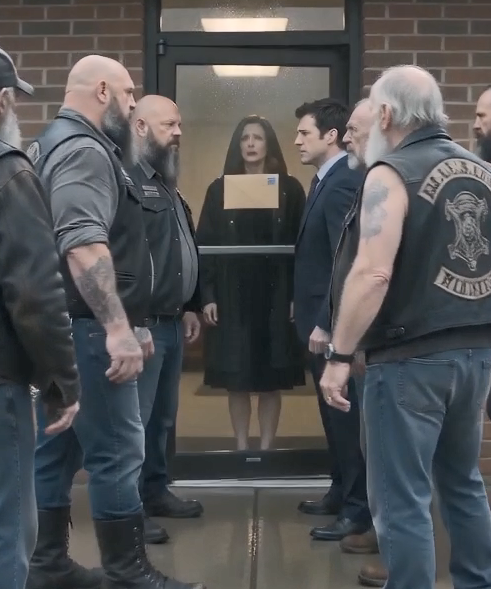
Beside me stood my husband, my younger brother David, two aunts, four cousins, and my father’s only surviving sister. We were his family.
At least, that was what I believed the word meant.
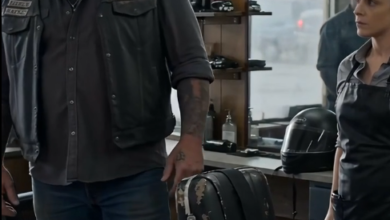
The bikers formed a quiet line beneath the funeral home’s white portico. They were large men in dark leather, gray beards, tattooed forearms and heavy boots wet from the rain. Their motorcycles filled the curb beneath the bare maple trees.
The biggest stood in front.
Six-foot-four, perhaps two hundred eighty pounds, shaved head, thick black-and-gray beard. His plain vest creaked when he folded his arms.
“Move,” David said.
The biker did not.
“The visitation starts at ten.”
“I know.”
“Our father is inside.”
“I know that, too.”
David stepped closer.
I caught his sleeve.
Our father, Harold Whitmore, had died four days earlier at seventy-one. His death had been sudden enough that I still had a voicemail asking whether I wanted him to bring soup on Sunday.
I had not called back.
Now a stranger was deciding when I could stand beside his coffin.
Grief became anger because anger gave us somewhere to put our hands.
The funeral director, Mr. Callahan, appeared behind the glass doors. He looked nervous but did not unlock them.
David pointed at him.
“He hired these people.”
One biker shifted his weight. Another looked toward the street. None threatened us, but their stillness felt like a threat because every one of them was large enough to move us if he chose.
David called the police.
The club president heard him and made no attempt to stop him.
“Good,” he said. “Then everybody can hear the instructions at once.”
“What instructions?” I demanded.
He looked at me.
“Your father’s.”
Before I could answer, a city bus stopped at the corner.
Seven people climbed off.
An older Black man in a patched green coat. A white woman pushing a cart loaded with blankets. A thin Latino man carrying a paper grocery bag against his chest. Two men in work jackets. A woman with a cane. Another man wearing dress shoes without socks.
They walked toward the funeral home slowly.
The woman with the cart stopped when she saw us.
“Are we too late?”
The biker’s expression softened.
“No, ma’am.”
He stepped aside for her.
David moved forward again.
“You’re letting them in?”
The president lowered his voice.
“They’re why we’re standing here.”
The first police cruiser turned into the drive. Its blue lights reflected across the wet motorcycles and the funeral-home windows.
Two officers got out.
The younger one approached us. The older officer watched the bikers’ hands.
“Who called?”
“I did,” David said. “They’re keeping us from our father’s funeral.”
The president reached slowly into his vest.
The officer’s posture tightened.
“Keep your hands visible.”
The biker stopped.
“Letter’s inside left pocket.”
Mr. Callahan unlocked the door just far enough to step out. He was holding an envelope with my father’s handwriting across the front.
My name was on it.
So was David’s.
The funeral director gave it to the officer.
The president said, “Harold reserved the first thirty minutes for people who are usually made to stand outside. He asked us to make sure nobody turned them away.”
David laughed once.
Not because anything was funny.
“Our father was a retired accountant. He barely left his house.”
The man in the patched green coat looked at him.
Then he removed a folded photograph from inside his coat.
It showed my father beneath a highway overpass, kneeling beside a camp stove, pouring coffee into paper cups.
On the back, in my father’s handwriting, were four words:
“My Thursday night family.”
The officer handed me the unopened envelope.
Before I broke the seal, the woman with the cart touched my arm and whispered, “Your father told us you’d be angry—but he said there was something inside that letter you deserved to know.”
Part 2
My father had always hated being late.
He arrived at birthdays before the cake. He waited outside restaurants while the staff was still turning chairs upright. When David graduated from college, Dad reached the auditorium before the previous ceremony had ended and spent ninety minutes pretending he enjoyed the band.
Yet during the last three years of his life, he had missed Thanksgiving twice.
He forgot my birthday once.
He stopped answering on Thursday nights.
Whenever I asked where he had been, he said, “Out.”
That single word became a wall between us.
My mother, Ellen, had died five years earlier after a short illness. Dad cared for her at home through the final months, learning medications, changing sheets and sleeping in a chair beside the bed because she was afraid to wake alone.
After the funeral, everyone praised his devotion.
Then we went home.
He remained in the house where every room still expected her.
At first, David and I called every day. We brought meals. We asked him to stay with us. Dad thanked us, refused most invitations, and began sorting Mother’s belongings at a pace that made no sense.
He donated her shoes but kept old grocery lists.
He gave away the dining table and preserved a chipped mug she hated.
Grief had no system, though my father had spent forty years building systems for everyone else.
He had been a payroll accountant for a regional construction company. He wore pressed shirts, used the same calculator for twenty-seven years, and could detect a missing receipt from across a room.
Nothing about him suggested nighttime trips beneath an overpass.
Nothing except, perhaps, Thursdays.
Mother died on a Thursday.
For months afterward, Dad went missing from his own house every Thursday evening. When I called, he answered late and sounded tired.
I assumed he was drinking.
There was no history of it. No bottles in the trash. No smell on his breath.
Still, suspicion can grow comfortably in the spaces where nobody tells the truth.
David assumed there was a woman.
That possibility made him furious in a way I never understood. He said Dad was disrespecting Mom. I said loneliness did not cancel love.
Then I became angry for other reasons.
Dad missed my daughter’s school concert. He said the truck would not start. The following week, I saw it outside a diner on the other side of town at nearly midnight.
When I confronted him, he replied, “I was helping somebody.”
“Who?”
“Someone who needed it.”
“That’s all you can say?”
“For now.”
He protected strangers with the privacy he denied his children.
We argued.
I told him family should not have to compete with secrets.
He told me I was right.
Then he kept the secret anyway.
At the funeral home, the sealed envelope seemed heavier than paper should.
The older police officer asked whether I wanted somewhere private to read it.
I looked through the glass doors.
Beyond them, my father’s coffin rested beneath warm lights. The people from the bus stood in the lobby, uncertain whether they were permitted to take another step.
The bikers remained outside.
They had not entered ahead of us.
They had opened a passage and stayed behind.
“What’s your name?” I asked their president.
“Ray Dawson.”
“How did you know my father?”
“He walked into our garage carrying thirty-two pairs of wet socks.”
I stared at him.
“That sounds like him?”
“No,” I said. “It doesn’t.”
Ray nodded.
“That’s where this gets difficult.”
I opened the envelope.
Dad’s handwriting had deteriorated slightly during the final year, but the lines remained straight.
Sarah and David,
If Ray is standing outside, then I am asking something difficult of you from a place where you cannot argue with me. I’m sorry for the unfair advantage.
Despite myself, I almost smiled.
It was exactly the kind of joke Dad made when he knew we were angry.
The first half hour belongs to the people who were turned away from too many doors while they were alive. Some knew me as Harold. Some called me Mr. H. One called me Payroll because I kept receipts.
They may not own funeral clothes. They may carry their belongings with them. Please do not let anyone photograph them without permission. Let them stand near me before the room becomes crowded.
They were my friends.
I stopped.
David read over my shoulder.
“That doesn’t explain why we’re outside.”
I continued.
You are outside because I knew you would be admitted eventually. They could not be certain of that. For thirty minutes, I want certainty to belong to them.
David turned away.
Rain dripped from the portico roof in a steady line.
The woman with the cart watched us through the glass, then looked down as if she had already seen too much of our family.
There was more.
You have every right to be hurt by what I didn’t tell you. I thought I was protecting other people’s stories. In truth, I was also avoiding questions about what happened to me after your mother died.
Ray has the second letter.
I looked at him.
He touched the inside of his vest but did not remove anything.
“Not yet,” he said.
David stepped toward him.
“You don’t get to decide that.”
“No. Your father did.”
The younger officer moved between them without touching either man.
“Let’s keep some space.”
Mr. Callahan spoke for the first time.
“Harold filed written instructions with me three months ago. The private period is part of the visitation arrangement he purchased.”
“He paid to lock out his children?” David asked.
“He paid to welcome specific guests first.”
The correction made David’s face harden.
I understood him.
The same door can feel different depending on which side holds your grief.
The older officer read the paperwork, spoke with the funeral director and then turned toward us.
“No one is being removed from a public service. There is a private visitation period before the scheduled family visitation.”
David looked at the clock.
Ten minutes had passed.
Twenty remained.
The law had not been broken.
That did not mean our hearts suddenly agreed.
I folded Dad’s letter and watched the people inside approach his coffin.
The man in the green coat reached it first.
He removed his knit cap.
Then he placed one unopened packet of crackers beside my father’s folded hands.
Part 3
The man’s name was Leon Briggs.
I learned that after the first thirty minutes ended and Ray opened the door himself.
He did not welcome us as if the building belonged to him. He held the door, stepped back and lowered his eyes.
David passed without looking at him.
I stopped.
“What happened to the crackers?”
Ray glanced through the lobby.
“Ask Leon.”
I found him standing beside a table of photographs we had chosen from my father’s life. Wedding day. Fishing trip. Christmas with the grandchildren. Dad holding my mother’s hand beside a hospital bed.
Leon was studying an image of Dad in a suit.
“He hated ties,” Leon said.
“He wore one every day for work.”
“Still hated them.”
I almost told him that he couldn’t know my father better than I did.
Instead, I asked about the crackers.
Leon touched the pocket of his coat.
“The first night I met him, he tried to hand me soup.”
“What’s wrong with soup?”
“I hadn’t eaten in two days, and he filled it with hot sauce.”
I looked at him.
Leon smiled.
“Your dad couldn’t cook.”
“That sounds more familiar.”
The smile left.
“I gave him my crackers so he’d stop apologizing.”
Dad returned the following Thursday with sealed sandwiches from a deli and a packet of crackers for Leon.
He brought crackers every week afterward.
A bad bowl of soup became an appointment neither man missed.
Leon had lived outside for parts of six years. He did not compress the reasons into a speech for me. There had been a workplace injury, pain, treatment, lost employment, a relationship that ended badly and periods when he rejected help because accepting it came with questions he could not bear.
My father never called him “the homeless man.”
He called him Leon.
The woman with the cart was Ruthie Bell. She had stayed in a shelter, then in transitional housing. The cart remained with her because giving it up felt like tempting the world to take back the room she had obtained.
Dad had helped her replace identification documents after her bag was stolen.
The thin man with the grocery sack was Mateo Ruiz. He had slept behind a laundromat while waiting for a work injury claim and later moved into a shared apartment. He still carried his documents everywhere.
Each person held a different piece of my father.
Ruthie remembered him sewing a coat button badly enough that she repaired his repair.
Mateo remembered Dad spending three hours on the phone over a payroll error at a day-labor agency.
A man named Curtis remembered Dad bringing dry socks but forgetting underwear.
“He turned red for a week,” Curtis said.
I laughed.
Then I cried because they had stories from years I thought my father spent alone.
David remained near the coffin.
He spoke to nobody except his wife.
My aunt whispered that the visitors smelled like rain and cigarettes. She did not mean it cruelly, but Ruthie heard.
Ruthie moved toward the exit.
Ray stepped aside to let her pass.
He did not tell her she was overreacting.
He did not shame my aunt.
He asked, “Want me to walk out with you?”
Ruthie glanced toward Dad’s coffin.
“No. I’m tired of leaving first.”
She turned around and returned to her chair.
My aunt heard that.
Her face reddened.
A few minutes later, she carried two cups of coffee across the room and offered one to Ruthie. They sat without speaking.
Apology sometimes begins before the words know how to arrive.
The funeral home filled.
Former coworkers came. Neighbors. People from church. Men who had once worked under my father and still called him Mr. Whitmore. They saw bikers near the walls and unfamiliar mourners in worn coats occupying the first rows.
Some looked confused.
Mr. Callahan made no announcement dividing the room into respectable grief and suspicious grief.
Everyone signed the same book.
At noon, a local photographer arrived.
He had seen the motorcycles and assumed there was a story.
Ray met him at the entrance.
“No pictures inside.”
“I’m with the community page.”
“No pictures.”
“This is public.”
“This is a funeral.”
The photographer pointed toward Leon and the others.
“Did your club bring them?”
“They came for Harold.”
“That’s what I’m asking.”
Ray moved between the camera and the lobby.
His hands stayed down.
“Then ask them without filming first.”
The photographer left after Mr. Callahan confirmed the family did not want coverage.
I had not made that decision.
Dad had.
He had anticipated the possibility that kindness toward vulnerable people would be treated as content.
That realization stung because I had spent the morning wanting an explanation that belonged to me.
Perhaps he knew I would ask questions before remembering that the answers were other people’s lives.
Still, he had left us with pain of our own.
The private period explained the door.
It did not explain the years of silence.
I found Ray beside a side window.
“Give me the second letter.”
He looked toward David.
“It’s for both of you.”
“He won’t come.”
“Then I’ll wait.”
“You obey every instruction a dead man gives you?”
His jaw tightened.
“Only the ones I promised to keep.”
“What did he promise you?”
Ray looked through the window at the wet parking lot.
“Thursday nights.”
Before I could ask more, a commotion rose near the coffin.
David had picked up the crackers.
He was holding them above the open trash receptacle beside the refreshment table.
Leon stood frozen.
“David,” I said.
My brother looked at us with tears running down his face.
“We put photographs there. Flowers. Mom’s wedding ring. And someone leaves food?”
Leon stepped forward.
“They’re mine.”
David’s fist closed around the packet.
“You put crackers beside my father?”
“Yes.”
“Why?”
Leon’s voice broke.
“Because they were the first thing I gave him.”
The room went silent.
My brother looked at the packet.
Then at Leon.
Slowly, he lowered his hand.
Leon held out his palm.
David placed the crackers into it.
For a second, I believed he would walk away.
Instead, he asked, “Why did my father need food from you?”
Ray closed his eyes.
That was the question the second letter answered.
Part 4
Ray brought us into a small arrangement room at the rear of the funeral home.
David sat across from me. His wife stayed beside him. I asked mine to join us, too.
Ray remained near the door.
The second envelope had been folded enough times to soften its edges. My father had written Ray’s name across the front, but inside was a letter addressed to us.
Ray handed it to David.
My brother did not open it.
He placed it on the table.
“Tell us.”
Ray shook his head.
“Harold wanted you to read his words.”
“You’ve controlled enough of today.”
Ray flinched, but he did not answer angrily.
He pushed away from the wall.
“You’re right.”
Then he stepped outside and closed the door.
The absence of resistance seemed to unsettle David more than an argument would have.
He opened the envelope.
There is something I should have told you years ago.
The letter described the first Thursday after our mother’s death.
Dad had spent the day answering condolence cards. Near evening, he put on his coat and drove without choosing a destination.
He ended up beneath the Cumberland Avenue overpass because he saw several people gathered around a barrel fire. He had blankets in his trunk intended for donation and decided to leave them.
He expected gratitude.
Instead, Leon asked whether he was lost.
Dad said no.
Leon looked at his clean coat, polished shoes and empty face.
“Then why do you look like you got nowhere to go?”
My father sat down.
For nearly an hour, he said very little.
Then he admitted Ellen had died.
A woman passed him coffee. Somebody offered a cigarette, which he declined. Leon opened a packet of crackers and gave him half.
Dad cried beside strangers whose names he did not know.
They did not ask him to become less broken before sharing the fire.
In the letter, Dad confessed that he had driven to the river earlier that evening and sat inside his truck imagining what would happen if he did not return home.
He did not describe a plan.
He described exhaustion, isolation and the belief that his children would eventually be better without the burden of caring for him.
My hands went cold.
David stopped reading.
His wife took his wrist.
After several moments, he continued.
Leon did not know what I had been thinking. He only knew I should not be alone. He walked three miles beside my truck because he would not accept a ride but also would not let me leave until I promised to call Sarah.
I remembered that call.
Dad had asked what I was cooking.
I said pasta.
He said Mother always overcooked pasta and then immediately apologized for mentioning her.
I told him he never had to apologize for her name.
We spoke for twelve minutes.
I had not known a stranger stood outside his truck waiting for the call to end.
Leon kept my father alive long enough to hear my voice.
Dad returned the following Thursday with soup.
It was terrible.
He returned again.
Over time, the visits became organized. He learned what people requested rather than bringing whatever made him feel useful. Socks. Bus passes. Batteries. Help with forms. Copies of identification documents. Storage fees. Phone calls.
He made mistakes.
He sometimes offered solutions too quickly. He tried to keep receipts for gifts until Ruthie told him friendship did not require an audit.
The biker club entered the story when Dad arrived at Ray’s repair garage with wet socks.
He had purchased them cheaply, stored them badly and discovered mold in half the bags. Someone at the overpass told him bikers might know how to distribute supplies.
Ray knew a shelter coordinator.
He also knew where to buy durable socks at cost.
Their first conversation became an argument because Dad wanted thirty-two replacement pairs by that evening and Ray said shouting did not make stores stock faster.
“They eventually liked each other,” I whispered.
David almost laughed.
The letter continued.
Dad and the bikers built a Thursday route. They provided transport to appointments, delivered requested supplies to outreach workers and helped move belongings when someone found housing.
My father did the paperwork.
Of course he did.
He tracked expenses, grant applications and donation receipts with more care than he had ever used on our family vacation budget.
Yet he kept it from us.
At first I said the stories were not mine to share. That was true. Later I used that truth as cover because I was ashamed of why I had gone there.
He was ashamed that Leon had met him at the lowest point of his life.
He was ashamed that a man without a bed had protected a man with an empty house.
He worried we would see his Thursday friends only through the crisis surrounding them. He worried we would treat them as indebted to him.
Mostly, he worried we would discover our father had considered leaving us permanently.
I mistook silence for protection.
The sentence was underlined.
David placed the letter down.
He walked to the wall, pressed both palms against it and lowered his head.
“I was five minutes away,” he said.
“What?”
“Five minutes. I lived five minutes from him.”
“So did I.”
“We should have known.”
I heard Ray’s voice through the closed door.
“Knowing where someone lives isn’t the same as knowing where they are.”
David opened the door.
Ray stood in the corridor, staring at the floor.
“You listened?”
“The walls are thin.”
David looked at him.
“Why didn’t he tell us?”
Ray met his eyes.
“Because he loved you badly in that particular way.”
My brother’s face twisted.
Ray continued.
“He thought hiding the worst night meant you could keep a stronger father. He was wrong.”
There was no comfort in pretending Dad’s secrecy had been noble.
It had protected privacy.
It had also denied us the chance to know him fully.
Love and failure had lived inside the same decision.
David returned to the table.
“What do we do with this now?”
No one answered.
There are revelations that change the past only in stories. In life, they give you another version and leave both versions standing.
Dad had missed the concert.
He had lied about the truck.
He had also spent that evening helping Mateo secure a replacement identification card before a housing appointment.
My anger did not disappear.
It gained a neighbor.
Understanding.
Neither one moved out.
Part 5
The funeral service began at two.
By then, the rain had stopped, though water still dripped from the motorcycles parked along the curb.
Ray and the club sat near the back.
Leon, Ruthie, Mateo and the others occupied two rows near the front because my father had requested it. Our family sat behind the coffin.
For the first time that day, nobody was outside.
The pastor spoke about Dad’s marriage, work and devotion to family. He knew nothing about Thursdays until that week, so he did not pretend expertise.
Then he invited anyone who wished to share a memory.
My aunt spoke first. She told a story about Dad hiding a frog inside her lunchbox when they were children.
A former coworker described him catching a payroll error that saved twelve employees from missing rent.
Then Ruthie approached the front.
She kept one hand on her cane.
“Harold was terrible at knowing when to stop helping.”
A few people laughed softly.
“He once tried to carry my cart up three stairs after I told him it was heavier than him. It rolled backward and knocked him into a bush.”
More laughter.
Ruthie looked toward the coffin.
“He came back the next week with a ramp.”
That was Dad.
Not the fall.
The return with measurements.
Mateo spoke about his missing wages. Dad had helped him document the hours and connect with someone qualified to assist. He did not give Mateo money and announce the problem solved.
“He made copies,” Mateo said. “So many copies.”
I smiled through tears.
Curtis held up a pair of black socks.
“Mr. H taught me wool blend.”
The pastor seemed uncertain whether that was a joke.
It was.
The room laughed harder.
Finally, Leon stood.
He did not go to the front.
He spoke from beside his chair.
“The first night Harold came under the bridge, he thought he was bringing blankets. He brought good ones, too.”
He looked at David and me.
“But that night he needed something.”
Nobody moved.
“I didn’t save your dad alone. Your sister answered the phone. You two kept calling after that. His wife’s memory kept making him mad enough to wake up. The club gave him work worth scheduling. We all held a piece.”
Leon’s eyes went to the packet of crackers, returned to its place beside the coffin.
“Your father did the same for us.”
No one person owned the rescue.
After the service, people gathered in the lobby.
Some relatives apologized to the Thursday group. Others hovered at a distance, unsure how to begin. Ruthie solved several conversations by asking where the sandwiches were.
David approached Leon.
I watched from across the room.
“I almost threw away the crackers.”
“I saw.”
“I’m sorry.”
Leon nodded.
“They’re still sealed.”
My brother looked down.
“Did he talk about us?”
“All the time.”
David’s head lifted.
“What did he say?”
“That Sarah corrected his grammar even though she works with children who spell dinosaur six different ways.”
I covered my face.
David laughed.
“And me?”
“You still owed him a socket wrench.”
“That was his?”
“Apparently this was debated weekly.”
They spoke for nearly twenty minutes.
I did not interrupt.
Ray joined me beside the guest book.
“You all right?”
“No.”
“Fair.”
I looked at his club.
They were stacking chairs, carrying flowers to cars and directing people toward the food. Their presence no longer seemed like a barricade.
Still, something bothered me.
“Why bikers?”
Ray understood.
“Why did he choose us to guard the door?”
“Yes.”
“Because we were hard to embarrass.”
I waited.
“Your father worried somebody would complain about the smell of wet coats, the carts, the clothes. He wanted men at the door who wouldn’t fold when respectable people got uncomfortable.”
That description included us.
I disliked it.
It was also accurate.
Ray touched the guest book.
“He didn’t ask us to judge your family. He said you’d be hurt.”
“Yet you kept us out.”
“For thirty minutes.”
“It felt longer.”
“I know.”
His willingness to let me remain angry made anger harder to perform.
“What would you have done if the police ordered you to move?”
“Moved.”
I looked at him.
“He asked us to protect the invitation, Sarah. Not fight officers at his funeral.”
That answer relieved me.
I had spent the morning imagining men prepared to turn Dad’s service into a confrontation. Ray had prepared paperwork, the funeral director and a promise to obey the law.
Their bodies created the image.
Their discipline created the boundary.
A wall that knew when to become a door.
Mr. Callahan approached with another envelope.
This one contained a document establishing a small fund Dad had created with the remainder of a life-insurance policy. It would support the Thursday outreach through an established local nonprofit.
Dad had asked Ray’s club to continue providing transport and practical help if they wished.
He had asked David and me to serve as volunteer financial reviewers.
My brother stared at the page.
“He gave us his paperwork?”
I laughed.
It was the first laugh that belonged entirely to my father.
Even after death, Harold Whitmore had found a way to hand his children a ledger.
Participation was optional.
He had underlined that, too.
David said no immediately.
I said I needed time.
Ray nodded.
“No deadline.”
There was, of course, a reporting deadline.
Dad had written that in the margin.
Part 6
I attended my first Thursday outreach meeting six weeks later.
I did not go beneath the overpass carrying blankets and a need to prove I had inherited my father’s goodness.
Marlene, the club treasurer, had called and said the nonprofit needed help reconciling purchase records.
That sounded safer.
Numbers did not ask why I had missed calls.
The meeting took place in Ray’s garage after closing. The air smelled of motor oil, coffee and cold leather. A V-twin engine ticked softly near an open bay while rain darkened the pavement outside.
Dad’s old calculator sat on the desk.
I recognized it immediately.
One key was polished almost white.
“How did you get this?”
Ray looked over.
“He left it here every Thursday.”
I picked it up.
At home, I had searched drawers for that calculator after his death. I wanted something he had touched during the ordinary years.
It had been here.
Part of me resented that.
Part of me understood that his ordinary life had grown larger than our house.
I reviewed receipts.
Socks. Bus passes. Replacement-document fees paid through the partner organization. Storage assistance. Fuel cards issued in small amounts according to established procedures.
Dad’s notes were everywhere.
Ask Ruthie before changing delivery day.
Mateo wants work boots, not sneakers.
Leon hates grape jelly.
He had turned attention into administration.
David refused involvement for three months.
Then he appeared one evening carrying a socket wrench.
Leon was drinking coffee near the bay.
David placed the tool on the table.
“Apparently this is yours.”
Leon examined it.
“No. Harold said it was his.”
“It was mine first.”
They argued for ten minutes.
The wrench ended up mounted above the desk with a small handwritten label:
Ownership disputed.
That became the first object from Dad’s Thursday life we displayed publicly.
Not his photograph.
Not a plaque calling him a saint.
A tool nobody could agree belonged to whom.
Our family changed slowly.
My aunt began volunteering at a shelter kitchen once a month, mostly because Ruthie told her the coffee was terrible.
David took longer.
He had loved Dad through shared tasks: gutters, car repairs, football games. Learning that Dad had done those things with other men felt like discovering a second family after the estate had closed.
Leon never asked David to be grateful for his father’s survival.
He simply kept talking about him.
That helped.
One Thursday, Leon did not arrive.
Ray made a call through the appropriate outreach contacts rather than sending bikers searching through camps. Leon was safe at a clinic and had given permission for us to know that much.
I noticed how careful everyone was with information.
Dad’s secrecy had not been entirely wrong.
His silence with us was.
The distinction mattered.
Privacy protected dignity; secrecy isolated love.
Over time, I learned to ask which one I was being offered.
The first anniversary of Dad’s death fell on a Thursday.
We held no public memorial.
Instead, the nonprofit arranged its usual outreach, and the club transported requested supplies. David brought crackers. I brought sealed sandwiches because Dad’s soup had become a joke nobody was willing to recreate.
At the end of the evening, Ray opened the garage doors.
The club started their motorcycles one by one. The low rumble filled the building, shook the old calculator on the desk and settled inside my chest.
Dad had disliked motorcycles.
I learned that from Ray.
“He said they sounded like the sky dropping furniture.”
“Then why did he keep coming here?”
“Free coffee.”
That was probably true.
Before I left, I placed Dad’s calculator inside my bag.
Then I stopped.
“Does anybody still use this?”
Marlene raised her hand.
I put it back.
The object belonged where its work continued.
I took a photocopy of one of his notes instead.
Leon hates grape jelly.
I kept it in my wallet.
Part 7
Two years after the funeral, another man died.
His name was Curtis Bell, though he had once introduced himself to me as “Nobody You Need to Worry About.”
He had secured housing during the final year of his life, and the address remained written inside his coat because he said he still enjoyed proving he had one.
His funeral was small.
A sister came from Kentucky. Two former coworkers attended. Several people from Thursday came together on the city bus.
The bikers arrived early.
This time, they did not block the entrance.
They held umbrellas.
Ray stood beneath the portico in the same black vest, more gray in his beard. When Curtis’s sister approached, he asked whom she wanted admitted first.
She looked confused.
“Everyone.”
So everyone entered.
The door followed the wishes of the dead and the needs of the living.
During the service, Leon placed a pair of black wool-blend socks beside Curtis’s photograph.
No one tried to remove them.
Afterward, we gathered outside while rain tapped against the funeral-home awning. Curtis’s sister asked how we had known him.
I began explaining Thursday nights.
Halfway through, I noticed a woman standing near the curb with a cart covered by a blue tarp. She had not attended the service. She was watching the food table being packed away.
I carried two sealed sandwiches toward her.
Then I stopped several feet away.
“Would you like one?”
She looked at me carefully.
“Turkey?”
“One turkey. One cheese.”
“I’ll take cheese.”
I gave it to her.
I did not ask for her story.
She did not owe me one in exchange for lunch.
Behind me, Ray was loading folding chairs into a van. David and Leon were arguing about the correct way to stack the flower stands. Ruthie sat beneath the awning, giving instructions nobody had requested.
For a moment, I could see Dad among them.
Not as a ghost.
As a collection of habits people continued because he had practiced them long enough to share.
Copies made before documents disappeared.
Names written correctly.
Crackers remembered.
Doors held until the person approaching knew the invitation included them.
On the third anniversary of Dad’s funeral, our family returned to Callahan Funeral Home.
Mr. Callahan had kept the original guest book in storage until we decided what to do with it. David and I collected it together.
In the car, we turned through the pages.
Relatives.
Neighbors.
Coworkers.
Then the uneven signatures of people who had entered first.
Leon Briggs.
Ruthie Bell.
Mateo Ruiz.
Curtis Bell.
Somebody had drawn a small cup beside Dad’s name.
Inside the back cover, Mr. Callahan had placed a copy of Dad’s instruction:
For thirty minutes, I want certainty to belong to them.
David read it twice.
“Do you think he knew the police would come?”
“Yes.”
“Do you think he enjoyed that?”
“A little.”
David smiled.
Then he grew quiet.
“I wish he’d told us.”
“So do I.”
Understanding had not erased that sentence after three years.
It no longer needed to.
We could love the father who called about soup, resent the man who hid his pain and continue the work of the stranger beneath the overpass.
All three were Harold.
That Thursday, we brought the guest book to the garage.
Marlene placed it in a cabinet beside the disputed socket wrench. Dad’s calculator remained on the desk, its pale key catching the light.
At seven, the motorcycles rolled out for the evening route.
Ray led.
David drove the supply van.
I stayed behind long enough to close the cabinet.
Through its glass, I could see the guest book open to Leon’s signature and the four words my father had once written behind a photograph:
My Thursday night family.
Outside, the final motorcycle waited at the gate until I stepped through.
Then the gate closed behind us.
Nobody was left outside.
Follow our page for more biker stories about hidden families, quiet promises, and doors that finally open for the people once turned away.