A Barber Turned Away a Homeless Man Who Needed a Shave for a Job Interview—Then a Biker Recognized the Face Beneath Eighteen Years of Hard Living
I stood up when the barber told the homeless man he was driving customers away, gave the stranger my chair, and offered triple the price—never imagining whose face would emerge beneath that tangled gray beard.
The man had already put his hand on the door.
He stopped without turning around.
Behind the counter, Gordon held a clean cape between two fingers. The clippers on his workstation hummed against the wood, moving in a little circle until he switched them off.
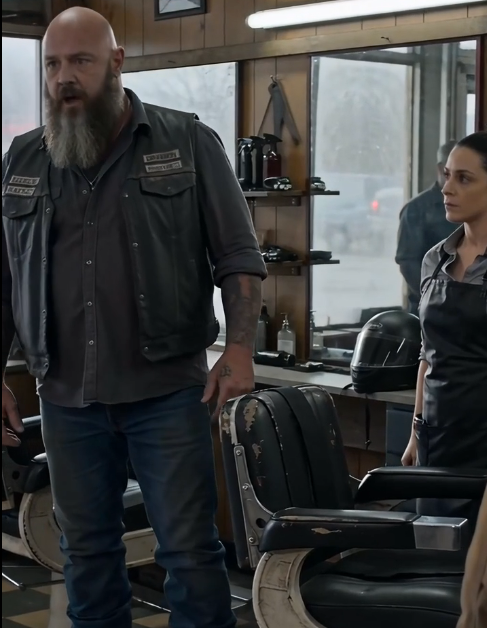
“I’m running a business, Jack.”
“So charge me.”
“You don’t understand.”
“I heard you fine.”
My name is Jack Mercer. I was fifty that September, six-foot-four, with tattooed forearms, a heavy beard, and a black leather vest that creaked when I moved. I repaired trucks outside Knoxville and rode a Harley most days the weather allowed.
I had come for a haircut because my daughter wanted a decent picture of us before she left for college.
That was the whole reason I was there.
The stranger wore a coat too warm for the morning. Its sleeves shone at the elbows, and one pocket hung lower than the other. He carried a clear plastic document sleeve folded inside a grocery bag.
“I only need the beard cleaned up,” he had said. “I have an interview.”
Gordon asked whether he had money.
The man showed him a few bills.
Gordon looked at them, then at the coat.
“You’re driving my customers away.”
Nobody had left.
That was the part I couldn’t get past.
Six customers sat beneath photographs of haircuts none of us would look that good wearing. One man studied his phone. Another shifted his boots away from the stranger’s bag.
I stood.
The stranger’s hand tightened on the doorknob.
“Sir,” I said, softer this time. “You can have my appointment.”
He looked at me then.
His eyes were pale blue and tired in a way sleep wouldn’t have fixed. Under the beard, his mouth moved as though he was deciding whether accepting help would cost more than walking away.
“I don’t want trouble.”
“Neither do I.”
Gordon made a sound behind us.
I turned toward him.
“Cut his hair. Shave him. I’ll pay triple.”
The stranger lowered his eyes.
I realized I had made him expensive instead of welcome.
Before Gordon could answer, I asked the man, “Is that what you want?”
He looked toward the clock above the mirror.
“I need to be there by one.”
“We have time.”
A younger barber named Leah stepped forward. She had watched the whole exchange with a comb held motionless in her hand.
“My chair’s free,” she said.
I moved my helmet and gloves off the seat beside her station. The man sat carefully, keeping his grocery bag between his shoes.
“Would you like me to put that somewhere?” Leah asked.
“No, thank you.”
She nodded and left it where he could see.
The shop smelled of shaving cream, hot towels, and rain drying on my leather. Outside, a truck changed gears at the intersection. Inside, the scissors began their small, steady work.
The stranger closed his eyes.
When Leah asked him to lift his chin, he opened them and looked at me through the mirror.
“You can sit down,” he said. “I’m not going anywhere.”
Something about his voice bothered me.
Not his words.
The way he left space after them.
I sat.
Hair fell onto the cape. Leah shortened the beard, paused to check what he wanted, then worked carefully around his jaw. A narrow pale mark appeared beneath his lower lip.
My fingers tightened around my helmet.
I knew that mark.
I knew the shape of his mouth.
Eighteen years vanished, and I was standing beside a hospital incubator in boots I hadn’t changed for three days.
“Look at me,” I whispered.
Leah stopped.
The man turned his head—and suddenly I was afraid to ask his name, because the last time I had seen that face, my daughter’s life had been in his hands.
Part 2
Eighteen years earlier, I was thirty-two and believed being a father would begin on a date somebody had written in a calendar.
We had a crib still in its box. My wife, Beth, had folded three small sleepers into a drawer and asked me to move a dresser I kept insisting would fit through the doorway without taking the drawers out.
We argued about paint.
Yellow or green.
That was where we were in our preparation for parenthood when everything changed.
Beth went into labor far too early.
The next hours came to me later in disconnected pieces: a nurse asking me to step aside, Beth looking for my hand, a pair of scissors cutting fabric, the sudden understanding that the room had become a workplace for people who could not afford my panic.
Our daughter arrived small enough that I initially thought they were carrying something wrapped around her rather than carrying her.
I had never been frightened by something so small.
Her name was Sophie.
We had chosen it because Beth liked how it sounded when you said it gently. In the hospital, everybody said it gently.
Dr. Elliott Warren led part of the team caring for her.
He was around fifty then, clean-shaven, with short brown hair turning gray above the ears and a small pale scar beneath his lower lip. He spoke in complete sentences without filling them with promises he couldn’t make.
I hated that at first.
I wanted certainty.
I wanted him to say she would come home, that Beth would get to complain about sleepless nights, that the unopened crib would become furniture instead of evidence of our foolish confidence.
He told us what the team knew and what they were watching. Then he asked what we wanted him to explain again.
He never made us apologize for asking twice.
One night, Sophie’s condition worsened.
I remember how quickly people moved without running. I remember Beth being guided toward a chair and me standing in a place where someone needed to put equipment.
Dr. Warren turned toward me.
“Jack. Give us room.”
I moved.
His voice followed.
“We’re working on her.”
There was a whole team around my daughter. Nurses whose faces I can still picture. Another physician. People doing things I did not understand and was glad they did.
But when I remember that night, I remember Warren’s face because he was the one who came to us afterward.
He pulled up a chair.
That frightened me more than if he had stayed standing.
Then he said Sophie had responded to treatment.
Beth bent forward with both hands over her mouth.
I asked whether that meant she would be all right.
He paused.
“It means we have this step.”
At the time, I thought he was withholding comfort.
Years later, I understood he was giving us something strong enough to stand on.
One real step.
I was not an easy man in those days.
I had stopped drinking only a little over a year before Sophie was born. Sobriety had improved my life without automatically improving every part of my character. I still mistook anger for usefulness. If I couldn’t fix something, I found somebody to blame.
One afternoon, I became loud at the nurses’ station over information I had misunderstood.
Dr. Warren took me into a side room.
He did not threaten me.
He did not flatter me because I was a frightened father.
He said, “You can be scared here. You cannot make it harder for the people helping her.”
I sat down.
Then, to my humiliation, I cried.
He handed me tissues and waited until I could speak.
“I don’t know what I’m supposed to do.”
“Be her father.”
“How?”
“Start by coming back tomorrow.”
So I did.
Tomorrow, and the next day, and all the days that followed.
Sophie came home after weeks that changed how Beth and I measured time. We brought a cake to the unit later. We wrote cards. We sent a photograph every Christmas for several years.
Some were addressed to Dr. Warren, some to the nurses.
Eventually, he left that hospital. Our cards were forwarded for a while, then one came back. We asked, but there was no simple way to obtain his private whereabouts, and life kept moving around our gratitude.
We never forgot him.
But forgetting and losing track are different things that can produce the same empty space.
He remained safely inside our past.
Sophie grew into a girl who hated peas, loved swimming, and once glued fabric wings to my work boots because she said every dragon needed feet.
At eighteen, she was taller than Beth and quick enough with a joke to make me regret teaching her sarcasm.
She had chosen a college close enough to visit and far enough to insist she was leaving.
The haircut was her idea.
“Dad, please don’t look like you crawled out from under a truck in every photograph.”
“I work under trucks.”
“You also own a shower.”
I booked an appointment.
That morning, she texted me while I waited at Gordon’s.
Don’t let him shave your whole beard. I need to recognize you.
I was still smiling at that message when the man in the heavy coat opened the door.
I noticed the smell.
I will not pretend I didn’t.
Damp fabric. Old sweat. The sourness of clothes that had been worn without a proper chance to dry.
I also noticed how he held the grocery bag clear of the floor.
A person trying to keep something clean.
Before Gordon spoke, the stranger had quietly moved aside to let an older customer reach the door. He had apologized when his bag brushed a chair.
He was making himself smaller with every movement.
That was why I stood.
Not because I recognized him.
I stood before I knew he had ever done anything for me.
Part 3
“Sir?”
The man watched me through the mirror.
Leah lowered the trimmer.
“You okay, Jack?”
I set my helmet on the floor because I could no longer trust my hands.
“What’s your name?”
He hesitated.
“Elliott.”
My chest hurt.
“Elliott Warren?”
His expression changed—not recognition, but the guarded look of somebody hearing a name he no longer expected strangers to know.
“Yes.”
I leaned forward.
“Did you work with premature babies?”
The shop had gone quiet enough that I could hear the air conditioner switch on.
He looked at Leah, then at the grocery bag between his shoes.
“A long time ago.”
I put a hand over my mouth.
For eighteen years, I had carried a clear picture of this man inside a clean hospital. He had belonged beside warm lights, washed hands, people looking to him for answers.
My mind kept trying to place that picture over the man in the barber chair.
The face matched.
The rest of the world refused to.
“My daughter,” I said.
Then I couldn’t continue.
Dr. Warren sat still.
“She was born early. Eighteen years ago. Sophie Mercer.”
He studied me.
I watched him search through more children than I could imagine, more frightened fathers, more rooms full of people asking for promises.
“Your wife?”
“Beth.”
He looked down briefly.
When his eyes came back, something had shifted.
“Yellow knitted hat?”
I laughed once, painfully.
“Her mother made it. It wouldn’t stay on.”
He nodded.
“I remember the hat.”
That was what broke me.
Not a medical detail. Not proof arranged like a test.
A hat.
A ridiculous little yellow hat my mother had made too large because none of us had understood how small Sophie would be.
He remembered something that had belonged to my child.
I covered my face and began crying in the middle of Gordon’s barbershop.
I was fifty years old, built like a refrigerator, wearing boots that left wet marks on the clean floor. I had cried before, but rarely where anyone could see, and never so suddenly that I couldn’t construct an excuse first.
Gordon moved toward us.
“Jack, what is—”
I held up a hand.
Dr. Warren began rising.
Leah asked him to wait while she removed the cape from around his neck. Hair slid to the floor. He stood, uncertain, and I reached for him.
Then I stopped.
“Can I?”
He nodded.
I hugged him.
He felt thinner than he should have. That is not a medical observation. It is what my arms knew before the rest of me could bear to know it.
“You gave my daughter a chance to live,” I said into his shoulder. “Please let me help you get a chance to start again.”
His hand rested against my back.
“There were a lot of us working on Sophie.”
“I know.”
“The nurses—”
“I know.”
I did know.
There were names in our family’s old cards, faces in the photographs. Gratitude for him did not erase anyone else.
But he was the person standing before me, and eighteen years had delivered us to a room where I had just offered money to make someone treat him decently.
I stepped back.
“Where have you been?”
He looked at the clock.
That hurt in a different way.
His life had not stopped being urgent because I had discovered a story.
“My interview is at one.”
I checked my phone.
Eleven twenty-three.
“We can still make it.”
He nodded, relieved.
He wanted a future more than he wanted to explain his past.
Leah touched the chair.
“Let me finish, if that’s all right.”
He sat.
She worked quietly, asking what he wanted around the sideburns, whether the water was too warm, whether he preferred the beard completely removed or a little left.
He chose clean-shaven.
No one discussed what kind of appearance would make him look like a doctor.
He was going to an interview.
That was enough.
Gordon stood near the register, pale beneath the fluorescent light.
“I didn’t realize.”
I looked at him.
“What?”
“Who he was.”
Elliott’s eyes closed.
I could see him waiting for the humiliation to become a lesson delivered over his head.
So I kept my voice low.
“He told you he needed a shave.”
Gordon swallowed.
“Of course.”
“That was enough information.”
The man who had moved his boots away from the grocery bag suddenly became interested in the street.
Leah continued shaving.
When she finished, she held a mirror so Elliott could see the back of his head. He checked it carefully, then smiled a small, private smile.
“Thank you.”
“You’re welcome.”
No one applauded.
I was grateful for that.
We did not need to congratulate ourselves because a man had received the service he entered a business to request.
Gordon said there would be no charge.
I told him I had made an offer and would honor it.
Leah looked at her boss.
He looked at Elliott.
For a moment, I worried they would start negotiating generosity while Elliott stood waiting.
Instead, Gordon said, “I owe you an apology.”
Elliott held his gaze.
“Yes.”
Gordon apologized.
No excuses about a difficult morning or the cost of running a shop. He said he had spoken cruelly.
Elliott nodded.
“I appreciate you saying that.”
He did not tell him it was all right.
It hadn’t been.
I paid for the service and left Leah a tip.
Then I asked Elliott where he needed to go.
He took the document sleeve from his grocery bag.
Inside was an interview confirmation for an evening position in the supply department of a rehabilitation center.
Not a physician’s job.
Not even a job asking him to explain everything he once knew.
He watched me read it.
“I can do that work.”
I handed it back.
“Then let’s get you there.”
Part 4
We had ninety minutes.
Elliott had planned to use the day center before the interview, but the shower schedule had filled before he arrived. He had washed as best he could and changed into the cleanest shirt he owned.
The haircut had been the remaining thing he hoped to manage.
His voice stayed level while he explained this. Mine took work.
I called a community center where our club volunteered. The manager knew me, and I asked whether a private shower and changing area could be made available that morning.
I did not explain Elliott’s former profession.
I said a man had an interview and needed a place to get ready.
She said yes.
Boone came to collect my Harley so I could drive Elliott in the shop pickup he brought over. He arrived ready with a joke, saw my face, and kept it to himself.
Elliott needed a shirt.
I asked his size before anyone bought anything.
He said he could pay us back.
“We can discuss money another day,” I told him.
“No. We can discuss it now.”
I stopped.
He stood beside the truck holding his bag with both hands.
“I need to know what I’m agreeing to.”
He was right.
I had moved so quickly into helping that I had begun arranging his day as though gratitude gave me authority.
So I told him plainly: the shirt and transportation were gifts. There were no conditions. He could decline anything.
He considered that.
“All right.”
He accepted help after he understood it.
At the center, I waited near a vending machine while he showered and changed. Boone brought a plain blue shirt, socks, and an inexpensive pair of trousers in the sizes Elliott had chosen.
The first trousers didn’t fit.
Boone went back.
There was no significance to that beyond a man needing pants that closed comfortably. I remember it because people later wanted every detail of the day to feel arranged by fate.
Most of the day was errands.
When Elliott came out, his old clothes were bagged separately. His hair was still damp. He looked at the cuffs of the blue shirt and folded each one back once.
I saw the doctor then.
But I also saw someone else: a sixty-eight-year-old man trying to get to an interview without arriving as a problem.
We bought sandwiches because he said he was hungry.
I wanted a quiet table where I could ask a hundred questions. He wanted something he could eat before one.
We ate in the truck with the windows cracked.
“Is Sophie well?” he asked.
“She is.”
“What’s she doing?”
“Starting college. She thinks she wants to work with kids.”
He smiled.
“That’s a good thing to want.”
I showed him a recent photograph after asking whether he wanted to see it.
Sophie stood beside Beth at a lake, hair blowing across her face, holding up a fish too small to justify her expression of triumph.
Elliott stared.
His thumb hovered over the screen without touching it.
“Eighteen.”
“Yes.”
He handed the phone back.
“I’m glad.”
Two words.
He said them with enough feeling that I had to look through the windshield.
Then I asked what happened after he left the hospital.
He ate another bite before answering.
“My wife got sick.”
Her name was Ruth.
She developed a progressive neurological illness. Elliott reduced his work, then left practice to care for her. They made decisions that seemed manageable one at a time: paying for additional help, selling their larger house, moving closer to family, using savings they had once expected to last longer.
He did not claim one bill destroyed everything.
It had been a long erosion.
There were expenses, strained relationships, exhaustion, and choices made by people who had stopped sleeping well enough to consider every consequence.
After Ruth died, he did not return to medicine.
“I thought I would,” he said.
He had intended to deal with the professional requirements, find a suitable role, reestablish a routine.
Then weeks passed.
His depression deepened. He avoided calls. A relative let him stay for a while. He left before they asked him to because he interpreted ordinary household friction as a warning that he had become unwanted.
Temporary rooms consumed what money remained.
Later, an eviction from a place he could no longer afford made the next place harder to obtain. He kept his belongings in bags because unpacking had begun to seem foolish.
He had been without stable housing for seven months.
There was no single doorway through which he had fallen.
“Do you have family?” I asked.
“A son.”
He looked at his sandwich.
“We’ve had some difficult years.”
I waited.
“He offered help. I told him things were better than they were.”
“Why?”
Elliott smiled without humor.
“I had been the person with answers for a long time.”
That was all he said about it then.
I let it be all.
The rehabilitation center appeared ahead of us, low brick buildings set behind a row of young trees. Elliott checked the time and put the document sleeve on his lap.
I asked whether he wanted me to come inside.
“No, thank you.”
“Want me to wait?”
He thought about it.
“Yes. If you can.”
“I can.”
He checked his reflection in the passenger window.
Then he went in.
I sat in the parking lot for forty-seven minutes.
For once, I did not call anyone or try to solve the next thing. I watched a groundskeeper collect fallen branches and remembered another waiting room, eighteen years earlier, when Elliott had been the one working while I sat uselessly in a chair.
When he returned, I could not read his face.
“How’d it go?”
“They were courteous.”
“Good.”
“They have other applicants.”
“All right.”
He settled the bag between his feet.
Then he said, “I stayed for the whole thing.”
I looked at him.
He kept his eyes forward.
“I almost left before they called my name.”
I nodded.
Some victories looked like a person remaining in a chair.
We drove without talking for a while.
At a red light, I asked whether I could call Beth and tell her whom I had found.
Elliott agreed.
I put the phone on speaker.
Beth answered, “Did you let Gordon cut it too short?”
I tried to say her name.
She heard my voice and stopped.
“What happened?”
I told her.
When I said Dr. Warren, there was silence.
Then, very quietly, she said, “Is he with you?”
“Yes.”
“Doctor?”
Elliott swallowed.
“Hello, Beth.”
My wife began crying.
I had to pull over.
Part 5
Beth came to the garage that afternoon with the yellow hat.
I hadn’t asked her to bring it.
She had taken it from the box where we kept Sophie’s hospital bracelet, old photographs, and a stack of cards we had never been able to throw away.
She stood in the office doorway holding the hat in her palm.
Elliott rose.
For a moment, they simply looked at each other.
Then Beth said, “You told me I could put my hand beside her. I was afraid I’d hurt her.”
Elliott nodded slowly.
“You were gentle.”
“I was terrified.”
“I remember.”
She hugged him after he opened his arms.
I stood beside the desk, giving them room.
The men from the club had arrived in ones and twos after hearing that something had happened. Marlene kept them outside the office until Beth was ready.
When the door opened, Boone offered coffee.
Luis found a chair that didn’t lean.
Nobody called Elliott a miracle worker.
I was glad, because he had already told me twice that a team saved Sophie, and because the man in front of us did not need to become larger than life before we admitted he needed a place to sleep.
That was the next question.
He had a bed available at a shelter that evening.
I offered a hotel.
He declined at first.
Then Marlene asked whether he was turning down the room because he didn’t want it or because he felt obligated to refuse.
He looked at her.
She waited.
Finally, he said, “I would like a door.”
We booked a room.
The first night came from me.
The second came from Boone, who quietly told the desk to keep the arrangement simple.
By the third, we were discussing what came after, because hotel money could become a way of postponing a problem rather than solving it.
That was when the club stopped agreeing with itself.
Travis wanted to launch a fundraiser immediately. He said people would give if they knew a doctor who saved premature babies was sleeping outside.
Marlene asked whether Elliott wanted the whole town knowing that.
“We can ask him.”
“We can. We also need a plan that doesn’t depend on exposing him.”
Deke folded his arms.
“How much are we committing to?”
The room tightened.
Deke had helped a relative for years, emptied savings he could not replace, and ended up bitter about promises made by people who did not have to write the checks.
I knew his caution had a history.
Still, my first response came out wrong.
“He saved Sophie.”
“I heard you,” Deke said. “I’m asking what we can actually do.”
I started to argue.
Then Elliott appeared in the doorway.
“I’m sorry,” he said. “I was looking for the restroom.”
Nobody believed that was all he had heard.
He looked at me.
“I should go.”
“No.”
His face closed.
I heard my own voice—too loud, too commanding—and understood how quickly I had turned concern into another room he needed to escape.
I lowered it.
“Please. You didn’t cause an argument. We need to make decisions like adults.”
Deke uncrossed his arms.
“That’s what I’m asking for.”
Elliott stayed, but he sat close to the door.
Marlene brought a notebook.
We listed what we could offer without pretending we had expertise we didn’t possess: a limited hotel stay, transport to appointments, help connecting with a local housing worker, a secure place for his belongings if he wanted it, meals when invited.
We would support access to healthcare and practical services through the appropriate people.
We would not decide that a haircut, gratitude, and a new shirt had treated depression.
We would not promise him a life we couldn’t deliver.
Elliott listened.
Then he made his own list.
He wanted to pursue the job. He wanted help replacing some paperwork. He wanted his son contacted, but not by a stranger announcing that his father had been discovered like a misplaced object.
He would make the call.
He wanted someone nearby when he did.
That was something I could do.
The call happened in the hotel room the next morning.
I sat near the door while Elliott held the phone.
His son’s name was Andrew. He lived several hours away and had two children Elliott had not seen in more than a year.
“Dad?”
Elliott closed his eyes.
“Yes.”
“Where are you?”
“I’m safe tonight.”
There was a pause.
“Where are you?”
Elliott answered properly then. The hotel. The town. The fact that someone was helping.
He did not say everything was fine.
Andrew’s voice rose, then broke.
“I asked you. I kept asking.”
“I know.”
“You said you had an apartment.”
“I didn’t.”
I looked down at my hands.
This was not a reunion I had earned the right to watch closely.
Elliott apologized without putting Ruth’s illness between himself and the apology. He explained that he was working with people and would send Andrew contact information if he wanted it.
Andrew wanted it.
He also wanted time.
Elliott agreed.
After the call, he sat quietly for several minutes.
Then he asked whether I thought Andrew hated him.
“I heard somebody who was scared.”
“He has a right to be angry.”
“Yes.”
He nodded.
We did not repair the rest before lunch.
Later that week, the rehabilitation center called.
Elliott did not get the job.
I was so angry on his behalf that he had to calm me down.
“They chose someone with more recent experience.”
“They know who you are?”
“They know what I put on the application.”
I wanted to call someone.
He saw it.
“Jack.”
I stopped.
“I went to an interview. I wasn’t promised a position.”
That was the day I began understanding how dangerous gratitude could become if I used it to push him into a life that made me feel better.
He needed chances, not guarantees purchased behind his back.
We applied elsewhere.
The word we is not quite right.
He applied.
I drove.
Marlene helped organize dates and documents. His housing worker pursued options. Elliott attended appointments, including ones he did not discuss with the club.
Sometimes he canceled coffee.
Sometimes he did not want company.
We learned not to confuse privacy with disappearance.
He learned to tell someone when plans changed.
It was slower than the story I had imagined while crying in the barbershop.
It was also beginning to resemble a life.
Part 6
Sophie met him two weeks after the haircut.
She had been away with a friend’s family when it happened, and I told her over the phone only after Elliott agreed.
She listened, then said, “Dad, does he want to meet me?”
That question made me proud.
Not because she owed him nothing.
Because she understood gratitude did not give us permission to overwhelm him.
Elliott said yes.
We arranged lunch at our house.
Beth made too much food, which was her usual response to uncertainty. I cleaned the garage for no reason anyone could identify. Sophie arrived holding a small envelope.
When Elliott stepped through the door, she shook his hand.
“Hi. I’m Sophie.”
He smiled.
“I’m pleased to meet you again.”
She looked at him for a moment.
Then she asked if she could hug him.
He nodded.
I turned toward the kitchen because my eyes had become unreliable around that man.
At the table, she told him about college, her roommate, and the class she was worried would be harder than she had admitted to us. He asked questions without turning her into a medical outcome.
That was a gift.
She was allowed to be eighteen.
Not evidence.
Not proof that somebody’s career had mattered.
A young woman complaining about parking.
After lunch, she gave him the envelope.
Inside was a photograph of the three of us taken that summer.
On the back, she had written a short note thanking him and the team for giving her the chance to know her parents.
Elliott read it, then set it beside his plate.
“I’m going to keep this.”
“I hoped you would.”
He did not cry then.
He asked whether she had a favorite subject.
The afternoon continued.
A month later, he accepted a part-time position handling records and inventory for a small community organization. The work was modest, paid, and suited the hours he could manage while continuing to address his health and housing.
No one handed him a stethoscope.
His former career remained part of him, but returning to clinical practice was not something a grateful father could arrange with a phone call. Elliott had questions to consider and requirements he would have to address if he ever chose that path.
For now, he wanted to arrive at work, do the job well, and go somewhere afterward that stayed his.
His housing worker helped him secure a small room first, then a more stable arrangement.
The day he received the keys, he called me.
“I’d like to borrow the truck.”
“Of course.”
“To move my things.”
I almost said we would do it for him.
Instead, I asked what time.
He drove while I held the directions.
There wasn’t much to move.
Two bags. A donated lamp he had selected himself. A kettle. The framed photograph Sophie had given him.
At the new place, he put the photograph on a shelf and stood back.
His hands rested at his sides.
For several seconds, neither of us spoke.
Then he asked whether I thought the lamp belonged near the chair or the bed.
We argued about it like men with an ordinary problem.
That winter, Andrew visited.
The club stayed out of the way.
I received one message afterward.
We’re having breakfast again tomorrow.
I understood how much was inside that sentence.
At Gordon’s, things changed less dramatically but visibly.
Leah continued cutting Elliott’s hair when he wanted an appointment. Gordon apologized again, privately, without asking him to certify that he was now a good person.
A community organization began arranging a few prepaid grooming appointments through the shop for people preparing for interviews. The arrangements were discreet. Customers did not sit beneath a sign explaining why their haircut had been paid for.
Gordon contributed appointments.
Leah did, too.
I never asked whether it redeemed him.
I watched what he did the next time someone arrived who didn’t look comfortable asking for service.
That told me more.
Part 7
Six months after that morning, Elliott called to ask whether I wanted coffee after his haircut.
I said yes.
When I arrived, he was already in Leah’s chair, wearing a clean gray sweater and holding a newspaper open across his lap. His coat hung on the rack with everyone else’s.
The grocery bag was gone.
Not every difficult thing had gone with it.
He still had days when getting out of bed took effort he disliked discussing. Money required planning. Andrew’s trust was returning slowly, and there were conversations about Ruth he had only begun to have.
But he had paid for his own appointment.
He was choosing how he wanted the sideburns.
And when Leah asked him to lift his chin, he did it without first checking whether anybody was waiting for him to leave.
I sat down beside the window.
Gordon offered me coffee.
I accepted.
A young man came in carrying a backpack. His jacket was worn, and his eyes moved over the prices before he approached the counter.
For a moment, my body remembered the earlier morning.
The readiness to stand.
The anger.
Then Gordon asked, “What can we do for you?”
The young man said he had an interview.
Gordon checked the schedule.
Leah glanced toward the spare chair.
No one asked the man to prove he had once been important.
I remained seated.
Elliott caught my eye in the mirror.
A small smile moved across his face.
Afterward, we walked to the diner next door. He insisted on buying my coffee. I let him because I had finally stopped treating every dollar he spent as something I needed to rescue.
We sat near the window.
He asked about Sophie.
I told him she had done well in the class she feared and badly at remembering to call home before midnight.
“Sounds about right.”
“She sent you something.”
I took a postcard from my vest.
It showed the campus under snow. Sophie had written about a child-development course, a terrible dining-hall meal, and the fact that she had finally learned to do laundry without turning white socks pink.
Elliott read every line.
Then he placed it carefully beside his cup.
I looked at his face—the same face I had watched eighteen years earlier while waiting for news I was afraid to hear.
“I used to think you were somewhere having a good life,” I said.
He glanced up.
“I know.”
“I guess I needed that to be true.”
He considered it.
“A lot of people need the doctor to be all right.”
I nodded.
“I’m sorry I didn’t find you sooner.”
He shook his head.
“You found me when you found me.”
Outside, a bus stopped at the curb. People got off carrying shopping bags and work coats. A man held the door for someone he had never met.
Elliott watched them.
Then he said, “You gave me your chair before you knew.”
I looked at him.
“That matters to me.”
I had spent months thinking about the debt.
The hospital.
Sophie.
The impossible chance that put us in the same barbershop.
He had been thinking about a chair.
An ordinary place to sit without apologizing.
I picked up my coffee.
He folded the postcard once along its existing crease and put it in the inside pocket of his coat.
When we left, he reminded me that his next appointment was in five weeks and asked if I wanted to make coffee a regular thing.
“Yes.”
“Don’t come early and pay for me.”
“I won’t.”
He gave me a look that said he would check.
Then he walked toward the bus stop, one hand in his pocket, the other carrying a small bag of groceries he had bought on the way over.
I went toward my Harley.
Halfway there, I looked back.
He was sitting on the bench, reading Sophie’s postcard again.
There was room beside him.
Follow our page for more biker stories about second chances, quiet kindness, and the strangers who become part of the life we keep.