A Biker Bought the Doll I Couldn’t Afford, Then Refused to Give It to My Daughter—What He Put in My Hand Changed How I Remember That Afternoon
The biker bought the doll my daughter had been trying not to cry over, but when she looked toward him, he turned the box away and quietly asked me to follow him behind a display of wrapping paper.
For one ugly second, I thought he had bought it to teach us another lesson.
We had already had one.
The clerk had delivered it loudly enough for three aisles to hear.
“Sir, looking at it longer isn’t going to change the price.”
My daughter had placed the doll back exactly where she found it. She straightened its yellow raincoat through the opening in the box, then pushed the package against the shelf so it lined up with the others.
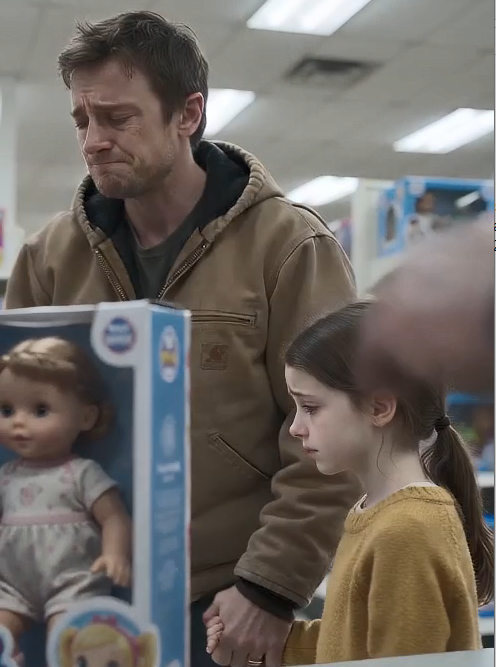
She was seven, and she was trying to leave neatly.
My name is Caleb Turner. I was thirty-four, a finish carpenter outside Knoxville, and that Saturday I had eighteen dollars in my pocket that did not already belong to somebody else.
Eighteen dollars.
The doll cost thirty-nine ninety-five before tax.
I knew that now.
I had spent the previous eight minutes hoping the price belonged to the larger doll beside it, then hoping there was another version, then trying to work out how to tell my daughter we needed to leave.
June helped me before I found the words.
“It’s okay, Daddy. Her shoes don’t even come off.”
Her eyes were red.
She had spent the whole week talking about those shoes.
I reached for her hand.
“Come on, bug.”
She followed, smiling too hard.
That was when the man in the leather vest stood up from the bench near the checkout.
He was enormous. Gray-black beard, tattooed arms, heavy boots, a motorcycle helmet resting beside him. A little chain on his wallet clicked against the bench as he moved.
I expected him to tell us we were blocking something.
Instead, he walked past us and picked up the doll.
June watched.
I squeezed her hand gently, trying to keep her moving.
Then he paid.
No discussion. No counting. He handed the cashier a card while I stood near the exit holding a child who had already begun apologizing for wanting anything.
“I like my other dolls,” June said.
“I know you do.”
“I wasn’t going to ask again.”
“You didn’t do anything wrong.”
The biker took the bag from the cashier.
June looked up.
He saw her face and shifted the bag behind his leg.
He did not offer it to her.
That hurt more than it should have.
A woman near the seasonal display smiled as though she knew what was about to happen. I felt my shoulders tighten. I did not want an audience for whatever this was.
The man approached slowly, stopping far enough away that I didn’t have to step back.
“Can I talk to you for a second?”
“About what?”
He glanced toward June.
“Something for you.”
There was a coloring table near the checkout. A young employee had already invited June to finish the butterfly she started when we arrived. I asked whether she wanted to sit there while I spoke to the man.
She looked at his bag, then at me.
“Can you still see me?”
“Every second.”
She sat.
I followed him a few steps toward the wrapping display, where I could see her yellow sweater between two rolls of blue paper.
“I don’t have money to pay you back,” I said before he spoke.
He nodded.
“I figured money was tight.”
My face burned.
He saw it.
“That came out wrong.”
He took the doll from the bag and rested it on a clear section of counter between us.
Up close, his hands were scarred and clean. His beard had a faint dent where a helmet strap had been. He smelled of leather, cold air, and peppermint gum.
“My name’s Ray,” he said.
“Caleb.”
He looked past me at June, carefully coloring inside a wing.
Then he turned the box so it faced my hands instead of his.
“I’m going to ask you to give this to her.”
I stared at him.
Before I could refuse, he folded the receipt into my palm—and explained why the last person he wanted my daughter remembering that afternoon was him.
Part 2
We had not gone into the store intending to buy a forty-dollar doll.
I need to say that because afterward I kept imagining an invisible jury reviewing my choices. Why take a child into a toy store if you couldn’t afford what she wanted? Why not say no immediately? Why stand there pretending arithmetic might change?
Poverty makes you defend decisions nobody else has to explain.
We were in the shopping center because June needed poster board for school. The toy store was next to the discount shop, and there was a sign in the window advertising selected dolls starting at fourteen ninety-nine.
I had eighteen dollars.
For the first time in several weeks, I thought I could say yes to something small.
I wanted an ordinary Saturday.
My wife, Mia, was working a double shift at a restaurant near the highway. I had been getting fewer carpentry hours since the contractor I worked for lost a renovation project. At the same time, the transmission in our only reliable vehicle needed repairs.
Nothing spectacular had happened.
No single catastrophe someone could point to and understand.
There were fewer hours, an expensive repair, groceries, rent, school supplies, and the steady discovery that small bills become large when they arrive together.
Mia and I were keeping up.
Barely.
We had stopped asking each other whether there was extra. We asked what could wait.
I still had work boots with good soles. June had lunch money. The lights were on. We were luckier than some families we knew.
Those facts did not make the eighteen dollars feel less humiliating under fluorescent lights.
June found the doll in the second aisle.
It had brown hair, freckles, and a yellow raincoat over a blue dress. She turned the box toward me, surprised.
“Daddy. She looks like me when it rains.”
June had a yellow raincoat that had belonged to a cousin. One cuff was patched where it caught on a fence. She loved it because the hood made a little roof over her nose.
I smiled.
“She does.”
That was the moment I should have checked the price.
Instead, I watched my daughter turn the doll around, searching for the tiny boots pictured on the back. I let myself enjoy the expression on her face before doing the responsible thing.
Hope got there before the number.
When I saw the price, I checked the shelf label twice.
Then I found an employee.
He was young, perhaps twenty-two, with a store lanyard twisted around his fingers. His name tag said Brent.
“Is this one included in the sale?”
He glanced at it.
“No. The sale dolls are over there.”
He pointed toward a lower shelf.
June followed us.
The cheaper dolls were smaller, with painted clothes and plastic hair. There was nothing wrong with them. In another moment, she might have liked one.
But she had already met the girl in the yellow raincoat.
She picked up a smaller doll and looked at me.
“This one’s nice.”
The way she said it made me want to buy the whole shelf and leave it there.
I asked Brent whether there were any coupons.
He shook his head.
“Any open-box ones?”
“No.”
“Maybe another color?”
“The price is the price.”
I should have left then.
Instead, I counted the bills in my wallet again.
Brent watched.
A couple needed to pass, so I moved June closer to the shelf. We weren’t blocking the aisle for more than a moment, but Brent looked toward the register as though our presence had become work he hadn’t agreed to do.
That was when he said it.
“Sir, looking at it longer isn’t going to change the price.”
A woman nearby stopped examining a puzzle.
My daughter’s face changed before mine did.
She understood tone.
She understood that an adult had decided her father looked foolish.
The money was between us, but the shame landed on her.
June put the doll back.
She made the joke about the shoes.
I reached for her hand too quickly. She stumbled half a step, and I loosened my grip immediately.
“Sorry, bug.”
“It’s okay.”
She kept saying that.
It’s okay that we can’t buy it.
It’s okay that the man spoke that way.
It’s okay that you pulled my hand because you wanted to get out before anybody saw your face.
I wanted her to stop taking care of me.
I had no idea how to ask without making her feel she had done that wrong, too.
As we passed the checkout, I noticed Ray watching.
My first thought was that he had heard everything.
My second was that I wished he hadn’t.
I knew nothing about him yet. Not his repair shop, his riding club, or the grown children who still called him to ask where a strange engine noise was coming from.
I saw a man who looked capable of buying things without checking.
Then I saw him pick up the doll.
I thought perhaps it was for his granddaughter.
For a moment, I resented him for having that easy choice.
I was wrong about how easy it was.
Part 3
Ray did not put the doll into my arms immediately.
He left it on the counter and waited.
I could see June at the coloring table. She was pressing so hard with the yellow crayon that I expected it to break.
“I appreciate it,” I said. “But I can’t—”
“You don’t owe me.”
“That’s easy to say now.”
He nodded, accepting the objection instead of brushing it aside.
“It’s a gift. No loan. No favor later. You can say no.”
I looked at the box.
The doll smiled through clear plastic with the bright, permanent confidence of something that had never checked a bank balance.
“I don’t want you walking out thinking you rescued my family.”
Ray’s expression shifted.
Not anger.
Recognition.
“Fair enough.”
He leaned one hip against the counter.
“I bought a doll, Caleb. That’s what I did.”
I breathed out.
It was the first sentence he had said that made the room feel larger.
Then he glanced toward June.
“You’re the one going home with her. You know what she eats, what scares her, how she likes the blanket tucked. I don’t get to walk in for three minutes and become the important man in her day.”
I stared at him.
He understood the thing I had been too ashamed to name.
I wasn’t angry that he could help.
I was afraid of the picture.
My daughter standing beside me while a stranger handed her what I couldn’t buy. The staff smiling. Somebody taking out a phone. Me expected to look grateful at the precise moment I felt myself shrinking.
Ray pulled the receipt from his pocket.
“If she wants to exchange it, you’ll need this.”
He folded it once and placed it in my hand.
Then he said quietly, “She doesn’t need to know who I am. She just needs to keep believing her dad is her hero.”
I looked toward June.
Her feet did not reach the floor.
One shoe was hooked behind the other, and she had set aside the best crayons so a smaller child could use them.
I swallowed.
“I don’t want to lie to her.”
“Then don’t.”
Ray’s answer came immediately.
“Tell her somebody helped if she asks. I’m not asking you to invent money. I’m asking if you want to be the one who gives her the gift.”
That was different.
It let me accept something without handing him the right to tell our story.
I touched the corner of the box.
“Why?”
He looked down at the little receipt.
“Because I remember standing beside my father while somebody explained how lucky I was that a stranger had stepped in.”
His voice had changed.
I waited, but he shook his head slightly.
“Not now. She’s waiting.”
The young employee at the coloring table looked toward us. Her name was Lena. She had heard enough to understand what we were doing and not enough to make it hers.
“Would you like a gift bag?” she asked.
I checked the doll box.
June would see it through the store bag.
“A plain one?”
Lena found a blue paper bag and a sheet of tissue.
Ray reached for his wallet.
She shook her head.
“I’ve got the bag.”
She said it ordinarily, without announcing her own contribution to the room.
The kindness stayed small enough for us to hold.
I lifted the doll into the bag.
My hands were shaking.
Ray noticed but did not offer to do it for me.
At the coloring table, June looked up as I approached. Her eyes went straight to the blue bag and then away, almost as though she was afraid of wanting it too soon.
“Bug.”
She stood.
I crouched because I wanted to see her face without making her tilt it toward everyone watching.
“We have something to take home.”
Her mouth opened.
“Poster board?”
I laughed.
The sound surprised me.
“We still need that.”
I held out the bag.
She peered inside.
For a second, she made no sound at all.
Then she looked at me with an expression so unguarded I had to grip my knee to keep from crying.
“The rain girl?”
“The rain girl.”
She touched the box, then pulled her hand back.
“Are you sure?”
That was the question that stayed with me.
Not delight.
Not disbelief.
Permission to stop protecting me.
“Yes,” I said. “I’m sure.”
June put her arms around my neck, and the bag knocked gently against my shoulder.
I held her.
Behind her, I could see Ray looking toward a display of puzzles. He had turned his body away from us, giving us the closest thing to privacy a busy store could offer.
He refused to watch himself being thanked.
June stepped back and examined the bag again.
“Can I carry it?”
“Of course.”
“With both hands?”
“That would help.”
She smiled for real.
I hadn’t understood how much I missed that smile until it came back without effort.
At the register, Brent watched us.
I met his eyes.
For a moment, I considered saying something that would make him feel as small as I had felt.
Lena’s manager had arrived from the back. She spoke quietly with Brent, then came over and introduced herself.
“I heard there was a problem.”
I kept my voice low.
“He spoke to us in a way I wouldn’t want anyone speaking to my daughter.”
The manager nodded.
“I’m sorry.”
I didn’t tell her it was fine.
It wasn’t.
But I also did not want to spend the rest of June’s afternoon turning the store into a courtroom.
“Please address it,” I said.
“We will.”
June shifted the bag in her hands.
“Daddy, can we go show Mom?”
“Yes.”
I looked for Ray.
He was near the entrance, holding his helmet.
Our eyes met.
I raised the folded receipt slightly.
He nodded once.
Then he opened the door for us.
Part 4
Outside, the air smelled of rain and hot pavement.
June stopped beneath the awning and asked whether the doll needed a seat belt.
“In the car,” I said. “Probably a good idea.”
She nodded, satisfied.
Ray’s motorcycle was parked near the curb. Up close, I could hear the metal ticking as it cooled. His helmet had a scratch across one side, and there was a small stuffed dinosaur attached near a buckle on his bag.
June noticed it.
“Is that yours?”
“My grandson says it is.”
“Does it have a name?”
“Apparently I named it wrong, so we’re still working on that.”
She laughed.
I was glad she spoke to him about something that had nothing to do with money.
Then she looked at her bag.
“Did you help Daddy?”
I felt myself stiffen.
Ray looked at me.
I answered.
“He did.”
June considered that.
“Like Uncle Ben helped us move the couch?”
“Something like that.”
She smiled at Ray.
“Thank you.”
“You’re welcome.”
That was all.
No grand announcement.
No promise that she would remember him forever.
She went back to asking whether her doll would fit in the small chair she had at home.
The truth had not broken anything.
I asked Ray if I could have his number.
He shook his head at first.
“You don’t need to pay me back.”
“I know. I’d still like your number.”
He studied my face, then gave it.
I put it in my phone.
My hands had settled by then. I could look at him without feeling that I needed either to apologize or make an enormous promise.
“Thank you,” I said.
He nodded.
“Get her home.”
On the drive, June held the doll upright in the bag so it could see out the window.
At a red light, she asked whether I was mad at her.
“No. Why would you think that?”
“You got quiet.”
I looked at her in the mirror.
“I was upset about what the man said.”
“Because I wanted the doll?”
“No, bug. Because he was unkind.”
She moved the box on her lap.
“I didn’t like how he talked to you.”
“I didn’t either.”
For a while, she watched the traffic.
Then she said, “I thought if I said the shoes were bad, you wouldn’t feel bad.”
I pulled into an empty section of the grocery-store lot.
I needed to turn around.
June looked frightened.
“Did I do something?”
“No.”
I unbuckled and faced her.
“You were trying to help me. I know that. But you don’t have to make things you like smaller so I don’t feel upset.”
Her eyes filled again.
“I didn’t want you to be sad.”
“I’m the grown-up. I can be sad and still take care of you.”
I hoped it was true in a way she could feel.
I had not done a perfect job of it in the store.
So I added, “And I’m sorry I pulled your hand when we were leaving. I was embarrassed. That wasn’t your fault.”
She nodded.
Then she asked, “Can grown-ups be embarrassed?”
“All the time.”
She looked genuinely surprised.
I had mistaken silence for protecting her.
At home, we waited for Mia to finish her shift before opening the box. June wanted her mother to watch.
The doll’s name became Penny before the plastic ties were removed.
Mia listened to my account after June went to bed.
I showed her the receipt.
She read it, then sat beside me at the kitchen table.
“I wish I’d been there.”
“You were working.”
“I know.”
We sat quietly.
Then she asked, “Did he make you feel small?”
“No.”
It was the first time I had been able to say that clearly.
“The clerk did. Ray didn’t.”
Mia touched the receipt.
“Keep that part straight.”
A week later, I met Ray for coffee.
I invited him to a diner near his garage and told him beforehand I was buying the coffee. He accepted without arguing, which I appreciated more than he could know.
He arrived on his Harley, carrying his helmet under one arm. People looked up as he crossed the room.
I understood why.
He was a lot of man coming through a small doorway.
But I also noticed how he stepped aside for a waitress carrying plates, how he moved his chair so the aisle stayed clear, how he waited until I sat before opening the menu.
I asked about what he had said in the store.
The memory of his father.
Ray looked toward the window.
“I was ten.”
He had needed winter boots. His father, a mechanic named Walt, had taken him to a department store with enough money for the pair they had seen advertised.
The sale had ended.
Walt counted his cash, asked a question, and then told Ray they would try somewhere else.
A customer overheard.
He bought the boots.
That should have been the happy part.
But the man insisted on putting them on Ray himself. He called over an employee, told Ray how lucky he was, and joked that someone had to look after him.
“My dad stood there holding my old shoes,” Ray said.
I could picture it too clearly.
“The man meant to help.”
“Maybe,” Ray said. “He helped my feet. He embarrassed my father.”
Walt thanked him.
Then he worked extra shifts, saved the amount, and tried to return it through the store. The customer refused the money and seemed offended that it was offered.
For years, Ray believed his father was being stubborn.
“Then I had kids,” he said.
He stirred coffee he had not put sugar in.
“Dad spent that whole winter feeling like the story ended with him failing. I knew better, but I never told him.”
I looked at him.
“Is he still around?”
Ray shook his head.
“No.”
He set the spoon down.
“That’s the part I can’t fix.”
Part 5
My first instinct was to say that his father must have known.
It is something people say when they want to close a painful distance with a sentence.
I stopped myself.
Ray did not need me to invent peace on his behalf.
“What would you tell him now?” I asked.
He looked at his hands.
“That I remember the things before the boots.”
“Like what?”
“He fixed a radio so I could listen to baseball. Came home from a double shift and sat through a terrible school play. Cut the crust off sandwiches even though he said crust was the best part.”
He smiled.
“Little liar.”
I laughed.
Then he said, “I don’t remember the name of the man who bought the boots. I remember Dad warming them near the heater before school.”
I looked at the receipt tucked into my wallet.
I had been measuring the toy-store day at the register.
June might measure it somewhere else.
Children keep their own accounts.
That did not make the humiliation harmless. It gave it less authority over the whole story.
Ray asked about my work.
I told him what I did, the lost project, the hours that had become unreliable. He listened without immediately offering me a job carrying tools in a field I didn’t know.
At the end, he asked whether I wanted him to pass my number to people who needed carpentry.
“Only if they need the work.”
“That’s generally the idea.”
I smiled.
“And I’ll quote it properly.”
“I’d hope so.”
Two weeks later, Luis from his club called about shelves at a small business he helped maintain. I measured the space, gave a price, and did the work.
He paid the invoice.
Nobody called it giving back.
Nobody deducted the doll.
The work belonged to my hands.
Ray and I kept in touch after that, mostly through small messages. A photograph of a crooked cabinet somebody wanted repaired. A joke about rain ruining his ride. June holding Penny in a blanket she made from an old T-shirt.
I asked before sending the photograph.
He said he would like to see it.
He did not post it.
Later, I learned that the doll had caused an argument in the club.
They organized a holiday toy drive every year. Several members thought Ray’s story would be useful in promoting it. One wanted a photograph of me giving June the doll.
Travis, a younger biker, said people donated when they could see the result.
He wasn’t entirely wrong.
The drive needed money. Good intentions did not fill boxes. The club had supported dozens of families the year before, and they wanted to support more.
Ray understood that.
He still said we had not agreed to become the advertisement.
“Then ask,” Travis said.
Ray did.
He called me, explained the request, and made it clear that saying no would not change anything between us.
I said no.
I had barely begun to separate the memory of June’s smile from the memory of strangers watching me fail. I didn’t want either turned into a picture people could judge.
“Understood,” Ray said.
No disappointment in his voice.
No reminder of how much good the photograph might do.
When he told the club, a few men were frustrated.
Marlene, their treasurer, asked whether a family had to surrender privacy to make the accounting persuasive.
They found other ways to show the work.
Receipts, totals, donated supplies, photographs of volunteers organizing unopened toys. Families could share something if they wanted, but no one had to perform gratitude.
Then Ray asked a question that changed the drive itself.
“Why are we handing every gift to the kids?”
There was a silence.
“That’s the toy drive,” someone said.
“Is it?”
In previous years, volunteers had dressed as Santa or stood beside tables, giving toys directly to children while their parents watched.
It had been generous.
It had also given strangers the best moment.
Ray asked whether parents might prefer to choose gifts privately, take them home, and decide how to give them.
Some already did.
Others had never been offered the choice.
The club began asking families what would work for them.
I helped build temporary shelves for the new arrangement.
Mia volunteered at the wrapping station. She was better at wrapping than any of the bikers and told them so within the first twenty minutes.
The event took place in a community hall.
There were appointment times, tables arranged so people could move without being watched by a crowd, and an area where parents could select gifts for their children.
It wasn’t called a test of deservingness.
Nobody had to explain every bad month in front of strangers.
People chose.
Volunteers helped when asked.
Ray spent most of the day carrying boxes.
Near the end, a father stood at the doorway with a toy truck in his hands. He looked at me and said, “My boy’s going to think I planned this.”
“You did come pick it out.”
He smiled.
That was all I offered.
I had learned something about leaving a man enough room to keep his own moment.
Part 6
Things at our house improved gradually.
The shelving job led to another. Then the original contractor picked up work again, and for a while I had to decide which projects I could accept.
That was a better problem.
It was still work.
There were tools to replace, taxes to plan for, and mornings when the truck made a noise I preferred not to hear. Mia kept her job. We paid the repair balance down instead of celebrating with money that hadn’t cleared.
June continued being seven.
She lost a tooth.
She decided broccoli looked like trees and therefore should be respected from a distance.
Penny acquired a bad haircut because June wanted them to match after her own haircut went shorter than expected.
I said nothing.
A few months later, one of the doll’s arms loosened.
June brought it to me with the seriousness of someone presenting an emergency.
“Can you fix her?”
“Let me look.”
I cleared a space at the kitchen table.
She sat beside me while I examined the joint. It took a little patience, one small tool, and an amount of concentration that would have embarrassed me if the neighbors knew.
June watched every movement.
“Are you a doll doctor?”
“Apparently.”
“Do they make money?”
“Not in this house.”
She laughed.
When the arm moved properly again, she took Penny and hugged me.
“You always know what to do.”
I almost corrected her.
I almost told her about the times I didn’t, about money, about being scared and asking for help.
Instead, I said, “Sometimes I have to figure it out.”
She nodded.
That answer seemed acceptable.
I didn’t have to be all-powerful to be her father.
The next time Ray came by, June showed him the repair.
“Daddy fixed her arm.”
“I see that.”
“He used the tiny screwdriver.”
“Those are important.”
She ran to get it.
Ray looked at me.
I shook my head, smiling.
“Apparently that’s what she remembers.”
“Good.”
Later that evening, June asked why Ray had helped us at the store.
I told her some people notice when someone needs a hand.
“Did he know us?”
“No.”
“Then how did he know you’re nice?”
I thought about that.
“He didn’t need to know everything about us to be kind.”
She accepted it.
Then she asked whether I had been a hero before Penny or after.
I looked at her.
“Who said hero?”
“You told Mom.”
I had.
Children hear the things you assume belong to another room.
I put down the dish towel.
“What do you think?”
She shrugged.
“Before.”
“Why?”
“You came when I threw up at school.”
I laughed.
“That’s the standard?”
“And you learned the braid.”
That had taken three online videos and a great deal of mercy from her.
She added, “And when the man was mean, you didn’t let go of me.”
I stood still.
I remembered pulling too quickly.
She remembered being held.
Both were true.
I told her again that I was sorry for rushing her.
She leaned against me.
“I know.”
The worst minute had not swallowed all the others.
I called Ray after she went to bed.
I told him about the arm, the braid, the school nurse.
For a while, he said nothing.
Then he cleared his throat.
“My dad picked me up once in the middle of a shift because I got sick.”
“What happened?”
“He apologized because he smelled like work.”
I closed my eyes.
Ray laughed softly.
“I remember being glad he was there.”
We stayed on the phone another few minutes, talking about nothing urgent.
A truck needing brakes.
The weather.
His grandson’s dinosaur.
Ordinary subjects had become part of the friendship, and I was grateful. I did not want to spend the rest of my life being the man he bought a doll for.
He did not seem to want that either.
Part 7
Almost a year after the toy store, Ray came to June’s school for a small family craft afternoon.
She had invited him herself.
There were cardboard boxes, glue sticks, scraps of fabric, and children attempting projects that required more structural support than anyone had budgeted.
June wanted to build Penny a house.
Ray examined the cardboard walls.
“Who designed this?”
“Me.”
“All right. Architect’s in charge.”
I cut a doorway while he held the box steady. June decided the roof needed to open because dolls deserved sunlight.
Mia arrived halfway through and informed us that we had attached the windows upside down.
June said that was on purpose.
We accepted it.
On the drive home, the dollhouse occupied most of the back seat. June sat beside it, holding Penny and explaining that Ray would have to visit once the glue dried.
I looked at her in the mirror.
The year had not become a story about the toy store.
It had become a year in which a man named Ray joined the people she expected to see.
That was a much better thing.
The receipt remained in my wallet longer than it needed to.
The return period ended. The ink began fading. There was no practical reason to carry it.
One evening, I took it out and placed it in a drawer with June’s school photographs and a birthday card Mia had made when we couldn’t afford to exchange gifts.
I didn’t frame it.
It belonged among ordinary things that mattered.
Sometimes I thought about what Ray said behind the wrapping-paper display.
That June didn’t need to know who he was.
That she needed to keep believing her father was her hero.
I understood the love inside it.
I also knew June had made her own adjustment.
She knew who Ray was.
She knew he helped.
Knowing that had not taken anything away from me.
It had shown her that her father could accept kindness and still be the person who came when the nurse called, warmed the car in winter, fixed a doll’s arm, and stood in the kitchen learning how to braid.
There was room in her world for more than one good man.
Ray had given me the gift without taking the place.
That winter, I volunteered at the toy event again.
A father came through with a small list folded in his hand. He paused near the dolls, compared two boxes, and looked at the price labels left over from the store.
“They’re both available,” I told him.
He glanced at me.
“This one?”
“If that’s the one you want.”
He picked it up.
Then he asked for a gift bag.
I found a plain blue one.
Across the hall, Ray was carrying another box toward the shelves. He caught my eye but didn’t come over.
The father tucked tissue around the doll carefully.
I recognized the movement.
The concentration.
The relief he was trying not to show too soon.
“Do you want a hand?” I asked.
He shook his head.
“I’ve got it.”
I stepped back.
He did.
Follow our page for more biker stories about quiet kindness, family, and the small choices that help someone hold their head up again.