For Twelve Years, a Tattooed Biker Attended 340 Funerals No One Else Came To — At the Last One, He Discovered the Dead Man’s Father Had Once Saved His Life
Part 2
Rook did not begin attending funerals because he was comfortable around death.
He began because empty rooms frightened him.
Twenty-five years earlier, Gabriel Maddox had been thirty-seven, recently divorced, unemployed, and sleeping wherever Denver winter allowed him to remain unnoticed.
He had served six years in the Army, then spent another decade pretending the things he carried home were manageable. Construction work came and went. Painkillers became alcohol. Alcohol became anything that made the nights shorter.
By January 1998, he owned a duffel bag, one pair of boots, and an old motorcycle that no longer ran.
The temperature dropped below zero during a storm that closed roads across the city. Rook remembers walking behind a row of warehouses because wind blew less violently between the brick walls.
He remembers sitting beside a dumpster to rest.
He does not remember falling unconscious.
Samuel Boone found him near 2:00 a.m.
Samuel was fifty-nine, a night custodian at the St. Vincent outreach kitchen. He had finished mopping floors and was carrying trash outside when he noticed one boot extending beyond a stack of pallets.
Rook’s coat was too thin.
His gloves were wet.
His breathing had slowed.
Samuel covered him with his own brown wool coat, called an ambulance, and stayed in the alley until paramedics arrived.
That should have been the end of their connection.
It was not.
Samuel visited the hospital the next afternoon. He brought coffee, clean socks, and a photograph taken by an outreach worker after the ambulance arrived.
Rook was embarrassed by the image of himself beneath blankets, but Samuel insisted he keep it.
“So you remember somebody saw you,” he said.
Rook asked why he had stayed.
Samuel shrugged. “Cold people shouldn’t wait alone.”
For four days, Samuel returned. He found Rook a bed in a veterans’ transitional program. He gave the intake counselor accurate information when Rook tried to minimize his drinking.
He refused to accept thanks because, as he put it, Rook had not yet done anything with the life being returned to him.
“Thank me later,” Samuel said. “When it costs you something.”
Rook entered treatment.
Recovery did not transform him quickly. It was a year of day labor, meetings, relapses narrowly avoided, and apologies that did not reopen every door.
When he was stable enough to look for Samuel, St. Vincent had closed for renovations. The outreach staff had scattered. Samuel’s listed telephone number had been disconnected.
Rook mailed letters to old addresses.
All came back.
Three years later, he learned Samuel had died from a heart attack.
There was no obituary beyond a line in county records. No funeral home could tell Rook where the service had taken place. He assumed Samuel’s family had buried him privately.
The chance to say thank you had closed.
Rook carried the photograph inside his vest from then on.
Years later, after building a small motorcycle-repair business and joining the Iron Divide Riders, he read a newspaper story about volunteers sitting bedside with dying patients who had no family.
The program was called No One Dies Alone.
Rook completed the training. At first he took midnight vigils because sleep still came badly. He sat beside veterans, retired teachers, former addicts, mothers estranged from children, and people whose histories remained unknown.
He learned to read aloud without sounding theatrical. He learned how to moisten a dying person’s lips and when silence was kinder than another question.
The first funeral he attended belonged to a man named Arthur Bell.
Rook had kept vigil through Arthur’s final night. When he learned no relative would attend the burial, he rode thirty-two miles through rain and stood beside the grave.
Afterward, he wrote Arthur’s name in a black notebook.
The ritual came from that first overnight vigil. Arthur had been unconscious when Rook arrived, but a nurse said hearing might remain.
Rook had no scripture ready and knew nothing about Arthur’s life, so he read the weather report, then a newspaper article about the Rockies, pausing whenever Arthur’s breathing changed.
Near dawn, a janitor recognized the patient and remembered that Arthur once played trumpet outside baseball games. Rook added that detail to the first page after the funeral.
It taught him that information often arrived from people official forms never considered family.
His second funeral was for a retired cafeteria worker named June Talley. Four former students appeared ten minutes late because they had learned of her death through a shelter volunteer.
Rook waited in the rain and showed them where the grave was.
From then on, he never assumed “unclaimed” meant “unloved.”
Sometimes it meant the people who cared had not been found in time.
The notebook became his answer to that delay. He wrote names in permanent ink, left margins for facts discovered later, and carried every volume in a locked cabinet at his garage.
The small book inside his vest held only the current hundred.
Then came another funeral.
And another.
Twelve years later, Elias Boone became number 340.
Part 3
Rook treated every name differently because he understood how easily repetition could turn mercy into routine.
Before each funeral, he asked for one fact the official paperwork had missed. Shelter staff told him about favorite foods, jokes, habits, songs, and small kindnesses.
Nurses described the way someone folded blankets or watched birds. If no detail existed, Rook arrived early and read the full name aloud before anyone else entered.
“First time for me,” he once explained, “even if it’s number three hundred.”
The Iron Divide Riders knew about the funerals but rarely joined him. Rook insisted the program was not a club event.
A line of motorcycles could honor a veteran or protect a family from disruption, but it could also turn an unclaimed person’s burial into a spectacle about the living.
“One witness is enough,” he told them. “Unless they ask for more.”
That belief was tested after funeral number 340.
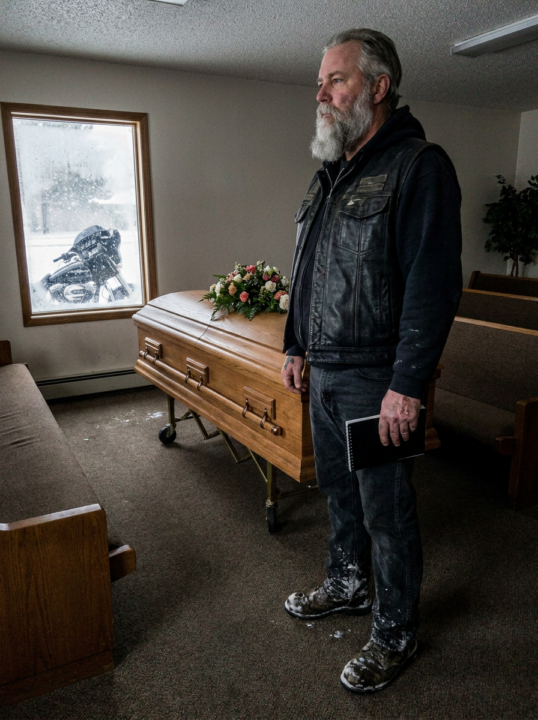
My assistant, Daniel Cho, had recorded ten seconds of Rook standing alone. He filmed from the rear because the sight of a huge tattooed biker before sixty empty pews struck him as something people needed to see.
Daniel posted the clip after receiving my permission—but before asking Rook.
By evening, the video had spread beyond Denver.
Comments called Rook a hero. News stations requested interviews. Donations arrived for No One Dies Alone. Strangers sent messages asking bikers to attend funerals in other states.
Rook was furious.
“Elias isn’t scenery,” he told me.
Daniel apologized and removed the original post, though copies remained. Rook refused every interview. He considered leaving the volunteer program because he feared future funerals would attract cameras.
The Iron Divide president, Miguel Alvarez, argued that attention could help people.
“You’ve spent twelve years saying nobody should be forgotten,” Miguel said. “Now people notice.”
“They notice me.”
“Then point them somewhere useful.”
Rook walked out of the clubhouse.
The disagreement lasted three days. Brotherhood was not tested by fists or loyalty patches. It was tested by whether the men around Rook could respect the difference between witnessing a stranger and using one.
During those three days, the attention became harder to control.
A family in Wyoming asked whether fifty bikers could surround an uncle’s burial even though the uncle had disliked motorcycles. An influencer offered to sponsor matching jackets if his channel could film the next service.
Someone mailed Rook a plaque bearing his name in letters larger than the names of the dead.
He threw the plaque into a drawer.
At the same time, the volunteer office received sixty-two new applications and enough donations to cover transportation for unclaimed burials through winter.
Good and vanity had arrived in the same envelope.
Rook could not separate them by simply walking away.
He returned on the condition that every volunteer attend privacy training and no image be shared without permission. The program agreed. Daniel helped write the camera policy as part of his apology.
Miguel eventually came to the garage alone.
“No cameras,” he said. “No club parade. But let us help with what comes next.”
Rook looked up from a carburetor. “What comes next?”
“Finding out who Elias was.”
The photograph had unsettled all of us. County records confirmed that Elias’s father was Samuel Boone, the same man who had rescued Rook.
But important questions remained.
Why had Samuel’s son died homeless and alone?
Why had Elias carried photographs of Rook?
Why had the wool patch from Samuel’s coat been sewn into his lining?
I contacted a social worker who had known Elias. She described him as private, intelligent, and suspicious of official systems. He had worked as a radio repair technician until the shop closed.
Medical debt followed.
Then eviction.
He had one sister, deceased, and no known partner or children.
The social worker remembered a green storage-locker key Elias kept on a cord.
That key had been inside the property envelope.
The county authorized us to inspect the locker for information about relatives. Rook came only after I promised there would be no cameras.
The unit contained one chair, three boxes, an old radio, and Samuel Boone’s brown wool coat with a square cut from the inside hem.
The chair faced the radio. A paper schedule beside it showed Elias had listened to late-night baseball rebroadcasts and a Sunday gospel program. Empty batteries had been sorted by size rather than discarded.
On one wall, he had marked shelter closing times and warming-center addresses for three winters.
Even inside a six-by-eight storage unit, Elias had built systems against chaos.
In the first box were letters addressed to Gabriel Maddox.
None had been mailed.
The oldest began with five words:
My father talked about you.
Rook sat down on the concrete floor.
He had spent twenty-five years believing Samuel’s family did not know his name.
Elias had known it all along.
Part 4
The letters covered nearly two decades.
They also revealed a father and son who loved each other without finding an easy language for it. Samuel was practical, devout, and convinced that work could repair nearly anything.
Elias was quieter, skeptical of institutions, and embarrassed by help he could not repay. They argued about money, responsibility, and the difference between rescuing someone and controlling him.
After Samuel found Rook, the alley story became their recurring argument.
Elias believed his father took unnecessary risks. Samuel believed a safe life was not useful if it trained a person to step around suffering.
Neither fully persuaded the other.
Yet Elias saved the photograph, the coat, and every detail his father repeated.
He wrote the first letter after Samuel’s death. He had found Rook’s hospital photograph among his father’s belongings and heard the alley story many times, but he knew only a first name and that Gabriel rode motorcycles.
The letters began as a way to speak to the stranger who had occupied so much of Samuel’s final years.
My father said you were angry when you woke up because he ruined your plan to disappear.
My father said anger was proof some part of you still wanted a witness.
My father kept asking whether you came back to the kitchen. You never did, but he never called you ungrateful.
In another letter, Elias described Samuel returning to the alley on later winter nights with blankets in the trunk.
He never found Rook there again, but he found others.
The rescue that changed Rook’s life had also changed Samuel’s routine. For his final three years, he organized informal midnight checks behind warehouses whenever temperatures collapsed.
“He kept going,” Rook whispered.
The debt Rook thought belonged only to him had already moved outward before he knew it existed.
Rook stopped reading.
“I tried,” he said.
No one in the storage unit accused him. Still, he looked like a man defending himself before a court that existed only inside his head.
The later letters revealed Elias’s own decline. After Samuel died, Elias cared for an aunt with dementia, lost work, and accumulated debt.
Pride kept him from shelters until cold forced him inside.
He had seen Rook once without recognizing him for certain—an enormous biker repairing motorcycles during a charity event near Colfax Avenue.
Elias stood across the street and watched.
I thought about asking if you knew my father. Then I decided a man who looked that settled could not be the Gabriel from the hospital photograph.
Years passed.
Elias eventually learned Rook’s full name from a short article about the Iron Divide Riders repairing a veterans’ residence.
He clipped the article but still did not make contact.
The clipping was folded around a photograph of Rook handing an apartment key to a veteran. Elias had underlined one sentence describing the biker as formerly unhoused.
In the margin he wrote:
He made it.
Then, beneath that, almost too lightly to see:
Maybe I still can.
For a time, the letters became more hopeful. Elias wrote about a new repair job and a room he rented above a laundromat. He described buying a bus ticket toward Rook’s garage, then losing his nerve at the transfer station.
Later letters grew shorter as illness, debt, and eviction narrowed his days.
His explanation appeared in a letter written eight years before his death.
I was ashamed. My father saved you when you had nothing. By the time I found you, you had built a life and I had begun losing mine. I did not want to arrive as another person asking you to rescue him.
Rook pressed the page flat with one scarred hand.
“He thought I’d see him as a burden.”
Miguel leaned against the storage wall.
“You thought Samuel’s family would see you the same way.”
The reverse image silenced everyone.
Two men connected by one act of mercy had spent years hiding from each other for the same reason. Each believed gratitude had to arrive clean, successful, and free of need.
Neither understood that Samuel’s kindness had never demanded proof of worthiness.
The final letter had been written six months before Elias died.
Gabriel,
If this reaches you, I may finally have worked up the nerve to come by your shop. I carry a piece of my father’s coat because he once told me it kept two men alive that night. It kept you warm. It gave him a reason to believe showing up mattered.
I have not always lived well. Neither did you, from what he told me. Maybe that is why I think you would understand.
The letter ended without a signature.
Inside the wool coat’s pocket was a bus schedule. Rook’s motorcycle shop had been circled. The route ran three times a day from the shelter district.
Elias had been planning to visit.
He never made the trip.
Rook lowered his head. For twenty-five years, he had imagined thanking Samuel with a successful life, a repaired motorcycle, perhaps a check to the old outreach kitchen.
He had attended 340 funerals because Samuel told him gratitude should cost something.
Yet Samuel’s own son had needed precisely what Rook gave strangers: a witness who arrived before shame could turn loneliness permanent.
Rook had reached him only after death.
That was the wound beneath the twist.
The discovery did not feel like fate rewarding devotion. It felt like mercy arriving late and asking whether late mercy still counted.
Rook read the unfinished letters twice.
The second time, he stopped defending the years he had failed to find Samuel and began listening to the years Elias had spent trying to be found.
Shame had made both men mistake silence for rejection. Each waited to become presentable before approaching someone whose defining act had been refusing to require that.
Rook gathered the letters, the wool coat, and the old radio. Then he opened his notebook to Elias Boone.
Beside the short line marking no family present, he wrote two words.
Samuel’s son.
After a moment, he crossed out the line.
“He had family there,” Rook said.
“He just didn’t know it.”
Part 5
The county allowed us to hold a second memorial because donations had covered the cost and because Elias’s story had brought forward people who remembered him.
Rook agreed on three conditions: no press inside, no speeches about him, and every person who attended had to learn one fact about Elias unrelated to how he died.
The chapel filled.
Not with hundreds. Rook would have hated that.
Thirty-seven people came, enough to make the room feel inhabited without turning Elias into a public event. At the door, each person received a blank card and was asked to write one thing he or she wanted remembered—not about Elias, but about someone whose funeral might otherwise be empty.
By the time the service began, the basket held names of mothers, cellmates, teachers, shelter neighbors, and one dog that had waited outside a hospital for three days.
Rook placed the basket beneath the wool coat.
The room now carried more than a recovered biography. It carried evidence that remembrance could be practiced before perfect information arrived.
Shelter residents came first. A woman named Janice remembered Elias repairing the cord on her reading lamp. A veteran named Howard said Elias knew how to tune an old radio by ear.
A bus driver recalled waiting ten seconds each morning because Elias moved slowly in winter.
The Iron Divide Riders occupied the final two rows without their club banner. They arrived quietly and parked their motorcycles across the rear lot so the engines would not interrupt the service.
Daniel Cho stood near the door without a phone.
Rook placed Samuel’s brown wool coat over the empty chair beside the casket. The missing square inside the hem matched the patch Elias had carried.
When the service began, I did not read the county’s four-line biography.
I read the details people had brought.
Elias Boone repaired what others discarded.
He never took the final cup of coffee.
He listened to baseball on a radio held together with tape.
He carried his father’s coat because it reminded him that warmth could belong to more than one person.
Then Rook approached the lectern.
It was the first time anyone had seen him speak at one of the funerals. Before he began, we heard Elias’s repaired radio playing softly from a table near the wall.
Between bursts of static came the faint call of a baseball game.
A shelter resident smiled when he recognized the sound.
Rook’s black notebook looked small in his hands.
“I didn’t know Elias,” he began. “That’s what I wrote the first time.”
He opened to page 340.
“I was wrong.”
Rook told the room about Samuel finding him in the alley. He did not polish the account. He said he had been drunk, angry, and ready to vanish.
He said Samuel saved him without first asking whether he deserved the ambulance.
Then he told them what the letters revealed.
“Elias knew where my shop was,” Rook said. “He thought he had to become okay before he knocked. I thought I had to become okay before I thanked his father.”
His voice roughened.
“We wasted years trying to arrive without needing anything.”
Rook looked toward the coat.
“Samuel didn’t save me because I arrived right. Elias didn’t have to arrive right either. I wish I had found him soon enough to say that where he could hear it.”
He stopped there.
No sermon.
No declaration that everything happened for a reason.
Rook removed the photograph from his vest and placed it beside Elias’s photograph. Samuel’s face appeared in both, twenty-five years apart.
After the memorial, shelter workers asked what would happen to the donations left over. Rook directed the money into a transportation fund for people trying to reach family, treatment, job interviews, or funerals.
The program was called Samuel’s Route.
Iron Divide riders volunteered as drivers, but they followed strict rules. No social-media photographs without permission. No club spectacle. No person had to explain why they needed the ride.
The first passenger was an elderly woman traveling to her estranged sister’s hospice room.
Rook drove her in his pickup because a motorcycle would have frightened her.
The second was a young veteran entering detox.
The third was a shelter resident who wanted to attend the burial of a man he knew only as Blue.
The black notebook continued.
At funeral 341, Rook added the name Darnell Hayes. This time, three riders stood behind him because Darnell had loved motorcycles and a shelter worker had asked them to come.
Before leaving, Rook opened Elias’s page and added the details learned at the second memorial:
Repaired radios.
Saved batteries.
Waited for others to take coffee first.
Planned a bus ride he never completed.
The entry covered the entire page.
Number 340 was no longer the shortest biography in the book.
Rook still stood at attention.
But he no longer believed one witness always had to mean one person.
Sometimes brotherhood meant knowing when quiet service could widen without becoming a performance.
Part 6
Every January, on the night Samuel found him, Rook rode to the alley behind the former outreach kitchen.
The building had become expensive apartments, but the service lane remained: brick walls, metal doors, and a wind current that cut between dumpsters.
For years, he had gone alone.
After Elias’s funeral, he brought the brown wool coat.
He did not wear it. The fabric had become fragile, and one sleeve was torn. He folded it across his motorcycle seat and stood beside it while snow collected on the pavement.
At 2:00 a.m., Miguel arrived with coffee.
Rook did not ask why.
The following year, five riders came. They brought insulated gloves, blankets, bus passes, and hand warmers for the outreach van.
Nobody filmed.
The Harley engines shut off one by one until only wind remained.
They divided into pairs and checked the alleys Samuel had once walked. When they found someone outside, they offered warming-center transportation before questions.
If the person refused, they left dry gloves, a heat pack, and the outreach number.
Rook never called the night a tribute ride.
He called it a route that needed covering.
By the third year, shelter residents who had received rides returned to help pack supplies.
Mercy had stopped moving in one direction.
Rook also changed the notebook.
Beside each future name, he left space for connections discovered later. A nurse might remember a song. A former coworker might appear after seeing a notice. A shelter resident might know a nickname.
Rook stopped treating a funeral as the final chance to define someone.
Sometimes a life continued arriving after burial.
Elias’s old radio sat on a shelf inside the motorcycle shop. Rook repaired it using diagrams found in the storage unit.
The casing remained scratched, and the tuning needle stuck near the lower frequencies, but on clear nights it received a station broadcasting baseball games.
Rook played it while closing the garage.
Samuel’s coat hung nearby inside a glass-front cabinet—not as a shrine, but as an object still capable of work.
Beneath it sat donated winter coats for anyone who entered cold.
No questions first.
Warmth first.
On the cabinet door, Rook taped a copy of Elias’s final bus schedule. The route to the motorcycle shop remained circled.
The original stayed inside his vest, beside the hospital photograph.
Two journeys never completed had finally reached the same place.
Part 7
Three years after Elias Boone’s funeral, I attended service number 417.
The chapel was not empty.
Seven shelter residents filled one pew. Two nurses sat behind them. Three Iron Divide Riders stood at the back without phones.
Rook occupied his usual place beside the aisle, older now, beard nearly white, black notebook held against his chest.
Daniel Cho stood beside me, now trained as a No One Dies Alone coordinator. He still carried a phone for work, but it remained zipped inside his coat.
The ten-second video that once angered Rook had brought volunteers; the apology afterward had taught them how attention must be governed by dignity.
Before I began, a young volunteer placed one flower beside the casket and straightened it with both hands—the same way Rook had once straightened Elias’s.
Outside, snow gathered on the Harley’s seat.
Inside, I read the deceased woman’s name and one fact somebody had saved: she carried packets of sugar for strangers even though she drank her coffee black.
Rook wrote it down.
After the final prayer, he opened his vest. Samuel’s photograph remained there, softened by years of handling.
Beside it was Elias’s bus schedule.
The two men had never met Rook together. Yet both had changed the way he entered every quiet room afterward.
Samuel had shown him that rescue begins before a person can repay it. Elias had shown him how shame can keep people outside doors already open.
The lesson existed not as a speech but as a coat cabinet, a transportation schedule, and strangers learning one another’s names.
Rook closed the notebook and stood at attention until the casket left the chapel.
Follow the page for more stories about bikers whose quiet promises reveal the people beneath the leather.
No one left alone.
Not anymore.