Part 2: A Boy Painted “KILLER” Across a Biker’s Leather Vest and He Refused to Wipe It Away — Ten Years of Hospital Records Revealed Who Had Been Protecting Him Since His Father Died
Part 2 — The Rider Behind the Pickup
The truth did not begin on the night my father died.
It began six years earlier, inside an Amarillo emergency room where Dad worked weekend shifts as an EMT while taking fire-science classes. I learned this from Nurse Evelyn, the woman carrying the hospital box, although Hammer stood close enough to correct her and never did.
At thirty-six, Ray Dawson had been a different man. He still weighed nearly 285 pounds and rode a Harley, but there was less gray in his beard and more anger in his hands. He repaired diesel engines during the week, drank through most weekends, and collected misdemeanor charges like other men collected ride pins.
One March night, Hammer lost control of his motorcycle after leaving a bar outside Vega.
The Harley slid beneath a guardrail. Hammer landed in frozen mud with three broken ribs, a fractured wrist, and enough whiskey in his blood to make several hospital workers decide he had created his own problem.
My father did not.
Daniel Reed crawled into the ditch, held Hammer’s airway open, and remained beside him while the rescue crew cut through the guardrail. When Hammer woke in the emergency department, Dad was cleaning road grit from his beard.
“You’re the fool who kept me alive?” Hammer asked.
Dad answered, “Apparently.”
Hammer tried to leave.
Dad took his boots.
It sounds absurd until you understand my father. He was five-foot-nine, lean, soft-spoken, and almost impossible to move once he believed he was right. He placed Hammer’s boots beneath the nurses’ desk and told the giant biker he could have them after completing treatment and calling someone sober for a ride.
Hammer cursed him for twenty minutes.
Dad brought coffee.
By dawn, the two men were speaking about engines. Hammer admitted his drinking had cost him a marriage, a construction job, and the right to see his twelve-year-old daughter without supervision. Dad told him apologies were cheap unless repeated through action.
Hammer never drank again.
That was the first thing my mother had hidden from me: my father and Hammer were not strangers. They met for coffee every few weeks. Dad sometimes visited Dawson Diesel after late shifts, and Hammer inspected our truck without charging him.
Dad did not tell many people because Hammer hated being introduced as a redemption story.
“Man quit drinking,” Dad once told my mother. “That’s work, not entertainment.”
Hammer joined the Iron Lanterns, a veteran-heavy riding club that ran sober escorts for members leaving treatment programs. His cut remained plain except for a small patch stitched inside the lining where only he could see it.
ONE MORE MORNING.
Dad had written those words on the discharge form after Hammer’s crash. When Hammer complained that rebuilding his life would take years, Dad replied that he only needed to stay sober until one more morning.
Then do it again.
By the year my father died, Hammer had accumulated 2,191 mornings.
He kept count with tiny marks inside a garage cabinet.
On March 18, Dad stopped at Dawson Diesel because the pickup’s steering wheel had begun trembling above fifty miles per hour. Hammer replaced a worn tie-rod end and discovered a cracked rear tire. Dad could afford the repair but not four new tires until payday.
Hammer offered to lend him his truck.
Dad refused.
They argued.
That argument became the online rumor about a biker threatening a man at a truck stop. Someone heard Hammer shout, “You’re not taking that thing home,” and watched Dad drive away while Hammer pulled on his leather cut.
The witness never heard the rest.
Hammer followed because Dad’s spare tire was nearly bald, rain had started, and the safest route home included an unlit section of Route 66 where water collected in the ruts. He planned to stay behind the pickup until Dad reached the city limits.
Dad knew he was there.
He flashed his hazard lights twice—their usual thank-you signal.
Seventeen miles later, an eastbound SUV crossed the centerline on a curve. Dad turned sharply to avoid it. The pickup struck soft gravel, spun, and rolled down the embankment.
Hammer laid the Harley down before the truck stopped moving.
He slid across wet pavement, tore his right shoulder on a mile marker, and cracked two ribs against the ditch. That explained the repaired leather and the blood that was partly his.
He ran anyway.
Dad was trapped behind the steering wheel. The cab smelled of coolant, gasoline, rain, and hot electrical wiring. Hammer tried the door. It would not open.
He kicked the window twice.
On the third strike, the glass broke inward, cutting his knuckles and forearm. He reached through, cleared the lock, and pulled until a passing truck driver joined him.
They bent the door far enough to reach Dad.
The other driver called 911. Hammer pressed both hands against a wound beneath Dad’s coat and spoke into the cab because silence seemed dangerous.
“Stay with me, Danny.”
Dad opened his eyes.
“My boy?”
“Not in the truck.”
“Good.”
That one word haunted Hammer for years.
At the scholarship ceremony, I looked at the old blood-bank bracelet and asked why he had never told me any of this.
“Your mother asked me not to.”
I turned toward her.
Mom lowered herself onto a folding chair. She looked smaller than she had that morning, as though ten years of holding the same secret had finally acquired weight.
“I didn’t ask him to hide the crash,” she said. “I asked him to hide what your father said afterward.”
Hammer stared at the white word drying across his vest.
The Iron Lanterns remained near their bikes. Nobody spoke. Even Andre, the club president, kept his hands folded over his belt.
My father had not died beside the highway.
He survived the ambulance ride.
He reached the hospital alive.
And for the next four hours, Hammer stayed close enough to hear every word.
Part 3 — Four Hours Beneath Fluorescent Lights
Dad needed blood before the trauma surgeon could operate.
The hospital had O-negative units available, but a multi-vehicle wreck north of Amarillo had strained the supply. Hammer heard a nurse asking for emergency donors in the corridor.
He knew his type.
O negative.
He removed his leather cut, held out the arm with fewer glass wounds, and told them to take whatever they legally could.
A technician saw the blood covering his shirt and refused until a physician examined him. Hammer had torn stitches from an old shoulder repair, fractured two ribs, and lost enough blood through his forearm cuts to make donation unsafe.
He signed the refusal form with his left hand.
Then he donated anyway.
Not a reckless amount. Not enough to make him a mythical hero. One standard unit, taken under supervision after fluids and an examination, because Dad needed compatible blood and Hammer would not accept no while he could still stand.
The red bracelet in his vest came from that donation.
He kept it beside Dad’s visitor passes.
Afterward, Hammer sat on the emergency-room floor because every chair made his ribs hurt. His boots left rainwater beneath him. Blood seeped through the bandage around his forearm, and the vending-machine coffee tasted like scorched plastic.
Mom arrived at 11:07 p.m.
She recognized Hammer from Dad’s stories. Then she saw his blood, his motorcycle helmet, and the state trooper walking toward her.
Fear filled the missing pieces before anyone could explain.
“You followed him,” she said.
Hammer nodded.
“You were there.”
“Yes.”
“What did you do?”
“Couldn’t hold the truck.”
Mom struck him.
The slap opened a cut on his cheek. Hammer did not raise a hand. He looked past her toward the operating-room doors and said the SUV had crossed the line.
The police confirmed his statement, but the driver had fled. Investigators later found broken headlight plastic and gray paint on a guardrail. They never found a matching vehicle.
At 12:26 a.m., the surgeon came out.
Dad had severe internal injuries. They had stabilized him long enough for Mom to enter, but the surgeon did not promise another morning.
Hammer stood.
The room tilted beneath him. A nurse caught his elbow.
Dad asked to see him.
Mom did not want that. She wanted the last minutes for family, not for the enormous biker whose presence had become fused with the worst phone call of her life.
Dad insisted.
Hammer entered without his vest. His beard was still wet, and the hospital gown barely closed across his shoulders. He stopped several feet from the bed because he was afraid the sight of his injuries would burden the dying man.
Dad lifted two fingers.
Closer.
Hammer moved beside him.
The bedside cassette recorder belonged to the chaplain. Dad requested it after medication made his thoughts difficult to hold. He recorded short messages for Mom and me because I was seven and sleeping at my grandmother’s house.
My mother kept those tapes.
She played hers once, then locked the box.
The recording addressed to me remained sealed.
Dad spoke slowly. He told me where he kept the fishing lures I liked. He reminded me that the loose board beneath our porch was not a secret hiding place because every adult knew about it. He said he was proud that I had learned to ride a bicycle without training wheels.
Then Dad stopped.
The monitor continued.
Hammer’s breathing entered the tape, rough and uneven.
“Ray’s here,” Dad said. “The big ugly one.”
Hammer answered, “You look worse.”
Dad almost laughed.
Then he spoke the sentence that controlled the next ten years.
“If Mason needs somebody to hate, don’t fight him.”
Hammer leaned closer. “Kid ain’t gonna hate me.”
“He might. Ellen might.”
“Danny—”
“Don’t defend yourself by making them relive it.”
Dad asked Hammer to help Mom only if she accepted. He asked him to make sure I graduated high school. He asked him to keep the Harley noise away from the house at night because I woke easily.
Then Dad did something no one expected.
He offered Hammer forgiveness.
Not for causing the crash. Hammer had not caused it.
Dad forgave him for surviving.
Hammer’s face changed when Nurse Evelyn told me that. His jaw tightened beneath the beard, and his fingers closed around the edge of the scholarship table.
Dad had seen guilt forming in him already.
“If you turn this into punishment,” Dad whispered on the tape, “you waste what I did for you.”
Hammer answered, “You ain’t dying.”
Dad looked toward the recorder.
“Ray lies badly.”
Those were among his last clear words.
At 3:41 a.m., my father’s heart stopped. Doctors restarted it once. At 4:09, it stopped again.
This time, Mom asked them to let him go.
Hammer remained in the corridor. He did not enter. He pressed his forehead against the cinderblock wall and held the blood-donor bracelet so tightly that the plastic edge cut his palm.
When Mom came out, she handed him Dad’s truck key.
“Keep it,” she said.
Hammer refused.
She threw it at him.
The key struck his chest and fell beneath a chair.
He picked it up.
Ten years later, it still hung from his Harley’s ignition alongside a worn brass tag stamped with my father’s initials.
That seemed like the climax when Nurse Evelyn told it in the parking lot. Hammer had witnessed the crash, broken the window, donated blood, and stayed until Dad died.
It should have cleared him.
It did not clear me.
“Why did you miss the funeral?” I asked.
Hammer’s eyes moved toward his club brothers.
Nobody answered.
I picked up the spray can again.
“If he mattered that much, where were you?”
Andre stepped forward.
“Hospital.”
“He’d already been discharged.”
“Different hospital,” Andre said.
The morning after Dad died, Hammer rode alone toward Oklahoma City. His club found the Harley abandoned on the shoulder seventy miles east of Amarillo, the engine still warm and Dad’s blood dried across the fuel tank.
Hammer was unconscious beneath an overpass.
Not from the crash.
Not from blood loss.
An empty whiskey bottle lay beside his hand.
Part 4 — The Bottle Beneath the Overpass
For one ugly hour, the Iron Lanterns believed Hammer had broken 2,192 sober mornings.
Andre found him first. The club president smelled whiskey on Hammer’s clothes, saw the empty bottle, and felt something inside their brotherhood tear loose.
Hammer had built his place in the club around sobriety. He escorted struggling riders to treatment. He held motorcycle keys during funerals and divorces. He once slept on a prospect’s porch for three nights because the man had said he might drink if left alone.
Now Dad was dead.
The bottle appeared to explain everything.
Andre wanted to carry Hammer home quietly. Switch Hayes, the club’s oldest mechanic, refused. Brotherhood, he said, did not mean protecting a man from the truth.
They called an ambulance.
At the veterans’ hospital, Hammer’s blood test showed no alcohol.
The whiskey had been poured over him.
A driver had seen the injured biker stop beneath the overpass, believed him impaired, and tried to steal the Harley. Hammer resisted. The man struck him behind the ear, emptied liquor across his cut, and fled when another vehicle approached.
Police later recovered the attacker’s fingerprints from the bottle. He was arrested during a different robbery six months later.
Hammer spent three days hospitalized with a concussion, cracked ribs, blood loss, and an infected glass wound. Dad’s funeral took place on the second day.
My mother knew.
Andre called her from the hospital. She told him not to bring the club to the funeral because the sight of motorcycles would confuse me and fuel rumors about the crash.
Hammer tried to leave his bed.
Two nurses and three bikers stopped him.
When the funeral procession passed the hospital exit on Interstate 40, Andre rolled Hammer’s bed near a third-floor window. The Iron Lanterns stood beside him without their leather cuts.
Hammer watched Dad’s hearse pass beneath an overcast Texas sky.
He did not cry.
His hands shook until the procession disappeared.
Then he reached beneath his pillow and removed the truck key my mother had thrown at him. He pressed it into Andre’s palm.
“Sell my bike.”
Andre refused.
“Sell it.”
Hammer’s 1984 Harley was the only valuable thing he owned outright. He had rebuilt it over twelve years, using parts gathered from swap meets and wrecked touring bikes. The tank bore shallow dents from the slide beside Dad’s pickup.
He wanted the motorcycle sold to pay our rent.
Andre called my mother. She rejected the money.
The club found another way.
They created the Daniel Reed Road Trust with a first deposit of $4,800—the amount raised by selling Hammer’s custom engine work, overtime hours, and a set of vintage cylinders he had been saving. The Harley remained his, but only because every Iron Lantern secretly contributed enough to replace the amount it would have brought.
Hammer discovered that months later.
He nearly left the club.
“You don’t steal a man’s sacrifice,” he told them.
Andre answered, “You don’t get to make grief a solo ride.”
That was how the brotherhood was tested. Not by a fight, a rival club, or a dramatic highway rescue. It was tested by whether eleven stubborn men could keep one grieving rider alive when he was determined to pay every debt with pieces of himself.
They did.
The trust began small. Hammer deposited fifty dollars from each paycheck. Andre added proceeds from a Sunday ride. Switch donated repair labor. Another member, Luis Ortega, placed a coffee can on the club bar marked DANNY’S BOY.
The name embarrassed everyone.
It also filled.
By my tenth birthday, the account held $9,300. By fifteen, it had passed $28,000. Hammer performed extra diesel work, sold restored carburetors, and directed every honorarium from motorcycle safety classes into the fund.
He kept no receipt at home.
All records went to Nurse Evelyn, the trust’s independent custodian. My mother received statements but never donor names because Hammer believed anonymous help would feel less like ownership.
It did not remain entirely anonymous.
I found the R.D. signature when I was sixteen.
Mom considered telling me everything then. Hammer asked her not to lie if I confronted her, but he also refused to volunteer the story.
“Boy needs his father,” he said. “Not a substitute built out of guilt.”
When the online accusation appeared during my senior year, the Iron Lanterns wanted to release the hospital records.
Hammer said no.
Andre argued that silence had stopped being honorable. People were calling Hammer a killer. Students were sharing the crash photograph. Someone left a threatening note at Dawson Diesel.
Hammer folded the note and put it inside his vest.
“Kid’s got one week until graduation,” he said. “I’m not turning his father into internet meat.”
He would attend the scholarship ceremony, present the trust documents, and leave before anyone made a speech about him.
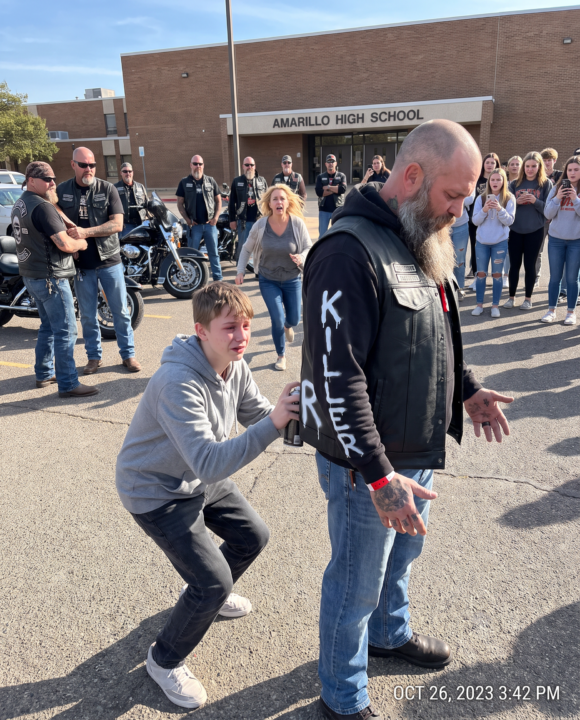
Then I painted his vest.
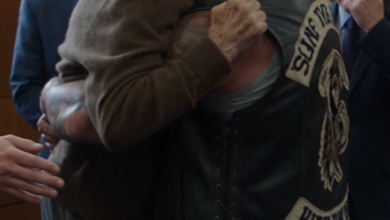
As Hammer listened to Nurse Evelyn describe the trust, he ran one thumb across the wet R in KILLER.
I asked why he had kept returning to our street every March.
He removed the brass key from his Harley.
It was not our truck key.
It opened a safe-deposit box.
Dad had arranged the box two weeks before the crash. He had been investigating something connected to the unidentified SUV, something he had not trusted the local rumor mill to handle.
Inside were photographs, a broken headlight fragment, and a handwritten plate number.
Hammer had known the evidence existed for ten years.
He had also known whose vehicle it identified.
The SUV belonged to the father of one of the Iron Lanterns.
Part 5 — What Hammer Chose Over His Patch
The vehicle belonged to Walter Cole, Andre’s father.
Walter owned a regional paving company and served on two county boards. Ten years earlier, he drove a gray SUV matching the paint recovered from the guardrail. He had been returning from a private poker game outside Vega when Dad’s pickup swerved.
Dad recognized him.
So did Hammer.
For several seconds after the crash, Walter stopped on the opposite shoulder. Hammer saw the damaged headlight and part of the plate beneath the rain. Walter looked toward the ditch.
Then he drove away.
Dad had suspected Walter of operating company vehicles after drinking. Two weeks before the crash, he photographed the SUV outside a bar and recorded its plate, intending to report him if it happened again. He placed copies in the safe-deposit box and gave the key to Mom.
After Dad died, Mom could not find it.
She assumed it had been lost in the wreck.
It had not.
Dad slipped it into Hammer’s palm inside the ambulance.
“Box,” he whispered.
Hammer spent months wondering what the word meant. He eventually matched the brass key to a bank logo, found the box using Dad’s papers, and opened it with my mother present.
The evidence was enough to reopen the investigation.
It was not enough to prove Walter had caused the crash beyond doubt. The SUV had been repaired and sold. The plate photograph established ownership but not the driver. Walter denied being there.
Andre believed Hammer.
His father ordered him to choose family.
Andre chose the club.
Walter retaliated by telling customers that Dawson Diesel employed criminals. He persuaded the property owner to terminate Hammer’s garage lease and threatened to expose the club’s members’ old convictions.
The Iron Lanterns fractured.
Three men left because they believed Andre should protect his father. Two thought Hammer had hidden the evidence to control the club. Another accused him of using Dad’s death to turn himself into a martyr.
Hammer surrendered his back patch.
“Not asking brothers to inherit my war,” he said.
Andre placed the patch on the table between them.
“Ain’t yours alone.”
The case remained unresolved until Walter died of a stroke four years later. In his safe, Andre found a body-shop receipt dated the morning after Dad’s crash. It listed repairs to a front headlight, passenger mirror, and gray bumper.
Taped behind the receipt was a handwritten note.
Tell Ray he was right. I saw the truck go down. I kept driving.
Walter had not admitted striking Dad. He admitted leaving.
That was enough for Andre to separate from his father’s business, but not enough for a prosecution against a dead man. Mom decided not to publish the note. She wanted me to remember Dad’s life, not spend my childhood inside a fight no court could finish.
Hammer carried a copy behind his vest pocket.
That was the stiff document I had noticed before painting him.
When he handed it to me, I expected hatred in Andre’s face. Instead, the club president looked tired.
“My father left your father in that ditch,” he said. “Hammer made me face it.”
“Why are you still riding together?”
Andre glanced toward Hammer.
“Because he didn’t make me become my old man.”
The statement landed harder than any accusation.
Hammer could have destroyed Andre’s family. He could have publicized Walter’s note, rebuilt his reputation, and exposed the man connected to Dad’s death.
He chose silence because I was a child, Mom wanted privacy, and Andre had already lost the father he believed he knew.
Silence protected everyone except Hammer.
I stared at the word on his vest.
My anger had been built from accurate fragments arranged in the wrong order: Hammer followed Dad. He argued with him. He was present at the crash. Blood covered his hands. He missed the funeral. Money came from his account.
Every fragment was true.
The story they formed was false.
I asked about the trust. Nurse Evelyn opened the cardboard box and spread ten years of statements across the scholarship table.
Hammer had contributed $46,800.
The Iron Lanterns had added $31,400 through memorial rides and repair events. Investment growth brought the education fund to $93,217.
It could cover college, trade school, paramedic training, or any accredited program I chose. Hammer had refused to attach conditions.
The trust did not even require me to graduate on time.
“What if I’d dropped out?” I asked.
“Money waits,” Hammer said.
“What if I never went to college?”
“Then it helps you build something.”
“What if I hated you forever?”
His eyes settled on the paint.
“Wouldn’t change the paperwork.”
Nurse Evelyn handed me the first cashier’s check. Hammer’s signature appeared beneath the purchaser line. The date was two days after he left the veterans’ hospital.
He had walked directly from discharge to the bank.
The first deposit was not $4,800.
It was $4,843.17.
The extra $43.17 came from everything in his wallet the night Dad died: two twenties, three ones, a dime, a nickel, and two pennies.
He kept nothing for gasoline.
Switch had pushed the Harley to the bank after the engine ran dry.
My mother finally spoke.
“Your father saved Ray once,” she told me. “Ray spent ten years believing that meant he owed us everything.”
Hammer shook his head.
“No debt.”
“Then why?”
He looked toward Dad’s photograph displayed beside the scholarship certificates.
“Man asked.”
That was all.
No speech.
No demand for forgiveness.
I picked up the leather cut. The wet paint had dried into a rough white crust. I carried it toward the maintenance sink outside the gym.
Hammer followed but stayed several steps away.
I turned on the faucet.
The word would not wash off.
The leather absorbed it.
I scrubbed until white water ran over my fingers, yet the deeper strokes remained inside the cracks.
“I ruined it,” I said.
Hammer took the vest from me.
“No.”
He turned it inside out. The ONE MORE MORNING patch was sewn above Dad’s folded note. Beside it were the ten visitor badges, the donor bracelet, Walter’s confession, and a small photograph of me riding a bicycle at seven.
“You finished it,” he said.
Then he put the vest back on with KILLER still visible.
Part 6 — One More Morning
Hammer wore the painted vest to my graduation.
Mom asked whether he wanted a clean cut. Andre brought one from the clubhouse. Hammer refused both offers.
The white letters had faded to gray, but they remained legible beneath the afternoon sun. Some parents stared. Others recognized the social-media photograph and lifted their phones.
Hammer stayed near the parking lot.
He did not enter the family seating area until I walked out and handed him Dad’s spare graduation ticket.
“You don’t owe me that,” he said.
“I know.”
He sat beside Mom.
When my name was called, the V-twin engines remained silent. The Iron Lanterns had parked eleven motorcycles along the far fence, but Hammer had asked them not to start a celebration until every graduate had crossed the stage.
Afterward, I accepted the Daniel Reed Memorial Scholarship.
I did not call Hammer a hero.
He would have hated that.
I said the fund had been built by mechanics, veterans, roofers, nurses, truck drivers, and one man who understood that keeping a promise could require accepting hatred without surrendering kindness.
Hammer looked down at his boots.
Andre pretended to cough.
That summer, I began working mornings at Dawson Diesel. Hammer never treated me like a charity case. I swept floors, cleaned tools, and learned that a socket returned to the wrong drawer could produce ten minutes of creative profanity.
At noon, he taught me engines.
At four, he taught me to ride.
He used Dad’s old pickup to haul a battered Harley Sportster into the garage. The truck had been repaired after the crash and stored for years because Mom could not bear to sell it.
Hammer had bought it from the insurance salvage yard.
He kept it covered.
The first time I sat behind the wheel, I found the original hazard switch still scratched from Dad’s final two flashes.
Hammer waited outside the open door.
“Want me to stay?”
“Yes.”
He nodded once.
Every March 18, we now meet beside the Route 66 drainage ditch. We do not place flowers. Dad disliked watching cut things die in jars.
Instead, Hammer checks the roadside emergency box the Iron Lanterns installed there. It holds reflective triangles, tourniquets, flashlights, blankets, and cards explaining what witnesses should do after a crash.
Then he makes one deposit into the trust.
Ten dollars.
The amount no longer matters. The ritual does.
One more morning.
One more promise kept.
The word on his vest has changed too. After three years of rain, sun, road dust, and leather oil, most letters have nearly disappeared.
Hammer will not repaint them.
He will not remove them either.
“They leave when they’re ready,” he says.
Part 7 — The Name Beneath the Paint
Four years after graduation, I finished paramedic training.
I could have chosen college. The trust gave me that freedom. But every time I imagined useful work, I saw my father crawling into a ditch for a stranger who smelled of whiskey and gasoline.
Hammer attended my certification ceremony wearing the same vest.
Only the K and the final R remained clearly visible.
I told him it looked ridiculous.
He answered, “Kid painted it crooked.”
After the ceremony, I returned the unused portion of the trust. Hammer refused the check. Nurse Evelyn refused it too.
The documents stated that any remaining money would support children who lost a parent in a highway accident, regardless of whether their families rode motorcycles.
The fund had never been mine alone.
Dad’s request had grown.
During my first month on an ambulance crew, we responded to a motorcycle crash west of Amarillo. The rider was unconscious beneath a guardrail. His cut frightened the new technician beside me, and the smell of alcohol drifted from his clothes.
For one second, all the old fragments assembled themselves.
Biker.
Bottle.
Crash.
Guilt.
Then I remembered the overpass.
The rider’s blood contained no alcohol. A broken bottle from a passing garbage truck had soaked his jacket after the motorcycle went down.
Accurate fragments.
Wrong story.
We stabilized him and transported him to the same hospital where Dad died. Hammer arrived before midnight because the injured rider belonged to no club and had no emergency contact.
He sat on the corridor floor.
Same boots.
Same beard, now mostly gray.
Same scarred hands wrapped around bad coffee.
I lowered myself beside him.
“You staying all night?”
“Man shouldn’t wake alone.”
At sunrise, the rider opened his eyes.
Hammer stood, stretched his aching back, and walked toward the exit without waiting for thanks. The vest creaked across his shoulders. The remaining gray paint caught the fluorescent light.
Before he reached the door, I called his name.
Not Ray.
Not Mr. Dawson.
“Hammer.”
He stopped.
I handed him a new patch I had made from a strip of Dad’s repaired truck seat. Four words had been stitched into the dark vinyl:
HE STAYED UNTIL MORNING.
Hammer read it twice.
Then he gave me his vest.
I sewed the patch beneath the last surviving letters of KILLER, not over them. The accusation remained part of the leather, but it no longer controlled what anyone saw first.
Outside, Hammer started his Harley. The V-twin struck once, twice, then settled into that heavy uneven pulse I had heard outside my childhood window every March.
He rode toward Route 66.
This time, I rode beside him.
Follow our page for more powerful biker stories about misunderstood riders, hidden sacrifices, and the promises they keep long after the highway goes quiet.