The Biker Pulled a Disabled Student from Her Wheelchair and Let It Crash Down the Stairs—One Month Later, She Led His Entire Club from a Hand-Built Harley Sidecar
Part 2 — The Girl Who Refused to Be Carried for Photographs
My name is Leah Morgan, and my daughter had spent most of her life explaining that a wheelchair was not the saddest thing about her.
The saddest thing, according to Tessa, was adults crouching beside her for photographs without asking.
She was seven when a driver ran a red light and struck our car outside Columbus. The collision killed her father, fractured two of Tessa’s vertebrae, and damaged her spinal cord.
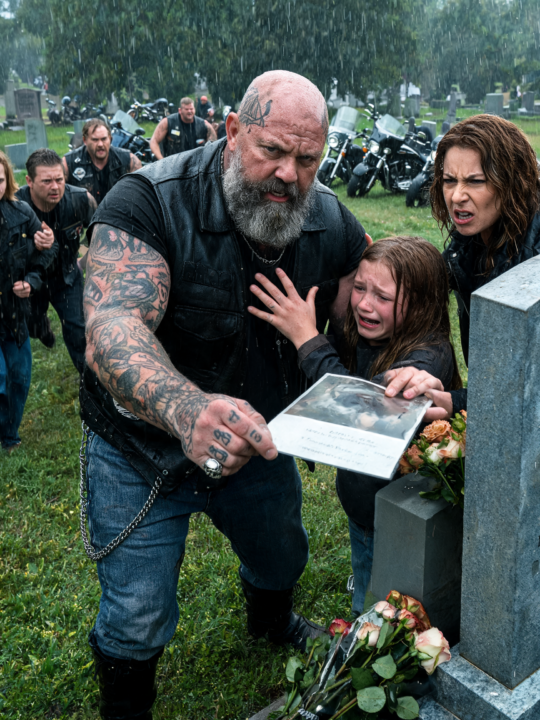
Doctors called the injury incomplete because she retained sensation and limited movement below her waist.
That word gave relatives unrealistic hope.
They treated every muscle twitch as evidence that Tessa might eventually become the person she had been before the crash. Rehabilitation became a countdown toward walking instead of a process of learning how she could live now.
Tessa resisted.
At nine, she fired a physical therapist who repeatedly described a wheelchair as “giving up.” At eleven, she joined adaptive basketball and learned to turn fast enough to make cautious adults gasp.
At fourteen, she began studying mechanical drafting because equipment fascinated her.
Wheelchairs were full of engineering compromises invisible to people who never used them. Seat angle affected breathing. Axle position changed turning effort. One loose caster could transform a doorway into a collision.
Tessa understood her chair as part of her movement, not part of her body.
That distinction mattered.
Touching the wheelchair without permission felt different from touching her, but neither was casual. Moving it while she sat inside could remove control as quickly as grabbing someone’s shoulders.
Hammer learned the same lesson from his son.
Owen Dawson was twenty-one when a training vehicle overturned at Fort Hood. The accident damaged his lower spine, leaving him with full arm strength and no functional movement below his waist.
Hammer flew to Texas believing his job was to remain strong.
He performed strength badly.
He lifted Owen without asking, answered doctors’ questions before Owen could speak, and modified their house while his son remained in rehabilitation.
Owen returned home to find ramps, grab bars, lowered counters, and a bedroom moved downstairs.
He hated half of it.
Hammer took the rejection personally.
“I built everything you need,” he said.
“You built everything you need to feel useful,” Owen answered.
The words split them.
For three months, they communicated through Bishop, the Iron Lantern road captain. Bishop delivered tools to Owen and food to Hammer while telling each man the other remained unbearable.
Repair began inside the garage.
Owen wanted to ride again, but transferring onto a motorcycle seat required assistance and created pressure risks. Standard sidecars could carry passengers, yet few allowed a full wheelchair to roll inside securely.
He began drawing.
His first design resembled a metal box attached to a Harley. Hammer called it a coffin with suspension.
Owen called Hammer’s Road King a sofa with exhaust pipes.
They started working together.
The sidecar needed a rear-entry ramp, a docking system connected to the wheelchair frame, lateral supports, a five-point occupant restraint, rollover protection, independent braking, weather shielding, and enough suspension travel for uneven roads.
Owen also wanted control.
He designed an accessible panel for communications, horn, route indicators, and an emergency engine-kill request. The motorcycle operator retained physical control, but the sidecar rider could signal decisions rather than sit as cargo.
Their drawings improved.
Then money stopped the project.
Certified fabrication and testing cost more than Hammer could afford. The Iron Lanterns offered club funds, but several members opposed taking liability for an experimental passenger system.
Brotherhood divided.
Owen believed the club saw his wheelchair before seeing his engineering. Hammer defended the members’ safety concerns, creating another wound between father and son.
They stopped building.
Six months later, Owen died from a pulmonary embolism, a known risk after spinal-cord injury. He had complained of chest discomfort that morning but dismissed it as muscle strain.
Hammer found him inside the garage beside the unfinished sidecar frame.
A brass compass lay open on the workbench.
Owen planned to lead the first route himself.
After the funeral, Hammer locked the garage. He placed the blueprints and compass inside his vest, where road vibration softened their folded edges over thirteen years.
The Iron Lanterns established an adaptive-riding fundraiser but never finished Owen’s design.
Bishop suggested it twice.
Hammer refused twice.
Completing the sidecar without Owen felt like stealing a destination from the man who drew it.
Then Tessa entered Beckford High’s engineering fair with her own blueprint.
She did not know about Owen. She had created the design after organizers rejected her request to join the Iron Lanterns’ annual scholarship ride.
The insurance carrier would allow her at the starting event but not inside the convoy because no approved passenger equipment met her transfer needs.
Tessa responded the way engineers respond to closed doors.
She drew another entrance.
Her design contained mistakes, but one feature Owen’s plans lacked: the entire restraint platform could detach, allowing it to serve as an emergency mobility base if the wheelchair became damaged during travel.
She had designed around the fear Owen never wrote down.
What happens if the chair fails away from home?
At the top of the school stairs, that question stopped being theoretical.
Hammer heard the axle crack because he had spent years listening to mechanical failures. He pulled Tessa free because he knew metal could be replaced.
He also knew being carried without permission could leave an injury no X-ray showed.
After placing her in the backup chair, Hammer apologized before anybody thanked him.
“I’m sorry I grabbed you.”
Tessa studied the wreckage below.
“I’m not.”
“You might be later.”
“Probably.”
She was.
Both truths remained.
Part 3 — Five Seconds before the Wheel Came Off
The school’s engineering fair occupied the upper lobby because the gymnasium had flooded during a roof repair. Display tables narrowed the path toward the elevator and left the stairwell threshold dangerously crowded.
Tessa hated the arrangement.
Her chair fit between the tables, but students repeatedly stepped backward into her path while discussing projects. Teachers moved poster boards without noticing how each adjustment reduced her turning space.
At 1:36, Tessa left her display and headed toward the elevator.
Hammer watched from Owen’s old blueprint booth, where Iron Lantern members judged mechanical projects for a vocational scholarship.
Tessa’s chair made a soft clicking noise.
She had heard it all week.
The repair company inspected the wheelchair three days earlier after she reported rear-wheel wobble. A technician tightened the quick-release receiver without removing the plastic axle cover.
He marked the chair safe.
Tessa trusted the report because she needed to trust somebody. A replacement chair cost more than our car, and insurance review could take months.
Hammer did not know any of that.
He saw the left wheel tilt inward at the top, then return.
Motorcycle wheels taught him to watch alignment rather than noise. A bearing might complain for miles, but sudden lateral movement meant metal or mounting hardware had stopped holding load correctly.
“Tessa.”
She glanced toward him.
The chair continued rolling.
The plastic cover concealed the axle sleeve, but its outer edge shifted relative to the frame. Hammer saw a thin crescent of rust appear and disappear.
“Stop.”
Tessa gripped both push rims.
The right wheel slowed.
The left did not.
A fracture passed through the remaining axle wall. The wheel folded outward, steering the chair toward the staircase.
Students stood behind her.
Hammer could not pull the wheelchair backward without risking the wheel collapsing beneath Tessa. He could not reach the brake levers because the frame had already rotated away.
He chose the person.
One arm moved behind her shoulder blades. His other hand passed beneath her thighs, and he lifted upward while turning his hips away from the stairs.
Tessa left the seat.
The wheelchair did not stop.
Its right caster struck the metal threshold and pivoted sideways. The chair paused for less than a second, balanced between the floor and the first step.
Then gravity took it.
The first impact broke the left wheel loose. The second folded a footplate. The frame struck the railing, rotated, and fell toward the lobby.
Noise filled everything.
Metal. Shouting. Books hitting tile.
Hammer tightened his hold while Tessa fought him instinctively. One elbow struck his jaw.
He tasted blood.
He did not release her.
Mr. Collins arrived after the chair crossed the threshold. He saw Tessa struggling in a biker’s arms and reacted before asking questions.
The rolled poster struck Hammer’s shoulder.
Security seized the back of his vest. Hammer turned his scarred hands outward, showing he held no weapon and would not fight.
“Bring a chair,” he said.
“Put her down.”
“Floor’s concrete.”
“You took her from her wheelchair.”
“Wheelchair took itself.”
The sentence sounded cruel in the moment.
Tessa understood it first.
“He caught me,” she said.
Her voice ended the physical struggle but not the fear. Security maintained its grip until the nurse arrived with a transfer board and backup wheelchair.
Hammer asked Tessa where she wanted his hands during the transfer.
That small question changed the room.
She instructed him to support her shoulders while the nurse handled her hips. They lowered her into the loaner chair without twisting her back.
Then Hammer walked downstairs.
He did not inspect the mangled frame first. He collected Tessa’s medication pouch, phone, and schoolbooks from the landing.
Her blueprint remained caught beneath one bent side guard.
He freed it carefully.
The axle lay six feet away. Dark discoloration covered roughly three-quarters of the fracture surface, showing that fatigue damage had developed gradually.
The final break appeared bright and fresh.
Hammer sealed the piece inside a clear evidence bag provided by the school nurse. He photographed the repair label and asked Principal Hargrove to contact the wheelchair manufacturer before allowing anyone to discard the chair.
The principal resented his tone.
“You created a scene that could have injured students below.”
“Stairwell was clear.”
“You could not know that.”
“I looked.”
“You also lifted a student without consent.”
Hammer glanced upward.
“Yeah.”
He would not turn necessity into innocence.
Tessa’s mother—me—arrived eleven minutes later. I saw the viral video before reaching the school.
The clip began with Hammer holding my daughter and the wheelchair crashing below. Its caption accused a biker of throwing a disabled girl’s chair down the stairs after an argument.
I entered ready to attack him.
Tessa stopped me.
“Mom, the axle broke.”
I inspected her body before listening. No new pain. No skin injury. No head impact.
Then I looked at Hammer.
He stood beside the fractured axle with a red mark across his jaw where Tessa struck him.
“Did you pull her out?”
“Yes.”
“Did you push the chair?”
“No.”
“Would she have gone with it?”
Hammer looked toward the lower landing.
“Yeah.”
That single word removed the air from my chest.
The wheelchair manufacturer sent an investigator the following morning. The axle sleeve had failed from a fatigue crack worsened by corrosion.
The repair contractor should have removed the cover during Tessa’s inspection. Records showed the technician completed twelve inspections across town in ninety-three minutes.
He never removed any wheels.
The contractor suspended him, but the investigation uncovered a larger problem. Technicians were paid per completed visit, rewarding speed rather than careful work.
Tessa’s repair request had become a checked box instead of an examined machine.
The school district immediately inspected every student mobility device with family consent. Four wheelchairs needed urgent repairs, including one with a failing caster fork.
Hammer’s action saved more than Tessa.
Yet public opinion remained divided.
Some insisted he should have stopped the chair without touching her. Others argued disabled people were not allowed to criticize rescuers.
Tessa rejected both versions.
“He saved me,” she said during a school meeting. “He also took control of my body because there was no time. I can be grateful and still need him to understand what that felt like.”
Hammer sat in the back row.
“I do,” he said.
Then he handed her Owen’s folded sidecar plans.
Part 4 — The Workshop Hammer Had Kept Locked
Owen’s workshop opened three days after the accident.
Hammer stood outside for nearly an hour with the brass key inside his fist. Bishop, Cody, Tessa, and I waited behind him without offering encouragement.
Some doors become heavier through time.
When the lock finally turned, the scent of old gasoline, dry rubber, rust, and trapped dust moved into the morning air.
An unfinished sidecar frame occupied the center of the garage. Welding marks ended midway along one support, while a temporary plywood floor had collapsed near the rear ramp.
Owen’s wheelchair measurements remained written across a whiteboard.
Hammer touched nothing.
Tessa rolled inside using a temporary chair supplied by the manufacturer. She studied the frame, the welds, and the accessible control panel drawn across a cardboard template.
“This isn’t safe,” she said.
Hammer almost laughed.
“No.”
“The ramp angle would high-center my footplate.”
“Yep.”
“The frame’s too narrow for modern chairs.”
“Yep.”
“Owen knew that?”
“Eventually.”
Tessa placed her blueprint beside his.
The designs resembled one another only in purpose. Thirteen years of improved docking systems, suspension components, wheelchair-restraint standards, and sidecar engineering separated them.
Hammer wanted to combine the plans and begin cutting steel.
Tessa stopped him.
“Who certifies it?”
He named a motorcycle fabricator.
“Who tests the wheelchair restraint?”
Hammer remained silent.
“Who checks passenger protection?”
Silence again.
She folded her arms.
“You saved me from one uninspected machine. Don’t put me inside another.”
The words reached the entire club.
Hammer had intended to build the sidecar himself because craftsmanship was his language of grief. He believed careful hands and love would make the machine safe.
Tessa required evidence.
They contacted Dr. Priya Shah, an adaptive-equipment engineer who had worked with veteran transportation systems. She agreed to review the design only if a licensed sidecar manufacturer handled structural calculations and independent inspectors tested the final assembly.
Insurance approval required additional documentation.
The one-month deadline seemed impossible.
The Iron Lantern charity convoy was scheduled in thirty-two days. Tessa wanted to lead it because the ride funded accessible equipment inspections after her wheelchair failure.
Bishop recommended postponing.
Hammer objected.
Tessa surprised both men by supporting Bishop.
“I’d rather miss one ride than become the reason everybody copies an unsafe build.”
Hammer stared at Owen’s frame.
His son had once accused the club of using safety as an excuse to exclude him. Hammer feared repeating that mistake.
Dr. Shah explained the difference between delay and denial.
“If the standard changes only because the passenger uses a wheelchair, that is discrimination. If the same crash loads, restraints, braking requirements, and inspection rules apply, that is engineering.”
Tessa added one condition.
She would participate in every design decision affecting her position, transfer method, communication, visibility, and emergency release.
Nobody would build a container around her and call it access.
The new sidecar began with a certified production chassis compatible with Hammer’s Road King. The club modified it beneath manufacturer guidance, adding a widened rear-entry ramp, anti-slip surface, wheelchair docking station, redundant tie-downs, occupant harness, padded roll structure, independent brake, suspension adjustment, and weather cover.
The platform could detach as Tessa’s drawing proposed.
The control panel included a horn, intercom, navigation display, route signals, and an illuminated request switch allowing Tessa to tell Hammer to stop.
She insisted the stop request be large enough to hit with either hand.
Owen’s brass compass was mounted behind clear impact-resistant material, visible but removable.
Hammer wanted to weld Owen’s initials onto the frame.
Tessa refused visible memorial markings.
“I don’t want people seeing me and thinking I’m riding inside somebody else’s grave.”
Hammer left the room.
Bishop found him beside the Road King, gripping the handlebars until his scarred knuckles turned pale.
“She’s right,” Bishop said.
“Didn’t say she wasn’t.”
“Then why’d you leave?”
“Because being right hurts sometimes.”
Brotherhood faced another test when costs exceeded the club’s fund. Several members proposed reducing professional testing or using a cheaper latch system.
Hammer rejected both.
He sold two restored motorcycles from his private collection. Bishop redirected the club’s anniversary party budget.
Cody organized legal fabrication work during evening shifts.
Nobody cut safety.
The first static test revealed flex near the rear ramp hinge. Hammer wanted to reinforce it immediately, but Dr. Shah required recalculation before modifications.
He waited.
The second test passed.
During the first road trial, the sidecar brake engaged too aggressively and pulled the motorcycle right. The convoy date stood four days away.
Hammer suggested reducing braking force manually.
Tessa said no.
They replaced the actuator and repeated the test.
The motorcycle passed inspection twelve hours before the scheduled ride.
Yet one decision remained.
Who would lead?
Club tradition assigned the road captain’s motorcycle to the front. Bishop held that position.
He removed his captain patch and placed it before Tessa.
“Borrowed,” he said. “One day.”
Tessa touched the patch but did not attach it to her clothing.
“I don’t need the title.”
“What do you need?”
“The route.”
Bishop handed her the map.
She revised three turns to avoid rough railroad crossings and selected rest points with accessible bathrooms.
Then she gave Hammer Owen’s brass compass.
“Mount it where both of us can see.”
For thirteen years, Hammer had carried the compass beside his heart.
Now it pointed through a windshield.
Part 5 — The Convoy That Waited for Her Signal
Ride morning began at 5:40 beside Mae’s Riverside Diner.
Forty Harleys formed two rows beneath a gray Ohio sky. Riders checked tires, lights, fuel, radios, and the spacing required around Hammer’s sidecar.
Tessa arrived in her repaired wheelchair.
The manufacturer had replaced the entire axle assembly, while the contractor paid for independent inspection and a backup chair. Tessa checked the quick-release pins herself before leaving our van.
People gathered to watch her transfer.
She hated that.
The sidecar’s rear ramp lowered with a controlled hiss. Tessa rolled forward, aligned her chair with the docking guide, and locked into place without anybody lifting her.
A green indicator confirmed the primary dock.
Cody connected two redundant restraints. Tessa tested the emergency release, harness, intercom, horn, stop request, and navigation display.
Hammer waited beside the motorcycle.
“Ready?” he asked.
“No.”
He did not start the engine.
She adjusted one lateral pad, tightened her shoulder strap, and checked the compass.
“Now.”
The V-twin turned over.
Its low rumble traveled through the sidecar frame. Tessa felt vibration beneath her chair, across the docking platform, and into the hands resting on her push rims.
She smiled.
Not because the motorcycle made her free.
That word was too easy.
She smiled because the machine responded to a decision she controlled.
Bishop gathered the riders for briefing. Tessa delivered the route through the intercom system, explaining speeds, railroad crossings, accessible stops, and the hand signal indicating medical assistance.
No one called the plan inspirational.
They called it clear.
At 7:00, Tessa raised her left hand.
Hammer released the brake.
The Road King and sidecar moved first, while forty motorcycles waited until she cleared the diner entrance.
Then came the engines.
The convoy traveled south on Route 17, passed Beckford High, crossed the county line, and stopped at three schools receiving grants for mobility-equipment inspections.
Students gathered along sidewalks.
Some cheered for the bikers. Others pointed toward the sidecar.
Tessa ignored cameras and watched the navigation display.
At the first railroad crossing, she signaled a lower speed. Hammer obeyed without debate.
At the second stop, a reporter asked how it felt to have Hammer “give her a motorcycle experience.”
Tessa corrected him.
“He didn’t give me a ride. We built transportation.”
Hammer stood behind her and said nothing.
That silence showed how far he had traveled.
The convoy’s final destination was the rehabilitation center where Owen once received therapy. Staff placed his unfinished sidecar sketches inside the lobby beside Tessa’s completed engineering plans.
Hammer initially resisted displaying them.
Tessa insisted because failures belonged in the record.
Owen’s frame was too narrow. Tessa’s first ramp angle was wrong. Hammer’s initial braking adjustment failed testing.
The finished machine existed because none of them hid what did not work.
At the center, Tessa met a twelve-year-old boy named Jordan who used a powered wheelchair after muscular dystrophy weakened his arms.
He wanted to sit inside the sidecar.
Hammer began explaining why the docking system would require different hardware.
Tessa interrupted him.
“Ask what he wants first.”
Jordan did not want to ride that day. He wanted to study the controls because he designed video-game steering systems.
Tessa lowered the sidecar panel and let him inspect it.
Hammer watched from several feet away.
Owen had once asked for engineering partnership while his father kept offering physical help. Tessa was teaching him the same lesson again.
The convoy raised enough money to inspect 186 mobility devices across five districts. Seven required urgent repairs, including two failing wheel bearings and a cracked footplate mount.
The repair contractor restructured technician pay, ending quotas based entirely on completed visits. Families received full inspection reports with photographs of covered components.
Beckford High widened the engineering-fair route and installed a barrier near the staircase threshold.
No one waited for another five-second rescue.
At the end of the ride, Tessa asked Hammer to stop near Owen’s workshop.
She rolled down the ramp and entered alone.
The unfinished sidecar frame remained inside.
“Why keep it?” she asked.
Hammer examined the incomplete weld.
“Used to think finishing it meant leaving him.”
“And now?”
“Now I think hiding it left everybody.”
Tessa proposed converting the frame into a testing rig for student designs. It would never carry a passenger, but young engineers could use it to study ramps, docking geometry, and failure points.
Hammer agreed.
The first student to work on it was Jordan.
Owen’s unfinished machine became a place where other ideas learned not to fail.
Part 6 — The Chair at the Bottom of the Stairs
Tessa’s destroyed wheelchair was never repaired.
Investigators released it after the insurance case closed, and Hammer expected us to discard it. Tessa asked the school to preserve the broken axle and one twisted frame section.
They were mounted inside the engineering lab behind clear shielding.
A photograph showed only the fracture surface.
No image displayed Hammer carrying Tessa. She refused to let her body become the exhibit.
Students learned to distinguish the dark region of an old fatigue crack from the bright edge of final failure. They practiced documenting equipment without claiming expertise beyond their training.
The display ended with one question:
What did the machine try to tell us earlier?
Tessa visited the lab every Thursday. She helped students inspect wheel alignment, caster movement, brake engagement, fasteners, and unusual sounds.
Licensed technicians handled actual repairs.
Hammer handled coffee.
He and Tessa continued arguing about the sidecar. She wanted a lighter weather canopy, while Hammer believed Ohio rain required something resembling truck armor.
Dr. Shah mediated.
The canopy became lighter.
Each month, the Iron Lanterns hosted an accessible design workshop inside Owen’s reopened garage. Wheelchair users, engineers, mechanics, occupational therapists, and students shared the same tables.
The club’s leather cuts did not grant authority.
Experience did not replace consent.
Hammer kept a hand-lettered rule above the welding bench: Nothing about us without us.
He had copied the phrase after Tessa explained its history in disability advocacy. His lettering leaned badly, but she would not let him repaint it.
Owen’s brass compass remained mounted inside the sidecar during rides. Between events, Hammer removed it and carried it inside his vest.
He no longer kept the blueprints there.
The originals stayed in the workshop, unfolded beneath protective glass where people could study them.
Bishop resumed his road-captain role, but Tessa planned every route involving the sidecar. She checked accessible stops, road surfaces, construction zones, and restroom entrances.
Riders learned to wait for her signal.
On the anniversary of the stairwell incident, the club did not hold a rescue celebration. Tessa considered that idea unbearable.
They performed inspections instead.
At noon, she and Hammer visited the staircase. The repaired barrier stood at the upper threshold, and students moved around them without noticing.
Hammer looked toward the lower landing.
“Still hate being carried?”
“Yes.”
“Still glad I did it?”
“Yes.”
He nodded.
Both answers fit.
They listened briefly to the ordinary hallway—shoes, lockers, laughter, rolling wheels, and no sound of failing metal.
Then Tessa turned away first.
Hammer followed.
Part 7 — The Road Captain in the Sidecar
Four years later, Tessa entered an engineering program specializing in mobility systems and vehicle accessibility.
She arrived at college inside her wheelchair.
Hammer transported the sidecar separately because Tessa refused to turn move-in day into a motorcycle parade.
He complained.
She won.
The Iron Lanterns still organized one convoy each autumn, and Tessa continued leading from the sidecar whenever her schedule allowed.
The machine accumulated scratches along its ramp and mud beneath its fender. Hammer repaired every mark until Tessa told him useful equipment should look used.
After that, he repaired only what affected safety.
Owen’s compass developed a small vibration inside its mount. Hammer removed it, added a thin rubber seal, and asked Tessa before reinstalling it.
She noticed the question.
He noticed that she noticed.
Neither mentioned it.
During her final ride before leaving for college, the convoy stopped outside Beckford High. New students gathered near the accessible entrance, while Mr. Collins stood beside the stairwell barrier.
Tessa lowered the sidecar ramp and rolled onto the pavement.
A freshman named Ava approached using a power chair. She asked whether the sidecar made Tessa feel normal.
Tessa glanced toward Hammer.
“No.”
Ava looked disappointed.
“It makes me feel included,” Tessa continued. “Normal was never the design requirement.”
Hammer lowered his head to hide a smile.
Before departure, Tessa gave Bishop his road-captain patch back. She had kept it inside the sidecar storage compartment for four years without wearing it.
Bishop closed her fingers around it.
“Still borrowed.”
Tessa placed the patch beside Owen’s compass.
Then she rolled into the sidecar, secured the dock, fastened her harness, and tested the controls.
Hammer mounted the Road King.
He waited.
Forty engines idled behind them, their uneven V-twin rhythm moving through the pavement like distant thunder.
Tessa studied the route map.
She raised one hand.
The convoy moved only then.
Leave “SIDECAR” below for another chapter, and follow the page for more biker stories about courage, brotherhood, and people who build a place for others beside them.
The road opened beside her, not ahead of her.