Forty Bikers Stopped for a Little Girl Selling Lemonade to Buy Her Mother Dinner — Then One Rider Recognized the Necklace She Was Wearing
Part 2
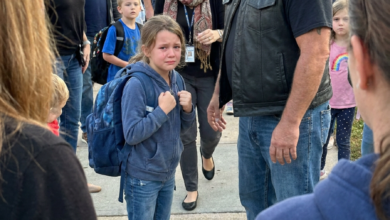
For a minute after Ruby asked that question, nobody touched the lemonade.
Mara crouched beside her daughter, though the brace made the movement awkward. “Yes,” she said. “This is Ray.” She gave Ruby no description to go with my name. No warning, no story, no instruction to forgive me. She stood again and looked at the volunteer, whose name was Mrs. Alvarez, to thank her for watching the stand.
I was grateful Mara had not asked Ruby to come to me. I would not have deserved it, especially after frightening her.
Grady led our riders away from the table. It took some work to move forty people without turning it into a spectacle. One brother rolled his bike farther down the street. Another asked the woman filming to leave Ruby out of the video. She lowered her phone, though I had no way of knowing what she might already have recorded.
Donna, who had raised two sons and had very little patience for men making children manage adult feelings, came over to me.
“You recognize the mother?”
“Yes.”
“And the girl?”
“I’ve never met her.”
Donna studied my face. “Then don’t make up the rest.”
That was fair. I had done enough of that years before.
Mara and I had met when she was working the morning counter at a diner outside Carthage. I repaired motorcycles at a shop half a mile away. She learned that I took my coffee without sugar. I learned she kept a spare pair of socks in her car because she hated working a whole shift with wet feet.
By the following summer, we were sharing a small house. I bought the moon necklace for her birthday. It was not expensive, but I had worked an extra Saturday to pay for it. At the jewelry shop, I dropped my toolbox against the wrapped box while loading the bike. The blue enamel chipped before the gift ever reached her.
Mara wore it that night. “Now I’ll know which one is mine,” she said.
At the time, that sounded like the start of something.
Then I hurt my back at work. The prescribed pain medication did its job for a while, and I pretended not to notice when I began taking more than directed. I grew short-tempered. I missed shifts. I spent money we needed and told Mara I would straighten things out next week.
I kept moving the date.
One evening, after she refused to lend me money, I slammed a kitchen chair into the wall. I did not strike her. I said that to myself for years as though it settled what she had experienced while standing on the other side of the room.
She left a few days later.
I lost that house, went through treatment, relapsed once, and eventually stayed sober. Grady was one of the men who helped me through the part where promises had stopped meaning anything. I had lived in Lebanon for seven years and worked at our club’s repair shop for five.
Mara knew none of that as far as I was aware. I knew nothing of the eleven years she had spent raising Ruby.
When she finally approached me, Ruby stayed with Mrs. Alvarez. Mara did not smile.
“Thank you for apologizing to her,” she said.
“She’s all right?”
“Her neck is fine. You scared her.”
“I know.”
She looked toward the riders. “She asked about the motorcycles. I told her some people ride in groups.”
“That’s all?”
“What else was I supposed to tell her before today?”
There was no accusation in the question, but I heard one anyway. I started to say that she could have found me. The words reached the back of my teeth and stopped. Mara had left a man who broke furniture in front of her. I could not ask her to justify keeping her distance from him.
Instead, I asked about the wrist brace. She said she had fallen at work six weeks earlier and was recovering. She had recently moved to Lebanon for a food-service job with steadier hours; the injury had interrupted that plan. Ruby heard her worrying about groceries and arranged the lemonade stand with Mrs. Alvarez.
“She was not supposed to tell strangers why she needed the money,” Mara said, glancing toward her daughter. “But I’m not angry with her for trying.”
The church had a food pantry. Mrs. Alvarez reminded Mara it would open the next morning and offered to bring a bag over that evening. Mara thanked her, then said she wanted to see what they already had at home. Pride, perhaps. Or simply the wish to make one decision herself after a bad afternoon.
I had questions about Ruby that I could barely hold inside my chest. Mara saw them. She asked me not to ask in front of her daughter.
Before she left, I bought one cup of lemonade at the marked price. I put the change Ruby gave me into my pocket. I did not give her a hundred-dollar bill or tell her everything would be fine.
Ruby watched me carefully as I took the cup.
“Is it good?” she asked.
“It is.”
She narrowed her eyes. “I didn’t put enough sugar in the first batch.”
“This one’s good,” I said.
Mara guided her toward the car. Ruby took the jar and the damp grocery list. The silver moon had disappeared beneath her shirt, but I could still see the shape of it when she climbed into the passenger seat.
Grady came over once the sedan was gone. “You want to tell me?”
“I knew her mother.”
He waited.
“A long time ago.”
Grady looked down the road where Mara had driven. “That girl knew your name.”
I turned the paper cup in my hand until the rim bent.
That was when I began to understand that Mara had not simply carried the necklace away. She had carried some version of my story into Ruby’s life, and I did not know which version the girl had heard.
Part 3
On Monday morning, I went to the shop early and failed to repair a motorcycle I knew how to repair.
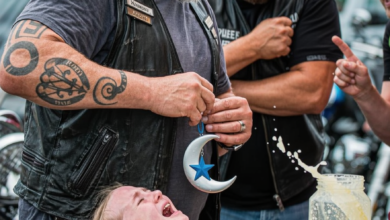
The same bolt lay on my bench for twenty minutes. Every time I picked up a wrench, I saw Ruby backing away from me. I could still feel the brief pull of the necklace chain between my fingers.
Grady came in at eight. “Go apologize again if Mara agrees to it,” he said. “But leave the kid out of whatever answer you’re chasing.”
“I apologized.”
“You spoke. She was crying. Those aren’t always the same thing.”
He was right. I set the wrench down.
I did not have Mara’s number. Mrs. Alvarez had given Donna permission to pass along hers, but only for a message about the video. The woman who recorded us had posted a short clip. It showed my hand near Ruby’s throat, lemonade falling and Grady pulling me back. It ended before my apology.
There were comments beneath it that I did not read twice.
Donna called Mrs. Alvarez while I stood beside her. We asked whether Ruby’s face could be blurred or the clip removed. Mrs. Alvarez said she would speak to the woman who posted it. Then, after a pause, she told Donna that Mara had accepted a pantry bag and had gone to a scheduled follow-up for her wrist.
That was all we needed to know. Mrs. Alvarez was not there to report on them for me.
By afternoon the video was gone. A few people had already saved it, but no one I knew shared it again. I hoped Ruby would never see the comments.
That evening, Mara called the shop. She said Ruby wanted to know why I had looked so upset at the necklace. Mara had told her it used to belong to her.
“What did you tell her about me?” I asked.
“Enough that she knew your name. Not enough to put my decisions on her.”
I sat on a stool beside the parts washer. “Can we talk?”
“Just us. At the diner tomorrow. In public.”
We met after her appointment. Mara wore the brace and had cut her hair shorter than when I knew her. She ordered iced tea. I ordered coffee and left most of it untouched.
The first thing she told me was that Ruby had slept well and had returned to school. The second was that the lemonade money had paid for bread, eggs and fruit. She did not say it to make me feel better. She said it because Ruby’s purpose had been real, even if the day had gone badly.
I asked about the pantry bag. Mara said it helped, and then asked me to stop reviewing the family’s groceries like a foreman checking inventory.
“I’m sorry,” I said.
She leaned back. “You’ve said that twice in ten minutes. Give me a minute to know which thing you mean.”
I let her have it.
Mara explained the practical part of their situation. She had moved to Lebanon for a cafeteria job scheduled to begin before school started. She injured her wrist during temporary kitchen work, missed several weeks of pay, and had been living on smaller checks while paperwork for assistance moved slowly. She was returning to light duties, but the next pay period was still ahead.
It was a tight stretch. She had not told Ruby they were out of food, because they were not. She had been stretching meals and saying she had eaten earlier. Ruby had noticed.
“She notices everything,” Mara said.
I thought of the carefully folded grocery list.
Then Mara told me what I had waited to hear without knowing whether I had the right.
She learned she was pregnant after she left me.
I gripped the underside of the table. A server moved past with a tray of burgers. At the next booth, someone laughed. The diner continued while I tried to make sense of a sentence that had changed eleven years of my life.
“Is Ruby—”
“She might be yours,” Mara said. “Based on the timing, I believe she is. I didn’t want to tell her something as fact without knowing. And I wasn’t going to put an infant into the life you were living then.”
I looked at her. “I got sober.”
“I can see that you’re sober now.”
“Years ago.”
“I didn’t know when. For a long time, I didn’t want to check.”
That hurt. It was also an answer I understood.
I asked whether she had tried to contact me. She told me she called my old number once after Ruby was born. It had been disconnected. She kept a letter for a while but never mailed it. Each month she waited made the next one harder; eventually waiting became the way they lived.
I could have argued about all the years I missed. Mara could have answered with the night I broke the chair. We would both have been talking about ourselves while an eleven-year-old girl stood at the center of the question.
“Does Ruby know?” I asked.
“She knows you were important to me once. She knows we parted when things weren’t safe or steady. She knows you may be her father.”
I stared at her.
“She asked last night,” Mara said. “After the stand. I answered her.”
The old false ending had already happened in my head: find Mara, learn Ruby was mine, fix what I could. But Ruby had been told before I sat down in that diner. She was somewhere making her own sense of it, without knowing whether I would stay, what I would ask of her or whether she wanted any of it.
Mara slid a damp paper napkin toward me because I had crushed mine in my fist.
“Before you make plans,” she said, “you need to know what Ruby asked me after that.”
I waited.
“She asked whether meeting you meant she had done something wrong by being afraid of you.”
Part 4
I drove home with Mara’s question repeating in my head.
Ruby had seen me reach for her necklace. Now she was being asked, through no choice of her own, to consider me as a father. If I rushed toward her because I wanted eleven missing years back, I would teach her that my feelings still came first.
I called Mara the next morning. “Tell Ruby she was right to pull away,” I said. “She doesn’t have to trust me because we might be related.”
Mara was quiet for a moment. Then she said she would tell her.
We agreed to meet at the church on Saturday, with Mrs. Alvarez there, if Ruby wanted to come. I spent the week looking for something I could bring her and rejected every idea. A stuffed animal would be strange. A new necklace would be worse. Donna suggested I bring nothing and show up when I said I would.
“I can do that,” I told her.
“Do it more than once.”
On Saturday, I parked my Harley a block away. Ruby noticed anyway; she had already learned its low idle. She sat at the end of a church picnic table with Mara beside her and Mrs. Alvarez near the door.
I stopped a few feet away. “Hi, Ruby.”
“Hi.”
For several minutes we spoke about the lemonade. She said the first batch had been too sour. I told her she had been right about it. She asked whether the forty riders were all my friends.
“Some of them,” I said. “A few are like family.”
She rubbed the blue star on her pendant with her thumb. I kept my eyes on her face.
Then Ruby asked, “Why did you grab it?”
I told her about the screw beneath the table. I also told her that I could have asked before reaching.
“It looked like you wanted to take it,” she said.
“I know. I won’t touch it again.”
She considered that. Then she wanted to know how I knew it was the same necklace. I described the chipped enamel. Mara told her the toolbox story, including how angry I had been with myself for damaging a gift before I gave it.
Ruby looked at her mother. “You never told me he was clumsy.”
Mara said, “I’ve been saving some stories.”
It was the first time I saw them laugh together while I was there. I did not join in. I was too busy realizing that the moon had not been kept in a locked box as proof of a lost romance. It had lived an ordinary life with them. Ruby wore it to school and rubbed its chipped edge when she was nervous.
When Mrs. Alvarez took Ruby inside to get water, Mara told me another part of the story.
Years earlier, Ruby had found the necklace in Mara’s dresser and asked who gave it to her. Mara answered that a man named Ray had given her a good gift during a difficult time. As Ruby grew older, Mara told her a little more. She had never used me as a threat or a promise. She wanted Ruby to have a story she could ask about when she was ready.
“She asked to wear it this year,” Mara said. “It helped when we moved.”
I thought Mara had kept the necklace because she had not let go of me. I had missed what it had become for her daughter: a familiar object from home when almost everything else was changing.
Ruby returned with three paper cups of water. She put one in front of me, then sat on the opposite end of the bench. The space between us was hers to set.
Mara explained that a parentage test was possible if Ruby wanted a clear answer. She had already spoken with a local clinic about the process. Ruby looked at the three of us and said she did want to know, but she did not want to do it that day.
“All right,” Mara said.
I said the same.
Ruby frowned. “What if it says you’re not?”
“I’d still be the man who scared you at your lemonade stand,” I said. “And I’d still owe you a better second meeting.”
That made her smile despite herself.
The next weeks had fewer dramatic moments than I expected. We met once at the library, where Ruby showed me a book about deep-sea animals. I learned she liked drawing houses with far too many windows. She learned I could rebuild an engine but could not remember the names of three fish she had just taught me.
At the second meeting, she asked Mara if I could come to the school art display. At the third, she asked me directly. I went, stood in a crowded hallway and found her drawing. It showed the lemonade table beneath a large gray cloud, with forty tiny motorcycles parked along the road. In the drawing, the girl behind the table was smiling.
I was not sure whether that meant she had forgiven me. I did not ask.
Ruby eventually decided she wanted the test. The clinic explained consent and collected the samples with Mara present. I paid my portion. Nobody made an announcement to the club. I told Grady only that I might need a quiet room when the result arrived.
Three weeks later, Mara called. She asked me to come over after Ruby’s homework was done.
When I reached their apartment, Ruby had set three cups on the kitchen table. Mara held an unopened envelope. She put it down between us, but before either adult touched it, Ruby rested her hand on top.
“If it says he’s my dad,” she asked Mara, “does that mean I have to call him Dad?”
“No,” Mara said.
Ruby looked at me for the same answer.
“No,” I told her. “Your name for me is your choice.”
Only then did she move her hand.
Part 5
The test said I was Ruby’s biological father.
I read the result twice. Mara read it once, then sat back as if a question she had carried for eleven years had finally been put down. Ruby watched both of us instead of looking at the paper.
“Are you surprised?” she asked me.
“A little,” I said.
She knew I was lying. “You thought so already.”
“I hoped I knew. That’s different.”
Ruby nodded as though that was an answer she could use. Then she took the envelope, asked Mara where the result was written and read it for herself.
I expected to feel something clean and certain. Instead, I felt happiness beside grief, and shame close behind both. The paper told us who I was to Ruby biologically. It did not tell us whether I could learn how to be useful in her actual life.
Mara understood that before I did. She asked Ruby whether she wanted us to talk together or whether she wanted a break. Ruby chose a break. She took her drawing pencils to her bedroom and left the door open a few inches.
At the kitchen table, Mara and I spoke softly. She had not asked for help with rent or a new arrangement overnight. She wanted us to find out what Ruby could comfortably handle, and she wanted practical support that would still be there after the shock wore off.
I told her I wanted to contribute regularly. We agreed to speak with a family-law adviser about recording parentage and support properly. Neither of us wanted a handshake arrangement that might become another uncertainty for Ruby. Mara also wanted to know how any changes would affect the assistance application she had already started. I had not thought of that.
There was much I had not thought of.
The next afternoon, I told Grady. He listened in the shop office while a fan rattled in the window.
“So,” he said, “you have a daughter.”
“Yes.”
“What does she need this week?”
I had no answer ready.
Grady pointed through the glass at a row of motorcycles awaiting repairs. “Start smaller than eleven years, Hammer. What does she need this week?”
School pickup on Thursday, Mara had mentioned. A new pair of sneakers soon, Ruby had said after outgrowing hers. Groceries, while Mara returned to full shifts. I wrote those down, then called Mara to ask which she wanted me to handle. She accepted the Thursday pickup after checking with Ruby. She preferred to buy the sneakers with her daughter herself. For groceries, she suggested a shared list rather than my arriving with bags she had not requested.
For years I had told myself I would do anything to repair what I had broken. It turned out that “anything” was easier to say than “Thursday at three-fifteen, and ask before buying milk.”
There was another difficulty. Ruby had not kept our meetings secret, and the old video had traveled farther than I knew. A parent recognized me outside school and asked Mara whether she felt safe allowing me near her daughter. Mara answered that I was there at her request. Later she told me she hated having to explain our family to a stranger, but she understood why the woman had asked after seeing that clip.
I wanted to defend myself. Instead, I remembered Ruby stumbling against the cooler. A few seconds on a phone showed something frightening because, for a few seconds, I had frightened her.
I began attending a support meeting again. I had not relapsed, but I needed somewhere to say what I could not put on an eleven-year-old: that I was afraid one mistake at the stand would become the only thing she remembered about me, and that trying too hard might become another mistake.
Donna knew more than the others. She had watched me at the stand and had been there for our first meeting at the church. One evening she asked how Ruby was.
“She calls me Ray.”
“That’s your name.”
“I know.”
“You sound disappointed.”
“I’m not. I just catch myself waiting for something I haven’t earned.”
Donna gave me a look over her coffee. “Then stop waiting for a word. Keep your Thursday.”
Thursday came with heavy rain. Mara texted to say Ruby would be released through the covered side entrance instead of the front. I arrived early in my truck, because Ruby had told me she did not like getting on a motorcycle in the rain. I brought no surprise gifts. There was a towel on the seat in case her backpack was wet.
She climbed in and immediately asked whether the truck’s clock was wrong.
“Four minutes fast,” I said.
“Why don’t you fix it?”
“It gets me places early.”
“You still got here twenty minutes early.”
“I know.”
She buckled her seat belt and looked through the rain at a row of children waiting for rides. Then she asked me about Mara.
“Do you still love my mom?”
I kept both hands on the steering wheel. I could have given her an answer about the past, about regret, about what seeing Mara again had stirred up. None of that belonged in a child’s lap on the way home from school.
“I care about her,” I said. “She and I will work out our own feelings. You don’t have to.”
Ruby watched the windshield wipers for a while.
“Good,” she said. “Because I already have homework.”
At their apartment, Mara opened the door with her wrist brace gone. She saw that Ruby was dry, took the school notice from her backpack and thanked me for the ride. Ruby went inside without a hug. Then she came back.
“Can you do next Thursday?”
“Yes,” I said. “If you and your mom want me to.”
She nodded once and disappeared down the hall.
That was how the test result began to change our lives: not at the moment we opened the envelope, but on a rainy Thursday when Ruby asked whether I would come back.
Part 6
By October, Mara was back on a regular work schedule. The assistance paperwork was resolved, and Ruby’s lemonade jar moved from the kitchen counter to a shelf above the refrigerator. There was no sudden fortune, no new house, no crowd waiting to celebrate us. Mara worked, Ruby went to school, and I learned which entrance opened when it rained.
Some weeks were easy. Some were not.
Ruby had questions at inconvenient times. Once, while we were assembling a bookshelf, she asked whether I would have liked her when she was a baby. I set the screwdriver down because I knew an answer meant to reassure her could easily sound like I was asking her to comfort me.
“Yes,” I said. “I would have liked you.”
She fitted a wooden peg into the wrong hole. “You don’t know. I cried a lot, Mom says.”
“Then I would have learned what helped.”
She examined me for a moment, then handed me the peg to fix.
Mara and I also had things to say that were too old for Ruby. We said them in the evenings, outside the apartment or over coffee while she was with Mrs. Alvarez. I apologized for the chair. Mara told me how long afterward she flinched when something fell in a kitchen. I listened. She did not ask me to turn that conversation into a promise about us.
I had spent years remembering our last argument as a scene in which she left. Hearing her account made me remember that I had given her a reason to.
The club adjusted around us. Grady stopped asking how I felt and began asking whether I could still cover my shifts. Donna kept an extra child-sized helmet at the clubhouse after Ruby asked to see the bikes up close; nobody put it on her or started an engine until Mara approved. Ruby preferred the workshop anyway. She liked the drawers of labeled bolts and the little tray where lost screws collected.
One Saturday, she found me cleaning an old carburetor at the bench. The moon necklace lay on top of her sweatshirt.
“Mom says you gave her this before I was born,” she said.
“I did.”
“Do you want it back?”
“No. I gave it to her.”
“She gave it to me.”
“Then it’s yours.”
Ruby turned the chipped tip between her fingers. “It helps me remember our old apartment. I wore it the first day at my new school.”
I had spent the summer assigning meaning to that moon. First it was proof that Mara had kept a part of us. Then I thought it was a clue to Ruby’s parentage. Ruby had her own reason for wearing it, one she had chosen long before she met me.
I asked whether the clasp ever caught on her shirt. She said it did. I offered to have a jeweler check the chain, with Mara’s permission and with Ruby there to watch. She agreed. At the shop, she chose a sturdier clasp and insisted the chip remain exactly as it was.
When the jeweler asked whether the pendant had been damaged recently, Ruby glanced at me.
“Before I was born,” she said.
The necklace came back in a small paper envelope. Ruby put it on herself while Mara checked that the clasp sat comfortably. I kept my hands at my sides.
A month later, the church held a fall fair in the same parking lot where we had met. Ruby asked to sell lemonade again, though the weather was cold enough that Mrs. Alvarez suggested warm cider too. Mara helped set up the table. I carried the cooler from the car and left the cups for Ruby to arrange.
The first customers were three riders from our club. Ruby counted out their change without rushing.
Then she saw me watching the loose screw beneath the table.
“We fixed it,” she said.
I looked. She was right. Mrs. Alvarez had replaced it before the fair.
Ruby folded her arms, pleased with herself. “You can stop worrying about the moon.”
I wanted to tell her I had been worrying about much more than that. Instead, I bought a cup of cider and let her keep the right change.
Part 7
Near closing time at the fall fair, Ruby’s hands were red from the cold. Mara told her to put the lid on the cider urn while I carried the empty cooler to the car. Around us, volunteers took down folding tables and brushed fallen leaves from the church steps.
Grady arrived with two riders. He bought the last cup of lemonade even though Ruby warned him it was cold.
“Your money,” she said.
He drank it. His face tightened, and Ruby laughed.
I stood a few feet away, listening to their motorcycles settle into the ordinary sounds of the parking lot. That was new for me. For years, I had treated the roar of forty engines as the answer to most things. It could get people to stop, look up and come together. It could not make a child feel safe by itself.
Ruby called me over to help with the jar. Its lid had stuck after someone spilled cider on the rim. I loosened it and handed it back without opening it for her. She counted the bills while Mara put away the cups.
“What will you buy?” I asked.
Ruby shrugged. “Maybe a present for Mom. Maybe nothing yet.”
She had learned that money could wait on a shelf. I was glad of that.
Mara came beside me as Ruby returned the jar to her bag. We had spoken often since August, but not about becoming a couple again. Some of our conversations were warm. Others ended with both of us needing a walk. We were raising Ruby together as carefully as we could; neither of us owed the other a different ending.
“You’re on for Thursday?” Mara asked.
“Three-fifteen. Covered entrance if it rains.”
“She has an art project to carry.”
“I’ll make room in the truck.”
Mara nodded. There was an ease to the exchange that I had once thought only grand apologies could bring. It had come from smaller things: arriving, listening, asking, returning.
Ruby joined us with the cooler’s last loose paper cup in her hand. She offered it to me, then stopped.
“Ray,” she said, “were you scared when Mom got out of the car that day?”
“Yes.”
“Me too.”
“I know.”
She leaned against Mara, looking at the row of bikes. Then she held out the cup again. Inside was a single coin she had kept separate from her sales.
“It’s from the first lemonade you bought,” she said. “I gave you the wrong change. I owe you a quarter.”
I had carried that change home in my pocket and never counted it. Ruby had. She pressed the quarter into my palm and closed my fingers over it, the way a child does when she wants you to keep something small.
The blue star rested against her yellow sweatshirt. Its chipped edge caught the late light.
If you want more biker stories where the first impression is only the beginning, follow this page for the roads, families and second chances still ahead.
Ruby took Mara’s hand. We walked to the car together.