Next part: I Pulled an Eight-Year-Old Girl Off a Bridge Railing and the Whole Town Called It Child Abuse — Three Seconds Later, the Railing Fell Into the River
Part 2
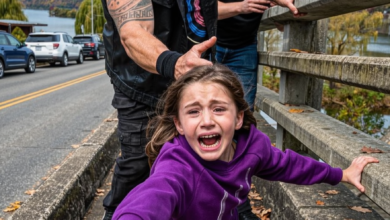
The sound was the railing coming apart.
The post Ellie had used tore loose first. A length of upper rail followed it, wrenching the neighboring section sideways before both pieces fell into the Graystone River. They struck the water with a sound I heard over the cars braking behind us.
Ellie lifted her face from Jo’s coat.
The space where she had stood was open.
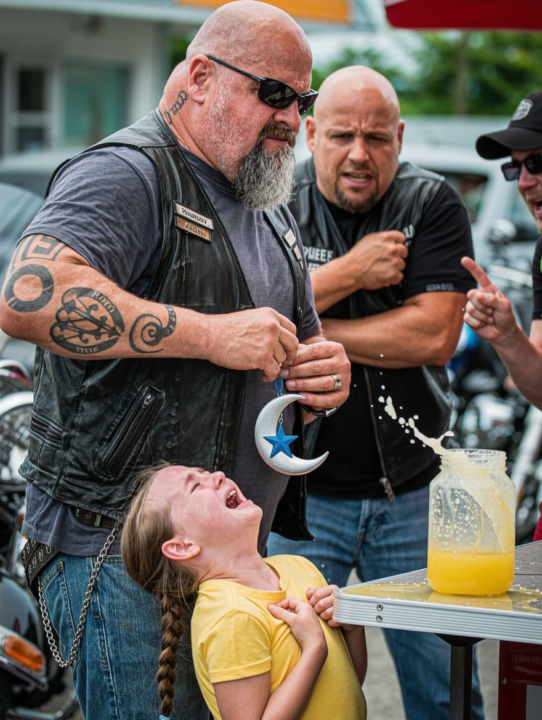
Jo pulled her farther along the walkway. I told the 911 dispatcher the rail had fallen and gave her the nearest street entrance so responding officers would not drive into the stopped traffic. A driver got out to help; I asked him to warn people approaching from the other end. He took one look at the gap and went.
Someone on the bridge counted aloud afterward. Depending on where they started, people said the rail fell two or four seconds after I pulled Ellie down. The city camera would put it at three. At the time, I had not been counting. I was checking whether Ellie’s knee was still bleeding and whether she could stand.
The first officer to arrive moved everyone off that stretch of walkway. A second officer stopped cars at the bridge entrance. Jo gave her name, Ellie’s name and her brother’s phone number. The officer asked me to stay nearby for a statement.
I did. I also called Grady, my club president, because my motorcycle was blocking part of the narrow approach and I was shaking too hard to ride it home.
I am not proud of how frightened I was. I had acted before I was certain the railing would fail. Now it had failed, and the thought of what three seconds could have changed kept taking the strength out of my legs.
Ellie’s name was Eleanor Hayes. Everyone called her Ellie. Jo was her father’s sister, and they had spent the morning at the riverfront park. Jo had gone to a nearby cart for bottled water while Ellie stayed at a picnic table within sight. When she turned back, Ellie was walking toward the bridge.
Jo had followed immediately. Traffic slowed her at the crossing. By the time she reached the walkway, I had already pulled Ellie down.
“I should’ve been closer,” Jo told the officer.
The officer did not offer an opinion on that. He asked her to call Ellie’s father.
An ambulance crew cleaned Ellie’s knee, checked her head and asked how she had landed. She had a scrape and bruising, but she was alert and answered their questions. Jo chose to take her for a medical evaluation with the crew. Before they left, Ellie asked me whether I could see her bracelet in the water.
“No,” I told her.
She looked at the broken gap. “It was right there.”
“I know.”
She studied my face for the first time without trying to get past me. I could not tell whether she was beginning to understand what had happened or was only thinking about the bracelet. An eight-year-old should not have had to sort out both at once.
Grady arrived with his truck. He looked at the gap, then at my motorcycle and my hands. “You call the shop?” he asked.
“No.”
“I’ll cover it. Give your statement.”
Grady did not tell the officers we were good men. He did not ask them to skip questions because I had apparently saved a child. He rolled my Harley away from the traffic, waited beside me and let them work.
I told the officer I had seen movement at the base plate. A city public-works supervisor came to the bridge and crouched several feet from the break to look at the remaining posts. She did not touch them. Orange barriers were placed at both ends of the walkway, and by late afternoon the bridge was closed to traffic.
That should have settled what strangers thought they saw. It did not.
The man at the pickup had filmed from behind me. His clip began as I reached Ellie, showed her fall, and ended while she was still fighting to get back to the rail. He had stopped recording before it broke. The video reached a local page that evening with a caption calling me a biker who had attacked a child.
I watched eleven seconds of it once.
There was Ellie crying on the concrete. There was my arm around her. There was no view of the loose post, no crack, and no river. Anyone seeing only those seconds had reason to ask what I had done. Some people asked. Others decided they knew.
At six that evening, Ellie’s father called from the hospital. His name was Daniel Hayes. He wanted to know whether I was the man who had pulled his daughter down. When I said yes, he asked me to meet him the next morning.
His voice was controlled. That made it harder to tell what he believed.
Before he hung up, I heard Ellie ask him for the bracelet. He told her they would talk about it when she had eaten.
Then Daniel came back on the line.
“She thinks you took it,” he said.
Part 3
I met Daniel outside the hospital cafeteria.
He was thirty-eight, worked as a bus mechanic, and had grease caught in the lines of his hands even after washing them. He had not slept much. Ellie had been examined and discharged the previous evening with instructions for cleaning her knee and watching for symptoms after a fall. Jo was with her at home.
Daniel put two coffees on the table but did not sit until I did.
“I saw the video,” he said.
“I figured.”
“I also saw the bridge after they closed it.”
He turned his cup by the cardboard sleeve. I waited. He was Ellie’s father; he was allowed to take his time with the man who had hurt her while pulling her to safety.
“She says you took Mom’s bracelet,” he said. “Did you touch it?”
“No. I saw it caught on the outside of the rail. I couldn’t reach it.”
“She says she left it there.”
“Was it there before yesterday?”
“No.” Daniel looked at me across the table. “She meant she put it down for a second before it slipped.”
He told me Ellie’s mother, Caroline, had died eleven months earlier after an illness. Daniel had given Ellie Caroline’s silver bracelet in a small cloth pouch a few weeks before the bridge incident. It had a blue glass bead and a flat moon charm. The clasp needed repair, so he had asked Ellie to keep it in the pouch rather than wear it.
At the park, she took it out to show Jo. Jo had said they would put it back after buying water. Ellie heard “after” as the sort of adult answer that means something may never happen. She put the bracelet on the picnic table while opening the pouch. When a gust lifted the cloth, she snatched at it and knocked the bracelet away.
It skidded across the path and came to rest beyond the bridge rail. Ellie went after it before Jo could cross the road.
The night before, Daniel said, Ellie had also asked him to fix the clasp. He had told her they would do it another day. That was the “before” Jo heard when Ellie cried, You said that before. No one had known the bracelet was on the bridge until Ellie climbed up to reach it.
Daniel rubbed both eyes with the heels of his hands.
“I’m telling you because I don’t want you thinking she meant to jump.”
“I don’t.”
“She asked if people think that.”
“I haven’t told anyone she did.”
He nodded. For a few moments we drank coffee that had already gone lukewarm.
I told him what I had seen: the rust flake, the post shifting, Ellie’s foot coming up onto the lower bar. I told him where I had grabbed her and how my boot had slipped. I did not soften the part where her knee hit the ground.
Daniel said the scrape hurt when she bent it. He also said she had drawn me that morning with arms as long as the whole bridge. He almost smiled when he said it, then looked troubled by the smile.
“I’m glad you got her down,” he said. “I’m angry she got hurt. I’m trying to hold both.”
“I am too.”
Outside, rain started against the cafeteria windows. I asked whether Ellie would be willing to hear me apologize once she was ready. Daniel said he would ask her, and that the answer might be no.
The online video continued moving. By noon, a customer at our repair shop had called to ask whether he should collect his motorcycle before the police came. Another canceled a job. Grady handled both calls without telling the men what to think. He had seen only part of the incident himself. He wanted the investigation to finish.
I wanted the same thing. I also wanted to stop strangers from using Ellie’s face to argue about me.
Donna, another club member, found a post showing a still image of her crying. She messaged the page owner and asked him to remove or blur the child’s face. He refused at first. Later that evening, after Daniel contacted him too, he replaced the image with a view of the bridge.
That small change mattered more to Daniel than any defense of my reputation.
The city had a traffic camera mounted above the east approach. A police investigator called to tell me it covered the walkway. Officers were reviewing it with public works. I asked when people would see the full sequence. The investigator could not promise any release; Ellie was a child, and her family’s privacy came before my wish to clear my name.
I understood. Daniel did not owe the internet a video of his daughter falling just because a different video had spread.
On Monday, a city engineer inspected the closed bridge. The damage was worse than the missing section. Corrosion had eaten into connections along roughly sixty meters of railing. The painted bars had looked serviceable from the road, but several base plates and anchors had lost strength underneath.
The engineer would not tell me whether every section could fail the way Ellie’s had. He told me nobody would be allowed onto the bridge to find out.
Then he mentioned something I could not put out of my mind. Public works had received a report about a loose post months earlier. The report named the Mill Street Bridge. The crew that closed it had found no record of a structural repair.
Grady had heard enough. “Let the city sort its paperwork,” he told me. “You stay away from that barrier.”
I planned to. I still had not found a way to tell Ellie her mother’s bracelet might be somewhere beneath the river, and on the second night after the bridge closed, Daniel called with another question.
“Would you know anyone who searches underwater?”
Part 4
On Tuesday morning, the city invited Daniel and Jo to view the traffic-camera recording. An investigator called me later that day to review my statement against it. I watched the footage in a small office with a wall clock that ran fast and a printer rattling behind us.
The camera was distant. It could not show Ellie’s face or the bracelet clearly. It showed her climbing, the railing post shifting as she put weight on it, and me running from beside my parked motorcycle.
It also showed where my boot slipped.
The investigator played the next few seconds without speaking. Ellie and I fell away from the railing. Jo ran in. Then the post gave way and pulled the adjoining rail down with it.
Three seconds.
I had lived inside those seconds since Saturday. Seeing them measured on a screen did not make me feel better. I kept thinking about how close Ellie’s reaching hand had been to the piece that fell.
The investigator asked me to confirm what I had said about the rust at the base. I did. The engineer’s photographs showed corrosion and a fractured connection. I was a mechanic, not the city’s bridge inspector; the official findings would come from them.
Daniel called that evening. Jo had watched the recording too. Daniel said they were willing to let the city release a short sequence if Ellie’s identity was obscured and the footage was presented with an explanation of the structural failure. He did not want the hospital visit or her mother’s bracelet discussed publicly.
“You don’t have to do it for me,” I said.
“I’m doing it because people are still walking up to that bridge to see what happened,” he answered. “They need to understand why it’s closed.”
The city released the excerpt on Wednesday, the third day after the incident. A local station showed the camera view beside the cropped phone video. The difference was plain: one recording began with my hands on Ellie; the other showed the post moving before I reached her and the railing falling after.
Some people who had called me an abuser apologized. Others deleted their posts. A few insisted the fall had been unnecessary, though none of them had been close enough to grab Ellie when the post moved. I did not search for every comment. Daniel told me he had stopped reading them too.
The larger finding came in the city’s inspection notice: approximately sixty meters of railing needed replacement or substantial repair. The entire bridge would stay closed during that work. A review of the earlier loose-post report was opened separately.
There was no satisfying villain in the paperwork I later saw. A report had been logged. A visual inspection had been recorded. No one had opened the base connection to find what was happening behind the paint. That gap in the process might have cost Ellie her life.
I thought the camera release would end my part of the story. Then Daniel brought me a photograph.
Caroline was standing in their kitchen, laughing at someone outside the frame. The bracelet circled her wrist. Its blue bead was visible near the moon charm. Daniel said Ellie kept asking whether the river had taken it forever.
He had called a river-recovery company. They could search, but the current was still running high from rain, and work crews were beginning to secure the bridge. They needed approval for a search area, a safe access point and a time when the repair crew was clear. Even then, the company could promise nothing.
“Why did you call me?” I asked.
“Because you asked what she lost.”
I told him I would pay for a properly arranged search if he wanted me to. He looked at the photograph for a long time.
“Don’t tell Ellie until there’s something to tell,” he said.
We met the dive team’s supervisor at the riverfront the following morning. She studied the photograph, the camera’s view of where the bracelet had caught, and the direction the current had been flowing when the rail fell. She described several places where a light chain might snag downstream. She also described all the reasons they might never find it.
I appreciated her honesty. Daniel looked as though he wanted a better answer, but he signed the authorization after the city cleared a limited search area.
On the first day, the divers found part of the broken railing. On the second, one brought up a chain that turned out to be a fishing lure. They stopped when visibility worsened. Daniel thanked them and went home without telling Ellie what they were doing.
That evening, Jo called me. Ellie wanted to speak to me at the church, with Daniel and Jo present. I had thought she might ask about her bracelet. Instead, when I arrived, she held up a drawing of the bridge and pointed to the place where the rail had broken.
“Did you know it would fall?” she asked.
“No. I saw it move, and I was afraid it might.”
“Then you were scared too?”
“Yes.”
She sat with that answer for a while. She still had a bandage on her knee. I wanted to say I was sorry again, but she was asking me something else.
Finally she pointed to a tiny figure she had drawn beside the motorcycle.
“That’s you before you ran,” she said. “I made you too small.”
“I looked small from where you were.”
Ellie shook her head. “I wasn’t looking at you. I was looking at Mom’s bracelet.”
On the ride home, I realized I had misunderstood what she wanted from that meeting. She had seen me as the person who stopped her reaching it. Now she wanted to know what I had seen. She was trying to put both views of the bridge into one picture.
The dive team returned for a third day. They searched the downstream side of a submerged concrete support and found nothing Ellie could hold in her hand.
Part 5
The fourth search day began cold and overcast.
I met Daniel at the river before the divers entered. He carried a thermos and Caroline’s photograph in a plastic sleeve. I brought coffee from the gas station, which he accepted without looking at the cup. By then we had spent more hours beside each other than we had spent talking.
The supervisor reviewed the search grid. On the previous day, a diver had felt a heap of branches caught against a low ledge downstream. Water had been too cloudy to sort through it safely before the light faded. They would check it once conditions allowed.
Daniel asked whether the bracelet could have traveled beyond the grid. The supervisor said yes. She did not add encouragement she could not support.
We waited behind the marked work area. The bridge rose above us with temporary barriers along its edge. Traffic was being diverted through town; every few minutes a truck braked on the longer route and sent a low sound across the water.
A diver surfaced with wire tangled in a branch. Then a bottle cap. Then nothing for nearly an hour.
I had paid for the search because I could, and because Ellie had asked for that bracelet while I was holding her away from the rail. Waiting beside Daniel, I understood how badly I wanted the river to give me an answer. Money had arranged four days of careful work. It could not make a small silver chain appear.
Near midday, the supervisor came toward us carrying a clear evidence bag. Inside it was a mud-darkened bracelet with a blue bead and a flat moon charm. The chain had caught around a branch beneath the ledge.
Daniel took off his glasses to look at it. He did not reach for the bag until she offered it.
“The clasp’s bent,” he said.
“She mentioned the clasp,” I answered.
He nodded. Then he sat on the low wall behind us and cried quietly enough that the divers kept packing their equipment without turning toward him.
We brought the bracelet to a jeweler Daniel chose. She cleaned it, documented the damage and repaired only the clasp with his approval. The moon still had fine scratches. The bead had survived. Daniel wanted Ellie to recognize it as Caroline’s, not as something made to look new.
I asked whether I could make a box for it. Daniel said yes, as long as I let him decide when Ellie received it.
At the club workshop, I cut a small piece of walnut left from an old cabinet job. I made the lid twice. The first one bound at a corner because I rushed the fit. The second closed cleanly. I lined the inside with plain blue cloth Donna found in her sewing drawer.
When Grady saw the finished box, he asked why I had spent so long on something Ellie would probably open in two seconds.
“She might keep it after that,” I said.
He ran a thumb along the lid. “Then sand this edge again.”
We delivered it to Daniel at his house, not at a club gathering. Jo was there. Ellie was at the kitchen table doing spelling homework when Daniel called her over. He placed the box in front of her and told her the search team had found something.
She opened it.
For a moment she did not touch the bracelet. She bent close to look at the blue bead and the moon, then asked Daniel whether he was sure it was her mother’s.
He showed her the photograph. Ellie set it beside the open box and turned the charm until it matched Caroline’s wrist in the picture.
“That scratch was already there,” she said.
Daniel leaned over to see which one she meant. He had not noticed it. Ellie had.
She lifted the bracelet with both hands. She did not put it on. She laid it back in the box, closed the lid, then opened it once more, as if checking that it would still be there.
“Did you go in the water?” she asked me.
“No. Trained divers did.”
“For four days?”
“Yes.”
She looked at Daniel. “You knew?”
“After Ray asked me. We didn’t know they could find it.”
Ellie nodded, then surprised me by sliding the box across the table.
I thought she was giving it to me. She was pointing out that the lid needed a place for the cloth pouch she had used to carry the bracelet. The pouch was still in her backpack. She wanted them together.
“Could you make it fit?” she asked.
I could. It meant taking the lining out and cutting the recess a little deeper. I told her I would bring it back on Saturday.
“Promise?”
I looked at Daniel before answering. He gave a small nod.
“Saturday,” I said.
Finding the bracelet changed less than strangers might imagine. Caroline did not come back. Ellie still had a scraped knee, and the bridge remained closed. But the thing she had been reaching for was no longer beneath water she could only stare into.
Two days later, I returned the box with room for the pouch. Ellie tested the lid herself, placed the pouch beside the bracelet and carried it to her bedroom. She came back without the box and asked whether I wanted lemonade.
Part 6
For two months, the Mill Street Bridge stayed closed.
The city replaced the damaged railing and repaired the adjoining sections identified in the inspection. Crews worked behind barriers while traffic used the longer road through town. The review of the earlier report took time too. Public works changed how loose-post complaints were assessed; a look from the walkway would no longer close a report where corrosion at a connection was suspected.
I knew those details from the city notices and from speaking with the engineer, not from discovering them myself. My part had lasted a few seconds on the walkway. Other people spent weeks making sure another child would not have to rely on a stranger noticing movement under a painted rail.
The phone video never vanished entirely. Once in a while someone sent it to me, usually with the camera footage attached and a sentence about being wrong. I stopped opening those messages. Ellie had her bracelet. The bridge was getting fixed. That was enough for me to work with.
Ellie was less interested in the online argument than adults were. She asked about the divers twice, mostly because she wanted to know how they could see in muddy water. She drew them in enormous helmets among fish that probably did not live in the Graystone River. The diver who had found the bracelet received her drawing through Daniel and sent back a photograph of the search boat, with no one’s face in it.
On a Saturday in October, Daniel invited me to a small gathering at the church. Mrs. Alvarez had organized a thank-you lunch for volunteers who helped direct pedestrians during the bridge closure. I arrived on my Harley and parked away from the entrance so people could hear one another at the tables.
Ellie was pouring lemonade.
She saw me stop and lifted one hand. There was no blue cloth pouch at her waist and no bracelet on her wrist. Later she told me the box was at home on a shelf beside Caroline’s photograph. She wanted to wear the bracelet someday, but she and Daniel had decided to have a sturdier safety chain fitted first.
I was glad she could decide when.
Jo came to buy a cup while I stood at the end of the table. For weeks, she had been polite with me, though I could feel the memory of seeing Ellie hurt whenever we spoke. That afternoon she asked whether I would help Daniel carry chairs inside after lunch.
“Sure,” I said.
“I watched the camera again,” she told me.
“You don’t have to.”
“I know. I wanted to see where I was when she climbed.”
I waited while she looked toward Ellie. Jo had crossed the road as fast as she could. I told her so, because it was what I had seen, not because I thought it would take away the fear.
We carried the chairs later with Daniel. Some were missing rubber feet and scraped against the floor. Ellie followed us inside with a dish towel, insisting she had been assigned to wipe the tables even though Mrs. Alvarez said the job was already done.
Before leaving, she showed me the small scar on her knee. It was healing, a pale line where the deeper part of the scrape had been.
“It doesn’t hurt now,” she said.
“I’m glad.”
She looked up. “I was mad at you.”
“You had reason.”
“I’m not mad every day.”
It was a child’s careful answer. I accepted it exactly as she gave it.
The bridge reopened several days later. I did not join the officials or the news cameras. I rode across on a weekday morning, stayed in the traffic lane and looked straight ahead until I reached the far side.
On the return trip, I parked where I had parked that first Saturday. I walked onto the repaired sidewalk and put one hand against a post. It held firm. Beneath the new paint, I could see the edges of a new base plate seated against the concrete.
I went home and got back to work.
Part 7
The following spring, Daniel asked whether I could help Ellie make a wooden stand for her drawings. She had been leaning them against Caroline’s photograph, and the corners kept curling.
I brought a few pieces of walnut to their garage. Ellie inspected them like a customer at the repair shop and chose the one with a dark knot near the edge. Daniel held the board while I marked the cuts. Ellie sanded the front until she could run a finger along it without catching a splinter.
We worked for most of an afternoon. There was no talk of the bridge until we had finished and Ellie put Caroline’s photograph on the stand. The little box sat beside it, closed.
“Mom’s bracelet is in there,” she said, though we both knew.
“It has a good place.”
She glanced at my hands. “You made that box because I thought you took it.”
“I made it because they found it,” I said. “And because you needed somewhere to keep it.”
Ellie moved the box closer to the photograph. She thought about my answer, then asked Daniel if she could show me something. He said she could if she wanted.
She opened the lid. The bracelet lay inside its cloth pouch. Ellie slipped it out just far enough to show me the blue bead, then tucked it away again. The repaired clasp had held through a few short afternoons when she wore it at home.
I had last seen that bracelet beyond a bridge railing, caught where an eight-year-old could see it and could not bear to leave it. Now she could open a box whenever she wanted to remember her mother. I had once believed bringing it back would finish the story for her. Watching her handle it, I knew it was simply one way she would carry Caroline with her.
Daniel made sandwiches. Jo came by after work. We ate in the garage with the door open to the mild air, moving the drawing stand out of the way whenever someone needed to pass. Ellie told us about a school project. I understood half of it and asked her to explain the rest.
When I left, she walked with me to the driveway. My Harley was parked beside Daniel’s car. She stood back while I put on my helmet.
“Ray?”
I looked over.
“Next time, can I show you where I got the idea for my drawing?”
“Sure. Ask your dad when works.”
She nodded and ran inside to ask him before I had started the engine.
I waited. Through the open garage door I could see Daniel listening, then checking a calendar on his phone. Ellie turned and gave me a thumbs-up. It was a small arrangement for another ordinary afternoon.
If you want more biker stories about difficult first impressions, quiet courage and the people who return after the cameras leave, follow this page for the next ride.
I started the Harley. Ellie waved from the garage.