Next part: A Seven-Year-Old Girl Smashed My Harley’s Headlight in the Middle of Town — Then She Asked Me to Hit Her if That Was What It Took to Make Me Stay
Part 2
The first officer arrived while the broken headlight was still scattered beside my front tire.
He spoke to Lucy with Nora present and me several feet away. His partner checked the street. I gave my name, showed him where I had parked and said I had seen a man in an olive cap near the pharmacy after Lucy pointed him out. I did not tell him the man was guilty of anything. I had watched him for less than a minute.
Lucy gave the officer more.
On Tuesday, she had seen the man beside the crossing near her school. On Wednesday, he was near the laundry on the route she took home. Thursday, she saw him by the pharmacy and turned toward Bell’s instead of taking the last two blocks to her apartment.
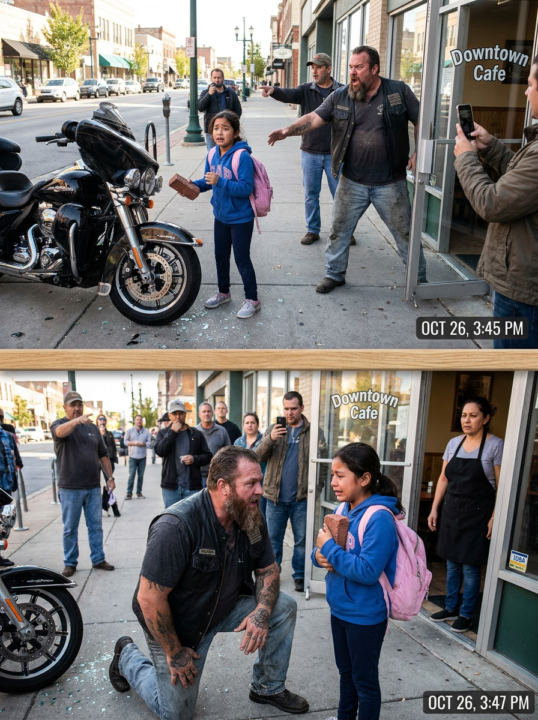
“Did he speak to you?” the officer asked.
“Once. Yesterday. He said he knew a faster way home.”
The officer wrote that down. He asked whether Lucy had gone with him.
“No,” she said. “I stayed by the other kids until he went.”
That was a decision a seven-year-old had made alone. I glanced at Nora. She was holding her phone, ready for the officers to take a copy of the recordings rather than showing them to the crowd outside.
Lucy’s mother, Elena Rivera, was reached at work. She said she was coming. The officer also called the school to verify Lucy’s dismissal arrangement. Elena had signed for her to walk home. She normally left with other students for the first stretch and continued alone for the last few blocks. No one at the school had known about the man.
I had not known any of this when I ran out of the café. I was the owner of a damaged motorcycle who happened to be standing where Lucy needed an adult. That felt like a thin piece of luck.
Nora’s security system kept footage for several weeks. At first, she thought the recording she had noticed was from the previous day. The camera’s clock ran eleven minutes slow, so the officer checked it against a purchase receipt before logging the time. He asked Nora not to play the recordings for customers or send clips to anyone. She agreed and took him into the small office behind the counter.
I sat with Lucy near the back of the café.
The crowd outside shifted whenever somebody came through the door. A woman asked if I was pressing charges over the headlight. I told her no. Lucy heard that and looked at me for the first time since the police arrived.
“Am I in trouble?”
“We’ll let your mom and the officers sort out what happens next,” I said. “I’m not asking anyone to punish you for my lamp.”
It was clumsy, but I wanted her to know the broken glass was not the reason we were sitting there.
Grady, our club president, came in after I called him to collect the bike. He is smaller than I am and has a quieter voice, which makes people underestimate him until he tells them what needs doing. I explained the damage and asked him to bring the shop truck.
He saw Lucy at the table. “Is she safe here?”
“For now. Police are checking.”
He nodded and went outside to keep people away from the glass without touching the bike. Two members of our club had been riding with him. He sent them home; a crowd of bikers outside the café would not help Lucy speak to an officer.
I have been riding with the Iron Lanterns for twenty-one years. Most days that means fixing a brother’s tire, visiting someone in the hospital or being told to eat before taking a long road. It had never meant sitting still while a child decided whether she could trust us. I found that harder than any ride.
My hands still wanted to do something.
Lucy noticed the tattoos across my fingers. “Does that hurt?”
“Not anymore.”
She considered the answer. “The light hurt your bike.”
“Yeah. We can fix a light.”
Nora brought her a grilled cheese sandwich. Lucy asked whether her mother had to pay for it. Nora said she had made too many. I could see Lucy did not believe her, but she ate half.
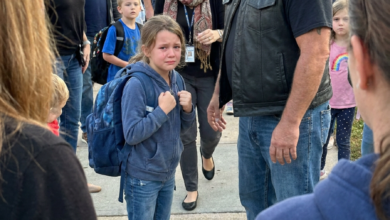
Elena arrived in work shoes with one lace untied. She stopped at the sight of the police car, then came inside looking for her daughter. Lucy ran to her and began explaining the brick before Elena could ask about the man.
“I had to make him stay,” she said.
Elena looked at me over Lucy’s head. She saw my size, the vest, the shattered bike through the window. I watched her put those details together and waited.
The officer drew her aside. They spoke privately while I remained at the table.
When Elena came back, she did not thank me. She asked Lucy why she had not told her someone was following her.
“I tried,” Lucy said. “You were leaving for work.”
Elena closed her eyes. The café’s refrigerator hummed loudly in the pause.
From the back office, Nora called for the officer. She had found a clear view of the pharmacy entrance on Tuesday, Wednesday and Thursday. The same olive cap appeared in all three recordings.
That was when the man across the street stopped being only Lucy’s frightening description.
Part 3
The officer asked Elena to remain inside with Lucy while detectives reviewed the videos.
I walked out to my motorcycle. The lens was shattered, but the lamp housing had taken most of the blow. I picked up a loose piece of glass with a shop rag so no one would step on it. Grady stopped me before I could start the engine.
“You’re not riding that home.”
“I know.”
“You look like you’re about to chase somebody.”
I put the glass into the rag. “I’m not.”
He waited until I looked him in the eye. Then he handed me the truck keys and told me to sit behind the wheel while he loaded the bike.
Grady knew my past. Years earlier, I had answered a barroom insult with my fists and paid for it with a short sentence, lost work and a long stretch of learning to walk away before anger did the walking for me. I had not hit anyone since. Seeing Lucy try to bargain for an adult’s protection had brought that old anger close enough for Grady to notice.
There was no useful place for it. The detectives had evidence to collect. Elena and Lucy needed calm people around them. I sat in the truck until I could feel my hands relax.
Later that afternoon, with Elena’s permission, an officer told me what the cameras established. The man had appeared near Lucy’s route on three consecutive school days. The recordings from Bell’s showed him at the pharmacy crossing each afternoon. Another business supplied a clearer view of his face and his movements near the school-side bus stop.
It was not proof by itself of what he intended. The police treated it as a reason to identify him and keep looking.
Lucy gave a detailed account. On Tuesday she noticed him because he wore the same olive cap as a man who had asked a driver for directions. Wednesday he offered her the “faster way.” She stayed near classmates. Thursday she saw him before the others had turned off for their homes. She crossed at a different light and came toward Bell’s.
“Why Bell’s?” Elena asked her.
“Because the motorcycle was there.”
“You could have come inside.”
“I didn’t know if they would let me stay.”
No adult had told Lucy she could ask a shop for help. She knew a person would come running for a broken headlight.
Elena sat down when Lucy said that. She worked an early cleaning shift at a medical laundry and an evening shift at a diner four days a week. Her hours had changed when a coworker went on leave. Lucy’s short walk from school had seemed manageable; Elena had checked the route with her and signed the school’s walker form.
Their neighbor used to be outside most afternoons and would watch Lucy reach the apartment building. The neighbor had injured her ankle that week and was staying with her sister. Elena knew she needed another arrangement, but believed she had a few days to make one.
She did not know Lucy had already changed her route twice.
I learned these details gradually, not while Elena was being interviewed. That day I knew only that she looked exhausted and frightened, and that every question about the walk sounded to her like an accusation. The officer told her they needed the timeline to protect Lucy. He did not ask her to defend every shift she had worked.
At about four, a detective returned to Bell’s. He had identified a man matching the recordings, but would not say more while Lucy was in the room. He asked Nora to keep the back exit clear. Another officer stood near the café entrance.
Elena pulled Lucy close.
For twenty minutes, I thought the man had left the area. Then the detective’s radio sounded. He stepped aside to listen, spoke briefly into it and walked toward the street.
The man in the olive cap was still nearby.
I stayed behind the café window with Grady. From there we could see officers moving past the pharmacy. One turned down the narrow lane behind it. Another waited by the pedestrian crossing. I saw a figure in an olive cap near a newspaper box, perhaps forty meters from Bell’s door.
Lucy saw him too.
She ducked behind Elena so quickly that her chair tipped over. Nora righted it. Grady moved in front of the window to block Lucy’s view, not because the officers needed him but because she asked him to.
The officers approached the man. There was a short exchange I could not hear through the glass. He took one step toward the lane, stopped when he saw the second officer and put his hands where they could be seen. They detained him there.
I wanted to feel that everything was over.
Instead, a detective came inside and asked Elena whether Lucy could speak with a specialist trained to interview children. He told her they had reason to believe the man was connected to an outstanding warrant in another state. Identity still had to be confirmed, and they would not ask Lucy to identify him through the window.
Lucy sat holding the empty grilled-cheese plate. “Can I go home now?” she asked.
Elena looked at the officer, then at her daughter. A man had been detained. She did not yet know whether home, two blocks away, would feel safe to Lucy that evening.
The headlight could wait. So could my bike.
Part 4
The man’s identity was confirmed that night through police records. A detective later told Elena he was wanted in another state on a warrant connected to an earlier child-abduction case. He had been arrested near the pharmacy that afternoon, about forty meters from where Lucy sat inside Bell’s.
I was not given his case file. I did not need it.
The three days of footage, Lucy’s account and the warrant were enough for police to take the matter seriously. They asked businesses to preserve their recordings and spoke with the school about the route. They did not put Lucy in front of a news camera or ask her to repeat her story to everyone curious about the broken Harley.
The next morning, I stopped by Bell’s to speak with Nora. My motorcycle was at the club workshop, and Grady had ordered a replacement headlight. At the curb, someone had already swept up the glass. The only trace of what happened was a pale patch of dust where my front tire had stood.
Nora poured coffee before I asked.
“She saved herself,” she said.
I thought of Lucy standing with the brick against her chest. “She tried every way she could think of.”
“That’s what I mean.”
I wanted to agree. I also kept thinking about how frightened she must have been to believe she needed to damage a stranger’s motorcycle before he would listen.
Elena called later. She said Lucy was home with her that day and that a school counselor had been in touch. Elena was arranging an after-school option with help from the school. She did not ask our club to take over Lucy’s walk, and I did not offer to collect her without being asked.
Then she asked whether I was making her pay for the lamp.
“No.”
“Ray, I can pay it in parts.”
“I believe you. I’m telling you I’ve got it.”
She was quiet for so long I thought the call had dropped.
“I don’t want Lucy thinking she has to break things to get help,” Elena said.
“Neither do I.”
That changed the conversation. I said I would come by with the repair invoice once it was done, so Lucy could see exactly what had happened to the bike. Elena said she would explain why breaking a light could have hurt someone, including Lucy. She wanted her daughter to understand that people could listen before things reached that point.
A week later, we met at Bell’s after school. Lucy came with Elena and the counselor’s permission. The café was open, and Nora kept our table in sight. I brought the damaged headlight unit in a cardboard box.
Lucy leaned forward to look, then pulled back. The glass had already been removed; there was no sharp edge within her reach.
“Are you mad now?” she asked.
“I was startled. I worried you’d cut your hands. I’m not mad at you.”
She touched the outside of the box. “I tried saying excuse me to a man yesterday, before the brick. He kept walking.”
I did not know that.
Lucy had approached a pedestrian near the bus stop after seeing the olive cap across the street. The pedestrian was on a phone call. He had not heard more than the first word, and Lucy had been too scared to follow him. Her plan changed when she saw my motorcycle.
That was another small piece of the three days: she had asked once. The answer had simply failed to reach an adult.
I told her she could go into Bell’s, the pharmacy, the school office or another staffed place and say plainly, “I’m scared. Please call my mom and the police.” Nora repeated that she could always come through the café door. Elena practiced the sentence with her. Lucy wanted to know whether she was allowed to say it even if she was wrong about somebody.
“Yes,” Elena said. “We can sort that out with you.”
Grady stopped in later to collect me. Lucy recognized him as the man who had stood between her and the café window while police approached the suspect. She asked whether he rode the motorcycle too.
“Different one,” he said.
“You look less scary.”
“Don’t tell Ray.”
It was the first time she laughed near me.
The club met that Sunday. Grady told the members what Elena had agreed we could share: a child had felt unsafe on a walk home, businesses had helped, and the police had handled the investigation. We did not discuss the suspect’s name or Lucy’s exact route.
Some riders immediately wanted to stand outside the school the next day. Donna, who had worked in a school office for years, stopped them.
“You cannot just arrive in leather and decide you’re security,” she said. “Parents and staff need to know who you are, where you’re allowed to stand and what you do if a child needs help.”
She was right. We could offer time. The school and families had to decide whether that time would be useful.
Before the meeting ended, I put the broken headlight on the table. Nobody suggested mounting it like a trophy. Grady asked what I was going to do with it.
I told him I did not know yet.
Part 5
Our first conversation with the school was shorter than the club meeting.
The principal, Mrs. Harper, thanked us for the offer and explained that school dismissal was not something volunteers could join by showing up. Staff had a plan for children on campus. Parents chose how their children traveled afterward. Any community effort would need clear boundaries, coordination with the district and a way to make sure volunteers were suitable to work near children.
Donna had prepared for that answer. She brought a page of questions instead of a promise: where the school’s responsibility ended, which crossings already had staff, what businesses were willing to be safe places, and how a volunteer should report a concern without following a child or confronting a stranger.
Mrs. Harper kept the page.
For a month, we worked with a neighborhood group, the school and several parents on a small pilot. Club members who wanted to participate completed the required screening and training. The district approved where volunteers could stand beyond school property. We paired people, wore plain visible vests over our riding clothes and kept our motorcycles parked away from dismissal.
That last part bothered a few brothers. The bikes were how people knew us.
“They’re not the reason we’re there,” Donna said.
The pilot covered one short walking route used by families who opted in. Two volunteers stood at agreed points at opposite ends of the stretch, outside shopfronts whose owners knew them. We did not collect children’s names, take photographs, give rides or change anyone’s pickup arrangement. If a child needed help, a volunteer brought them into a staffed business and called the parent, school or emergency services as appropriate.
On the first afternoon, almost nothing happened.
A crossing signal took too long. One volunteer got cold feet and went back to his truck for thicker socks. A third grader asked if the plain vest meant we were construction workers. I told him I repaired motorcycles. He asked if that was construction for motorcycles. I said it was close enough.
That quiet afternoon was worth more than a dramatic one.
The next week, a parent pointed out that one of our standing places was too close to the corner. A group of children had to walk around us to reach the crossing. We moved. A shop owner asked that volunteers not block her delivery door. We moved again. Some families preferred not to interact with the riders at all, and that was fine.
Lucy did not join the pilot because Elena had arranged an after-school program. I was glad she had. The route was for the children and families who chose it, not a monument to what had happened to her.
She did come to the workshop once with Elena. By then the new headlight was installed and my Harley was roadworthy. I showed her both lamps: the working one on the bike and the damaged unit resting on a shelf.
“You changed it,” she said.
“I have to see where I’m going after dark.”
She seemed relieved. Then she asked why I had kept the broken one.
“I’m still deciding.”
“I thought you would hate looking at it.”
“I don’t love remembering you were scared,” I said. “I do remember why I stayed.”
She looked at the damaged housing for a long time. “It made a loud noise.”
“It did.”
“It worked.”
“Lucy, you can ask an adult for help before making a loud noise.”
“I know now.”
Elena stood beside her, listening. She thanked me later for saying that. Lucy’s choice had protected her, but Elena did not want a story told so often that the brick became a lesson in what children should have to do.
As the pilot settled, another school asked about a route near a library. Then a parent group across town wanted to know how we had arranged screening and shop participation. We sent them our notes. We did not send a line of bikers to every school and call it a program.
The work grew slowly. Donna became better known to principals than any of our motorcycles were. She kept schedules, checked who had completed training and reminded volunteers that an uneventful day still counted. Grady covered gaps when someone was sick. I helped when my shop hours allowed, usually at the end near a bakery where the owner gave us coffee that tasted burnt by four.
One afternoon, the pedestrian from the bus stop came into my shop. He had learned from the news that Lucy had tried to speak to him that day. He wanted to know whether Elena would let him apologize.
I said I would pass along the request, nothing more. Elena chose not to arrange a meeting; Lucy did not need another adult’s guilt handed to her. She asked me to tell him that if a child interrupted him again, he should take a moment to listen.
He nodded. I believed he would.
I had expected the biggest surprise to be the wanted man’s arrest. It was not. It was watching adults learn how often a small request can be missed, and how much ordinary planning it took to make the next one easier to hear.
Part 6
Three years after the headlight broke, versions of the safe walking route operated near eleven schools.
The club did not run eleven schools. Local parent groups, approved volunteers, participating businesses and school staff carried most of the work in their own neighborhoods. Our Iron Lanterns helped start routes where we had members, shared the practical guide Donna had written and took our turns on schedules like everyone else.
Some mornings I was proud of what it had become. Other mornings I was filling out a volunteer form while a stapler jammed, and pride had very little to do with it.
Lucy was ten by then. Elena’s work hours had become steadier, and Lucy had grown tall enough that I might have walked past her at a distance if not for the same careful way she looked at a street before crossing it. I still saw them sometimes at Bell’s Coffee. Lucy liked the cinnamon rolls. Elena liked that Nora remembered her order.
The man who followed Lucy remained a matter for the courts. I did not follow his case closely, and I never gave strangers details about Lucy’s testimony. People sometimes asked whether she had identified him, as though the answer belonged to anyone buying coffee. I told them the police had done their job and changed the subject.
One day Lucy asked to see the old headlight again. I had moved it from the shop shelf to the front of a retired Harley in the clubhouse. The bike had needed more work than I could justify for road use, and I had kept it as a project before she ever picked up the brick. My riding motorcycle had a proper working lamp.
The damaged headlight on the retired bike remained cracked. I secured the loose pieces so nobody would cut a hand on them, and put a narrow strip of tape across the split. Beside it I fixed a small handwritten line:
This little girl saved herself.
Lucy read it twice.
“You wrote that about me?”
“Yes.”
“You stayed too,” she said.
“I did. You made sure I heard you.”
She touched the edge of the unbroken metal housing, well away from the glass. “I didn’t know how else.”
I had heard that sentence in different forms for three years. It still hurt. She knew other ways now; Elena and Nora had practiced them with her, and so had her teachers. But the seven-year-old at the curb had used the one idea she trusted in that moment.
Donna came into the clubhouse carrying route schedules. Lucy asked her how many people worked the walks. Donna gave a number, then immediately corrected herself because a new neighborhood team had joined the week before. Lucy looked astonished that Donna could know so many volunteers.
“I mostly know their phone numbers,” Donna said.
On the way out, Elena thanked her. Donna waved it away and asked whether Lucy had remembered her homework folder. Lucy had not. We all waited while she went back into the clubhouse to find it under the table.
That was the shape of our life after the arrest and the news cameras: schedules, wrong counts, burnt coffee, misplaced folders. The old headlight sat in the corner. Most afternoons, nobody mentioned it.
At the fall volunteer meeting, Mrs. Harper brought a parent who wanted to start a route near another school. He had heard the story about Lucy but was unsure whether bikers would make children nervous. Grady did not argue with him.
“Come watch one afternoon,” he said. “Talk to the school. Talk to the businesses. If it doesn’t fit your neighborhood, build something that does.”
The parent visited, then helped set up a route with mostly non-rider volunteers. Donna was delighted. She said the program was working best when people stopped thinking they needed motorcycles to take part.
Lucy heard that and grinned at me. “So you broke your light for nothing.”
“I believe you broke it.”
“I know.” She paused. “But you kept it.”
“I did.”
She went back to her homework before I could make the moment larger than she wanted.
Part 7
On the third anniversary of the day Lucy broke my headlight, I rode past Bell’s Coffee after my shift.
It was closing. Nora was stacking chairs inside. The curb where I had parked looked smaller than I remembered. A delivery truck stopped at the light, and for a second I heard the same low engine note that had been behind us when Lucy set the brick down.
I pulled over and went in for coffee.
Nora noticed where I was looking. “Different bike,” she said.
“Working headlight.”
“Good. I worried about you riding the other one.”
“The other one stays inside.”
She handed me my cup. Her wall clock was seven minutes slow. It always had been. I had learned that on the day police compared her camera time with a receipt, and she still refused to change it because, she said, regular customers knew what time it meant.
Lucy and Elena came in while I was there. They had been shopping for school supplies. Lucy carried a packet of colored pencils she wanted to show Nora. She was ten, nearly eleven, and no longer reached up to the counter for napkins.
She saw me and said hello as if meeting me there were ordinary. That felt right.
Elena bought two cinnamon rolls. We sat for a few minutes while Lucy described a drawing she was making for class. It showed a row of storefronts and a school crossing. She had given every person on the street a different destination.
“Where’s the motorcycle?” I asked.
“Not in this one,” she said. “It’s about walking.”
I let her explain the rest without interrupting. In her picture, the café door was open, the crossing light had changed, and two volunteers stood far enough from the sidewalk that children had room to pass. She pointed out a dog near the bakery that Nora said looked nothing like the bakery owner’s real dog.
Elena laughed. Lucy argued for the drawing. I drank my coffee.
I used to think the moment that mattered was the crash of brick against glass. It was the moment I heard her. The days after it mattered too: what Lucy told the officer, what Nora’s cameras held, the time Elena found to change her daughter’s afternoons, and the unremarkable shifts volunteers kept showing up for.
Outside, I put on my helmet. Lucy followed Elena toward their car, then turned back.
“Ray, do you remember what I said when you came out?”
I did. I had never forgotten.
“You told me I could hit you,” she said, making a face at how strange it sounded now.
“And asked me to stay.”
She nodded. “I knew you’d come out for the bike. I didn’t know if you’d stay for me.”
“I’m glad you asked.”
“I’m glad you did.”
Elena called her to the car before she could stand in the cooling air much longer. Lucy waved and went. I waited for them to pull away, then started my motorcycle and checked the beam of its working light against the pavement.
If you want more biker stories about people who are misjudged and the small choices that change a life, follow this page for the next one.
I rode home. The other headlight stayed where Lucy could see it.