Part 2: An Old Man Slashed a Biker’s Harley Seat at His Daughter’s Grave—Then Her Wedding Ring Fell from the Foam and Exposed the Promise Hammer Had Carried Across 1,842 Miles
Part 2 — The Daughter Who Married the Road Captain
I met Elise Mercer-Reyes eleven years before her death.
She walked into the Iron Saints’ garage on a Tuesday afternoon wearing blue hospital scrubs and carrying a cardboard box filled with bandages, antiseptic, gauze, and twelve handwritten instructions nobody intended to follow.
Her husband, Michael Reyes, rode behind her.
Michael was thirty-four then, a former Army medic and the calmest road captain our club had ever known. He was a broad-shouldered Mexican American man with close-cropped black hair, a quiet voice, and an irritating habit of obeying speed limits when everyone else wanted to reach breakfast.
Elise pointed at him.
“This man has been cleaning road rash with gas-station peroxide.”
Michael looked at Hammer. “She makes it sound worse than it is.”
“It is worse than it sounds,” Elise replied.
That was her introduction to the club.
Within a month, she had reorganized our first-aid cabinet, replaced expired supplies, taught CPR to twenty-three riders, and threatened to staple Preacher’s vest to his chest if he removed his wound dressing again.
Hammer respected her immediately.
Not because she was Michael’s wife.
Because she never treated the club like a collection of frightened boys trapped inside large bodies and loud motorcycles. She saw each man clearly, including the arrogance, loyalty, fear, pride, and tenderness they preferred to keep separated.
Walter Mercer did not approve of us.
He had raised Elise in a brick house outside Roanoke where every picture frame hung level and every household bill was filed by month. He had spent most of his career as a high-school principal. Rules gave him comfort. Predictability felt like protection.
Motorcycles offered neither.
When Elise introduced Michael, Walter saw the leather vest before he saw the man inside it. He asked about employment, insurance, criminal history, and retirement savings before asking how Michael had met his daughter.
Michael answered each question.
Then he returned the following Saturday and repaired Walter’s leaking porch roof without mentioning their first conversation.
Walter softened, but not enough to admit it.
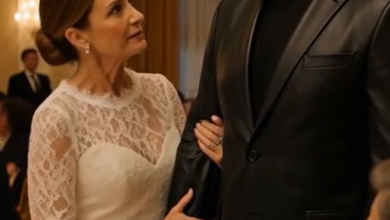
Elise and Michael married beneath an oak tree on her parents’ property. Half the guests wore suits. The other half wore leather cuts with club patches covered during the ceremony at Walter’s request.
Hammer stood beside Michael as best man.
Margaret Mercer, Elise’s mother, gave her daughter the wedding ring she had worn for thirty-nine years. It was a narrow gold band, worn thin along one edge, with Walter’s and Margaret’s initials engraved inside.
A jeweler added Elise’s and Michael’s initials beneath them.
The ring joined two marriages.
That mattered later.
Michael and Elise planned a long motorcycle honeymoon along the Blue Ridge Parkway, west through Tennessee, then south toward the Gulf before returning through Texas and New Mexico. Hospital scheduling, military reserve obligations, and Margaret’s declining health kept postponing it.
“We’ll ride it someday,” Michael told Elise.
They traced the route on a paper map and stored it inside Hammer’s garage because Michael claimed his wife would lose it.
Elise did not lose things.
Michael did.
Their postponed honeymoon remained on that wall for three years.
Then Michael joined a charity ride raising money for children of fallen emergency workers. Forty-one motorcycles left Roanoke on a clear October morning. Hammer led. Michael rode directly behind him.
A drunk driver crossed the center line near Pearisburg.
Hammer saw the pickup first.
He swerved left, trying to draw it away from the formation. The driver overcorrected. The pickup clipped Hammer’s rear saddlebag and struck Michael nearly head-on.
The road exploded into noise.
Metal scraped asphalt. Glass scattered. Engines fell silent. Someone screamed for an ambulance.
Michael landed beyond the shoulder.
Hammer crawled to him.
His own right shoulder was dislocated. Blood filled one eye. Still, he removed his belt, stabilized Michael’s injuries, opened his airway, and kept him conscious while another rider called emergency services.
Michael knew how badly he was hurt.
He also knew Hammer would lie.
“Tell Elise I wasn’t scared,” Michael whispered.
Hammer answered, “Tell her yourself.”
“Ray.”
“Save your air.”
“Promise me.”
Hammer gripped his hand.
“Tell her yourself.”
Michael died eleven minutes later.
When Walter reached the hospital, he saw Hammer sitting on the floor with Michael’s blood dried across his vest.
He did not ask what happened.
He struck Hammer across the face.
“You led them.”
Hammer accepted the blow.
“You brought him onto that road.”
Hammer said nothing.
“You killed my daughter’s husband.”
Elise stepped between them.
“Dad, stop.”
Walter left.
The official crash report later described Hammer’s attempt to redirect the pickup and the first aid he provided. Walter never read the complete document. He read the first page, saw Hammer listed as ride leader, and closed it.
Elise knew the truth.
Hammer refused to defend himself.
“Wouldn’t bring Michael back,” he told her.
Walter’s anger became a structure he lived inside for eight years.
Then Elise found the lump beneath her ribs.
Part 3 — The Ring She Removed Before Dawn
Elise’s diagnosis came quietly.
Pancreatic cancer.
Late stage.
She received the result on a Wednesday and worked the rest of her shift before telling anyone. Michael had been gone seven years. Her mother Margaret had died two years after him. Walter was seventy-four and living alone.
Elise told Hammer first.
Not because he was her closest friend.
Because he did not interrupt difficult sentences with false hope.
She found him in the Iron Saints’ garage adjusting the chain on an old motorcycle. He listened while she explained the scans, treatment possibilities, and the limited time doctors expected.
When she finished, Hammer tightened one bolt.
“How long?”
“Maybe eight months. Maybe less.”
He placed the wrench down.
“What do you need?”
“No speeches.”
“Good.”
“I need a ride.”
Hammer looked at her.
Elise’s health had kept her off motorcycles for years. Treatments weakened her. Nerve pain made long periods in one position difficult. Riding as a passenger would become unsafe quickly.
Hammer began modifying a sidecar.
Elise stopped him.
“Not me.”
“Then who?”
“My ring.”
She removed the gold band and placed it on his workbench.
Hammer did not touch it.
Elise unfolded the old honeymoon map she and Michael had stored in the garage. The paper had yellowed along the creases. Michael’s notes remained in black ink: fuel stops, cheap motels, mountain overlooks, a diner in Amarillo that claimed to serve the state’s largest pie.
She traced the route with one finger.
“Michael and I kept waiting for the right month.”
Hammer stared at the ring.
“Road’s almost two thousand miles.”
“You own a motorcycle.”
“Your father will want this.”
“He’ll get it.”
“When?”
“September fourteenth.”
That would have been Walter and Margaret’s fiftieth wedding anniversary.
Elise wanted the ring returned at Blue Ridge Memorial Cemetery, between her mother’s grave and the plot already reserved for her.
Hammer’s jaw tightened.
“You’ll tell him?”
“No.”
“He hates me.”
“I know.”
“Could call cops.”
“He probably will.”
Hammer looked at her.
Elise almost smiled.
“Put it under the passenger seat,” she said. “Where Michael sat when his bike was in the shop. Where I sat on our first club ride. Let the road touch it.”
Hammer shook his head. “Road don’t touch inside a seat.”
“You know what I mean.”
He did.
The plan had another condition.
Hammer was not to explain the ring’s location until the route was complete. If Walter demanded it early, Hammer had to refuse. Elise believed her father would otherwise place it in a bank box and spend the rest of his life treating love like another object grief had confiscated.
She wanted him to know the ring had moved.
It had crossed mountains, desert, rain, heat, and every road she and Michael had once planned to share. It had not remained sealed beside death.
Hammer still resisted.
“You ask Preacher.”
“I’m asking you.”
“Why?”
Elise’s voice changed.
“Because you stayed with Michael.”
Hammer looked toward the garage floor.
“He died.”
“He wasn’t alone.”
“Same result.”
“Not to me.”
She slid the ring closer.
Hammer finally picked it up.
His fingers were too large to hold it naturally. The narrow gold band rested against his scarred palm like something made for another species.
“September fourteenth,” he said.
“Her anniversary.”
“At the cemetery.”
“Between us.”
Hammer nodded.
That was the promise.
Elise underwent treatment for six months. Some weeks gave her enough strength to visit the garage. Others kept her in bed. Hammer drove her to appointments when Walter’s arthritis prevented him from managing the hospital parking structure.
Their drives were mostly silent.
Walter hated needing him.
Hammer never used that dependence against him.
During Elise’s final week, she asked both men to enter her hospital room. The ring was already sewn beneath Hammer’s Harley seat, wrapped in Margaret’s blue wedding ribbon and sealed against water.
Walter did not know that.
Elise looked at her father.
“Ray has something for you.”
Walter understood immediately.
“The ring.”
“Yes.”
“Then give it to me now.”
“September.”
“Elise, don’t do this.”
She reached for his hand.
“You put everything precious in a drawer after Mom died.”
Walter looked away.
“You stopped using her coffee cup. You covered her piano. You packed her coat before the weather even changed.”
“That isn’t the same.”
“The ring goes home after it moves.”
Walter turned toward Hammer.
“Give it to me.”
Hammer’s face remained still.
“Can’t.”
“I am asking while she is alive.”
“Still can’t.”
Walter stepped closer.
Elise’s monitor changed rhythm.
She tightened her fingers around her father’s hand.
“Dad.”
He stopped.
Elise died before dawn three days later.
Hammer attended the funeral but kept the ring.
Walter watched him leave with it.
That was when grief hardened into accusation.
Part 4 — The Road Elise Never Got to Ride
Hammer waited six months before beginning the route.
Not because the weather was wrong.
Because he could not sit on the motorcycle without remembering Michael behind him and Elise’s ring beneath the seat.
Preacher offered to ride beside him.
Hammer said no.
I offered.
He said no again.
Then, on the first Sunday of August, he arrived at the garage before sunrise with the old honeymoon map folded inside his vest.
“Fuel up,” he told us.
That was the invitation.
Twelve Iron Saints followed him east from Flagstaff, although the original route had begun in Virginia. Hammer wanted to retrace the western half first, then finish where Elise and Michael had planned to start.
The ring remained sewn inside the passenger seat.
Hammer had cut a narrow opening beneath the vinyl, inserted the waterproof packet, and stitched the seam himself. His work was ugly but strong. Inside the packet were the ring, Margaret’s blue ribbon, Elise’s letter to Walter, Michael’s full crash report, and a photograph from Elise’s wedding.
At every fuel stop, Hammer pressed the seam.
The first days took us through New Mexico and Texas. Heat shimmered above the pavement. The Harley’s engine pushed warmth against Hammer’s boots. Road coffee turned bitter before we finished each cup.
In Amarillo, we found the diner Michael had marked on the map.
It no longer served the state’s largest pie.
Hammer bought one anyway.
He placed a slice on the empty passenger seat before eating his own. Nobody mentioned it.
Near Oklahoma City, a storm trapped us beneath a closed gas-station awning. Wind drove rain sideways. Hammer covered the passenger seat with his leather vest while leaving his own head exposed.
Preacher looked at him.
“Waterproof packet, right?”
“Probably.”
“You sealed it.”
“Probably.”
Preacher held out a tarp.
Hammer used it.
In Arkansas, a rear bracket cracked. The seat had to be removed to reach the bolt. Hammer refused to let the mechanic touch it.
He repaired the bracket from below, working two hours with his shoulder pressed against hot pavement.
“You could cut the stitches and reseal them,” I said.
“No.”
“Why?”
“Promise ain’t supposed to be convenient.”
That sentence explained most of Ray Dawson.
The route continued through Tennessee and into the Blue Ridge Mountains. We stopped at every location Michael had marked: an overlook above a river, a roadside chapel, a small motel with blue doors, and a diner where newlyweds could eat free if they showed a wedding photograph.
Hammer carried Elise’s picture inside.
The waitress looked at the twelve bikers.
“Which one is the newlywed?”
Hammer placed the photograph on the counter.
The waitress’s expression softened.
She brought twelve plates.
No bill.
Hammer left enough cash to cover all of them and wrote nothing on the receipt.
The final destination before Roanoke was the curve where Michael died.
A small white cross remained beyond the shoulder. Walter had never visited it. Elise came every year until treatment made travel impossible.
Hammer parked beside the cross.
He removed his gloves and rested one scarred hand on the passenger seat.
For eleven minutes, he did not move.
The same length of time he had held Michael beside the road.
Preacher began counting without telling us. When the eleventh minute ended, Hammer looked toward the tree line.
“Was scared,” he said.
Nobody asked who.
Michael.
Hammer.
Both.
He started the engine.
The road to Roanoke carried us through light rain. September fourteenth arrived cold and gray. Walter would be visiting Margaret’s grave because he had done so every anniversary since her death.
Elise had counted on that.
We reached Blue Ridge Memorial shortly before noon.
Walter was already there.
Hammer parked beside the two graves and removed his helmet. He intended to retrieve the packet with a small seam cutter from his saddlebag, open the seat carefully, and place the ring in Walter’s hand.
He never reached the saddlebag.
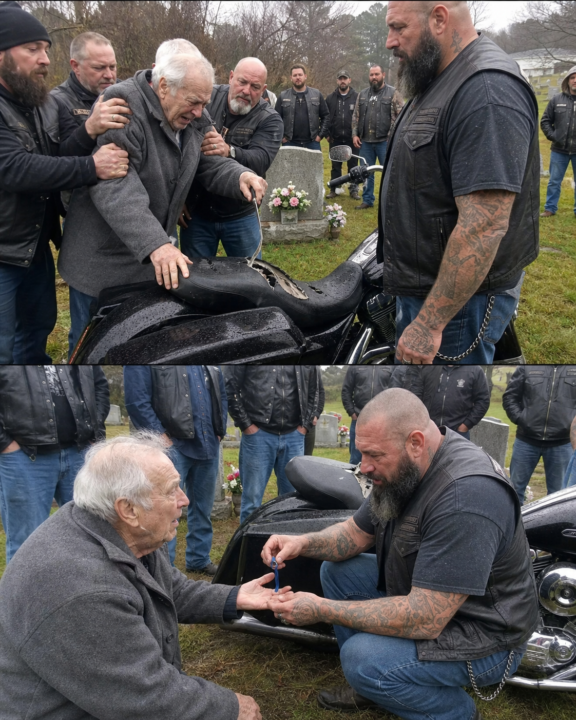
Walter approached holding his knife.
The old man saw the Harley before he saw the exhaustion in Hammer’s face. He saw the machine that had carried Michael toward death and the man who had withheld Elise’s ring for nine months.
He demanded it.
Hammer answered badly.
“Not like this.”
Walter heard contempt where Hammer meant, not while a knife is in your hand.
Then Walter attacked the seat.
Preacher and Boone restrained him. I caught his elbow. The knife opened nine inches of vinyl and foam before we stopped him.
Hammer shouted one word.
“Wait.”
The ring fell.
For the first time, Walter saw the truth arrive without anyone explaining it.
Gold against wet grass.
Blue ribbon against gray stone.
A promise opening because of the same blade meant to destroy it.
Part 5 — The Letter Walter Almost Cut in Half
Hammer retrieved the ring first.
He wiped mud from it and placed it in Walter’s palm. The old man closed his fingers, then opened them again, as if he no longer trusted himself to hold anything tightly.
The waterproof packet remained inside the torn seat.
Walter’s knife had cut through its outer layer but stopped before reaching Elise’s letter. Hammer removed the packet and handed it over.
Walter could not open it.
His hands shook.
Hammer took the knife from Boone, folded the blade, and returned it to Walter’s coat pocket. Then he opened the damaged packet with his fingers.
Inside lay four objects.
The first was Elise and Michael’s wedding photograph. Elise stood beneath the oak tree wearing Margaret’s gold ring. Michael’s leather cut hung over the back of a chair because Walter had forbidden visible club patches during the ceremony.
The second was the honeymoon map.
The third was Michael’s crash report.
The fourth was Elise’s letter.
Walter recognized her handwriting before Hammer unfolded the paper.
He read silently.
Then he began again from the top because the first attempt had passed through his eyes without entering him.
Elise wrote that the ring belonged to three people before it belonged to grief. Margaret wore it through forty-two years of marriage. Elise wore it through thirteen years with Michael. Walter had placed it on Margaret’s hand and deserved to receive it back only after it completed the road both women had wanted him to keep living.
She told him not to bury it.
Not with Margaret.
Not with her.
She asked him to wear it on a chain or keep it somewhere sunlight could reach.
Then came the paragraph about Hammer.
Dad, Ray did not take Michael from us. A drunk driver did. Ray turned his motorcycle toward the truck to pull it away from the other riders. He was hit first. His shoulder was out, his face was bleeding, and he still held Michael’s airway open for eleven minutes. Michael’s last hand was inside Ray’s hand. Please stop punishing the man who stayed.
Walter lowered the letter.
Hammer looked away.
The crash report confirmed every detail. Witnesses described Hammer swerving toward the pickup. A paramedic noted the improvised stabilization he provided. The attending physician believed Michael reached the hospital only because Hammer kept his airway open, though the internal injuries remained unsurvivable.
Walter had possessed a copy of that report for eight years.
He had never read beyond the first page.
“You never told me,” he said.
Hammer stared at Elise’s grave.
“You weren’t asking.”
“I struck you at the hospital.”
“Yes.”
“You let me believe—”
“Needed somebody.”
“That is not an answer.”
Hammer finally met his eyes.
“You needed somebody.”
Walter understood.
Hammer had allowed himself to become the shape of Walter’s anger because the real target—a drunk driver, chance, death itself—could not stand in a hospital hallway and receive a father’s fist.
“You should have defended yourself.”
“Wouldn’t help Elise.”
“It might have helped me.”
Hammer considered that.
“Maybe.”
That single word was the closest he came to admitting his silence had consequences too.
Walter touched the torn passenger seat.
“You carried this all the way?”
“One thousand eight hundred forty-two miles.”
“In the foam?”
“She picked the spot.”
“Why?”
“Said road had to touch it.”
Walter looked at the filthy Harley.
The scratches, dead insects, rain streaks, worn tire, and torn seat gave him evidence the ring had not waited inside a drawer. It had passed through heat, storms, mountain curves, and every place his daughter and son-in-law had marked.
Walter pressed the band between his thumb and forefinger.
Inside were the initials W.M. + M.M., then E.M. + M.R.
Two marriages.
Four lives.
One survivor standing between two graves.
Walter turned to Hammer. “The seat can be repaired?”
“Yes.”
“I’ll pay.”
“No.”
“I cut it.”
“Yes.”
“Then let me pay.”
Hammer looked at the crooked opening.
“Already needed one.”
That was a lie.
Everyone knew it.
Walter knew it too.
He did not argue again.
Instead, he bent toward the graves and placed the ring between Margaret’s and Elise’s headstones. He left it there for exactly one minute while rain gathered on the gold.
Then he picked it up.
Not buried.
Not abandoned.
Taken home.
The Iron Saints released their grip on Walter completely. Preacher stepped away first. Boone followed. Nobody demanded an apology for the knife.
Walter provided one anyway.
He faced Hammer.
“I am sorry.”
Hammer nodded.
“For the seat,” Walter added.
Hammer waited.
“For the hospital.”
Another nod.
“For eight years.”
Hammer looked at the ring.
“Long road.”
Walter closed his hand around it.
“Then perhaps we begin with one mile.”
Part 6 — The Stitch Walter Refused to Hide
Walter repaired the seat himself.
He had never upholstered anything in his life, but he refused Hammer’s offer to order a replacement. He removed the torn vinyl, watched online demonstrations, bought marine-grade thread, and spent three evenings learning to pull a curved needle through material tough enough to fight back.
His first seam was terrible.
Hammer examined it.
“Crooked.”
Walter adjusted his glasses. “So is your face.”
Hammer almost smiled.
They removed the stitches and began again.
The second seam held. It remained visible across the passenger seat—a dark line running exactly where Walter’s knife had entered.
Hammer could have covered it with a patch.
He did not.
Walter began visiting the Iron Saints’ garage every Thursday. At first, he claimed he came only to check whether the seat repair was failing. Then he started bringing coffee. Later, he reorganized the club’s chaotic paperwork and discovered three members had forgotten to renew their registrations.
Preacher called him Principal.
Walter pretended to dislike it.
The ring hung from a simple chain beneath his shirt. He wore it over his heart, as Elise requested, but pulled it out whenever someone asked. He told Margaret’s story first, then Elise’s.
He always included the road.
In spring, Hammer mounted a small metal box beneath the repaired passenger seat. It was waterproof, secured with four bolts, and no larger than a deck of cards.
Walter saw it.
“What is that?”
“Promise box.”
“For what?”
Hammer shrugged.
The first object placed inside came from a club widow who wanted her husband’s dog tags carried on the annual memorial ride. The second was a child’s letter to a firefighter buried in Tennessee. The third was a photograph a veteran could not bring himself to deliver to his brother’s grave.
Hammer carried each item.
He returned every one.
Nothing remained inside forever.
Walter joined several trips by car. He photographed mileage, kept delivery dates, and insisted every promise box item be recorded in a small ledger.
Hammer called the system unnecessary.
Then he asked Walter to keep the ledger in his desk.
On September fourteenth, one year after the cemetery confrontation, Walter rode with the club.
Not on the back of Hammer’s Harley. His balance was poor, and his arthritis made mounting unsafe. Preacher found a touring trike with a padded passenger seat and convinced its owner to lend it for the day.
Walter wore Margaret and Elise’s ring beneath his shirt.
The convoy followed the final forty miles of Elise and Michael’s route to Blue Ridge Memorial. At the cemetery, Walter stood between the two graves and removed the chain.
He let the ring rest against both headstones.
One minute.
Then home again.
Hammer waited beside the repaired seat.
Walter touched the crooked seam.
“Still holding.”
Hammer nodded.
“So am I.”
Part 7 — The Last Eleven Minutes Became a Mile
Walter turned eighty in October.
The Iron Saints held his birthday at the garage because he refused restaurants with loud music, weak coffee, or laminated menus. That eliminated nearly every place the club enjoyed.
Preacher bought a cake shaped like a law book.
Hammer brought no gift.
At least, that was what Walter believed until the garage door opened.
Outside waited a restored 1978 Harley-Davidson sidecar rig, dark blue with a broad passenger seat, handrails, and enough suspension to protect Walter’s back on uneven roads.
He stared at it.
“No.”
Hammer placed a helmet in his hands.
“I am eighty.”
“Paperwork confirms.”
“I attacked your motorcycle.”
“Seat survived.”
“I dislike motorcycles.”
“Been noticing.”
Walter looked around the garage. Every Iron Saint had turned away with suspicious precision, pretending to inspect tools and oil cans.
“You planned this.”
Hammer fastened his gloves.
“Eleven minutes.”
Walter’s expression changed.
Hammer pointed toward the road.
“We ride one mile for each.”
Eleven miles for the time Hammer held Michael beside the highway.
Walter climbed into the sidecar.
The first mile was slow. His shoulders stayed rigid, and both hands gripped the rails.
By mile four, he looked toward the Blue Ridge hills.
At mile seven, he released one hand.
At mile eleven, Hammer pulled into the overlook where Elise and Michael had once planned to stop during their honeymoon. Wind moved across the grass. Autumn leaves scraped over the pavement.
Walter removed the ring from beneath his shirt.
He held it toward the mountains.
Hammer stood beside him without speaking.
“What did Michael say?” Walter asked.
Hammer knew which moment he meant.
“He said to tell Elise he wasn’t scared.”
“Was he?”
“Yes.”
Walter nodded.
“Thank you for telling me the truth.”
Hammer looked toward the parked motorcycle.
“Took awhile.”
They remained at the overlook until the sun dropped behind the ridge.
On the return ride, Walter no longer held both rails. One hand rested over the ring beneath his shirt. The other lay open beside him, feeling the vibration of the sidecar through his palm.
At Blue Ridge Memorial, they stopped without planning to.
Walter placed his hand against Elise’s headstone.
“Your ring came home,” he said.
Behind him, the repaired Harley seat carried its crooked scar beneath the fading daylight.
Hammer started the engine.
Walter climbed back into the sidecar.
Two graves remained beneath the oak trees, but the ring left with the living.
Follow our page for more unforgettable biker stories about broken seats, hidden promises, and rough-looking men who carry what grieving families cannot.