Part 2: A Biker Spent Every Night Shaving Dolls Inside a Laundromat While Customers Laughed — Then His Daughter Arrived Wearing a Chemotherapy Bracelet
Part 2 — The Clippers He Could Not Turn On at Home
Mason Calloway had been riding motorcycles since he was sixteen, but the Harley was never the most important machine in his garage.
That distinction belonged to an old pair of Wahl clippers with a cracked cord and a strip of faded yellow tape around the handle.
They had belonged to his wife, Rebecca.
I learned the rest because Mason returned to my laundromat after Lucy left that first morning, not to practice but to clean. He swept synthetic hair from beneath Washer Seventeen, wiped fingerprints from the folding table, and placed every bald doll into a cardboard box.
I helped without asking permission.
After a while, he talked.
Mason met Rebecca at a barbershop in Joplin in 1998. He had been twenty-eight, working as a structural welder and riding a Harley that leaked oil onto every driveway where he parked it. She was twenty-six, recently licensed, and raising her younger sister after their parents died.
Rebecca did not like motorcycles.
She liked Mason even less.
On their first meeting, she told him his beard made him look like a broom that had survived a house fire. Mason returned the next week and asked her to fix it.
She refused to shave the beard.
“Your face needs somewhere to hide,” she said.
He married her fourteen months later.
Rebecca opened a two-chair barbershop near Route 66. Mason built the counters, repaired the plumbing, and welded a steel sign she said was too heavy for the building. She kept the yellow-taped clippers at her station.
When Lucy was born, Rebecca used those clippers to trim the soft hair at the nape of the baby’s neck. Mason stood nearby holding a washcloth as though someone might call on him to perform surgery.
He could rebuild a transmission.
He could not comb a child’s hair.
Rebecca taught him slowly. Start at the ends. Never pull against a knot. Put your palm between the comb and the scalp. If a child says it hurts, believe her.
Lucy inherited her mother’s thick dark hair.
By age seven, it reached the middle of her back. Mason learned ponytails, though they leaned to the left. He learned braids, though loose strands escaped within minutes. He learned to sit through glitter clips, plastic crowns, and arguments about whether motorcycle boots matched a purple dress.
They always matched.
Then Rebecca developed ovarian cancer.
The diagnosis came late. Surgery bought time. Chemotherapy took hair, weight, sleep, and the familiar shape of their household.
Mason handled the practical things. He drove to appointments. He measured medications. He filled the freezer with meals nobody wanted. When Rebecca vomited, he held the basin. When insurance denied a scan, he remained on the phone until someone reversed the decision.
But when her hair began falling, he failed her.
Rebecca wanted him to shave it.
She did not want a stranger. She did not want a hospital barber. She wanted Mason, the man whose beard she had trimmed every month for fourteen years.
He set a chair in their kitchen and placed the yellow clippers on the counter.
Then he turned them on.
The buzzing made Rebecca close her eyes.
Mason saw fear in her face and froze.
“Turn them off,” he said.
“I’m ready.”
“I’m not.”
“She asked you, Dad,” Lucy said from the doorway. She was eight.
Mason could not move.
Rebecca waited nearly twenty minutes before a home-health nurse finished the job. The guard caught twice. The bare metal grazed the tender skin behind Rebecca’s ear, leaving a thin red line.
Rebecca never complained.
That made it worse.
She died five months later.
Mason kept the clippers inside a metal toolbox beneath his workbench. He never used them. He also stopped trimming the lower six inches of his beard because that was the last section Rebecca had cut.
His club brothers knew the braid mattered.
They did not know why.
For three years, Mason raised Lucy alone. He built his shifts around school pickup. He learned which laundry detergent irritated her skin. He attended dance recitals in boots because his only dress shoes had split at the heel.
The Mercy Road Riders helped, but Mason kept the hardest parts locked down.
Rook drove Lucy to school when Mason worked early. Deke repaired her bicycle. Club wives brought meals until Mason asked them to stop because Lucy wanted normal dinners, not sympathy casseroles.
Then Lucy bruised her knee getting off a school bus.
The bruise did not fade.
A week later, she developed nosebleeds. She slept through a Saturday morning ride she had planned for months. Blood tests led to more tests, then to a pediatric oncologist named Dr. Priya Shah.
Acute lymphoblastic leukemia.
Mason listened to the diagnosis without interrupting. He asked about survival rates, treatment phases, infection risks, and whether Lucy could still ride behind him.
He did not ask about hair.
Lucy did.
Dr. Shah told her the chemotherapy would probably cause significant loss after the second treatment cycle. It might happen gradually. It might come out quickly.
In the parking garage, Lucy asked her father whether he could shave it when the time came.
Mason answered too fast.
“Of course.”
She studied his face. “Don’t lie.”
“I’m not.”
That evening, he opened Rebecca’s toolbox.
The yellow-taped clippers still smelled faintly of machine oil and disinfectant. Mason plugged them into the garage wall, held them for three seconds, and shut them off.
He tried again the next night.
Same result.
At home, the sound returned him to Rebecca’s kitchen chair. It brought back the red line behind her ear, Lucy watching from the doorway, and the helpless knowledge that love had asked for one simple act his hands refused to perform.
So he rode.
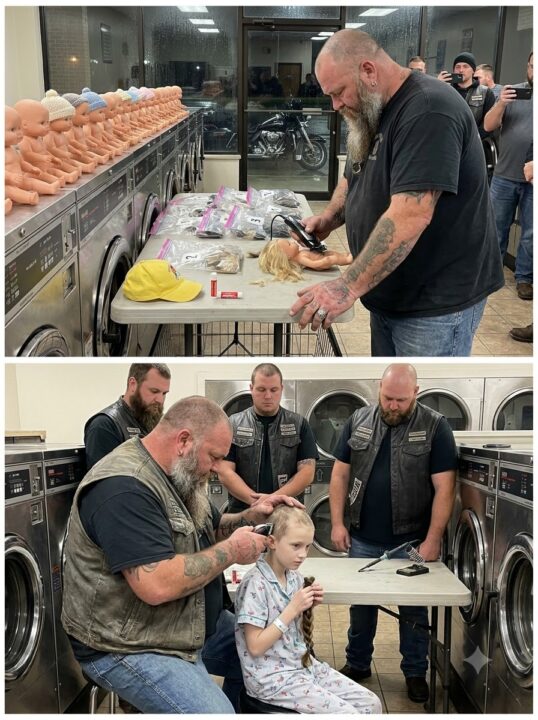
He chose my laundromat because it never closed and because the heavy machines swallowed the buzzing. He bought used dolls from thrift stores, garage sales, and a church donation room.
The first doll came from Lucy’s old toy box.
That was the one Deke picked up.
The tiny hospital band around its wrist had belonged to Rebecca.
And beneath its dress, in a place none of us had yet seen, eight-year-old Lucy had written a message to her mother.
Mason had been practicing on it without knowing.
Part 3 — The Video That Reached Room 412
The video appeared online before Mason completed his fifth night of practice.
Its title called him a dangerous biker shaving dolls at a laundromat after midnight. The woman who uploaded it added ominous music and slowed the moment Mason turned toward the camera.
That changed everything.
People did not see his trembling hand.
They saw tattoos.
They did not see numbered bags designed to help him compare pressure and clipper guards.
They saw hair collected like trophies.
They did not see the hospital envelope, the knitted caps, or the old clippers wrapped inside Rebecca’s towel.
They saw exactly what the caption told them to see.
By noon, local groups had shared it thousands of times. Comments called Mason unstable. Someone identified the Mercy Road Riders. Another found the address of their clubhouse.
A reporter phoned Rook.
The owner of Suds & Spin phoned me.
“Tell him he can’t come back,” Mr. Donnelly said.
“He hasn’t hurt anyone.”
“He is frightening customers.”
“They were laughing at him.”
“They’re still customers.”
That was the argument.
Money against dignity.
Dignity lost.
I told Mason outside the following night. His Harley idled beneath the sign, its exhaust beating against the wet August heat. He listened, removed his helmet, and looked through the glass at Washer Seventeen.
“Donnelly say it?”
“Yes.”
“Then I’m gone.”
No threat.
No complaint.
That was Mason.
He carried the dolls back to his motorcycle. Rook offered the clubhouse, but Mason refused because young prospects slept upstairs and club engines came and went at all hours.
Deke suggested his garage.
Mason shook his head.
“No spectators.”
“You had half the internet watching.”
“Exactly.”
Rook wanted the club to confront the woman who posted the video. Mason forbade it. Deke wanted to flood her employer with calls. Mason forbade that too.
“She laughed,” Deke said.
“So did you.”
Deke went quiet.
Brotherhood bent that night. It nearly broke.
Several riders believed Mason had made the club look ridiculous. One older member named Hollis argued that personal grief should not become club business. Another said if Mason was too distracted to lead rides safely, Rook should temporarily replace him.
Rook shoved his chair backward.
Mason stopped him with one look.
“Hollis is right about the road.”
The room changed.
Mason placed his road-captain patch on the workbench. Until Lucy’s treatment stabilized, he would not lead. He would not risk missing a hazard because his mind was inside a hospital room.
Rook refused to take the patch.
Mason left it anyway.
While they argued, the video reached Lucy.
A classmate sent it to her tablet in Room 412. Lucy watched her father hunched over a doll while strangers laughed. At first, she thought it was funny.
Then she saw the yellow clippers.
She knew.
Mason had promised he was not afraid. The video showed otherwise.
Lucy called him and said there was hair on her pillow. That part was true. What she did not say was how much.
When Nurse Camille Reyes entered the room, Lucy was holding a clump large enough to cover her palm. More hair lay across the pillowcase and along the shoulders of her pajamas.
Camille offered a cap.
Lucy refused.
“Get my dad.”
Mason arrived forty minutes later. He had ridden too fast. The heat from the exhaust followed him into the parking garage, and his palms smelled of leather and gasoline when he entered Lucy’s room.
She had placed the fallen hair in a specimen cup.
“Why did you lie?”
Mason looked at the cup. “I said I’d do it.”
“You said you weren’t scared.”
“I’m still doing it.”
“That wasn’t my question.”
He sat beside the bed. His size made the plastic chair appear built for a child.
Lucy pulled off her cap.
The sight struck him harder than any crash.
Long dark hair remained across most of her head, but several pale spaces showed near the crown. Loose strands clung to her cheek. One side had tangled where the hair was releasing at the root.
Mason reached toward her.
She moved away.
“Don’t touch it until you can tell the truth.”
He lowered his hand.
“I’m scared.”
“Of hurting me?”
“Of remembering.”
Lucy understood. She had been eight when Rebecca died, old enough to remember the kitchen chair and the clippers stopping.
“Mom thought you didn’t want to do it,” she said.
“She knew better.”
“I didn’t.”
That landed.
Mason looked toward the window. Springfield traffic moved below in small red and white lines. His motorcycle waited in the garage, but there was nowhere he could ride that sentence out of his body.
Lucy asked why he practiced in a laundromat.
“The washers made it quieter.”
“The video wasn’t quiet.”
“No.”
“Everybody saw you.”
“Looks that way.”
Lucy picked up his phone and replayed the clip. She watched the customers laugh, then paused on the moment Mason touched the repaired plastic ear.
“Which doll was that?”
“Your old one.”
“The one Mom gave me?”
Mason nodded.
Lucy remembered the hospital band around its wrist. She remembered hiding a folded note beneath its dress after Rebecca died.
“Where is she?”
“In the box.”
“I want her.”
Mason called Rook. The club was searching for a private place where he could practice. Deke had already purchased twelve mannequin heads. Another brother had borrowed barber equipment from his sister’s salon.
Rook delivered Lucy’s doll to the hospital.
When Lucy lifted its dress, a piece of lined school paper fell onto the blanket.
Her eight-year-old handwriting remained visible in purple crayon.
MOM, DAD DIDN’T SAY NO BECAUSE HE DOESN’T LOVE YOU. HE SAID NO BECAUSE HE THINKS IF HE STARTS, YOU’LL HAVE TO GO.
Mason read it once.
Then again.
Rebecca had never seen it.
Lucy had hidden the note after the funeral, believing her doll could carry messages somewhere adults could not reach.
Mason folded the paper carefully.
That looked like the climax.
It was not.
Lucy picked up the yellow clippers from Rook’s bag and held them toward her father.
“Tomorrow morning,” she said.
“At the hospital?”
“No.”
“Home?”
She shook her head.
“I want the machines loud.”
Lucy wanted Washer Seventeen.
But Mr. Donnelly had banned Mason from the laundromat, the online crowd was planning to appear there, and someone had already painted the word FREAK across the club’s garage door.
Rook looked at Mason.
“This one’s club business.”
Mason looked at Lucy.
“No fighting.”
Rook nodded.
“No fighting.”
Then Lucy pointed toward the braid hanging from Mason’s beard.
“And you go first.”
Mason’s hand rose to the steel ring Rebecca had fastened there before her final hospital admission.
For three years, no blade had touched it.
Now Lucy was asking him to choose between the last thing his wife had cut and the child still sitting before him.
His hand closed around the braid.
“Tomorrow,” he said.
Part 4 — The Chair Between the Washing Machines
By six the next morning, nearly sixty people had gathered outside Suds & Spin.
Some came because they had seen the video. Some expected trouble. Others wanted another recording of the giant biker with his dolls.
The Mercy Road Riders arrived without revving their engines.
Twenty-three Harleys rolled into the parking lot in a low, controlled line. No one blocked the entrance. No rider covered his face. Rook ordered every man to leave his gloves, temper, and pride with his motorcycle.
Mr. Donnelly arrived ten minutes later.
He saw Mason standing beneath the laundromat sign with Lucy beside him. She wore a yellow cap, a hospital mask, pajamas under a denim jacket, and motorcycle boots too large for her thin legs.
A portable IV pump hung inside a small backpack.
Mr. Donnelly looked at me.
“You brought him back?”
“I opened on time.”
“He’s banned.”
Lucy stepped forward. “Then ban me too.”
Mason touched her shoulder. “Not your fight.”
“It’s my hair.”
That ended the argument more effectively than any threat.
Mr. Donnelly unlocked the door.
Nobody cheered.
The laundromat was too clean that morning. I had scrubbed the folding table twice. Rook disinfected the chair. Nurse Camille checked the room, then limited the number of people allowed inside because Lucy’s immune system was compromised.
Mason entered first.
He placed Rebecca’s yellow-taped clippers beside three guards, a comb, alcohol wipes, disposable towels, and the tiny bag numbered thirty-four.
Lucy noticed the dolls lined above Washer Seventeen.
Every one had been fitted with a cap.
Deke had done that.
He stood near the dryers without his leather cut, ashamed to wear it after making the hospital-band doll wave. Lucy saw him and held out her hand.
Deke placed the doll in it.
“I’m sorry,” he said.
Lucy examined the uneven patch behind its ear. “Dad did this?”
“First night.”
“He got better.”
The truth was that Mason had become technically good. He could guide the clippers with either hand. He knew how to tilt around ears, how to remove weight without pulling, and how to use a warm towel before cleaning a sensitive scalp.
None of that made him ready.
Lucy climbed into the chair.
The washers began turning.
Customers filled the safe spaces behind the windows and along the vending machines. The woman who had filmed Mason stood near the back, her phone lowered. Evan and his warehouse friends arrived carrying bags of quarters but no laundry.
Mason wrapped a white cape around Lucy.
Then she pointed toward his beard.
“You promised.”
Mason looked at Rook.
For twenty-three years, Rook had never seen him without the long braid. Rebecca had shaped it during club weddings, hospital vigils, charity rides, and funeral escorts. After she died, Mason allowed the rest of his beard to grow wild but protected those lower six inches.
It was not vanity.
It was evidence.
Rebecca’s hands had been there.
Mason sat on a second chair facing Lucy. He removed the steel ring. The braid loosened slightly but held its shape.
Lucy took the barber shears.
Her hands were weak. Camille helped position her fingers.
“Here?” Lucy asked.
Mason swallowed. “Higher.”
She moved the scissors upward.
“Dad?”
“Do it clean.”
The blades closed.
Once.
Twice.
The third cut separated the braid.
Lucy caught it before it fell.
The crowd inhaled as one body.
Mason’s chin looked strangely bare. A pale line showed where sunlight had not reached his skin for years. He touched it, then looked at the braid resting across Lucy’s lap.
“Your turn,” she said.
Mason stood behind her.
He divided her hair into sections. Lucy wanted four braids saved: one for herself, one for Mason, one for Rebecca’s memory box, and one for another child who might someday need to know that losing hair did not mean losing everything.
Mason tied the first section.
His fingers shook.
He tied the second.
The clippers waited.
Washer Seventeen entered its spin cycle, filling the room with a deep mechanical roar. Mason switched on Rebecca’s clippers.
He froze.
Again.
Lucy watched him through the reflection in the dark washer door.
“Dad.”
“I know.”
“No. Look at me.”
He met her eyes in the curved glass.
“I’m not Mom,” she said.
The words could have sounded cruel.
They did not.
“I’m still here. Don’t shave a memory. Shave my head.”
Mason breathed.
Then he placed the guarded blade against the nape of her neck.
The first pass removed a narrow path through the dark hair. Loose strands fell onto the white cape. Mason stopped immediately and checked her skin.
“Too hard?”
“No.”
“Hot?”
“No.”
“Pulling?”
“Dad.”
“What?”
“Keep going.”
He did.
The crowd that had laughed at thirty-four dolls watched Mason complete pass after pass. He moved slowly around the thinning areas, never forcing the guard through a knot. Camille handed him warm towels. Lucy held Rebecca’s braid in one hand and Mason’s in the other.
Halfway through, the clippers stopped.
The cracked cord had failed.
Mason stared at the dead machine.
For one second, he was back in Rebecca’s kitchen. The work was unfinished. The person he loved was waiting. His hands had failed again.
Then Deke stepped forward with a new clipper.
Mason did not take it.
“That sound’s wrong.”
Lucy understood. He needed Rebecca’s machine, not because it cut better, but because finishing with it would change the memory that had trapped him.
Rook unplugged the cord and examined the break.
He had repaired motorcycle wiring beside highways in snow, heat, and darkness. With insulated connectors from his saddlebag and a tool kit from the Harley, he repaired the old cord on the folding table.
Two minutes later, the clippers came alive.
Mason finished.
When the final strands fell, Lucy rubbed both palms across her bare scalp. Her eyes filled, but she smiled before the tears escaped.
“Did you hurt me?” she asked.
“No.”
“Then stop looking like you did.”
A few people laughed softly.
This time, Lucy laughed too.
The woman who recorded the original video approached. Her name was Melissa Grant. She was not merely a stranger looking for attention. She had recognized Mason from somewhere he did not remember.
Eight years earlier, Mason and the Mercy Road Riders had paid for her son’s funeral after an uninsured driver killed him.
She had never thanked them.
Instead, she had posted the cruelest version of Mason because grief had made her suspicious of public tenderness. She believed anybody performing kindness where others could see it must want something.
“I knew your face,” she admitted. “I didn’t know from where until last night.”
Mason continued cleaning Lucy’s scalp.
Melissa deleted the video.
It was too late. Copies remained everywhere.
Lucy asked her to do something else.
“Post this part.”
Mason shook his head. “No.”
Lucy looked at him in the washer-door reflection.
“You let them laugh at you so I wouldn’t know you were scared. Now let them see you weren’t too scared to stay.”
Mason gave one small nod.
Melissa raised the phone.
The second video began with Mason removing a final strand from behind Lucy’s ear. It ended when he placed the yellow cap over her head and tucked both severed braids inside his leather cut.
Then the strangest thing happened.
Rook sat in the chair.
“Guard number two,” he said.
Mason stared at him. “You’re bald already.”
“Sides aren’t.”
Deke sat next.
Then Evan.
Then Mr. Donnelly.
By nine o’clock, twelve men had surrendered hair to the laundromat floor. Some did it for Lucy. Others did it because they had laughed. One did it because his sister had started chemotherapy in Kansas City and he had not found the courage to call her.
Hollis, the brother who wanted Mason removed as road captain, arrived last.
He placed Mason’s patch on the folding table.
“I was wrong.”
Mason looked at the chair.
“Sit down.”
Hollis sat.
Brotherhood did not repair itself with speeches.
Sometimes it required clippers.
Part 5 — What the Dolls Had Been Teaching Him
The second video spread farther than the first.
This time, viewers saw the whole room.
They saw Lucy in the chair. They saw the huge tattooed biker moving the clippers as if every inch mattered. They saw club brothers sweeping hair instead of posing for cameras.
But the most shared moment occurred after the shave.
Lucy selected the brunette doll with the repaired ear and placed it beside her bare head. Melissa photographed them together.
That was when Lucy discovered the numbered bags.
She asked Mason why he had saved synthetic hair from every practice attempt.
Each number recorded something different.
Bag one meant too much pressure.
Bag four meant the guard had caught.
Bag nine meant the clipper angle was wrong.
Bag seventeen meant Mason had completed an entire scalp without touching plastic.
Bag twenty-two meant curly hair needed different sectioning.
Bag thirty-four contained the cleanest result.
Mason had not been collecting trophies.
He had been documenting failures.
The red marks on two dolls came from washable makeup. Mason created them wherever the clipper might have irritated real skin. The adhesive bandages showed places where he needed to slow down.
The strawberry lip balm belonged to Lucy. He kept it nearby because its smell steadied his breathing during hospital visits.
The yellow caps had been knitted by club members’ wives, but Mason tested each one on a bald doll to find rough seams that might irritate Lucy’s scalp.
Even the laundromat mattered for more than noise.
Chemotherapy made Lucy sensitive to smells. Mason had practiced beside detergent, bleach, hot dryers, wet leather, coffee, and engine oil so he could identify which odors remained on his hands and clothes.
Before touching her, he had washed with fragrance-free soap.
Every strange detail had been preparation.
Mason had treated fear like a machine he could disassemble.
One piece at a time.
There was still one detail nobody understood: why he had chosen Washer Seventeen when eighteen machines were available.
Rebecca had worked at Suds & Spin before opening her barbershop. During their first year together, she washed towels there after closing because her rented shop did not have a commercial machine.
She always used Washer Seventeen.
Mason would sit on the folding table while she cleaned her clippers and criticized his beard. They planned their wedding there. Years later, when money was tight, they brought baby Lucy in a laundry basket and let her sleep beneath the same warm dryer air.
Mason had not chosen a random public place.
He had returned to the last room where the three of them had felt ordinary.
Lucy listened without interrupting. Then she placed Rebecca’s braid, Mason’s braid, and her four smaller braids on the folding table.
“What do we do with them?”
Mason had no answer.
Nurse Camille did.
The hospital’s child-life room kept dolls for young patients preparing for procedures. Most had removable caps, but none reflected the frightening moment when hair began falling unexpectedly.
Lucy proposed a kit.
A child could shave a doll first.
The doll could wear the same cap.
A parent could practice without pretending not to be afraid.
Mason disliked the idea immediately because it meant other people seeing his failures. Lucy liked it for the same reason.
“Parents need bag number one,” she said.
“Why?”
“So they know everybody starts there.”
That sentence became the foundation of the Washer Seventeen Project.
The Mercy Road Riders collected new dolls in multiple skin tones and hair textures. Barbers donated clippers with safety guards. Oncology nurses wrote plain instructions about sensitive scalps, infection prevention, and when families should ask medical staff for help.
Mason inspected every kit.
He refused to attach his photograph or road name. Each box contained only a small card with three sentences:
YOUR HANDS MAY SHAKE.
THEY CAN STILL BE GENTLE.
START WITH THE DOLL.
Mr. Donnelly offered the laundromat as an assembly location one Sunday each month. He replaced the folding table Mason had used and mounted the old one on the wall.
Mason objected.
Lucy overruled him.
Melissa organized an online fundraiser to supply children’s hospitals across Missouri. She used the audience created by the cruel video to finance the repair.
Deke handled doll collection.
He became obsessive about it. Any donated doll with badly tangled hair was cleaned, conditioned, and brushed before entering a practice kit. When asked why, he answered that fear did not need extra knots.
Hollis returned Mason’s road-captain patch during the first assembly night.
Mason did not accept it immediately.
“You questioned whether I was safe to lead.”
“I did.”
“You were right to question it.”
Hollis waited.
Mason looked around at his brothers sectioning doll hair, checking cap seams, labeling guards, and arguing over instruction cards.
“Road’s different now,” Mason said.
“Still need a captain.”
Mason picked up the patch.
He did not sew it back onto his cut. Lucy did that from her hospital bed using uneven black stitches. The patch leaned slightly to the right.
Mason never corrected it.
His most difficult reconciliation was not with Hollis, Mr. Donnelly, or Melissa.
It was with Rebecca.
Weeks after Lucy’s shave, Mason returned to the kitchen chair where he had failed his wife. He placed Rebecca’s photograph on the counter and connected the repaired yellow clippers.
Lucy sat nearby wearing her cap.
Mason switched them on.
The sound filled the kitchen.
He did not turn them off.
He trimmed the rest of his beard short, removing the sections Rebecca had never touched. When he finished, Lucy ran her fingers along his jaw.
“You look weird.”
“So do you.”
“Mine grows back.”
“So does mine.”
That was when Mason finally told Lucy what Rebecca had whispered after the nurse shaved her head.
She had not blamed him.
She had said, “He’ll learn when she needs him.”
Mason had spent three years believing Rebecca meant grief would teach him how to raise Lucy.
Now he understood.
She had meant this exact night.
The dolls had trained his hands.
Rebecca had prepared his heart.
Part 6 — The Light Above Washer Seventeen
Lucy’s treatment lasted another twenty-two months.
There were good scans, frightening fevers, delayed cycles, and one infection that kept her isolated for nine days. Her hair began returning as soft dark fuzz before falling thin again during a stronger treatment block.
The second shave happened at home.
Mason did not need dolls.
He still placed one on the counter.
The Mercy Road Riders adjusted their life around her blood counts. When Lucy could not safely attend a ride, they rolled past her hospital window in pairs, never revving near the entrance.
When she could travel, Rook drove the support truck with sanitizer, blankets, medication, and enough water for a small army.
Mason remained road captain.
He rode differently.
His eyes checked mirrors more often. He stopped pretending exhaustion was discipline. If fear distracted him, he handed Rook the route.
That admission changed the club more than any rule.
The Washer Seventeen Project delivered its hundredth kit to a children’s hospital in St. Louis. By the second year, hospitals in five states were using them.
Parents sent photographs of unevenly shaved dolls beside children wearing matching caps. Some included thanks. Others included news nobody wanted.
Mason answered every letter himself.
Usually with four words:
YOUR HANDS WERE GENTLE.
Evan, the young warehouse worker who mocked him, trained as a barber. He offered free head shaves for oncology patients and caregivers but kept one condition: the child could shave a doll first.
Melissa continued recording project events, but she asked permission before lifting her phone.
Deke carried Lucy’s hospital-band doll on charity rides. It sat inside a clear box in his saddlebag, protected from rain and exhaust dust. The plastic ear Mason damaged was never replaced.
“It shows the first lesson,” Lucy said.
Mr. Donnelly installed a small light above Washer Seventeen. It remained on after the laundromat’s other overhead lights dimmed at midnight.
Every Thursday, Mason returned.
Sometimes he assembled kits. Sometimes he repaired old clippers. Sometimes he simply sat with coffee while machines rolled behind him.
Customers still stared.
Now the dolls stared back.
Three years after diagnosis, Lucy rang the brass bell at the oncology clinic. Mason stood behind her with Rebecca’s repaired clippers hanging from his belt in a leather pouch.
He did not cry.
His beard moved once when his jaw tightened.
Rook looked away anyway.
That evening, thirty-seven motorcycles traveled to Suds & Spin. Lucy rode behind Mason for the first time since treatment began, her returning hair lifting beneath the edge of her helmet.
They stopped beneath the light at Washer Seventeen.
Lucy placed a new doll on the table.
“Why another one?” Mason asked.
She looked toward a nervous father waiting near the door with a seven-year-old boy in a hospital cap.
“For him.”
Mason pushed the clippers across the table.
The father’s hands shook.
Mason sat opposite him.
“Start with the doll.”
Part 7 — The Doll in His Saddlebag
Five years after the night customers laughed at Mason, Washer Seventeen finally failed.
The drum seized during an overnight cycle. Mr. Donnelly said repairing it would cost more than replacing the machine.
Mason bought it.
Rook and Deke removed the washer through the front doors while Lucy supervised from a chair. She was sixteen now, healthy, sharp-tongued, and wearing her dark hair just below her shoulders.
They installed the dead machine inside the Mercy Road clubhouse.
Its drum became storage for practice dolls.
Its square door remained open.
Above it hung Rebecca’s yellow-taped clippers, retired after the cord failed a second time. Beneath them sat bag number one and bag number thirty-four—Mason’s first failure beside the night his hands became ready.
Lucy donated her four saved braids to the project’s small traveling display. She kept Mason’s braid in Rebecca’s memory box.
The original doll stayed with him.
Whenever Mason rode to deliver kits, she traveled inside his left saddlebag between a tool roll and a sealed yellow cap. Her broken ear still carried Deke’s tiny bandage. Rebecca’s hospital bracelet remained around her wrist.
Mason’s beard grew back, though he never braided it again.
On the sixth anniversary of Lucy’s diagnosis, the Mercy Road Riders delivered their one-thousandth practice kit. The receiving hospital asked Mason to speak.
He refused.
Lucy spoke instead.
“My father wasn’t practicing because he knew what to do,” she told the families. “He practiced because he didn’t—and he loved me more than he feared looking foolish.”
Mason stood against the back wall with his arms folded.
When she finished, he looked down at his boots.
That night, the club stopped at Suds & Spin. Washer Seventeen’s replacement turned quietly behind the glass while Mason sat at the same folding table.
A father approached carrying an unopened practice kit.
“My daughter’s hair started coming out tonight,” the man said. “I can’t switch the clippers on.”
Mason opened his saddlebag and removed the scarred doll.
He placed her between them.
“Neither could I.”
The father sat.
Mason plugged in the clippers.
Outside, thirty-seven Harleys cooled beneath the Missouri night. Inside, the dryers knocked, quarters dropped, and two frightened fathers practiced how to make their hands gentle.
Nobody laughed.
Follow the page for more unforgettable biker stories, and leave BEAR below if you want the next full story from Mercy Road.