A Feared 6’5″ Biker Tattooed a Secret Tally Across His Ribs — Years Later, His Daughter Revealed Why the First Mark Was Never Hers and Why the Final One Changed Them Both Forever
Part 2 — Before Rosie Became a Number on a Whiteboard
I met Gabe Mercer fourteen years before Rosie got sick.
He was thirty-seven then, fresh out of a New Mexico correctional facility after serving four years for aggravated assault. He never defended what he had done. A man at a bar had struck Gabe’s younger brother, Micah, and Gabe kept hitting after the man stopped fighting back.
Micah survived.
The stranger nearly did not.
Prison did not transform Gabe into a different person. It made him more careful with the person he already was. He came out speaking slowly, drinking nothing stronger than diner coffee, and working twelve-hour shifts welding railings for a fabrication yard south of Albuquerque.
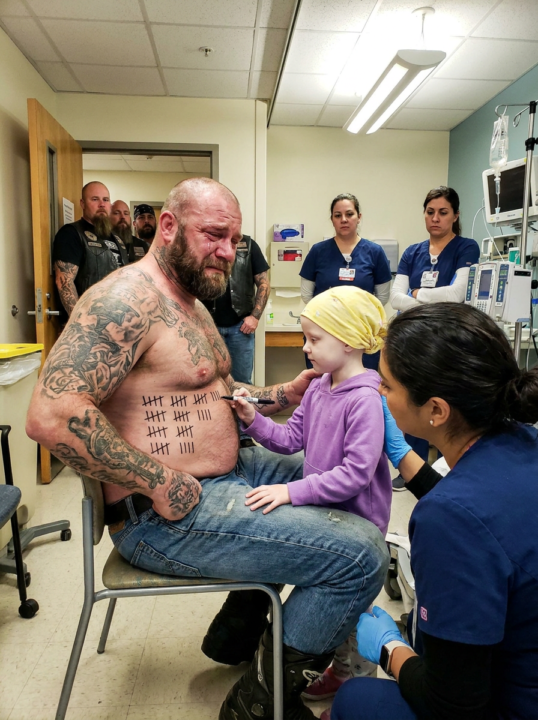
The Iron Mesa Riders gave him a place to stand without pretending his past had vanished.
He earned his road name after helping lift a collapsed steel gate off a trapped mechanic. At first we called him Giant. Mack said that lacked imagination. Someone suggested Goliath, and the name stayed.
Gabe disliked it.
Rosie loved it.
She was born two years after his release. Her mother, Lena, was a pediatric respiratory therapist who had met him when his Harley stalled outside the hospital after visiting Micah. Lena knew exactly who Gabe had been, including the court record and the anger classes.
She married him anyway.
Not because she believed love cured violence. She married him because he had already begun doing the work himself.
Fatherhood frightened Gabe more than prison.
He held newborn Rosie as if she were made from blown glass. He checked her breathing every twenty minutes. He installed the car seat twice, rejected both attempts, then drove to a fire station and asked a nineteen-year-old firefighter to inspect it.
When Rosie developed a fever at three months, he sat beside her crib all night.
At dawn, Lena found him counting breaths.
That habit never left.
Gabe counted everything connected to his daughter: bottles, naps, temperatures, steps across a parking lot, seconds between coughs. He kept a tiny notebook in the inside pocket of his vest. Other bikers recorded fuel mileage or repair lists.
Gabe recorded Rosie.
First laugh: 11:14 a.m.
First step: eight and a half months.
First motorcycle ride: not until her mother says so.
That final entry remained unresolved.
Rosie grew into a loud, funny child who liked purple dinosaurs, grilled cheese without crusts, and sitting on the garage floor while Gabe repaired his Harley. She called every wrench a “fixer” and every motorcycle a “rumble horse.”
At six, she asked why his knuckles were scarred.
“I used them wrong,” he said.
She considered that answer. “Do they work right now?”
“Most days.”
Children accept complicated truths when adults stop decorating them.
The first sign of illness was a bruise behind Rosie’s knee. Then came fatigue, nosebleeds, low fevers, and pain in her legs. Gabe blamed playground falls. Lena did not.
Blood tests led to another test.
Then another.
The diagnosis came on a Tuesday morning: acute lymphoblastic leukemia.
Gabe listened without moving.
The oncologist, Dr. Anika Shah, explained survival rates, treatment phases, possible complications, and the long road ahead. Lena asked questions through tears. Gabe stared at a whiteboard where someone had drawn a smiling sun.
When Dr. Shah finished, he asked one thing.
“How many treatments?”
She told him they could not reduce the coming years to a simple number. There would be chemotherapy sessions, maintenance therapy, spinal procedures, transfusions, tests, delays, and adjustments.
“How many to start?” he asked.
“Four weeks of induction.”
“How many days?”
Dr. Shah answered cautiously.
Gabe opened his notebook.
The counting began.
On Rosie’s first chemotherapy day, he wore his leather cut into the ward. A nurse asked him to remove it because of infection-control concerns. Gabe’s expression hardened. Lena touched his arm.
He removed it.
That small act told me how scared he was.
Gabe considered the vest armor. He had worn it into court, funerals, roadside fights, and the room where Micah died five years after Gabe’s release from complications related to an old heart condition.
In the cancer ward, armor had rules.
He folded it over a plastic chair.
Rosie watched the medicine enter her line.
“Is it poison?” she asked.
Dr. Shah did not lie. “It is medicine strong enough to hurt bad cells, but sometimes it hurts good cells too.”
Rosie looked at her father. “Are you scared?”
Gabe could have protected her with another lie.
“Yes.”
“Me too.”
He held out his hand.
“Then we do scared together.”
She finished the session after six hours.
That night, Gabe went home, showered, and stood shirtless before the bathroom mirror. Lena found him pressing one finger against an old black line near his left ribs.
“What are you doing?”
“Counting.”
He took a sterilized sewing needle and bottle of ink from a drawer.
Lena stopped him before he touched his skin.
The next morning, Gabe rode to Last Light Tattoo.
He asked Vanessa for a single line beside the old one.
The first mark was already there.
The second belonged to Rosie.
After every completed chemotherapy session, another followed. Gabe said it was so Rosie would never become a case number on a whiteboard.
If the hospital counted what cancer took from her, he would count every day she took back.
Part 3 — The Session That Did Not Earn a Mark
By session twenty-six, the routine looked almost ordinary.
That was dangerous.
Gabe arrived before sunrise with road coffee and Rosie’s purple backpack. Lena packed crackers, clean clothes, disinfectant wipes, and the yellow scarf Rosie preferred when her scalp became tender. One Iron Mesa Rider waited downstairs each treatment day in case the family needed food, a ride, or someone to curse at privately.
We rotated.
Nobody called it a schedule.
But there was one taped inside Mack’s garage.
Rosie noticed the riders before Gabe did. On treatment mornings, she looked through the hospital window and searched the parking lot for a black leather vest. Sometimes it was mine. Sometimes Denny’s. Sometimes Reuben brought a ridiculous folding chair and sat beside the Harley like a guard outside a castle.
The nurses began calling us the parking-lot uncles.
We raised money without telling Gabe. He refused charity directed at himself, so we paid the mortgage through a shell game Mack described as accounting and a prosecutor might have described differently. We covered hospital parking, replaced two worn tires on Lena’s car, and filled the freezer with food.
Gabe discovered the mortgage payments in month three.
He entered the garage during a club meeting and threw an envelope onto the table.
“Who?”
Nobody answered.
He looked at me.
I looked at Mack.
Mack looked at the ceiling.
Gabe’s jaw worked.
“I didn’t ask.”
Mack stood. He was five-foot-eight and sixty-three years old, which made him the only member reckless enough to argue with Goliath at close range.
“No,” Mack said. “Rosie didn’t ask for cancer either.”
The room tightened.
Gabe could have walked away from the club. For several seconds, I thought he would.
Then he pushed the envelope back toward Mack.
“Keep receipts.”
That was his surrender.
Session thirty-eight lasted nearly nine hours. Rosie vomited until there was nothing left. Gabe held the basin, cleaned her mouth, changed her shirt, and told a terrible story about a coyote stealing Reuben’s underpants from a campsite.
Rosie smiled once.
The mark went on that night.
Session forty-one ended with a fever.
The mark went on after Dr. Shah confirmed the infusion was complete.
Then came session forty-two.
Rosie woke pale and quiet. Her blood counts were low. Dr. Shah discussed postponing treatment, but later approved a reduced infusion under close monitoring. By noon, Rosie’s temperature climbed. By two, her heart rate increased. At 2:17, she began shivering so violently that the bed rails clicked.
Nurses entered.
Then more nurses.
Gabe stood with his back against the wall because there was nowhere else to put a man his size. Lena held Rosie’s foot beneath the blanket. Dr. Shah ordered the chemotherapy stopped.
The bag remained half-full.
No finish.
No mark.
They moved Rosie into intensive care with a suspected bloodstream infection. Gabe followed until the doors closed. Then a nurse told him he had to wait.
He did not understand.
Not emotionally. Not physically.
Gabe grabbed the door before it shut. The nurse called security. I stepped between them and placed both hands against his chest.
“Brother.”
“She’s in there.”
“I know.”
“She’s alone.”
“Doctors are with her.”
“I promised.”
His voice broke on the last word.
Two security officers approached. Gabe looked at their hands, then at mine. For a moment I saw the old violence returning—not as cruelty, but as terror searching for somewhere to land.
I said the only thing that reached him.
“If you get arrested, she wakes up without you.”
His grip released.
Gabe sat on the floor.
He stayed there for eleven hours.
The club arrived one rider at a time. Hospital rules kept us out of the corridor, so men waited in the lobby, stairwell, cafeteria, and parking garage. Leather cuts appeared on every floor. Boots moved quietly. Nobody started an engine.
At 1:06 a.m., Dr. Shah came through the doors.
The infection had responded to antibiotics. Rosie was stable, but treatment would pause until her body recovered.
Gabe nodded.
“Did she finish?”
Dr. Shah knew about the tally.
“No.”
That was all.
At dawn, Gabe rode to Last Light Tattoo.
Vanessa unlocked the shop when she saw him outside. He lifted his shirt, exposing forty-one completed marks and the space waiting for another.
“Do it,” he said.
She shook her head. “She didn’t finish.”
“She survived the day.”
“That isn’t your rule.”
“My skin. My rule.”
Vanessa put down her gloves.
“Her count,” she said. “Not yours.”
Gabe’s eyes hardened. “Ink the line.”
“No.”
He struck the counter with one fist. Ink caps jumped. The front window rattled.
Vanessa did not move.
“Walk out,” she said. “Come back when you remember what those marks mean.”
Gabe stared at her.
Then at the blank space.
The anger drained out of him, leaving something worse.
Helplessness.
He lowered himself into the tattoo chair and covered his face with both hands.
Vanessa drew a tiny dot with temporary surgical marker.
“Her place is saved,” she said. “But she earns the line.”
For nine days, Gabe protected that dot. He did not shower normally. He covered it with plastic. When it began fading, Vanessa redrew it.
Rosie recovered.
The restarted session took nearly seven hours. Gabe watched every drop enter the IV line. When the bag emptied, the nurse disconnected it and said, “Finished.”
Gabe closed his eyes.
That night, Vanessa tattooed the forty-second mark.
The entire club waited outside.
We thought the crisis had passed.
Then Dr. Shah called Lena the next morning and asked both parents to return without Rosie.
A new scan had revealed something they had not expected.
Part 4 — Why the First Tally Never Belonged to Rosie
The scan did not show a new tumor.
It showed a complication near Rosie’s hip—an area of bone damage likely connected to treatment. It was serious but manageable. She would need additional monitoring, physical therapy, and possibly surgery later.
Gabe heard only one phrase.
More hospital.
He returned to the parking garage, leaned against his Harley, and stared at the tally beneath his shirt. The club had seen him angry, bruised, drunk years earlier, handcuffed, grieving, and exhausted.
We had never seen him afraid of hope.
Hope created something to lose.
He skipped the next club meeting. Then another. He stopped answering calls. Lena said he still attended every appointment, slept beside Rosie’s bed, and handled medication schedules with military precision.
But he no longer came to the garage.
I found him one night outside an abandoned house in Barelas, an old Albuquerque neighborhood south of downtown. His Harley stood at the curb. The house had plywood over two windows and a rusted swing frame in the yard.
Gabe sat on the porch steps.
“Whose place?” I asked.
“Mine.”
He had grown up there with Micah and their older sister, Elena.
That surprised me.
Gabe rarely spoke about family before Rosie. We knew Micah had died. Elena was not a name I had heard.
He raised his shirt.
Then he pointed to the first faded tally.
“Elena’s.”
The story came slowly.
Elena Mercer was eleven years older than Gabe. When their mother left and their father disappeared into alcohol, Elena became the parent. She cooked, signed school forms, worked evenings at a grocery store, and taught Gabe how to patch bicycle tires.
At seventeen, she was diagnosed with Hodgkin lymphoma.
Their father refused to discuss it. He believed naming illness gave it power. Elena traveled to treatment by city bus, sometimes alone. Gabe was six years old the first time he accompanied her.
He remembered the infusion room smelling like plastic and oranges.
Elena gave him a pen and told him to draw one line on her paper bracelet after she finished each chemotherapy session. She wanted proof that days could be completed even when they felt endless.
One day, Gabe drew the line on his own ribs.
“Why there?” I asked.
“She said she’d lose the bracelet.”
He used ink from a broken ballpoint pen and a sewing needle heated over the stove. The line became infected. Elena cleaned it and called him an idiot.
Then she kissed his forehead.
Gabe made a promise: after every session Elena finished, he would add another line.
But she stopped him.
“One is enough,” she said. “You don’t carry my count.”
Elena completed treatment and entered remission.
For nearly two years, she seemed well. Then the cancer returned aggressively. Their father disappeared for three days after hearing the news. Gabe, now eight, sat beside Elena and asked where to place the next tally.
She told him no.
She died five months later.
The first line remained.
Gabe had never added to it.
“What does this have to do with Rosie?” I asked, though I already knew.
He looked at the boarded house.
“When Dr. Shah said leukemia, I was six again.”
The giant biker, the prison record, the club, the scarred knuckles—all of it disappeared for a moment. On that porch sat a boy holding a paper bracelet while the only person who had raised him tried not to die.
Gabe had not invented Rosie’s tally to celebrate courage.
He had invented it to negotiate with memory.
If he recorded each completed session, maybe no day could vanish. If he placed the count on skin, no hospital could misplace it. If the marks continued, Rosie continued.
That was the private arithmetic.
But there was more.
Gabe admitted he had changed the story of the old tattoo whenever people asked. He called it a prison mark, a bar-fight count, even a record of men buried. Letting people fear him was easier than explaining the one-inch line made by a terrified child waiting for his sister to survive.
The most frightening tattoo on his body had been drawn out of love.
I sat beside him.
“What did Elena mean when she said not to carry her count?”
Gabe rubbed both hands over his face. “I thought she meant stop tattooing.”
“And now?”
“She meant her dying wasn’t mine to keep paying for.”
The porch boards creaked beneath us. Traffic passed two streets away. Somewhere, a freight train sounded across the dark city.
Gabe lifted his shirt again.
Rosie’s marks stood beside Elena’s single line.
He had begun the tally because he feared history repeating itself. Yet the marks had become something else. Rosie asked about them after session nine. Gabe told her they were hers.
From then on, she counted too.
Before difficult treatments, she touched the empty space where the next line would go. She did not see death there.
She saw a place waiting for another victory.
That difference belonged to Rosie.
Gabe returned to the club the following Sunday. He did not apologize for disappearing. Bikers rarely use speeches when an action will do.
He placed Elena’s photograph on the meeting table.
Then he told the truth about the first mark.
Mack removed his glasses. Denny stared at his hands. Reuben asked what Elena looked like.
“Mean,” Gabe said.
It was the first time he smiled while speaking her name.
The brotherhood changed after that. We stopped treating Rosie’s illness like a battle Gabe had to lead. We recognized the older battle he had been fighting alone since childhood.
The next time Rosie entered the hospital, twenty-nine riders did not wait in the parking lot merely for her.
We waited for him too.
Part 5 — The Seventy-Third Line
Rosie’s treatment continued for eleven more months.
The number grew slowly.
Forty-eight.
Fifty-three.
Sixty-one.
There were delays, transfusions, infections, a physical therapy program for her hip, and weeks when Gabe kept the empty spaces on his ribs covered because seeing them made him impatient.
Rosie changed too.
Her hair began returning as dark fuzz. She developed a sharp sense of humor about adults who spoke in whispers around sick children. She named the infusion pump Gerald and accused it of complaining whenever it beeped.
At session sixty-four, she asked Gabe whether the tattoos hurt.
“Yes.”
“As much as chemo?”
“No.”
“As much as stepping on a building block?”
“Worse.”
Rosie studied him. “You’re lying.”
“Correct.”
She decided she wanted to make the final mark herself.
Lena refused immediately.
Gabe refused more loudly.
Dr. Shah tried not to become involved in a family argument concerning a child, tattoo equipment, and a man whose rib cage already resembled a prison calendar.
Rosie waited.
She had learned patience from treatment.
Three weeks later, she approached the subject again. Vanessa could prepare the sterile equipment and guide her hand. The needle would touch Gabe, not Rosie. Dr. Shah would approve only if it occurred after clinical care ended and outside the sterile treatment area.
Eventually, the adults surrendered.
The final planned chemotherapy session was number seventy-three.
By then, the story of the marks had spread through the ward, though Gabe never permitted photographs. Parents knew. Nurses knew. Children asked to see the tally. Gabe showed it only if Rosie approved.
On the morning of the final session, the Iron Mesa Riders assembled outside the hospital before dawn.
Twenty-nine Harleys.
The air smelled of cold pavement, exhaust, and coffee. Nobody revved an engine. Gabe hated performative noise near sick children.
Rosie arrived in Lena’s car wearing her purple sweatshirt and pale yellow scarf. She got out slowly because of her hip, then raised one fist.
Twenty-nine bikers raised theirs.
No cheering.
Just presence.
The infusion began at 8:12 a.m.
At 10:40, Rosie became nauseated.
At noon, her blood pressure dipped, then stabilized. Gabe sat close enough for their knees to touch. He did not count the drops. He had stopped doing that months earlier after Dr. Shah told him counting could not control medicine.
Instead, he read Rosie a book about a girl who traveled through space.
At 3:26, the final bag emptied.
The nurse disconnected the line.
“Finished,” she said.
Rosie looked at Gabe.
“Now.”
The small ceremony took place in a family room beside the ward. Vanessa arrived with sealed equipment. Dr. Shah watched from near the door. Lena helped Gabe remove his vest and shirt.
The tally covered most of his left ribs.
Seventy-two marks for Rosie sat beside Elena’s first faded line.
Rosie put on gloves. Vanessa positioned her hand and explained every movement. The needle buzzed.
Gabe faced the wall.
Rosie drew the seventy-third mark.
It wandered slightly left.
Gabe called it perfect.
Then Rosie counted.
When she reached the old line, she stopped.
“That one isn’t mine.”
The adults exchanged glances.
Gabe had never told her.
He lowered himself until they were eye level. Then he spoke about Elena—the sister who raised him, the bus rides, the paper bracelet, and the line a frightened six-year-old boy put on his ribs because he thought skin could remember better than paper.
Rosie listened.
“Did she get better?”
“For a while.”
“Then?”
Gabe did not soften it.
“She died.”
Rosie looked at the tally again.
“So we have seventy-four.”
Gabe shook his head. “That first one is hers.”
“I know.”
She touched Elena’s mark.
“One for her. Seventy-three for me. Seventy-four times somebody finished a hard day.”
Nobody corrected that arithmetic.
Rosie removed her yellow scarf. Beneath it, her new hair was barely half an inch long. She placed the scarf in Gabe’s hand and asked Vanessa for a marker.
On the skin beside the final tattoo, Rosie drew a small star.
“This one doesn’t get ink,” she said.
“Why?”
“It’s for tomorrow.”
Gabe closed his hand around the scarf.
For years, he had marked only completed suffering. Rosie had just given him a symbol for the life that had not happened yet.
The riders entered in small groups. Each man touched Gabe’s shoulder, nodded toward Rosie, and left enough space for the next. Mack brought a small bell for Rosie to ring, but she refused.
“Everybody does the bell,” she said. “I want engines.”
Hospital rules prevented twenty-nine Harleys from starting beneath the ward windows.
So the club moved the motorcycles to an empty lot across Route 66.
Rosie watched from the sixth floor.
At sunset, Lena called Mack.
Twenty-nine engines started together.
The glass trembled beneath Rosie’s fingers.
Part 6 — What Gabe Added After the Cancer Was Gone
Remission did not feel like an ending.
Rosie still had blood tests. Every unexplained bruise frightened Gabe. Every fever turned the house silent. Her hip required therapy, and some mornings she woke exhausted despite having finished treatment months earlier.
Cancer left the building slowly.
Gabe kept counting at first.
Days since chemotherapy.
Days without fever.
Days until the next appointment.
Rosie caught him writing numbers inside the notebook and took it away.
“No more counting bad things,” she said.
“What do I count?”
She opened to a blank page.
“Firsts.”
The new list began.
First day back at school.
First full mile walked without resting.
First haircut after treatment.
First time arguing with Mom about bedtime again.
Gabe did not tattoo these moments. Rosie said skin had limited space and life should be allowed to become too large for it.
The tally remained untouched.
He no longer hid it. At club cookouts, when summer heat made leather unbearable, the marks showed beneath his sleeveless shirt. Strangers still guessed prison, violence, or death.
Sometimes Gabe corrected them.
Sometimes Rosie did.
“Those are my Thursdays,” she told one new prospect.
The young man looked confused.
Gabe said, “That’s enough explanation.”
Vanessa photographed the tally once with the family’s permission—not for social media, but for Rosie’s medical scrapbook. In the image, Gabe stood sideways while Rosie pressed her palm beside the final mark. The temporary star had faded, yet they both remembered where it had been.
A year after remission, Rosie returned to the ward carrying seventy-three small cards. Each card had a black tally on the front and a handwritten message inside.
This day can finish.
She gave them to children beginning treatment.
Gabe carried the box.
The nurses remembered the giant biker who once refused to remove his leather vest. Now he entered in a clean cotton shirt, washed his hands twice, and asked where to place the cards without interfering.
Armor had changed shape.
The club funded transportation vouchers for families traveling from rural New Mexico. They called the program Elena’s Ride, though Gabe resisted using her name until Rosie insisted.
“She took the bus alone,” Rosie said. “Other kids shouldn’t.”
That settled it.
Every spring, riders escorted a small van—not children on motorcycles—from distant towns to the hospital. The motorcycles remained behind the vehicle, never crowding it, their engines low and steady along Route 66.
Gabe rode first.
Rosie sometimes rode in the van to greet families. She showed frightened children the photograph of the tally and told them her father was enormous but fainted emotionally around needles.
“I did not faint,” Gabe protested.
“Emotionally,” she repeated.
He had no defense.
The marks no longer counted how close Rosie came to death.
They counted how often she returned to life.
Part 7 — The Mark He Never Had to Add
Five years after Rosie’s final chemotherapy session, we met at Last Light Tattoo again.
The shop had moved two blocks east, but the old neon clock still ran seven minutes slow. Vanessa had gray at her temples. Mack used a cane. My beard had turned almost white.
Rosie was fourteen.
Her hair reached her shoulders. She still had weakness in one hip, though it did not stop her from playing drums badly in a school band. She wore a denim jacket, black sneakers, and the same stubborn expression that had defeated most adults in her life.
Gabe remained six-foot-five.
Time had softened nothing visible. His beard carried more silver. The scar above his ear had deepened. The leather cut still made strangers cautious.
Rosie brought him to the shop for a tattoo.
Not another tally.
Vanessa placed a stencil beside the seventy-third line: a small unfinished star matching the one Rosie had drawn with marker years earlier.
Gabe looked at his daughter.
“I thought you said no ink.”
“I changed my mind.”
“Why unfinished?”
Rosie pointed to the open edge.
“Because tomorrow still has room.”
Vanessa tattooed the star.
Gabe watched Rosie in the mirror rather than the needle. She talked about college, motorcycles, and a boy he was not allowed to threaten. He disagreed with the last condition.
When the tattoo was finished, Gabe stood.
The old line for Elena remained at the top. Beneath it stretched Rosie’s seventy-three completed days. Beside the last was the open star.
Past.
Survival.
Tomorrow.
Rosie photographed it on her phone.
“You posting that?” Gabe asked.
“No.”
“Why take it?”
“So I remember.”
Gabe smiled. “Skin remembers.”
“Phones make backups.”
She hugged him around the waist, careful of the fresh bandage. Gabe placed one broad hand against the back of her head.
Outside, the Iron Mesa Riders waited beside their Harleys. Not twenty-nine anymore. Some brothers were gone. New riders had arrived. Brotherhood changed faces but kept its promises.
Gabe put on his vest.
Before mounting his Road King, he looked toward the western sky. Evening light had spread across Albuquerque, turning the hospital windows in the distance pale gold.
Rosie climbed into Lena’s car.
She rolled down the window and raised one finger.
“One ride around the block,” she called. “Then home.”
Gabe started the engine.
The V-twin answered beneath him.
He touched the left side of his ribs once, not counting the lines, only confirming they were still there. Then he pulled into traffic with the club behind him while Rosie watched through the open window.
Follow our page for more powerful biker stories about intimidating men whose quiet scars reveal the people they refused to abandon.