An Aging Biker Searched Forty Years for His Missing Daughter—Then an Idaho Police Chief Touched Her Neck While the Man Who Raised Her Watched
The man behind the glass door stood up.
Chief Anna Mercer lowered her hand from her neck.
“Dad, wait.”
He stopped with his coat half lifted from the chair. White hair, pressed trousers, a paper sack from the bakery beside his feet.
I had imagined the man who took my daughter a thousand ways.
None of them carried lemon muffins to a police station.
“My name is Walter Mercer,” he said. “There seems to be some confusion.”
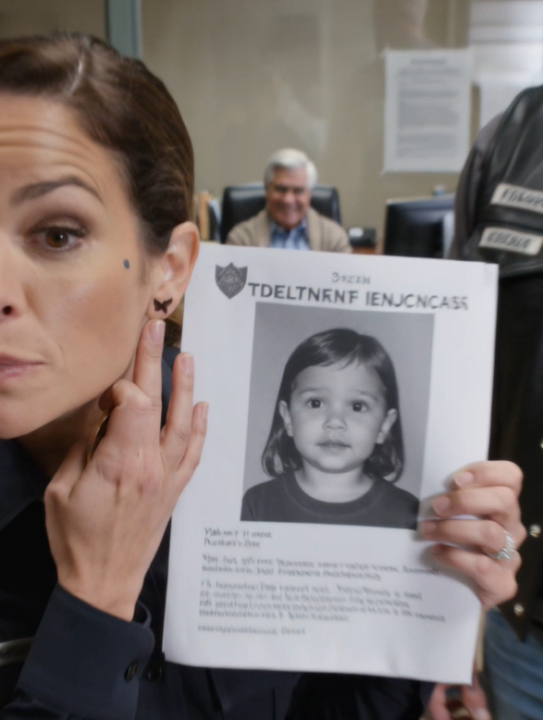
Anna looked at my flyer again.
The old photograph had softened through decades of copying. A little girl with untidy bangs. A brown mark beneath her left ear, broad at the top and narrow in the middle.
Lily June Bennett.
Missing at three.
I knew every line.
Anna’s mark was partly hidden by her uniform collar.
Similar.
Not proof.
I had learned the cost of confusing those things.
There had been a waitress in Nebraska. A college student in Alabama. A woman whose husband threatened to call the police if I came near their house again.
I never approached a possible match now without someone appropriate helping.
That was why I had brought the flyer inside.
Walter took out his wallet.
“Anna was adopted. We have the documents.”
His voice was calm.
Mine wouldn’t settle.
I told him nobody had accused him of anything.
He looked at my leather vest, then the road dust on my boots.
The receptionist had stopped typing.
Anna asked us both to sit in separate rooms.
Then she removed her badge from her belt and placed it on her desk.
“I can’t be the person investigating this.”
She said it to the deputy standing nearby.
Clear.
Professional.
Her hands were shaking anyway.
An investigator from outside her department was contacted. So was the office in Florida that still held my daughter’s case.
I gave permission for them to call the number on the flyer. Not a number I supplied from memory.
Anna noticed that.
“You’ve done this before.”
“Too often.”
Walter produced a photograph from his wallet.
Anna at five, missing a tooth, standing beside a woman in a yellow sweater.
His wife, Elaine.
He turned it over.
A date.
Anna’s birthday in April.
Lily’s was in October.
For a moment, the ground shifted back beneath him.
Six months was a lot when someone was counting a child’s years. Adoption could explain a changed name. It didn’t explain every difference.
I looked down at my own hands.
Maybe I had brought another stranger’s family into forty years of damage.
Anna asked when I had last seen Lily.
“October. A Thursday. She was wearing yellow overalls.”
Walter made a sound.
Not a word.
More like somebody catching a breath before a sneeze.
Anna turned toward him.
He picked up the bakery sack.
“I need to call your mother.”
She nodded.
Then she asked him to remain available.
After he left the room, Anna looked at me across the desk.
“My father told me my birth parents died in a house fire.”
I held the edge of the chair.
If her story was true, whose child had I spent forty years looking for?
That last Thursday, Lily sat inside a green chalk circle on our driveway.
She had drawn it herself around the spot where she parked her little chair.
“Shop office,” she told me.
I was replacing a cable on my motorcycle. She handed me tools I hadn’t requested and charged imaginary customers with a dead pocket calculator.
Before lunch, she climbed onto my lap.
I sang the song her mother hated because I had changed the last line.
“Keep one star awake.”
Lily always made me sing that part twice.
Afterward, I went into the garage for a wrench.
I could still see her through the open door.
Then a delivery driver asked me to sign for a box at the side gate.
When I came back, her chair was empty.
The green circle remained until the next rain.
I told the outside investigator that story without making the years shorter.
Her name was Detective Ruiz.
She listened.
Then she asked what evidence I had brought that wasn’t available on the flyer.
I opened my saddlebag.
Copies of the original report. Family photographs. A reference number for the DNA sample I had provided years earlier. The names of people who had worked the case.
I had learned to pack my history so someone else could read it.
Ruiz asked about my route.
Florida to Oregon.
“Why Oregon?”
An old lead had been reviewed after a volunteer helped organize part of the file. Someone connected with a questionable private placement service had later worked around Medford.
It wasn’t a destination with a daughter waiting at the end.
It was a direction.
I stopped in towns that allowed flyers in laundromats, diners, and public buildings. Sometimes somebody remembered something. Usually they remembered another missing child.
At sixty-nine, I rode shorter days than I used to.
My knees hurt in cold weather.
I stayed in cheap motels, called friends to say I’d stopped, and kept enough money to get home.
Searching had to fit inside an ordinary life or it would consume all of it.
For years, it nearly had.
My wife, Mary, worked double shifts when I couldn’t stop driving. Later, I worked while she called newspapers.
She died eight years earlier.
I hadn’t brought that photograph into the station.
Ruiz asked whether Anna would consent to a properly documented DNA comparison.
Anna said yes.
She also asked whether an examination of her childhood records could be handled by people outside her chain of command.
Yes.
She wasn’t surrendering her job because of a flyer.
She was separating her authority from her need for an answer.
That evening, I checked into a motel beside a feed store.
My riding friend Luis called from Florida.
“You find the right place?”
“Don’t know.”
“You eaten?”
“Don’t know that either.”
He stayed on the phone until I ordered soup.
Later, Anna sent a message through the contact arrangement Ruiz had established.
Could I provide a clearer baby photograph?
I enlarged one on my phone.
The mark was already there beneath Lily’s ear.
Not a scar.
Not something acquired later.
Had someone changed more than Anna’s name when they told her where she came from?
Walter’s papers were better than I expected.
There was an adoption order.
A court name.
A date from years before every old record could be checked from a desktop.
There were photographs of a child arriving in Oregon and letters from a private placement intermediary.
Ruiz didn’t pronounce anything authentic because it looked old.
She requested confirmation.
Eventually, the court record was located.
A real proceeding had occurred.
That changed the conversation.
Walter wasn’t simply an old man who had printed a convincing story the night I arrived.
He and Elaine had adopted a child through a process that left records.
Anna looked almost relieved when Ruiz explained it.
Then she looked at me and seemed ashamed of the relief.
“You can want him innocent,” I told her.
She stared at the table.
“I do.”
“I know.”
The documents identified an intermediary named Raymond Hale, who had arranged private placements and died several years earlier.
His signature appeared on the account of how the child became available.
Her mother had supposedly surrendered her.
Her father was described as absent.
I read that word three times.
Absent.
I had left the garage for less than a minute.
A lifetime had been built inside the space.
Elaine came to speak with the investigators. Later, Anna told me what her mother had said with permission to share it.
She believed the child needed a family.
She remembered waiting in a rented house, buying pajamas in two sizes, and asking why Anna woke crying for someone called Mama.
Walter had said that was normal.
Nobody handed Elaine a missing-person flyer.
Nobody told her a man in Florida was walking roadsides with a photograph.
Her memory wasn’t a verdict.
It was another account that needed checking.
For a while, the suspicion moved toward Hale.
A dead intermediary.
A real adoption.
Parents who might have believed what they were told.
I hated how badly I wanted the man in Walter’s photographs to be an innocent fool.
It would give Anna somewhere to stand.
Ruiz asked me whether Mary had signed any relinquishment.
“No.”
“Not privately? Not during a separation?”
“We weren’t separated.”
I heard the sharpness in my voice.
She didn’t retreat from the question.
She shouldn’t have.
The record contained what appeared to be Mary’s consent.
I had to accept that investigators couldn’t decide it was false merely because I loved her.
So I provided examples of her handwriting.
Old school forms.
Insurance papers.
A birthday card she’d signed to my sister.
My missing child had turned into documents again.
That was how the work had to proceed.
Then a notation in the intermediary’s file sent investigators back to Florida.
A payment recorded before Lily disappeared.
Not after.
A reservation, the ledger called it.
Anna didn’t tell Walter about that entry.
She called me instead.
“Can you come somewhere that isn’t the station?”
We met at a diner with chairs that dragged against the floor.
She wore a scarf despite the warm evening.
If Walter had only accepted a child already surrendered, what had he paid to reserve before she was missing?
The DNA result arrived through the investigators.
Anna was my biological daughter.
Ruiz explained it carefully.
I heard the first sentence.
The rest came through as sound.
Anna sat across from me, her scarf folded beside her coffee. She looked at the report for a long time, then asked whether I wanted another copy.
Such an ordinary question.
I started crying.
Not loudly.
I couldn’t find the next breath without it catching.
Anna put a paper napkin beside my hand.
She didn’t call me Dad.
I didn’t ask.
For forty years I had searched for a little girl. The woman in front of me had a mortgage, a profession, and a mother who wasn’t Mary.
Finding her didn’t erase the person she’d become.
Afterward, she asked about Mary.
I showed her a photograph from a fishing trip.
Mary wore a ridiculous hat she claimed improved her luck.
Anna laughed once.
Then she cried.
We took turns watching the parking lot until we could look at each other again.
The records continued moving around us.
Money had changed hands before the abduction. A surviving copy of Hale’s correspondence referred to the Bennett child by name.
The birthmark was described.
So was our Florida town.
Walter had told investigators he never knew the child’s origins beyond what the intermediary disclosed at placement.
The correspondence suggested a much earlier interest.
Investigators examined who had written what, where the papers came from, and whether other records supported them.
None of us got to skip that because the result hurt.
There was another motive too.
Elaine had inherited property from her parents. Family correspondence referred to the future of that estate and Walter’s wish to present a settled household.
In one letter, Walter wrote that Elaine had been talking about separation. Beneath a discussion of her inheritance, he asked Hale to move faster: A child will give her a reason to stay. Anna read that line once, then handed the page back without looking at either of us.
That did not make the inheritance itself criminal.
It helped explain why money, reputation, and the appearance of a family had become tangled together.
Elaine told investigators she hadn’t known the payment was made before the child was supposedly available.
She provided the boxes Walter had asked her not to touch.
Inside were retained receipts and letters.
No convenient confession.
Enough small pieces to change the weight of the story.
Walter’s account changed with them.
He said he had paid for help finding a child.
Then he said Hale had promised a particular placement.
Then he said he hadn’t asked the questions he should have.
Each version placed him closer.
Meanwhile, the missing-person report was updated.
The name Lily Bennett began appearing beside Anna’s life.
A reporter called my motel.
Another waited outside the station.
I asked how they had learned where I was staying.
Neither answered.
That night, Walter called me directly.
I didn’t know he had my number.
He said Anna was exhausted. He said reopening old wounds could ruin her career.
“She’s got a good life.”
“She can decide what belongs in it.”
“You don’t understand this town.”
Afterward, the motel clerk knocked.
A caller had warned that I might be harassing local women.
She asked whether everything was all right.
I looked at the flyers spread across the bed.
How quickly could forty years of searching be made to look like a dangerous man refusing to leave?
The clerk didn’t ask me to leave.
She asked whether I wanted her to stop transferring calls to my room.
“Please.”
She wrote something on the pad beside the desk.
Then she asked whether I had somebody coming.
I called Luis.
He listened without interrupting.
“Don’t get on the motorcycle tonight,” he said.
“I’m not running.”
“Didn’t say you were.”
Two days later, he arrived in a rented car with a paper bag of oranges from an airport shop.
“Best I could do.”
We sat outside the motel eating them over a trash can.
He had left work, flown to Boise, and driven the rest. He wasn’t there to confront anybody.
He was there because forty years could still make a man too tired to recognize when he needed company.
By then, the story had traveled through town.
An old biker.
A missing child.
Their police chief.
Walter, who had served on school committees and spent winters delivering firewood to people who couldn’t afford it.
People wanted the familiar man to remain familiar.
I understood that.
I didn’t understand the woman who told me Anna already had a father and I should stop making her uncomfortable.
Luis answered before I could.
“She can tell him that herself.”
That evening, Anna requested leave from her duties while the personal and professional questions were examined. Another person handled the department.
Her voice was flat when she told me.
She wasn’t asking me to fix it.
I nearly offered anyway.
Then I remembered she had been in charge of her life long before I reached Idaho.
“I can bring dinner.”
She said yes.
We ate at Elaine’s house while Walter stayed elsewhere.
Elaine put three plates on the table and stared at the fourth place setting she’d taken out automatically.
Then she returned it to the cupboard.
I looked away to let her do it.
She had raised my daughter.
I could hate the way that happened without pretending every lunch packed and fever watched had meant nothing.
Later, Walter’s lawyer sent a letter warning me about public accusations.
I had made none.
A local article nevertheless described me as claiming the town’s police chief had been kidnapped.
Claiming.
The word made forty years sound like a theory I’d developed on the road.
Ruiz told me not to argue with articles. Investigators were examining the evidence independently.
I followed that advice.
Most days.
One night I typed a furious message and showed it to Luis.
He read it.
“Want an answer or want to hurt him?”
I deleted it.
The next morning, Anna came to the motel.
She stood beside the picnic table with an envelope in her hand.
“I need you to hear something before someone else tells you.”
I moved my papers.
She didn’t sit.
“I knew another name before you walked into the station.”
I looked at the envelope.
Not an old man’s papers.
Hers.
How long had my daughter been carrying a way back to us without using it?
Anna found the name twelve years earlier.
Lily June Bennett.
It appeared on a copy of an early placement document, folded inside a folder Walter kept with the family records.
She was applying for a position that required a careful account of her background. Different dates on two old forms had raised questions.
She asked Walter.
He told her the placement service had used an incorrect name while protecting her biological mother.
He said that woman had been troubled.
He said looking for her would hurt Elaine.
Anna believed part of it.
She chose to believe the rest.
“I thought a court order meant I didn’t have to look underneath it.”
I waited.
“There was an address in Florida.”
My hands went still.
“Did you check it?”
“No.”
She said the word without defending it.
She had corrected the date discrepancy through the explanations and records available at the time. But when asked about other names, she had treated Lily Bennett as a clerical error instead of disclosing the uncertainty fully.
Now that decision was part of the review.
She had told Ruiz.
She had given investigators the folder.
She wasn’t asking me to keep it between us.
That mattered.
It didn’t stop me thinking of Mary sitting beside the kitchen phone twelve years earlier.
Still alive.
Still hoping.
Anna saw something change in my face.
“Your wife was alive then.”
“Yes.”
She sat down.
I had imagined finding my daughter in danger, finding her injured, finding her angry at the people who took her.
I hadn’t imagined needing to be angry with her.
“You could have asked one more person,” I said.
“I know.”
“Somebody who didn’t need you to stop asking.”
She cried quietly.
I looked toward the road until I could speak without making her responsible for all forty years.
“You were lied to as a child.”
“I was an adult when I found the paper.”
Both things stayed between us.
Neither erased the other.
Later, she told Elaine what she’d found and why she’d hidden it.
Elaine cried too.
Not because Anna had another mother.
Because someone had used her love as a reason to keep a child from knowing the truth.
Anna apologized without asking us to say she had done nothing wrong.
For several days, we spoke less.
Luis worried I might leave.
I told him I wasn’t going to punish an adult daughter by disappearing from her life.
But I needed time to stop confusing honesty with an immediate obligation to forgive.
Then Anna brought me something she’d kept since childhood.
Not a document.
A little cassette she’d made at eight, singing songs into a kitchen recorder.
She had never known where one of them came from.
The words were wrong in places.
The last line wasn’t.
Keep one star awake.
She set the recorder on the table and pressed stop before I could ask her to play it again.
A town council meeting was scheduled that week. Walter’s name was on the agenda for a community honor arranged months earlier.
Anna intended to ask that it be postponed.
Would the man who had taught her to speak honestly let her finish speaking?
The meeting room had folding chairs and a coffee urn that had probably outlasted three mayors.
Luis sat beside me.
Anna sat with Elaine.
She wasn’t in uniform.
The council chair explained that the proposed honor would be deferred while serious questions were examined. Nobody needed to decide a criminal case in a municipal meeting.
That should have ended it.
Walter stood.
He said his family had been subjected to speculation. He said he’d taken legal advice and wanted the public to understand he had acted through an adoption process.
Some people nodded.
Others watched Anna.
She raised her hand.
The council chair recognized her.
“I was adopted through a proceeding built on information that is now being examined,” she said. “The DNA establishes that Frank Bennett is my biological father. It doesn’t decide every question about how I reached Oregon.”
She paused.
“I’ve also disclosed records I should have questioned years ago. My own decisions are being reviewed.”
Nobody applauded.
A woman near the back lowered her phone.
Walter looked at Elaine.
She didn’t look away from Anna.
He said he’d always done what he believed was best.
Anna asked whether that included telling her both biological parents were dead.
He said that was what he had been told.
Then she asked why his letters named the Bennett child before the date of the alleged surrender.
He glanced toward the council chair.
“This isn’t the place.”
“You’re the one who asked to explain.”
I kept my hands flat on my knees.
Anna didn’t read out private financial records. She didn’t speak as the investigating chief.
She spoke as the child in the papers.
She asked why he had told investigators he had never been in Florida.
Walter said travel from forty years ago could be difficult to remember precisely.
I heard a chair move behind me.
Then he looked at me.
“You don’t know what her life would’ve been.”
I stood.
Luis touched my elbow, then released it.
I didn’t move toward Walter.
“No,” I said. “Neither do you.”
He started describing the life he’d given her. School. Music lessons. A safe house.
All things I wished she’d had.
None things that required me to be erased.
Then he said I had left her unattended.
Anna turned her head.
Walter’s face had reddened.
“You left her sitting in that green circle while you worked on your motorcycle.”
The room went quiet.
I could see the driveway.
The little chair.
Chalk on her fingers.
The circle’s color hadn’t appeared on my flyers. Investigators had kept that detail out of public descriptions. Elaine had never heard me tell the story.
Anna said, “How do you know it was green?”
Walter opened his mouth.
Closed it.
Then anger carried him farther than caution.
“Because I stood across the road. Five minutes. You never looked up.”
He stopped.
His account had always begun with a child delivered in Oregon.
Now it began across the road from my garage.
Elaine put one hand over her mouth.
Anna remained still.
I said nothing.
There were witnesses enough.
Walter tried to describe it as rescuing a neglected child. He said he carried her because she was frightened.
Anna’s voice barely rose above the room.
“From who?”
The council chair ended the exchange. Independent investigators were notified of what had been said, and the recording was preserved.
Nobody chased Walter.
Nobody asked my friends to deliver justice.
Outside, Anna stood beside my motorcycle, staring at the helmet on its seat.
“If he hadn’t seen himself as my rescuer,” she asked, “would he ever have admitted he was the one who took me?”
I didn’t have an answer.
I had spent years asking what kind of man could take a child.
The answer turned out to be a man who could also buy school shoes.
That was harder to live with than the monster I had imagined.
The public admission didn’t replace the investigation. The letters, adoption records, money, travel history, and original Florida case still had to be put together.
There were interviews.
There were lawyers.
There were proceedings that stretched across calendars I’d once expected to spend riding west.
Walter eventually admitted taking Lily from the driveway and knowingly participating in the false account that followed.
The consequences came through the courts.
They didn’t arrive quickly enough to feel like forty years had been answered.
Nothing could.
Elaine wasn’t asked to pretend she had never loved him.
She separated from him anyway.
She gave investigators what she had and gave Anna space when she needed it.
Sometimes she called me to ask whether Anna had eaten.
Sometimes I called her with the same question.
We began with that.
Anna’s professional review took its own course. She corrected her records and answered questions about what she’d withheld years earlier.
Finding her father didn’t excuse those decisions.
Neither did those decisions make the abduction her fault.
We learned to leave both facts standing.
I didn’t ask her to become Lily overnight.
She had signed Anna on reports, birthday cards, and the papers for her first house. That name held a life.
Mary had given her Lily.
I loved that name too.
There was room to grieve what I lost without demanding she erase what remained.
Before I went home, she asked to see my route map.
The paper was soft at the folds.
Florida.
Old stops marked in different inks.
This year’s line reaching toward Oregon.
She followed it with one finger.
“Were you going all the way?”
“That was the plan.”
“What now?”
I looked at Idaho.
“I might stay a little longer.”
She smiled.
Not the child’s smile from my photograph.
Hers.
Weeks later, we traveled to Florida together. She wanted to see the place I’d kept describing.
The garage had been rebuilt.
The driveway was different.
There was no chalk.
At Mary’s grave, Anna set down flowers and stood with both hands inside her coat pockets.
I waited near the path until she asked me to come closer.
She didn’t make a speech.
Neither did I.
Afterward, we went home and ate sandwiches at the kitchen table.
She asked to see photographs without me explaining every one first.
Sometimes she recognized a face she couldn’t name.
Sometimes she recognized nothing.
We didn’t force it.
On her last evening, she found a stack of unused flyers beside the cabinet.
She picked one up.
Three-year-old Lily stared back at her.
“Can I keep this?”
“Of course.”
She folded it carefully, photograph inward, and put it in her bag.
The next morning, I walked her to the car.
She hugged me first.
Then she held my wrist for a moment before letting go.
“I don’t know what to call you yet.”
“Frank works.”
She nodded.
I watched her place the flyer safely beside her purse.
For the first time, I wasn’t sending my daughter’s picture away in the hope someone would bring her back.
She was taking it home herself.
Anna lowered the window.
“Will you call me tomorrow?”