A Little Girl Handed a Biker the Toy He Made for His “Dead” Daughter—Then He Saw His Wife Waiting Behind Her in the Autograph Line
The woman in the line lowered her sunglasses.
My knees struck the folding table.
A stack of photographs slid onto the concrete. Somebody laughed, thinking it was part of the demonstration. Then Natalie said my name, and the laughter stopped.
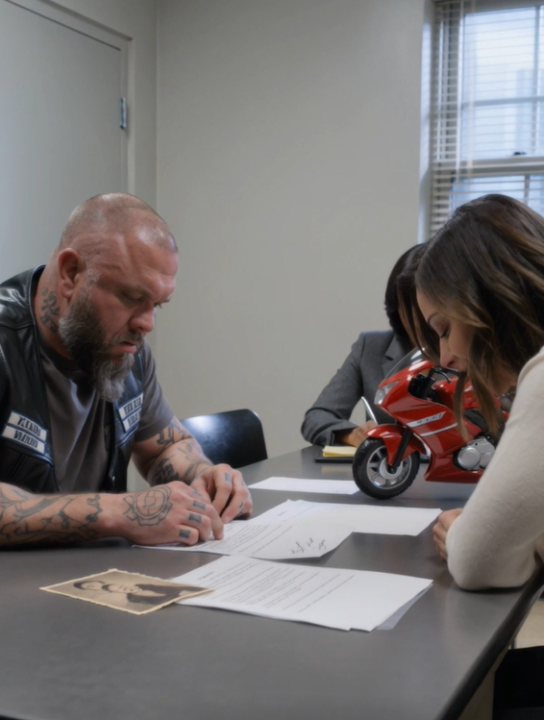
Ruby kept both hands on the toy.
I couldn’t decide where to look.
At seven, she had lost the round cheeks I remembered. Her hair was darker. There was a gap where a front tooth should have been.
But her left thumb still rubbed the little motorcycle’s saddle when she waited.
I had watched that thumb wear the paint away.
“How old are you?” I asked.
“Seven.”
The number hurt.
Three birthdays.
Three Christmas mornings.
Natalie stepped beneath the signing canopy.
“Mason, please. Not here.”
I looked at her.
“Where, then?”
My brother Warren was beside the display bikes, talking to a sponsor. He had organized my first memorial ride. He had sat with me when I stopped sleeping.
I turned toward him automatically.
Natalie caught my sleeve.
“Don’t call him.”
That was the moment the reunion changed shape.
Until then, I had been looking at a miracle.
Now my wife was telling me to keep it from the person who had carried me through losing her.
A woman standing behind Natalie introduced herself as Claire. A friend. She asked whether we could move somewhere quieter without leaving the venue.
I wanted answers in front of everyone.
Ruby wanted the toy back.
She pulled gently until I released it.
“You’re bending the wheel.”
I opened my hand.
I am six-foot-four, tattooed up my neck, with a gray-streaked beard and hands built for stubborn machinery. My daughter was looking at those hands as though they might break something.
I stepped back.
My friend Luis cleared the queue and called the event manager. We used a small meeting room beside the first-aid station. The door stayed open. Claire sat near Ruby, who could see both parents.
No one locked anything.
No one touched a phone without asking.
I sat opposite Natalie and tried to breathe through my nose.
“Where have you been?”
“Outside Cincinnati.”
Four hours from the cabin.
Less than two from my house.
I had driven past exits leading to her life.
“All three years?”
She nodded.
I stood so fast my chair scraped.
Ruby flinched.
I sat down again.
Natalie said there had been threats. Debt. Papers she shouldn’t have signed. She said Warren had arranged somewhere safe.
“Safe from who?”
She didn’t answer quickly enough.
Outside, a motorcycle engine started, then stopped. The ordinary sound made the room feel unreal.
I remembered the official investigation. No identified remains. Two people unaccounted for. A cabin that had burned while I was working in another state.
I had kept calling.
But Warren brought photographs and updates, and eventually I held a memorial because I couldn’t keep living beside an unanswered phone.
Now I wondered how much certainty had come from him.
Then Ruby looked from me to her mother.
“Mommy said you knew where we were.”
Which one of us had been living inside whose lie?
The summer before the fire, I built Ruby’s toy at my workbench.
It started as a cheap metal motorcycle from a swap meet. I replaced the bent handlebars, painted the tank red, and scratched her name beneath it.
RUBY.
The kickstand broke while I was fixing it. I made another and mounted it on the right because the left bracket was ruined.
“Wrong side,” Natalie told me.
“Custom.”
Ruby rolled it across the kitchen floor, satisfied.
That weekend we took her to a little county fair. When the crowd thickened, I crouched and pointed toward the bright ticket booth.
“If we get separated, stay where the lights are. I’ll come.”
She made me repeat it.
Then she climbed onto my boots while we waited for the carousel.
I remembered Natalie’s hand against my back.
I remembered thinking we had finally reached the quiet part of our lives.
In the meeting room, Ruby asked whether I still had the blue truck.
“Yes.”
“Mommy said you sold everything.”
“I sold some things.”
Her bed.
The little bicycle with white tires.
I didn’t say those.
Natalie asked Claire to take Ruby for a snack. Ruby checked that the toy could come, then checked whether I would remain in the room.
“I’ll be here.”
When she left, I put both palms on the table.
“Start with the debt.”
Natalie had opened a small catering business. I knew that much. I remembered the trays, the late evenings, the optimism.
I hadn’t known the size of its losses.
She borrowed through Warren, who handled financing for several local businesses and occasionally helped with my accounts.
At first, the amount was manageable.
Then came penalties, new documents, and people demanding money she didn’t have.
“Warren said he could refinance it.”
I stared at her.
“You could’ve told me.”
“I know.”
“He could’ve told me.”
“I know.”
She said the demands became threats. Men knew Ruby’s school. One photograph showed our front door.
Warren told her I would confront them and get hurt.
He offered a temporary place to stay.
The cabin fire happened after she and Ruby left it.
She hadn’t set it.
That detail came out before I asked.
“Why were you there?”
“Warren said we’d meet somebody who could settle it. Then he told us to leave before the meeting.”
Later, the fire was reported.
Warren called her and said the confusion gave them time.
“How much time?”
“At first? A week.”
Natalie pressed her fingers together until the nails whitened.
He told her not to contact me directly. He would explain enough to keep me safe. He said I had agreed to distance while the debt was handled.
“Did you hear that from me?”
“No.”
“Once?”
“No.”
She began crying then.
I didn’t move toward her.
I was thinking about the first night after the fire. Warren on my porch. Warren taking the phone because I couldn’t make myself ask the same question again.
My brother hadn’t merely watched us grieve separately.
Had he been standing between two living people, telling each one the other had chosen silence?
Warren arrived before we finished.
He stopped in the doorway, one hand on the frame.
For the first time since I had known him, he looked unable to select an expression.
Then he sat down.
“Thank God.”
He said it to Natalie.
I waited.
He explained that he had helped her escape a dangerous financial situation. He said she had asked him to keep her location private and that he had respected what he believed was a frightened mother’s decision.
He produced messages.
Real ones.
Natalie asking him not to give out an address.
Natalie saying Ruby was settled.
Natalie saying she couldn’t face me yet.
I looked at her.
She didn’t deny sending them.
That was the first reversal I hadn’t prepared for.
Warren wasn’t inventing every part of his account.
Some of the silence had belonged to her.
“Why didn’t you tell me they were alive?” I asked.
He rubbed his forehead.
“I should have.”
Three words.
No explanation large enough to hold them.
He said the fire had confused everything. He said he feared exposing them. He said Natalie kept postponing the conversation he urged her to have.
Natalie shook her head.
“You said he knew.”
“I said he understood you needed space.”
“No.”
Their voices rose.
I stood between neither of them.
I was finished volunteering to become the shape other people needed.
I called the event manager and asked for help arranging somewhere Ruby could wait comfortably. Then I called a lawyer I had used for the shop.
I told him my missing wife and daughter were alive.
He stopped asking about my unpaid invoices.
He advised me to preserve messages, avoid making public accusations, and make sure the relevant investigators knew they had been located.
We did that.
There was no instant reunion photograph.
No social media announcement.
I spoke to an officer, gave my name, and answered questions I had answered three years earlier.
Natalie spoke separately.
So did Warren.
Claire stayed with Ruby.
When my daughter came back, she had a paper cup of apple juice and a sticker folded inside her pocket because she didn’t want it on the toy.
She asked whether I was angry with her.
“No.”
“Because I found you?”
“Never because of that.”
Her shoulders eased.
I wanted to hold her.
I asked.
She let me, but only briefly. Her body was stiff against mine before it softened. Then she stepped back to Claire.
Three missing years couldn’t be repaired by squeezing harder.
Before leaving, Warren showed me another message from Natalie.
I can’t keep doing this. He deserves the truth.
She had sent it fourteen months earlier.
Underneath was his reply.
Soon. Let me make it safe first.
He said that proved he had been trying.
I read it again.
Fourteen months.
A promise without a date.
Then Natalie said something neither of us could explain away.
“If it was only about safety, why did the debt get bigger every month I stayed gone?”
My lawyer referred Natalie to someone independent.
We needed that before we needed another conversation together.
Her new lawyer was Ruth Salazar. Mine was Ben Ortiz. Neither treated us like a reunited couple who should start sharing decisions immediately.
That helped me trust them.
Over the next several weeks, the ordinary work began.
Records requested.
Addresses confirmed.
Schools contacted with appropriate care.
The old missing-person investigation updated.
Ruby’s identity had not legally changed. Natalie had used her maiden surname for herself and moved between short-term rentals before settling.
She had avoided the people most likely to recognize them.
Claire told me later that Ruby had refused to let anyone pack the toy in a moving box. It traveled in her coat pocket, then beside her pillow. Three different addresses, one small object she insisted must remain within reach.
That wasn’t an invisible new life.
It was a small one, maintained by fear and habit.
I learned these things gradually. Some from Natalie. Some from documents her lawyer could share. Some from investigators asking me questions about signatures.
The first loan was larger than she had admitted.
The later loans were larger still.
There were fees paid to a business Warren controlled. There were payments described as security expenses, relocation costs, and interest on amounts Natalie couldn’t explain.
Her catering business had failed.
That was real.
The machinery built around its failure was something else.
Warren had access to enough of our financial lives to make his explanations sound complete. He could tell Natalie which bill frightened me, then tell me which bill she was supposedly handling.
I had thought he was helping us communicate.
He had been choosing what each of us heard.
Ben showed me a guarantee carrying my signature.
It wasn’t mine.
I looked at it until the letters stopped resembling letters.
There were more documents.
A claimed interest in my shop.
Instructions about proceeds if property was sold.
Nothing became automatically valid because somebody put my name on a page. Nothing disappeared automatically because I said it was forged.
The papers had to be examined.
That took time.
Then Ruth found the arrangement for Natalie’s housing.
The rent hadn’t been paid to an unrelated landlord.
The property was connected to Warren.
She had been paying him to remain hidden from me.
I sat in Ben’s office with my coat still on.
“How much did she pay?”
He gave me the figure.
I looked at the floor.
That was the amount I had nearly lost trying to keep the shop open after the fire.
Different accounts.
Different grief.
One man close enough to reach both.
Then came the photograph.
Warren had shown it to me years earlier: a blackened toy motorcycle lying beside scorched wood.
He said someone at the property had found it.
He had never described it as an official identification.
He didn’t need to.
I had recognized the shape and supplied the rest.
Now Ben placed a clearer copy beside a photograph of Ruby’s toy.
The damaged model had a kickstand on the left.
Ruby’s had it on the right.
I felt the chair beneath me as if I had just sat down.
The toy in the ashes wasn’t hers.
If that photograph had been arranged, what else had my brother placed in front of me and waited for me to believe?
Warren called before I reached the parking lot.
“Don’t let a toy turn this into something it isn’t.”
I stopped walking.
I hadn’t told him about the kickstand.
Ben had requested the original photograph through his lawyer. That was enough to let him know which thread we were pulling.
“What is it, then?”
“A family trying to survive.”
I ended the call.
The next morning, a creditor contacted my shop about a payment I didn’t recognize. Then a supplier asked whether I was closing.
Some documents were disputed.
Rumors moved faster than documents.
Warren had spent years becoming the respectable version of me. He wore clean shirts to meetings. He understood financing. When donors came to our rides, he remembered their spouses’ names.
I built the motorcycles.
He explained me.
Now his explanation was that grief had made me unstable and Natalie had returned to protect Ruby from my reaction.
There were photographs to support almost anything.
Me crying outside the old cabin.
Me standing over Warren at a family cookout while we argued about a trailer.
Me holding a beer.
Not one showed me hurting anyone.
That didn’t stop people choosing a story.
A sponsor withdrew from an upcoming event until matters were clarified. One club member asked whether I should step back from the children’s charity ride.
I handed him the planning folder.
“Keep the ride going.”
He looked relieved.
That hurt more than an argument would have.
Then Warren submitted messages in which Natalie had described being frightened of telling me about the loans.
Those were real too.
For two days, a visit with Ruby was delayed while the adults worked out arrangements everybody could agree were safe and clear.
Nobody had declared me an unfit father.
Still, I stood in a hardware store staring at a small pink flashlight I’d bought for her and wondered how I had lost her again without leaving town.
Ben told me to stop arguing by telephone.
I did.
He told me to write down what I could verify and leave the rest alone.
I tried.
Luis came over and found three pages of questions beside an untouched dinner.
“You eaten?”
“Not hungry.”
“That wasn’t the question.”
He heated the food and sat across from me until I finished.
Later, Ruby called through Claire’s phone.
She wanted to know whether the toy’s handlebars could be straightened.
“Sure.”
“Not today. Just someday.”
“Whenever you want.”
She was quiet.
Then she asked whether I had stopped liking motorcycles because one had made me sad.
“No, sweetheart.”
“Okay.”
A child was checking whether the only object connecting us had become unwelcome.
After the call, I put the flashlight in my truck.
I couldn’t fix the marriage by proving a signature false. I couldn’t get three years back by finding the right invoice.
But I could be there when the next visit happened.
Natalie called the following morning and asked to meet with both lawyers present.
Her voice sounded different.
No request to wait.
No warning about Warren.
“I signed one of them,” she said.
Which of the papers I’d been calling forgeries had actually come from my wife?
Natalie put the first guarantee on the table.
“This one.”
She had written my name.
Not Warren.
Not a clerk.
Her.
The room became very quiet.
Ben asked whether she understood which document she was identifying. Ruth had already discussed it with her.
Natalie said yes.
Her first loan had kept the catering business alive for another month. By then, she knew it probably wouldn’t survive.
She told herself one good contract would repay everything.
Then another.
She was ashamed of failing at something I had helped her begin. Instead of telling me, she borrowed more.
Warren offered a route around the conversation.
“He said couples do it all the time. He said you’d thank me when it worked.”
I looked at the signature.
It was closer to mine than the others.
Of course it was.
She had watched me sign birthday cards, school forms, a mortgage.
“Did you think it was okay?”
“No.”
That answer mattered.
It didn’t make the paper smaller.
Warren used that choice to keep her making others. He said I would lose the shop. He said I would never forgive her. Later, he said people collecting the debt would hurt us if she stopped cooperating.
Some threats were being investigated.
Some might have been invented.
Natalie hadn’t known which was which.
But she had known one thing she hadn’t admitted at the show.
Twenty months after disappearing, she watched a video of my second memorial ride.
She saw me standing beneath photographs of her and Ruby.
She heard me thank people for remembering them.
She knew then that I believed they were dead.
I pushed my chair back.
Ruth asked whether we needed a break.
“No,” I said.
I needed the sentence finished.
Natalie had written to Warren, demanding that he tell me. The message about deserving the truth came afterward.
He said a creditor was watching.
He said contact would expose Ruby.
He said he needed more time.
“And you gave it to him.”
“Yes.”
Fourteen months.
School mornings.
Packed lunches.
Ruby growing tall enough to reach the kitchen counter.
All while I kept her last drawing in a drawer because looking at it stopped me working.
I went into the hallway.
Luis was there, waiting to drive me home if I needed him.
I stood beside the water fountain until I could return without frightening anybody.
When I sat down, Natalie didn’t ask me to understand.
She said she would give her lawyers and investigators everything she had. She would correct every statement suggesting I had agreed to their disappearance.
Then she explained why she had finally come.
Claire saw an advertisement for the Columbus motorcycle exhibition. My name. My face. A signing time.
Natalie told Warren she intended to approach me.
He said I had canceled.
Claire called the organizers.
I hadn’t.
A small, checkable lie had finally broken a much larger one.
Natalie brought Ruby because she couldn’t bear another promise about her father that a grown-up might delay.
I looked at her.
“You could have called.”
“I know.”
There was nothing left to hide inside that answer.
When Ruby asked later whether Mommy and Daddy were friends again, what truth could we give her that wouldn’t make her feel responsible for repairing us?
The first public confrontation took place at a civil hearing over the disputed financial claims.
Ruby wasn’t there.
Claire took her to a library event. We told her the adults were sorting out paperwork, which was true without making her carry the rest.
I wore a clean shirt beneath my vest.
Ben had asked whether I would prefer a jacket.
“This is clean.”
“Then wear it.”
Warren sat across the room looking like somebody waiting to explain a misunderstanding.
His account had narrowed.
He had helped a frightened woman.
He had passed along information he believed accurate.
He had managed payments.
He hadn’t created the family’s problems.
Natalie testified about the signature she had written. Ruth had prepared her to answer plainly, including where the truth harmed her.
She did.
That made Warren’s version harder to hold.
He couldn’t dismiss everything as confusion once she was admitting her own deliberate choices.
Then came the housing payments.
The fees.
The messages promising safety while postponing contact.
Each question required a smaller explanation than the one before.
I listened with both feet flat on the floor.
When the photograph appeared on the screen, I felt my shoulders rise.
The blackened motorcycle.
The scorched wood.
For three years, that picture had lived behind my eyes whenever somebody said there was no confirmed answer.
Ben asked Warren where it came from.
He said he had received it from someone connected with the property.
Who?
He couldn’t remember exactly.
Was there an original message?
He hadn’t kept everything.
Had any investigator identified that toy as Ruby’s?
“No.”
Had he told me that?
He said I had been distressed.
Ben placed a recent photograph beside it.
Ruby’s toy.
Red paint worn at the saddle.
Her name underneath.
The kickstand on the right.
He asked whether Warren recognized the modification.
Warren looked at me.
I remembered Natalie smiling across the kitchen table.
Wrong side.
Custom.
The model in the ashes had an ordinary left-side stand.
Ben asked how Warren had concluded it was the same object.
Warren said lots of toys looked alike.
“Then why did you tell your brother Ruby’s name was underneath this one?”
My hands went cold.
He had said that.
I had described it in my statement.
Now there was a purchase record too: a model motorcycle bought after the fire through an account Warren used.
Not enough by itself.
Enough to ask the next question.
“Did you buy the object in this photograph?”
Warren looked down.
His lawyer leaned toward him. There was a pause while they spoke.
When the questioning resumed, Warren stopped pretending he didn’t remember.
“Yes.”
“Did you arrange the photograph?”
“Yes.”
Nobody moved.
“Why?”
“He wouldn’t stop looking.”
Warren said it quietly, almost resentfully.
I could hear the courtroom’s ventilation.
Ben asked whether Warren knew Natalie and Ruby were alive when he showed me the picture.
“Yes.”
There it was.
No missing message.
No misunderstanding between frightened people.
He had manufactured something for me to grieve over because my questions interfered with the arrangement he was controlling.
He started explaining again.
Protection.
Debt.
A temporary solution that lasted too long.
The court kept the financial questions moving. The admission became part of a record other investigators would examine. It didn’t finish every case in that room.
But something finished inside me.
I stopped waiting for my brother to produce an explanation that would return him to the man I remembered.
Outside, he said my name.
I kept walking.
If blood could no longer tell me whom to trust, what would I teach my daughter to look for instead?
The answer turned out to be ordinary things.
People doing what they said.
People correcting themselves.
People arriving when a child expected them.
I had to practice all three.
The proceedings took months. The financial records were examined alongside what Natalie and Warren had admitted. Agreements were challenged. Claims were withdrawn or resolved. Some damage could be measured in money.
Some couldn’t.
Warren eventually faced consequences for his part in the deception and the financial conduct behind it. Natalie faced her own responsibility for the signature and the choices that followed.
Neither lawyer promised either of us a painless way through.
I didn’t ask again.
The fire remained a separate matter. Nothing we learned entitled me to invent an arson story. The evidence concerning the loan scheme was strong enough without making every frightening possibility true.
We corrected what had been reported.
We told the people who had mourned with me.
I made one brief public statement asking everyone to leave Ruby alone.
The club canceled nothing that benefited children because my family had become complicated. Luis helped keep the rides running. The member who asked me to step back later apologized.
I accepted it.
I didn’t instantly feel the same around him.
Natalie and I did not move back into one house.
That wasn’t a punishment announced across a table. It was a decision made through careful conversations neither of us enjoyed.
We worked toward being reliable parents before pretending we could be anything else.
Ruby saw someone who helped her talk about things grown-ups had made confusing.
I saw someone too.
At first, I hated every quiet room with a box of tissues.
Then I stopped spending the appointments proving I didn’t need them.
Ruby began visiting the shop.
I marked a safe spot for her chair away from machinery. She brought books, crackers, and the red toy.
One afternoon she asked whether I’d known how to find her.
“No.”
“Did you try?”
“Yes.”
She rubbed the saddle.
“Mommy said you couldn’t.”
“I couldn’t find you. That doesn’t mean I stopped wanting to.”
She considered that for a long time.
Then she asked for another cracker.
Sometimes the important conversations ended that way.
I bought a bed.
Not the old one.
She chose a quilt with moons and complained that the pillow was too tall. We found another.
Her first overnight visit was arranged long before it happened. I asked too many questions about food. Natalie answered them without mentioning that I used to know.
I appreciated that.
At bedtime, Ruby lined the toy motorcycle beside the pink flashlight.
The replacement kickstand still leaned to the wrong side.
She touched it.
“Don’t change this.”
“I won’t.”
From downstairs, a neighbor’s motorcycle rumbled past. Ruby sat up, listening until it faded.
Then she looked toward the open bedroom door.
“Remember the fair?”
I nodded.
“Stay where the lights are.”
“I remember.”
“The signing table had lights.”
I sat beside her bed.
For three years she had kept a small motorcycle nobody else could touch. Then she’d carried it beneath the bright lamps of a crowded exhibition and put it into my hands.
I wanted to tell her everything that meant.
Instead, I straightened the quilt.
She laid her palm over mine.
The toy stood between the flashlight and a glass of water, finally allowed to spend a night somewhere new.
Ruby looked at the doorway again.
“Can we leave that light on?”