An 80-Year-Old Woman Stole a Biker’s Harley While He Bought Coffee — He Followed Without Calling Police and Learned She Had Built Its Engine With Her Dead Husband
Part 2 — The Engine With Two Sets of Fingerprints
I bought the Harley fourteen years before Evelyn stole it.
“Bought” makes the transaction sound cleaner than it was.
I had been out of prison for eleven months, sober for nine, and employed only because Boone’s uncle owned a diesel shop that believed cheap labor was more useful than a spotless record. I slept on a cot behind the parts room and kept everything I owned inside two army-surplus bags.
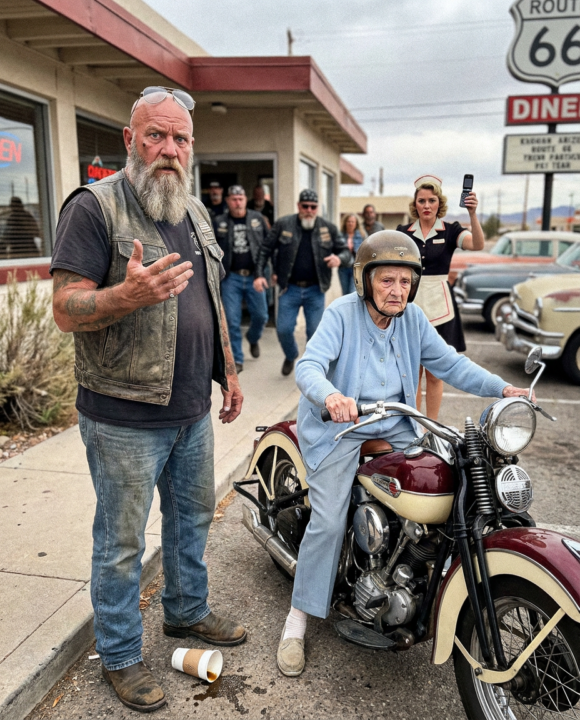
My assault conviction came from a bar fight in Flagstaff. A man lost six teeth. I lost four years and the right to pretend my anger only hurt me.
After prison, silence was dangerous.
If the shop became too quiet, I heard the other man striking the floor. If a customer slammed a toolbox, I smelled disinfectant and concrete. I worked until my hands shook because exhaustion was the only thing that stopped memory.
Then Boone found the Harley at a storage auction outside Needles, California.
The frame wore faded burgundy paint beneath three layers of black. The wheels did not match. The seat had been eaten by mice, and the fuel tank smelled like varnish.
The engine was wrapped in an oil-stained quilt.
“Scrap,” Boone said.
I touched the crankcase.
“Not scrap.”
The engine had been assembled by someone who distrusted factory shortcuts. Copper safety wire linked the fasteners beneath the rear rocker box. The oil passages had been polished by hand. A thin nickel had been machined into a timing plug, and one fin carried three shallow file marks.
None of it made the motor more valuable.
It made it personal.
Somebody had cared.
For eight months, I rebuilt that motorcycle after the shop closed. I cleaned sludge from passages with guitar strings. I heated frozen bolts and removed them a quarter turn at a time. When money ran out, Iron Mercy riders brought parts without admitting they were gifts.
Cole Mercer, then a nineteen-year-old prospect, found a correct primary cover in Tucson. Deacon Price traded a carburetor rebuild for two truck tires. Boone fabricated a bracket after I broke the original and threw it across the shop.
Brotherhood did not look noble.
It looked like men insulting one another under fluorescent lights while quietly making sure nobody went home alone.
We found initials inside the timing cover.
W.H. + E.H.
I assumed they belonged to a previous owner and his wife. Boone searched old registration records, but the title trail disappeared after a Nevada salvage auction in 1992.
Behind the oil tank, I found half of a red bandanna stiff with grease. In the saddlebag was a motel key from Amboy, California, and a paper matchbook from a restaurant near the Santa Monica Pier.
The objects did not belong together.
I kept them anyway.
The first time the rebuilt engine started, it threw smoke across the repair bay and frightened Cole off a stool. Then the exhaust settled into an uneven, stubborn pulse.
I placed two fingers against the tank.
The vibration moved through my hand, wrist, and forearm.
For the first time since prison, the noise inside my head stopped.
I tapped the tank twice.
That became my ritual.
Boone saw me do it but never asked why. Real brothers learn which doors not to open.
Over the next fourteen years, the Harley carried me through two funerals, three winters of sobriety meetings, and the night my mother died in a hospice room outside Phoenix. I never named it. Names made loss too easy to describe.
I maintained the engine exactly as I found it. Copper safety wire. Handmade timing plug. Three file marks. Rich rear cylinder.
When modern parts would have improved it, I chose old ones.
I thought I was preserving a mechanic’s work.
I did not know the mechanic was an eighty-year-old woman in orthopedic shoes.
After Evelyn disappeared from the Copper Cup, I followed on Boone’s Road King and listened to my Harley several hundred yards ahead. The borrowed motorcycle was smoother, faster, and more comfortable.
I hated it.
Evelyn’s shifts were slow but exact. She anticipated the stubborn clutch and gave the engine half a second longer before asking for power. She did not fight the handlebars.
She negotiated.
At the edge of Kingman, Boone’s voice came through my helmet communicator.
“Kara found an envelope.”
“Read it.”
“She left a ring.”
I watched Evelyn lean west.
“What kind?”
“Wedding band. Old title too. Engine number matches.”
My grip tightened.
Boone continued. “She says she built it with her husband.”
The motorcycle ahead of me suddenly sounded different. I heard no mechanical change, only the weight of two people inside every combustion stroke.
“Name?”
“Evelyn Hart. Husband was Walter.”
W.H. + E.H.
The initials had been beneath my hand for fourteen years.
Boone told me to stop her. Oatman Road twisted through the Black Mountains with narrow shoulders, falling rock, wild burros, blind curves, and drop-offs that punished small mistakes.
“She’s eighty,” he said.
“I noticed.”
“Her family may not know she’s gone.”
“Find them.”
“And you?”
“I’ll keep her upright.”
“That isn’t an answer.”
It was the only one I had.
Near Cool Springs, Evelyn raised her left hand and touched the red bandanna around her wrist. Mine remained folded inside the Harley’s saddlebag.
Two halves.
One engine.
A road neither of us yet understood.
I had spent fourteen years believing I rescued that motorcycle from a storage unit.
Now I was beginning to suspect the motorcycle had simply waited until it could return both of us to the people we had lost.
Part 3 — The Misfire Above Oatman
The engine coughed before the first steep switchback.
Once.
Twice.
Then hard.
I closed the distance while Evelyn reduced throttle. A pickup behind me tried to pass on a blind curve, so I moved into the center of the lane and forced it back.
The driver leaned on his horn.
I stayed there.
Evelyn reached a narrow gravel turnout near Sitgreaves Pass and stopped beside the guardrail. By the time I parked, the rear cylinder was knocking.
“Kill it,” I said.
She already had.
Heat lifted from the engine. The smell of burned oil mixed with juniper, dust, and hot brakes. Far below us, Route 66 cut through brown rock like a faded scar.
Evelyn tried to lower the kickstand.
Her left leg shook.
I caught the motorcycle, not her. She noticed the difference.
“Thank you,” she said.
“That was seven hundred pounds landing on my boot.”
“It has landed on larger fools.”
I almost smiled.
She remained seated while I stabilized the bike. Up close, I saw how much the ride had cost her. Sweat dampened her white hair. Her hands were swollen around the grips, and a purple bruise spread beneath the skin of her right wrist.
“You done?”
“No.”
“Didn’t ask where you were going. Asked if you were done.”
She looked west.
“No.”
I removed my tool roll.
The rear spark plug was wet. Evelyn leaned close, listened while I turned the engine, then pointed toward the carburetor.
“Float needle.”
“You heard that?”
“I made that mistake before you grew the beard.”
I removed the bowl. She was right.
A microscopic shaving had trapped the needle, flooding the rear cylinder. I cleaned it while Evelyn held the screws in her palm.
Her fingers arranged them by length without looking.
Boone arrived with Cole, Deacon, and two riders despite my instruction to come alone. Four Harleys rolled into the turnout, their engines echoing from the rock walls.
Evelyn stiffened.
“You brought a posse.”
“They don’t listen.”
Boone removed his helmet.
“You stole his motorcycle.”
“Yes.”
“You could have asked.”
“I did not know he owned it until this morning.”
“That usually makes stealing worse.”
Evelyn extended the old title.
Boone did not take it.
“This doesn’t make it yours.”
“No,” she said. “It explains why I was weak enough to take it.”
Cole walked around the Harley. He was thirty-three by then, lean and restless, with a short beard and a habit of turning fear into anger.
“You rode this pass alone at eighty?”
“I rode it at thirty-one.”
“That was fifty years ago.”
“Forty-nine.”
“That distinction won’t help when you miss a curve.”
I stood.
“Enough.”
Cole looked at me. “We’re letting her keep going?”
I glanced at Evelyn’s shaking wrist.
“We’re fixing the motor.”
“That’s not what I asked.”
“No. It isn’t.”
Brotherhood becomes easy when everyone agrees. The test comes when protecting someone means standing in the way of what they believe they need.
Boone wanted police. Cole wanted the key. Deacon wanted an ambulance. Evelyn wanted west.
I wanted time.
Kara had found Evelyn’s daughter through an emergency card inside the canvas purse. Her name was Margaret Ellis, a sixty-two-year-old school secretary in Prescott Valley.
Margaret answered Boone’s call on the third attempt.
Her first words came through the speaker.
“Is my mother alive?”
Evelyn closed her eyes.
Boone said she was safe.
“My mother cannot legally ride,” Margaret replied. “Her license expired. Her cardiologist told her not to drive long distances. Please take the key.”
Evelyn reached for the phone.
“Margaret.”
“You stole a motorcycle?”
“I borrowed an engine.”
“That sentence is not better.”
“I found your father’s Harley.”
Silence.
Even the riders stopped moving.
Margaret’s voice changed. “No, you didn’t.”
Evelyn described the nickel timing plug, copper wire, file marks, and dent beneath the left tank. Her daughter began breathing harder.
“Mom, Dad searched for that bike for thirty years.”
“I know.”
“He died searching.”
“I know.”
“You don’t get to follow him.”
Evelyn flinched.
That sentence did what the mountain road could not.
Her shoulders collapsed.
I took the phone before she dropped it.
“Margaret, this is Ray Dawson.”
“The thief?”
“Current owner.”
“Then stop her.”
“I will if she can’t ride safely.”
“She cannot ride safely.”
“I’m looking at her. You’re not.”
“You don’t know my mother.”
“No. I know the machine.”
Margaret’s voice sharpened. “And if she dies on it?”
The question entered every man in that turnout.
Nobody answered.
Evelyn reached for the key. Boone blocked her hand.
“Not yet,” he said.
She stood too quickly. Her knees buckled, and Deacon caught her beneath both arms. For one second, she hung between a biker with skull tattoos and a motorcycle she had spent half her life mourning.
That looked like the end.
We gave her water. Deacon checked her pulse. Boone placed the key in his vest pocket. Cole moved the Harley away from the road.
Evelyn sat on the guardrail and stared at the engine.
“I only needed it to reach Santa Monica,” she said.
“Three hundred miles,” Boone replied. “Not happening.”
“Walter and I were supposed to finish there.”
“You can finish in a truck.”
“No.”
“Then you don’t finish.”
Evelyn looked at me.
“You understand.”
I did.
That was the problem.
I remembered my first week out of prison, when everyone told me which rooms to enter, which chairs to sit in, and how much of my life I had forfeited. Most were trying to help.
It still felt like being locked up.
I turned to Boone.
“Give her the key.”
He stared at me.
“No.”
“I own the bike.”
“And I’m your road captain.”
“On club rides.”
“This became a club ride when we followed you.”
Cole stepped between us. “Hammer, she can barely stand.”
“Then we don’t let her ride alone.”
Evelyn lifted her head.
Boone understood first.
His jaw tightened. “You want to escort a rider without a valid license across three hundred miles of desert.”
“I want to get the engine to Santa Monica.”
“That is not the same thing.”
“No,” I said. “It’s safer.”
We would put Evelyn in Deacon’s truck through the worst curves. Cole would ride the Harley. At each safe stretch, after rest and a medical check, Evelyn could take the bars again. We would bring water, tools, medication, and a support vehicle.
Evelyn hated the proposal.
That meant it was probably fair.
“You ride behind me?” she asked.
“Beside you.”
“No police?”
“Not unless we need them.”
Boone still held the key.
“Brother,” he said quietly, “if this goes wrong, you carry it.”
“I already carry worse.”
His fist closed around the key.
Then the sound of another vehicle climbed the pass.
A tan SUV entered the turnout. A woman with gray hair jumped out before it fully stopped.
Margaret.
She walked straight toward her mother and slapped her across the face.
Evelyn did not move.
Margaret immediately wrapped both arms around her.
They held each other beside the stolen Harley while six bikers looked away.
The false ending had arrived: daughter found, thief stopped, motorcycle recovered.
Then Margaret opened the SUV and removed a battered metal box.
Inside were Walter’s ashes, a folded Route 66 map, and a sealed letter addressed to the man who owned the engine when Evelyn finally found it.
Part 4 — Walter Hart’s Last Instructions
We opened Walter’s letter at the Cool Springs station.
The building had been restored, but the desert around it remained hard and empty. Tin signs knocked against the wall. Wind pushed dust beneath the porch.
Evelyn sat on a wooden bench between her daughter and the motorcycle.
Margaret handed me the envelope.
“Dad wrote it six days before he died,” she said. “He made me promise not to give it to Mom unless she found the bike.”
“That makes no sense.”
“He said it would.”
The handwriting trembled across three pages.
Walter Hart began with the engine.
He and Evelyn met in 1965 at a machine shop in Kingman. Walter was twenty-four and certain women belonged behind office desks. Evelyn was twenty-one and could grind a valve seat within half a thousandth of specification.
She corrected his work in front of the foreman.
He invited her to dinner.
She refused.
He returned the next day with the damaged cylinder head from his motorcycle and asked whether she could save it.
She did.
They married eleven months later.
In 1974, Walter acquired a damaged Harley FLH with a cracked crankcase and missing top end. He and Evelyn rebuilt the engine after putting Margaret to bed each night. Walter handled the heavy work. Evelyn measured clearances, polished oil passages, and corrected every shortcut he attempted.
The copper safety wire was hers.
The nickel timing plug came from a coin Margaret had swallowed and later passed as a toddler. Walter cleaned it, machined it, and installed it without telling his wife.
Evelyn discovered the joke during the next oil change.
The three file marks represented three people.
Walter. Evelyn. Margaret.
The red bandanna had been torn in half the morning they began their unfinished ride in June 1976. Evelyn tied one piece around Walter’s wrist and kept the other.
They planned to follow Route 66 from Kingman to Santa Monica. It was supposed to be their delayed honeymoon.
They reached Oatman before a highway patrol officer found them. Margaret, then twelve, had been taken to a hospital with a ruptured appendix while staying with Evelyn’s sister.
Walter and Evelyn turned around.
The trip waited.
Life did not.
They opened a small repair garage. Walter injured his back. Evelyn cared for her mother through dementia. Margaret married, divorced, and returned home with two children.
Every anniversary, Walter placed the Santa Monica map on their kitchen table.
“Next year,” he would say.
In 1989, Margaret’s youngest son required heart surgery. Insurance refused part of the cost.
Walter sold the Harley.
He never told Margaret what he received for it. He simply paid the hospital balance and returned to work in a truck with no air-conditioning.
The engine passed through at least eight owners. It went to Nevada, then California, then vanished after a warehouse fire destroyed several title records.
Walter searched swap meets, classified advertisements, and motorcycle forums. He remembered the serial number until dementia began taking numbers away.
Evelyn remembered for him.
Two years before his death, Walter no longer recognized his own garage. He still recognized the sound of a Shovelhead at idle.
Evelyn would play recordings.
He tapped the table twice whenever one sounded close.
The same ritual I had adopted.
I stopped reading.
“Why twice?” I asked.
Evelyn held up two fingers.
“One for the person riding,” she said. “One for the person who got them there.”
Walter’s final page was addressed to the stranger who had become the engine’s caretaker.
If Evelyn finds this motor after I am gone, she may do something reckless. She has always confused grief with a work order. Do not let her ride alone. Do not make her stop unless her body truly cannot continue. The road was hers before it was mine.
Below that, he had added:
Ask her what the engine carried while we were gone.
I looked at Evelyn.
She looked at me.
“What did it carry?” she asked.
The question was meant for me.
I told her about the storage unit. Prison. The diesel shop. The nights when I rebuilt the motorcycle because sleeping meant hearing a man’s teeth strike a barroom floor.
I told her about sobriety meetings forty miles away, reached on that engine when my truck would not start. I told her about sitting outside my mother’s hospice room, unable to enter until the Harley’s cooling metal stopped ticking.
The riders had never heard most of it.
Neither had Boone.
I kept my eyes on the timing cover.
“There was a night near Seligman,” I said, “when I planned to keep riding until fuel ran out and then walk into the dark.”
Nobody moved.
“The rear cylinder started missing. I got angry and stopped at a service station. Spent three hours fixing the copper wire beneath that rocker box.”
Evelyn’s wire.
“By sunrise, I didn’t want to disappear anymore.”
The porch became quiet.
I had believed I saved myself by repairing a motorcycle.
The truth sat beside me in orthopedic shoes.
Evelyn and Walter had built an inconvenience into that engine—an old-fashioned piece of wire that loosened at the exact moment a broken man needed a reason to remain until morning.
Evelyn reached toward my hand.
She stopped before touching it.
“May I?”
I nodded.
Her fingers closed around my scarred knuckles.
“So it wasn’t lost,” she whispered.
I could not answer.
She tapped the fuel tank twice.
“It was busy.”
That was the twist Walter had understood before any of us.
Evelyn thought she had stolen the Harley to carry her dead husband to Santa Monica. Instead, the machine they built had already carried a stranger through fourteen years he might not otherwise have survived.
Boone walked to the motorcycle and removed the key from his vest.
He held it out to Evelyn.
“Rules,” he said.
She listened.
“Support truck on the pass. Medical stop in Needles. Hammer decides whether you’re steady enough to ride. No arguing when he says rest.”
“I built that engine.”
“He owns the brakes.”
Evelyn looked at me.
“Fair.”
Margaret wiped her face. “I’m coming.”
“You hate motorcycles,” Evelyn said.
“I hate phone calls from strange bikers more.”
Cole loaded the Harley into Deacon’s trailer for the steep descent. Evelyn climbed into Margaret’s SUV with Walter’s ashes on her lap.
Before the door closed, she looked at me.
“You still think I stole it?”
“Yep.”
Her mouth tightened.
Then I added, “But I’m lending it back.”
Part 5 — Three Hundred Miles West
We left Oatman after noon.
Cole rode the Harley down the western face of the Black Mountains while Evelyn followed in Margaret’s SUV. She watched every shift, leaning forward whenever the engine note changed.
At Topock, we stopped beneath a service-station canopy.
Heat pressed against us from every direction. The metal fuel tank burned through my gloves. The Colorado River appeared blue in the distance, too clean-looking for the desert around it.
Deacon checked Evelyn’s blood pressure.
It was high.
“So is his,” she said, pointing at Boone.
“His heart is mostly chain lubricant,” Deacon replied.
We waited forty minutes.
Evelyn drank water, ate half a sandwich, and argued about sodium. When her hands stopped shaking, she took the Harley through a quiet stretch toward Needles with me beside her and the support vehicles behind us.
People stared.
They saw an eighty-year-old woman riding a vintage Harley while seven enormous bikers formed a loose shield around her. Phones appeared at gas stations. A trucker sounded his horn.
Evelyn ignored everyone.
Her shoulders softened with each mile.
Outside Needles, she lifted one hand and pointed toward an abandoned motel. Walter’s old room key in my saddlebag carried the same name.
“That’s where we stayed after Margaret was born,” she said at the next stop. “We had nine dollars and a baby who refused to sleep.”
“Good room?”
“Terrible.”
“Why keep the key?”
“Walter stole it.”
I looked at her.
She smiled. “Marriage requires balanced criminal records.”
By evening, we reached Amboy.
The motel key had brought us there, not Needles as I had once assumed. Walter and Evelyn had spent their first anniversary at a roadside motor court that no longer existed.
Evelyn dismounted slowly. She touched the engine, then the cracked pavement.
Margaret placed Walter’s metal box on the seat.
“We can stop here,” she said.
Evelyn shook her head.
“Your father wanted the ocean.”
“So do you?”
“No,” Evelyn answered. “I want to hear him arrive.”
We slept in separate motel rooms in Barstow. Boone stationed Cole outside the Harley, although nobody believed Evelyn could steal it twice without passing six bikers.
At 4:12 a.m., I heard boots in the corridor.
Not Evelyn’s.
Boone knocked once.
“Highway patrol is downstairs.”
Cole had called them from Oatman.
I found him beside the vending machines. His face looked young again.
“You called?”
“She doesn’t have a license,” he said. “If she hits somebody, we did that.”
“You went behind the club.”
“I protected the club.”
Boone stepped between us.
“No fists.”
My hands were already closed.
A California Highway Patrol officer waited in the parking lot. He was in his sixties, broad through the waist, with the tired eyes of a man nearing retirement.
His name was Aaron Hart.
Walter’s younger brother.
Cole had not called a random police station. He found Aaron through the original title and told him the entire story.
Aaron had driven overnight from Bakersfield.
Evelyn came outside carrying Walter’s ashes.
The brothers-in-law had not spoken for eleven years.
Aaron blamed Evelyn for allowing Walter to keep searching for the motorcycle after dementia worsened. Evelyn blamed Aaron for selling Walter’s tools without asking.
Neither had attended the other’s family holidays.
Aaron looked at the Harley.
Then at Evelyn.
“You always took his worst ideas seriously.”
“Somebody had to.”
“You cannot legally ride on public roads.”
“I know.”
“I can impound that motorcycle.”
“It isn’t mine.”
“That has not slowed you down.”
He opened his patrol vehicle and removed a white helmet.
Walter’s helmet.
Aaron had kept it after his brother stopped riding. The shell was too old for safe use, but inside rested a newer certified helmet painted in the same white-and-burgundy pattern.
“I can’t authorize this,” he said. “I can only choose which roads to inspect closely today.”
Cole exhaled.
That was his redemption.
Fear had made him betray our plan. Love for the club made him find the only officer who could understand it.
We changed the arrangement. Evelyn would ride only short, controlled stretches. I would take the Harley through traffic and difficult interchanges. She would remain in the support vehicle whenever fatigue returned.
The goal was no longer proving she could ride three hundred miles.
The goal was bringing the engine there.
Near San Bernardino, traffic thickened. I rode the Harley while Evelyn sat beside Margaret. At each fuel stop, she listened to the idle and adjusted something small.
At Pasadena, rain began.
California rain carries oil from the road before it carries dust. Boone reduced speed. Aaron’s patrol car followed at a distance after his shift ended.
We entered Los Angeles under gray light.
Evelyn returned to the Harley for the final safe section west. I rode beside her. Boone led. Cole and Deacon controlled the rear.
The city opened ahead of us in red brake lights, wet concrete, and the hiss of tires.
Evelyn never looked toward the ocean.
She watched the fuel tank.
At Santa Monica, Margaret carried Walter’s ashes to the edge of the pier. We did not scatter them. Walter had asked to finish the road, not leave it.
Evelyn placed the metal box on the Harley’s passenger seat.
The engine idled beneath it.
She pressed both palms against the tank.
“Walter,” she said, “you missed the turn again.”
The V-twin stumbled once.
Then it settled.
Evelyn laughed so hard she had to lean against me.
Tourists photographed the bikers, the old woman, and the antique motorcycle. They believed they were witnessing the end of an unusual ride.
They were wrong.
Evelyn opened Walter’s metal box and removed one final object: a signed bill of sale transferring the Harley’s original purchase money to Margaret’s son.
The motorcycle had paid for his heart surgery in 1989.
The boy it saved was now Dr. Samuel Ellis, a cardiac surgeon in Los Angeles.
He had been waiting near the pier.
Samuel walked through the riders and embraced his grandmother. Then he placed a stethoscope against the Harley’s fuel tank.
“Still beating,” he said.
Evelyn rested one hand over his heart.
“So are you.”
Walter had sold the motorcycle to save a child.
The engine had later stopped me from disappearing.
Now it had carried Walter’s ashes to the ocean.
That machine had never been stolen from its purpose.
Only redirected.
Part 6 — The Woman in Bay Three
Evelyn returned my key before we left Santa Monica.
I tried giving it back.
She closed my fingers around it.
“I stole one ride,” she said. “Don’t make me steal ownership too.”
The Harley returned to Kingman in Deacon’s trailer because none of us wanted to ask more from the old engine. Evelyn sat beside it for most of the drive, one hand resting on Walter’s metal box.
Three weeks later, she entered Dawson Fleet and Diesel carrying the canvas purse.
Every mechanic stopped.
She removed a micrometer, three worn wrenches, and the other half of the red bandanna.
“Your rear cylinder is still rich,” she said.
That became her first Tuesday in Bay Three.
Margaret drove her from Prescott Valley twice a month. Evelyn taught Cole how to dress a valve seat by hand, showed Deacon where the original oil passage had been widened, and slapped Boone’s wrist when he reached across a moving belt.
Nobody called her honorary anything.
She worked.
The younger riders began bringing her engines older mechanics had declared unsalvageable. Evelyn never promised a repair. She placed two fingers against the metal, listened, and decided whether the machine still wanted labor.
Walter’s ashes remained in a cabinet above Bay Three.
His photograph hung beneath it.
I offered Evelyn the Harley whenever she visited. Sometimes she rode one slow loop around the lot. Other days, her wrists hurt too much, so I started the engine and let her listen.
The unfinished route became an annual ride.
Iron Mercy called it Walter’s Run, but Evelyn crossed out the name on our first flyer.
She wrote WALTER AND EVELYN’S RUN in black marker.
“Dead men already get too much credit,” she said.
Money from the ride went toward travel and lodging for families whose children needed heart surgery far from home. Dr. Samuel Ellis matched the first year’s donations.
Cole designed the route with rest stops every forty miles.
Boone printed emergency contacts.
Aaron Hart rode at the rear after retirement, still pretending not to be a member.
Kara kept Evelyn’s untouched coffee cup on a shelf inside the Copper Cup. Beside it hung a small card:
She paid later.
Evelyn and Margaret repaired what eleven years of blame had damaged. Not quickly. Not neatly.
But they began.
As for me, I finally told the club what happened outside Seligman on the night the engine kept me alive. Nobody gave a speech.
Boone replaced the copper safety wire.
Cole brought coffee.
Deacon sat beside me until sunrise.
That was enough.
Every time I started the Harley, I touched the tank twice.
One for the person riding.
One for the hands that got them there.
Part 7 — Coffee Before the Theft
One year after Evelyn stole my Harley, I parked it outside the Copper Cup at the same hour.
She was already waiting.
Evelyn had turned eighty-one. Her white hair was shorter, her steps slower, and her cardigan burgundy instead of blue.
The canvas purse remained.
So did the trouble in her eyes.
I left the ignition key beside the sugar jar and ordered two coffees. Kara placed Evelyn’s untouched cup at the window booth.
“You going to arrest her this time?” she asked.
“Thinking about it.”
Evelyn entered through the front door.
Every Iron Mercy rider in the diner became quiet. Margaret waited outside in the support SUV. Aaron sat near the counter wearing a plain leather vest without a patch.
Evelyn walked toward my key.
She stopped.
Then she looked at me.
“May I borrow your motorcycle?”
The room held its breath.
I pushed the key across the table.
“Bring it back.”
“No promises.”
She drank the coffee this time.
Outside, Evelyn put on Walter’s white-and-burgundy helmet. I steadied the Harley while she climbed onto the saddle.
She turned the fuel valve. Two clicks of enrichener. One slow roll of throttle.
The engine started immediately.
Before shifting into gear, she tapped the tank twice.
I mounted Boone’s Road King. Seven riders started around us, followed by Aaron and Margaret.
We rode west through Kingman at sunrise.
Evelyn remained at the bars until Cool Springs. From there, Cole took the difficult pass. She continued in the support vehicle with Walter’s ashes on her lap, no longer ashamed to let other hands carry part of the distance.
At Amboy, she rode again.
At Santa Monica, Dr. Samuel Ellis waited beside the pier with his wife and two children. Evelyn placed the youngest child on the Harley’s stationary seat and guided his small hand toward the fuel tank.
“Two taps,” she said.
“Why?”
“One for you.”
She helped him tap once.
“And one for everyone who got you here.”
The child tapped again.
That evening, I rode the Harley east while Evelyn sat behind me. Her arms did not reach completely around my chest, so she held the sides of my leather cut.
The Pacific disappeared in the mirrors.
Walter’s metal box rested safely in the saddlebag. The two halves of the red bandanna were tied together around the handlebar.
At the first red light, Evelyn leaned toward my ear.
“You know I wasn’t stealing it.”
“What do you call taking a man’s Harley without permission?”
“Completing delayed maintenance.”
The light changed.
The old engine carried us forward, still rich in the rear cylinder, still wired by Evelyn’s hands, and still refusing to become a museum piece.
Some motorcycles are owned.
That one keeps choosing its riders.
Drop LASTRIDE below and follow the page for more full stories about bikers whose hardest roads begin with quiet mercy.