A Fifty-Two-Year-Old Biker Pulled a Young Bride Away Before She Said “I Do”—Then Her Phone Proved Who Had Really Been Holding Her Captive
Part 2
Emily came into our home at thirteen carrying a black trash bag and a library book she had already renewed twice. A county worker brought her after dark, apologized for the hour and promised the placement would be temporary.
Most foster placements begin with that word.
Temporary.
Jo prepared the spare room with clean sheets, a small desk and a lamp shaped like a yellow moon. Emily stood in the doorway without setting down the trash bag. She asked whether the bedroom door locked from the inside.
Jo told her it did, then showed her how the lock worked and how to open it again.
Emily slept with the desk pushed against the door for the first three nights.
I did not know how to talk to a frightened thirteen-year-old. I knew engines, framing lumber and the weight of concrete bags. Jo understood children better. She taught me that trust was built through small promises completed on time.
If I said dinner was at six, dinner appeared at six.
If I said I would knock, I knocked.
If I said I would attend a school meeting, I arrived early.
Emily tested every promise.
She once left a five-dollar bill on the kitchen floor to see whether I would take it. Another time she poured orange juice onto the counter and waited for me to shout. I handed her a towel and told her the floor was harder to clean if we let it dry.
Months passed before she stopped placing the desk against her door.
Two years later, she asked me to teach her how to use a socket wrench. By sixteen, she could change brake pads under supervision and identify three club members by the sound of their motorcycles entering our driveway.
The Ridge County Riders did not replace her family. They became part of the network around her. Boone helped with algebra. Maggie taught her to drive in an empty church parking lot. Nate built a bookcase because Emily’s paperbacks were stacked two rows deep beneath her bed.
She remained close to Diane, her biological mother, through supervised visits. Diane was dealing with unstable housing and problems she worked hard to correct. When Emily was seventeen, reunification became possible.
Jo cried after Emily moved home.
I did too, though I waited until the garage door was closed.
Reunification was supposed to mean we had done our job. Emily still visited on Sundays. She called Jo when she had questions about college applications and called me when her first used car made a clicking sound.
Then Jo became ill.
She died ten months after her diagnosis. Emily was nineteen.
Grief changed the shape of our relationship. I became quieter. Emily was trying to work, attend community college and support Diane, who had injured her back. We missed calls. We postponed dinners.
Grant entered her life during that space.
At first, everyone liked him. He was twenty-seven, worked for a property management company and always remembered to bring something when he visited. He paid for dinner before anyone asked. He spoke politely to Diane and called me Mr. Mercer.
The first warning looked like concern.
Grant said Emily’s car was unreliable and insisted on driving her. Then he said her community college schedule exhausted her and encouraged her to take a semester off. When she stopped attending club cookouts, she explained that crowds made Grant uncomfortable.
Each reason sounded possible alone.
Together, they formed a wall.
Maggie noticed it before I did. She said Emily looked at Grant before answering questions. I told her not to assume the worst because the man was reserved.
I wanted to be fair.
Fairness became delay.
One Sunday, I asked Emily whether she was happy. Grant had gone outside to take a call. Emily said yes too quickly. Then she asked whether I would still answer if she called in the middle of the night.
“Every time,” I told her.
Grant returned before I could ask why.
A month later, Emily’s number stopped working. Her social media account sent me a short message saying she needed distance and that my involvement felt controlling.
The accusation hit exactly where it needed to.
Foster parents are taught that young people must be allowed to define relationships after placement ends. I had always feared becoming another adult who ignored Emily’s boundaries.
I answered once.
I love you. I’ll give you space. My number won’t change.
The message showed as read.
I did not know Grant had read it.
I did not know he had written the first message.
For nearly three years, he used my respect for Emily’s boundaries as another lock.
Part 3
The wedding invitation never arrived. Diane learned about the ceremony from a distant cousin who saw a photograph online. When she tried calling Emily, her number went directly to voicemail.
She went to Magnolia Wedding House anyway.
A venue coordinator met her at the entrance with a printed photograph. Grant had identified Diane as an estranged relative likely to cause a disturbance. The coordinator apologized but refused entry.
Diane called Emily from a borrowed phone. Grant answered.
He told her Emily did not want to speak.
Then he ended the call.
Inside, Jenna was helping Emily dress. They had worked together at a pharmacy before Grant convinced Emily to quit. Jenna had remained in contact through occasional messages Grant did not notice.
She knew more than she admitted.
Two months before the wedding, Emily had told Jenna that Grant kept her driver’s license in his desk because she “lost things.” He managed their bank account, monitored location sharing and objected when she spoke privately with Diane.
Jenna urged her to leave.
Emily said she had nowhere to go.
That answer showed how completely Grant had erased the people who would have opened their doors without question.
On the wedding morning, Jenna brought Emily’s old phone. Diane had kept it in a drawer after the service was disconnected. Jenna charged it, purchased a prepaid card and carried it inside beneath makeup supplies.
Emily initially refused to use it.
Grant had told her that I hated him, that Diane wanted money and that Maggie had called her ungrateful. He showed her selected messages and described conversations that never happened. Over time, Emily stopped trusting her own memory of us.
Jenna asked one question.
“If Cal received a message saying you needed him, what would he do?”
Emily looked toward the locked dressing-room door.
“He’d come.”
She sent the sentence.
Before she could make a second call, someone knocked. Jenna hid the phone among decorative flowers attached to Emily’s gown and left the room.
That phone was against Emily’s waist when I entered the chapel.
I saw Grant’s hand on her arm. I heard him claim she had told me to disappear. When Emily said she had not sent that message, three years of confusion narrowed into one fact.
He knew words that should have existed only between Emily and me.
I asked her to leave.
Grant told the guests I was dangerous. He said foster care had made Emily dependent on people who wanted to control her. There was enough truth inside that sentence to make it effective: Emily had depended on adults, and adults had failed her before.
Then he turned to Emily.
“If you walk out, don’t come back.”
She lowered her eyes.
For one terrible second, I thought fear would keep her beside him.
Jenna moved first.
She stepped away from the bridesmaids and placed herself between Grant and the side aisle.
“Emily,” she said, her voice shaking, “your mother is outside.”
Emily looked up.
Grant said Diane had been invited and chose not to attend.
Jenna shook her head.
“He had security stop her.”
That was the moment the first bridesmaid removed herself from the wedding line. Two others remained frozen. The best man told Jenna to stop making a scene.
Jenna answered, “The scene started before today.”
Grant reached for Emily’s wrist.
She pulled away.
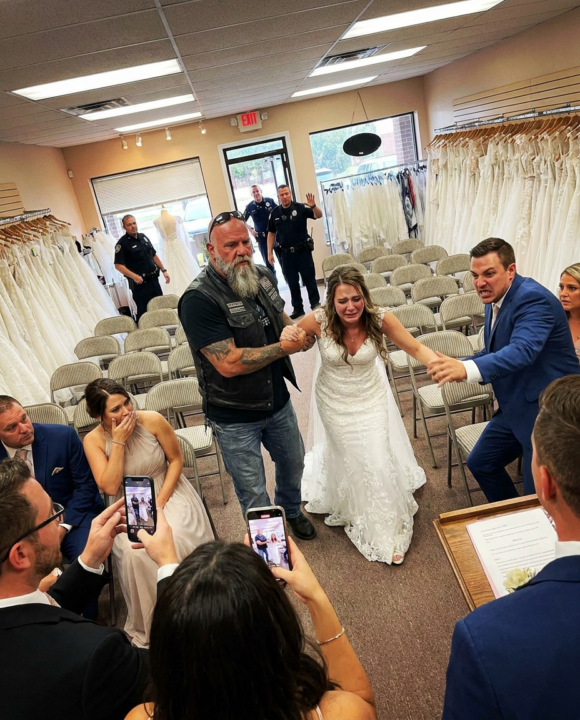
I held out my hand. Emily crossed the distance and gripped it so tightly her nails pressed into my skin.
The guests began shouting when I turned toward the exit. Grant followed. A chair overturned. Someone grabbed the back of my vest and released it when Boone stepped into the aisle.
I had told the riders to remain outside.
Boone had entered after hearing the commotion.
His appearance made the scene look worse. Now two enormous bikers were inside a wedding, one pulling the bride and the other blocking the groom.
I told Boone to keep his hands down.
Emily lost a shoe. The hem of her dress caught beneath it, and she stumbled. I held her forearm until she regained balance. She kept moving.
“Don’t stop,” she said.
We reached the lobby just as Officers Lewis and Patel entered.
Lewis ordered me away from Emily. I released her immediately.
Grant rushed forward, telling them she was having a trauma response and that I had manipulated her. He used calm words. He called her “my fiancée” and kept trying to stand close enough to touch her.
Officer Patel placed herself between them.
Lewis moved me toward the wall.
Guests crowded behind us, recording everything. In their videos, the apparent kidnapper was being detained while the groom pleaded for his bride.
Then Officer Patel asked Emily a direct question.
“Do you want to leave with that man?”
Emily’s mouth opened.
Grant answered first.
Officer Patel turned toward him.
“I asked her.”
Silence spread across the lobby.
Emily reached into the flowers on her dress and removed the phone.
“Yes,” she said. “I called my dad.”
Part 4
The word dad hit me harder than Grant’s hand ever could have.
Emily had not called me that since Jo’s funeral.
Officer Lewis took the phone only after Emily unlocked it and offered it to him. He read the message she sent me, checked the time and asked whether anyone had told her what to write.
“No.”
“Did Mr. Mercer threaten you?”
“No.”
“Did he touch you without permission?”
Emily looked toward me.
“He caught me when I fell.”
Officer Patel led her into a small office away from Grant, me and the wedding guests. That separation mattered. Consent given while surrounded by people can be difficult to evaluate. Emily needed space to answer without watching anyone’s face.
Grant objected.
Lewis ordered him to remain in the lobby.
I stood by the wall with my hands visible. Boone waited near the entrance. Maggie had entered carrying the canvas bag but stayed back until an officer invited her closer.
Ten minutes passed.
Then twenty.
During that time, Grant called his attorney, his parents and someone he identified as Emily’s physician. He claimed she had anxiety and was not capable of making an informed decision.
Officer Lewis asked whether a court had found her unable to make decisions.
Grant said no.
That ended that argument.
Jenna approached Lewis and asked to make a statement. She admitted bringing the phone. She described seeing Grant remove Emily’s driver’s license from her wallet months earlier. She had also witnessed him take Emily’s bank card after accusing her of wasting money on lunch with a coworker.
Jenna had kept quiet because Grant threatened to report her for stealing medication from the pharmacy where she and Emily once worked. Jenna denied stealing anything, but the accusation frightened her enough to maintain distance.
Lewis asked why she came to the wedding.
“To give her one chance to call somebody.”
Jenna was crying hard by then. She kept apologizing.
I wanted to tell her she had done enough. It was not my statement to interrupt.
Officer Patel eventually returned with Emily. The wedding veil was gone. She held it folded across her arms as though it belonged to someone else.
Patel explained that Emily had clearly stated she wished to leave. She was an adult, no marriage ceremony had been completed, and no one could force her to remain.
Grant demanded the phone.
Emily said it belonged to her.
He claimed he had paid the bill.
Patel told them ownership could be documented later. For the moment, Emily retained the device she was using to seek help.
Then Emily disclosed the locked drawer.
Grant had taken her passport, birth certificate, Social Security card, driver’s license and debit card. He kept them in a desk at their apartment. When she asked for her license, he drove her wherever she needed to go.
He had also changed the password on her email and replaced the recovery number with his.
Some guests stopped filming.
Others continued.
Grant called it financial organization. He said Emily had misplaced documents before. Emily answered that she had asked for them repeatedly and had been refused.
Officer Lewis documented both statements. He explained that officers could accompany Emily later while she requested access to the apartment and personal property, subject to the circumstances and local procedure. A victim advocate could also help her replace documents and secure accounts.
He did not arrest Grant in the lobby based solely on competing statements.
The absence of a dramatic arrest disappointed several people watching.
Real exits are often administrative before they feel free.
Maggie opened the canvas bag. Inside was a dark green coat long enough to cover most of the wedding dress, soft flat shoes, sweatpants, water and an unopened phone charger.
Emily stared at the contents.
“How did you know?”
Maggie answered, “I once left in heels.”
She helped Emily remove the remaining high shoe. She did not touch the gown until Emily asked.
Diane waited outside behind the motorcycles. Officer Patel offered to escort Emily through a side exit so she would not have to cross the chapel again.
Emily took two steps toward the door.
Then she stopped.
Her hand went to her bare right ring finger.
“My mother’s ring.”
Grant said it was not hers.
Emily turned.
Diane had given her a thin gold ring that belonged to Emily’s grandmother. Emily planned to wear it as her connection to the women in her family. Grant objected because it did not match the jewelry his family had selected.
That morning, he ordered her to remove it.
The ring was upstairs in the bridal dressing room.
Maggie offered to retrieve it.
Emily looked toward the staircase.
“No,” she said. “I left it there. I’m getting it.”
Part 5
Officer Patel accompanied Emily upstairs. Maggie went with them after Emily asked. Grant remained below with Officer Lewis, who made it clear he was not to follow.
I waited in the lobby.
That waiting was harder than rushing into the chapel.
For years, I had imagined what I would say if Emily returned. I had rehearsed explanations about the unanswered calls and the message that told me to stay away. Now she was one floor above me, still wearing a wedding dress, reclaiming a ring from a room where she had nearly surrendered her name.
No prepared speech belonged there.
Jenna sat on the bottom stair. Her hands shook.
She told me Grant had removed the ring after seeing it beneath Emily’s glove. He said wearing another family’s jewelry during the ceremony insulted his mother.
Jenna had placed it inside a small velvet box near the mirror.
“Why didn’t you leave with her?” I asked.
The question came out harsher than I intended.
Jenna looked at the floor.
“I was afraid.”
I wanted to judge her. Then I remembered the years when I had accepted silence because I was afraid of crossing Emily’s boundary. Fear had shaped every person in that building differently.
“You spoke today,” I said.
She nodded without looking up.
Emily returned carrying the velvet box.
She had removed the veil and gathered her hair into a loose knot. The green coat covered the gown. Maggie carried the train so it would not catch beneath Emily’s new shoes.
At the bottom of the stairs, Emily opened the box.
The ring was thin, scratched and slightly bent. It held no large stone. Diane’s mother had worn it while working in a hospital laundry for thirty-one years.
Emily slid it onto her right hand.
Grant told her that leaving would humiliate both families and waste thousands of dollars. Emily looked around at the white flowers, catered tables and rows of guests.
Then she gave the ring box to Jenna.
“He spent my savings too,” she said.
That revealed another part of the control.
Emily had contributed nearly eleven thousand dollars to a joint account intended for housing. Grant moved most of it toward wedding expenses she had repeatedly asked to reduce. Because his name was also on the account, recovering the money would not be simple.
The wedding had become a debt attached to her escape.
Diane entered through the side door after Officer Lewis confirmed Emily wanted her there. Mother and daughter stopped several feet apart.
Grant had told each of them the other wanted no contact.
Diane held out both hands.
Emily crossed the space and pressed her face against her mother’s shoulder. Neither spoke at first. The lobby heard only fabric shifting and Diane repeating her daughter’s name.
I stepped away.
Emily found me a few minutes later.
“Why did you stop calling?”
The question carried three years of pain.
I told her about the message asking for distance. She asked to see it. I opened my phone and found the old thread.
Grant had not deleted the evidence because it was on my device.
Emily read the message once. Then again.
“I didn’t write this.”
“I know that now.”
“You believed it?”
“I believed you had the right to tell me to leave.”
Her face tightened.
“I thought you gave up.”
That was the cost of Grant’s manipulation. He did not merely isolate Emily physically. He made every person outside his control believe withdrawal was her decision.
I told her I was sorry.
She told me she was angry.
Both statements could remain true.
She did not climb onto my motorcycle. That would have looked dramatic, but the wedding dress, her emotional state and the absence of riding gear made it unsafe. Maggie drove her in a borrowed SUV with Diane and Jenna. Officer Patel gave them contact information for a local support organization and confirmed a safe destination that Grant did not control.
Our motorcycles followed at a distance.
At the first traffic light, Emily looked through the rear window.
I lifted one hand from the handlebar.
She raised hers.
Her mother’s ring caught the light.
Part 6
The next week contained more paperwork than celebration.
Emily met with an advocate, changed passwords and opened an account at a different bank. She reported her identification documents and arranged an officer-accompanied visit to the apartment.
Grant returned some property voluntarily. Other items had to be documented and replaced. The advocate helped Emily organize screenshots, account records and messages without forcing her to decide everything at once.
The marriage license had never been completed.
Legally, there was no marriage to dissolve.
Emotionally, Emily still had to dismantle a life.
She stayed with Diane first, then moved into a small apartment near her old community college. The club paid the security deposit through our community assistance fund after Emily agreed to accept it as a loan with no deadline.
She later repaid twelve dollars.
When I asked why, she said she wanted the first repayment to be an amount she chose.
I kept the twelve dollars in an envelope.
Jenna remained in Emily’s life. Their friendship did not return immediately to what it had been. Emily was grateful for the phone and hurt that Jenna had waited. They talked through both truths.
Maggie visited without asking questions. She brought groceries, a tool kit and the green coat from the wedding. Emily wore that coat until one sleeve frayed.
My relationship with her rebuilt more slowly.
For the first month, she called me Cal. Then Rook. One night, her car would not start outside work, and she called me at 11:43.
“Dad,” she said when I answered, “are you awake?”
I was already putting on my boots.
Part 7
Four years after the wedding, Emily keeps her mother’s ring on a chain whenever she works. She became a case assistant for an organization serving young adults leaving foster care, though she never tells them her story unless it helps them make their own decision.
The old wedding phone remains in a drawer.
She kept the green coat too.
Magnolia Wedding House returned part of the unused reception payment after reviewing the police report and video. Some guests apologized. Others insisted they had only reacted to what they saw.
What they saw was a large biker holding a crying bride’s arm.
What they missed was the direction she was running.
Officer Lewis later told me he had arrived expecting to arrest someone. For several minutes, he thought that person would be me. He changed his assessment when Emily spoke for herself and produced the message.
That phone did not rescue her alone.
Jenna had to return it. Diane had to keep trying. Maggie had to bring clothes. The officers had to create enough space for Emily to answer freely.
And Emily had to take my hand.
On the anniversary of the wedding that never happened, she sometimes visits Jo’s grave. The first year, she brought the bridal flowers she had preserved. The second, she brought nothing.
Last spring, she asked me to accompany her.
We stood beside Jo’s marker while motorcycles passed on the highway beyond the cemetery trees. Emily touched the ring hanging at her neck.
“I thought you abandoned me,” she said.
“I thought I was respecting you.”
“Both hurt.”
I nodded.
Before we left, she placed one hand on my old leather vest.
“If I ever send a message like that again?”
“I come.”
“Even if I’m wrong?”
“I come and let you decide.”
She smiled, small and tired.
“That’s what I needed the first time.”
We walked back toward the motorcycles. Emily wore proper boots, jeans, gloves and a helmet Maggie had helped her choose. She rode behind Maggie, not me.
That choice made me proud.
At the cemetery gate, she looked back once at Jo’s marker, touched her mother’s ring and lowered her visor.
Then we took her home.
Follow this page for more biker stories about misunderstood rescues, chosen families, and the quiet courage it takes to reclaim your own life.