A Nine-Year-Old Girl Poured Red Paint Over My Twelve-Year Dream Harley—Then She Told Me to Look Beneath the Rear Wheel
Part 2
The kitten remained beneath my Harley until animal-control officer Rebecca Shaw arrived. She asked everyone to step behind the painted parking lines and photographed the cord from several angles before touching it.
Molly stood beside her grandmother with red hands pressed against her shirt.
Her grandmother, Elena Reyes, had emerged from the store after hearing the commotion. She apologized for the paint before she understood why Molly had poured it.
I told her to stop apologizing.
The motorcycle could wait.
Rebecca placed a folded towel near the kitten’s head, then asked me to support the animal’s body while she loosened the cord. The loop had tightened around the left hind leg, but circulation remained. The kitten hissed once, tried to bite my glove and then went limp against my palm.
That tiny weight changed the parking lot.
People who had been recording me lowered their phones. The store employee who had moved forward to protect Molly brought a cardboard box and punched air holes in the lid. Someone found a clean shop towel.
Molly asked if she could touch the kitten.
Rebecca told her to wait until a veterinarian checked the leg.
Molly accepted that answer, but she followed the box with her eyes as though looking away might make the animal disappear.
Officer Shaw took the kitten to a veterinary clinic less than a mile away. I followed in my pickup after leaving the Harley at the store. Nate and Boone stayed behind to protect the area and speak with the manager.
Elena drove Molly.
At the clinic, a technician examined the kitten and found swelling, superficial abrasions and mild dehydration. No bones were broken. The cord had not remained tight long enough to cause lasting damage.
The kitten weighed two pounds and was likely nine or ten weeks old.
Female.
No microchip.
No collar.
Molly sat in the waiting room wearing an oversized disposable gown because her shirt was covered in paint. Her grandmother had scrubbed her hands in the restroom, but red remained around her fingernails.
When the veterinarian said the kitten would recover, Molly began crying.
She had not cried when I ran toward her.
She had not cried when adults accused her of vandalism.
She cried only after learning the kitten would live.
I sat across from her with red paint drying on my jeans.
“Why didn’t you run?” I asked.
Molly wiped her face on the paper sleeve.
“If I ran, you might think I did it for fun.”
The answer stayed with me.
The store manager called while we waited. He had preserved the surveillance footage and given a copy to police. The camera showed the teenager entering from an alley behind the shopping plaza. Another angle captured his face when his hood slipped.
A patrol officer recognized him as Zane Foster, fifteen, who lived six blocks away.
The footage also showed Molly.
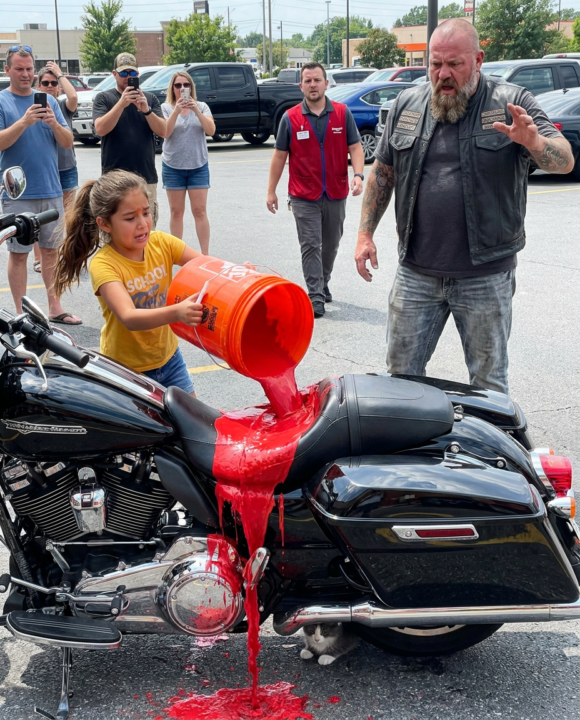
She called to me once from beside the motorcycle. She ran around the lumber cart. She waved. Then she looked at the paint and made her decision.
The entire sequence lasted twenty-three seconds.
That was how long she had to decide whether another person’s expensive property mattered more than an unseen animal.
She chose the animal.
When I returned to Dawson Hardware, the red paint had begun drying. Store employees had placed absorbent pads beneath the motorcycle to prevent paint from entering a storm drain. The manager offered to pay for professional cleaning because the bucket should not have been accessible on the returns cart.
I declined.
Molly had used the paint.
I was still grateful it was there.
A detailing shop examined the Harley that evening. The paint was water-based latex, but it had entered seams, coated the seat and dried against hot metal. Some could be removed. Other areas would require disassembly, replacement or refinishing.
The estimate was painful.
Boone read it and swore.
Nate told him to look at the photographs from beneath the rear wheel.
The money became less important again.
The next morning, I visited the clinic. The kitten stood unsteadily inside a kennel, her bandaged leg held off the floor. When I approached, she flattened her ears.
Then she smelled my hand.
She moved forward one step.
The technician said animals sometimes associated a scent with the person who held them during rescue. I told her the actual rescuer was in school.
That afternoon, police called.
Zane’s parents had brought him to the station after seeing the security image. They surrendered his phone through the appropriate process and agreed to cooperate.
The officers found multiple short recordings.
The kitten beneath my motorcycle was not his first experiment.
It was the first one somebody had stopped in time.
Part 3
I attended the first meeting at the police station because my motorcycle was part of the incident. Molly and Elena were interviewed separately with a victim-services worker present. Officer Shaw represented animal control.
Zane sat between his parents at the far end of a conference table.
He looked younger than fifteen.
That surprised me. In the security footage, the hood and deliberate movements made him appear calculating and older. In person, he was thin, pale and unable to keep one knee from bouncing beneath the table.
His father stared at the floor.
His mother had been crying.
The detective summarized what could be discussed. Zane’s phone contained recordings involving three other animals during the previous month. In each case, he created a dangerous situation, positioned the phone and waited to film the outcome.
The details were upsetting, but the animals had been identified and recovered. One required veterinary treatment. None had died.
That fact offered relief.
It did not reduce the seriousness.
Zane initially described the recordings as pranks. He said he wanted to see how people reacted. When the detective asked why the animal had to be in danger, Zane stopped answering.
Boone had wanted to attend. I told him no.
Our club was already angry, and Zane did not need thirty large men filling a police station. Accountability administered through intimidation would teach him only to fear getting caught.
I was not calm either.
I kept seeing the rear tire. I kept imagining the engine starting, the bike rolling backward and a phone recording everything from a shopping cart.
When Zane looked at me, I asked one question.
“Were you going to stop me?”
His mother closed her eyes.
Zane stared at his hands.
“I don’t know.”
It was the most honest answer he gave that morning.
His case was referred through the juvenile process. A behavioral-health assessment was ordered. The investigators documented the animal incidents, the recording behavior and the increasing risk.
Our club had no authority to decide whether charges disappeared.
That distinction mattered.
We could provide information, recommend a restorative option and decide whether we sought payment for the motorcycle. Police, juvenile professionals, the families and the relevant court process would determine the outcome.
At the next club meeting, Boone demanded that I pursue every available penalty.
“He tied a living animal to your bike,” he said.
“I know.”
“He did it before.”
“I know.”
“You’re thinking about letting him walk.”
I was not.
I was thinking about what happened after punishment.
Maggie had contacted director Helen Brooks at Safe Harbor Animal Rescue. Helen had experience working with court-approved youth programs, but she rejected the first version of our suggestion immediately.
“You do not put a teenager who endangered animals into a kennel and hope compassion appears,” she said.
She was right.
If Zane entered a restorative program, he would begin without direct animal contact. He could wash bowls, fold laundry, clean empty carriers, move sealed food bags and attend structured education. Only trained staff could decide whether he progressed.
A clinician would have to approve participation.
His parents would have to transport him.
The shelter could remove him at any violation.
The club would pay veterinary costs and then seek restitution through the formal process rather than trading silence for labor. We would not conceal the incident or invent our own sentence.
Boone still objected.
“What if he hurts another one?”
“Then the program stops and the professionals handle it.”
“What if he changes nothing?”
“Then at least nobody pretended six months alone could fix him.”
The room divided.
Several riders saw supervised service as weakness. Others had spent time in juvenile detention themselves and knew punishment without intervention could sharpen anger instead of changing it.
Nate said almost nothing until the end.
Then he placed a photograph of the rescued kitten on the table.
“She survived because a nine-year-old made a hard decision in twenty-three seconds,” he said. “We’ve had two weeks. We can make a harder one.”
The club voted.
Eighteen supported proposing the supervised program.
Eleven opposed.
I abstained as the property owner and reporting witness.
The recommendation moved forward with the juvenile authorities. Zane’s family agreed. The program lasted six months, alongside counseling, school requirements and restitution.
His first job at Safe Harbor was washing empty food bowls.
He was not allowed near the cats.
Part 4
The kitten came home with me three weeks after the parking-lot incident.
That was not the plan.
Safe Harbor intended to place her in foster care after the veterinary clinic discharged her. I visited twice and told everyone I was merely checking on the animal connected to my case.
On the third visit, the kitten climbed onto my boot.
Helen looked at me.
I told her it meant nothing.
The kitten crawled beneath the hem of my jeans and hooked one paw into the laces.
Helen brought adoption paperwork.
Molly named her Ember because of the red paint. I wanted to call her Carburetor until Molly explained that my Harley did not use one.
Ember won.
My house had never contained a cat. I bought the wrong litter, three unnecessary beds and a scratching post so large that Boone asked whether I had adopted a mountain lion.
Ember ignored every bed and slept inside my open helmet bag.
She remained wary of engine noise. The first time I started the Harley in the garage, she disappeared beneath a cabinet and stayed there for an hour. After that, I rolled the motorcycle outside before starting it.
The Harley itself required careful work. Paint had entered the seat stitching and several crevices. The shop removed it from controls, tires, brakes, lights and any surface where residue could affect safe operation.
The red stains on the body panels could have been refinished.
I said no.
Instead, the shop cleaned loose material, stabilized what remained and applied a compatible protective finish after confirming the surfaces were safe. The result was uneven. Red streaks crossed the black tank and side panels like melted wax.
People assumed it was custom paint.
I never corrected them quickly.
Meanwhile, Zane began his program.
For the first month, he arrived twice a week after school and worked in a utility room separated from the animals. Helen required him to wear plain work clothes, leave his phone in a locker and follow written tasks.
He washed bowls.
He folded towels.
He cleaned empty transport carriers.
He complained constantly.
Helen documented everything. Restorative service was not theater. Arriving late, refusing tasks or treating staff badly had consequences.
During the third week, Zane tried to take a photograph inside the shelter. Helen ended his shift immediately and reported it to his case supervisor.
He returned the next week without his phone.
That was a minor change.
The larger one came during laundry duty.
A dryer stopped working, leaving the shelter without enough clean bedding. Zane knew how to clear the lint housing because his father repaired appliances. He asked permission, waited for supervision and showed a staff member the blocked vent.
The dryer started again.
For the first time, his skill helped an animal without placing it in danger.
Helen did not praise him dramatically. She wrote “completed repair under supervision” on his log and assigned the next load.
Three months into the program, Zane was permitted to work in the dog-food storage area while animals were secured elsewhere. A month later, after his clinician and shelter staff agreed, he began preparing enrichment toys under direct supervision.
He was still not allowed alone with an animal.
One Saturday, Molly visited Safe Harbor with Elena to donate cat food. She saw Zane stacking clean carriers.
Her body became rigid.
Zane saw her too.
Helen moved between them and asked Molly whether she wanted to leave. Molly said no. Then she asked whether Zane was the person from the camera.
Helen told her yes.
Zane started to apologize.
Molly stopped him.
“Why did you tie her?”
He had been asked that by detectives, counselors and his parents. Molly’s version carried no legal language and offered nowhere to hide.
Zane said he wanted people to watch his videos.
Molly looked at the shelves of carriers.
“Did you want the animals to watch?”
He stared at her.
“No.”
“They were the ones there.”
Zane did not answer.
Molly placed the cat food on the counter and left.
Helen later told me Zane completed his entire shift without complaining.
That did not prove transformation.
It was another small mark moving in the right direction.
Part 5
The six-month review occurred at Safe Harbor rather than the police station. Zane, his parents, a case supervisor, his counselor, Helen and an animal-control representative attended. I was invited because of the restitution agreement.
Molly was not required to participate.
She asked to come.
Elena sat beside her, prepared to leave at any point. Ember remained safely at my house; nobody considered bringing the cat into a meeting with the teenager who had endangered her.
Zane had completed the assigned hours. He had attended counseling and stayed in school. His parents had paid part of the motorcycle-related restitution and contributed toward veterinary costs under the formal agreement.
The club had declined payment for cosmetic refinishing.
We accepted repayment for necessary safety cleaning and mechanical inspection.
That distinction became important to Zane’s father, who asked why I left the visible paint.
I told him it was my choice.
The damage had two meanings now. It recorded what Zane had done, but it also recorded what Molly had prevented.
Removing every red mark would erase the wrong part of the story.
Helen reviewed Zane’s shelter performance. The first month had been poor. The next two were inconsistent. During the final weeks, he arrived early, completed work without prompting and helped create an inventory system for donated supplies.
Then Helen added a fact none of us knew.
Zane had requested permission to continue after his required period ended.
His father looked at him.
Zane stared at the table.
“Why?” the case supervisor asked.
He shrugged.
Helen waited.
Eventually, he said, “Because leaving when the hours are done makes it look like I was only waiting for them to end.”
That answer did not erase the videos.
It did reveal that he understood how actions could be interpreted over time.
Molly asked whether he had filmed anything else.
“No.”
“Deleted things?”
He looked toward his parents, then back at Molly.
“Yes.”
The room tightened.
He explained that before surrendering the phone, he had deleted a folder containing failed attempts and planning clips. Investigators had recovered some data, but he wanted the admission recorded because he had minimized the number of times he searched for animals.
His mother began crying.
The case supervisor asked specific questions and documented the disclosure. Additional follow-up was required. The meeting did not become a celebration.
Truth created consequences even when spoken late.
Afterward, Zane approached me while Helen stood nearby.
He apologized for the kitten and the motorcycle.
I asked which one he regretted first.
His eyes dropped.
“At first? The bike. Because that was what got me caught.”
“And now?”
“The kitten.”
“Why?”
He looked toward Molly.
“Because she had no idea what any of us were doing.”
That was the first answer from him I believed completely.
Zane continued volunteering under Safe Harbor’s rules. For several more months, he remained in support areas with supervised duties. Over time, staff permitted limited animal contact while another trained adult was present.
He never handled Ember.
I required that boundary.
A second chance did not require the rescued animal—or the people who saved her—to participate in his redemption.
Zane stayed for two additional years.
He learned to clean kennels correctly, prepare feeding charts and recognize when an animal’s behavior required staff attention. At seventeen, he helped repair the shelter’s washer without being asked.
Helen still kept his phone in the office during every shift.
Trust returned in measured pieces.
Part 6
Molly visited Ember most Saturdays during the first year.
She would sit on my living-room floor and read aloud while Ember attacked the corners of the pages. Elena brought coffee and watched from the couch.
Molly never asked for repayment for the ruined shirt or sneakers. I bought her new ones anyway. She chose blue shoes because, she said, she had already worn enough red.
On Ember’s first birthday, the club held a supply drive for Safe Harbor. We parked the red-streaked Harley outside the shelter with a collection trailer behind it.
People stopped to photograph the paint.
A small card on the donation table explained that visible damage can mark a rescue. It did not name Molly or Zane.
Molly arrived carrying one can of kitten food purchased with her allowance.
Zane was working inside.
They did not become friends. That would have been too easy and unfair to both of them. When they crossed paths, they nodded. Once, Molly reminded him that a carrier latch was not fully closed.
He checked it immediately.
The Harley was never restored to glossy black. I cleaned it, maintained it and rode it safely, but the red streaks remained under the protective finish.
Every time I swung one leg over the seat, Ember watched from the front window.
I also changed one habit.
The earbuds stayed in my pocket around parking lots.
Molly had called me three times.
I had heard none of them.
The paint became the message I could not ignore.
Part 7
Five years have passed since the day Molly poured that bucket over my Harley.
She is fourteen now and volunteers at Safe Harbor on weekends. Unlike Zane’s early placement, hers began because she asked. She completed the youth orientation, follows staff rules and spends more time labeling food containers than holding kittens.
Ember lives with me.
She has grown into a compact gray cat with one white rear paw and an unreasonable interest in leather gloves. Her injured leg healed completely. She still dislikes engines, so I start the Harley only after checking the garage and watching her return to the kitchen window.
Zane is twenty.
He no longer volunteers every week, but he still covers shifts during supply drives and helps maintain the shelter’s laundry equipment. He is studying building maintenance at a community college.
His history did not vanish.
It became something he had to answer with years of different choices.
Last autumn, all three of us were at the shelter’s fundraising event. Molly stood beside the Harley explaining the paint to a child who thought the design looked like flames.
Zane remained several feet away.
He waited until Molly finished before approaching me.
“Do you ever wish you’d repainted it?” he asked.
I looked at the uneven red streaks, the stained seat seam and the place where Molly’s bucket first struck the tank.
“First week, every hour.”
“And now?”
Ember was visible through the shelter window, asleep on a folded towel. Molly had moved to the donation table. Helen was showing Zane’s father a repaired dryer.
“No,” I said.
The motorcycle had been my dream for twelve years. Molly damaged it in twenty-three seconds and gave those twelve years a meaning I never planned.
Before leaving, Molly crouched beside the rear tire.
She always checks beneath it.
So do I.
She looked up and told me the pavement was clear. I put on my helmet, started the engine and waited until she stepped onto the sidewalk.
The Harley rolled forward, black beneath the red.
Ember was safe inside.
Follow this page for more biker stories where a shocking first impression hides an act of courage—and one decision keeps changing lives.