Full story: A Six-Year-Old Cut My Twenty-Year-Old Biker Vest to Pieces—Then Her First Words in Six Months Changed Every Rider in Our Club
Part 2
Eli Mercer joined the Iron Ridge Riders seventeen years before he died, although “joined” makes the process sound cleaner than it was. He arrived at our garage outside Joplin on a coughing used Harley with mismatched saddlebags, a cracked mirror and enough electrical tape around the wiring to make every mechanic there nervous.
He was thirty-one, recently divorced and working nights at a tire warehouse. He talked too much when he was anxious. During his first meeting, he called Boone “sir,” knocked over a cup of coffee with his elbow and spent ten minutes apologizing while everybody laughed.
I did not trust him.
That changed beside Highway 60 on a July afternoon when my rear tire failed forty miles from home. Three other riders continued to the next gas station because the shoulder was narrow and traffic was heavy. Eli stopped with me. He stood in the heat holding a bright orange shop rag above his head so approaching drivers would see us, then waited two hours for the tow truck.
When I told him he could have gone with the others, he shrugged.
“A brother alone isn’t a brotherhood.”
That was Eli. He did not always know the correct thing to say, but he usually knew when to stay.
Years later, when my wife, Nora, died after a short illness, Eli came to my house every Thursday for three months. He never asked whether I needed company. He brought two coffees, left one on the porch rail and repaired something I had ignored. A loose hinge. A leaking outdoor faucet. A fence post that leaned after a storm.
Lily was born two years after Nora died. Eli treated her arrival like the club had been awarded a national holiday. He brought her to the garage when she was four months old, wearing pink ear protection much too large for her head. Thirty grown men took turns pretending they were not afraid to hold her.
By the time she could walk, she knew us by our boots. Boone wore brown engineer boots with a repaired buckle. Mouse wore black boots with red laces. Mine had a shallow cut across the right toe. Lily would sit beneath the workbench, point at a pair and name its owner before looking up.
My vest fascinated her most.
The lining had been patched with a square of blue flannel from one of Nora’s old shirts. Lily liked to put her hand inside the pocket and touch it. She once asked whether the fabric made Nora part of the club. I told her it meant Nora still traveled with me.
Eli heard that answer.
Later, he added a small strip of cloth from Lily’s first baby blanket inside his own vest. It was hidden where no one could see it unless he opened the lining. To outsiders, the two of us looked like hard men wearing hard leather. Inside, we carried blue flannel and a child’s faded blanket.
The day Eli died began with a weather forecast none of us respected enough. Scattered storms were predicted west of Joplin, and the group ride was supposed to end before dark. Eli was not riding with the club. He had traded shifts at the warehouse and was returning alone from helping his mother with a broken water heater in Carthage.
Rain moved across Route 171 faster than expected. According to the crash report Dana later shared with me, Eli entered a slick curve near an overpass and left the road. His helmet showed a hard impact. Emergency crews reached him quickly, but he did not survive.
The report did not blame another driver. It did not give us a villain.
That made the grief harder for some men. Anger wants a target. When none exists, it turns toward weather, roads, machines, schedules and every decision that might have changed five minutes.
I turned mine toward myself.
Eli had called me that evening. My phone showed the missed call at 8:17. I had been in the shower and did not hear it. He left no message. I spent months wondering whether he had wanted to tell me about the rain, ask me to meet him or simply complain about his mother’s water heater.
Dana said he had probably called to ask whether we still had coffee at the garage. She tried to free me from the question.
It did not work.
At the funeral, several men stood near the back and talked quietly about the accident. I later learned Lily had been beneath the coat rack on the other side of the wall, sitting with a coloring book. She heard fragments.
“He had his vest on.”
“He went for a ride.”
“He never made it home.”
Another relative said, “Those motorcycles are going to kill every one of them.”
No one knew Lily was listening.
After the burial, she stopped speaking. She would not say good morning, ask for water or answer when the counselor gave her a choice between crayons. Dana initially thought Lily was refusing to talk because she was angry. The therapist explained that the silence might be the only part of her world Lily felt she could control.
Then, six months later, she saw my vest hanging in the garage and heard thirty motorcycles preparing to leave.
To us, it was a memorial ride.
To Lily, the same sequence was beginning again.
Part 3
The cookout was held at my house on a gray Saturday in October. We planned it carefully because it would be Lily’s first time around the full club since the funeral. Dana said she wanted to come, but she asked us to keep the motorcycles quiet until Lily settled in.
We agreed.
That promise lasted thirty-seven minutes.
A prospect arrived late and rolled into the driveway with his pipes louder than necessary. Three other men started their bikes to move them away from the garage. The overlapping V-twin rumble shook the aluminum door, and Lily dropped the paper plate she was carrying.
I saw it happen.
I also misunderstood it.
She bent down, picked up the plate and walked toward Dana. I thought she was startled by the noise and recovering. Dana rubbed her back. A few minutes later, Lily was drawing with sidewalk chalk beside the fence, so I returned to the garage.
The memorial route was short: fourteen miles to the roadside marker, fourteen miles back. No speed, no formation display, no crowd waiting at the end. We planned to leave flowers, stand quietly and return before the temperature dropped.
I had spent the previous night preparing my vest. I cleaned the leather, repaired a loose snap and moved Eli’s memorial pin closer to the top pocket. The pin was small, carrying only his initials and the years of his life. Lily had seen me attach it that morning.
She touched the pin with one finger.
Then she touched the vest.
I thought she understood we were honoring him.
That was my second mistake.
Shortly before the ride, Boone called me into the backyard because two riders disagreed about who should lead. The argument was minor, but old men can stretch a small disagreement until it resembles official business. I left my vest hanging beside the workbench and followed him outside.
Lily entered the garage alone.
We later reconstructed what happened from the position of the objects and from what she eventually told her counselor. She first tried to lift the vest onto the workbench. It was too heavy. She dragged it across the floor instead, leaving a curved line in the dust.
The utility knife was lying beside a box I had opened that morning. I had closed the blade but failed to put the tool away. Lily knew how the slider worked because she had watched her father open packages.
She began at the bottom hem.
Leather resisted her. The first marks were shallow, so she pressed harder. She cut the lining, then worked through the same place repeatedly until a strip separated. The sound drew Mouse from the driveway.
He found her kneeling on the vest.
“Lily,” he said. “Honey, put that down.”
She turned toward him with the knife in both hands. Mouse stopped. He had children of his own and understood that rushing her could make things worse. He called for me without taking his eyes off the blade.
The rest of the club followed his voice into the garage.
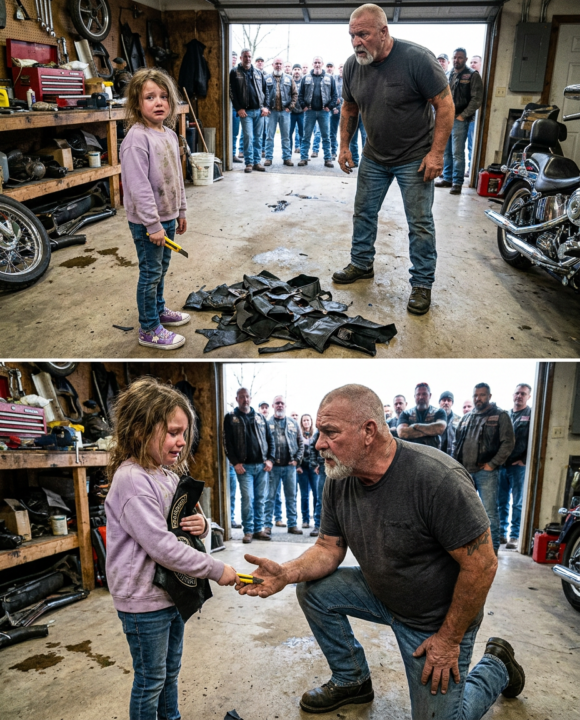
That was the scene I entered: thirty riders filling the doorway, one child trapped between them and a ruined vest spread across the floor.
For a few seconds, anger came before understanding. I would be lying if I said otherwise. My stomach tightened when I saw the club patch on the concrete. I saw Nora’s blue flannel lining sliced through. I saw the pocket where Eli had hidden a ridiculous plastic ring Lily gave me when she was three.
Then Lily looked at my hands.
The anger went out of me.
She had seen adults angry before. I could tell from the way she braced herself. Her chin was down, her shoulders high, her feet positioned as though she expected to be knocked backward.
I knelt and asked for the knife.
She shook her head.
Behind me, Boone muttered that someone should get Dana. I told him to do it quietly. Mouse moved the other men back half a step, giving Lily more air without leaving me alone with her.
“Look at me,” I said.
She did.
“This part matters. Put the knife in my hand.”
Her breathing became uneven. For one frightened second, the blade tilted toward her wrist as she adjusted her grip. I kept my voice steady and did not reach.
“Turn it sideways. That’s it.”
Lily obeyed. The plastic handle touched my palm. I closed my fingers around it only after she released it completely.
Safe.
I retracted the blade, put the knife above the workbench and checked both of her hands. No blood. No cut. The red lines on her palms came from squeezing the handle.
The immediate danger was over.
We thought that was the crisis.
It wasn’t.
When Dana arrived, she stared at the pieces on the floor and asked Lily what she had done. Lily turned toward the motorcycles in the driveway. One engine was still idling, producing that slow, heavy pulse you can feel through concrete.
She covered her ears.
Mouse shut the engine off.
The silence that followed felt heavier than the noise.
I asked Lily why she had cut the vest. At first, she moved her lips without sound. Dana knelt a few feet away and told her she did not have to answer. Lily looked at the memorial pin on the severed front panel, then at me.
“Uncle Ray, don’t go anymore.”
Dana froze.
I did too.
Lily’s voice was rough and small, as if six months of silence had gathered inside her throat. She pointed at the torn vest.
“You wear it. You ride. Then you die.”
Every man in the doorway heard her.
That was the first major truth. The vest had become part of a pattern in Lily’s mind: leather, motorcycles, goodbye, death. She had not destroyed it because she hated me or the club. She had tried to make me impossible to lose.
Then she showed us the second truth.
She crouched beside the pieces, lifted the rectangle containing the club patch and held it against her chest.
“Daddy said this means family,” she whispered.
Lily had not spared the patch by accident.
She had cut away the road and saved the brotherhood.
Part 4
No one spoke for several seconds. Boone lowered his head. Mouse turned away and pressed both hands against the edge of the workbench. Dana made a sound that began like a sob, but she covered it before it fully escaped.
I stayed on one knee.
Lily still held the patch against her shirt. The leather around it was jagged. A loose thread hung across her wrist.
I asked who told her wearing a vest meant someone would die.
She looked toward Dana, frightened she had done something wrong again. Dana said, “You can tell him.” Lily swallowed.
“At Daddy’s goodbye,” she said.
We called the funeral a celebration of life around children, but Lily knew what it was. She remembered the closed casket, the flowers that arrived without anyone ordering them and the adults using quiet voices whenever she entered a room.
She told us what she had heard behind the coat rack. Not entire conversations. Pieces.
“Vest on.”
“Went riding.”
“Didn’t come home.”
Those fragments had spent six months joining themselves together in her mind. Each time she saw one of our leather cuts, she saw a warning adults were ignoring. Each engine meant departure. Each departure might bring another knock at the door.
Then she added something Dana did not know.
On the night before the funeral, Lily had found Eli’s vest hanging over a dining chair. She pulled it down and slept on top of it. In the morning, relatives took it away because the club planned to display it near his photograph.
When she woke and found the vest gone, she believed her father had left a second time.
Dana covered her face. She had asked her sister to collect the vest because she could not bear to touch it. No one had explained that decision to Lily. Adults moving through grief had changed the meaning of an object without realizing a child had built her safety around it.
The vest beneath us suddenly felt different.
It was no longer only mine.
I looked at the strips spread around Lily’s sneakers. Repair was technically possible. A skilled leather worker could replace panels, reinforce seams and preserve most of the original patches. It would be expensive and ugly, but I could wear it again.
Boone assumed that was what I wanted.
He began gathering pieces, saying his cousin knew a leather craftsman in Springfield. Another member found a clean storage bin. The men finally had a task, so they moved quickly, relieved to do something with their hands.
“Stop,” I said.
Boone looked up.
I told everyone to leave the pieces where they were. He thought I was protecting evidence of the damage until Lily calmed down.
“No,” I said. “It stays cut.”
Boone’s expression changed. He and I had argued perhaps five serious times in twenty years. I could see the sixth arriving.
“That’s your full-patch vest,” he said.
“I know what it is.”
“Nora repaired that lining.”
“I know.”
“Then let us fix it.”
Lily’s eyes moved between us. Her shoulders rose again. The argument was becoming another punishment she believed she had caused.
I lowered my voice.
“If I repair it tonight and put it on tomorrow, what does she learn?”
Boone looked at Lily. His anger did not disappear, but it changed direction. He sat on an overturned bucket and rubbed his beard.
Dana asked what I planned to do instead.
At that moment, I had no plan.
I only knew I would not sew the vest back together and pretend nothing had happened. Lily had finally spoken because fear became larger than silence. The damage on the floor was the first thing she had managed to explain in six months.
Throwing it away felt wrong.
Repairing it felt worse.
Then Mouse picked up a strip from the side panel, about two inches wide. He turned it over in his hands. Part of Nora’s blue flannel remained stitched behind it.
“What if nobody wears the whole thing?” he asked.
Boone glanced at him.
Mouse laid the strip across the chest of his own vest. The idea reached me before he finished explaining it.
There were thirty members present.
The destroyed vest could be divided into thirty pieces.
Each man could carry one.
At first, the proposal sounded ceremonial, almost too neat for the mess in front of us. Then its harder meaning became clear. If thirty riders accepted a piece, thirty riders would also accept what Lily had asked of me. Come home.
Boone objected immediately. Club cuts were personal. A man earned his own vest; he did not divide it among others. Pieces carrying another rider’s road wear were not decorations.
Mouse answered quietly.
“She isn’t decorating us.”
That ended the argument.
We gathered every piece and placed them on white shop towels. I counted thirty-two usable sections, excluding small scraps. One contained the main patch. Another held my road name. A third carried Eli’s memorial pin. The rest were plain leather, scarred leather, pocket edges, seams and fragments of lining.
I kept the patch aside.
Lily watched me.
“This goes with you,” I said.
She shook her head and pointed at my chest.
I told her the patch meant family because her father had been right. Family did not depend on my wearing it while riding. I would place it in a frame so she could see it without hearing an engine start.
Then Boone surprised everyone.
He removed his own vest and laid it on the workbench.
“Cut mine first,” he said.
Part 5
Boone did not mean that we should destroy his vest. He meant he wanted the first piece of mine sewn onto it, and he wanted Lily to choose where it went.
That distinction mattered.
We did not hand her the utility knife again. Mouse traced one of the intact leather strips with tailor’s chalk. His wife, Denise, kept an industrial sewing machine in the small upholstery shop behind their house. She could cut the pieces safely, seal the edges and stitch them without weakening anyone’s vest.
Dana asked Lily whether she wanted to help choose the locations.
Lily nodded.
The memorial ride was canceled. No one complained. Thirty motorcycles remained parked in my driveway until the engines were cold.
We ate the cookout food inside the garage. Paper plates balanced on toolboxes. The hamburgers were dry because they had stayed on the grill too long, and the potato salad had warmed enough that Denise threw it away. Nobody made a speech.
Lily sat beside the workbench drawing rectangles on a sheet of paper.
She had spoken, but her voice did not return all at once. After those first sentences, she became quiet again. Dana later explained that a child’s recovery did not move in a straight line. The words in the garage were an opening, not a switch.
That afternoon Lily answered mostly by pointing.
She placed Boone’s piece near the inside of his left shoulder. Mouse’s went beside the lower pocket. She chose a narrow strip of blue lining for me, although I no longer had a vest to attach it to.
When I asked why, she tapped my shirt over my heart.
I had to look away.
During the next week, Denise worked slowly. She called me after opening the first seam because she had found objects inside the lining: the plastic ring Lily gave me when she was three, a folded fuel receipt from a trip with Eli and Nora’s original repair stitches beneath a later patch.
The receipt was nearly blank with age. Only the date and the word Arkansas remained visible.
Denise asked whether I wanted those things returned.
I told her to keep the ring with my piece and put the receipt in the frame for Lily. She asked what to do with the blue flannel.
“Share it,” I said.
There was not enough for thirty visible patches, so she cut tiny squares and placed them behind several leather pieces. Most could not be seen once sewn down.
That became another layer of the idea: some things a rider carries are visible; some are held beneath the seam.
We gathered at Denise’s shop the following Saturday. She had arranged thirty vests across two long tables. Each now carried a small, irregular section of my old leather. No two pieces looked alike.
Boone’s included part of a repaired seam.
Mouse received the edge of the pocket.
A younger rider named Cal got the section scorched by the exhaust pipe in New Mexico. He asked what had caused it, and for the first time in years, I told the complete embarrassing story: I had backed into my own hot motorcycle while arguing about directions.
The room laughed.
Lily laughed too.
It was a brief sound, almost swallowed, but Dana heard it. She turned so quickly that her chair scraped the floor. Lily looked startled by the attention and became quiet again.
No one asked her to repeat it.
Denise had made the frame for the club patch from dark oak. Behind the leather she placed acid-free backing and the faded gas receipt. The memorial pin remained attached near the corner. She did not clean the jagged edges where Lily had cut around it.
When I presented it, Lily touched the glass.
“Is it dead?” she asked.
The question caught me off guard. I asked what she meant.
“The vest.”
I considered telling her an object could not die. That answer would have been accurate and useless.
“No,” I said. “It changed jobs.”
She studied me.
“What job?”
I pointed around the room. Thirty riders stood wearing thirty fragments.
“Now it reminds all of us to come back.”
Lily looked at every vest. Some pieces were obvious; others disappeared against older black leather. She counted them twice, using one finger.
She reached twenty-nine and frowned.
The thirtieth piece was still on the table. It was the strip containing my road name, HAMMER. I had not decided where it belonged because I did not own another vest.
Lily picked it up and carried it to Dana.
Her mother stiffened.
Dana was not a club member. She did not ride. Since Eli’s death, she had avoided even sitting on a stationary motorcycle. She told Lily the piece belonged to me.
Lily shook her head.
“Daddy came home to us,” she said. “Mommy has to come home too.”
That was the second time she spoke in front of the whole group.
Denise found an old denim jacket in her shop and pinned my road-name strip inside it temporarily. Dana did not wear the jacket that day. She took it home over one arm.
Several months later, she brought it back. She had asked Denise to remove my name and use a plain piece instead. The HAMMER strip was returned to me.
I sewed it inside my new leather vest, where no one could see it.
The fragment Lily gave me was hidden.
Her request wasn’t.
Part 6
The club meeting after the vest ceremony lasted nearly four hours. Our rides had always followed informal habits: the experienced rider led, someone stayed near the rear, and everybody checked his own machine. Eli’s death exposed how much of that depended on assumption.
Lily’s words made assumption difficult to tolerate.
Boone proposed a written ride plan. Mouse wanted a dedicated support vehicle for every organized trip. Cal argued that a truck behind thirty motorcycles could not prevent a crash. He was right, but that was not the point. The vehicle could carry water, first-aid supplies, tools, emergency contacts and a rider who became ill or exhausted.
We adopted the rule.
Every official club ride would have a designated road captain, a rear sweep rider and a support vehicle when the route or group size justified it. No member would be pressured to keep riding after dark. Weather checks would happen before departure and again at planned stops. Anyone could call off a ride without being mocked for fear.
The last rule created the longest argument.
Some older men heard caution as weakness. Boone ended that argument by lifting the flap on his vest and showing the piece Lily had chosen.
“A six-year-old had more courage than us,” he said. “She admitted she was scared.”
We also stopped using careless phrases around families. No more jokes about dying on the road. No more telling children that their fathers “lived to ride.” Motorcycles were part of our lives, but they were not entitled to every hour or every risk.
During the first five years under the revised rules, no member was killed or seriously injured during a club-sanctioned ride. We had flat tires, dead batteries, a bee inside Cal’s helmet and one support truck that overheated near Wichita. We also canceled six trips because of storms and ended two early when riders became tired.
The old version of us might have kept going.
The thirty pieces kept answering first.
Lily gradually returned to speech. Her first full conversation with me happened almost a year after the garage incident. She asked whether my new vest was dangerous.
I opened it and showed her the HAMMER strip sewn inside.
“Only if I forget what this means,” I said.
She touched the old leather, then asked whether she could hear my motorcycle start from inside the house. I said yes. She stood behind the screen door with Dana while I started it, shut it off and walked back to the porch.
We repeated that several times over the following months.
Start.
Stop.
Return.
The engine slowly became a sound with two possible endings.
Part 7
Eight years have passed since Lily cut my vest.
She is fourteen now. She plays clarinet, corrects my grammar in text messages and claims my garage coffee smells like burnt tires. She remembers only parts of that October afternoon, but she remembers the question she was trying to ask.
Will you come back?
Every year on the anniversary of Eli’s death, the thirty riders who received a fragment try to visit Dana and Lily. Age and distance have changed the gathering. One member moved to Oregon. Two no longer ride. Boone uses a cane after knee surgery. Denise died three winters ago, and Mouse now wears her thimble on a cord beneath his shirt.
We still bring the pieces.
Those who cannot attend send their vests ahead or join by video while someone holds a phone over the kitchen table. We never start thirty motorcycles outside Lily’s house. We arrive in small groups during daylight and park along the curb with the engines turned off as soon as we roll in.
The framed patch hangs in Lily’s bedroom above a narrow bookshelf. The jagged leather remains visible around its edges. Behind it rests the faded Arkansas fuel receipt and a photograph of Eli wearing his own vest while holding Lily in oversized pink ear protection.
This year, Lily took the frame down before we arrived.
She carried it into the living room and placed it beside the thirty vest fragments. Then she handed me a small envelope. Inside was a drawing she had made when she was six but never shown anyone.
It pictured thirty black figures standing beneath a row of dark clouds. Each figure had a tiny brown square on his chest. In the center was a girl holding a large patch. On the back, written in Dana’s handwriting, were words Lily had dictated to her counselor:
They all have a little piece, so none of them can disappear all at once.
I read it twice.
Boone asked what it said. I handed him the paper because my voice had stopped cooperating.
Before we left, Lily walked outside with us. I told her the route, the expected weather and the time I planned to call when I reached home. That routine began when she was six. I have never skipped it.
She checked that the old strip was still inside my vest.
Then she stepped back.
“Come home, Uncle Ray.”
I fastened the front, looked at the thirty pieces surrounding her and gave the only answer that had ever mattered.
“That’s the plan.”
The engines started one at a time. Lily remained beside the driveway, holding her father’s framed patch against her chest, until every rider turned safely onto the road.
Follow the page for more biker stories about grief, brotherhood, and the quiet promises carried beneath old leather.