A Ten-Year-Old Girl Sold Thirty Drawings of a Father She Had Never Met—Then One Biker Recognized the Crooked Smile
Thirty colored-pencil portraits lay across the sidewalk, every one showing the same man’s crooked smile, when a ten-year-old girl told us she was selling them for two dollars each because she had never seen her father’s real face.
There were six of us riding through Richmond, Indiana, that Saturday morning. We had stopped near the old depot because Boone wanted coffee, Travis needed fuel, and I had spent the previous twenty miles pretending the ache in my left hand wasn’t getting worse.
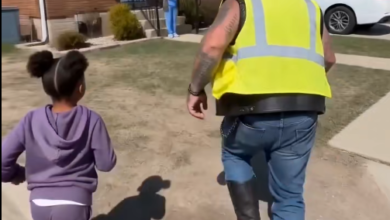
My name is Mason Holt, though the Iron Lanterns have called me Bear since my beard began turning gray. I was fifty-seven, six-foot-four, and heavy enough that children usually stared at my tattoos before deciding whether to hide behind their parents.
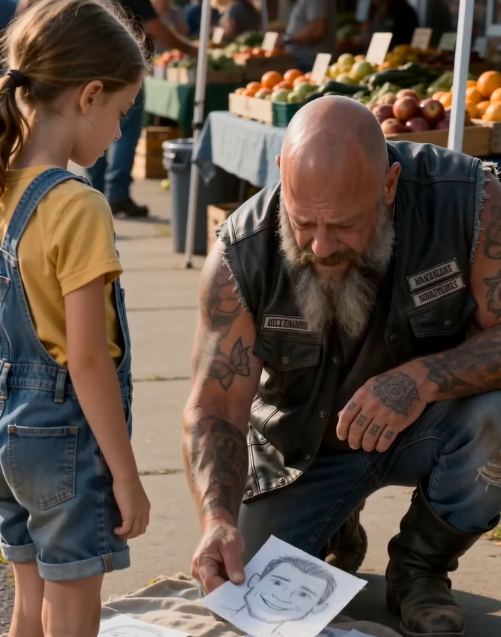
The girl did not hide.
She sat cross-legged beside a faded red wagon, wearing denim overalls, a yellow T-shirt, and two different socks above scuffed sneakers. A piece of cardboard leaned against the wagon with $2 EACH written in blue marker, but the wind kept folding one corner over the price.
More than thirty drawings were arranged on an old bedsheet.
At first, I thought they were copies.
Then I knelt.
The man’s hair changed from brown to black. His eyes were wider in some pictures, almost closed in others. A scar appeared beneath his chin in every version, and the left corner of his mouth always lifted higher than the right.
Same face. Different attempts.
Boone crouched beside me. “That somebody famous?”
The girl shook her head.
“That’s my dad.”
I looked again.
Some portraits had been drawn with crayons. Others used colored pencils worn nearly to the wood. One was sketched in black pen on the back of a grocery circular, with the advertisement showing faintly through the paper.
“Your father know you’re selling these?” Travis asked.
She looked up without seeming offended.
“He died before I was born.”
Travis lowered his eyes.
The girl introduced herself as Evelyn Carter, though everybody called her Evie. She was ten years old, finishing fourth grade, and had been drawing the same man since she was seven.
She had never met him.
She had never seen a photograph of him.
Her mother described him while cooking dinner after work: eyes that tilted slightly at the corners, a narrow scar beneath his chin, thick eyebrows, and a smile that pulled harder on one side whenever he was trying not to laugh.
Evie would listen, draw, and hold up the result.
Her mother would say the eyes needed narrowing, the chin needed softening, or the smile needed moving half an inch.
Then Evie tried again.
“Which one looks most like him?” Boone asked.
She pointed toward the wagon.
Inside lay a portrait wrapped in a clear plastic grocery bag. It was more careful than the others, drawn on white art paper with the edges left clean. The man wore a green work shirt. His face was turned slightly toward the viewer, and the crooked smile looked hesitant, as if somebody had surprised him with good news.
“That one isn’t for sale,” Evie said.
“What are the others for?”
“A frame.”
I thought she meant she was saving money to frame a surviving family photograph.
I was wrong.
She wanted a wooden frame for the one drawing she believed was closest to her father. The frame she had seen at a discount store cost almost thirty dollars, and she wanted one with actual glass because plastic scratched too easily.
“Why not put his photograph in it?” Travis asked before Boone could stop him.
Evie’s fingers folded the edge of the grocery bag.
“We don’t have any.”
She explained it without drama. There had been a kitchen fire when she was three. Her mother got Evie out, but the box containing old photographs, letters, and hospital papers had burned in a bedroom closet.
Every picture of her father disappeared.
Her mother worked breakfast shifts at a motel and evening shifts at a senior-living cafeteria. Money covered rent, food, electricity, and an inhaler Evie sometimes needed during winter. A frame belonged in the category of things they might buy later.
Later kept moving.
So Evie began selling portraits.
Over three months, she had sold eleven.
A teacher bought one. A bus driver bought two. An elderly woman chose a drawing because the man’s expression reminded her of her son. After replacing pencils and paper, Evie had saved fourteen dollars and seventy-three cents inside a mint tin.
That was when a woman carrying farmers’ market flowers stopped beside us.
She studied the pictures and asked, “Why would anybody buy a portrait of a stranger?”
Evie considered the question.
“Because he isn’t a stranger to me.”
The woman walked away without purchasing anything.
I picked up the nearest drawing.
It showed the man in profile, with the chin scar drawn too long and the ears drawn too small. The smile was barely there.
But my right hand began shaking.
Not the left hand that ached in cold weather.
The right.
Boone noticed first.
“You all right, Bear?”
I did not answer.
Eleven years earlier, I had knelt beside a crushed pickup on U.S. Route 40 while gasoline ran beneath my boots and a young man bled through the work shirt I pressed against his ribs.
The windshield had hidden most of his face.
But I remembered the scar beneath his chin.
I remembered the eyebrows.
Most of all, I remembered the smile that pulled toward one side when he told me not to lie about whether he was going to survive.
Three minutes before the ambulance arrived, that man had pushed a brown leather wallet into my hand.
Police later tried to locate his family.
So did I.
Nobody ever found the pregnant woman whose first name he whispered before he died.
For eleven years, the wallet remained inside a green metal box at our clubhouse because throwing it away felt like breaking the last promise I had made him.
I looked from the drawing to Evie.
“What was your father’s name?”
“Lucas Bennett.”
The street sounds disappeared.
Coffee cups stopped halfway to mouths. Boone stood slowly. Travis looked toward me, waiting for an explanation I could not yet give.
I placed the drawing back on the sheet with both hands.
Then I asked Boone to ride to the clubhouse and bring me the green box from the locked cabinet.
Evie watched his motorcycle pull away.
“What’s in the box?” she asked.
I looked at the face she had drawn thirty times from a dead man’s description.
“The reason I know you got his smile right.”
Part 2
Evie did not immediately believe me.
That was reasonable. I was an enormous stranger in a wet leather vest claiming to recognize a dead man from a child’s colored-pencil drawing. Her mother had taught her not to follow adults, accept rides, or give strangers their address.
She obeyed those rules even while hope pulled at her face.
“You knew him?”
“I met him once.”
“Were you friends?”
“No.”
That answer confused her.
“How can you remember somebody you only met once?”
I looked toward the road.
“Some meetings last longer.”
Before I explained, I asked where her mother was. Evie pointed across the street toward a brick motel where Hannah Carter worked the breakfast shift. The manager knew Evie was selling drawings near the farmers’ market and checked on her through the lobby window.
Boone was still thirty minutes from returning, so I asked the manager to call Hannah outside. I wanted Evie to hear the rest with someone she trusted beside her.
Hannah arrived wearing black work pants, a pale uniform blouse, and a plastic name tag. She was thirty-five, though the tiredness around her eyes made her appear older until she smiled.
She did not smile when she saw six bikers surrounding her daughter.
“What happened?”
“I’m fine, Mom,” Evie said quickly. “He knows Dad.”
Hannah stopped walking.
The plastic laundry bag she carried slipped from her fingers.
She stared at me, then at the drawings, then back at my vest. I watched recognition struggle against disbelief, but I had never met her before.
“You knew Lucas?”
“I was with him after the wreck.”
Her hand found the back of a folding chair.
For several seconds, nobody spoke.
Then Hannah sat.
The market continued around us. A man sold tomatoes beneath a green canopy. Two teenagers argued over kettle corn. Somewhere behind the depot, a motorcycle engine started and settled into a low idle.
Hannah asked the first practical question.
“Which wreck?”
“Route 40. East of town. November, eleven years ago.”
Her face lost its color.
“That was him.”
She had been twenty-four and five months pregnant. Lucas had been working temporary construction jobs in Ohio while she stayed with an aunt in western Pennsylvania. They were not married, but they had chosen the baby’s name and planned to rent an apartment when his job ended.
On the night he died, they had argued by phone.
Lucas promised to drive to Pennsylvania the next morning.
Instead, he headed east after finishing a late shift, hoping to surprise her before breakfast.
He never arrived.
A state trooper contacted Hannah two days later after tracing information from Lucas’s employer. By then, his personal effects had been entered into evidence, and she was advised that someone would contact her after the investigation.
Nobody did.
Then Hannah’s aunt became ill. Hannah moved twice in six months, changed phone numbers, and gave birth early. Letters sent to the old address were returned.
“I called the county,” she said. “They told me his things had been released.”
“To a half brother in Nevada.”
Hannah frowned.
“Lucas didn’t have a brother.”
That was the first sign that the failure had been larger than a lost address.
I remembered the man who came to the county office eighteen months after the wreck. He claimed to be Lucas’s next of kin, signed property forms, and took a duffel bag of clothing and tools. The detective handling the case had called me because I had continued asking about the wallet.
The supposed brother did not want it.
He said to throw it away.
I asked to keep it.
At the time, I assumed the man had been estranged from Lucas. Now Hannah’s denial turned an old discomfort into a new question.
“Do you remember his name?” she asked.
“Curt Bennett.”
Hannah shook her head.
“No Curt.”
Travis muttered something under his breath.
I told him to let Denise handle it. Denise Ward, the attorney who helped our club with contracts and occasionally kept younger members from making emotional decisions expensive, could request the old property record.
But the stranger who had taken Lucas’s tools did not matter as much as the box Boone was bringing.
Evie sat beside her mother, holding the protected drawing in her lap.
“Did my dad say anything?”
That question had lived inside her for ten years.
I wished Boone would arrive before I had to answer.
He didn’t.
“Yes.”
“What?”
I could have told her everything on a sidewalk between a produce stand and a motel parking lot. I could have repeated Lucas’s final words exactly and watched a child carry them for the rest of her life.
Instead, I told her the part she needed first.
“He said your mother’s name.”
Hannah covered her mouth.
“He knew about me?” Evie asked.
“Yes.”
“You’re sure?”
“He made sure I was.”
Something changed in her posture. She had grown up knowing her father died before she was born. Somewhere along the way, that fact had become a private fear that perhaps he had died before wanting her.
My answer did not remove the grief.
It changed its shape.
The sound of Boone’s Harley reached us several minutes later. He parked carefully at the curb, shut down the engine, and removed a scratched green metal box from his saddlebag.
It was smaller than a shoebox.
I had opened it every November for eleven years.
Inside were newspaper clippings about the wreck, copies of letters returned from addresses in Pennsylvania and Ohio, a business card from the state trooper, and the brown leather wallet Lucas Bennett placed in my hand.
Evie stared at it.
Hannah whispered, “I bought him that wallet.”
I set the metal box on the table but did not open the wallet.
It belonged to them now.
Before handing it over, I needed them to understand why a stranger had kept it for more than a decade—and why I had never managed to complete what Lucas asked me to do.
Part 3
The night Lucas died, I was returning from a motorcycle-parts swap in Dayton.
Cold rain had started near New Paris, just enough to turn old oil on the highway into a thin reflective skin. I was riding behind Boone and another club member named Eddie when brake lights appeared ahead of us and vanished.
A pickup had crossed the center line, clipped a concrete drainage wall, and rolled into a shallow ditch.
We stopped.
The truck rested against a cluster of bare trees with the passenger side crushed inward. The headlights still burned into the mud. One wheel spun slowly, ticking each time a torn piece of metal struck the frame.
Eddie called emergency services.
Boone ran uphill to warn approaching traffic.
I went to the driver.
Lucas was trapped behind the steering column. The side window had shattered, and rain reached through the opening. He was conscious, though his breaths came too quickly and his hands could not find anything solid to hold.
I told him my name.
He said his was Luke.
That was all we had time for.
The dispatcher warned us not to move him unless fire or another immediate danger developed. Then fuel began running beneath the truck, carrying the sharp smell of gasoline into the wet grass.
Smoke rose from the engine compartment.
The dispatcher changed instructions.
Eddie used a pry bar to widen the door opening while I cut the seat belt. We could not remove Lucas cleanly. Part of the dashboard held his legs, and every movement changed his breathing.
He understood what that meant before we said anything.
“Don’t leave me in here,” he said.
We didn’t.
A volunteer firefighter arrived in a personal vehicle and helped stabilize the wreck. Together, we freed Lucas enough to slide him onto a tarp several yards away.
No explosions followed.
No dramatic fireball.
Just rain, smoke, and one injured man getting colder beneath my hands.
I pressed a folded sweatshirt against his side. Lucas gripped my wrist and asked how far away the ambulance was.
The dispatcher said approximately three minutes.
I told him help was close.
He studied my face, then gave that uneven smile.
“You’re a bad liar, biker.”
Those were the first words that returned when I saw Evie’s drawings.
The crooked smile had not come from happiness. It appeared because Lucas was trying to make me less afraid.
He asked for his wallet.
I found it in his back pocket and placed it in his hand. He lacked the strength to open it, so he pushed it toward me.
“Hannah.”
I asked for her last name.
He said something I could not hear over an approaching truck. I leaned closer.
“Carter,” he managed. “Pennsylvania.”
Then he said one more word.
“Baby.”
I told him I would find them.
He looked at me for several seconds, deciding whether I meant it.
Then his grip loosened.
The ambulance arrived while I was still speaking to him.
Paramedics worked for nearly twenty minutes. They continued treatment during transport, but Lucas was pronounced dead at the hospital.
Three minutes.
For years, I hated those three minutes as though I could have reached into time and dragged them closer.
The trooper took the wallet that night. Investigators found an expired Nevada driver’s license, cash, two fuel receipts, a room key without a hotel name, and three photographs.
There was no current address.
Lucas’s employer had hired him through a subcontractor. Records listed an emergency contact who had died two years earlier. The Pennsylvania number associated with Hannah had been disconnected.
Police tried.
I tried.
The first Hannah Carter I called was seventy-one. The second had never known a Lucas. Several numbers led nowhere. I mailed letters to addresses pulled from public directories, but only two were opened, and neither recipient was Evie’s mother.
The crash report eventually closed.
The world continued.
I did not.
Every November, I opened the green box and tried again. Internet searches became easier, but Hannah’s name was common, and she had changed her surname briefly after marrying a man named Carter when Evie was four. That marriage lasted less than two years, but she kept the surname because Evie used it in school.
Lucas’s obituary contained no mention of a girlfriend or unborn child. The funeral was arranged by a subcontracting supervisor and a church outreach worker. His mother and grandparents were already dead.
He had been poor, temporary, and easy to lose.
That is how a man can exist loudly in one person’s life and barely appear in public records.
When the county prepared to dispose of unclaimed personal property, the supposed half brother appeared. He had the correct date of birth and enough information to satisfy an overworked clerk.
Denise later discovered that Curt Bennett was actually a former coworker who had shared housing with Lucas. He took the tools, sold them, and disappeared.
He left the wallet because it contained nothing valuable to him.
The detective called me.
I signed for it.
For eleven years, I told myself I was protecting what remained.
Standing beside Evie’s bedsheet, I understood another truth.
I had also been hiding from the possibility that my promise had failed.
Hannah listened without accusing me. That was almost worse.
“You kept looking?” she asked.
I showed her the returned envelopes.
She recognized two addresses.
At one, she had moved three weeks earlier. At another, the landlord had evicted everyone after a heating-system failure.
The letters had missed her by inches and months.
Evie touched the wallet with one finger.
“Can I open it?”
I slid it across the table.
“It’s yours.”
She unfolded the cracked leather slowly. Eleven years had stiffened the corners. The cash and cards were gone because they had been separately inventoried, but the photographs remained inside a transparent sleeve.
Evie pulled out the first one.
It showed three men standing beside a concrete mixer.
Lucas was not among them.
The second was a faded photograph of a young woman sitting on the hood of a blue car.
Hannah made a sound that stopped every person at the table.
“That’s me.”
Evie had seen younger pictures of her mother, but this one had escaped the fire. Hannah was laughing at whoever held the camera, her hair whipping across her face.
On the back, Lucas had written only two words.
My home.
Evie turned over the third photograph.
Then she stopped breathing.
The picture showed Lucas alone beneath a gas-station awning, wearing a green work shirt and looking away from the camera. Somebody had said something just before the shutter clicked.
His head had turned.
His mouth had lifted harder on the left.
The smile was exact.
Part 4
Evie did not cry immediately.
She held the photograph level with the drawing protected in the grocery bag and looked from one to the other. Her father’s real face was leaner than she had imagined. His nose was slightly crooked. The chin scar was shorter, and his eyes narrowed more when he smiled.
But she had found him.
Thirty attempts built from her mother’s memory had carried her close enough that a stranger recognized him on a sidewalk.
“That’s him?” she asked.
Hannah nodded.
“Can I touch it?”
“It belongs to you.”
Evie placed her thumb against the white border, avoiding the image itself.
I had expected tears, maybe a hug, maybe the stunned silence that already surrounded us.
Instead, she asked a practical question.
“Who took this?”
Hannah studied the gas-station canopy in the background.
“I did.”
It had been taken the week Lucas accepted the Ohio construction job. They stopped for fuel outside Pittsburgh, and Hannah teased him about shaving badly. He tried not to smile because he was pretending to be annoyed.
That was the expression she had described during all those evenings at the kitchen table.
The real photograph confirmed details she had remembered correctly.
It also showed what memory had softened.
Lucas looked tired. One shirt button was missing. Grease darkened the edge of his sleeve, and worry lived beneath his smile.
He was not a perfect father preserved by death.
He was twenty-six, broke, frightened, and trying.
Evie traced the air above his face.
“He looks like he knows me.”
Hannah’s eyes filled.
“He did know about you.”
“But he never saw me.”
“No.”
A child should not have to understand the difference between being unseen and being unwanted, but Evie had spent years trying.
I reached for the wallet, remembering something investigators had treated as ordinary evidence.
Behind the photograph sleeve was a narrow pocket stitched into the leather. The seam had loosened, exposing the edge of another piece of paper.
I had never noticed it.
Neither had police, as far as the inventory showed.
Evie used one fingernail to pull it free.
It was not a fourth photograph.
It was a folded ultrasound print, creased twice and worn white along the edges.
Hannah stood so suddenly the chair fell backward.
“I gave him that.”
Her voice broke.
The image was faded, but the curve of a tiny head remained visible. At the top was a clinic date from nearly eleven years earlier. Hannah had given the only copy to Lucas after their argument about the Ohio job.
She believed he had left it inside his room.
She never knew he carried it.
On the back, written in black pen, were five words:
Evelyn, if she’s a girl.
Evie read them twice.
“That’s my name.”
Hannah pulled her close.
For the first time that morning, Evie cried.
She did not cry delicately. Her shoulders shook, and she buried her face against her mother’s uniform. Hannah held the real photograph in one hand and the ultrasound in the other, protecting both from the wind.
I turned away.
Boone placed his hand on the back of my neck.
“You found them,” he said.
“Too late.”
He tightened his grip.
“You found them.”
There are arguments a man can win with facts.
That was not one.
I had kept a promise eleven years late, and the delay had consequences. Evie grew up inventing the face she should have known. Hannah spent a decade believing everything had burned. I carried Lucas’s wallet while his daughter sold drawings to strangers for enough money to frame an approximation.
Finding them did not erase any of that.
It only gave us a place to begin.
The market manager brought a clear plastic container to protect the photographs. Someone retrieved the fallen chair. The woman who had earlier questioned why anyone would buy a stranger’s portrait returned and quietly placed two dollars beside one drawing.
Evie saw the money.
She wiped her face and said, “You have to choose one.”
The woman chose the portrait drawn on the grocery circular.
By noon, people had heard enough of the story to crowd the sidewalk. Several wanted photographs of Evie and the bikers. Hannah refused.
Good.
That moment belonged to her daughter.
Travis bought one drawing. Boone bought another. Eddie, who had driven in after Boone called him, purchased the portrait showing Lucas in a baseball cap he had probably never owned.
We paid the marked price.
Evie insisted.
“This is my business,” she said.
By 12:30, only nineteen portraits remained.
I picked up the first drawing that had made my hand shake. It showed Lucas in profile, his scar too long and his ears too small.
“I want this one.”
Evie examined it.
“That’s not a good one.”
“It found me.”
She considered that, then handed it over.
“Two dollars.”
I gave her two.
Not twenty. Not a hundred. Two.
She placed the bills inside the mint tin and counted everything. With the day’s sales, she had enough to buy the wooden frame.
That should have been the end.
Then Hannah looked toward the remaining portraits and said something none of us expected.
“We can’t frame only one anymore.”
Evie held the real photograph against her chest.
She no longer needed a frame for her best guess.
She needed one for the face that had finally come home.
Part 5
We walked to the discount store three blocks away.
Nobody rode.
Evie pulled the red wagon while Hannah carried the photographs inside the plastic container. Six bikers followed behind them, each holding a drawing purchased from a ten-year-old artist.
People stared.
Let them.
At the store, Evie led us directly to the frame aisle. The wooden frame she had been saving for was still there: dark brown, eight by ten inches, with a narrow metal edge.
She checked the price tag.
Twenty-seven dollars and ninety-nine cents.
Her mint tin contained thirty-one dollars and seventy-three cents after the morning’s sales.
She could afford it.
That mattered to her.
When Boone reached for his wallet, I stopped him.
Evie paid the cashier herself, counted the change, and carried the bag out with both hands.
Our club paid for something else.
The photograph of Lucas was too small for the frame. A print shop near the depot scanned it carefully, removed none of the scratches, and enlarged it without smoothing the details that made him real.
We also copied the photograph of Hannah and the ultrasound. Originals went back into the wallet. Copies went into archival sleeves Denise purchased after arriving that afternoon.
Denise had already begun investigating the false half brother and the missing property records. No dramatic arrest followed. Curt Bennett had died three years earlier, and most of Lucas’s tools were impossible to trace.
But one item resurfaced.
A county inventory listed a silver watch engraved with the initials L.B. It had never been released because the clerk could not reconcile its serial number with the property form. The watch remained in a storage box at the sheriff’s office.
Two weeks later, after Hannah established her relationship to Lucas and submitted Evie’s birth certificate, the county returned it.
The watch no longer worked.
Evie wore it around her wrist anyway, the band loose enough to slide almost to her elbow.
That afternoon, however, our attention remained on the photograph.
The print-shop employee placed the enlarged image on the counter.
Evie stared at it.
The crooked smile had become clear enough to show a shallow dimple beside Lucas’s mouth. The scar beneath his chin was lighter than the rest of his skin. His eyes looked directly past the camera toward Hannah.
“I got the eyebrows wrong,” Evie said.
“You were close,” I told her.
“I made them too nice.”
Hannah laughed through her tears.
“Your father did have angry eyebrows.”
The sound changed the room.
Until then, Lucas had been a tragedy. A wreck. A wallet. A promise. A collection of clues carried by people who had lost him differently.
Hannah’s laughter made him human again.
She told Evie that Lucas burned toast, sang badly in the car, and refused to throw away socks until his toes came through. He was afraid of deep water. He loved grape soda. Whenever he lied about being worried, he rubbed the scar beneath his chin.
Evie listened.
Then she asked whether he had wanted to be a father.
Hannah answered carefully.
“He was scared.”
“That isn’t what I asked.”
Hannah looked at the ultrasound print.
“Yes. He wanted you.”
“How do you know?”
“Because he was driving back.”
The argument before Lucas’s death had not been about abandoning Hannah. He had taken the Ohio job because they needed money for an apartment deposit, but Hannah feared he would remain away after the baby arrived. During their final call, she accused him of choosing work over them.
Lucas said he would prove her wrong.
He finished his shift, packed his belongings, and started toward Pennsylvania in the rain.
The room key in his wallet belonged to a weekly motel he had already checked out of. The fuel receipts followed an eastbound route. The duffel bag taken by the false relative had contained everything he owned at the jobsite.
Lucas was not running away.
He was going home.
For eleven years, Hannah had blamed herself for their final argument. She believed it sent him onto the road angry and exhausted. Now the wallet told a different story.
The argument had not driven him away.
It brought him back.
That truth comforted her and hurt her in equal measure.
We framed the enlarged photograph at the print shop because dust from the sidewalk clung to everything. Evie cleaned the glass three times and placed the image precisely in the center.
She chose to put the ultrasound copy behind the portrait.
“Only we need to know it’s there,” she said.
That evening, we drove to their apartment.
Hannah and Evie lived on the second floor of an aging yellow duplex near Glen Miller Park. The stairs leaned slightly, and the hallway light flickered when the refrigerator started.
Their living room contained a worn sofa, two unmatched lamps, a folding table used as a desk, and one empty nail above the mantel.
Evie had hammered that nail into the wall three months earlier.
She had been waiting for the frame.
I held it level while she stepped back.
“Left,” she said.
I moved it left.
“No, your other left.”
I shifted it right.
“Too far.”
After four adjustments, she nodded.
I drove the hook into the wall and hung Lucas’s photograph in the place prepared for a drawing.
The room became quiet.
Hannah stood beside her daughter.
Evie held the empty wallet.
At last, she could compare the remembered face with the real one. They were different, but not as different as they should have been.
The scar had guided her.
The smile had guided her.
Mostly, her mother’s love had guided her.
Evie placed the wallet beneath the frame.
Then she looked at the nineteen unsold portraits still inside the red wagon.
“What do I do with those now?”
Boone smiled.
“We’ve got walls.”
Part 6
The Iron Lanterns clubhouse had plenty of walls.
Most were covered with ride photographs, memorial patches, faded event posters, and license plates collected before half our members were born. Boone suggested clearing the long wall beside the meeting room.
Nobody argued.
We did not take Evie’s paintings as charity.
The club bought all nineteen at the marked price. Members who had already purchased drawings donated theirs to the display, though each asked Evie to sign the back first.
She wrote Evelyn Carter, age 10 on every one.
We arranged the portraits in the order she had drawn them, beginning with the earliest crayon face and ending with the careful version wrapped in the grocery bag.
The progression was visible.
At first, Lucas had round eyes, a square jaw, and a smile across his entire face. As Evie’s hand improved and Hannah’s memories became more specific, the eyes narrowed, the chin softened, and the smile moved slowly toward one side.
Thirty pictures showed a child learning her father one correction at a time.
The final place on the wall was reserved for a copy of the real photograph.
Evie objected.
“That one goes at home.”
“It does,” Boone said. “This is another copy.”
She approved the arrangement only after we promised the clubhouse image would be smaller than hers.
For the first month, members brought visitors to see the wall. Some wanted the story. Others simply stood there.
Travis stared at the drawings longer than anyone.
His father had left when he was seven and was still alive somewhere in Arizona. Seeing Evie’s efforts changed something in him, though he never explained it directly.
He started calling his mother every Sunday.
That was one of the quieter consequences.
The drawings were supposed to give Evie a father’s face. Somehow, they also made grown men consider which faces they had chosen to forget.
Hannah’s life did not suddenly become easy. She continued working two jobs until the motel promoted her to front-desk supervisor. The club offered to cover her rent for several months, but she refused.
She did accept practical help.
Eddie repaired the duplex stairs after the landlord supplied the lumber. Boone’s wife helped Hannah apply for a hospital cafeteria position with steadier hours. Denise corrected the county records so Evie was formally listed as Lucas’s surviving child.
That correction resulted in a small unpaid final paycheck from the subcontractor’s successor company.
It was not a fortune.
It paid for school clothes, dental work, and a used laptop.
Evie used the laptop to study photographs, though she continued drawing by hand.
The real picture did not end her portraits.
It changed them.
Now she drew the crooked nose accurately. She added the missing shirt button and the grease near his cuff. Sometimes she placed Lucas in scenes he never lived to experience: sitting at her school concert, holding an umbrella at the bus stop, or watching her blow out birthday candles.
Hannah worried those pictures might keep Evie trapped in grief.
A counselor told her imagination could also provide a safe way to build a relationship with someone known only through stories.
Evie understood the distinction better than most adults.
“He wasn’t really there,” she told me while coloring one picture at the clubhouse. “But I can draw what I wish.”
Then she started a new page.
This time, the figure had a long gray beard, tattooed arms, and a hand wrapped around a paper coffee cup.
“That me?”
“Maybe.”
“You made my nose too big.”
She studied my face.
“No, I didn’t.”
I bought that drawing for two dollars.
She made me pay full price.
Part 7
One year after we found Evie on the sidewalk, the Richmond community center hosted a small student art show.
Evie submitted three portraits.
The first was her earliest drawing of Lucas, with round eyes and a straight smile.
The second was the final imagined portrait—the one she had once planned to frame.
The third was drawn from the recovered photograph.
She titled the group Thirty Ways to Remember One Face.
Hannah attended in a blue dress she had bought secondhand. Boone, Travis, Eddie, and I stood near the back because six leather-clad bikers already occupied more space than the room comfortably allowed.
Evie won no trophy.
She did not need one.
A local teacher asked whether she would let the school display the series during a family-history project. Evie agreed on one condition: the real photograph had to remain at home.
After the show, she handed me a narrow wrapped package.
Inside was a new portrait.
It showed Lucas beneath the gas-station awning, his crooked smile turned toward Hannah. In the background stood a biker beside a damaged pickup, though those two moments had occurred months apart.
“You know that didn’t happen,” I said.
“I know.”
“Then why put me there?”
She shrugged.
“Because you carried his face until I could.”
I could not answer that.
Evie had signed the bottom in pencil. Beneath her name, she added a price.
Two dollars.
I reached for my wallet.
She shook her head.
“This one is already paid for.”
“With what?”
“Eleven years.”
The portrait now hangs in my workshop above the locked cabinet where the green box once sat. The cabinet is empty, but I never removed it.
At Hannah’s apartment, Lucas’s real photograph remains above the mantel. His wallet rests beneath it, holding the ultrasound print he carried through his final night.
At the clubhouse, thirty versions of his face cover an entire wall.
Visitors sometimes ask why a motorcycle club displays children’s drawings between memorial photographs and old ride maps.
Boone gives them the short answer.
“Because she remembered a man none of us were allowed to lose.”
Every few months, Evie brings another picture. She no longer draws only Lucas. She draws her mother, the motel manager, the print-shop employee, Officer Ruiz, Boone’s wife, and any person whose face she thinks somebody might need later.
She still charges two dollars.
We still pay.
On the anniversary of the wreck, Hannah, Evie, and I rode to the curve on Route 40. We left no large memorial, only a small photograph sealed inside a weatherproof sleeve.
It showed Lucas smiling crookedly.
Evie placed one hand against the roadside marker before walking back to my motorcycle.
This time, she knew exactly whose face she was touching.
Follow our page for more biker stories about forgotten promises, unexpected family, and the people who carry memories safely home.