An 8-Year-Old Girl Walked Up to the Army Base Gate, Set Her Dead Father’s Medal on the Guard Desk, and Said “I Don’t Need This, I Need My Dad”—The Biker Who Followed Her Home Found Out Why
Part 2 — The Badge Counter
The white car pulled away from the curb just as we reached the steps.
The woman with the lanyard rolled down her window and smiled at Kiara.
“Sweetie! There you are! Your mama’s been worried sick.” She held out a butterscotch Dum Dum. “You can’t just wander off like that.”
Kiara didn’t take it.
The woman’s eyes slid to me, my safety vest and leather vest and badge clipped crooked to my pocket. Her smile didn’t change, but something behind it did.
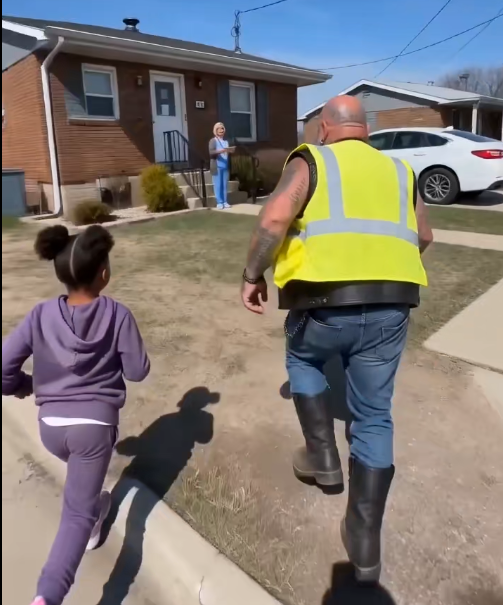
“Thank you for bringing her home,” she said. Then she drove off.
The mother came down the steps with her arms crossed tight over her scrubs.
“Who are you?”
“Earl Dobbins, ma’am. Most people call me Hoss. I work the Visitor Control Center at the Henry Gate.” I took off my cap. “Your daughter walked in about an hour ago and returned her father’s medal.”
The woman closed her eyes.
“Oh, Kiki,” she whispered.
Her name was Danielle Wallace. Inside, the duplex was spotless and nearly empty. There was a couch, a folding table, and a shadow box on the wall with a folded flag and an empty space where the medal was supposed to go.
She told me in pieces, while Kiara sat on the floor coloring.
Staff Sergeant Andre Wallace, 1st Infantry Division, died during a night river-crossing exercise at Fort Riley eight months ago. An armored vehicle slid off the bank. He went into the Republican River after two privates who were trapped inside. Both privates lived. Andre didn’t.
The Army awarded him the Soldier’s Medal posthumously.
And then nothing happened.
“Because it was a training accident, they have to do a line-of-duty determination,” Danielle said. “His commander has to sign it. Until he does, nothing gets paid. The death gratuity. Survivor pay. Our housing allowance. It’s all stuck.”
“How long have you been working on it?”
“Eight months. I’ve driven out there eleven times.”
She worked as a cashier at Dillons on Washington Street, then cleaned floors on the overnight shift at Geary Community Hospital, then drove DoorDash on weekends. The rent was due Friday. She was four hundred dollars short.
“I didn’t think Kiara knew,” she said quietly. “I never said anything in front of her.”
Kiara didn’t look up from her coloring book.
“I hear you on the phone at night,” she said. “In the bathroom. With the water running.”
Danielle put her hand over her mouth.
Then I made the mistake of really looking at her. Her face. The way she held her car keys.
And I remembered.
I’d seen her before. More than once. Standing at my counter in scrubs, holding that same manila packet, asking for a visitor pass to the Survivor Outreach Services office.
The last time, maybe three months ago, it was 4:52 p.m. on a Friday. I’d told her, “Ma’am, the office closes at five. You’ll need to come back Monday.”
And I printed her nothing.
I’d been a soldier for twenty-two years. I knew what a Gold Star widow looked like. I’d stood at too many gravesides. And I hadn’t even looked up from my screen.
How many other families had I waved off at that counter without ever asking why they kept coming back?
“Miss Renee’s the only one who’s really helped us,” Danielle said. “She works at Survivor Outreach. She said her husband runs a company that helps families speed things up.”
“For money,” I said.
Danielle looked away.
I picked up the packet and turned to the last page.
Line of Duty Determination. Appointing Authority signature: ______. LTC Patrick J. Hanley.
I knew that name.
Where had I seen it?
Part 3 — Kiki-Bird
A year and a half ago, the Fort Riley Fourth of July celebration at Victory Park smelled like funnel cakes and gunpowder.
Andre Wallace was six-foot-three and built like a linebacker, with a laugh you could hear over the howitzer salute. He sat on a picnic blanket with seven-year-old Kiara on his shoulders while the fireworks went off over the Kansas River.
Every morning, when he pulled out of the driveway for PT, he gave her the same salute from the truck window. Two fingers off the eyebrow, quick and sharp. And she always saluted back.
“That’s ours, Kiki-bird,” he told her. “Nobody else gets that one.”
That night on the blanket, she asked him why soldiers never cried.
He thought about it for a long time.
“Soldiers cry,” he said finally. “But when you really need the Army to listen, you stand up straight, you walk right up to the front gate, and you don’t cry. Soldiers listen to people who don’t cry.”
She remembered every word.
Seven months later, they held his memorial ceremony at the division chapel. A general pinned the Soldier’s Medal on Danielle’s coat. Kiara sat in the front pew in black tights and didn’t cry once.
Afterward, a friendly woman from Survivor Outreach Services hugged Danielle in the chapel lobby. Her name was Renee Kolb. She wore a lanyard and smelled like vanilla, and she had a little sheet of butterfly stickers in her cardigan pocket.
She took the green folder with Andre’s casualty packet in it and stuck a pink butterfly sticker right on the front.
“So I never lose it, sweetie,” she told Danielle. “I’ll walk this to the colonel’s office myself. You won’t have to do a thing.”
She gave Kiara a butterfly sticker too. Kiara put it on the inside of the medal box.
It’s still there.
So where did the green folder go?
Part 4 — Routing
Renee Kolb’s office was in the Survivor Outreach Services building on Custer Avenue. It was cheerful and cluttered, with family photos, a Precious Moments figurine, and a big jar of butterscotch Dum Dums on the desk.
I got in because Danielle signed a form giving me permission to discuss her file. Renee received me like a long-lost friend.
“Mr. Dobbins! The hero of the Henry Gate.” She came around the desk and squeezed my hand in both of hers. “I heard all about it. That poor baby.”
Before I could say anything, she turned her monitor toward me.
“Let me show you exactly where we are, because I know how this looks.”
It was an email thread with dozens of messages, all to Lt. Col. Patrick Hanley, Andre’s former battalion commander.
March 2: Sir, the Wallace LOD requires your signature as appointing authority. Can you please sign at your earliest convenience?
April 11: Following up on SSG Wallace LOD.
May 20: Sir, this family is in financial crisis.
Every single one came back with the same auto-reply. This mailbox is no longer monitored.
“Colonel Hanley changed duty stations in February,” Renee said, shaking her head. “He’s at Fort Leavenworth now, at the Command and General Staff College. I’ve written him eleven times. I’ve called. Nothing.” She lowered her voice. “Between you and me? Some officers just don’t care once they’re gone.”
“Why doesn’t the new battalion commander sign it?”
“Because it’s an appointing authority signature,” she said patiently. “Legally, it has to be the commander at the time of death. That’s regulation. It’s not my rule, Mr. Dobbins. I just push the paper.”
“And the money Danielle’s been giving you?”
She didn’t even blink.
“That’s my husband Dwight’s company. Heartland Gold Star Claims. He’s a former Army paralegal. He helps families with VA appeals, back pay, benefit disputes. Danielle hired him voluntarily. She signed a client agreement.” Renee folded her hands. “Dwight’s been trying to reach Hanley through his own contacts. He’s working very hard for that family.”
She seemed sincere. She seemed tired. She had a stack of thank-you cards from Gold Star families pinned to her corkboard.
I left her office feeling like I’d walked in swinging at the wrong person.
Maybe this was just what it looked like. A broken system, and a colonel who’d moved on and stopped answering email.
On my way out, I stopped by her desk to grab my cap. The bottom drawer of her filing cabinet was pulled out about an inch.
I could see the edges of green folders inside. Dozens of them.
On the top one, peeking over the drawer’s edge, was a pink butterfly sticker.
Renee came back in with a fresh cup of coffee and slid the drawer shut with her hip, smiling.
“Anything else, Mr. Dobbins?”
If she’d written Colonel Hanley eleven times, why was Andre Wallace’s folder still in her drawer?
Part 5 — The Queue
I hadn’t talked to Sergeant First Class Ramon Lopez in fifteen years. We’d served together at Fort Hood, back when we both had more hair. He was retiring that summer from the battalion S-1 shop, the personnel office that handles casualty paperwork.
He agreed to meet me at the Freddy’s Steakburgers on Chestnut Street in Junction City.
“Colonel Hanley signed every single LOD in his queue before he left,” Lopez said, looking at the packet I’d brought. “I watched him do it. It was his last day. He signed until midnight.” He frowned. “I never saw a Wallace packet. Not once.”
“Survivor Outreach says she’s sent it to him eleven times.”
“Sent it where?”
He pulled out his phone and logged into the Army’s tracking system.
“Every LOD packet gets routed electronically,” he said. “From the casualty office, to SOS for family coordination, then to the appointing authority. Each handoff gets time-stamped.” He scrolled and frowned. Then he scrolled some more.
“Hoss,” he said slowly. “Wallace’s packet hit Survivor Outreach eight months ago. It never left. Status: Pending SOS Coordinator Review.”
“What about the colonel’s email address?”
“Hanley’s had a new address since February. It’s in the global directory. Anyone can find it in ten seconds.” Lopez kept scrolling. Then he stopped. “There’s more.”
He turned the screen toward me.
There were twenty-four packets, from twenty-four families. Every one was stuck at the same status, Pending SOS Coordinator Review, and every one listed Lt. Col. Hanley as the appointing authority who’d never received it.
One of them belonged to the family of a Private First Class Elena Delgado. She’d been killed in a range accident. Her packet had been pending for three years.
“Three years,” I said.
“And look at these.” Lopez pulled up a second list. “Nine more families with the same commander, same circumstances, same stuck status. Then suddenly, boom. Forwarded to the new battalion commander, Lt. Col. Shaw, and signed in forty-eight hours. All nine.”
“I thought it had to be Hanley. By regulation.”
Lopez laughed without humor.
“Hoss, any successor commander can sign a LOD if the original appointing authority has moved. That’s in the reg too. It takes one email.” He looked at me. “Somebody knew exactly how to fix this. She only did it for nine families.”
I didn’t need him to tell me which nine.
That night, I did something I wasn’t supposed to do. I logged into the Visitor Control Center database from my workstation and ran a search on the name Dwight Kolb.
He’d been issued a visitor pass to Fort Riley thirty-one times in two years, every time with a destination of Survivor Outreach Services, Custer Avenue.
Danielle showed me her bank records the next morning. She’d made a $1,500 payment to Heartland Gold Star Claims LLC four months earlier, with another $2,000 due by the end of the month.
The Delgado family in Manhattan, Kansas, had paid nothing. They couldn’t. They’d waited three years.
And Renee Kolb kept a jar of butterscotch lollipops on her desk and a drawer full of green folders with butterfly stickers on them.
I printed the visitor logs and Lopez’s screenshots and walked them to the garrison inspector general’s office myself.
The next morning, when I swiped my badge at the Henry Gate, the turnstile flashed red.
Part 6 — Barred
They escorted me to the security office before I could take off my jacket.
A civilian security manager named Gary Pruitt read from a printout. My unauthorized database search had been flagged within hours. I had accessed personally identifiable information for “purposes outside the scope of employment,” which was a violation of the Privacy Act. A formal complaint had been filed by the Survivor Outreach Services office.
My badge was revoked. Prairie Shield Security, the contractor I worked for, terminated me by phone before noon. I was issued a written bar from entering Fort Riley.
“Do you understand what that means, Mr. Dobbins?”
I’d served twenty-two years. I’d done two tours in the Gulf. Now I wasn’t allowed to drive through the gate I’d guarded.
“I understand.”
The inspector general’s office said my complaint would be “reviewed in the order received.” The woman on the phone estimated four to six months.
By that evening, Renee Kolb had called Danielle Wallace.
I know what she said, because Danielle told me later. Renee told her I was a disturbed veteran who’d been fired for stealing families’ private information. She said I’d been obsessed with the Wallace case for weeks. She told Danielle, kindly, to keep Kiara away from me.
“For her safety, sweetie,” Renee said. “And Dwight says if you can get the second payment in by Friday, he’s very close on your file.”
Danielle stopped answering my calls.
I sat in my garage that night with Andre Wallace’s Soldier’s Medal in its little blue box on my workbench. I’d picked it up from the guard desk the day Kiara left it. Nobody had asked for it back. I’d been planning to return it to Danielle when I had good news.
Now I didn’t have anything.
Thursday night, a thunderstorm rolled across the Flint Hills, the kind of Kansas storm that turns the sky green and floods the ditches in ten minutes.
At 10:40 p.m., my phone rang. It was Danielle, screaming.
“She’s gone. Kiara’s gone. Her rain boots are gone, and her backpack, and she left a note—”
“What does it say?”
Danielle’s voice broke.
“I’m going to try again.”
The gate. She was walking back to the gate. In the dark, along the highway, in a tornado watch.
I couldn’t go onto post. But I could ride the road.
I found her twenty minutes later, soaked to the skin, sitting under the Grandview Plaza overpass on Highway 18 with her backpack in her lap. She wasn’t crying. The rain was coming down sideways.
I knelt in the gravel and put my leather vest around her.
“I was going to give them Daddy’s flag this time,” she said through chattering teeth. “Since the medal didn’t work.”
I carried her home.
Danielle met us on the steps in the rain, still in her Dillons apron. She took her daughter, held her for a long time, then looked at me over Kiara’s wet head.
“Mr. Dobbins,” she said quietly, “can you come inside? There’s something I have to tell you. Before you find out from her.”
Part 7 — Line Jumping
Danielle sat at her folding table with a mug of tea she didn’t drink. Kiara was asleep on the couch under her father’s folded flag.
“I knew,” she said.
“Knew what?”
“About the other families.” She stared into the mug. “When I paid Dwight the first fifteen hundred, Renee told me exactly how it worked. She said, ‘Sweetie, there’s a line. There are a lot of families in it. But for a fee, Dwight can get your file moved to the front.'”
She pressed her lips together.
“I borrowed it from a payday loan place on Sixth Street. Three hundred percent interest. I signed Dwight’s client agreement. It had a confidentiality clause saying I wouldn’t discuss my case with any other families.” She finally looked at me. “And I didn’t. I sat in that waiting room at Survivor Outreach next to other widows. I saw Elena Delgado’s mother there twice. And I didn’t say a word, because I wanted to be first.”
“Danielle—”
“Don’t tell me it’s okay.” Her voice cracked. “I was willing to pay to cut in front of a woman who’d been waiting three years. Because my rent was due. Because I didn’t want my daughter to see us evicted.” She covered her face. “Andre jumped into a river to pull two strangers out. And I paid to cut the line.”
I didn’t say anything for a while.
“And I lied to Kiara,” she whispered. “Every Friday for eight months, I told her Daddy’s money would come next week. Every single Friday. And she knew. She always knew.”
I looked at the little girl asleep under the flag. She’d walked two kilometers to the base to return a medal because she figured that was the only thing that would make somebody pay attention.
She’d been right.
“I’m not gonna tell you it’s okay,” I said finally. “You did a wrong thing. You did it for a reason I understand. And the woman who set up that line knew exactly which widows would pay to jump it.” I put my hand flat on the packet. “But you’ve got one thing nobody else has.”
“What?”
“A receipt. And a client agreement with Dwight Kolb’s signature on it.”
Danielle wiped her eyes.
“They’ll say I bribed my way to the front.”
“Maybe. Or you can be the first one to stand up and say it out loud. Before Renee says it for you.”
She was quiet for a long time.
“Sunday’s Gold Star Mother’s and Family’s Day,” she said. “There’s a remembrance ceremony at Heritage Park downtown. The city livestreams it. The garrison commander speaks.” She hesitated. “Renee’s the emcee. She does it every year.”
“It’s off post,” I said. “Nobody can bar me from a city park.”
“And the other families?”
I pulled out my phone. Ramon Lopez had sent me the list of all twenty-four names.
“I’ve got a lot of phone calls to make,” I said. “And forty guys with Harleys who owe me favors.”
Could we get twenty-four families into one park before Renee Kolb found out?
Part 8 — The Butterfly Sticker
Heritage Park in downtown Junction City sits at the corner of Sixth and Washington, with a big limestone memorial to every soldier from the Big Red One who never came home. On the last Sunday in September, it was full.
Rows of folding chairs held Gold Star families. Gold Star pins glinted on lapels. A color guard from the 1st Infantry Division stood at parade rest. The Fort Riley garrison commander, Colonel Andrea Mitchell, sat in the front row. A city camera on a tripod livestreamed it all to Facebook.
Renee Kolb stood at the podium in a navy dress with a gold butterfly brooch, reading names in a gentle, practiced voice.
Then the motorcycles came down Washington Street.
There were forty Harleys, two by two, with chrome flashing in the September sun. The engines rumbled low and steady, and every rider was a veteran in a leather vest. They rolled to a stop along the edge of the park and cut their engines all at once.
Behind them, in borrowed cars and pickups, came the families. All twenty-four of them. The Delgados were first. Elena Delgado’s mother was seventy years old and walked with a cane, and she was carrying her daughter’s photograph in a frame.
The crowd turned to watch them come.
Renee’s voice faltered for half a second. Then she smiled.
“How wonderful,” she said into the mic. “More of our Gold Star families.”
Danielle stood up from the third row with Kiara holding her hand.
“Mrs. Kolb,” she said, loud enough to carry, “I want to ask about my husband’s file. Staff Sergeant Andre Wallace.”
Renee’s face filled with sympathy.
“Oh, Danielle, sweetie, we’ve been through this. I’ve done everything humanly possible. I personally hand-carried Andre’s packet to Colonel Hanley’s office before he left. I put my little butterfly sticker right on the front so it would never get lost.” She pressed her hand to her heart. “If the colonel never signed it, that’s on him. Not me.”
From the back of the crowd, a man in an Army service uniform stepped forward.
He was tall and gray at the temples, with silver oak leaves on his shoulders.
“Mrs. Kolb,” he said quietly. “I’m Lieutenant Colonel Patrick Hanley. I drove down from Fort Leavenworth this morning.”
The park went silent.
“I signed every line-of-duty packet that reached my desk before I left Fort Riley. I never received Staff Sergeant Wallace’s. I never received any of these twenty-four.” He looked at the families, at the Delgados, at the little girl holding her mother’s hand. “No one ever sent them to me.”
“That’s a lie,” Renee said, her voice going thin. “I emailed you eleven times—”
“To a mailbox you knew was closed.”
A woman in a dark suit stepped up beside Colonel Mitchell. It was Special Agent Diane Morrow of Army CID.
She held up a clear evidence bag. Inside was a green folder, worn at the corners, with a pink butterfly sticker on the front.
“We executed a search warrant on the Survivor Outreach Services office at 0600 this morning,” Agent Morrow said. “This folder was in Mrs. Kolb’s locked bottom drawer. So were twenty-three others. With butterfly stickers on every one.”
She turned the folder toward the camera.
“Staff Sergeant Andre Wallace. Never forwarded.”
Every head in Heritage Park turned toward the podium.
Renee Kolb gripped the edges of the lectern. Her face went white, then red.
“I couldn’t send them all at once,” she blurted. “If they all got signed, nobody would ever pay Dwight to—”
She stopped.
Too late.
The city livestream was still running. Two hundred people had heard it, and so had everyone watching online.
Colonel Mitchell slowly stood up.
And Kiara Wallace let go of her mother’s hand, walked straight up the center aisle to the podium, and looked up at Miss Renee.
She didn’t cry.
“You said you’d carry it,” Kiara said.
Renee Kolb looked down at the eight-year-old in front of her. Then she opened her mouth to answer.
What could she possibly say?
Part 9 — “I’ll Keep It Now”
She didn’t say anything. Agent Morrow walked her to a CID vehicle parked on Sixth Street.
Dwight Kolb was arrested at his home in Grandview Plaza that afternoon. In a federal indictment in Topeka, both of them were charged with bribery of a public official, wire fraud, and conspiracy to defraud the United States. Heartland Gold Star Claims had collected $71,400 from nine families over two years. Renee pleaded guilty to every count and got four years in federal prison. Dwight got three. Both were ordered to repay every family.
Colonel Mitchell escalated the case directly to Army Human Resources Command and to the Kansas congressional delegation. Within forty-eight hours, Lt. Col. Shaw, the current battalion commander, was authorized to sign all twenty-four line-of-duty determinations as successor appointing authority.
He signed them all in one afternoon, in front of the families.
All twenty-four cases were fully resolved within six weeks. The death gratuities, survivor benefits, back housing allowances, and education benefits went out to everyone. The Delgado family, who’d waited three years, received a letter of apology signed by the Secretary of the Army.
Fort Riley rewrote its casualty-routing procedure that November. Now any line-of-duty packet that sits with a single office for more than thirty days escalates automatically to the garrison commander. If an appointing authority changes duty stations, the packet goes to the successor without anyone needing to remember. No family’s survival depends on one person’s signature or one person’s desk drawer anymore.
The garrison inspector general reviewed my “Privacy Act violation.” Then he quietly withdrew it. My badge was reactivated with a letter of appreciation from Colonel Mitchell. Prairie Shield offered me my job back.
I took it. Somebody has to work that counter. Now I look up every time somebody walks in.
Danielle Wallace paid off the payday loan with Andre’s back pay, every cent, the same week the money hit her account. Then she drove to Manhattan, Kansas, and sat in Mrs. Delgado’s kitchen. She told her the whole truth about the line she’d paid to jump. Mrs. Delgado listened to every word, then poured her a cup of coffee and asked to see pictures of Andre.
People ask me about that afternoon. I always tell it the same way.
An eight-year-old girl brought her father’s medal back to an Army base because she figured that if she returned it, somebody would finally pay attention. Twenty-three other Gold Star families were waiting on exactly one signature from a man who’d been transferred.
The Army held the ceremony on a clear December morning on Cavalry Parade Field at Fort Riley.
Forty Harleys picked up Danielle and Kiara at their duplex on Grant Avenue and escorted them to the base. We rode two by two, flags flying from the sissy bars. Kiara rode in the sidecar on my old Electra Glide, wearing a helmet three sizes too big, grinning the whole way. When we pulled through the Henry Gate, the soldier at the guard shack snapped to attention.
On the parade field, in front of the color guard, Colonel Mitchell, Lieutenant Colonel Hanley, the two privates Andre had pulled from the river, and all twenty-four families, Colonel Mitchell called Kiara forward.
She opened a small blue box. It was the same box Kiara had set on my desk in April. There was still a pink butterfly sticker on the inside of the lid.
The Soldier’s Medal glinted in the cold sunlight.
“Kiara Wallace,” Colonel Mitchell said, “on behalf of a grateful nation and a grateful Army, I’m returning your father’s medal. This time, I promise you, we’re paying attention.”
Kiara looked at the medal for a long time.
Then she looked up at the colonel and took it in both hands.
“I’ll keep it now,” she said.
Then she turned around, found me in the line of bikers, and gave me her father’s salute. Two fingers off the eyebrow, quick and sharp.
I’m not ashamed to tell you I cried. Right there on Cavalry Parade Field, in front of forty bikers and a two-star general.
So did every one of them.
Then I straightened up, stood the way her dad taught her, and saluted her back.