My 10-Year-Old Shaved Her Head in the School Bathroom to Give Her Hair to a Friend on Chemo—She Cut It Wrong and Every Strand Was Useless, but That Wasn’t the Part That Made Me Call My Club
Part 2 — A Pocketful of Hair
I didn’t get to answer Hazel about Miss Tiffany, because the bathroom door swung open and there she was.
Tiffany Marsh was forty-four, with salon-perfect blonde highlights, a white blazer, and a PTA lanyard. She owned Glow Salon & Spa in Broken Arrow, ran the Mingo Valley Elementary PTA like a Fortune 500 company, and had founded a nonprofit called Crowns of Hope that collected hair “for children battling cancer.” Every mom in the district loved her.
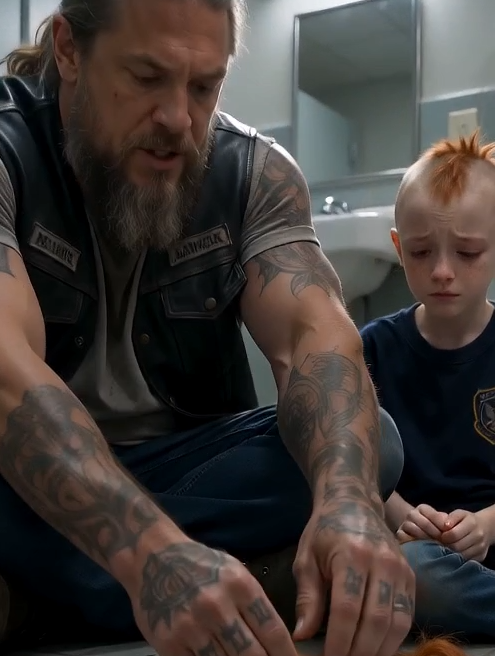
“Oh, sweet girl,” she breathed, dropping to her heels beside Hazel in her designer flats. “Brynn’s mom texted me. Are you okay?”
Hazel shrank against my side.
“I’m so proud of you, honey,” Tiffany said. Then she looked at me with soft, understanding eyes. “Mr. Tatum, I can take the hair for you. Crowns of Hope will get it where it needs to go.”
She reached toward the inside of my vest.
I put my hand flat over the pocket.
“I’ve got it, ma’am.”
Her smile flickered for half a second. Then it came back, brighter.
“Of course.” She stood and smoothed her blazer. “And just so there’s no confusion, I’d never offer a child money for hair. We give a twenty-dollar Target card as a thank-you to every donor. Hazel must have misunderstood.” She touched my arm. “Kids. Right?”
Then she was gone in a cloud of expensive perfume.
In the principal’s office, Mr. Halverson was gentle. He said Hazel wasn’t in trouble, but she’d “had a big moment” and should go home early. Ms. Osei, Hazel’s teacher, walked us to the parking lot. At my truck, she said quietly, “Sophie Ruiz has been out since February. Her mom said they’re waiting on a wig. It keeps getting delayed.”
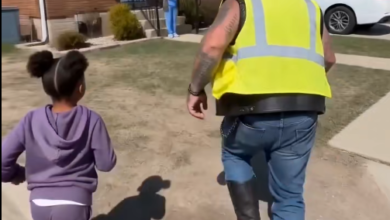
I drove Hazel home with a pocketful of her hair pressed against my ribs.
She was quiet the whole way, rubbing her bare scalp.
I kept thinking about the last time I’d seen a head that bare.
Four years ago my wife, Carrie, sat at our kitchen table in Owasso while I shaved off what chemo had left. Hazel was six. She held her mother’s hand the whole time.
And then I remembered a night last month. Hazel stood in my bedroom doorway in her pajamas, holding the old white wig box from the top of my closet. She asked, “Daddy, where did Mommy’s hair go? The long hair she cut before she got sick?”
I’d said, “I don’t know, Hazelnut. Somewhere good.”
I hadn’t wanted to talk about it. So I brushed her off and sent her to bed.
Now I sat in my truck in our driveway and wondered if that was why she’d done it. Maybe she’d spent a month thinking about where her mother’s hair went. Maybe she’d decided the only way to help a sick girl was the way her mother had, and she’d done it alone with craft scissors in a bathroom, because her father wouldn’t talk to her.
What kind of dad doesn’t notice his kid planning to shave her head?
That night, after Hazel fell asleep, I looked up Sophie Ruiz online.
There was a GoFundMe titled Sophie’s Fight, started by her mom, Angela. It had raised $38,410.
The most recent update was three weeks old.
Still waiting on Sophie’s custom wig from Crowns of Hope. They say soon. Sophie cries every morning. Please keep praying.
Where was Sophie’s wig?
Part 3 — Carrie’s Braid
Five years ago, the week before her first chemo infusion at Saint Francis, my wife sat on our back porch in Owasso and braided her own hair for the last time.
It was auburn, like Hazel’s, and it hung all the way to her waist. Carrie measured it with a sewing tape. Twenty-two inches.
“Some little girl’s going to love this,” she said.
Hazel was six. She ran into the house and came back with my old red bandana, the one I’d worn on every ride since high school. Before I could stop her, she tore a strip off the corner with her teeth.
“For the end,” she said. “So the girl who gets it knows it came from a family that loves her.”
Carrie laughed and tied it on.
The next week, she cut the braid off at Vega Hair Prosthetics on Brookside, where Marisol Vega was fitting her for a wig of her own. Marisol let Hazel watch, and she explained the rules like she was teaching a recipe.
“Braid it first, mija. A rubber band at the top, and one at the bottom. Cut above the top band. It has to be dry, and at least twelve inches. Loose hair tangles and it’s no good.”
Hazel nodded very seriously. She was six. She forgot all of it.
That Saturday, at the Mingo Valley Spring Carnival, Carrie handed her braid, still tied with my red bandana, to a smiling PTA mom at the Crowns of Hope booth.
“I’ll make sure it goes to a little girl right here in Tulsa,” Tiffany Marsh promised. She held it up for everyone to see.
After that, every morning, I braided Hazel’s hair myself and tied the end with a strip from that same bandana.
“Same as Mommy’s,” she always said.
I never asked where Carrie’s braid went.
Why didn’t I ever ask?
Part 4 — The Salon
I went to see Tiffany Marsh at Glow Salon & Spa the next afternoon.
She met me in her office in the back, all white leather and orchids and framed photos with the mayor. She’d clearly been expecting me.
“Mr. Tatum, I want to be completely transparent with you,” she said, and she slid a binder across the desk.
Inside was an IRS determination letter: Crowns of Hope Foundation, 501(c)(3), Tulsa, Oklahoma. There was a laminated thank-you letter on Saint Francis Children’s Hospital letterhead. And there were pages of photos of smiling bald children trying on beautiful wigs.
“Six years,” Tiffany said quietly. “Four hundred donations. I do this for free, on top of running a business and the PTA.” She put her hand on her chest. “So when a father comes in here looking at me like I’m a criminal, it hurts.”
“Then where’s Sophie Ruiz’s wig?”
Tiffany sighed, as if she’d hoped I wouldn’t ask.
“I didn’t want to say this. But Sophie’s mother ordered a custom wig in March. We require a deposit and a balance. Angela paid half. Then she stopped answering my calls.” Tiffany lowered her voice. “Mr. Tatum, that GoFundMe raised almost forty thousand dollars. You might want to ask Angela where it went.”
I sat back in the white leather chair.
It made sense. A desperate single mom with a sick kid and a pile of donated money. People do terrible things when they’re scared.
I drove to Angela Ruiz’s apartment complex off 71st Street. She opened the door three inches with the chain still on, wearing faded purple CNA scrubs. Her eyes were swollen from a night shift.
“Ms. Ruiz, my name is Wes Tatum. My daughter Hazel is in Sophie’s class—”
“I know who you are. Tiffany called me.” Her voice was flat and frightened. “Stay away from my daughter, biker. We don’t need your help.”
She shut the door in my face.
So I drove to Brookside with Hazel’s hair still in the Ziploc bag, to see if anything at all could be saved.
Marisol Vega set the bag on her velvet worktable and gently pulled out a handful of the tangled auburn hair.
“Sir, I’m so sorry,” she said. “None of this hair is usable.”
That evening I sat on the edge of Hazel’s bed and told her. I did it the gentlest way I knew, but there’s no gentle way.
Her face crumpled in slow motion.
“I ruined it,” she sobbed. “I ruined it, Daddy. Sophie’s never gonna come back, and it’s my fault, and my hair is just garbage—”
I held her while she cried until she was hiccuping. Her shaved head was warm against my chest, and the red bandana strip was still balled up in my vest pocket.
But it wasn’t Hazel’s tears that kept me awake that night.
It was what Marisol had said after I told her about Crowns of Hope, as I was walking out of her shop.
“I’ve been making wigs in this city for thirty years. I have never received a single ponytail from that foundation. Not one.”
If Crowns of Hope didn’t send hair to the only wig maker in Tulsa, where did four hundred braids go?
Part 5 — Lot 0417
Marisol called me at 6 a.m. the next day.
“Come to the shop. Bring coffee. You need to see something.”
She had her laptop open on the worktable.
“Real human hair is valuable, Mr. Tatum,” she said. “Especially virgin hair, never dyed or permed. Children’s hair, natural red or auburn. On the wholesale market, a twenty-inch braid like that goes for twelve hundred, two thousand, sometimes three.” She typed. “There are brokers who buy it from anyone. Salons. ‘Collectors.’ No questions.”
She turned the screen toward me.
It was a wholesale site called Global Virgin Hair LLC, based in Los Angeles, with private consignor listings. Marisol had found an old archived page.
Consignor: CHF-Tulsa. Lot 0417. Auburn, natural, 22 in., virgin. Original tie included (red cloth). $1,850. SOLD — April 2021.
There was a photograph.
It showed a long auburn braid, laid out straight on a white table. Tied at the end with a torn strip of red bandana.
My daughter tore that strip with her teeth when she was six years old.
I had to walk outside and stand on the Brookside sidewalk for ten minutes before I could go back in.
Marisol had found two hundred and nine more listings under CHF-Tulsa, going back six years. Blonde, brown, black, red. Children’s hair, mostly. Every lot was sold.
That afternoon I drove to the Oklahoma Attorney General’s office in Oklahoma City with Marisol’s printouts and a copy of the GoFundMe. An investigator from the Charitable Organizations unit named Paul Greer met me in a small conference room. He was quiet, with reading glasses, and he looked like he’d been doing this a long time.
He pulled up Crowns of Hope’s public tax filings.
“Six years of Form 990s,” he said. “Total revenue reported, $612,000. Program expenses, meaning money actually spent making wigs for children…” He scrolled. “Zero. The rest is listed under ‘operations.’ Salaries. A car lease. Rent.” He looked over his glasses at me. “Rent paid to Glow Salon & Spa. Which Mrs. Marsh owns.”
“And the Saint Francis letter?”
He made a phone call. It took four minutes.
“The hospital has never partnered with Crowns of Hope,” he said, hanging up. “That letterhead is copied from their website.”
Two days later, Angela Ruiz knocked on my door.
She stood on my porch in her purple scrubs, shaking, holding a folded receipt.
“Your daughter called Sophie,” she said. “On the school tablet. Told her she cut her hair off for her. Sophie hasn’t stopped crying.” She pushed the paper at me. “I paid Tiffany twenty-four hundred dollars in March for a custom wig. All of it. Not half. Here’s the receipt.”
Crowns of Hope Foundation. Custom pediatric wig — S. Ruiz. Paid in full: $2,400.
“Then why didn’t you tell anyone?”
Angela looked away.
“Because she has something on me,” she whispered. “And she said if I complain, she’ll post it on the PTA page for eight thousand people to read.”
I looked at that receipt. I thought about two hundred and ten braids, and a little girl crying every morning because she didn’t want her friends to see her head.
Money. Six hundred thousand dollars of it, made from children who thought they were helping other children.
“Okay,” I said quietly. “Then we don’t wait for Tiffany’s wig.”
“What do you mean?”
I caught my reflection in the storm door. My hair was gray-streaked and hung halfway down my back. I hadn’t cut it since the Navy.
“I mean I know a lot of guys with long hair.”
But Tiffany Marsh hit me before I could make a single phone call.
Part 6 — The Post
The post went up on the Mingo Valley PTA Facebook page at 7 a.m. Saturday. The page has 8,000 members.
URGENT SAFETY NOTICE FROM YOUR PTA PRESIDENT.
Parents, I hate to post this. A parent, a member of a local motorcycle club, has been harassing a family going through pediatric cancer and intimidating PTA volunteers at their place of business. He has shown up uninvited at a single mother’s home. Please be aware of this individual at school events. Our children’s safety comes first. ❤️ — Tiffany
Below it was a photo of me outside her salon, taken from her security camera, my arms crossed and my vest on. I looked exactly like what she said I was.
By noon, it had four hundred shares.
By Monday, Mr. Halverson had called me to say that “out of an abundance of caution,” I was not to come onto school grounds until further notice. I couldn’t drop off my own daughter. I couldn’t pick her up.
Tiffany’s husband, Greg Marsh, sat on the Broken Arrow City Council. On Tuesday, a code enforcement officer showed up at the club’s clubhouse, a converted machine shop off Highway 51 we’ve rented for nineteen years. He wrote eleven violations in an hour and gave us thirty days to fix them or lose occupancy.
Two of the guys got calls from their bosses. Somebody had sent screenshots.
On Wednesday night, someone walked down the line of bikes parked outside the clubhouse and slashed every tire. There were seventeen bikes. The security camera caught a figure in a hoodie and a white SUV with no plates waiting at the curb.
The Broken Arrow police took a report. The officer asked me, very politely, whether there was “any ongoing beef with another club.”
At school, a fourth-grader told Hazel her dad was in a biker gang that “scares cancer kids.” Hazel came home and locked herself in her room. She didn’t come out for dinner.
I sat alone at my kitchen table at midnight with a stack of printouts nobody but Paul Greer would read. A state investigation, he’d warned me, could take six months.
Sophie Ruiz didn’t have six months of mornings to cry through.
At 12:40 a.m., my phone rang.
It was Angela, sobbing so hard I could barely understand her.
“She came to the apartment tonight,” she said. “Tiffany. She measured Sophie’s head again. She said the wig is ‘almost ready’ but there’s a ‘rush fee.’ Fifteen hundred dollars. Cash. By Friday.” Angela choked on the words. “She said if I don’t pay, she’ll post what I did with the GoFundMe.”
“Angela,” I said quietly. “What did you do?”
The line went silent for a long time.
“Can you come over?” she whispered. “I need to tell somebody before she does.”
Part 7 — Twenty-Two
Angela’s kitchen table was covered with medical bills. The pile of envelopes stamped FINAL NOTICE was taller than the stack of Sophie’s get-well cards.
“I spent nine thousand dollars of it,” she said, staring at her hands.
“On what?”
“Rent. Three months, after I lost my night shifts sitting at Sophie’s bedside. The transmission on my car, so I could drive her to chemo. The electric bill, so they wouldn’t cut the power while she was on a feeding tube.” Her voice broke. “People gave that money for Sophie. And I used it to keep the lights on.”
“That is for Sophie,” I said.
“Is it?” She shook her head. “I never told anyone. I never updated the GoFundMe. And Tiffany found out somehow. She’s on the PTA board with the woman who manages my apartment complex. Ever since, she’s had me. Every time I asked about the wig, she’d say, ‘Angela, do you want me to explain your rent payments to eight thousand parents?'”
She wiped her eyes with the heel of her hand.
“So I stopped asking. I let my daughter cry every morning, because I was ashamed.” She looked at me. “I’m not a good guy in this story, Mr. Tatum.”
I thought about my own kitchen table, and Hazel asking where her mother’s hair went, and me saying somewhere good because I didn’t want to talk about it.
“Nobody here’s clean, Angela,” I said. “I sent my daughter to bed rather than answer a hard question. You kept the lights on. Neither of us sold four hundred braids.”
I put Marisol’s printout of Lot 0417 on the table. Carrie’s braid, with the red bandana.
Angela put her hand over her mouth.
“That woman sold your wife’s hair?”
“And she’s going to sell your daughter a wig that doesn’t exist for fifteen hundred more dollars. Unless we beat her to it.”
That night I called the club.
I’ll tell you what I told them, because that’s exactly how I said it, and Big Tom still quotes it at every meeting.
“My daughter cut off all her hair in a school bathroom to give it to a friend on chemo. She cut it wrong, so every bit of it got thrown out. I need every guy with long hair at Vega Hair Prosthetics on Brookside, Saturday, nine a.m.”
That Saturday morning, twenty-two of them showed up.
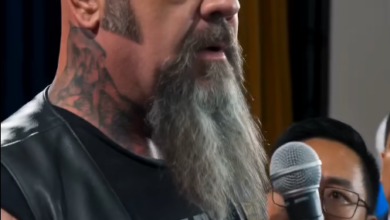
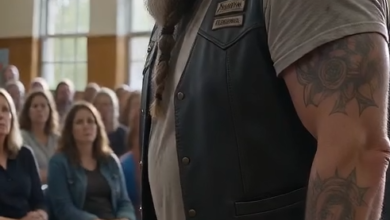
They were long-haired, gray-bearded men in leather, from Owasso, Sand Springs, Broken Arrow, and one guy who rode all night from Amarillo. Big Tom’s ponytail hung past his belt. Deacon Wills had grown his for thirty years and had never once let his wife trim it.
Marisol stood at the front of her little shop with her arms crossed and looked them over like a drill sergeant.
“Braid it first. A band at the top, a band at the bottom. Cut above the top band. Dry. Twelve inches minimum. Nobody cuts until I check.”
Then Hazel stepped forward with her shaved head. She was holding a roll of rubber bands and my old red bandana, torn into twenty-two strips.
One by one, she tied a strip around the end of every braid.
“So the kids who get it know it came from people who love them,” she said.
Twenty-two braids went into twenty-two labeled bags. Marisol counted, measured, and weighed them twice.
“Enough for six full wigs,” she said, and her voice cracked. “Maybe more.”
“The first one’s for Sophie Ruiz,” I said. “Custom. As fast as you can.”
“Three weeks,” Marisol said. “If I don’t sleep.”
She didn’t sleep.
Three weeks later was the night of the Mingo Valley PTA Spring Gala, when Tiffany Marsh was scheduled to receive the Tulsa Regional Chamber’s Volunteer of the Year award. It would be livestreamed on the PTA page, in front of eight thousand parents.
Paul Greer called me that afternoon.
“Mr. Tatum, I’ll be there,” he said. “But I need her to say it out loud. Can you get her to?”
What would make a woman that careful slip in public?
Part 8 — Lot 0417, Sold
The Mingo Valley gym was decorated in pink and gold. There were round tables with tablecloths, a silent auction along one wall, and a stage with a podium and a giant screen. Two hundred parents sat in folding chairs. A PTA mom held up an iPhone on a gimbal, livestreaming to the page.
Twenty-two bikers stood along the back wall with their arms crossed. Every one of them had a fresh, short, slightly uneven haircut.
Paul Greer sat at the end of the last row in a brown suit.
Hazel sat with me, her hair grown out to a short fuzzy cap of auburn.
Tiffany took the stage in a white sheath dress to a standing ovation. She cried prettily. She thanked her husband, Councilman Greg Marsh, in the front row. She talked about “the four hundred brave children” who’d donated through Crowns of Hope.
“And right now,” she said, her voice catching, “one of our own Mingo Valley students, sweet Sophie Ruiz, is still waiting for her wig. But I promise you, Crowns of Hope will not rest until Sophie can walk back into this school with her head held high—”
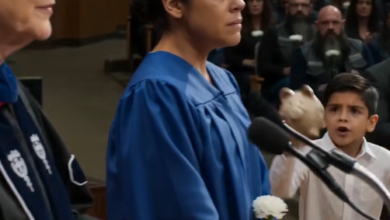
“I already have my wig.”
The small voice came from the third table.
Two hundred heads turned.
A ten-year-old girl in a lavender dress stood up from her chair. She had shoulder-length, glossy brown hair, with bangs and a little side braid.
Nobody had noticed her. She’d walked in with her mom twenty minutes earlier, sat down with her classmates, and not one person in that gym had realized anything was different.
“Sophie?” Ms. Osei whispered.
Sophie Ruiz grinned and tugged gently on her side braid. At the end of it was a tiny strip of red bandana.
“Hazel’s dad’s friends made it,” she said. “Twenty-two of them. They cut their hair the right way.”
Hazel squeezed my hand so hard it hurt.
The crowd broke into stunned, scattered applause.
Tiffany’s smile froze on her face like a mask.
“Well,” she said, recovering, “that’s… wonderful. Crowns of Hope supports every—”
I stood up.
“Mrs. Marsh, I just have one question,” I said. “Five years ago, my wife Carrie gave you her braid at the Spring Carnival. Where did it go?”
Every phone in the room swung toward me.
Tiffany softened instantly. Her eyes filled. She pressed her hand to her heart.
“Oh, Wes. I’ll never forget Carrie’s braid,” she said, her voice shaking. “Auburn, almost two feet long, with that little strip of red bandana tied on the end. I held it in my own hands. It made the most beautiful wig for a seven-year-old girl at Saint Francis Children’s Hospital.”
At the back of the room, Paul Greer stood up.
“Mrs. Marsh,” he said calmly, “I’m with the Oklahoma Attorney General’s office. Saint Francis Children’s Hospital has never received a wig or a single donation of hair from Crowns of Hope.”
He held up a printout to the gimbal camera.
“But Global Virgin Hair LLC, a wholesale broker in Los Angeles, has a record of it. Lot 0417. Auburn, natural, twenty-two inches. Original tie included, red cloth. Sold for one thousand eight hundred and fifty dollars in April 2021.” He lowered the paper. “The consignor was Crowns of Hope. Two hundred and ten lots in six years.”
The gym went completely silent.
“You just described it,” Greer said. “Red bandana and all. You know exactly what you sold.”
Tiffany’s face went white, then red.
“Do you people have any idea what one braid is worth?” she snapped. Her voice was high and furious, and it carried across the whole gym and out to eight thousand screens. “Parents just hand it over for a twenty-dollar gift card, like idiots, and the broker pays two thousand dollars, and you think I should just—”
She stopped.
On the livestream, the comments were scrolling too fast to read.
Councilman Greg Marsh stood up in the front row, looked at his wife, and walked out of the gym without a word.
Paul Greer started toward the stage.
Tiffany looked out over the crowd, at the bikers along the back wall, at Angela holding her daughter, at Hazel’s short auburn fuzz. Then she leaned toward the microphone, her voice shaking with rage.
“If anybody here wants to talk about stealing,” she said, “why don’t we start with Angela Ruiz and where her GoFundMe money really—”
Angela stood up before she could finish.
Part 9 — Saving It for Next Time
Angela told the whole gym herself, standing next to her daughter. Nine thousand dollars. Rent, a transmission, and an electric bill. She said she was ashamed. She said she’d pay it back.
Nobody booed.
A dad at the next table pulled out his checkbook and wrote a check for nine thousand dollars right there. Then he slid it across to her without a word. The GoFundMe hit seventy thousand dollars by morning.
Tiffany Marsh was charged in Tulsa County with charitable solicitation fraud, obtaining money by false pretenses, and extortion. The Attorney General dissolved Crowns of Hope and froze its accounts. She pleaded guilty to six counts and was sentenced to five years. She was ordered to pay $612,000 in restitution. Glow Salon & Spa closed that summer. Greg Marsh resigned from the city council in June.
The PTA took down her safety notice and posted an apology. It was signed by every remaining board member and pinned for a month.
The city quietly withdrew all eleven code violations at our clubhouse. The tire shop on Highway 51 replaced all seventeen sets of slashed tires at cost when they heard what for.
Of the six wigs Marisol made from those twenty-two braids, one went to Sophie Ruiz. The other five went to the pediatric oncology unit at Saint Francis Children’s Hospital. Marisol delivered them herself. Hazel insisted on coming. Before they handed them over, she tied a fresh strip of red bandana into every one.
Sophie went into remission that fall. She still wears her wig on picture day, even though her own hair has grown back, because she says it’s “lucky.”
The club voted unanimously to make it official. Every year, on the second Saturday in April, we hold Haircut Day at Vega Hair Prosthetics. Marisol inspects every braid. Hazel ties every bandana.
In five years, we’ve donated enough hair for ninety wigs.
People ask Hazel why she kept her hair short for three whole years after that day in the bathroom. She always gives the same answer, with a shrug, like it’s obvious.
“I’m saving it for next time.”
Last April, at our fifth Haircut Day, she finally let it grow. It was auburn, just like her mother’s, hanging halfway down her back.
That morning, she sat on the bench in Marisol’s shop while I braided it one last time. Her hair was thick and warm in my hands. I banded the top. I banded the bottom. Marisol came over with a measuring tape.
“Fourteen inches,” she said, smiling. “Perfect.”
Hazel held out her hand to me.
I reached into the inside pocket of my vest and pulled out something I’d carried every day for five years. It was a small, tangled lock of auburn hair, cut wrong with dull craft scissors on a school bathroom floor. A faded strip of red bandana was still tied around the end.
“You kept it,” Hazel whispered.
“Every day.”
She took it and looked at it for a long moment. Then she untied the old red strip, gently, and tied it onto the end of her new braid.
“So she knows it came from people who love her,” Hazel said.
Then she handed me the scissors.
“You do it, Daddy. Above the band. The right way.”
I cut.
The braid came away clean in my hand, fourteen inches of auburn with a faded red bandana tied at the end. It was perfect.
Hazel ran her fingers through her short new hair and grinned up at me.
“Same time next year?” she asked.
I looked at the line of twenty-two long-haired, gray-bearded men waiting their turn by the door, and the little girl in front of me who’d started all of it with a pair of dull craft scissors.
“Sweetheart,” I said, “every year.”