A Biker Walked Onstage at a High School Graduation, Grabbed the Microphone From the Principal in Front of 800 People, and Read Two Names That Were Never on the List—Nobody in That Gym Knew Why They’d Been Left Off
Part 2 — The Wrong Shade of Blue
For three long seconds, the only sound in the gym was the hum of the speakers.
Then the principal, Dr. Howard Lin, a slight man with wire glasses who’d run Lamar Heights for less than two years, did something nobody expected.
He held out his hand.
Not to the officers. To me.
“May I have my microphone back, sir?”
I gave it to him. The officer still had my other arm.
Dr. Lin looked out at the back row, where Gabby Reyes was standing in her wrong-shade-of-blue gown with her little sister clinging to her hand, and where Darnell Price, six-foot-two, had just risen from his folding chair in work boots and a gown he’d rented that morning.
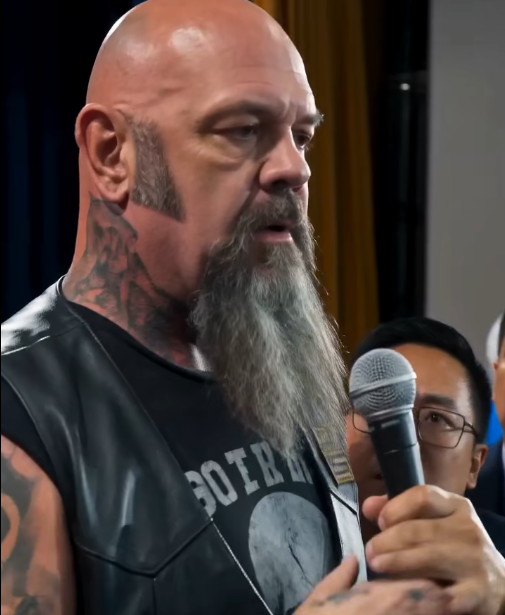
“Ms. Reyes,” Dr. Lin said into the microphone. “Mr. Price. Did you complete your diploma requirements through this district?”
Gabby nodded. She couldn’t speak.
“Yes, sir,” Darnell said. His voice cracked. “Pathways Academy. May 9th.”
Dr. Lin was quiet for a moment.
“Then I’d be honored,” he said, “if you’d both come up here.”
Gabby didn’t move. Luz had to push her.
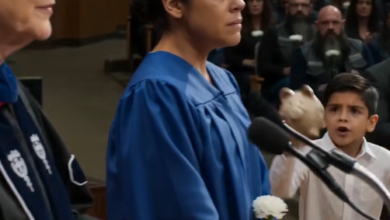
They walked up that center aisle together, past eight hundred people, past rows of graduates in the right shade of blue. And then it started, a few claps in the bleachers, then the band, then the whole gym on its feet. The sound shook the windows.
Dr. Lin shook their hands on that stage. He didn’t have diplomas for them. He handed them each a blank leather diploma cover from the stack on the table.
“The paper’s coming,” he said. “I promise.”
Gabby looked out across that gym, and for one second she looked exactly like her father.
The officer let go of my arm.
I should’ve felt like a hero.
Instead, in the parking lot afterward, Gabby walked right up to me with her cap in her fist and her eyes blazing.
“You didn’t ask me, Lyle.”
“Gabby—”
“Eight hundred people now know I dropped out. That my dad died. That I stock pallets at the Walmart distribution center at three in the morning.” Her voice shook. “That was mine. I didn’t want to be somebody’s charity case on YouTube.”
She got in her ancient Corolla with Luz and drove away.
I sat on my bike in that parking lot for a long time.
I’d made a promise to her father. I’d told myself that walking onto that stage was keeping it. But maybe what I’d really done was make a nineteen-year-old girl’s private struggle into my big moment.
Maybe I’d taken the microphone for me.
A Beaumont ISD police officer walked over and handed me a citation for disruption of a school function, a Class C misdemeanor, along with a criminal trespass warning.
“Off the record?” he said quietly. “I’ve got a nephew at Pathways. Nice work.”
At 7:14 the next morning, Gabby forwarded me an email without a single word of her own.
FROM: Office of Academic Records, Beaumont ISD
RE: Pathways Diploma — Gabriela Reyes
Your diploma is under administrative review pending a credit audit. Your transcript is on hold.
The woman who signed it was Dean of Academic Records Darlene Sloane.
The cookie lady.
Why would the district suddenly audit a diploma it had already awarded?
Part 3 — The Silver Dollar
Three years ago, Tommy Reyes and I were sitting on our bikes outside the Sonic on Dowlen Road, eating tater tots and watching the refinery flares light up the sky over Port Arthur.
Tommy had ridden with our club for twenty years. He was a pipefitter at the Motiva refinery, built like a fire hydrant, with the loudest laugh in Jefferson County.
That night he pulled a silver dollar out of his vest pocket. It was a 2007 American Eagle, polished from years of being turned over in his fingers.
“Year Gabby was born,” he said. “I’m giving it to her when she walks across that stage. Lamar Heights, class of ’25.” He grinned. “First Reyes ever to graduate high school. Can you believe it?”
“You’ll cry like a baby.”
“Oh, I’ll be sobbing.” He flipped the coin and caught it. “You’ll be there, right, Lyle? Front row.”
“Wouldn’t miss it.”
Six weeks later, he died of a heart attack on the night shift. He was forty-four.
The funeral was at Broussard’s on Calder Avenue. Two hundred bikers rode in the procession. Gabby was sixteen. She sat in the front pew with her mother and two little sisters and the silver dollar her mom found in Tommy’s vest, clutched in her fist so tight it left a mark.
I remember one other face from that day.
There was a friendly woman from the high school attendance office named Darlene Sloane. She’d brought lemon bars in a Tupperware. She hugged Gabby’s mother. In the funeral home guestbook, she signed her name in purple ink, with a little heart over the a in Darlene.
“Whatever that girl needs, I’ll handle the paperwork,” she told me by the coffee urn. “She’ll always have a place at Lamar Heights.”
I believed her.
Three months later, Gabby stopped going to school.
Why didn’t I ever ask where she went?
Part 4 — The Memo
Darlene Sloane met me in her office on the second floor of the Beaumont ISD administration building on Calder Avenue. That was a mistake on her part, or a strategy.
She was sixty-one, soft-spoken, with silver curls, a cardigan, and reading glasses on a beaded chain. A framed cross-stitch on her wall said Every Child Matters. There was a jar of peppermints on her desk.
Before I could say a word, she started crying.
“Mr. Barnett, I want you to know I cried watching that video,” she said. It had two million views by then. “Those children deserved that moment. I’ve wanted to give it to them for eight years.”
She opened a folder and slid a single page across the desk.
It was a memo on district letterhead, dated 2018, signed by Superintendent Dr. Alan Whitcomb.
Effective immediately, participation in campus commencement ceremonies is limited to students in the official four-year graduation cohort. Students completing requirements through alternative programs (including Pathways Academy) will receive diplomas by mail.
“I fought this,” Darlene said, dabbing her eyes. “I sent emails. I was told to follow district policy or find another job. I’m a widow with a mortgage, Mr. Barnett.” She lowered her voice. “Dr. Whitcomb doesn’t like being questioned.”
“And Gabby’s diploma being ‘under review’?”
She looked pained.
“Not my decision. That came from the superintendent’s office the morning after the ceremony. I just sign what they send me.”
It made sense. A frightened middle manager, a powerful boss, and a memo with his name on it.
I walked out of her office with a peppermint and a new target.
Dr. Alan Whitcomb wouldn’t see me. His secretary said he was “unavailable indefinitely.” The district put out a statement calling my actions “a dangerous disruption by an outside individual” and promising a “full review of commencement policies.”
That night I sat in my garage with a beer and the memo, staring at Whitcomb’s signature.
Then Darnell Price called me.
“Mr. Barnett? Sorry it’s late.” His voice was tight. “I need to tell you something weird. I enlisted in the Army in April. My recruiter just called. He says the district sent my records to MEPS, and they show I transferred out of Beaumont ISD junior year. To a school in Oklahoma.” He paused. “Sir, I’ve never been to Oklahoma in my life.”
I set down my beer.
“Who signed your withdrawal paperwork, Darnell?”
“My mom. That’s what it says.” He hesitated. “But Mr. Barnett, when it’s dated, my mom was in the ICU at Christus St. Elizabeth on a ventilator. She couldn’t sign anything.”
So who did?
Part 5 — Code 82
It took a public records request, a reporter from the Beaumont Enterprise named Kendra Lyles, and three weeks.
The Texas Education Agency keeps a record of every student who leaves a public school. It’s called the PEIMS leaver code. If a student drops out, the school has to code it as a dropout, and dropouts count against the district’s graduation rate and its state accountability rating.
If a student transfers to another school, it doesn’t count at all.
Kendra laid the printouts across my kitchen table.
Over eight years, forty Beaumont ISD students had left high school and later enrolled at Pathways Academy to finish their diplomas. Every one of them had been coded Leaver Code 82: Enrolled in school outside Texas.
Every one of them, on paper, had moved away.
“Forty dropouts that never counted,” Kendra said. “It bumped the district’s four-year graduation rate almost four points. That’s the difference between a C and a B in the TEA ratings.”
“And if those kids walked across the stage at graduation…”
“Then somebody might notice that forty students who supposedly moved to Oklahoma and Arizona and Louisiana were somehow graduating from Lamar Heights.” Kendra tapped the paper. “And then somebody might ask why.”
She slid over a copy of Dr. Whitcomb’s contract, which she’d gotten from the school board’s public files.
Performance incentive: $45,000 annual bonus upon district achieving TEA accountability rating of B or higher.
He’d collected it six years running.
Then she laid down the last thing.
It was a copy of Gabby Reyes’s withdrawal form from her sophomore year, pulled from her cumulative file.
Student is withdrawing to enroll in Westside High School, Tulsa, Oklahoma. Parent signature: Tomas Reyes.
The signature was in purple ink.
It was dated October 14th.
Tommy Reyes was buried on August 30th.
I couldn’t breathe.
“Darnell’s form is the same,” Kendra said quietly. “Signed by his mom in purple ink on a day she was on a ventilator. Of the forty forms I’ve pulled so far, thirty-one are signed in purple ink.”
She pushed one more page across. It was an email she’d obtained from the district’s servers through the records request, from Darlene Sloane to Dr. Alan Whitcomb, May 2019.
Alan, the Pathways kids keep asking to walk. If they’re on that stage, someone will ask how they “transferred” and came back. Keep them off the program. I’ll handle the paperwork.
And Whitcomb’s reply:
Agreed. Commencement memo attached. Thank you, Darlene. Your merit increase is approved.
I sat back in my chair.
The memo hadn’t been forced on Darlene. She’d asked for it. She’d built the rule herself, and then she’d let the superintendent sign his name to it so that when somebody finally asked, she’d have a piece of paper to cry over.
Money, for both of them. Forty-five thousand a year for him. A merit raise for her. And for both of them, the safety of knowing nobody would ever look too closely at forty kids nobody was looking for.
“Kendra,” I said. “When does this run?”
“Friday,” she said. “Front page.”
On Thursday night, the district struck first.
Part 6 — Under Review
On Thursday morning, Beaumont ISD filed a formal criminal complaint against me with the Jefferson County District Attorney. The charge was disruption of a school function under the Texas Education Code, plus criminal trespass. It was signed by the superintendent.
By noon, a Facebook page called Beaumont Parents for Safe Schools had posted my mugshot from a 1998 bar fight in Orange, Texas, next to the graduation video, with the caption Is THIS who we want around our kids?
By three, Kendra’s editor had called her into his office. The district’s lawyers had sent the Enterprise a letter threatening a defamation suit over the “unverified” PEIMS story. The paper was “reviewing” it.
The story didn’t run Friday.
On Saturday, Gabby called me for the first time since the parking lot.
“Lamar Institute of Technology just rescinded my admission,” she said flatly. “For the fall nursing program. My transcript is ‘invalid pending district audit.’ They gave my spot to the waitlist.”
“Gabby, I’m so sorry—”
“And this morning, a lady from the district showed up at Mom’s house.” Her voice shook. “With lemon bars. She sat at our kitchen table and told Mom that if I ‘cooperate with the audit’ and sign a statement saying I was never pressured to withdraw, my diploma would be restored by Monday. If I don’t, there might be ‘questions about how I left the district in the first place.'”
Darlene Sloane, in Tommy’s kitchen again, with lemon bars again.
“Don’t sign anything,” I said.
“Lyle.” Gabby went quiet. “You don’t understand. There are questions about how I left. Okay? There are.”
Then she hung up.
On Sunday, my club’s clubhouse on Eastex Freeway got a visit from the Beaumont fire marshal, who wrote us up for occupancy violations. Two of my guys who work at the refinery got called into HR and asked whether they’d “participated in the graduation incident.”
By Sunday night, the people who’d cheered in that gym were saying nothing. Darnell’s recruiter put his enlistment on hold. Kendra stopped answering her phone.
I sat in my garage with Tommy’s old riding gloves on the workbench and every piece of paper I had spread out in front of me.
I had proof of forty forged forms. I had an email. I had a contract.
And a nineteen-year-old girl had just told me there was something about her own withdrawal she didn’t want anyone to find out.
What did Gabby know that I didn’t?
Part 7 — Sign Your Daddy’s Name
Gabby came to my house at midnight in her Walmart distribution center vest, straight from a cancelled shift. She sat on my back steps for a long time before she said anything.
Then she took the silver dollar out of her pocket and turned it over and over in her fingers, the way Tommy used to.
“After Dad died,” she said, “Mom couldn’t get out of bed for two months. Luz was six. Bella was three. Somebody had to work. So I started stocking shelves at the H-E-B on Calder at night and going to school in the day. I fell asleep in every class. I missed nineteen days that fall.”
“The truancy office called. They said if I hit twenty-five absences, they’d file on Mom in justice court. A fine. Maybe worse.” Her jaw tightened. “Mom was barely holding on. A court date would’ve finished her.”
“Then Ms. Sloane came over. With lemon bars. She was so nice, Lyle. She said she had a ‘clean way’ to fix it. If I withdrew as a transfer, there’d be no truancy case, no court, nothing. And I could come back to Pathways later, whenever I was ready. She said it happened all the time.”
Gabby stared at the coin.
“She brought the form already filled out. Tulsa, Oklahoma. She said it needed a parent signature, but Mom was asleep, and she didn’t want to ‘upset her.'” Gabby’s voice broke. “So she handed me her purple pen, and she said, ‘Just sign your daddy’s name, honey. Nobody ever checks.'”
“And you did,” I said quietly.
“I was sixteen. My dad had been dead for six weeks. I signed his name.” She pressed the silver dollar against her lips. “That’s the question, Lyle. That’s what she’s holding over me. I forged a dead man’s signature on a government form. If this all comes out, it doesn’t just come out about her. It comes out about me.”
I looked at this girl on my back steps. She’d raised her sisters, worked nights, and finished school on her own while everyone who was supposed to look out for her looked away. That included me.
“You were a kid,” I said. “She was the adult with the purple pen.”
“Does that matter? I still did it.”
I didn’t have a clean answer. I don’t think there was one.
“I was in your dad’s funeral line,” I said. “I promised him I’d be in the front row for you. Then I let three years go by without asking once where you’d gone.” I shook my head. “We both have something to answer for, Gabby. But neither of us coded forty kids as moving to Oklahoma for a bonus.”
She was quiet for a long time.
“What do we do?”
My phone buzzed. It was Kendra, finally.
“The Enterprise won’t run it,” she said. “But the Beaumont ISD school board has a special public meeting Tuesday night to review commencement policy, because of your video. It’s livestreamed. Public comment is open to anyone.” She paused. “Darlene Sloane is presenting the district’s position. Whitcomb will be there.”
I looked at Gabby.
She closed her fist around her father’s silver dollar.
“I’ll go,” she said. “But I’m telling them about me too. All of it.”
Would the truth set her free, or would it cost her everything she had left?
Part 8 — Purple Ink
The board room at the Beaumont ISD administration building holds two hundred people. On Tuesday night, three hundred showed up.
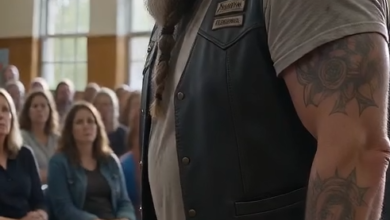
Pathways students and their families were there. So were my club, forty bikers lining the back wall in leather vests with arms crossed. Teachers came in their Lamar Heights polos. Dr. Lin sat in the second row with his hands folded. A KFDM camera crew was set up beside the district’s own livestream.
Darlene Sloane stood at the podium in her cardigan and reading glasses and gave the district’s presentation.
She was perfect.
She spoke about “the deep pain of being unable to include every child,” about “a district policy I personally fought against,” and about Dr. Whitcomb’s 2018 memo, which she put up on the screen. She called me “a well-meaning but misinformed man” and hinted gently at “complexities in some students’ withdrawal records that we must handle with discretion.”
Then the board president opened public comment.
I went first.
“Ms. Sloane,” I said, “Gabriela Reyes’s withdrawal form says her father, Tomas Reyes, signed it, giving permission for her to transfer to Tulsa, Oklahoma. Do you remember that form?”
Darlene smiled kindly.
“Of course. I remember Mr. Reyes. A lovely man. He came into my office and signed it himself. He was worried about his daughter’s attendance.” She tilted her head sympathetically. “Families make hard choices, Mr. Barnett.”
“He signed it himself? In your office?”
“Yes.”
“On October 14th?”
“If that’s the date on the form.”
I nodded slowly. Then I turned to the board and held up a large green book with a gold cross on the cover.
“This is the guestbook from the Broussard’s Funeral Home viewing for Tomas Reyes,” I said. “August 29th. Six weeks before he supposedly walked into Ms. Sloane’s office and signed that form.”
I opened it to a page I’d marked with one of Tommy’s old club bandanas and held it up to the KFDM camera.
There, in purple ink, with a little heart over the a:
Darlene Sloane, Lamar Heights HS. “So sorry for your loss. Whatever Gabby needs, I’m here.”
“You came to his funeral,” I said. “You brought lemon bars. You hugged his widow. Six weeks later, you put a purple pen in his sixteen-year-old daughter’s hand and told her to sign her dead daddy’s name.”
The room went dead silent.
Darlene’s face went white.
“Thirty-one of the forty Pathways withdrawal forms,” I said, “are signed by a parent in purple ink. One of those parents was dead, and another was on a ventilator. Every one of those forty students was reported to the state as having moved away, which kept the district’s rating at a B and paid the superintendent a forty-five-thousand-dollar bonus six years in a row.”
Kendra stood up beside me and handed the board president a stack of printouts: the PEIMS codes, Whitcomb’s contract, and the May 2019 email.
If they’re on that stage, someone will ask how they “transferred” and came back. Keep them off the program. I’ll handle the paperwork.
Up at the board table, Superintendent Whitcomb stood up so fast his chair hit the wall.
“Darlene drafted that policy. I signed what she put in front of me!”
“You approved my merit increase in the same email, Alan!” Darlene snapped. Then she caught herself, but too late. Three hundred people and two livestreams had heard every word.
The board president took off her glasses.
Then a young woman in a Walmart distribution center vest stood up from the third row and walked to the podium, holding a silver dollar.
“My name is Gabriela Reyes,” she said, her voice shaking but clear. “I’m the one who signed my father’s name. And I need to tell you exactly how it happened.”
Darlene Sloane looked at her. Her lips moved, as if to say honey.
What would the board do with the truth?
Part 9 — One Sentence
The board voted 7–0 that night to suspend Dr. Alan Whitcomb and Darlene Sloane, pending investigation. The Texas Education Agency sent a special investigator the following week.
By August, both of them had been indicted by a Jefferson County grand jury for tampering with governmental records, a state jail felony in Texas for every falsified form. Whitcomb resigned and was ordered to repay six years of performance bonuses. He took a plea deal: probation and a permanent bar from public education in Texas. Darlene Sloane pleaded guilty to thirty-one counts. She got two years in state jail and lost her educator certification for life.
The district attorney declined to charge Gabby, a sixteen-year-old who’d signed a form under pressure from an adult official. He said it in one sentence at the press conference, and that was all the press conference needed.
The TEA recalculated eight years of Beaumont ISD graduation rates. The district’s rating dropped from a B to a C. The new interim superintendent stood in front of the cameras and said, “Good. Now we know where we actually are.”
Gabby’s diploma was restored on a Thursday. Lamar Institute of Technology reinstated her admission to the nursing program the next day, with a handwritten apology from the dean.
Darnell Price shipped out to Fort Sill in September. His recruiter drove him to the bus himself.
That October, at a special school board meeting, Dr. Howard Lin read a new policy aloud.
Effective immediately, every student who completes diploma requirements through any Beaumont ISD program, including Pathways Academy, is entitled to participate in campus commencement.
Then he read forty names. Every Pathways graduate from the last eight years. Some of them were in the room. One was a mother of two. One was a welder from the Exxon plant. One was a nurse’s aide who’d come straight from a twelve-hour shift.
They stood up one at a time when he read their names.
The district still had my citation. Dr. Lin called me into his office in November.
“The board requires a formal written apology for the disruption, Mr. Barnett,” he said with a small smile. “For the file.”
He slid a piece of district letterhead and a pen across his desk.
I wrote exactly one sentence.
For eight years, forty kids weren’t allowed to stand on that stage, and nobody ever asked why, so I did.
Dr. Lin read it twice. Then he signed the bottom of it, put it in the file, and dismissed the citation.
People still ask me about that day. I tell it the same way every time.
I grabbed the principal’s microphone at a graduation in front of eight hundred people. All I did was read two names. For eight years, forty kids who finished school the hard way weren’t allowed on that stage, and nobody ever asked why.
The next May, I sat in the front row at Lamar Heights High School’s graduation. I’d promised Tommy I’d be there.
There were nine Pathways graduates in the program that year. Their names were printed in the same font as everyone else’s, in alphabetical order, with no asterisks.
Gabby sat beside me in pale blue nursing scrubs. She’d come straight from clinicals at Christus St. Elizabeth.
When they read the first Pathways name, a seventeen-year-old girl who’d dropped out to care for her grandmother, Gabby grabbed my hand.
Then she reached into her pocket and pulled out her father’s silver dollar, the 2007 Eagle, worn smooth.
“Dad was going to give me this when I walked,” she whispered. “I never got to give it back to him.”
She stood up, walked down the aisle to the edge of the stage, and pressed the silver dollar into the hand of that seventeen-year-old girl as she came down the steps with her diploma.
“Flip it when you’re scared,” Gabby told her. “My dad said it works.”
The girl stared at her, then at the coin, then clutched it to her chest.
Gabby came back and sat down beside me, wiping her eyes.
“He’d be sobbing right now,” she said.
“Oh, he’d be a wreck,” I said.
I looked up at that stage where, a year earlier, I’d read two names into a stolen microphone.
Then I put my fist to my chest and tapped it twice.
Two taps, for Tommy.
I’ve got her.