Part 2: A Ten-Year-Old Boy Set Fire to a Biker’s Irreplaceable Map—Then the Burning Red Marks Revealed Which Children Had Finally Reached Safety
Part 2 — The First Red Mark Outside Murfreesboro
I met Hammer three years before Caleb burned the map, although I had already heard warnings about him from other caseworkers.
Some described the Iron Vow as reliable volunteers.
Others considered the club too visible, too intimidating, and too likely to turn a confidential child-welfare matter into a public confrontation.
Both concerns were reasonable.
Hammer had spent his youth confronting problems with fists before learning that frightened children rarely benefited from another angry adult entering the room.
His first arrest occurred at seventeen.
He broke a foster father’s truck window while trying to retrieve Anna’s backpack after the siblings were separated. The judge saw property damage.
Hammer saw the only photograph of his mother trapped inside.
The result was still a crime.
He spent time in juvenile detention, entered unstable employment, and later served eleven months in county jail after an assault outside a Nashville bar.
When Hammer spoke about those years, he offered no romantic explanation.
“I hurt people because I was hurt,” he once told me. “That explains the road. Doesn’t clean it.”
Anna chose another direction.
She completed community college, worked for a youth shelter, and eventually became a certified family-support specialist. She taught Hammer that protecting children required documentation, patience, and adults willing to follow procedures even when those procedures moved painfully slowly.
The map helped them communicate.
Its original paper showed Tennessee highways from the 1970s, along with county roads no longer printed under the same numbers. Their birth mother had kept it inside a glove compartment before the children entered foster care.
Anna saved it.
At their first placement outside Murfreesboro, she marked the address red after both children reported conditions to a teacher. A blue line led toward the public library where Anna found a telephone and called their caseworker.
The response took six days.
Hammer remembered every one.
Their second placement was safer but temporary. Anna drew a small blue circle because the foster mother allowed them to keep food inside an unlocked kitchen cabinet.
That ordinary permission became important.
Children who have lived with deprivation sometimes measure safety through details adults overlook: an unlocked bathroom, a bedroom door that closes, clean clothing, and food that does not require permission each time hunger arrives.
The map eventually contained seven childhood placements.
Four were red.
Two were blue.
One remained unmarked because the siblings stayed only three nights and remembered almost nothing.
After Hammer’s release from jail, Anna invited him to help move furniture into a licensed transitional home for teenagers aging out of care. He expected a speech about reform.
She handed him a dresser.
The work was simple.
Carry it upstairs.
Secure it to the wall.
Leave without requiring gratitude.
Hammer returned the following weekend.
When the Iron Vow formed years later, Anna requested help transporting donated beds. The riders arrived on motorcycles, realized beds did not fit on saddlebags, and returned with trucks.
That failure became their first lesson.
Being willing was not the same as being useful.
Anna trained them.
Riders completed background screenings when programs required contact with children. They agreed never to photograph placements, reveal addresses, question children about cases, or confront accused caregivers.
The club’s role remained practical.
When a licensed caseworker needed a bedroom prepared before a kinship placement, the Iron Vow assembled furniture. When an approved move required belongings transported quickly, they provided trucks.
When teenagers aged out, riders taught basic vehicle maintenance under program supervision.
The map remained inside Hammer’s office.
Anna added red marks only after formal reports or substantiated concerns, never based on rumor. Black lines appeared when children connected to those sites reached safer placements or adulthood with support.
The marks did not represent revenge.
They represented unfinished work.
Caleb first appeared on the map eighteen months before the burning. His teacher reported repeated hunger, unexplained absences, and a fear of returning to his foster placement after school.
The investigation developed slowly.
Caleb and his siblings were moved temporarily, then returned after the caregiver completed required corrective steps. Three months later, new concerns emerged.
This time, their case transferred to me.
Hammer never asked for details he did not need.
He learned only that three siblings might require emergency transportation and storage if a judge approved removal.
The Iron Vow prepared three trucks.
Then they waited.
That waiting tested Hammer more than any confrontation. He knew an address existed on Anna’s map, yet going there without authorization could frighten the children, compromise an investigation, or give caregivers grounds to accuse workers of harassment.
Several younger riders wanted to watch the property.
Hammer prohibited it.
“We don’t turn scared kids into surveillance targets.”
Bear asked what they should do instead.
Hammer pointed toward the trucks.
“Keep them fueled.”
For ninety-three days, the vehicles remained ready.
During that time, Hammer crossed no line and entered no driveway. He followed Anna’s rules even after she was no longer alive to enforce them.
Then Caleb made a call from his school office.
The final move began.
Part 3 — The Night Three Children Left with Plastic Bags
Caleb did not call the Iron Vow.
He called his caseworker.
That distinction matters because viral versions of stories often erase trained professionals and replace careful processes with one dramatic rescuer.
The court order, deputy response, placement approval, medical assessment, and transportation plan were handled by authorized teams.
Hammer carried boxes.
The emergency hearing occurred on a Thursday morning after investigators received new documentation from Caleb’s school and a pediatric clinic. By afternoon, a judge approved removal of all three siblings pending further proceedings.
Their maternal aunt, Teresa Morris, had already completed an expedited safety assessment. She lived forty miles away and could keep the children together.
We planned to transfer them before dinner.
Then the caregiver refused access.
Deputies spoke with him at the door while I waited beside the county vehicle. Hammer and six Iron Vow members remained two blocks away in their trucks, following my instruction not to approach until requested.
The children were inside.
Caleb had been told to pack one bag, but every container he found belonged to the foster home. He placed clothing inside black trash bags.
Noah packed school papers.
Lily carried her stuffed rabbit and one shoe because the second had disappeared beneath a bed.
The negotiation lasted nearly two hours.
Nobody stormed the house.
Nobody threatened the caregiver.
The removal order was explained, verified, and enforced through lawful authority. When the door finally opened, the children walked out with a deputy and child-welfare supervisor.
Caleb looked down the street.
He saw Hammer’s black Road King parked beside three moving trucks.
The motorcycle frightened him.
One previous caregiver had used engine noise to announce an unpredictable return home. Caleb associated a loud exhaust with doors closing and adults becoming careful.
Hammer noticed his reaction.
He shut down the Harley.
Then he pushed it behind the truck where Caleb could no longer see it.
The Iron Vow approached only after I waved them forward. They carried the children’s bags, bicycles, school supplies, and approved personal items.
Luis found Lily’s second shoe.
He placed both shoes together inside a clean box rather than commenting on where they had been.
Bear discovered that Noah’s bicycle had no functioning brakes. He loaded it without promising an immediate repair.
Children in unstable placements hear promises casually.
Hammer had trained the riders to offer only what they could complete.
The caregivers argued about a small wooden dresser they claimed belonged to the home. Caleb said his late mother purchased it before the siblings entered care.
The conflict could not be resolved at the scene.
Hammer left it.
Caleb became angry.
“That’s ours.”
Hammer crouched several feet away, keeping his body below the boy’s eye line.
“Then your caseworker will document it.”
“They’ll throw it away.”
“Maybe.”
“So take it.”
Hammer looked toward me.
I could not authorize removal of disputed property.
He answered Caleb honestly.
“Not mine to steal for you.”
The boy kicked one of the truck tires.
Hammer let him.
The trucks traveled behind the county vehicle toward Teresa’s house. Iron Vow motorcycles did not form a convoy because the children needed an ordinary, quiet move.
At a gas station, Caleb asked why Hammer had not taken the dresser.
Hammer explained that protecting someone did not give him permission to ignore every boundary.
Caleb hated the answer.
Two weeks later, the court confirmed ownership through an old photograph and receipt Teresa located. The Iron Vow collected the dresser legally.
Luis repaired its drawer.
Hammer delivered it without mentioning the earlier argument.
That small return changed Caleb’s opinion of him.
The larger case continued for months. The children attended school, counseling, medical appointments, and supervised family contacts as determined by professionals.
Teresa struggled financially after receiving three children with little notice. The Iron Vow helped repair a bedroom window, delivered bunk beds through an approved nonprofit, and paid a utility bill anonymously.
Hammer visited only when Teresa and the case team agreed.
He never entered bedrooms.
He never asked Caleb to describe what happened in the former placement.
Instead, they rebuilt Noah’s bicycle brakes at an outdoor workbench. Caleb watched.
Eventually, he asked about the old map hanging in Hammer’s office.
Red marks covered it.
Caleb recognized his former road.
His face changed.
“Why’s my house on there?”
Hammer removed the map from its frame.
He explained that it marked places connected to completed or formally documented child-welfare concerns, but no child names or safe destinations appeared.
Caleb touched the final uncrossed red mark.
“Does this mean we’re still there?”
Hammer answered, “Means the paperwork ain’t finished.”
The children were physically safe with Teresa, but the placement, custody arrangements, and long-term plan remained under review. Hammer refused to cross out the address early.
Safety needed more than one good night.
Ten months later, Teresa received permanent guardianship. The court confirmed the children could remain together, and the final legal appeal ended.
I called Hammer from the courthouse steps.
“Cross it.”
He drove to Teresa’s house carrying the map inside a weatherproof tube. Caleb used Anna’s old black pencil to draw the final line through the red mark.
Everyone expected Hammer to return the map to its frame.
He handed Caleb the lighter instead.
The boy stared at him.
Hammer said, “We’re not taking those roads with us.”
However, when Caleb tried burning it at Teresa’s house, he stopped after the first corner darkened.
He wanted the Iron Vow present.
Not because the map belonged to them.
Because every person who helped carry its unfinished marks needed to witness the moment it became unnecessary.
Part 4 — Anna’s Sentence Beneath the Roads
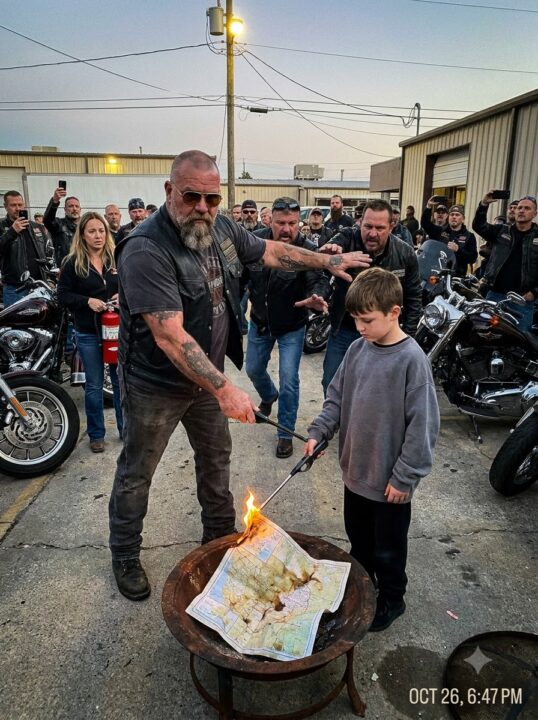
The controlled burning took place two days later behind Dawson Motorcycle Repair. We used a clean metal fire bowl on bare concrete, kept water and an extinguisher nearby, and obtained permission from Teresa and the case team.
Caleb did not handle the lighter alone.
Hammer stood beside him.
I remained within reach.
The club members knew none of this when they first saw flame touch the map. Hammer had told only Bear that a private ceremony would occur, but Bear believed Caleb would add the final black line and return the paper.
Seeing the map burn felt like watching Anna disappear again.
Bear knocked away the lighter.
Hammer handed it back.
The argument that followed was not about paper.
It was about who owned history.
Luis believed the map should enter the county archive. Doc wanted it framed beside Anna’s photograph, while another rider suggested removing confidential marks and keeping only the blue routes.
I explained that copying, displaying, or transferring the map without reviewing every location could expose information connected to people who never consented to public recognition.
The official evidence was preserved elsewhere.
Agency files contained reports, findings, orders, and case documentation under legal protections. Anna’s map was an unofficial working artifact, incomplete by design and dangerous if interpreted without context.
A red mark did not prove every accusation.
A black line did not explain each outcome.
Public display could misidentify addresses whose residents had changed years earlier.
Hammer understood.
He also knew practicality was not the only reason for burning it.
Anna had left instructions.
Eight years earlier, while receiving treatment for ovarian cancer, she removed the map from Hammer’s office and wrote across the back in blue ink.
He did not discover the message until after her funeral.
It read:
“When every child represented here has reached a safer place, burn the roads. Keep their names only where the law protects them, and keep their futures nowhere they can be hunted.”
Beneath that, she added:
“Ray, a map is useful because it tells you where to go. This one should never become a reason to return.”
Hammer had obeyed every part except the final instruction.
For eight years, one or more red marks remained unfinished. New addresses occasionally appeared, but Anna’s health prevented her from approving changes during her final months.
After her death, Hammer stopped adding cases outside the original network.
He wanted the map completed, not expanded forever.
The Iron Vow’s advocacy work continued through formal organizations using secure systems rather than paper pinned behind a garage desk.
Caleb’s sibling group became the last unresolved family connected to Anna’s version.
That was why Hammer chose him.
The decision still bothered Bear.
“You’re putting Anna’s last thing in a fire.”
Hammer turned the map over so everyone could see her sentence.
“She said it wasn’t the last thing.”
Then he opened the empty frame inside the garage.
Behind where the map had hung rested a clean sheet of white paper and a photograph of Anna carrying a dresser beside four Iron Vow riders.
Across the blank sheet, Hammer had written no addresses.
He attached small cards listing only public resources: youth shelters, legal-aid offices, crisis lines, food programs, libraries, and approved advocacy organizations.
The new display showed where help could be found, not where harm had occurred.
Anna’s work remained.
Its method changed.
Bear read her instructions twice.
Then he removed his gloves.
One by one, the other riders did the same. In the Iron Vow, bare hands signaled that nobody intended to fight, threaten, or hide behind club identity.
Caleb knelt beside the bowl again.
Before lighting the map, he asked whether burning the red marks meant pretending nothing happened.
Hammer shook his head.
“What happened belongs to you. The address doesn’t.”
Caleb considered that.
He removed the small blank border section Hammer had cut away. The piece contained no roads, names, dates, or marks.
“What’s this for?”
“First place you choose yourself.”
Caleb placed it inside his pocket.
Then he lit the map.
Flame followed the fold lines. Red houses disappeared first, then blue routes, black crossings, county borders, and old highways no longer carrying their original numbers.
Hammer’s hands remained at his sides.
His scarred knuckles trembled.
Bear placed one hand on his shoulder.
That was the brotherhood’s final test: not protecting the object Anna left, but helping Hammer obey the future she requested.
The fire reached her handwriting last.
Caleb read the sentence until smoke made the blue ink disappear.
Nobody applauded.
When only ash remained, Hammer covered the bowl.
The map was gone.
Then Caleb asked the question none of us expected.
“If there’s no map now, how do you find the next kid?”
Hammer looked toward me.
I answered.
“They find professionals. Professionals call people who can help.”
Hammer nodded.
“We’re the truck, kid. Not the compass.”
That distinction became the foundation of everything the Iron Vow did afterward.
Part 5 — The House That Received Three Beds
Caleb kept the blank paper inside his wallet for three years.
At first, he refused to draw on it because every possible mark felt too permanent. Hammer never pressured him.
The Morris children settled into Teresa’s home slowly.
Permanent guardianship created legal stability, but it did not erase disrupted schooling, guarded eating habits, nightmares, or the fear that one mistake could trigger another move.
Teresa learned to keep predictable snacks available.
Lily stored crackers inside her pillowcase for months. When Teresa found them, she did not punish her or demand an explanation.
She placed a sealed snack box beside the bed.
Noah struggled whenever unfamiliar vehicles remained outside the house. The Iron Vow stopped parking motorcycles near Teresa’s driveway and arrived in ordinary trucks until he chose otherwise.
Caleb tested promises.
If Hammer said he would come Saturday at ten, Caleb watched the clock beginning at nine. Hammer arrived early but waited around the corner so his knock occurred exactly at ten.
Consistency became their language.
The club returned the restored dresser after the court resolved ownership. Hammer left the damaged section visible beneath the lowest drawer because replacing every scar would have required replacing too much original wood.
Caleb asked why he had not made it perfect.
“Wasn’t broken there,” Hammer said.
The repair strengthened the joints.
That was enough.
The ashes from Anna’s map remained inside a sealed container while Teresa, Laura from the advocacy center, and our legal team discussed what could be done respectfully.
Nobody scattered them at former addresses.
Nobody turned them into jewelry or a public memorial connected to identifiable children.
Eventually, Caleb chose a private garden behind Teresa’s home.
He mixed a small portion of the cooled ash into soil beneath three sunflower plants, one for each sibling. The remaining ash went into a sealed family keepsake box with Anna’s photograph and a copy of her instruction.
Hammer attended the planting but did not speak.
Caleb wrote nothing on the garden markers.
By summer, the sunflowers rose above Lily’s shoulders.
The Iron Vow’s advocacy partnership also changed. The club signed a formal memorandum with a licensed nonprofit defining what riders could and could not do.
They provided transportation of property, home repairs, storage, donated furnishings, and supervised mentoring programs.
They did not conduct investigations.
They did not keep private address lists.
They did not approach children outside approved settings.
Every volunteer completed training and screening appropriate to the role.
Some members left.
They had joined because dramatic rescues made them feel powerful, not because they wanted to assemble bunk beds, repair leaking faucets, or wait for caseworkers to approve deliveries.
Hammer allowed them to leave.
The riders who remained learned that quiet support usually looks like work nobody films.
Bear became responsible for inventory. Luis coordinated meals through the nonprofit, while Doc taught vehicle maintenance to older teenagers only after program staff approved enrollment.
Hammer handled beds.
He could assemble one without instructions, though he still read the instructions because Anna once said confidence should never replace checking the bolts.
The empty map frame stayed in Dawson Repair.
Public-resource cards replaced private addresses. Each card carried current contact information reviewed quarterly by the nonprofit.
Caleb helped update them.
At thirteen, he discovered two numbers had changed and corrected the board before Hammer noticed.
“You’re getting useful,” Hammer said.
Caleb smiled because that was Hammer’s version of praise.
The viral video of the burning map reached the internet despite our request for privacy. A bystander outside the tire shop captured only the first seconds: a child lighting paper while bikers surrounded him.
Some viewers accused the club of destroying evidence.
Others claimed Hammer trained children to hate foster families.
We released a limited statement confirming that all official documentation remained secured and that the burned item contained no unique evidence.
We did not identify Caleb.
Hammer refused interviews.
“His fire,” he said. “Not my story to sell.”
The attention faded.
What remained was the work.
Two years after the burning, another sibling group needed beds before moving into an approved kinship placement. The nonprofit contacted the Iron Vow.
Caleb joined the assembly team under supervision.
He tightened every bolt twice.
One bed frame arrived with a cracked wooden support. A younger rider suggested covering it because the mattress would hide the damage.
Caleb stopped him.
“Hidden still breaks.”
Hammer heard.
He looked toward the empty map frame.
Then he handed Caleb a replacement board.
No speech followed.
None was needed.
That evening, after the room was prepared, Caleb used the blank strip from Anna’s map for the first time.
He drew a blue line.
It did not lead away from an unsafe house.
It led from Teresa’s home to Dawson Motorcycle Repair.
At the end, he drew a small square.
Hammer asked what it meant.
“Somewhere people come back.”
Hammer folded the paper and returned it.
“Good road.”
Part 6 — The Routes They Stopped Writing Down
Five years after the map burned, the Iron Vow no longer kept any private child-welfare addresses at the clubhouse. Assignments came through secure nonprofit channels, and information was limited to what volunteers needed for each task.
Hammer complained about passwords.
He followed the rules.
Caleb turned fifteen and began working Saturdays at Dawson Repair. He swept floors, sorted fasteners, and learned why a torque specification mattered more than how strong somebody felt.
Hammer paid him properly.
He refused to call unpaid labor character building when the garage benefited from it.
Noah joined a school robotics team, while Lily became the only sibling comfortable speaking about their moves during a youth advisory council.
Each child carried the history differently.
Teresa never demanded one family story.
On the anniversary of the burning, they gathered beside the sunflower garden. There were no candles, speeches, or motorcycles arranged for photographs.
Caleb checked the soil.
Hammer repaired the garden gate.
Bear brought lemonade that contained too much sugar, and Luis complained while drinking three cups.
The plants changed each year. Some failed during drought, while others grew from seeds dropped by earlier flowers.
Nothing stayed identical.
The garden remained.
The blank-road paper accumulated more blue lines. Caleb marked his school, Teresa’s house, the library, the garage, his first job, and the advocacy center.
He never used red.
When a place became difficult, he did not mark the building as permanently bad. He wrote the date on a separate card and discussed what happened with people qualified to help.
Hammer had taught him that a map could become a prison if every painful location remained the most important thing about a life.
Caleb taught Hammer something in return.
Anna’s original map did not need to exist for her work to remain real. Hammer had feared that burning it would reduce twenty-two years into ashes.
Instead, its absence changed his attention.
He stopped looking backward at crossed-out houses and began measuring practical things still unfinished: how many beds were needed, which van required tires, and whether a teenager’s driver-training fee had been paid.
The empty frame became crowded with public-resource cards, thank-you notes without names, equipment receipts, and drawings mailed by young adults after they left care.
None identified a placement.
One drawing showed a black Harley beside three sunflowers.
Hammer kept it near Anna’s photograph.
At seventeen, Caleb asked whether Hammer regretted choosing him to light the map.
“Sometimes.”
The honesty surprised him.
“Why?”
“Was a lot to put in a kid’s hand.”
Caleb acknowledged that. The ceremony had helped him, but it also connected him publicly to a history he sometimes wanted private.
They discussed it without converting the decision into either pure success or permanent harm.
Hammer apologized for not asking whether Caleb wanted the club present.
Caleb accepted.
Then he explained why he had requested them.
“I wanted them to see I wasn’t on it anymore.”
Hammer understood.
The club witnessed the end because Caleb needed adults who knew the map to watch his address stop defining him.
The next anniversary ceremony became smaller.
Only family attended.
The bikers respected that too.
Before Caleb left for college, he gave Hammer a new state road atlas. Its pages were clean, updated, and free of marks.
Hammer opened it across his workbench.
“You know phones got maps now?”
“This one burns better.”
Hammer looked at him.
Caleb smiled.
The biker closed the atlas and placed it inside the empty frame without drawing a single red house.
Part 7 — The Last Mark Was Never an Address
Caleb returned to Franklin after completing a degree in social work. He did not become a caseworker immediately, because lived experience and professional readiness are not the same qualification.
He began at the youth advocacy center.
His first role involved organizing supplies, coordinating transportation, and ensuring donated furniture met safety requirements.
Hammer called him management.
Caleb called it inventory.
They were both partly right.
The Iron Vow riders had grown older. Bear’s knees objected to staircases, Luis closed his diner earlier, and Hammer’s beard had become almost completely gray.
His black Road King still announced him before he reached the garage, but he pushed it into sensitive locations whenever engine noise might frighten someone.
The club’s newer members knew Anna only through her photograph.
They knew the map through rules created after it burned.
No address lists.
No confrontations.
No children used as publicity.
No promises without a plan.
On the tenth anniversary of the ceremony, Caleb opened the clean atlas he once gave Hammer. Every page remained blank except one.
Hammer had drawn a small blue line outside Franklin.
It ran from Dawson Repair to Teresa’s house, then toward the advocacy center. The final mark appeared beside the sunflower garden.
Caleb pointed at it.
“I thought you were done drawing.”
“Got lost once.”
“You know that road.”
“Still got lost.”
Caleb understood the answer was not about navigation.
They rode and drove to Teresa’s house that afternoon. Caleb followed in a nonprofit van while Hammer led on the Road King.
No convoy followed.
The garden contained three mature sunflower stalks and several younger plants growing from fallen seed. Lily’s stuffed rabbit, repaired many times, watched from the porch chair.
Noah arrived carrying a robotics kit for Teresa’s neighbor.
The siblings were no longer the final family on a dangerous map.
They were three adults arriving at a familiar house by different roads.
Caleb removed the small blank strip from his wallet. The paper had softened along its folds, while the blue line leading toward Dawson Repair remained visible.
He offered it to Hammer.
The biker shook his head.
“Yours.”
Caleb placed it inside the clean atlas beside Hammer’s single route.
They did not burn either page.
Some maps deserve an ending.
Others deserve room.
Before sunset, Hammer started his Harley and waited beside the driveway. Caleb climbed into the van, while Noah and Lily stood near Teresa’s garden.
The Road King’s V-twin settled into a low uneven rhythm. Hammer lifted two fingers from the handlebar.
Caleb answered through the windshield.
Then the biker turned toward Route 31, following a road that carried no red mark, no confidential address, and no child waiting for permission to leave.
Behind him, three sunflowers moved in the exhaust breeze.
The last mark was home.
Follow our page and leave “HAMMER” below for more powerful biker stories about protected children, tested brotherhood, and roads that finally lead somewhere safe.