Part 2: A Tattooed Biker Destroyed a Boy’s Brand-New Bicycle While His Father Charged at Him — Then He Surrendered the Harley He Had Spent Twenty Years Rebuilding
Part 2 — The Man Who Inspected Every Weld
Ray Dawson had been breaking and rebuilding metal most of his adult life.
He owned Dawson Iron & Cycle in an old cinder-block building south of Flagstaff, where Route 66 ran past freight yards, auto shops, and diners that opened before daylight. A raven painted above his garage door had faded until it looked like smoke.
I began visiting the shop three days after the fundraiser.
At first, I went because I owed him an apology.
Ray had a purple bruise along his cheek from my fist. He never mentioned it. He stood beneath fluorescent lights repairing the cracked support bracket on a veteran’s wheelchair lift, his welding hood lowered and blue sparks falling around his boots.
I waited until the torch stopped.
“I hit you,” I said.
“Yeah.”
“You could’ve hit me back.”
“Yeah.”
“I’m sorry.”
Ray lifted the hood. “You thought I hurt your boy.”
“That doesn’t excuse it.”
“No. Explains it.”
He returned to the bracket.
The conversation was over.
Ray was fifty-six then. He had a shaved head, a black-and-gray beard that reached his chest, and hands marked by burns, cuts, and dark lines of machine grease that never completely washed away. Tattoos covered his arms, neck, and knuckles, but the one most people noticed was a small outline of a bicycle sprocket beneath his left thumb.
His club brothers called him Hammer because he had once carried a four-pound drilling hammer through a bar fight without swinging it.
“He just set it on the table,” Malcolm “Preacher” Boone later told me. “Everybody reconsidered their plans.”
Preacher was the sixty-one-year-old president of the Cinder Ridge Riders, a Black Army veteran with silver braids and a voice so calm it made louder men feel foolish. He met Ray in county jail in 1997 after both men made separate decisions involving alcohol, anger, and people they should have walked away from.
Ray served eleven months for aggravated assault.
When he came out, few shops would hire him.
A frame builder named Samuel Mercer did.
Mercer Cycles occupied the back half of a motorcycle dealership near Winslow. Samuel taught Ray TIG welding, metal fatigue, stress concentration, dye-penetrant inspection, and the uncomfortable discipline of rejecting a beautiful frame because of a flaw nobody else could see.
“Paint lies,” Samuel used to say. “Metal tells you first.”
Ray listened.
He became good enough to identify heat damage by color and a cold weld by sound. He would tap a joint lightly and tilt his head, hearing differences most people dismissed as imagination.
Motorcycles came naturally to him.
Fatherhood did not.
Ray’s daughter, Lucy, was born when he was twenty-nine. Her mother left three years later, exhausted by Ray’s drinking and long absences. Ray received weekend visits only after sobriety, counseling, and a year of keeping every promise his probation officer thought he would break.
Lucy was small, serious, and unafraid of the men in leather who gathered outside her father’s shop.
She called Preacher “Uncle Malcolm.”
She called every socket wrench a hammer.
At nine, she wanted a bicycle.
Ray could have built one. Instead, he bought a bright red youth mountain bike because Lucy wanted something that looked exactly like those ridden by children in her neighborhood.
The bike was discounted.
The box had been opened.
A dealer claimed another customer had returned it because the color was wrong. Ray examined the wheels, brakes, chain, pedals, and handlebars. He checked everything he expected to fail.
He did not strip the paint from the head tube.
For six months, Lucy rode it without trouble.
Then a dry clicking sound began near the front fork.
She mentioned it twice.
Ray promised to inspect it after finishing a motorcycle frame for an impatient customer. On the third morning, she rode toward school before he awakened.
The head tube separated while she descended a hill.
Lucy struck the pavement face-first.
Her helmet saved her life, but not the movement in her legs.
The manufacturer called it an isolated failure. The dealer had disappeared. The frame’s serial number led to a shipment listed as damaged during transport, supposedly destroyed and never sold.
Ray later found grinding marks beneath the paint. Someone had removed the original serial stamp, repaired a fractured weld poorly, applied new primer, and sold the bicycle as nearly new.
Police called it difficult to prove.
Lawyers called the damages unrecoverable.
Ray called himself late.
Lucy lived eight more years.
She used a wheelchair, finished high school, painted motorcycle tanks with ravens and desert flowers, and learned to tease her father whenever he became too quiet. The silver bicycle bell hung from her chair so she could summon him from the shop.
One ring meant coffee.
Two meant help.
Three meant she wanted Preacher because Ray was “being impossible.”
After Lucy died from complications of a respiratory infection at seventeen, Ray attached the bell inside his leather cut. It rang softly whenever he walked, though strangers assumed the sound came from a loose chain.
He also began carrying a steel inspection gauge.
Every bicycle near him received a glance.
Every repaired frame received suspicion.
Every unexplained click made his shoulders harden.
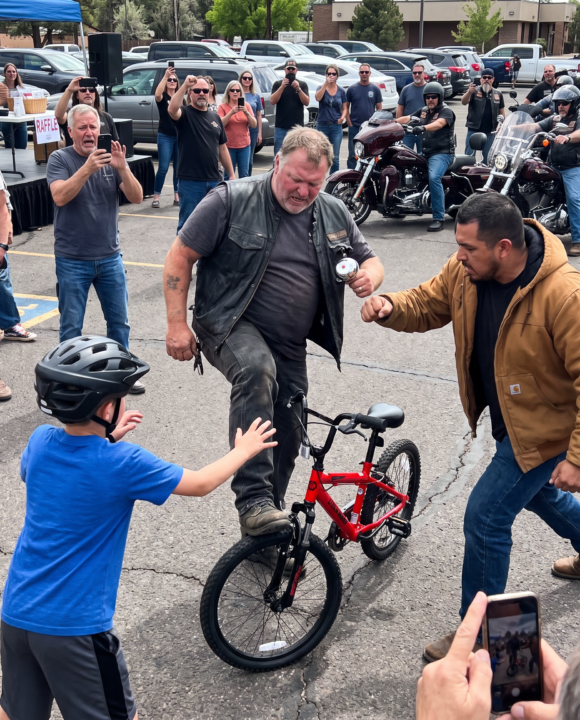
That was the contradiction I had seen at the fundraiser: a man feared because of his size standing terrified beside a child’s bicycle.
Noah’s bike had carried the same crescent grinding mark as Lucy’s.
Not similar.
The same.
And Ray knew that if the frame left the parking lot intact, somebody might paint it again, sell it again, and place another child above a joint already waiting to break.
So he made it impossible to hide.
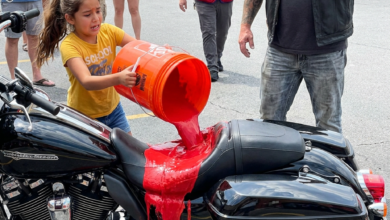
He broke it open in front of witnesses.
Part 3 — The Bicycle That Was Never Supposed to Exist
The sporting-goods dealer was named Curtis Vale.
Vale owned High Desert Outfitters, a medium-sized store selling camping equipment, bicycles, fishing gear, and outdoor clothing. He sponsored youth teams, donated prizes to schools, and placed his smiling face on every community program that would accept it.
I had trusted him.
Everyone had.
After Ray exposed the defective weld, Officer Lena Ortiz secured the bicycle as evidence. She photographed the joint, recorded witness statements, and asked Vale for purchase documents.
He produced a donation receipt.
It listed the bicycle as clearance inventory.
The serial-number field was blank.
Vale claimed an employee had assembled it from spare components and an unused replacement frame. The explanation sounded careless, not criminal. He offered Noah any bicycle in his store and promised a written apology.
The crowd softened.
Ray did not.
“Where’s the rest of the shipment?” he asked.
Vale laughed. “What shipment?”
“The mark.”
“I don’t know anything about your mark.”
Ray held up Lucy’s bell. Beneath its mounting clamp, Samuel Mercer had engraved a crescent after completing a repair to her wheelchair. The symbol was also used by a small fabrication company that once processed damaged bicycle frames for recycling.
That company had closed sixteen years earlier.
Its final foreman was Curtis Vale’s older brother.
Vale stared at the bell.
Then he looked toward the officer.
“My brother is dead.”
Ray answered, “Metal isn’t.”
Officer Ortiz told both men to stop speaking until formal statements could be taken.
Ray walked to his Harley.
The motorcycle was a black 1999 touring model assembled from parts over two decades. Its tank carried one of Lucy’s painted ravens. The left saddlebag had a small silver handprint beneath its lid. Its seat had been lowered so Lucy could transfer onto it during the years when Ray took her for short rides using a custom sidecar.
The sidecar was gone.
Its mounting points remained.
That Harley was not simply valuable. It was the last machine Lucy had helped him build.
Ray started it.
The V-twin settled into a heavy uneven rhythm.
He rode directly to High Desert Outfitters.
Vale drove behind him. Officer Ortiz followed. I took Noah in my pickup because my son would not let the broken bicycle leave his sight without knowing what happened next.
At the store, Vale offered us a blue bicycle priced at $429.
Ray examined it.
He checked the fork, joints, brake cables, crank, and wheel alignment. The frame was sound, but it was too large. Noah had to tilt the bike dangerously to reach the ground.
“This one fits his budget,” Vale said.
“My budget?” I asked.
“You received the first bike free. I’m replacing it as a courtesy.”
Ray lifted his eyes.
“Courtesy.”
Vale’s face reddened. “I’m trying to resolve this.”
“No. You’re trying to end it.”
Ray found a smaller bicycle from a reputable American company. It had hydraulic disc brakes, a correctly sized frame, reflective tires, and adjustable components that would fit Noah as he grew.
It cost almost twelve hundred dollars.
I laughed once when I saw the tag.
It was not amusement.
“That’s impossible,” I said.
Ray rolled it to the counter.
Vale refused.
Officer Ortiz reminded Ray that price negotiations were not police business. The defective frame would be investigated, but nobody could force the store to provide a premium replacement.
Ray placed Lucy’s silver bell on the counter.
Then he removed a folded title from his vest.
Vale read it.
His attention shifted through the front window toward the Harley.
“That bike is worth more than twelve hundred,” he said.
“Then you’re getting a deal.”
I stepped between them. “Ray, no.”
He ignored me.
Vale asked whether the motorcycle ran.
Ray stared at him until the question answered itself.
“You trade that Harley,” Vale said, “and the bicycle is yours.”
“Not enough.”
Vale almost smiled. “You just said—”
“All children’s bikes from the same storage lot get pulled. Every frame gets inspected by someone who doesn’t work for you. You provide Officer Ortiz with every invoice and shipping record. Boy gets the safe bike.”
“And you give me the Harley?”
“Title. Keys. Now.”
The room went silent except for the hum of the air-conditioning and a loose ceiling vent ticking above aisle four.
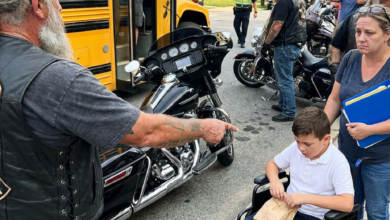
Noah tugged Ray’s leather cut.
“Mr. Hammer, I don’t need that bike.”
Ray looked down.
“You need one that holds.”
“Your motorcycle is better.”
“It’s metal.”
“It has the bird your daughter painted.”
Ray’s expression changed.
I had not told Noah about Lucy.
Preacher had.
Noah touched the raven on the Harley’s tank through the window. “You can fix my old bike.”
“My old bike?”
“The yard-sale one. Dad still has it.”
The chain was broken. The rear axle was bent. The frame was three colors because previous owners had painted over rust.
Ray could have repaired it.
He knew that.
But he also knew Vale would leave the defective inventory untouched if the dispute ended with a cheap favor behind closed doors.
Ray pushed the title across the counter.
Vale signed the trade receipt.
Then he handed over the boxed bicycle.
The false ending arrived quickly.
People believed a guilty dealer had made compensation and a generous biker had sacrificed a prized Harley for a child. The story was clean. Photographs of Noah beside the sealed box spread online. Ray became a local hero before anyone understood why he hated the word.
But Officer Ortiz did not close the investigation.
Ray had slipped something beneath the title before Vale signed it: a photocopy of the defective frame’s grinding mark and a handwritten request that every related bicycle be preserved.
Vale signed directly across both documents.
He had acknowledged the mark.
That evening, he tried moving fourteen children’s bicycles from his warehouse.
The police were waiting.
Part 4 — What Ray Bought With the Harley
The investigation reached farther than High Desert Outfitters.
Fourteen bicycles in Vale’s warehouse carried altered serial markings. Nine had repaired head-tube fractures. Three bore fresh paint over porous welds. Two looked structurally sound, but their serial numbers belonged to frames officially destroyed after a freight-truck rollover in Nevada.
None should have been sold.
Officer Ortiz contacted state investigators and the Consumer Product Safety Commission. Records connected the bicycles to a salvage broker operating through storage units in Arizona and New Mexico.
Curtis Vale claimed ignorance.
His paperwork disagreed.
For six years, Vale had purchased damaged frames cheaply, used legitimate components to make them appear new, then moved them through clearance sales, donations, raffles, and nonprofit events where formal buyers were unlikely to demand warranty records.
The donated bicycles bought him publicity.
The children carried the risk.
Noah’s prize had cost Vale less than eighty dollars.
I learned this during a meeting at the police station. Ray sat beside me with both tattooed forearms on the table, turning Lucy’s bell slowly between his fingers.
He had not slept.
Without the Harley, he arrived in Preacher’s pickup. Each time an engine rumbled outside, his eyes moved toward the window before he could stop them.
Vale’s attorney argued that Ray had contaminated evidence by breaking the frame.
The state metallurgist disagreed.
Ray’s destruction had preserved the truth.
Because the fracture opened in public, witnesses saw the concealed defective joint before Vale could remove, replace, or alter it. The direction of failure showed that most of the weld had been separated before Ray touched it. Microscopic oxidation existed deep inside the crack, proving it had grown over months or years.
The bicycle had been waiting to fail.
Possibly during Noah’s first ride.
The officer asked Ray how he knew how much force to use without creating a new fracture.
He answered, “Didn’t.”
I turned toward him.
“What do you mean?”
“I knew it was bad. Didn’t know how bad.”
“You could have waited for police.”
“Boy had his hands on it.”
“You could’ve explained.”
“I tried.”
“No, you ordered everyone around and broke it.”
Ray’s eyes remained on the bell.
“Yeah.”
For the first time, anger returned—not because he had destroyed the bicycle, but because he had made Noah believe something beautiful had been taken from him.
“You scared my son,” I said.
“Yeah.”
“You made him cry.”
“Yeah.”
“You decided the result mattered more than how you treated him.”
Ray looked at me then.
That landed.
Lucy had said something similar during her recovery. Preacher later told me she hated when her father confused protecting her with controlling everything around her.
Ray stood and left the meeting.
I thought he was walking away from responsibility.
Again, I was wrong.
He went to find Noah.
My son sat outside the station drawing the broken red bicycle in a notebook. He had colored the frame in two halves and placed a large black bird above it.
Ray lowered himself onto the curb.
His leather creaked. The bicycle bell rang once inside his vest.
“Your dad’s right,” he said.
Noah kept drawing.
“I shouldn’t have done it like that.”
“You had to break it.”
“Had to stop you riding it.”
“That’s the same.”
“No.”
Ray waited until Noah looked at him.
“I could’ve told you what I heard. Could’ve moved you back. Could’ve asked the officer to hold it. I saw another kid for a second, not you.”
“Your daughter?”
Ray nodded.
“Did she die because of her bike?”
“Not that day.”
“Did she forgive you?”
Ray rubbed his scarred thumb across the silver bell.
“She said there was nothing to forgive. Made me mad.”
“Why?”
“Needed somebody to blame.”
“Who did you blame?”
“Me. Dealer. Welder. Company. Road. Took turns.”
Noah studied him with the direct seriousness children sometimes use when adults become less frightening.
“Did it help?”
“No.”
That was Ray’s entire confession.
Noah closed the notebook and handed it to him. On the next page, he had drawn the black Harley from memory. The raven on the tank was too large. The wheels were uneven. A small sidecar held a girl ringing a bell.
“You shouldn’t have traded it,” Noah said.
Ray stared at the drawing.
“I didn’t trade it for your bicycle.”
“Yes, you did.”
“No. Bicycle was twelve hundred. Harley was worth more.”
“What did you buy, then?”
Ray looked through the station doors toward the evidence-room hallway.
“Time.”
The Harley’s value forced Vale to sign immediately. It kept him focused on profit. It placed the motorcycle, title, defective-frame image, and signed acknowledgment inside one documented transaction while police watched.
Ray had gambled that a greedy man would reveal what a cautious man might hide.
It worked.
Vale’s warehouse move provided probable cause for a wider search. Investigators found altered frames, counterfeit labels, grinders, primer, paint records, and a ledger showing more than sixty youth bicycles sold across three states.
Thirty-seven were eventually located.
One belonged to a twelve-year-old girl in Gallup whose front wheel had begun clicking the previous week.
Another was ridden daily by brothers sharing it on their route to school.
A third hung in a family’s garage, wrapped for a birthday two days away.
Ray’s Harley had not purchased one safe bicycle.
It helped stop dozens of unsafe ones.
There was still a problem.
Vale now legally owned the motorcycle.
And before he was arrested, he sold it.
Part 5 — The Raven Disappeared
The Harley vanished into an auction network within forty-eight hours.
Vale transferred it to settle a debt with a wholesale vehicle broker. The broker moved it to Phoenix, where its identification number entered a private sale listing without photographs.
By the time Preacher found the listing, the motorcycle had been purchased with cash.
The buyer’s name was shielded through a small dealership.
Ray pretended not to care.
He returned to Dawson Iron & Cycle and worked on other people’s machines. He repaired a cracked exhaust hanger, rebuilt a transmission, fabricated a wheelchair ramp, and welded a new kickstand onto a veteran’s trike.
But every evening, he paused beside the empty space near his workbench.
The concrete there was darker from years of oil.
A hook above it held Lucy’s old riding helmet.
Without the Harley, Ray rode a borrowed touring bike from the club. He returned it washed and fueled after every trip. When Preacher offered him the keys permanently, Ray refused.
“Not mine,” he said.
The story online became bigger.
A community fundraiser collected enough money to buy Ray a new motorcycle. He returned every donation. A dealership offered him a current model in exchange for interviews and promotional photographs. He declined before the sales manager finished speaking.
They did not understand.
He did not want another motorcycle.
He wanted the uneven brush marks Lucy had left beneath the raven’s right wing. He wanted the silver handprint inside the saddlebag. He wanted the shallow dent from the day her wheelchair rolled forward and tapped the fuel tank.
Those imperfections could not be ordered.
Noah received his replacement bicycle after an independent mechanic inspected it. Ray adjusted the seat, brake levers, and handlebar reach without charging us.
Before Noah’s first ride, Ray knelt beside the frame.
He ran his fingernail over every weld.
He squeezed both brakes.
He checked every spoke by sound.
Then he stood.
“Hold?”
Noah asked.
Ray nodded. “Holds.”
My son did not ride immediately.
He removed a small object from his pocket: the paper tag that had hung from the broken red bike. He had written LUCY on the blank back.
“Can this go on it?”
Ray attached the tag beneath the new seat with a clear protective sleeve.
Then Noah rode.
He circled the shop yard once, slowly. Twice, faster. On the third pass, he lifted one hand from the bars and rang the new bell.
Ray flinched.
The sound was nearly identical.
One ring.
Coffee.
Noah circled again.
Two rings.
Help.
On the third lap, he rang it three times.
Preacher emerged from the shop laughing.
“Kid knows the code.”
Ray turned away, but not before I saw his eyes shine.
He did not cry.
Ray rarely gave grief that much room in public.
A month later, Vale pleaded guilty to fraud, reckless endangerment, falsifying product records, and evidence tampering. Investigators traced fifty-two defective or undocumented bicycles. Forty-nine were recovered. Three could not be located.
Ray kept their serial numbers taped beside his workbench.
Every club chapter between Flagstaff and Albuquerque received copies.
The Cinder Ridge Riders began holding free bicycle inspection days. People who once crossed streets to avoid them now brought children, helmets, loose chains, bent wheels, and secondhand frames to the clubhouse.
Ray inspected each bicycle.
He never said, “Looks fine.”
He said, “Holds.”
Noah helped.
My son learned how to identify cracked paint around stressed joints, how to check wheel bearings, how to test brakes, and why a helmet resting high on the forehead protected less than parents believed.
He also learned when not to touch tools.
Ray insisted on that.
“Knowing enough to stop is a skill,” he told him.
The final three bicycles were found because of Noah.
He recognized the crescent mark in an online photograph of a yard sale in Farmington. The seller had two similar bikes stored behind the first.
Police recovered all three.
That night, the club held a quiet dinner. No cameras. No speeches. Preacher placed Lucy’s bell at the center of the table and rang it three times.
Ray looked toward the door by instinct.
Nobody entered.
Then engines sounded outside.
One.
Three.
Nine.
The club brothers went still.
A black Harley rolled into the yard.
The raven was still on its tank.
Part 6 — The Brotherhood’s Quiet Trade
Luis “Crow” Ramirez had purchased the Harley.
He was a forty-six-year-old Latino biker who ran the Cinder Ridge Riders’ road support truck and spoke only when silence had failed. While everyone else raised money publicly, Crow traced the broker, found the buyer, and learned the motorcycle was headed toward a collector in California.
The cash buyer listed on the paperwork was a dealership employee.
Crow intercepted the sale legally.
He sold his custom truck, borrowed money from three club brothers, and purchased Ray’s Harley before it left Arizona. Then he hid it in a body shop while the scratched saddlebags and weathered paint received protective clear coat.
Nothing was repainted.
Lucy’s raven remained crooked.
Her handprint stayed beneath the lid.
Even the dent beside the fuel tank survived.
When Crow rode into the shop yard, Ray did not move.
The V-twin stopped. Cooling metal clicked in the silence.
Crow placed the key on the dinner table.
Ray looked at him. “No.”
“Wasn’t asking.”
“I can’t pay you.”
“Didn’t mention money.”
Ray’s voice hardened. “I’m not taking your truck.”
“Already sold it.”
“Then undo it.”
“Can’t.”
The two men stared at each other across Lucy’s bell.
This was the kind of moment that had broken clubs before: pride disguised as honor, gratitude disguised as anger, one brother believing sacrifice created a debt the other could never carry.
Preacher stepped between them.
“Harley belongs to the club,” he said.
Crow frowned. “Since when?”
“Since now. Hammer maintains it. Rides it. Keeps it from turning into furniture.”
Ray understood.
Ownership would remain with the club until Crow’s loan was repaid through inspection donations, volunteer repair work, and monthly contributions no brother was permitted to discuss. Ray could use the motorcycle without accepting it as charity.
It was an imperfect arrangement.
That made it possible.
Ray took the key.
He walked outside and placed one hand on the raven. His thumb found the uneven paint beneath its wing.
Then he opened the left saddlebag.
Inside was Noah’s drawing of Lucy in the sidecar.
Ray folded it carefully and placed it beside the silver handprint.
The club had rebuilt many machines.
That night, they returned one without changing it.
Part 7 — The Sound Before the Ride
Three years have passed since Ray broke Noah’s bicycle.
My son is thirteen now. His knees rise too high on the replacement bike, so Ray is helping him build a larger one from a bare frame. Noah performs every inspection twice.
Ray performs it once more.
High Desert Outfitters closed. The old store became a community repair center operated by a veterans’ group and the Cinder Ridge Riders. One wall holds damaged frames from the recovered shipment, each cut open at its weakest joint so families can see what paint once concealed.
The broken red frame hangs in the middle.
Noah asked that it remain unpainted.
Beneath it sits Lucy’s silver bell.
Every September, parents bring bicycles to the parking lot for free inspections. Large men with tattooed arms kneel beside tiny pink cruisers, secondhand BMX bikes, training wheels, and rusted hand-me-downs.
Ray listens before he looks.
Tap.
Turn.
Press.
Hold.
He still rides the black Harley. Lucy’s raven has faded further, and the seat shows a new split near one edge. Ray refuses to replace it because the tear does not affect safety.
“Ugly can hold,” he says.
Noah rings his bell whenever he approaches Dawson’s shop.
One ring.
Ray looks up.
Two rings.
He puts down his tools.
Three rings.
Preacher opens the garage before the boy arrives.
Sometimes visitors recognize Ray from the old parking-lot video. They ask whether he truly destroyed a child’s prize in front of everyone.
Ray answers, “Yeah.”
They ask whether he regrets it.
He studies Noah’s intact helmet, straight wheels, and carefully inspected frame.
“Regret the way.”
That is all.
On the anniversary of Lucy’s last ride, Ray takes the Harley toward Winslow. Noah and I follow in my pickup. At a quiet overlook, Ray parks beside the guardrail and removes the silver bell from his vest.
For several minutes, the highway wind is the only sound.
Then he rings it once.
Not for coffee.
Not for help.
Just to let the girl who painted the raven know that the machine still holds—and so do the children whose bicycles never had the chance to break beneath them.
Ray returns the bell to his vest.
The Harley starts.
And the raven goes home.
Follow our page for more biker stories about misunderstood riders, quiet sacrifices, and the families protected by what frightening men notice first.