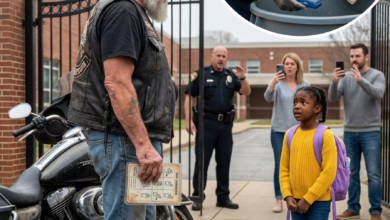
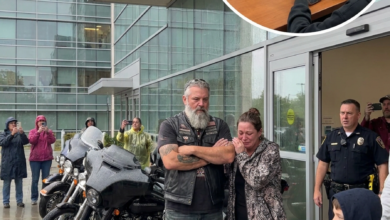
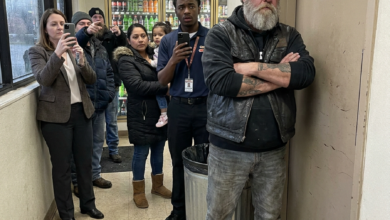
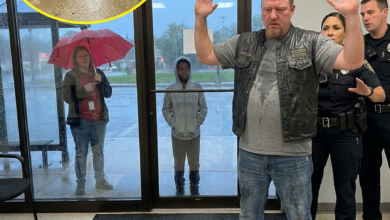
A Tattooed Biker Burst Into His Grandfather’s Nursing-Home Room and Shook Him Until a Nurse Screamed—Then the Silent Monitor Revealed Why He Had Seconds to Act
Part 2 — The Man Who Counted the Pauses
Henry Mercer had raised Eli before Eli understood that being raised could look like an old machinist standing outside a county jail at two in the morning without asking for an explanation.
Eli’s mother, Joanne, was Henry’s only daughter. She had Eli at nineteen, married a man who preferred taverns to rent payments, and spent most of her twenties leaving him and returning. By the time Eli turned eight, Henry had converted his sewing room into a bedroom and stopped pretending the arrangement was temporary.
Henry was not affectionate in ways children recognize immediately. He did not say much. He packed lunches, repaired bicycles, and placed his hand on the back of Eli’s neck whenever they crossed Route 40.
“Watch the traffic,” he would say.
That was Henry’s version of I love you.
Eli grew large before he grew careful. At thirteen, he was already taller than most teachers. At sixteen, he punched a senior who mocked his mother. At eighteen, he quit school and began loading freight at a Dayton warehouse.
The Harley came three years later.
It was an aging black Electra Glide with a torn seat and an exhaust leak. Henry called it “a furnace with handlebars.” Still, he helped Eli rebuild the carburetor beneath the yellow light in his garage.
“Machine tells you what’s wrong,” Henry said. “You just have to quit making noise long enough to hear it.”
Eli remembered that sentence.
He joined the Wayne County volunteer rescue squad after witnessing a pickup roll into a drainage ditch. He had climbed through broken glass, held the driver’s airway open, and remained there until an ambulance arrived.
Someone told him he had steady hands.
Training followed. First aid. CPR. Emergency medical technician certification. Night shifts. Highway wrecks. Kitchen falls. Overdoses in motel bathrooms where television sets kept playing while families stood outside.
Eli was good at the work because panic became quiet inside him.
But good was not invulnerable.
In 1998, his ambulance partner, Marcus Bell, died after a drunk driver crossed the centerline on State Road 121. Eli survived with two broken ribs and glass buried in his left shoulder. Marcus died before firefighters opened the passenger door.
Eli returned to duty too soon.
He began waking at the sound of metal striking metal. He drank to sleep, then drank because morning felt worse. The rescue squad asked him to step away after he arrived late smelling of whiskey.
He told Henry everyone had betrayed him.
Henry said nothing until Eli threw a socket wrench through the garage window.
Then the old man struck him once across the mouth.
“Your partner died,” Henry said. “You didn’t. Don’t make that his fault.”
Eli left.
For almost two years, he drifted through repair shops and cheap rooms. The Iron Mile Riders found him at a truck stop outside Eaton, asleep beside his Harley with an empty bottle under his jacket.
Their president was Calvin Reeves, already known as Doc because he had served as an Army medic. Doc took the bottle, poured it into the gravel, and told Eli to choose between throwing a punch and eating breakfast.
Eli chose breakfast.
The club did not cure him. Men do not cure one another that cleanly. They drove him to meetings, took his keys when he lied, and made him work off every loan by repairing bikes in Doc’s barn.
Henry visited once.
He brought the socket wrench Eli had thrown through the window.
“Garage still needs glass,” he said.
Eli returned home that afternoon.
Sobriety came unevenly. So did trust. Henry never used speeches, but he began leaving small jobs unfinished when Eli visited: a loose hinge, a mower belt, a radio with a dead wire.
It gave them a reason to stand near each other.
Years passed. Eli built a roadside recovery business near Dayton. He never returned to ambulance work, yet he renewed his CPR training every two years because Doc required every Iron Mile member to know how to keep another rider alive.
Henry aged.
First came the forgotten appointments. Then two falls. After Joanne died from ovarian cancer, Henry’s house became too quiet and his meals became smaller. Eli asked him to move in.
Henry refused.
“I raised you once,” he said. “Not doing it again.”
Maple Ridge seemed respectable. It had clean floors, a bright dining room, and a courtyard facing a stand of maple trees. Henry could keep his books, his radio tools, and a photograph of Joanne beside the bed.
Eli visited every Sunday.
At first, staff saw only the motorcycle. Henry saw the boy who still looked both ways on Route 40.
The breathing problem announced itself slowly. Henry snored. He woke with headaches. His memory worsened after bad nights. Twice, Eli found him asleep mid-sentence.
Then came the pauses.
One Sunday, Henry fell asleep while Eli read an article about an old Indian motorcycle. His snoring stopped. Ten seconds passed.
Then twenty.
At thirty-two seconds, Henry gasped and jerked awake.
Eli told me. I documented it and notified the medical provider. A sleep evaluation was ordered, but the appointment fell between two systems: Maple Ridge’s contracted physician and an outside respiratory clinic.
Henry caught bronchitis.
The study was postponed.
Three weeks later, Eli brought a cheap audio recorder and placed it on Henry’s bedside table with his permission. Maple Ridge administration told him personal recording devices were prohibited unless a consent form was completed.
He completed it.
The recorder captured choking, long silences, and a violent gasp that shook the mattress.
Eli sent the file to a respiratory therapist named Dana Coles, whose husband belonged to the Iron Mile Riders. Dana listened and told him Henry needed urgent evaluation, not another routine appointment.
She wrote a warning.
She faxed it.
Then she mailed it.
Nothing changed.
Eli began timing the pauses himself. He wrote each one on blue cards because Henry had used blue inventory cards in the machine shop.
Thirty-eight seconds.
Forty-two.
Fifty-one.
When Eli showed me that final number, I believed he was an anxious relative trying to control care he did not understand.
I did not know he had once listened for breath beside wrecked cars.
I did not know Henry had made him promise never to ignore silence.
And I did not know the urgent respiratory warning was sitting in a locked administrative drawer less than sixty feet from Room 214.
Part 3 — Room 214
Sunday, October 19, began like most understaffed Sundays at Maple Ridge.
Two aides had called out. One resident had fallen without injury before breakfast. Another kept trying to leave because she believed her children were waiting at school.
By noon, we were behind.
Henry ate half his chicken, complained the potatoes tasted like wallpaper paste, and asked whether Eli was coming. I told him I had heard the motorcycle from the nurses’ station.
He smiled.
“Boy still rides that noisy contraption.”
Eli entered carrying lemon drops, a clean flannel shirt, and the blue card. He had also brought a small pulse oximeter from a pharmacy, but facility policy prohibited using family-owned equipment to make clinical decisions.
I explained that.
“You can still look at the number,” he said.
“I can use approved equipment.”
“Then bring approved equipment.”
His tone irritated me because it touched the exact place where I already felt guilty. We had only two portable monitors on the unit. One was being used after a resident returned from hospital care. The other had a charging problem.
“I’ll check him after medications.”
“How long?”
“Soon.”
Eli looked at the wall clock.
That glance stayed with me.
At 4:21, Henry pressed the call button. An aide entered and found him drowsy but responsive. He said he had dreamed of Joanne standing at a bus stop. His blood pressure was elevated, though not critically. His pulse seemed regular.
He asked to nap.
The aide raised the head of his bed, placed the call button near his hand, and left the door partly open.
Eli sat beside him.
They spoke about the machine shop. Henry insisted a lathe could detect dishonesty. Eli said machines did not have morals. Henry said that was exactly what a dishonest machinist would claim.
Then Henry’s words blurred.
His chin lowered.
Snoring filled the room.
Eli watched.
The sound stopped.
Ten seconds.
Fifteen.
He called Henry’s name.
At twenty seconds, Eli tapped his shoulder.
At twenty-six, he rubbed his sternum and tilted the chin slightly upward, trying to open the airway.
At thirty, Henry did not gasp.
Eli shouted into the hallway.
Nobody came.
Our medication cart was outside Room 208, where I was persuading a resident to swallow an antibiotic. The television was loud. An aide was helping someone in the bathroom.
Room 214 remained silent.
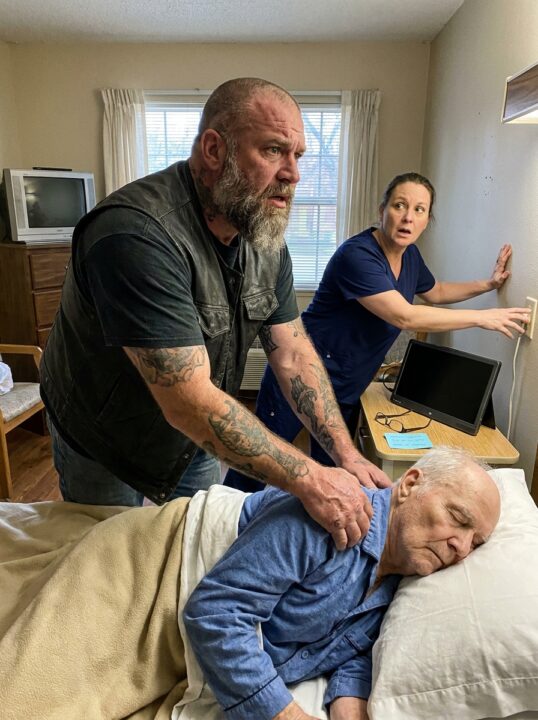
Eli shook Henry’s shoulders.
Once.
Twice.
“Grandpa. Wake up.”
Henry’s eyes remained closed.
The force of the second shake moved the bedrail. That was the moment I entered.
I saw a huge tattooed man leaning over a frail resident. I saw Henry’s head moving against the pillow. I did not see the thirty seconds before it.
“Get away from him!”
Eli checked the carotid pulse.
“He’s not breathing.”
“Let go.”
“He’s not breathing.”
I grabbed him.
He pulled free—not by striking me, but by turning his body between me and Henry.
That looked aggressive.
Everything he did looked aggressive once I had decided what I was seeing.
“Call a code,” he said.
“You need to step back.”
“Rachel.”
It was the first time he used my name.
“Look at his mouth.”
Henry’s lips had lost color.
I clipped on the facility pulse oximeter. It searched, flashed 71, then failed to read. I called the code.
The room changed.
Our charge nurse, Molly Hayes, brought the emergency bag. An aide wheeled in oxygen. We lowered the bed and assessed Henry. He had no normal breathing and no reliably detectable pulse.
Compressions began.
Molly counted.
“One, two, three, four…”
I fitted the mask over Henry’s nose and mouth. Oxygen flowed. His chest rose under assisted ventilation, but his face remained slack.
Eli stood at the wall.
“Harder,” he said.
Molly looked up.
“Leave the room.”
“Her compressions need to be deeper.”
“Security!”
Eli’s jaw tightened. His hands curled once, then opened.
He stepped into the hallway.
A guard named Leonard moved between him and the door. Leonard was sixty-eight and weighed perhaps 160 pounds. Eli could have passed him without effort.
He did not.
Instead, he counted compressions through the wall.
Paramedics arrived at 4:34. Their monitor showed a shockable rhythm after an initial period of resuscitation. Everyone moved back. The first shock did not restore circulation.
Eli heard the defibrillator tone from the hallway.
His knees bent slightly.
Doc Reeves arrived at the front entrance during the second attempt. Eli had texted the club earlier, asking Doc to bring copies of the respiratory documents. Security refused to let Doc upstairs.
At 4:39, paramedics restored a pulse.
Weak.
Present.
Henry remained unconscious.
As they moved him onto the stretcher, Eli approached. Leonard blocked him.
“That’s my grandfather.”
“You’re not going near him.”
“I need to ride with him.”
“Police are coming.”
Eli looked past Leonard toward the stretcher.
“Tell them he has severe apnea. Tell them his oxygen drops at night. Tell them about the fifty-one-second pause.”
I repeated the information to the paramedic.
It was the first useful thing I did for Eli that day.
The elevator doors closed around Henry.
Eli leaned against the wall, breathing through his nose. A thin line of blood ran across his palm where his fingernails had cut into it.
Administrator Charles Voss arrived several minutes later. He had been at a charity golf dinner. His tie was loose, and the smell of rain clung to his coat.
He asked what happened.
I told him a visitor had been shaking a resident.
I used the word assault.
Eli looked at me.
He did not argue.
Voss ordered security to remove him from the property and announced that visitation privileges would be suspended pending investigation. He instructed me to document bruising on Henry’s shoulders.
There were faint red marks.
In the ambulance bay, Deputy Ross asked Eli whether he had placed his hands on Henry.
“Yes.”
“Did staff tell you to stop?”
“Yes.”
“Did you stop?”
“After I got his airway open.”
“Why were you shaking him?”
Eli’s reply was flat.
“I shook him because he stopped breathing. I didn’t have time to call a nurse first.”
“You did call.”
“Twice.”
The hallway security recording later confirmed it. Eli had shouted. No one arrived for forty-three seconds.
Voss heard that and changed the subject.
He asked about the blue card.
Eli handed it to Deputy Ross. One side contained the timed pauses. The other bore Dana Coles’s name, phone number, and the words: URGENT—PROLONGED APNEIC EVENTS; EVALUATE IMMEDIATELY.
Voss said Maple Ridge had never received such a warning.
Doc appeared at the entrance carrying the brown envelope.
“Then somebody forged your employee’s signature.”
Inside were the fax confirmation, the mailed warning, Henry’s audio recording, and a certified-delivery receipt signed eleven days earlier by M. Talbot.
Miriam Talbot was Voss’s administrative assistant.
She had quit that morning.
The ambulance left for Reid Hospital. Eli stood under the awning until its red lights disappeared onto Chester Boulevard.
Then his phone rang.
It was the Iron Mile Riders’ vice president.
The club had called an emergency vote.
Eli had missed a mandatory memorial ride that morning to visit Henry. It was the third club event he had abandoned in two months, and several members believed he was using the brotherhood whenever he needed help while refusing his duties in return.
He had one hour to appear.
Eli looked toward the highway.
Then toward the hospital.
He removed his road-captain patch and handed it to Doc.
“Vote without me.”
He rode after the ambulance.
Part 4 — What the Biker Knew
Henry survived the night.
The cardiac arrest had followed a prolonged period without effective breathing. His doctors could not say whether severe obstructive sleep apnea alone caused the event; heart disease, low oxygen, and an electrical rhythm disturbance had likely converged.
What they could say was simpler.
He had been found in time.
Dr. Kavita Shah spoke to Eli in the intensive-care waiting room shortly after midnight. She explained that forceful shaking was not treatment for cardiac arrest and could injure a frail person, but calling Henry’s name and shaking his shoulder had been an appropriate attempt to check responsiveness.
Once Henry remained unresponsive and had no normal breathing, emergency activation and CPR mattered most.
“You recognized it quickly,” she said.
Eli looked at the vending machine.
“Not quickly enough.”
“You started the chain.”
“The nurses did CPR.”
“Because you called them.”
He accepted none of the credit.
I arrived at 1:15 a.m. with Henry’s medication list and advance-directive paperwork. I expected Eli to order me out.
He moved his boots so I could sit.
The waiting room fluorescent lights flattened everything: his tattoos, my uniform, the dried blood on his palm. Without the leather cut, he looked less like the man I had feared and more like somebody who had been holding his breath for nine hours.
“I’m sorry,” I said.
He stared at the intensive-care doors.
“For what part?”
The question was fair.
“For deciding what you were doing before I looked at Henry.”
He nodded once.
“That part.”
I told him we would investigate the missing warning. He asked whether I had checked the chart before saying that.
I had.
The respiratory referral appeared as “pending routine scheduling.” There was no urgent note, no recording, and no description of pauses longer than fifty seconds.
The paper chart held a clue. A blue sticky tab marked a section where a document had been removed. The holes made by the metal fastener did not align with the remaining pages.
Someone had filed the warning.
Someone else had taken it out.
At 2:03, Henry opened his eyes.
Eli was not in the room when it happened. He had gone downstairs to call Doc and ask about the club vote.
Henry looked at the breathing tube, then at me.
His hand moved weakly.
I leaned closer.
“Eli?”
“He’s here.”
Henry closed his eyes again.
That was all.
When Eli returned, I told him. His beard moved as his jaw tightened. He placed one hand against the wall and stood there until the tremor in his fingers stopped.
Doc called again.
The Iron Mile Riders had voted to suspend Eli for ninety days—not because he chose Henry, but because he had concealed how serious Henry’s condition was while asking club members to cover his rides, repairs, and roadside calls.
Several members believed Eli did not trust them.
Crow Mason, the loudest critic, said, “Brotherhood can’t carry what you won’t set down.”
Eli told Doc the vote was correct.
Then Doc mentioned something else.
Miriam Talbot had contacted him.
She wanted to talk.
We met her at a twenty-four-hour diner near the hospital. Rain traced the windows. Truck tires hissed along Interstate 70. Miriam sat in a rear booth with a cardboard records box between her feet.
She was fifty-nine, pale, and exhausted. Her hands would not stay around the coffee cup.
“I signed for the letter,” she said.
“Where is it?” I asked.
“I gave it to Mr. Voss.”
Eli remained standing.
“What did he do?”
“He asked whether the family had threatened legal action. I said no. He said the respiratory clinic was outside our contracted network and told me to route it through normal review.”
“You marked it urgent,” I said.
“I copied their label.”
“Then why remove it?”
Miriam looked at Eli.
“Because Maple Ridge was being sold.”
The company purchasing the facility had begun a compliance review. Three unresolved urgent referrals, repeated staffing shortages, and a recent fall investigation threatened the sale. Voss had ordered Miriam to relabel outside warnings as routine inquiries until after closing.
She resisted.
He reminded her that her husband’s insurance came through her job.
She obeyed.
Henry’s warning went into a locked drawer with six others.
The following week, Miriam saw Eli in the lobby asking about the sleep study. She retrieved the paper and filed it in Henry’s chart without telling Voss.
He found it.
He removed it.
Miriam resigned after copying everything.
The cardboard box contained the copies.
There were seven residents.
Henry was not the only one.
Eli finally sat down.
He did not strike the table or raise his voice. He took a napkin from the dispenser, folded it into a square, and asked Miriam whether any other resident was in immediate danger.
She named a woman in Room 107 whose cardiology report had been delayed.
I called Maple Ridge.
The overnight nurse contacted the on-call physician. The woman was transported for evaluation before dawn.
That was the second life touched by Henry’s blue card.
But the deeper twist came from the audio recorder.
Miriam had copied the file Dana sent with her warning. Near the end, after the choking and prolonged silence, Henry’s voice could be heard speaking to Eli.
The recording was faint.
Doc increased the volume.
Henry said, “You still counting?”
Eli answered, “Yeah.”
“Good.”
Then Henry said something none of us expected.
“Same way I counted yours.”
Eli reached across the table and stopped the recording.
Doc looked at him.
“What did he mean?”
Eli stared down at his scarred hands.
Twenty-one years earlier, during the worst period after Marcus died, Henry had found him unconscious in the garage. Eli had mixed alcohol with pain medication left from the ambulance crash.
His breathing had slowed.
Then stopped.
Henry had called emergency services, opened his airway, and followed dispatcher instructions until help arrived. He counted the seconds between breaths aloud because he was terrified that silence would become permanent.
Eli woke in the hospital two days later.
Henry never mentioned it again.
But when Henry began stopping in his sleep, Eli heard the same silence.
The old man had once counted his breaths.
Now Eli counted Henry’s.
That was why he recognized the moment before any monitor did.
Part 5 — The Bruises on Henry’s Shoulders
Henry remained in intensive care for four days.
The first twenty-four hours brought cautious language. Doctors watched for brain injury. Respiratory therapists adjusted oxygen support. Cardiologists studied the rhythm that had collapsed.
Eli sat beside the bed without his vest.
He kept the blue card on the table.
On the second morning, Henry recognized him.
“Boy,” he whispered.
Eli leaned forward.
“You trying to scare me?”
Henry’s mouth moved around the oxygen tubing.
“Worked.”
Eli lowered his head until his beard touched the blanket.
He did not cry. At least not in the way people expect. His shoulders remained still, but two drops darkened the sheet beneath his face.
Henry lifted one weak hand and placed it on Eli’s shaved head.
“Watch the traffic,” he murmured.
That was all Eli could take.
He walked into the hallway and stood beside a housekeeping cart until he could breathe again.
Hospital staff photographed the red marks on Henry’s shoulders as part of standard documentation. Maple Ridge’s attorney later referred to them as “possible evidence of inappropriate visitor handling.”
Henry heard about that from me.
He asked for a pen.
His handwriting wandered across the page, so I wrote while he dictated.
My grandson did not attack me. He tried to wake me because I was not breathing. If he bruised me, those are the cheapest bruises I ever bought.
Henry signed with an uneven H.
The statement ended the assault allegation, but it did not end the facility investigation. State surveyors arrived. Seven delayed medical documents were recovered. Charles Voss was placed on administrative leave and later terminated.
Miriam cooperated.
So did I.
Telling the truth meant admitting that staffing, habit, and my own assumptions had helped create the danger. I had received Eli’s concerns three times. I documented them, but I had not escalated hard enough when the system produced no response.
No one ordered me to ignore Henry.
I simply trusted the routine.
That was harder to confess.
Maple Ridge’s new interim administrator invited Eli to a care conference. Security asked whether they should remain in the room.
I said no.
Eli arrived in a clean black shirt. He left the club cut folded over his Harley because Henry had once told him hospitals contained enough patches already.
The meeting included Dr. Shah, a respiratory therapist, nursing leadership, a state investigator, Henry, Eli, and me.
Henry now had a positive-airway-pressure plan, cardiac follow-up, and nighttime oxygen monitoring. Staff had been trained to document witnessed apneic events by duration and response, not merely write “snoring” or “slept poorly.”
The investigator asked Eli what outcome he wanted.
He looked at Henry.
“Make it hard to lose paper.”
“That’s all?”
“No.”
He set seven blue cards on the table.
One for each resident whose urgent document had been delayed.
“Call their families.”
The facility did.
Two families transferred relatives elsewhere. Four remained after new care plans were created. One resident had already returned home.
Eli never asked for money. Henry’s attorney did, and a civil settlement later funded additional nighttime monitoring and an independent patient advocate at Maple Ridge.
The settlement remained private.
The blue cards did not.
Staff began using blue escalation forms for unresolved urgent referrals. Any nurse could place one on the administrator’s desk, and the issue had to receive a documented response before the end of the shift.
I disliked the color at first.
Then I understood.
Blue was not decoration. It was memory.
The Iron Mile Riders faced their own reckoning. During Eli’s suspension, several members learned how much work he had quietly covered for them across the years: stranded pickups, hospital visits, funeral escorts, and repairs performed after midnight without charge.
They wanted to cancel the suspension.
Doc refused.
“Rules matter most when we love the man who broke them.”
Eli had not broken a safety rule. He had broken trust by hiding his struggle and allowing resentment to grow. He accepted the ninety days.
Every Sunday, he visited Henry alone.
The club did not abandon him. They simply stopped solving his responsibilities without conversation. Crow handled Eli’s roadside route. Deacon ran the memorial ride. Doc called every evening and asked one direct question.
“What do you need?”
For the first month, Eli answered, “Nothing.”
Doc kept asking.
Finally, after Henry returned to Maple Ridge, Eli said, “I need somebody to sit with him Tuesday while I work.”
Crow volunteered.
He arrived in leather, removed his boots at Henry’s door, and spent three hours losing at checkers.
That was how the suspension changed.
Not through speeches.
Through a chair beside a bed.
Henry’s new breathing machine caused immediate trouble. He hated the mask. It dried his mouth, pressed against the bridge of his nose, and made him feel trapped.
The first night, he pulled it off six times.
The second night, Eli slept in a recliner beside him. Whenever Henry removed the mask, Eli replaced it without arguing.
At 2:11 a.m., Henry opened one eye.
“You planning to watch me all night?”
“Yep.”
“Creepy.”
“Go to sleep.”
At 3:06, Henry tried again.
“You got work.”
“Got a chair.”
At 4:40, the old man’s breathing remained steady beneath the soft mechanical pressure.
Eli wrote the time on the blue card.
Beside it, he added one word.
Breathing.
A week later, Henry asked about the other side of the card.
Eli showed him Dana’s warning.
Henry read it twice.
“Somebody lost this?”
“Somebody hid it.”
“Difference?”
Eli considered.
“Intent.”
“Result was nearly the same.”
Henry returned the card.
“That’s why machines need men listening.”
The statement traveled through the club after Doc repeated it at a meeting. Iron Mile members began collecting unused, unopened respiratory supplies—not to distribute medical equipment themselves, but to deliver them to a county nonprofit that matched donated devices with patients through licensed clinicians.
The first drive filled two trucks.
Eleven riders returned to Maple Ridge carrying sealed supplies, paperwork, and no cameras.
Residents watched from the windows.
The engines stopped.
For a moment, the hallway became silent again.
This time, silence meant everyone was breathing.
Part 6 — The Man Who Had Saved Him First
Henry did not remember every detail of Eli’s childhood by then.
He sometimes confused Tuesday with Thursday. He called Crow by the name of a machinist who had died in 1986. Once, he asked Eli whether Joanne would be home for supper.
Eli never corrected him harshly.
“She’s not coming tonight,” he would say.
Henry usually understood the space around those words.
His body recovered more slowly than his humor. He walked with assistance, tired easily, and complained that physical therapists were “organized criminals.” The arrest had weakened him, but the breathing treatment changed other things.
Morning headaches decreased.
He stayed awake through lunch.
Some of the confusion everyone had blamed on aging became less severe after uninterrupted sleep.
That realization hurt.
We had accepted decline because Henry was old.
Age had hidden a treatable danger in plain sight.
Eli never said “I told you so.” He began arriving with a notebook instead. He recorded mask use, skin irritation, appetite, blood pressure, and any breathing pause.
He taught me the sound he feared.
It was not snoring.
It was the absence after snoring—a silence that lasted too long, followed by no recovery breath.
We trained every night-shift aide to recognize it. Staff practiced emergency response with simulation mannequins. We reviewed the difference between attempting to wake an unresponsive person, calling for help, assessing normal breathing, and beginning CPR when indicated.
Eli attended the first training.
He stood at the back with his arms folded.
When the instructor asked for a volunteer, everyone looked at him.
“No,” he said.
Then Henry raised his hand from his wheelchair.
“I’ll do it.”
The instructor laughed. Eli did not.
Henry practiced calling emergency services with a training phone. When asked what had happened, he said, “My grandson scared a nurse into saving me.”
I objected.
Henry grinned.
The story spread through Maple Ridge. Residents stopped fearing the Sunday motorcycle. Several began waiting near the front windows at four o’clock.
Eli brought small jobs.
A loose radio knob for Russell. A broken wooden birdhouse for Mrs. Givens. A wheelchair pouch that needed a new snap. He repaired them at Henry’s activity table, where gasoline and leather mixed with coffee and disinfectant.
His hands still looked rough.
They moved gently.
At the end of the ninety-day suspension, the Iron Mile Riders held their winter meeting in Doc’s barn. Eli arrived without his road-captain patch.
The men formed a half circle around an oil-stained workbench. No ceremony had been planned, at least none Eli knew about.
Crow spoke first.
“I thought you were choosing family over the club.”
“I was.”
Crow nodded. “I thought that meant against us.”
Eli waited.
“I was wrong.”
Doc placed the patch on the bench.
“You want it back?”
Eli looked at it.
“Different rules.”
“What rules?”
“If a brother says he’s fine three times, ask a fourth.”
Several men shifted their boots.
Doc held out his hand.
“Agreed.”
Eli did not take the patch. He picked up a needle and heavy black thread.
Henry had taught him to sew when he was nine because buttons kept falling from his shirts. Eli resewed the road-captain patch himself, pushing the needle through worn leather with a pair of pliers.
The stitches were uneven.
They held.
Afterward, the riders traveled to Maple Ridge. Twelve Harleys entered slowly, exhaust pulsing against the brick walls. Henry waited beneath the entrance awning in a wheelchair with his breathing machine packed behind him.
Eli stopped at the curb.
Henry examined the patch.
“Crooked.”
“Did it myself.”
“Obvious.”
Doc handed Henry a small blue card.
At the top, he had written:
IRON MILE BREATHING CHECK—ALL PRESENT.
Below were twelve names.
Henry signed at the bottom.
The club began carrying the cards on long rides. At fuel stops, road captains used them to confirm every rider was present, alert, and fit to continue.
It started as a private joke.
Then a rider named Sammy developed chest pressure near Indianapolis. He tried to dismiss it as indigestion. Crow saw his gray skin, remembered Room 214, and called emergency services.
Doctors found a blocked coronary artery.
Sammy survived.
Another blue card gained a time.
Different road.
Same lesson, though nobody said it aloud.
Listen when the noise stops.
Part 7 — The Sunday Ride
Two years after Room 214, Henry turned eighty-five.
Maple Ridge held his birthday in the courtyard. There were grocery-store cupcakes, weak coffee, and a banner made by residents whose letters slanted downhill.
Henry wore a blue button-up shirt.
Eli arrived at 3:58.
The Harley’s V-twin rolled across the parking lot, then settled into silence. He removed his gloves, tucked them beneath one arm, and entered carrying a square package.
By then, nobody moved away.
Mrs. Givens demanded a ride. Russell wanted to know why Eli had not replaced the Road King’s noisy lifters. One aide asked him to look at a broken walker brake.
Henry waited beneath the maple tree.
The package contained the repaired radio from his old house. Its walnut case had been polished, the dial illuminated, and the damaged speaker cloth replaced.
Eli set it on the table.
“Still works.”
Henry touched the wooden edge.
“Machines talk.”
“If you listen.”
The radio found an old country station. Static softened into a steel guitar. Henry closed his eyes, but his chest rose beneath the blue shirt.
Eli watched it anyway.
Up.
Down.
Up again.
I brought him coffee.
“You still count?”
“Sometimes.”
“Does he know?”
“He counts me too.”
I looked at Henry. His eyes remained closed.
“How?”
Eli tapped the side of his head.
“Old man hears everything.”
Henry opened one eye.
“Coffee needs sugar.”
Eli handed him a packet.
The state investigation had ended months earlier. Charles Voss surrendered his administrator’s license under a settlement with regulators. Miriam Talbot found work at a medical office, where urgent faxes were logged by two people instead of one.
Maple Ridge changed ownership.
I remained.
That surprised some people, including me. Leaving would have been easier. Staying meant walking past Room 214 and remembering the forty-three seconds when Eli shouted while none of us answered.
So I stayed.
Every new nurse heard Henry’s case during orientation—not as a legend about a heroic biker or a villainous administrator, but as a sequence of ordinary failures that nearly became permanent.
A delayed referral.
An understaffed shift.
A family concern documented but not escalated.
A frightening man judged before his words were heard.
And one person who watched a blanket stop moving.
Near sunset, the Iron Mile Riders arrived. Eleven engines entered the lot and shut down one by one.
Doc carried a blank blue card.
Crow brought a sugar-free cake Henry claimed tasted like insulation. Sammy, now riding again after cardiac rehabilitation, wore his hospital bracelet tied beneath his cut.
Eli crouched beside Henry.
“Short ride?”
Henry looked toward the motorcycle.
“Doctor said no.”
“Doctor said no highway.”
“Difference?”
“Parking lot.”
Henry considered the legal argument.
“Slow.”
Eli helped him into the sidecar the club had fitted with a supportive seat and safety belt after obtaining medical approval. He secured Henry’s helmet, checked every strap, then checked them again.
The riders circled the Maple Ridge lot once.
No speed.
No spectacle.
Only the low pulse of engines, residents waving from the windows, and Henry holding one gloved hand above the sidecar door.
When they returned, Eli shut off the Harley.
Henry remained seated for a moment, breathing through a smile.
“Still noisy,” he said.
Eli touched two fingers to the old man’s wrist.
“Still here.”
Henry covered Eli’s hand with his own.
“Same thing.”
That evening, I watched Eli wheel him back toward Room 214. His leather creaked. Henry’s breathing machine rolled behind them. A blue card showed above Eli’s vest pocket.
At the door, Henry looked back.
“Watch the traffic.”
Eli nodded.
“Always.”
Follow our page for more biker stories about feared riders, quiet courage, tested brotherhood, and the lives hidden beneath worn leather.