A Boy Brought a Missing Biker’s Jacket Into Our Garage—Then Asked Why His Family Said I Had Identified the Body Sixteen Years Earlier
For a moment, I wondered whether the boy had confused my name with somebody else’s.
Then I saw his face.
He was waiting for me to explain something simple.
Something adults understood.
“I never identified a body,” I said.
Behind me, Ray switched off the radio.
The boy pulled the jacket closer.
His name was Owen Bell. He had already told us that twice, and I had barely heard him because Cal Mercer’s left sleeve was lying across my workbench.
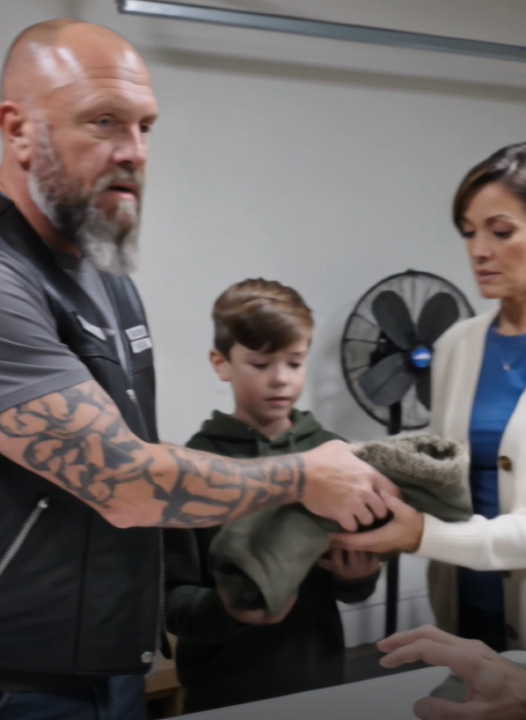
“Maybe Uncle Dean meant another Hank.”
“Maybe.”
I said it for him.
Not because I believed it.
There weren’t many Hank Ellises in Chillicothe, Ohio. There were even fewer who owned a motorcycle garage and had spent sixteen years wondering where Cal had gone.
I crouched so Owen wouldn’t have to look up.
“Where’s your mom?”
“Next door.”
“Would you ask her to come over? You can leave the jacket here, or take it. Your choice.”
He studied me.
Then folded the coat carefully.
“I’ll take it.”
Good.
I liked that he hadn’t automatically trusted us.
When he left, Benny came out from under the truck.
“What the hell was that?”
I shook my head.
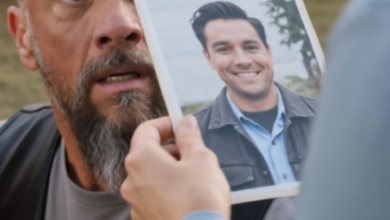
On the office wall hung a faded photograph from a charity ride. Cal stood beside me in that jacket, grinning around a paper cup.
I had looked at that picture for years without studying it.
Now I couldn’t look away.
There was something else bothering me.
A statement.
A form.
Dean had brought paperwork after Cal vanished. He said it would help settle the shop accounts and keep Cal’s daughter fed.
I had signed as a witness.
Not to a death.
I was certain of that.
Almost certain.
Sixteen years is enough time for certainty to develop soft spots.
Nora Bell came through the open bay with Owen beside her.
She was thirty-two now.
The last time she had stood in my garage, she was sixteen and wearing a black dress to the memorial Dean arranged.
No coffin.
A framed photograph.
Flowers beside a helmet.
I remembered being told she didn’t want to speak to any of us.
Now she looked at the photograph on my wall.
Then at me.
“Did you find my father?”
“No.”
Her hand went to Owen’s shoulder.
“But you knew he died.”
“I knew what your uncle told me.”
She took a breath that seemed to catch halfway down.
“He said you were there.”
“At the memorial.”
“No. At the place they found him.”
The garage door rattled in the wind.
I asked Ray to turn the front sign around. We weren’t closing permanently. We just needed an hour without people asking about oil changes.
In the office, Nora sat on the edge of a chair.
“Uncle Dean handled everything,” she said. “I was sixteen.”
“So was your dad, once. When I met him.”
I stopped.
That wasn’t useful yet.
We needed dates.
Documents.
Something harder than grief.
Nora opened a storage box she had brought from her car. Beneath photographs and an old school folder lay several envelopes addressed to her.
One carried a postmark from six months earlier.
Why was a man we had mourned still writing to his daughter?
Twenty years earlier, Cal’s kitchen smelled of onions and burnt toast.
Nora was twelve.
She sat at the table forcing a needle through his jacket cuff while he pretended not to notice every time she stabbed the wrong place.
“It’s a moon,” she told me.
“Looks like a bent staple.”
She kicked my boot.
Cal laughed so hard he spilled his coffee.
He had asked her to stitch a small pocket behind the lining for emergency bus money. She added the blue crescent because, she said, otherwise he would forget where it was.
Dean sat across from us sorting invoices.
The brothers owned a small commercial repair business then. Cal handled the work. Dean handled the money.
Whenever an invoice had been paid, Dean tore off its upper-right corner before filing it.
“Stops me paying twice,” he said.
Cal told him a pen would do.
Dean said Cal lost pens.
Nora finished three stitches, announced that sewing was terrible, and pushed the jacket into her father’s lap.
He wore it anyway.
That was what I remembered while Nora held the recent envelope.
The blue pocket.
The torn corners.
A perfectly ordinary evening before every object in it became something we needed to explain.
“Open it,” I said.
She looked at Owen.
Ray offered him the waiting-room television. He declined.
“I’m staying.”
Nora nodded.
Inside was a letter written in block capitals.
Nora, I don’t know whether the others reached you.
I’ve stopped asking your uncle for permission to try.
There was a telephone number.
A post-office box in Dayton.
A signature.
Dad.
Nora read the first line again.
Then the second.
She didn’t cry.
She laid the page flat and pressed her palms beside it.
“My grandmother died in February,” she said. “Dean told me the storage unit was full of junk. He kept putting off giving me the key.”
“What changed?”
“The bill. They sent it to me as the estate contact.”
She had paid the overdue balance and gone that morning.
Owen found the jacket inside a garment bag.
Nora found the letters in a carton marked SCHOOL.
She thought they were old.
She hadn’t checked the dates.
I brought her water.
She left it untouched.
“Why would Grandma keep these?”
“Maybe she didn’t put them there.”
The unit held things Dean had removed from his mother’s house over several years. Nora had assumed everything belonged to the same period.
It didn’t.
Some boxes were dusty.
The letter carton had fresh packing tape.
Nora dialed the number.
Voicemail.
A man said his name was Cal and asked callers to leave a message.
Older voice.
Rougher.
But I knew it.
I gripped the back of the chair.
Nora hung up before the tone.
“I can’t.”
“You don’t have to.”
Owen looked from her to me.
“If he’s alive, why didn’t he come get her?”
None of us answered.
The boy had reached the question the rest of us were carefully walking around.
Nora turned the jacket over.
Something crackled behind the lining.
Was the answer already inside the pocket she had sewn for him?
We didn’t cut the coat open.
Nora remembered enough of the stitching to find the concealed opening beneath the inner seam.
She slid two fingers inside.
The blue envelope came out folded nearly in half.
On the front, in Cal’s handwriting, were three words.
Hank. Read first.
My name looked younger.
I sat down.
Inside were carbon copies of payment records, two repair invoices, and a short note.
Cal had written that he needed me to compare them with the charity-run accounts.
He said Dean was moving money through a vendor Cal didn’t recognize.
He said he had left the jacket on my office chair because he couldn’t wait.
I stared at that sentence.
“He never brought it here,” I said.
Ray leaned against the door.
“You sure?”
“No.”
The word tasted bad.
I remembered the last week before Cal vanished. We had argued about missing money from a fundraiser for an injured rider’s family.
Dean showed me invoices.
Cal’s signatures.
A bank withdrawal.
I confronted Cal.
He said I didn’t understand.
I told him to bring proof.
Apparently he had.
And I had spent sixteen years believing he hadn’t.
Nora looked at the note.
“Dean said Dad stole the money.”
“He told me the same thing.”
“What did you believe?”
I could have softened it.
I didn’t.
“Too much.”
Owen stared at my hands.
I folded them beneath the table.
Nora used my office phone to call Dean. She put him on speaker.
She didn’t mention the letter or the hidden envelope.
Just the jacket.
His voice warmed immediately.
“Oh, sweetheart. You found that old thing.”
“You said Hank identified Dad.”
Silence.
Then a sigh.
“I said Hank confirmed the belongings.”
I looked at Nora.
She looked at me.
It was possible.
Not likely.
Possible.
“Did you tell me there was a body?” she asked.
“You were a child. We were all trying to spare you.”
“Was there?”
“Let’s talk in person.”
He sounded tired.
Responsible.
A man dealing with a painful misunderstanding.
For several seconds, I wondered whether we were doing this backward—taking old grief and turning every imperfect sentence into evidence.
Then Dean arrived.
He smiled at Owen.
Held out his hand for the jacket.
And told us whatever was in the blue envelope wouldn’t change what Cal had done.
Nora’s fingers closed around my sleeve.
I asked how he knew about the envelope.
Dean looked at her.
“You showed him?”
She said nothing.
He checked himself.
“Cal was always stuffing things in that coat.”
“An envelope?” I asked.
“A guess.”
“Blue?”
He took his hand back.
The office seemed to shrink around him.
Then he looked at me instead of his niece.
“You signed the statement, Hank.”
I remembered my uncertain signature.
The paper I hadn’t found yet.
What had I helped him put into the official story?
Dean left without the jacket.
He said Nora was exhausted, that I was stirring up trouble, and that we should speak when everyone had calmed down.
Owen watched his car pull away.
“He always says that when Mom asks about money.”
Nora closed her eyes.
“Not now, honey.”
The money question stayed.
I called an attorney who had helped with my shop lease. She referred us to Marisol Vega, who agreed to meet Nora the next afternoon.
Before then, we made copies.
Photographed envelopes.
Wrote down who had found what.
Ray brought sandwiches nobody wanted until Owen opened his.
Then we ate because he was watching.
Marisol began with the missing-person report.
Cal had been reported missing by his mother.
Months later, an investigator located him out of state. He confirmed he was an adult who had left voluntarily and did not want his location disclosed.
The file had been closed.
He had not been declared dead.
Nobody had asked me to identify him.
My statement concerned property.
Dean had said Cal wanted his business interest transferred to settle the money he owed.
I witnessed Dean signing a document.
I had not witnessed Cal’s signature.
That distinction was in my statement.
Dean’s version of it had grown over time.
Nora read the report until her hands shook.
“So someone knew he was alive.”
“Yes,” Marisol said. “That doesn’t tell us what your uncle told you afterward.”
The records gave us one answer and removed our easiest explanation.
Cal had not been trapped somewhere.
He had left.
We still needed to know why.
The blue envelope gave Marisol a starting point for the financial questions. It wasn’t a complete case. Old carbon copies could be incomplete, misleading, or impossible to verify.
But the vendor name appeared again.
Nora recognized it from a recent donor statement.
Dean now ran a nonprofit that funded tools and trade-school fees for young people.
Our riding group raised money for it.
I had handed him checks.
Last month.
Last year.
For years.
The vendor was still billing the organization.
Marisol helped Nora submit the documents to the nonprofit’s independent board members and retain an accountant to examine records Nora lawfully possessed as a volunteer bookkeeper.
She had been helping Dean on weekends.
He called it family service.
The accountant found repeated payments to a company controlled by Dean through another business.
Tools charged for twice.
Training sessions the listed instructor said he had never taught.
The old envelope wasn’t merely a relic.
It described the beginning of something still happening.
That night, Cal returned Nora’s call.
She asked me to stay.
His first word was her name.
She stared at the wall.
“Are you my father?”
“Yes.”
“Then tell me something Uncle Dean couldn’t have told you.”
There was a long pause.
Then Cal said, “You put bus money in my jacket. But you always took a dollar back for the sewing.”
Nora covered her mouth.
Owen moved closer to her.
On the telephone, a man began to cry.
If he had remembered that little pocket all these years, how had he lived without the girl who made it?
Dean reacted before we met Cal.
First came an email from a lawyer asking for the return of business documents he claimed belonged to him.
Marisol handled that.
Then came calls to Nora.
At work.
At home.
To her former husband, who shared custody of Owen and had nothing to do with any of this.
Dean described me as unstable.
Said the riding group was pressuring Nora.
Suggested Owen had been frightened into repeating things he didn’t understand.
I read the message Nora forwarded and felt my face get hot.
Ray took my keys off the desk.
“Walk around the block.”
“I’m not going anywhere.”
“Then walk around the building.”
I did.
Twice.
The hardest thing about being accused of frightening somebody is knowing anger will make the picture easier to sell.
Nora’s manager asked her to stop taking family calls at the clinic.
Her former husband wanted to know why their son was involved.
She told him.
All of it.
He came to the garage that evening.
His name was Matt. I had never met him.
He listened, looked at the copies, then crouched beside Owen.
“Did anybody tell you what to say?”
“No.”
“Are you scared of Hank?”
Owen looked at me.
“A little at first.”
Fair.
“Now?”
“He gave me the jacket back.”
Matt nodded.
After that, Owen stayed with his father while Nora handled the meetings.
Not because anyone took him away.
Because she decided he needed a few evenings when grown people weren’t dismantling his family at the kitchen table.
Dean tried one more route.
He offered Nora money.
Enough to clear her car loan.
Enough to catch up on rent.
The message called it an advance on what his mother had intended her to receive.
Then came the condition.
Stop circulating allegations.
Return the originals.
Nora sent the message to Marisol.
She did not answer him.
Three days later, somebody tried the garage office door after closing.
The camera showed Dean’s pickup.
It showed him checking the handle.
Then leaving.
We reported it.
Changed the lock.
Moved the originals somewhere he couldn’t reach.
No chase.
No confrontation in a parking lot.
Just another fact added to a growing file.
Cal agreed to meet Nora in Dayton at a diner near the warehouse where he worked.
He used his own legal name.
He hadn’t lived under a stolen identity.
He had moved.
Worked.
Paid taxes.
Let the years accumulate.
That ordinary explanation hurt Nora more than a dramatic one might have.
Before we left, she stood beneath his photograph in my office.
“You looked for him?”
“Yes.”
“How long?”
I looked at the floor.
“Not long enough.”
She nodded once.
Then asked me to drive.
We rode in my truck.
The jacket lay on the back seat, folded beside a paper bag containing the letters Dean had never passed on.
Halfway to Dayton, Nora asked whether I thought Cal had a good reason.
I kept both hands on the wheel.
“I think we should hear his.”
What if the man waiting for us had been hiding from something besides his brother?
Cal stood when we entered.
I knew him immediately.
That surprised me.
I had expected age to make a stranger of him.
Instead, it was my friend with thinner hair, heavier glasses, and a cautious way of holding his shoulders.
He looked at Nora.
She stopped three feet from the table.
“Hi,” he said.
She stared.
“That’s what you have?”
He lowered his eyes.
“No.”
We sat.
Nobody ordered.
Cal began with the money.
There had been real wrongdoing.
His.
Not all of it Dean’s.
Years before he vanished, the business had been struggling. Dean moved fundraiser money into payroll and told Cal it would be replaced before anybody noticed.
Cal signed papers he should not have signed.
He told himself saving four jobs justified borrowing money that wasn’t theirs.
It didn’t.
When Cal discovered Dean had also been paying himself through false vendor bills, he copied records.
The blue envelope.
My office chair.
The proof I had demanded.
Dean found the jacket first.
He told Cal I had read the documents and wanted nothing to do with him.
“He said you were going to the police.”
“I should have,” I said.
Cal nodded.
“Yes.”
That stopped me.
He wasn’t asking to be declared innocent.
He had signed over his business share under pressure, believing Dean would replace the missing funds and keep Nora supported.
Then he left for a few weeks.
That was what he called it.
A few weeks.
“What about your daughter?” Nora asked.
Cal rubbed the paper napkin between his fingers.
“I thought I’d come back when I had enough to make things right.”
“You were my father. Not my bank account.”
“I know.”
“No. You knew then, too.”
He stopped rubbing the napkin.
“Yes.”
When an investigator found him, he confirmed he had left voluntarily.
He thought Nora was safe with his mother and brother.
He was ashamed.
Afraid of the signatures he had put on those papers.
Afraid that coming home would mean looking at everybody he had disappointed.
Dean later told him Nora knew what he had done and wanted no contact.
Cal wrote anyway.
To the family address.
Through Dean.
Through his mother, until she became too ill to manage correspondence.
Then he wrote again.
But he didn’t come.
That fact sat between us after every explanation.
Nora opened the newest letter.
“You wrote that you stopped asking him for permission.”
Cal nodded.
“Six months ago.”
“Why did it take you sixteen years?”
He looked at his hands.
“I don’t have an answer that makes it better.”
The waitress approached.
Saw our faces.
Set a coffee pot down and walked away.
Nora began crying then.
Not loudly.
Cal didn’t touch her.
He asked.
She said no.
He accepted it.
I had spent days imagining bringing an innocent man home.
Instead, I had brought a father face-to-face with what he had chosen.
On the drive back, Nora watched the road.
“He can be a victim of Dean and still have abandoned me.”
“Yes.”
She wiped her face with her sleeve.
“I need both to be true.”
Back at the garage, my phone held a message from a board member.
Dean had demanded an open donor meeting to clear his name.
Would Cal tell the same ugly truth in a room where it could cost him something?
The meeting took place three weeks later in a rented room above the community center.
The board controlled the agenda.
Marisol had already helped send relevant information to the appropriate authorities. Nobody was pretending a donor meeting could replace an investigation.
But donors deserved an accounting.
And Dean had insisted on speaking.
He arrived in a navy suit carrying a folder.
I wore a clean shirt beneath my vest.
Nora sat beside Marisol.
Cal sat two chairs away from her.
The distance was her choice.
Ray and Benny came because our group had raised money for the program. So did several shop owners whose names appeared on donation checks.
There were no motorcycles revving outside.
No row of men blocking a door.
Dean stood beneath the fluorescent lights and talked about service.
Young people.
Second chances.
How painful it was to watch a family dispute threaten good work.
Then he looked at Cal.
“My brother made choices sixteen years ago.”
Cal didn’t look away.
“Yes,” he said.
The room shifted.
Dean had expected denial.
Cal stood when the chair recognized him.
He admitted signing improper payments.
Admitted leaving.
Admitted letting shame become an excuse for staying away.
He did not call himself a victim.
Then he explained the records.
The blue envelope.
The vendor bills.
The difference between money he had helped misuse and money Dean continued diverting afterward.
The accountant presented current transactions.
Dates.
Amounts.
Invoices.
The vendor’s ownership records.
Dean’s attorney, seated beside him, asked that certain questions be reserved for a formal response.
The board chair agreed.
Then Dean opened his own folder.
He held up an invoice.
“This proves the bill was paid. Cal always misunderstood the filing system.”
I leaned forward.
The upper-right corner was missing.
For a second, I was back in Cal’s kitchen watching Dean sort papers while Nora struggled with a needle.
Marisol touched my arm.
I wrote one sentence on her pad.
She read it.
Then passed it to the accountant.
He examined the invoice.
Asked whether that was the same copy Dean had previously described as an unpaid vendor demand.
Dean said it was.
The accountant displayed the earlier scan from the organization’s electronic records.
Same invoice number.
Same tear.
Same faint coffee stain.
But that earlier copy had supported a different payment request.
Dean had presented the same paid invoice again.
One of several duplicates the accountant had identified.
The torn corner wasn’t proof by itself.
It was something we could point to while the transaction dates and bank records did the heavier work.
Dean looked at the screen.
Then at me.
“You don’t understand how these things were handled.”
I kept my mouth shut.
The board chair asked who had authorized the second payment.
Dean said the records were incomplete.
The accountant displayed his approval email.
Silence moved through the room.
Not dramatic silence.
People reading.
People checking numbers.
People realizing they had written checks to a man whose explanation no longer matched his own paperwork.
Then Nora spoke.
“Did you tell me my father was dead?”
Dean shut his folder.
“I tried to give you stability.”
“Did you?”
He looked at her as though she were still sixteen and should know better than to embarrass him.
“You needed a father who stayed.”
Cal flinched.
Nora didn’t.
“So you decided I couldn’t know I still had one.”
The board suspended Dean’s authority over accounts and programs while the review continued.
There was no applause.
I was grateful.
Outside, Cal stood on the steps with his hands in his pockets.
He had lost his excuse in public.
Dean had lost control of the story.
Nora walked past both men and came toward my truck.
Now that everybody knew what had happened, who would actually do the work of living differently?
The consequences arrived at different speeds.
The nonprofit appointed outside financial oversight and notified donors.
Some programs paused.
Others continued under new management.
That mattered to Nora.
She didn’t want children losing training opportunities because the man managing the money had used them as cover.
Investigators examined the current records and the older documents that could still be verified.
Months later, Dean faced charges connected to the more recent transactions.
The case continued beyond the winter.
I stopped telling people it was over.
It wasn’t.
Cal obtained his own lawyer and cooperated concerning his part in the earlier misuse of funds.
There were questions that age and missing records made difficult to resolve.
He didn’t get to substitute being betrayed for answering them.
He returned money he could document owing.
Set up a payment arrangement for more.
Kept his warehouse job.
He did not move into Nora’s life as though a chair had been held for him.
At first, they spoke on Sundays.
Ten minutes.
Sometimes five.
Sometimes Nora canceled.
Cal answered the next week anyway.
He sent Owen a birthday card.
Nora read it first.
There was no photograph of a motorcycle.
No claim that they were already best friends.
Just a note saying he would like to know what Owen enjoyed, if Owen felt like telling him.
The boy wrote back about model airplanes.
Cal knew nothing about them.
He said so.
That was a better beginning than most of us had managed.
I apologized to Nora for believing too much of Dean’s account.
Then I apologized to Cal for not asking harder questions.
Neither apology changed sixteen years.
Nora accepted mine on a Thursday while helping Owen finish a school project in my office.
Cal accepted his while we were replacing a wheel bearing.
He still knew where I kept the sockets.
That almost broke me.
For a long time, I had imagined finding him and asking how he could do this to us.
When he finally stood beside my workbench, the question was still there.
But there was also a stubborn bolt.
An old habit.
A man handing me the correct tool without being asked.
We worked.
We talked.
We stopped when we needed to.
The jacket stayed with Nora.
She refused to display it on a wall.
“It’s a coat,” she said. “It’s been carrying enough.”
The documents were removed and preserved.
A leather repairer strengthened the seam without covering the blue crescent.
Nora paid for it herself.
One Saturday in April, she brought Owen to the garage.
Cal was there.
Not as a surprise.
She had agreed in advance.
Owen carried a plastic model airplane with a broken landing wheel.
He put it on the workbench.
“Mom says you fix things.”
Cal glanced at Nora.
Then back at the boy.
“Some things.”
“Can you try?”
“Yes.”
I went into the office to make coffee.
Through the glass, I watched them bend over the little airplane.
Nora stood nearby, arms folded.
Still cautious.
Still there.
The old jacket hung over the back of her chair.
One sleeve had slipped toward the floor.
I wondered who might wear it next, years from now, when its history no longer felt heavier than the leather.
Owen reached down and lifted the cuff.
“Don’t lose the moon,” he said.