A Biker Found His Former Teacher Sleeping in a Car With Her Old Dog—Then Discovered Why Her Daughter Had Told Everyone She Was Safe
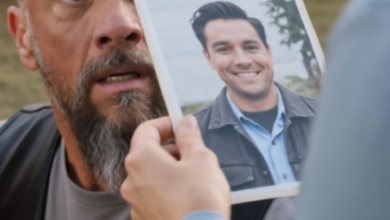
I took Hank’s phone and enlarged the picture with fingers that no longer obeyed me on cold mornings.
There was Leah.
My daughter.
Her blue coat. Her sensible shoes. One hand resting on the porch railing my husband had painted every other spring.
Beside her stood Evan.
The sign between them was unmistakable.
I looked at the date beneath the neighborhood association’s post.
Eleven days earlier.
“They told me the furnace needed replacing,” I said.
Hank stayed crouched outside my window.
“That’s why you left?”
“They said the house wasn’t safe until the work was done.”
Otto shifted his weight against my knee. He had arthritis in both hips, and the movement made him sigh like an old man settling into church.
Hank glanced at him, then back at me.
“Where were you supposed to stay?”
“An apartment.”
“What happened?”
“No dogs.”
That was the short version.
The one that made me sound stubborn.
The apartment manager had explained the policy politely. I had explained Otto was twelve and slept eighteen hours a day. Neither fact changed the lease.
Evan told me a rescue would find him a good home.
I asked which rescue.
He said I was making things difficult.
So I left.
I had been sleeping in the Buick for sixteen nights.
I hadn’t told Leah.
Every time she called, she sounded so relieved that I was somewhere warm. At first I thought she knew about the dog and was waiting for me to surrender.
Then shame made the conversations shorter.
Now her face was smiling beside my sold house.
I handed Hank his phone.
“Perhaps I signed something.”
He didn’t rush to disagree.
That frightened me more than reassurance would have.
There had been papers after my husband died. Insurance papers. Banking papers. A document allowing Evan to help when my hands were recovering from surgery.
I remembered signing.
I also remembered forgetting an appointment last month and finding my glasses in the refrigerator beside Otto’s medicine.
Perhaps they were right about me.
Perhaps things were slipping.
Hank rested his forearms on his knees.
“Mrs. Delaney, when did you last eat something hot?”
“Yesterday.”
“What?”
I considered lying.
“A baked potato.”
“Where?”
“The grocery deli.”
He nodded toward the restaurant across the lot.
“Would you let us buy lunch?”
“I have money.”
“I didn’t say you didn’t.”
Behind him, Ray Foster stood holding a knit cap between both hands. Benny Ortiz had already gone into the store and returned with a bag of dog food.
They looked older than I expected.
Of course they did.
So did I.
Hank opened the passenger door only after I nodded. He lifted Otto carefully, supporting his back legs, and settled him on a folded blanket in Ray’s truck.
Nobody mentioned a shelter.
Nobody called my daughter.
Inside the restaurant, the waitress brought coffee before I asked.
Hank slid his phone across the table again.
The photograph was gone.
He had found the real-estate listing.
Under ownership history was a company name I had never heard.
How could a house my husband left to me belong to someone else?
Eight Thanksgivings earlier, my kitchen had been full.
Leah brought sweet potatoes in a dish she always forgot to take home. Evan carved the turkey while my husband, Arthur, pretended not to supervise.
Hank came late from the repair shop, carrying grocery-store flowers.
He had been visiting every few months then.
Otto, still young enough to steal, escaped beneath the table with a dinner roll.
Arthur rang the cracked brass bell.
“Attendance, Ruth.”
I opened the red notebook beside my plate and wrote everyone’s name. I used it for groceries, borrowed money, birthdays, and who had eaten at our table.
“Still keeping records?” Evan asked.
“Someone has to.”
He photographed us beneath the blue kitchen cabinets.
That spring, after a pipe burst, we replaced those cabinets with pale green ones. Arthur gave the old breakfast counter to Hank for his shop.
Evan complained that the green made the room look smaller.
Arthur said nobody had ever come for the size of our kitchen.
That was the last Thanksgiving before his illness.
I remembered it while Hank made a phone call outside the restaurant.
The red notebook.
The blue cabinets.
Small things I had no reason to doubt.
Ray paid the check without announcing it. Benny found a motel that allowed dogs and had rooms opening directly onto the parking lot.
“I can pay,” I said again.
“Then pay tomorrow,” Ray said. “We already booked tonight.”
Their kindness embarrassed me.
I had bought these boys lunches when they pretended to forget theirs. Now they were handling me with the same clumsy care.
Hank returned.
“My sister knows an attorney who handles property disputes.”
“I don’t need a courtroom.”
“You need to know what happened.”
He said it gently.
Still, I heard my own classroom voice coming back.
At the motel, I unpacked my belongings onto a bedspread patterned with brown leaves.
Two sweaters.
Medication.
Arthur’s photograph.
A folder of documents I had stopped opening.
My red notebook.
Hank noticed it.
“You still have that thing?”
“This is the fifth one.”
He smiled for the first time.
“You wrote down the twelve dollars I borrowed for work boots.”
“You paid back nine.”
“I did?”
“Three dollars a week. You got the job before the last payment.”
He took out his wallet.
I pushed his hand away.
“Don’t be ridiculous.”
Otto walked a slow circle on the blanket Benny spread beside the heater.
For the first time in over two weeks, I took off my shoes somewhere I could stand upright.
Hank left his number on motel stationery.
No speech.
No promise to fix everything.
Just a number, large enough to read.
After he left, I opened the folder.
A sales document lay beneath my insurance card.
At the bottom was my name in a confident blue signature.
I hadn’t written that smoothly since my hand surgery.
Whose memory was failing—mine, or the story my family had told me?
Leah arrived the next morning before Hank.
She knocked so softly that Otto didn’t wake.
When I opened the door, she looked past me at the bed, the medicine bottles, the dog bowl beside the heater.
Then she looked at my feet.
I was wearing the thick socks Benny had bought.
“Mom?”
I stepped aside.
She didn’t sit.
“Why are you here?”
“Where did you think I was?”
“At Willow Court.”
“I never moved in.”
Her mouth opened.
For several seconds, nothing came out.
Then she took her phone from her purse and showed me photographs.
A small living room.
A recliner.
A kitchen with a bowl of oranges.
Evan had sent them.
Under one, he had written: Your mom finally settled. She needs quiet, so let her call when she feels ready.
Leah scrolled farther.
There were messages about deliveries, a broken elevator, the new television.
An entire life I had never lived.
“You thought these were mine?”
“He said you didn’t want visitors yet.”
“You called me.”
“And you said you were managing.”
I remembered.
I had said precisely that.
Every time.
Leah sat on the edge of the bed.
Her nursing badge was still clipped to her coat. She had come straight from an overnight shift at the rehabilitation hospital.
“The house,” I said.
She covered her face.
“I thought you agreed.”
“You stood beside the sign.”
“Evan said the proceeds would pay for your apartment and help fund your care later. He said you didn’t want to deal with strangers.”
I showed her the signature.
She stared at it.
Then at my right hand.
“He told me your grip was better.”
“It is better.”
“But not like that.”
“No.”
She began to cry.
I wanted to comfort her.
I also wanted to ask why she had not knocked on the apartment door once in sixteen days.
Both feelings stayed.
When Hank arrived, Leah stood abruptly.
“I didn’t know.”
He looked at me before answering.
“All right.”
Not forgiveness.
Not accusation.
Room to find out.
The attorney came at eleven. Her name was Nora Bell, and she brought a yellow pad rather than a stack of papers.
She asked what I owned, what I had authorized, and what documents I could locate.
Leah handed over her phone.
With my permission, Nora called Willow Court.
Their manager confirmed that an apartment had been reserved but never occupied. The photographs showed a furnished model unit.
The reservation had been canceled.
Not by me.
By Evan.
Four days before he told Leah I had moved in.
Leah went white.
Nora wrote down the manager’s name and asked for confirmation by email.
Then she called the number on the real-estate listing.
A recorded greeting named the seller’s company.
Cedar Lane Holdings.
Leah lowered her eyes.
“What?” I asked.
She swallowed.
“That’s Evan’s company.”
If my daughter had been fooled, what had her husband needed her to help him hide?
Nora did not promise to reverse the sale.
First she wanted the recorded documents, the closing file, and the authority Evan claimed to have used.
“Do you have a copy of the power of attorney?” she asked.
I pointed to my folder.
Arthur had kept everything in labeled envelopes.
After he died, I tried.
But grief had turned simple tasks into places where I got lost.
Nora read the document without commenting.
Then she asked for the page beneath it.
A transfer had placed my house into Cedar Lane Holdings.
A later agreement concerned a sale to another buyer.
The sale had not yet closed.
The sign in the photograph was ahead of the paperwork.
That distinction gave us something we hadn’t had before.
Time.
“The company is controlled by Evan?” Nora asked Leah.
“Yes.”
“Was that explained to your mother?”
“No,” I said.
Leah shook her head.
Nora requested records and sent notices that afternoon. She explained each step before taking it.
I understood perhaps half the legal language.
I understood the practical part.
Nobody should complete another transaction while we disputed what had already happened.
Over the next three days, paper replaced rumor.
The furnace company had inspected my house.
There was a genuine problem.
It required a repair.
Not evacuation for weeks.
Not selling the house.
Their estimate was less than Evan had said the motel would cost for a month.
Then came the bank statements.
My pension still arrived.
So did the small payment from Arthur’s retirement plan.
The money had not disappeared all at once.
It had been moved in amounts labeled household support, relocation, property management.
I had spent nights counting change for laundry while paying for an apartment I never occupied.
Leah read the statements sitting on the motel floor.
“I asked him if you needed anything.”
I watched her finger move down the page.
“He said you were being careful with money. That we should respect your independence.”
A payment from my account had gone toward a loan on Evan’s stalled commercial renovation project.
Another had covered property taxes owed by Cedar Lane.
He had not merely sold something I loved.
He had used my name to keep his own business breathing.
Hank stood by the window.
His jaw worked beneath his beard.
He said nothing until I asked him to.
“I want to go over there,” he said.
“To Evan?”
“Yes.”
“And do what?”
He looked at his hands.
“Nothing useful.”
That answer made me trust him more.
Nora arranged for a court filing to challenge the transactions and seek immediate restrictions while the records were reviewed.
Leah moved into her sister’s spare room.
She didn’t tell Evan where I was staying.
He found us anyway.
On the fourth afternoon, his truck stopped outside my motel door.
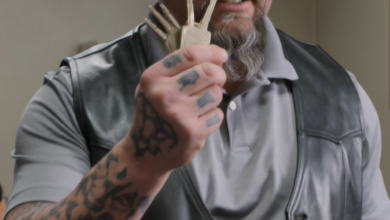
He stepped out carrying my house keys.
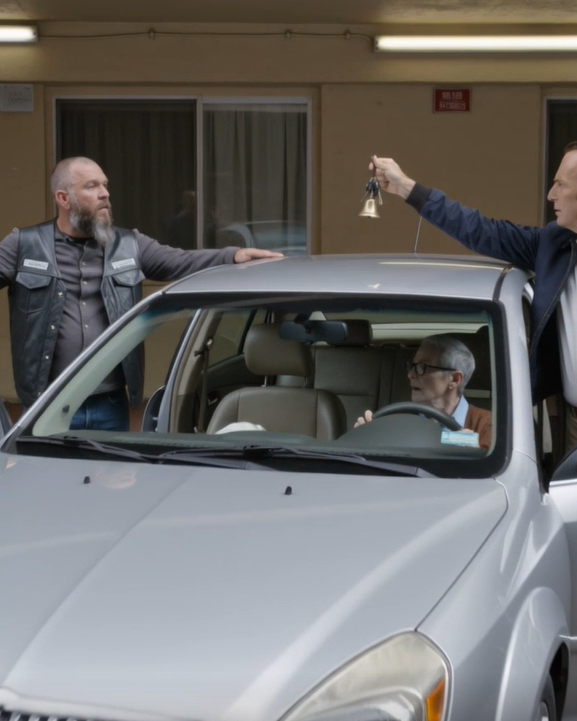
The little brass bell sounded wrong when he swung them.
Hank had come to drive Otto to a veterinary appointment and was standing beside my car.
Evan smiled at him.
“Family matter.”
I opened the door before either man answered.
How had he learned my room number when my daughter hadn’t given it to him?
Evan had tracked the Buick through a roadside-assistance device he installed the previous winter.
He called it a safety feature.
He had shown me the emergency button.
He had not shown me the location app.
I learned that afterward, when Leah found the account.
At the motel, all I knew was that he stood there with my keys.
“You’re worrying everyone,” he said.
“Then stop telling them I’m somewhere else.”
His smile thinned.
He looked at Hank.
“Could you give us a minute?”
Hank looked at me.
“No,” I said.
Evan changed his voice.
The patient voice.
The one people used when explaining why their mother could no longer be trusted with scissors.
“Ruth, we’ve been through this. You agreed the house was too much.”
“I agreed the gutters were too much.”
“You signed.”
“Then bring the original.”
His fingers closed around the keys.
“I came to take you somewhere comfortable.”
“Does it allow dogs?”
He glanced at Otto, visible through my open doorway.
“That’s part of the problem.”
Hank stepped closer.
Not toward Evan.
Toward me.
That small choice mattered.
Evan held up the key ring.
“I’m taking the car for safekeeping.”
Hank said, “Put my teacher’s keys down.”
The bell gave one flat clink.
Evan looked around.
Ray had arrived behind him. Benny was standing beside Ray’s truck.
Three men who knew how to wait.
None touched him.
“Then ask her,” Hank said.
Evan put the keys on the roof.
As Hank handed them back, Evan’s phone lit up.
I saw the message.
Buyer wants her out before inspection.
He turned the screen inward.
Too late.
After he left, the trouble changed shape.
A concern report reached local services.
The motel manager received a call about dangerous dogs and disruptive motorcycle activity.
Someone posted online that a vulnerable retired teacher had been “taken in by men exploiting her confusion.”
No names.
Enough details.
A former colleague called to ask whether I was being held somewhere.
I wanted to laugh.
Instead, I had trouble breathing.
Hank began leaving his vest in the truck when he visited.
I told him not to.
“It makes people talk.”
“They were talking before you got here.”
A social worker came.
I answered her questions alone.
I showed her my medication, my bank records, the attorney’s card.
She asked where Otto slept.
“Beside me.”
“Does he have food?”
I opened the cupboard.
She looked at the stacked cans, the clean bowl, the veterinary appointment receipt.
Then she asked what I wanted.
The question nearly undid me.
“My house back.”
She wrote it down exactly.
Nora advised us to preserve the posts and messages. The motel kept us in the same room. Ray removed the tracking device only after the account information had been documented.
Still, I began checking the parking lot whenever a truck slowed.
That evening, Hank asked why I had trusted Evan with so much.
I looked at the red notebook on the table.
There was an answer I had not given Nora.
What would Hank think when he learned I had helped Evan hide money from my own daughter?
I told Hank first because I was ashamed to tell Leah.
Two years earlier, Evan had come to my kitchen after dark.
Arthur had been dead six months.
The house was quiet enough that I could hear the refrigerator stop humming.
Evan brought doughnuts.
He said a construction payment had been delayed. Payroll was due. If he missed it, men with children would lose work.
He needed eighteen thousand dollars.
For six weeks.
“Leah will worry herself sick,” he said.
I had spent forty years recognizing that sentence in different forms.
Don’t tell my parents.
Don’t call the school.
Just this once.
Sometimes I helped anyway.
I wrote a check.
I wrote the amount in my notebook.
And I agreed not to tell my daughter.
“He paid some back,” I told Hank.
“How much?”
“Four thousand.”
“When?”
“The first three months.”
“And after?”
I rubbed the notebook’s cloth cover.
“He always had a reason.”
Hank sat across from me.
The chair looked too small beneath him.
“Why didn’t you tell her?”
“Because I didn’t want her to think I’d been foolish.”
There it was.
Not generosity.
Not the memory of Arthur feeding hungry students at our table.
Pride.
I had wanted to remain the woman who knew how to help.
I hadn’t wanted my daughter sorting my choices into evidence that I needed supervising.
Hank watched me without rescuing me from the silence.
Finally he said, “You should tell the lawyer.”
“I know.”
“And Leah.”
“I know that, too.”
Leah came after work.
I placed the notebook between us and showed her the page.
She read it twice.
“You knew he was struggling.”
“Yes.”
“You knew he was borrowing.”
“Yes.”
“And when I asked whether something was wrong, you said he was just tired.”
I nodded.
She stood up.
For a moment, I thought she would leave.
Instead, she walked to the window and pulled the curtain back.
“I thought I was imagining it,” she said.
“What?”
“The bills. The late calls. Money moving out of our savings. Every time I asked, he said everybody else understood except me.”
I had helped him make her doubt herself.
The realization sat heavily in my chest.
“I’m sorry.”
She did not answer immediately.
Otto crossed the room and leaned against her leg.
She rested a hand on his head.
“I need you to tell me things even when I won’t like them.”
“All right.”
“Especially then.”
The notebook changed Nora’s understanding of the case.
Evan had a real loan to point to.
Real permission for one transaction.
A relationship he could describe as ongoing financial support.
But the entries also established dates, amounts, repayments, and the limits I had written down.
Six weeks.
Loan.
No interest.
My handwriting had grown less steady across later pages, then changed after surgery to larger block letters.
Nora photographed every page.
She asked about my kitchen.
The cabinets.
The removed counter.
I answered, puzzled.
She showed me Evan’s written account of the disputed property transfer.
He described me signing at the blue breakfast counter last September.
Hank’s eyes moved toward the window.
“The blue counter’s in my shop.”
How many other details had Evan borrowed from a past he assumed I could no longer remember?
The hearing took place on a wet Thursday morning.
I wore the navy dress I had worn to Arthur’s retirement dinner.
Leah helped with the zipper.
Neither of us mentioned that I had become thinner.
Outside the courtroom, Hank stood beside Ray and Benny.
Three more former students joined them.
Marlene Price, who rode a white touring motorcycle and managed a dental practice.
Curtis Shaw, who once spent an entire semester pretending he didn’t need glasses.
And Paul Hensley, whose mother used to send me peaches.
They had not all been part of Hank’s riding group.
Word had traveled.
Some came to support me.
Some had photographs Nora requested after asking about the kitchen.
They wore clean shirts and carried their helmets.
No one lined up as if to intimidate anybody.
They sat.
They listened.
That was enough.
The hearing concerned temporary control of my property and the disputed transactions. It would not settle every account or decide every consequence that morning.
Nora had warned me.
I wanted one truthful thing said in a room where Evan could not interrupt it.
He looked respectable.
Gray suit.
Careful haircut.
A face trained to suggest that the difficult person in the family was somewhere else.
His attorney described me as generous but increasingly inconsistent.
There had been a real loan.
Real paperwork.
A real furnace problem.
All true.
All arranged to point away from the rest.
Then Nora questioned Evan about the authorization.
He said he had explained it.
He said I understood.
He said I signed while we stood in my kitchen.
“At the counter?” Nora asked.
“Yes.”
“Which counter?”
“The breakfast counter. Blue cabinets underneath.”
She let the answer remain.
Then she showed him a dated photograph from the kitchen renovation.
The blue cabinets lay dismantled in the driveway.
Another picture showed the green replacements.
Years before the supposed signing.
Evan leaned toward the microphone.
“I may have confused the color.”
Nora placed a photograph of Hank’s shop on the screen.
The old counter stood beside a parts washer.
“Did you also confuse where the counter was?”
His attorney objected to the phrasing.
The judge directed Nora to continue with questions about the document.
She did.
She asked where the original was.
Evan said he believed it had been misplaced during packing.
She asked who scanned it.
He said he had.
Then Nora showed the older letter he had used as the source.
Arthur had written it for a school fundraiser. I had signed beside him.
A tiny ink mark sat beneath the final letter of my surname.
The same mark appeared on the disputed authorization.
In exactly the same place.
A document examiner’s report described the matching signature image and the limits of what could be concluded from the files available.
It did not need to sound dramatic.
The picture was there.
So were the bank transfers.
So was the company’s ownership information.
So was the apartment manager’s written confirmation that I had never moved in.
The judge asked Evan directly whether he had transferred an image of my signature.
He looked at his attorney.
Then at Leah.
“I was putting together what she’d already agreed to.”
My daughter closed her eyes.
Not a forged life.
Just putting things together.
Like the model apartment.
Like the concerned messages.
Like the photograph beside the sign.
When Nora asked whether I had authorized using my pension to pay his company’s debt, he said I had always wanted to help.
Then I was called.
My hands shook.
I put them flat on the table.
“Yes,” I said. “I wanted to help him.”
I looked at Leah.
“I also hid the loan from my daughter. That was wrong.”
Evan lifted his head.
For a second, he seemed relieved.
Then I continued.
“I lent him eighteen thousand dollars. I did not give him my house.”
The room stayed quiet.
Behind me, someone shifted a helmet beneath a chair.
The judge issued temporary orders restricting further property transactions and requiring records and funds to be accounted for under supervision.
The larger dispute would continue.
But Evan could no longer move everything around while calling it care.
As we walked outside, Hank held the door.
“How’d we do, Mrs. D?”
I looked at the former students waiting in the rain.
For once, I had no grade to give.
What would returning home feel like after learning how quietly I could be removed from it?
It took four months to untangle the house.
Long enough for the weather to turn.
Long enough for me to stop measuring every expense against another night in the Buick.
The proposed outside sale did not proceed. The transfer into Evan’s company was later undone through the court process and a negotiated resolution.
I kept the papers.
Nora made me a plain-language summary.
I kept that on top.
Some money came back quickly.
Some became a repayment obligation secured by assets Evan had left.
Other questions went to investigators.
I gave statements and stopped asking Nora for dates she could not promise.
Leah filed for divorce.
That was her decision.
I asked once whether she was sure.
She looked at me across the diner table.
“I need you to let me know my own life.”
I put down my spoon.
“All right.”
We had both become used to explaining things away for the same man.
Learning to stop took practice.
For a while, I stayed in a small furnished rental that allowed Otto.
Then the furnace was repaired.
The locks were changed.
My mail came to my own door again.
Hank installed a rail beside the front steps. Ray found a reliable carpenter for the bathroom grab bars. Benny repaired the loose cabinet hinge without asking how long it had been broken.
I paid for the materials.
They let me.
That mattered.
The first Saturday back, I woke before sunrise and listened.
No engines idling beside my window.
No cart wheels.
No footsteps passing inches from the place where I slept.
Otto snored on the rug.
The house smelled faintly of paint and the lemon cleaner Leah used.
I sat on the edge of the bed until I understood that nobody was waiting for me to move the car.
The Buick stayed in my driveway.
I considered selling it.
Then I kept it.
The seats were professionally cleaned, and the blanket went through the wash three times. I put an emergency bag in the trunk with supplies selected by me.
The car had been a hard place to live.
It had also kept Otto and me together.
I could hold both facts.
In April, we invited people for supper.
Not a fundraiser.
I had refused that.
Not a celebration of how much everyone had done.
Just food.
Leah brought sweet potatoes and remembered her dish when she left.
Marlene brought bread.
Ray came with his wife.
Curtis wore his glasses openly.
Hank arrived late from the shop carrying grocery-store flowers.
For a moment, I saw him at seventeen.
Standing outside the juvenile courthouse, angry because being grateful felt too much like being small.
He had asked me then whether anyone would hire him after what he had done.
I had told him to come back Monday.
We would make some calls.
There had been no guarantee.
Only a next day.
Now he stood in my kitchen and asked where I wanted the flowers.
“By the window.”
He put them there.
Otto wandered beneath the table, older and slower, checking whether anyone’s generosity extended to roast chicken.
It did.
I pretended not to see.
When everyone had a plate, Hank picked up the brass bell from the shelf.
Its cracked note sounded across the room.
He looked embarrassed afterward.
“Sorry. Habit.”
“No,” I said. “That’s what it’s for.”
I opened the red notebook.
For months it had held dates, losses, appointments, and amounts I wished I had questioned.
Now I wrote down names.
Leah.
Hank.
Ray and Susan.
Benny.
Marlene.
Curtis.
Paul.
Then I paused with the pen above the page, wondering who else we might make room for next Saturday.
Hank pulled out the chair beside him.
“Saved you a seat, Mrs. D.”