A Pregnant Woman Was Abandoned at a Truck Stop—Then a Tattooed Female Biker Recognized the Lullaby Her Adoptive Mother Had Forbidden Her to Sing
The blood-pressure cuff tightened around my arm.
For a moment, that was the only thing I could feel.
Not the contraction. Not the cold sweat under my hospital gown. Just the machine squeezing while my mother stared at a woman she had supposedly never met.
“Cass,” she said.
One syllable.
The biker’s name.
I hadn’t told her.
The nurse, whose badge said MARTINEZ, stopped adjusting the monitor.
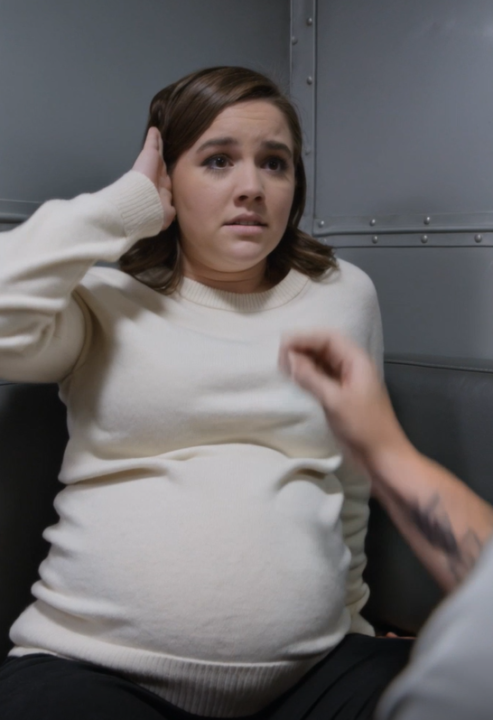
“Do you know each other?”
Elaine set her purse on the visitor’s chair.
“This woman has a history of making accusations.”
Cass didn’t answer.
She stood beside the bed in a faded gray shirt, her leather vest still folded under my overnight bag. A faded swallow covered one forearm. There were old scars across her knuckles.
My mother wore pearl earrings.
I looked between them and hated myself for noticing which woman looked easier to believe.
Another contraction started.
Cass reached toward me, then stopped before touching.
“You want my hand?”
I nodded.
Elaine moved to the other side.
“Sweetheart, you’re exhausted. Nathan said you became confused in the car.”
“He left me.”
“He went to get help.”
“With my phone?”
“He was frightened.”
I almost accepted that.
Nathan had always been the organized one. The brother who handled insurance calls, changed smoke-detector batteries, and reminded me when my registration expired.
I had been frightened enough to believe almost anything.
But Cass’s hand was warm.
Nathan’s passenger seat had been empty of everything except my tote when he drove away.
Nurse Martinez looked directly at me.
“Who would you like in the room?”
Elaine answered first.
“I’m her mother.”
The nurse kept looking at me.
“Cass,” I said.
My mother’s mouth tightened.
“Only Cass?”
“For now.”
Elaine picked up her purse. At the door, she turned.
“You don’t know what she was like back then.”
Cass watched the floor until it clicked shut.
“What were you like?” I asked.
“Seventeen.”
“That isn’t an answer.”
“No.”
She pulled the chair close without scraping it.
“My boyfriend’s parents arranged somewhere for me to stay. Said they’d help with the baby. After delivery, they told me she hadn’t survived.”
I stared at her.
“My birth mother signed papers.”
“That’s what I’ve been trying to understand.”
“You think I’m your daughter because of a song?”
“No. I think we need records because of a name.”
She swallowed.
“The song made me ask.”
That distinction kept me from asking her to leave.
She wasn’t demanding I believe her.
My mother had been.
A hospital social worker arrived shortly afterward. Cass gave her full name: Cassandra Mercer. I gave permission for her to stay.
Then my brother called the nurses’ station.
The message came through the room phone.
“He says he found your phone in his car,” Martinez told me.
There was a pause.
“He also says you asked him to leave you there.”
Cass’s hand stayed open beneath mine.
Had I said something in the car that Nathan could turn into that?
When I was nine, my mother used to sit on the kitchen floor with me during thunderstorms.
Our house outside Springfield, Missouri, had a dishwasher that rattled during the drying cycle. She would lean against it, draw me between her knees, and hum three notes while rubbing behind my right ear.
I always supplied the fourth.
Then she’d say, “There. You fixed it.”
My father, Robert, would bring us toast cut into triangles. Nathan, eight years older, pretended he was too grown up to join us, then stole the crusts.
One Saturday, Mom opened her cedar chest and showed me a blue flannel blanket with three yellow stitches near the hem.
“I made this while we were waiting for you.”
Underneath it sat a birthday card from my birth father’s mother, Doris Vale.
Elaine took that away before I could finish reading.
“Some people love making promises,” she said.
After that, the chest stayed locked.
Those were the two things I remembered while the social worker asked whether I felt safe going home.
A song with a missing note.
A blanket my mother said she had made.
I had built a childhood around them.
“My father would have told me,” I said.
Cass looked up.
“Your dad?”
“He died last winter. Robert Whitcomb. He wouldn’t have let someone tell you I was dead.”
“I don’t know what he knew.”
That answer hurt more than an accusation would have.
Robert had helped me assemble the crib after Luke’s funeral. My fiancé had died in a warehouse accident before either of us knew I was pregnant.
Dad had measured the nursery window twice because I wanted curtains that reached the floor.
Six weeks later, his heart stopped while he was carrying groceries inside.
I had lost two men who would have answered the phone.
Then Nathan had offered to handle everything.
The house.
The estate.
The paperwork I kept putting aside because reading it made my throat close.
Now I asked the social worker, Grace Bell, to help me call my father’s attorney.
“It’s after one in the morning,” I said.
“We can leave a message.”
I knew the number because Dad had written it inside his address book beneath CALL BEFORE SIGNING ANYTHING.
Grace used the room phone.
I left my name, the hospital, and a message that sounded absurd even as I said it.
“I think there’s something wrong with my adoption.”
Cass stayed quiet afterward.
When the next contraction passed, I asked where her motorcycles had been going.
“Home from a fundraiser in Joplin.”
“And you just happened to stop there?”
“Ray’s fuel light came on.”
I wanted something bigger.
A dream. A feeling. Some reason a woman who might have lost me had found me beneath a broken vending-machine light.
Instead, a man needed gas.
Grace returned carrying a plastic property bag delivered by security.
My phone was inside.
So was a handwritten note from Nathan.
“Ask Cass what she signed.”
Why would my brother know there was anything for her to sign?
The next morning, I delivered a daughter with Cass beside me.
There was nothing graceful about it.
I snapped at her for counting too loudly. Asked her to count again when she stopped. Cried because I wanted Luke, then apologized to a woman who had done nothing except hold a damp washcloth against my forehead.
“You don’t owe me good manners,” she said.
At 6:18, my daughter announced herself with a furious little cry.
I named her June.
Cass turned toward the window while the nurse settled June against my chest. Her shoulders moved once.
She stayed until I fell asleep.
When I woke, Nathan was standing outside the glass with Elaine.
Grace asked whether I wanted to see them.
“Just him.”
My brother came in carrying coffee he didn’t offer me.
“You scared everybody.”
“You left me.”
“You told me to pull over.”
“Because I felt sick.”
“You said you couldn’t be in the car another second.”
“So you drove away?”
He rubbed his face.
“I panicked. I went up to the highway to get a signal.”
“The truck stop had a cashier.”
“I know.”
That small admission disarmed me.
Then he put a photocopy on the tray table.
Cass’s signature appeared at the bottom.
A surrender.
Dated twenty-four years earlier.
There was a witness signature and a stamped court reference.
“She’s telling you she didn’t give you up,” he said. “That’s her name.”
I looked at Cass.
She had returned with fresh ice.
She set the cup down.
“Yes.”
The room felt smaller.
“You signed?”
“Yes.”
“You said they told you I died.”
“They did.”
“Before or after?”
Cass pressed her palm flat against her thigh.
“After I signed.”
Nathan gave a short breath.
There.
That was the sound.
The sound of a person watching his version become the reasonable one.
Grace asked where he obtained the copy.
“Family records.”
“May we keep it?”
He hesitated before saying yes.
Cass didn’t defend herself.
She asked whether I wanted her to leave.
I did.
For twenty minutes, I did.
Then Grace came back from speaking with the attorney’s office. A lawyer named Denise Holt had called from the road and would arrive that afternoon.
“She handled your father’s estate planning,” Grace said. “She says there are financial documents she wants you to see.”
Nathan stopped looking at Cass.
He looked at the photocopy instead.
I saw it.
“Why?”
“She’d rather explain herself.”
My brother picked up his coffee.
“I need to call Mom.”
After he left, Cass sat with her hands between her knees.
“Why didn’t you tell me?” I asked.
“Because you were having a baby.”
“That’s convenient.”
“Yes,” she said. “It is.”
No argument.
No plea.
I didn’t know what to do with someone who let the ugly part remain ugly.
Grace examined the surrender copy.
The date was clear.
So was the signature.
But the page number at the bottom read two of three.
What had my brother left off the other pages?
Denise arrived wearing rain-spotted flats and carrying a folder secured with two rubber bands.
She asked Nathan and Elaine to wait outside.
They protested separately.
Then together.
Denise waited until the door shut.
“Your father established a trust,” she said.
“I know. Nathan handles it.”
“Nathan helps your mother with records. Your mother is the current trustee. Those are different responsibilities.”
The trust held money from Dad’s sale of his machine shop, along with investments he had built over thirty years.
Nathan had received a substantial distribution when he turned twenty-five.
Mine was scheduled for my birthday.
Six weeks away.
“There have been advances listed against your share,” Denise said.
“What advances?”
She placed copies beside the hospital menu.
Three payments.
A home renovation.
A vehicle loan.
A business deposit.
My signature appeared beside each authorization.
I recognized the shape of it.
The way the last line rose.
The strange little gap between my first and last names.
They looked like signatures I had made on a tablet while Nathan stood beside the crib boxes.
“He said those were estate receipts.”
Denise didn’t call them forgeries.
She asked what I remembered.
The tablet. Nathan scrolling. His thumb covering the corner of the screen while he said the next page was the same as the last.
I remembered being grateful he knew what to do.
Then Denise showed me a fourth document.
An agreement assigning most of my remaining distribution to an investment company.
Nathan’s company.
Unsigned.
“That was in an email your brother sent my office yesterday,” she said. “He said you wanted to finalize it before delivery.”
I looked toward the door.
“My bag.”
Grace brought it from the closet.
The clipboard was inside the outer pocket.
Elaine had delivered the tote after returning to the truck stop. When she searched it for my insurance card, a cloth bundle had fallen out.
Cass had caught it.
I hadn’t understood their argument then.
Now Denise lifted the clipboard.
The agreement was underneath a hospital parking receipt.
I started shaking so hard that Grace moved June’s bassinet closer and told me to keep both feet on the floor.
“Did he leave me there because I wouldn’t sign?”
“What happened before he stopped?” Denise asked.
I closed my eyes.
Nathan’s voice.
The dashboard light.
A pen falling between the seats.
He had said the bank needed the forms.
I had said I couldn’t read while the pain kept coming.
Then he’d told me I was making everything difficult.
Denise wrote down my words.
Cass stood near the sink.
She hadn’t moved since we found the clipboard.
“My surrender,” she said. “There was a man there who kept saying nearly the same thing.”
“Who?”
“Richard Vale. My boyfriend’s father.”
Doris’s husband.
The grandmother’s birthday card returned to me: thick paper, blue ink, my name written carefully across the front.
Denise asked permission to request the complete adoption file through the appropriate court process and to challenge the trust transactions.
I signed only after she read each page aloud.
Then Grace checked my phone.
The most recent message from Nathan had arrived at 11:46 the previous night.
Finish the papers and I’ll come back.
Who had taught my brother that leaving someone frightened could make a signature easier to obtain?
My mother’s next move came dressed as help.
A woman from her church arrived with a soft pink gift bag and an envelope.
She told the desk she was bringing discharge information.
I recognized her voice through the partly open door.
Mrs. Givens.
She had brought casseroles after both funerals.
Grace asked her to wait.
Mrs. Givens sounded embarrassed.
“Elaine says she isn’t thinking clearly. There’s a woman here taking advantage.”
I looked at Cass.
She had been asleep in the chair, boots planted beneath her, one hand curled around a paper cup that had gone cold.
The envelope contained a letter from Elaine describing my grief, my “erratic decisions,” and Cass’s “known substance history.”
That last part was true.
Cass told me before Grace could ask.
“I had a drinking problem. I’ve been sober eleven years.”
My stomach dropped anyway.
“Anything else?”
“A DUI. Long time ago. No one hurt.”
I was tired of facts arriving wrapped in somebody else’s intentions.
“Why does she know that?”
Cass’s eyes moved to the envelope.
“Because I tried to find you.”
Elaine’s letter asked hospital staff to limit Cass’s access and allow family to coordinate my discharge.
No court order.
No medical authority.
Just my mother’s practiced certainty on good stationery.
The staff didn’t hand her control of me.
They did ask questions.
Necessary questions that still made me feel as though I was being examined for the right to hold my own daughter.
Had I slept?
Did I have somewhere safe to go?
Was I being pressured?
“Yes,” I said.
Then pointed to the envelope.
Grace documented my visitor preferences again. Security was informed. My room number would no longer be shared with callers.
None of it felt dramatic.
A keyboard.
A closed door.
A new note in a chart.
But my mother could no longer walk in.
Nathan found another way.
My phone service stopped that afternoon.
The account belonged to Elaine.
Then an alert came from my apartment’s entry system: my access code had changed. Nathan managed the duplex for the family company.
I had a newborn, a hospital gown, and no working key.
Cass said I could stay with her.
I said no before she finished.
Her face changed.
She nodded.
“All right.”
I wanted her to fight me. Something simple enough to resent.
Instead, she asked Grace about temporary lodging.
Ray, the rider whose fuel light had brought them to the truck stop, offered to pay for a room. Another rider offered a clean car seat still boxed from his granddaughter’s visit.
They didn’t come upstairs as a group.
They waited for instructions.
Denise advised me to preserve every message and avoid meeting Nathan alone. A local officer took a report about the abandonment and the threatening texts without promising what charges, if any, would follow.
By evening, my mother sent one message through an email account I still controlled.
Before you trust Cassandra, ask where she was fourteen years ago.
Cass read it over my shoulder.
Then pulled her chair back.
What had happened fourteen years ago that could make her look more frightened than she had at my bedside?
“I found you,” Cass said.
The breast pump on the table made a thin mechanical clicking sound.
I turned it off.
“When?”
“You were ten.”
I waited for her to correct herself.
She didn’t.
“Fourteen years ago?”
“Yes.”
“You knew I was alive?”
Her mouth trembled before she pressed it shut.
“Yes.”
I looked at June.
She slept with one fist beside her face, entirely unaware that I was suddenly furious at everyone who had ever used the word protect.
Cass took a folded envelope from her wallet.
Not evidence she had been saving for a grand reveal.
Something handled so often the paper had softened like fabric.
A photograph of me at a school fundraiser.
I was wearing a purple raincoat.
Nathan stood behind me.
“I hired someone,” Cass said. “After I got sober the first time. They found the adoption entry, then your family.”
“What happened?”
“I went to your mother.”
Elaine had shown her photographs.
A good house.
School awards.
A little girl with a father’s hand on her shoulder.
Then she had shown Cass a copy of her arrest record.
“She said if I went near you, she’d tell you I sold you. That I’d signed because I wanted money.”
“Did you?”
“No.”
“Then why did you leave?”
Cass stared at her boots.
“Because part of me believed you were better off.”
The answer landed harder than any excuse.
She had been sober eight months then.
Living in a rented room above a repair shop.
Working split shifts.
Elaine had offered her something she wanted badly enough to accept: proof that I was alive and an explanation for staying away.
“I asked for one letter a year,” Cass said.
“Did you get them?”
“Three.”
She showed me photographs of the letters stored on her phone.
School details.
A swimming lesson.
A broken wrist I actually had.
Elaine’s handwriting.
Then nothing.
“When they stopped, I went back. She said you knew about me and didn’t want contact.”
“And you believed her again.”
“Yes.”
I wanted her to say she had fought.
Hired another lawyer.
Waited outside every courthouse until someone listened.
Instead, she told me what she had done.
And what she hadn’t.
“I wrote letters,” she said. “I should have found a way to make sure you got them.”
I cried then.
Quietly.
Because she had failed me in a way I could understand, which made it harder to put her safely on one side of the room and my mother on the other.
The next afternoon, Denise returned with Doris Vale.
Eighty-one. A walker with tennis balls on its back legs. A woman I remembered from one birthday card and a name my mother disliked.
Doris recognized Cass first.
“You kept the swallow,” she said, looking at her tattoo.
Cass covered it.
Doris held a legal envelope in her lap.
“My husband arranged the adoption,” she said. “I helped him.”
No one interrupted.
“We told ourselves we were saving our son’s future. Then we told ourselves the baby had a better home.”
She looked at me.
“Your father died three years ago. He never knew where you were.”
I had lost another father before knowing his name.
Doris opened the envelope.
Inside were copies of correspondence Richard had kept.
One page described me as healthy.
Another instructed Elaine to tell Cass that the baby had died after transfer.
Cass made a small sound and bent forward.
Doris didn’t reach for her.
“I sent the birthday card after Richard died,” she said. “Elaine sent it back.”
Then she took out a cassette in a clear plastic case.
On the label, in a teenager’s uneven handwriting, were two words.
For Rosie.
Who was Rosie—and why did my mother still have the blanket that belonged with that tape?
The meeting happened twelve days later in a conference room at Denise’s office.
I had wanted somewhere public.
Somewhere Elaine couldn’t tell me afterward that I had misunderstood because I was tired.
Denise explained that a crowded confrontation would complicate things. Instead, I could bring support, and the people responsible for the trust records could hear the same account together.
There were nine of us.
Elaine.
Nathan.
Their attorney.
Denise and a colleague.
Doris.
Cass.
Me.
And Ray, sitting beside the door because Cass had asked him to drive.
June slept in a bassinet borrowed from Grace.
No cameras.
No cheering audience.
Just a long table and a water pitcher nobody touched.
Elaine began with concern.
“How is the baby?”
“Sleeping.”
“You haven’t sent photographs.”
“I know.”
Nathan pushed a folder forward.
“We can clear up the money misunderstanding.”
Denise left it where it was.
First came the transactions.
The company had borrowed heavily against a failed property project. Nathan had used distributions attributed to me to keep payments current.
Elaine had approved them as trustee.
Their attorney did most of the talking.
There were phrases like preliminary review and disputed authorization.
I let him finish.
Then I asked Nathan about the truck stop.
He looked toward his lawyer.
“I’ve already apologized.”
“You said I asked you to leave.”
“You were upset.”
“I was having contractions.”
“I thought you needed space.”
I opened my phone.
Denise had arranged for copies of the messages to be preserved.
Finish the papers and I’ll come back.
Nathan looked down.
The silence lasted long enough for June to stir.
Then Elaine turned toward Cass.
“You could have contacted her properly instead of taking advantage of this.”
Cass’s hand tightened around the edge of her chair.
I placed the blue blanket on the table.
Elaine stopped.
“I want to ask about this.”
“It’s yours,” she said.
“Did you make it?”
“Yes.”
The answer came easily.
As if she had said it so many times that checking it was unnecessary.
“While you were waiting to adopt me?”
“Claire, of course.”
I turned the hem over.
Three crooked yellow stitches.
“What are these?”
“A repair.”
“What happened?”
Elaine sighed.
“It caught in the cedar-chest hinge. You were little. I don’t remember every detail.”
Cass closed her eyes.
Doris looked at the table.
I took a second cloth from the envelope Denise had given me.
Not another blanket.
A photograph.
Cass at seventeen, sitting on a bed in a maternity residence, holding blue flannel.
At the hem, unmistakable even in the faded print, were three yellow stitches.
“My sewing teacher made me redo that corner,” Cass said. “I ran out of blue thread.”
Elaine looked at the picture.
Then at Doris.
“You gave her that?”
Doris didn’t answer.
I set the cassette beside the blanket.
Elaine’s hand moved toward it before she stopped herself.
“There’s a recording,” I said.
“You don’t know what’s on that.”
“I do.”
Denise had helped us find someone who could digitize it. I had heard Cass’s seventeen-year-old voice singing the tune my mother used on the kitchen floor.
Three notes.
A pause.
Then a laugh.
Come on, Rosie. You do the last one.
Underneath, in the recording, somebody called Cass’s name.
A young woman answered.
Elaine.
Not my mother’s current voice.
A younger version.
Laughing as she said, She’s going to know that song before she knows her own name.
Elaine stared at the cassette.
For the first time, she looked her age.
“You had everything,” she said to me.
I felt the sentence settle between us.
A dishwasher humming.
Toast triangles.
A father measuring curtains.
I had loved that life.
I still did.
“You could have given me all of that without telling her I was dead.”
Elaine’s eyes filled.
Nathan reached for his folder.
“Mom, don’t.”
But she was looking at Cass now.
“I didn’t know she would keep coming back.”
Keep coming back.
Not inventing a story.
Not mistaking a name.
Not appearing out of nowhere.
Their attorney spoke quickly.
Elaine stopped talking.
Across the table, Cass sat very still, her hands open beside the blanket she had made before anyone had taught her how to lose a child.
After twenty-four years of being told which woman had left me, what would I do with the truth that both had?
Nothing was settled that afternoon.
That was the part people disliked when I told them.
They wanted my mother escorted out in handcuffs. Nathan exposed in one clean scene. A judge handing Cass back every year she had missed.
Instead, there were document requests.
Separate attorneys.
A trust accounting.
A petition that eventually removed Elaine from control while the disputed transactions were examined.
I gave investigators my phone records and the messages Nathan had sent. The truck stop preserved the available camera footage after Denise contacted its management.
It showed his car leaving.
It showed me remaining beneath the canopy.
It showed Cass kneeling.
Small, distant figures.
Enough to make Nathan’s account harder to maintain.
Months later, a settlement restored most of the money taken from my share. Nathan had to sell his interest in one property. The remaining balance became an obligation with dates and consequences my attorney explained twice.
The criminal investigation moved separately.
I stopped asking Denise to predict its ending.
I wanted my own front-door key.
My own phone account.
A place for June’s bottles that nobody could threaten to take away.
Cass helped me find a rental near the clinic where I worked before maternity leave. Ray carried a secondhand dresser upstairs, complaining about the narrow landing the whole time.
The riders raised money for a crib.
I asked them to stop after that.
They did.
Cass visited on Tuesdays.
At first, for an hour.
Then for dinner.
We had a DNA test because wanting something badly wasn’t a substitute for knowing. The result arrived in an ordinary email while I was buying diapers.
I sat in the parking lot until my hands stopped shaking.
Cass cried when I called.
I didn’t call her Mom.
Not then.
She never asked.
There were days I was angry about the fourteen years she knew I existed. Days she answered the same question without making me feel cruel for asking again.
There were days I missed Elaine so badly I could smell her hand lotion.
I told Cass that once.
She was folding June’s laundry.
“I know,” she said.
“You don’t hate me for it?”
She smoothed one tiny sleeve.
“No.”
Elaine sent letters through Denise.
Some apologized.
Some explained.
Sometimes the same page did both.
I read them when I could.
I kept photographs of Robert on the kitchen shelf. One showed him holding my bicycle steady while I glared at him for suggesting he let go.
I didn’t remove Nathan from every picture.
I wasn’t ready to decide what a childhood became after learning who had arranged it.
Doris visited twice before winter. She brought copies of my birth father’s photographs and told me which stories she knew firsthand.
When she didn’t know, she said so.
I appreciated that more than she understood.
One Tuesday evening, sleet ticked against the window while Cass sat on the living-room rug.
Her boots stood on a towel by the door.
June lay across her lap, staring up at the faded swallow on her arm.
The blue blanket covered June’s feet.
I had washed it carefully and repaired a thinning edge with thread that didn’t quite match.
Cass began to hum.
Three notes.
Then she stopped.
The same place.
I stood in the doorway holding two mugs, suddenly nine years old and twenty-four and someone’s mother all at once.
For years, I had thought the missing note was something my mother left out so I could feel clever.
Now I knew a frightened seventeen-year-old had left a space for her baby to answer.
Cass glanced up at me.
She didn’t finish the tune.
She waited.
And I wondered how many ordinary Tuesdays it would take before that waiting stopped hurting.
“Stay for the last note,” I said.