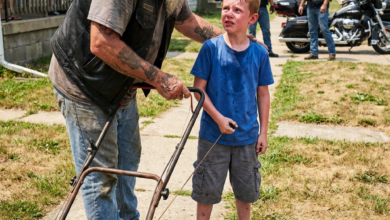
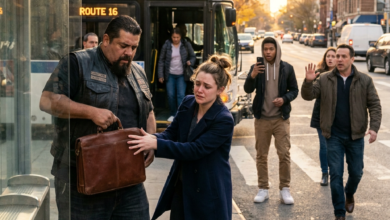
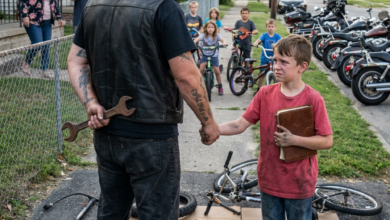
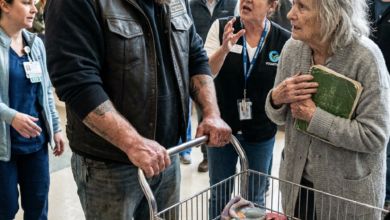
A Tattooed Biker Appeared to Clamp His Hand Over an Elderly Woman’s Mouth in a Crowded Street — Then the Paramedics Saw What He Had Protected Beneath His Leather Vest
Part 2 — The Medic Who Stopped Wearing Blue
I met Ray again three hours later in the emergency department at Mercy Hospital Springfield, where Eleanor lay behind a curtain while doctors checked her bloodwork, adjusted her medication, and examined the cut inside her cheek.
I went because the police needed a complete statement.
That was what I told myself.
The truth was uglier. I had watched the market video twice on my phone and heard my own voice accusing Ray while he protected a woman I had not known how to help.
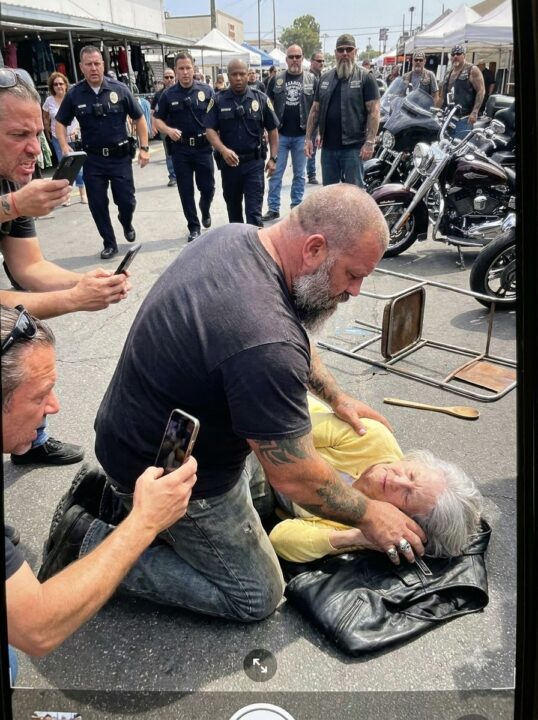
Ray sat alone near the vending machines. He had recovered his leather cut, but a dark damp mark remained where Eleanor’s head had rested. One sleeve of his charcoal shirt was streaked with lemonade and road dust.
His right hand carried three crescent cuts where Eleanor’s fingernails had caught him.
He had not bandaged them.
Hawk sat two chairs away, giving Ray the kind of space close friends give a man who has not yet decided whether he wants company. On the floor between them rested a black motorcycle helmet and the compact red medical pouch police had returned.
I approached with an apology prepared.
Ray did not let me finish.
“You called for help.”
“I called the police on you.”
“You saw something bad.”
“I saw it wrong.”
He looked toward Eleanor’s room.
“Most people did.”
That should have made me feel better.
It did not.
A nurse came to clean Ray’s hand. He refused the treatment until Eleanor’s granddaughter arrived, breathless and furious, still wearing a supermarket uniform.
Her name was Claire Whitcomb.
She saw Ray’s tattoos and the stains on his shirt before she saw the old medic card lying beside him.
“You were the man holding her down.”
“No,” Ray said.
“I watched the video.”
“You watched eleven seconds.”
“You covered her mouth.”
“I supported her cheek and kept her face clear. Nothing went inside her mouth.”
Claire pointed at his injured hand.
“Then whose blood is that?”
“Mine.”
She did not believe him.
A doctor stepped from behind Eleanor’s curtain and explained that the older woman had experienced a generalized tonic-clonic seizure lasting less than two minutes. She had sustained a minor mouth injury, but no broken teeth, aspiration, head trauma, or major complications.
“What stopped her from choking?” Claire asked.
“Positioning after the convulsions eased,” the doctor said. “And keeping the area clear. Mr. Dawson handled it appropriately.”
Claire looked at Ray again.
His size had not changed.
Everything around it had.
The physician also explained what Ray had refused to dramatize: people should not force the mouth open, insert spoons, wallets, fingers, or cloth, or attempt to hold down a person having a seizure. The correct response was to clear dangerous objects, cushion the head, time the seizure, call emergency services when appropriate, and place the person on their side once it was safe.
Ray had done all of that while strangers tried to stop him.
Claire sat down.
“Why did she know your name?”
Ray’s jaw tightened.
Hawk answered for him.
“Mrs. Whitcomb taught him.”
Seventeen years earlier, Eleanor had been the lead instructor for an emergency medical technician course at Ozarks Technical Community College. Ray had enrolled at thirty-nine, older than most students and angrier than all of them.
He was not yet called Hammer because of motorcycles.
He earned the name in a collision shop, where he could straighten a bent truck panel with fewer blows than anyone else. At the time, he carried a different reputation: bar fights, two arrests, one year of sobriety repeatedly threatened by the guilt he refused to discuss.
Ray’s daughter, Lily, had experienced her first seizure at age seven.
He panicked.
A neighbor insisted that Lily might swallow her tongue and tried to force a spoon between her teeth. Ray believed him. He held his daughter’s jaw while the neighbor pushed.
The spoon damaged two teeth and cut her gums. Lily recovered, but Ray never forgave himself for turning fear into another injury.
Her neurologist corrected the myth. A person cannot swallow their tongue during a seizure. Nothing should be forced into the mouth.
Ray remembered every word.
Two years later, Lily suffered another seizure while riding in Ray’s pickup. He protected her head, cleared the seat area, timed the convulsions, and called 911. She recovered without injury.
But Ray had already begun asking questions about emergency care.
He enrolled in Eleanor’s class.
Eleanor did not treat him gently. On the first morning, she saw his swollen knuckles, smelled stale whiskey trapped in his jacket although he had stopped drinking, and told him he could either learn to use his hands for something better or leave.
Ray stayed.
He failed the first written exam.
He passed the practical test.
Then he failed the background review for one ambulance company because of his arrests. Eleanor drove him to another service seventy miles away and made him apply again.
“She said a record told people where I’d been,” Ray explained. “Not what I could do next.”
He worked as an EMT, became a paramedic, and spent eleven years on an ambulance. He delivered two babies, performed CPR beneath a church pew, crawled into an overturned van, and once stayed inside a wrecked car for forty minutes holding pressure on a teenager’s leg.
Then Lily died at twenty-two.
Not from epilepsy.
A drunk driver crossed the centerline while she was returning from college.
Ray was on the responding ambulance.
He recognized her shoes before firefighters opened the door.
After the funeral, he stopped wearing blue.
He surrendered his paramedic license, returned to collision work, and joined the Iron Lanterns because the Harley’s engine made enough noise to keep certain memories from forming sentences.
He kept his EMT certification current.
He never explained why.
Inside Eleanor’s room, a monitor began beeping faster.
Ray stood before any nurse called his name.
Old habits did not ask permission.
Part 3 — The Video That Chose Its Own Villain
Eleanor stabilized by late afternoon. Her seizure appeared to have been triggered by a recent medication change combined with dehydration and the July heat.
The doctor expected to release her that evening.
Outside the hospital, Ray’s name was spreading for a different reason.
The young man who recorded the market scene had uploaded an eleven-second clip with the caption: “Biker holds grandmother down while people beg him to stop.”
The video began after Ray had cleared the chair.
It ended before he said he was protecting her airway.
Eleven seconds.
That was enough.
Local pages copied it. Then larger accounts did. Some called Ray a violent gang member. Others claimed the bikers had prevented medical care. A radio host asked why police had not arrested him.
No one contacted Eleanor.
No one requested the full recording.
By four o’clock, the collision shop where Ray worked had received forty-seven calls. His manager told him to stay home until the story cooled down.
The Iron Lanterns’ clubhouse windows were threatened.
A photograph of Ray’s house appeared online.
Then someone found Lily’s obituary and posted it beneath the video with the words: EVEN HIS OWN DAUGHTER WASN’T SAFE.
Hawk read that line in the hospital parking lot.
He closed the phone so hard the case cracked.
“We ride over there,” a younger club member said.
“Where?” Hawk asked.
“To the kid who posted it.”
“And do what?”
“Make him take it down.”
Ray stood beside his Road King without moving. The July sun struck the chrome tank, but his hands remained flat on the seat.
“No ride,” he said.
“He put Lily into it.”
“No ride.”
“He called you a killer, brother.”
Ray finally looked up.
“If twenty-five Harleys arrive at his house, what does his camera show?”
Nobody answered.
“Exactly what he wants.”
That was the first test of the brotherhood.
The second arrived five minutes later.
Claire came through the hospital doors holding her phone. Someone had sent her the viral clip before she heard the doctor’s explanation. Beneath it were thousands of comments demanding Ray’s arrest.
She asked whether she could make a statement.
Ray told her no.
“You saved my grandmother.”
“She’s awake. That’s enough.”
“It isn’t enough for them.”
“It is for me.”
Claire stared at him as though gratitude had become another fight he refused to enter.
Then Eleanor called from her room.
She wanted Ray.
We found her sitting against raised pillows, pale but alert, with a strip of medical tape on her arm. The tiny blue pin from her purse rested on the bedside table.
Ray stopped at the doorway.
Eleanor studied his beard and leather vest.
“You got old, Dawson.”
“So did you.”
“I had a head start.”
Her voice was weak, yet the dry authority remained. Ray lowered his gaze like a student who had arrived late.
Eleanor asked what he had placed in her mouth.
“Nothing.”
“What did you hold?”
“Your head. Then your position.”
“How long?”
“One minute, forty-three seconds of convulsions. Confusion afterward.”
“Did you restrain my arms?”
“No.”
“Did anyone try to insert an object?”
“Wooden spoon.”
“What did you do?”
“Removed it.”
Eleanor nodded.
“Pass.”
Ray almost smiled.
Claire recorded that exchange with permission. She wanted to post it, but Eleanor stopped her.
“The cropped video is not the problem,” she said. “The myth is.”
She asked how many people at the market had shouted that she was swallowing her tongue.
I counted at least four.
“How many tried to hold me?”
Two.
“How many brought something for my mouth?”
One.
Eleanor looked at Ray.
“That is the story.”
Before we could decide what to do, a nurse opened the curtain and told us a reporter was waiting downstairs.
Ray headed for the stairs.
Hawk blocked the doorway.
“You keep leaving before anybody sees you.”
“Move.”
“No.”
Ray’s shoulders hardened.
Hawk did not.
“For seventeen years,” Hawk said, “you’ve carried that red pouch on every ride. You stop at wrecks. You check strangers slumped in cars. You train prospects in CPR, then disappear before the ambulance doors close.”
“Not about me.”
“No. Today it is.”
Ray pushed past him.
Hawk caught the edge of his vest.
The room went silent.
Two men who had ridden through hail, funerals, divorce, and one club bankruptcy stood an arm’s length apart while every old instinct asked them to settle the disagreement physically.
Hawk released the leather.
“Brotherhood means we don’t use your worst day against you,” he said. “It also means we don’t let you hide inside it.”
Ray walked away.
For ten minutes, none of us knew whether he had left the hospital.
Then the fire alarm sounded.
Not a drill.
Smoke was entering the west stairwell from an electrical panel on the ground floor. Nurses began moving patients away from the corridor. Eleanor’s monitor had been disconnected for discharge, but the sudden alarm startled her.
Her eyes lost focus.
Ray reappeared at the curtain before the second seizure began.
This time, nobody told him to get away.
Part 4 — The Second Seizure and the Name Inside the Vest
Eleanor’s body stiffened against the hospital bed.
Ray lowered the rail.
A nurse protected her head with a pillow while another timed the seizure. Ray cleared the blanket, moved the bedside tray, and told Claire not to hold her grandmother’s arms.
Smoke remained faint in the hallway. The fire was small, but the alarms, flashing lights, and moving staff turned the room into confusion.
Eleanor began jerking.
Claire froze.
Ray stood beside her without touching Eleanor because the nurses had control.
“Watch her breathing,” he said. “Not her mouth.”
Claire stared at the bloodless lips she had feared would close forever.
“Can she swallow her tongue?”
“No.”
“What do I do?”
“Clear space. Time it. Stay.”
The seizure ended in fifty-one seconds.
The nurse positioned Eleanor on her side and supplied oxygen while Ray guided Claire’s hand to her grandmother’s shoulder.
“Talk low,” he said. “She may hear you before she can answer.”
Claire whispered her name.
Eleanor’s breathing steadied.
No one applauded.
Real emergencies rarely end with the room knowing exactly when relief has arrived. They become quieter by degrees: shoulders loosen, voices lower, equipment returns to drawers, and one person finally remembers to breathe.
The electrical fire was contained.
Eleanor remained overnight.
That second seizure changed Claire. She had seen competent care from three feet away, with no angry crowd and no cropped camera angle. Nothing entered her grandmother’s mouth. No one pinned her limbs. Nobody fought the convulsions.
They protected her from everything around them.
Then they waited.
Claire asked Ray to teach her again.
He did.
On the hospital’s rear loading dock, Ray demonstrated the steps using Hawk as the pretend patient. Hawk lowered his 250-pound body onto a folded moving blanket and complained that the concrete was ruining his shirt.
“Clear hazards,” Ray said.
I moved a plastic crate.
“Cushion the head.”
Claire folded a jacket.
“Time the seizure. Don’t restrain. Don’t put anything in the mouth. Call emergency services if it lasts five minutes or longer, repeats without recovery, happens in water, involves injury or breathing trouble, or it is the person’s first known seizure.”
“What about turning them on their side?” Claire asked.
“When safe—especially after the active convulsions ease—use the recovery position and monitor breathing.”
Hawk opened one eye.
“Do I survive?”
“Unfortunately.”
That was the first laugh of the day.
It did not last.
The reporter found us.
She introduced herself as Melissa Grant from a Springfield television station and asked Ray whether he wanted to respond to allegations that he had assaulted Eleanor.
Ray turned away.
Eleanor’s voice came from the wheelchair behind her.
“He can respond after I do.”
A nurse had brought her outside for air. Claire stood beside the chair, and the small blue medical pin was fastened to Eleanor’s cardigan again.
Melissa raised the microphone.
Eleanor pointed at Ray.
“That man was my student. Later he was my colleague. Today he was my EMT.”
Ray looked down.
Eleanor continued.
“He did not cover my mouth. He supported my head and kept my airway clear. He placed nothing between my teeth, because trained responders know that forcing an object into the mouth can cause injury.”
The reporter asked whether Ray had saved her life.
Eleanor disliked the question.
“He protected me until the seizure ended and transferred care correctly. That is what competent people do.”
Then she reached inside her purse and removed an old photograph.
It showed twenty-two EMT students standing beside an ambulance in 2009. Eleanor was in front, younger and stern, holding a clipboard.
Ray stood in the back row.
His beard was short. His arms were crossed. A little girl in a purple jacket sat on his shoulders.
Lily.
On the back, someone had written: DAWSON—BEST HANDS, WORST ATTITUDE.
Eleanor had kept the photograph for seventeen years.
Ray had kept something too.
He opened his leather cut and turned the left panel outward. Sewn inside, invisible when he wore it, was a faded blue Star of Life patch bearing the number of Eleanor’s EMT class.
Below it was a narrow strip cut from Lily’s purple jacket.
That explained why Ray had removed the vest so quickly at the market.
He had not sacrificed a piece of biker identity to cushion a stranger’s head.
He had placed the two people who taught his hands what to do beneath Eleanor’s skull.
The teacher.
The daughter.
Both hidden inside the leather.
Melissa lowered her microphone.
Hawk looked away.
Ray said nothing for a long time.
Then Eleanor touched the worn class patch.
“You kept it.”
“Kept the lesson.”
“Which one?”
Ray glanced at Claire, then at the phone still showing the cropped video.
“Hands don’t get good by looking good.”
The reporter aired the interview that evening.
It should have ended the story.
Instead, it opened another.
A viewer sent the station a longer recording taken from a bakery booth across the street. It began thirty seconds before Eleanor collapsed and continued until the ambulance arrived.
The footage showed everything.
Including the person who had nearly made the emergency much worse.
Part 5 — The Ninety-Three Seconds Nobody Shared
The full recording lasted two minutes and fourteen seconds.
The station aired it without music.
At the beginning, Eleanor reached toward my table and missed the edge. Ray, still thirty feet away, noticed before anyone else. His head turned toward her as her shoulders tightened.
He began moving before she fell.
The video showed him catching the back of her cardigan, slowing her impact enough to keep her skull from striking the metal table support. Her head still touched the chair edge, but the force was reduced.
It showed him folding his vest beneath her.
It showed his left hand resting along the side of her jaw and cheek—not over her lips—while his fingers kept her face away from spilled lemonade.
Then the wooden spoon appeared.
A vendor named Martin Cole pushed through the crowd and tried to place its handle between Eleanor’s teeth. Ray knocked it aside.
The eleven-second viral clip had begun at that precise instant.
Without the earlier footage, it looked as though Ray had struck an innocent bystander and seized control of a helpless woman.
With the earlier footage, the truth was plain.
Martin had been trying to help.
He had also been wrong.
That difference mattered to Ray.
When reporters asked whether Martin should apologize, Ray refused to condemn him.
“He heard something old,” Ray said. “Thought it was true.”
Martin visited Eleanor the following morning. He carried flowers and the wooden spoon inside a clear plastic bag.
He apologized for interfering.
Eleanor asked him to sit.
Then she made him repeat five rules: do not restrain, do not insert anything into the mouth, remove dangerous objects, time the seizure, and monitor breathing while calling for appropriate help.
Martin repeated them.
She handed the spoon back.
“Use it for soup.”
Claire posted the full video alongside Eleanor’s explanation. Views climbed faster than before. Some people deleted their accusations. Others pretended they had understood the situation all along.
The collision shop called Ray and asked him to return.
He arrived Monday at seven.
No speech.
No welcome banner.
The manager simply placed a new red first-aid cabinet beside Ray’s work bay and asked him to train the staff.
Ray agreed on one condition.
“No cameras.”
The condition failed within a week.
Not because anyone filmed him secretly, but because Springfield’s fire department asked whether Ray would help create a public seizure-safety demonstration. The viral misunderstanding had produced thousands of questions. Teachers, restaurant workers, church volunteers, and motorcycle clubs wanted clear instructions.
Ray refused.
Eleanor accepted for him.
She called Hawk.
Hawk called every Iron Lantern.
On Saturday morning, twenty-five Harley-Davidsons rolled into the parking lot of the Ozarks Community Center. Their V-twins shook the glass doors. Families waiting for a first-aid workshop stepped away from the riders until they saw folded blankets, training mannequins, stopwatches, and cardboard signs with simple safety steps.
Ray rode last.
Eleanor waited in a wheelchair beside the entrance, not because she could no longer walk, but because her new medication made her unsteady.
“You set me up,” Ray told her.
“You were always slow to volunteer.”
“I volunteer plenty.”
“You vanish afterward.”
Ray looked at Hawk.
Hawk studied the sky.
Inside, more than three hundred people filled the gymnasium. Martin attended. So did the police officer who had first ordered Ray away. I sat with Claire near the front.
Eleanor introduced Ray without mentioning the viral video.
“This is Raymond Dawson,” she said. “He has spent seventeen years pretending he stopped being a medic.”
Ray stood beneath basketball hoops in his leather cut, holding a stopwatch.
He looked trapped.
Then a father in the second row raised his hand. His nine-year-old son had epilepsy. He asked what to tell classmates who panicked during seizures.
Ray’s discomfort disappeared.
“Tell them the body looks frightening,” he said. “Looking frightening doesn’t mean the person needs to be fought.”
He demonstrated clearing the floor.
He folded a jacket beneath Hawk’s head.
He showed where hands should not go.
He explained that seizure first aid was protection, timing, observation, and calm—not forcing the mouth open or trying to stop every movement.
A teenage girl asked whether she should be embarrassed after a seizure in public.
Ray looked toward Eleanor.
She answered.
“No. The crowd should be embarrassed only if it refuses to learn.”
The room went quiet.
At the end, Claire played the full market video beside the cropped clip. She muted both and froze the frames at the same second.
In one, Ray looked like an attacker.
In the other, viewers could see the chair leg he had blocked, the folded vest beneath Eleanor’s head, the spoon falling away, and the EMT timer glowing on his watch.
Same man.
Same hands.
Different truth.
Afterward, the father of the nine-year-old approached Ray with his son. The boy wore a small medical bracelet and stared at Ray’s skull ring.
“Does your club help people with seizures?” he asked.
Ray considered the question.
“We do now.”
That became the Iron Lanterns’ next road.
Part 6 — The Red Pouches on Twenty-Five Motorcycles
By autumn, every Iron Lantern carried a compact red emergency pouch.
The contents were simple: nitrile gloves, gauze, a CPR face shield, trauma shears, naloxone, instant glucose, and a card listing seizure first-aid steps. There was no spoon, bite block, wallet, or object intended for anyone’s mouth.
Ray inspected the pouches before each group ride.
He checked expiration dates, replaced damaged gloves, and made prospects demonstrate the recovery position before they earned permission to ride in formation.
They complained.
He failed them anyway.
The club began offering free first-aid sessions at diners, veterans’ halls, libraries, and motorcycle rallies along Route 66. Eleanor attended whenever her health allowed, correcting Ray whenever he shortened an explanation too far.
“Say why,” she would tell him.
“People don’t listen that long.”
“They listened to eleven seconds of nonsense.”
Ray could not argue with that.
Martin volunteered too. He carried the wooden spoon at each workshop and raised it when Ray asked what never belonged in a person’s mouth during a seizure.
People remembered him.
That was his decision.
He could have hidden from the mistake. Instead, he made himself the example.
The young man who posted the cropped video eventually contacted Claire. He admitted he had trimmed the clip because shorter videos received more views. He had not expected Ray’s house, job, and dead daughter to become targets.
Ray agreed to meet him at the market.
Hawk objected.
Ray went alone.
I watched from my information table as the young man approached with both hands visible and his phone inside his pocket. He apologized, then offered to delete the original upload.
“Leave it,” Ray said.
The young man looked confused.
“Attach the full one.”
“People will still see the short clip first.”
“Then they’ll learn to wait.”
Ray asked him to film the next safety workshop.
Uncropped.
The boy did.
Eleanor’s seizures became less frequent after her medication was adjusted. Each July, she returned to the same place beside my table. Ray brought a folding chair, two bottles of water, and a paper map she never needed.
At 11:18, he checked his watch.
Eleanor noticed every time.
“You can stop timing me, Dawson.”
“No.”
“I’m not seizing.”
“Good streak.”
She rolled her eyes.
Then she drank the water.
Part 7 — What His Hands Were Actually Holding
One year after the market incident, the Route 66 Summer Market was louder than before. Children ran between food stalls, a local band played beside the courthouse lawn, and twenty-five Harleys occupied the same curb where strangers had once mistaken a rescue for an assault.
Ray parked his Road King last.
The engines shut down in sequence.
Silence followed.
Eleanor waited beside my table wearing the yellow cardigan from the previous summer. The blue medical pin rested above her heart, and Ray’s old Star of Life patch had been repaired along one edge.
She had stolen it from inside his vest.
Ray noticed immediately.
“That’s mine.”
“You abandoned the profession.”
“Borrowed retirement.”
“You kept the certification.”
“Technicality.”
Eleanor pinned the patch back inside his leather cut.
“Then stop lying.”
A young mother approached with her teenage daughter, who had recently been diagnosed with epilepsy. They had watched the full video together.
The girl asked Ray whether he had been afraid during Eleanor’s seizure.
“Yes.”
She seemed surprised.
“You looked calm.”
“Different thing.”
“What if everybody stares?”
Ray looked across the market—the same pavement, the same chair, the same awkward angles waiting to turn fear into certainty.
“Pick one face,” he said. “The rest are weather.”
The girl chose her mother.
Ray showed both of them how to create space and protect the head. Eleanor corrected his hand position by half an inch, proving she was still his instructor.
At 11:18, the market bell rang.
Ray checked his watch.
Eleanor remained standing.
She handed him a folded piece of paper. It was the printed frame from the full video: Ray kneeling beside her, his vest beneath her head, his palm along her cheek, the wooden spoon falling away.
Beneath the picture, she had written one sentence:
THE HAND THEY FEARED WAS THE HAND THAT KNEW WHEN NOT TO HOLD ON.
Ray read it twice.
Then he folded the paper and placed it inside his vest beside Lily’s strip of purple cloth.
The motorcycles started again.
Eleanor covered her ears and smiled as twenty-five V-twins rolled toward Route 66, each bike carrying a red emergency pouch and one rider who now knew what not to put inside a stranger’s mouth.
Ray passed last.
One scarred hand rested on the throttle.
The other tapped the hidden medic patch over his heart.
Follow the page and leave HAMMER below for more full stories about bikers whose most frightening hands quietly protect strangers.