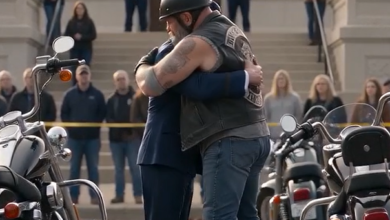
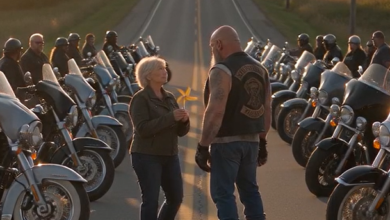
A COP CUFFED A BIKER TO A FIRE TRUCK WHILE NEIGHBORS BOOED, THEN A LITTLE GIRL RAISED A RED LEASH AND SAID, “MOM, I HAVE IT.”
Part 1
A COP CUFFED A SOOT-COVERED BIKER TO A FIRE TRUCK, AND THE CROWD STARTED BOOING BEFORE A LITTLE GIRL RAISED AN EMPTY RED LEASH.
At 6:17 on a Tuesday in October, Mara Bell stood on Linden Street in Chillicothe, Ohio, with a paper grocery bag split open at her feet. She had made it home from work in time to see fire burning through the upstairs windows. Two cans of tomato soup had rolled under the parked motorcycle. The engine ticked as it cooled. She remembered that sound because it was small enough to belong to an ordinary Tuesday.
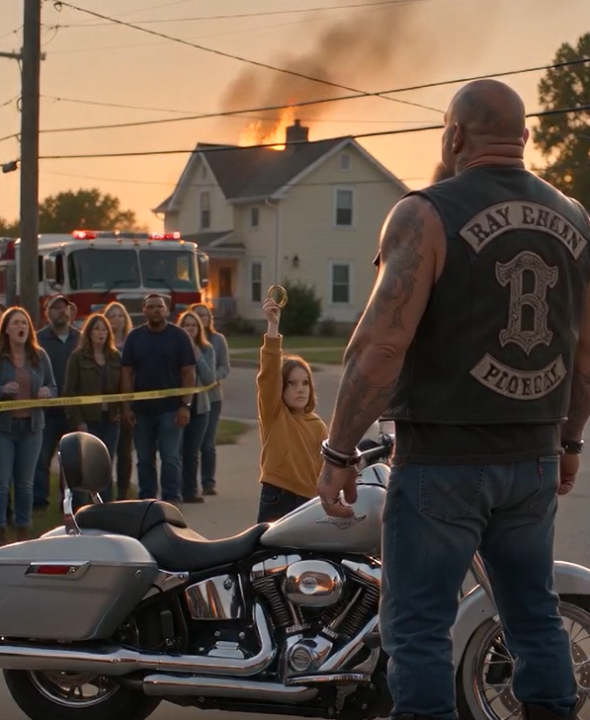
At the rear of the fire truck, Officer Evan Dunn closed a cuff around Ray Mercer’s wrist and locked the other bracelet to a fixed steel loop below the bumper. Ray pulled once, hard enough to scrape his skin. The click of the chain carried all the way across the street.
“Now he’s got an excuse to rough up the guy in leather,” a man behind Mara said.
Someone booed. Then several did. From the sidewalk, all they could see was a man trying to get up and a cop making sure he stayed put.
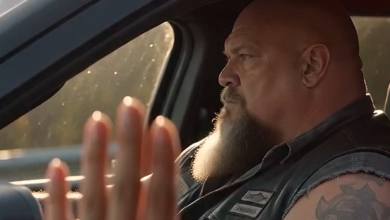
Ray was fifty-eight, broad enough to fill the rear step, with a shaved head and a long gray beard gone dark with soot. His tattoos ran down to the knuckles of the hand pressed against the pavement. Leather creaked when he tried to get a full breath. He looked straight at the house. He let every word from the curb go by him.
“Get him away from the truck if you’re so worried,” said Dale Hensley, the neighbor holding up a phone. He angled it toward the cuff. “I’ve got you on camera, Officer.”
Dunn raised his free hand. “Stay behind the line.”
Dale took half a step back and told the people behind him the officer had threatened him. Mara almost asked Dunn for the key herself. Then she heard her daughter beside her.
“Mom, I have it.”
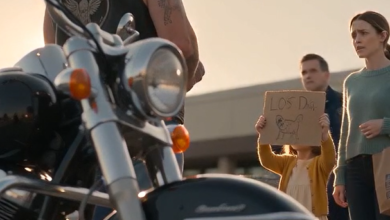
Lucy had the red leash wrapped twice around one fist. She stood on the safe side of the line in her mustard hoodie, with her brown hair stuck to one wet cheek. She worked the loops loose, one at a time, until the empty brass clip swung into view.
Ray saw it.
He stopped pulling. His shoulders dropped a little, the way they did when Lucy came over to ask whether she could borrow a wrench. Dale lowered the phone enough to look over it. Behind Mara, a woman who had been shouting said, much more quietly, “Whose leash is that?”
Ray lived next door. Most nights the kids knew he was home when the old cruiser gave its last low rumble at the end of his drive. On Sundays he fixed bikes in his garage. Lucy was allowed to pump up her own tires there as long as she put the hose back on its hook.
The chain slackened. Dunn had his key in his palm, but his eyes went to the upper windows, where a firefighter’s light swept past the roofline. Mara thought he might finally turn the key. Instead he leaned close enough for Ray to hear him above the pump.
“You’ve been in three times.”
Part 2
“The fourth time, you’re not coming out,” Dunn said.
Ray put one boot flat on the pavement. For an instant Mara thought he meant to stand up with the whole truck attached to him. Then he coughed into his shoulder and his boot slid back.
“Under the table,” he managed. “He hides under the table.”
Lucy lowered the leash.
“Who does?” Mara asked, although she knew as soon as she saw Lucy’s hand close around the clip.
“Otis.”
Mara had come home counting people. Her mother was in a folding chair on the far sidewalk, with a blanket over her nightgown. Her son, Ben, had one sock on and both hands around a paper cup he hadn’t touched. Lucy had met her at the line. Mara had counted them again every time somebody walked between them.
She’d forgotten the dog completely.
“Did Ray see him in there?”
Lucy shook her head. “He asked me where Otis goes when he’s scared. I told him under the table. I didn’t know he’d go back.”
Behind the truck, a firefighter waved two crew members farther out into the street. Dunn watched the signal. His key went back into his pocket.
“He was home when it started?” Mara asked.
“He’d just got back,” Ben said. He had come up on her other side, the cup crumpling a little in his hands. “I heard his motorcycle. Then Grandma yelled.”
“How did you get outside?”
“Ray carried me.”
Mara looked at Lucy.
“Me first,” Lucy said. “I was at the side door. I couldn’t get it open.”
The side door had swollen every October since Mara bought the place. Ray had offered to plane the bottom edge on Saturday. She remembered telling him they could do it whenever he had a spare minute.
“Then he went back for Ben?”
Lucy nodded. “He fell down outside both times. I thought he was going to stay down the second time.”
Across the street, Ray’s head had tilted toward the sound of their voices. Mara could see him trying to focus. She wanted him to see all three of them where they were standing, so she stepped aside and put one hand between Ben’s shoulder blades.
“And Grandma?” she asked.
Her mother answered from the folding chair. “I told him to leave me on the landing.” She spoke through the blanket, slowly, each breath an interruption. “He asked if I’d ever won an argument with him about my porch steps.”
“Did you?”
“I never could get him to send me a bill.”
Mara looked back at the truck. Nobody around Dale was booing anymore. He still had the phone up, but it pointed at the pavement now.
From inside the house came a noise like a loaded drawer running off its tracks. The firefighter who’d waved the others back turned his head. A section of gutter dropped. Then the roof folded into the second floor, sending a dark rush of dust out through the upstairs windows.
Later, Mara would hear Dunn’s warning and the collapse on the same uncut recording. The two sounds were thirty seconds apart. Standing there, she had time to take a single breath and hear Ben’s paper cup hit the sidewalk.
Ray stopped pulling. His free hand slipped off his knee, and he slumped against the rear step.
Then a firefighter rounded the far corner of the house carrying something that moved.
Part 3
Mara saw one white paw sticking out from under the firefighter’s arm. It kicked once, impatiently. She’d washed mud off that paw on Sunday.
“Otis?” Lucy called.
At the sound of her voice, the dog raised his head. One ear was folded inside out. His eyes found Lucy and stayed on her while the firefighter came toward the cleared side of the street. He was a twenty-pound terrier mix who barked at folded umbrellas. For once he didn’t make a sound.
“He came through the dog door into the backyard,” the firefighter said when she reached the line. Her helmet light lit up the leash in Lucy’s hand. “We found him tucked behind the rain barrel.”
“The dog door sticks,” Lucy said.
“Did he get all the way through?”
“He did. I picked him up outside.”
Lucy handed over the leash. The firefighter clipped it on before she put Otis down, and he pressed himself against Lucy’s shins so hard that Mara had to steady her by the elbow. Ben crouched and straightened the folded ear. Then he did it again, though it was already right.
On the other side of the line, Dunn got the key into the cuff. The loose bracelet struck the pavement. He moved it out of the way, sat down beside Ray, and called to a medic coming from the staging area.
Ray opened his eyes when Lucy called his name. He found her, then looked down where she was pointing. Otis had wrapped the leash around both her ankles.
“See?” she said. “It’s him.”
Ray’s chin dipped once. Mara waited for him to tell Lucy to untangle her feet. He always noticed things like that. Instead he looked at Dunn.
“Why the truck?”
“You’d already slipped past me once.” Dunn kept his voice low. From the line, Mara had to strain to hear him. “I told you to sit. Then I got between you and the door. You said you could make it.”
“Thought I could.”
“I know.”
The medic knelt with an oxygen mask. Ray reached for it himself, missed, and let her fit it. Dunn edged aside to give her room. His cuff key was still between his thumb and index finger.
“Three years ago,” Dunn said, “a man told me the same thing.”
Ray turned his eyes toward him.
“He was a dad. His kids were out. He wanted the dog.” Dunn looked down at his key. “I couldn’t hold him. He went in a fourth time. He didn’t come out.”
Ray’s fingers went still against the edge of the mask. The medic asked him to keep it in place and tell her his name. He said “Ray” clearly enough. The last name took two tries.
Another medic brought the stretcher around. Mara started forward to go with Ray, and then Lucy called “Mom” in a voice much younger than nine. Mara stopped. Her mother was still in the folding chair, and Ben was rubbing the bare part of his foot against his other ankle. There were too many people she wanted to follow.
“Can we tell Ray when Otis gets checked?” Lucy asked.
“Yes,” Mara said. “I’ll make sure he hears.”
The ambulance doors closed. Dunn stood and brushed grit off one knee. Only then did he put the key away.
From behind Mara came Dale’s voice.
“Would somebody tell me how to take a video down?”
Part 4
Dale had posted twelve seconds while the ambulance crew was getting Ray onto the stretcher. Somebody had already copied it to a neighborhood page. By the time Mara saw it on his phone, the caption said a biker had tried to help and a cop had cuffed him for it.
Dale swiped back to his own post. “I can delete mine.”
“Do you have the rest?”
He looked at her.
“You were still filming when the roof came down,” she said. “Do you have that?”
He opened the original. It ran well over a minute. There was a glimpse of the bumper, then Dunn’s open hand directing people behind the line. Dale’s own voice came through clearly. You heard him threaten me. There was a long stretch of pavement after that, with Lucy calling to Ray somewhere out of frame.
Then came the officer’s count. The warning. The terrible sound from upstairs.
Dale pressed pause.
“I thought if I got close enough he’d unlock it,” he said.
“You told us he threatened you.”
“I thought everybody would move back and let it happen if I didn’t say something.”
Mara understood the impulse better than she wanted to. She’d wanted the key, too. What she remembered most clearly was Dale turning around to check who was listening before he changed what the officer had said.
“Save the original,” she told him. “When you correct it, use your name.”
Dunn was near the truck talking to a supervisor. Mara waited until the supervisor stepped away. She still had her house keys in her jacket pocket. There was something almost embarrassing about carrying them now, as if she’d shown up to the wrong address.
“How did you know about the roof?” she asked.
“The captain called a collapse warning over the radio. I could hear it standing next to the engine.” He looked back at the cleared roadway. “Ray could barely hear me standing right beside him.”
“Could you see him go in all three times?”
“I saw him bring your mother out. A dispatcher was still on the phone with your son. The neighbors were pointing at Ray and counting trips. He’d already gone to his knees once in front of me, and he was up again before I could get him to stay there.”
Mara looked down at his right hand. There was a half-moon of gray grit under one thumbnail.
“Did the other family have a dog door, too?” she asked.
Dunn was quiet for so long she thought he might walk away.
“They found the dog at the sister’s house the next morning,” he said. “She’d picked him up before the fire. The father’s phone was on the kitchen counter. She’d texted him where the dog was.”
Behind them, Ben called for Mara. Her mother was ready to go to the hospital, and he wanted to know if he could get his other shoe first. She went over and told him there would be other shoes.
A neighbor named Patty took Otis to an emergency vet with Lucy’s permission. Before they left, Lucy made Patty put the red leash in her coat pocket. The clinic had its own lead. Lucy wanted hers back.
“Why did you take it out with you?” Mara asked.
“I didn’t,” Lucy said.
Mara waited.
“Ray had it. He gave it to me after he brought Grandma out. He said to hold on to it because he was going to need both hands.”
Part 5
The hospital gave Mara an update after Ray’s sister, June, called her back. Ray had inhaled enough smoke to need intensive care. He’d been put on a breathing machine after he reached the emergency department. June was driving in from Indiana and wanted to know if there was anyone who could get into Ray’s house to check whether he’d left a heater on in the garage.
Mara had a key. Ray had given it to her in a sandwich bag with the garage code written on the back of a hardware receipt. She knew where he kept the clean shop towels and which window needed a paint stirrer to stay open. She couldn’t remember ever asking where his sister lived.
Lucy sat beside her in a hospital waiting area, her feet barely reaching the floor.
“Is he asleep?”
“They’re keeping him asleep while the machine helps him breathe.”
“Does he know we found Otis?”
“I told the nurse. She wrote it down for him.”
Lucy considered this. “Where’d she put the paper?”
Mara didn’t know. Together they found a sheet of lined notebook paper in Lucy’s backpack. Lucy drew Otis behind the rain barrel with one ear sticking up. Underneath she wrote, You can stop looking.
The vet kept Otis overnight. Mara’s mother went home with her sister after a night of observation, and both kids were checked and released. For the next several days they stayed at Mara’s aunt’s house, where the bathroom door opened the wrong way and Otis wouldn’t drink until somebody moved his bowl next to the refrigerator. Ray came off the breathing machine. June texted that the note was taped where he could see it.
A week after the fire, the family went to see him. Ray had moved to a regular room, and June had arranged a short visit with Otis on the hospital’s enclosed ground-floor patio. Mara wheeled her mother down even though she insisted she could walk. Ben carried the drawing. Lucy brought the leash.
Ray sat in a chair with a blanket over his jeans. His beard was clean. A strip of gauze covered the scrape on his wrist. When Lucy held out the leash, he moved his hand toward it, then stopped.
“I can keep him,” Lucy said. “I just wanted you to see the clip.”
She lowered the brass clip to the pavement. Otis heard it and trotted straight to Ray’s boot, sniffed it twice, and sat.
Ben asked, “Why’d you have the leash?”
Ray waited through a cough. “I grabbed it on the way out with your grandma.”
“You were gonna use it?”
“If I got to him. He runs when he’s scared.”
Lucy looked down at Otis. “You said you’d check.”
Mara remembered the promise then. The previous spring, a tornado warning had sent the kids into Ray’s basement while Mara was at work. Lucy had refused to go down until somebody told her where the dog was. Ray had promised he’d check on Otis whenever Lucy couldn’t. He’d come down a minute later with the dog tucked inside his open leather cut, both of them looking inconvenienced.
“I said I’d check,” Ray agreed.
“Next time, can you tell me to wait with you?”
Ray took a breath before he answered. “Yeah. I can do that.”
June’s phone buzzed. She glanced at it, then handed it to Ray. The fire chief wanted to present him with a medal.
Ray read the message twice. “Does it say who else they asked?”
Part 6
The chief’s invitation named Ray and the crew members who had responded to the fire. There was no mention of Dunn. Mara found the omission strange until she learned that the police department was still reviewing his use of the cuffs. People had sent in the short clip, and a formal complaint had followed. Dunn had turned over his body-camera footage and given a statement.
“Can I write something?” Lucy asked.
“You can write what you saw,” Mara said. “You can give it to me when you’re done.”
Lucy sat at the end of her great-aunt’s kitchen table with a pencil, erasing until there was a soft spot in the paper. She wrote that Ray had carried her out. She wrote that he went back for Ben and Grandma. Then she added a sentence Mara hadn’t expected.
I told him about the table, but the policeman stayed there with him.
“Is that the part you want them to know?” Mara asked.
Lucy nodded. “There was a lot of noise. He could’ve walked away from everybody.”
Mara folded the page and put it with her own account. Dale had already supplied the original recording when the department asked for it. He’d also put a correction on the neighborhood page under his full name. He’d written out what Dunn actually said to him, and he’d asked the page administrator to pin the correction where people could find it. Later, he told Mara it had been viewed a fraction as many times.
“Do you want me to write another one?” he asked.
“Leave the first one where people can see it,” she said.
The fire captain met with the family before the ceremony. He drew the block on a sheet of yellow paper so Ben could see how the engines had been positioned. The rear of the truck where Dunn had stopped Ray was on the cleared side. The captain marked where the crew had backed out, then traced the path the firefighter had taken from the backyard with Otis.
Ben pointed at the space between the truck and the house. “That’s where Ray was going?”
“Yes,” the captain said.
“Did he know the roof would fall?”
“I don’t think he could see what we saw.”
That night Mara stopped by Ray’s garage with a container of soup from her aunt. He was home by then. He stood at the bench in a thermal shirt with his leather cut folded beside the vise. His cruiser was parked within reach, the seat covered by the old beach towel.
He showed Mara the silver patch on the back of the cut. It was shaped like an old swing gate, one corner lower than the other. A few riders he knew had made them years ago after they started spending Sunday mornings fixing things for people who couldn’t pay for a repair. Ray’s first job had been a gate that dragged on a neighbor’s driveway. The other riders called him Latch after he spent an entire morning getting it to close with one finger.
“Lucy thinks it’s a ladder,” Mara said.
“She’s only seen it sideways.”
He shook the cut open and hung it on the peg beside the door. Then he took the folded invitation off the bench and handed it to Mara.
“Could you ask Dunn to come?”
“He might say no.”
Ray picked up the soup container. “Ask if he’ll sit where I can see him.”
Part 7
Dunn came in through the side door of the fire station’s meeting room. He wore a navy sweater and kept the chair next to him empty until Mara waved him over. Ben scooted down a seat. Lucy had saved Dunn a paper program with a crease through the middle where she’d been holding it too tightly.
“Did you get my letter?” she asked.
“I was told you wrote one.”
“Did you read it?”
“I asked to. I read it this morning.”
“Okay,” she said, and went back to flattening the program on her knee.
The department had completed its review. With the captain’s radio warning, witness accounts, and the full recordings in hand, it found that Dunn had acted in response to the immediate danger. The chief had shared that result with the family before the ceremony. Mara had read the short notice several times, looking for a sentence that explained what it had cost Dunn to stand there while strangers shouted at him. She found the times of the radio call and the collapse, printed a line apart.
Dale was at the back of the room, holding a paper cup. He started toward Dunn twice before he made it over.
“I told them you threatened me,” he said. “You told me to stand back. I knew the difference when I said it.”
Dunn studied him for a second. “Did you leave the whole video with the department?”
“Yes. The whole thing.”
“Good,” Dunn said, and shifted his chair so Dale could pass.
At the front, the fire chief spoke about the crew’s work and introduced the firefighter who’d brought Otis around the house. Lucy leaned close to Mara and said, “That’s her.” She’d recognized the voice before she recognized the woman in a clean uniform. When Ray’s name was called, he stood slowly. He wore his black leather cut over a clean charcoal shirt. The sleeve tattoos, the gray beard, and the scuffed brown boots looked exactly the way Mara remembered them on the street.
The chief reached for the medal case. Ray put two fingers on the edge of the lectern.
“Can I say one thing first?”
The chief stepped aside.
“I want to thank the man who cuffed me to the truck.”
A chair creaked behind Mara. She watched Ray find Dunn in the second row.
“Three people were out,” Ray said. “I was still thinking about the one I couldn’t see. He heard the warning. I heard a kid ask about her dog.” Ray had to stop to breathe. “You stayed there, Evan. I’m glad you did.”
Dunn’s hands were flat on his thighs. Lucy watched him the way she’d watched Ray beside the truck, waiting to see if he could hear her over the room. After a few seconds, Dunn gave Ray a small nod.
The chief presented the medal. Ray stood for one photograph with the crew, then came back to his seat carrying the case. Mara expected him to tuck it under his chair. Instead he set it on his knee and let Ben open it.
“It’s heavy,” Ben said.
Ray held out a palm so Ben could set it back without dropping it. Lucy leaned across her brother.
“Can I borrow it Sunday?”
Ray looked at her. “What are you making?”
Lucy glanced down the row at Dunn before she answered.
“Something for your garage. You both have to come see it.”
Part 8
By Sunday the medal was back in its case. Lucy had borrowed it long enough to trace the circle onto two pieces of thin plywood Ray had left on the garage bench. Her great-aunt helped her drill the holes. She painted one piece with a silver gate and the other with a small key. On the backs, in pencil, she wrote RAY and EVAN.
Mara arrived with Otis and found Ray studying two hooks Lucy had set on the bench. The old cruiser was outside, cooling in the driveway. The garage smelled of oil, leather, and the toast he’d forgotten about while he hunted for a screwdriver.
“Which one goes higher?” he asked.
Lucy held the two hooks level in front of her. “Same.”
“Okay.”
“And they have to be where I can reach.”
“Then you tell me where.”
Ray handed her a pencil. Lucy made two marks beside the door, low enough to reach and far enough apart that the plywood circles wouldn’t knock together. Ray put a screw through the first hook. When Dunn walked up the driveway, Lucy ran out far enough to wave him in. She went right back to the bench, where the second screw was waiting.
Dunn turned the circle with the key over in his hand. “What do I hang on this one?”
“Whatever you bring with you.”
“I didn’t bring anything.”
Lucy looked at his jacket. He pulled out his car keys and hung them on the hook. The little circle tilted under the weight. He steadied it with a finger until it stopped moving.
For a while, the four of them stood at the bench talking about the things that needed replacing. Mara’s list had grown to three pages. Ben wanted the same size shoes he’d had before the fire, even though he’d been complaining they pinched. Her mother wanted a kettle she could lift with one hand. Lucy wanted an extra hook at their next place, low enough for the dog leash.
Ray opened a drawer and laid another hook on the bench.
“Keep that one,” he said.
Mara looked over at his leather cut hanging on the peg. Before the fire, she’d sometimes explained Ray to people by starting with his size or the tattoos and then telling them how good he was with her kids. She’d even heard herself do it at work the morning he took Lucy’s bike apart to fix the brake. She thought about what she’d say the next time someone asked who lived next door.
He was the neighbor her children went to when a door stuck, a tire went flat, or they needed an adult to take them seriously. That was plenty to start with.
Otis came in from the driveway, dragging the loose end of his leash. Ray sat on the low stool by the door, ready to catch it before the brass clip reached the concrete. Lucy got there first. She handed the loop to him and knelt to unclip the dog.
“You can hang it up,” she said.
Ray started to reach for the higher peg out of habit. Then he lowered his hand to the hook she’d marked for him. The leash swung once. Otis turned a circle beside his boots and lay down.
Follow the page for more stories like Ray’s.