Part 2: A Heavily-Tattooed Biker Brought A Tiny Pink Lunchbox To A High-Powered Business Meeting — And What Was Inside Made The CEO Step Out To Compose Himself
Part 2
Before I tell you what was in the lunchbox, you need to know what I didn’t know about Cole Brannigan.
I learned most of it later. Some of it from him. More of it from a man named Deke.
Cole grew up in nine foster homes between Pueblo and Colorado Springs. Nine by the time he was fourteen. He told me once, in the only long conversation we ever had, that he could tell you every family by the food.
“One house, it was bologna,” he said. “One house, it was nothing.”
At nineteen he got in a fight outside a bar on Northern Avenue. He didn’t start it. He didn’t walk away from it either. He did eleven months in Pueblo County.
He doesn’t tell that story to sound tough. He tells it the way you’d tell somebody where you broke your arm.
When he got out, a pipeline welder named Deke Halloran gave him a job, a couch, and a seat in a riding club that met in a cinder-block clubhouse off Highway 50. Deke was the one who taught him to weld. Deke was the one who taught him to read a balance sheet, too, on a folding table with a bare bulb over it.
“Man who can’t read the numbers,” Deke used to say, “works for the man who can.”
Twenty years later, Cole owned a water-reclamation company in Albuquerque. Thirty-eight employees. He’d built it cleaning up after other people’s messes — oil-field brine, mine runoff, poisoned wells.
That’s the company Halvorsen bought.
That’s the man we put in charge of a division.
And somewhere in the middle of all that, there was Lily.
Lily’s mother left when Lily was two. Packed a car in the night. Cole woke up to a note on the counter and a toddler standing in her crib, holding the rails.
He never says a bad word about her mother. Not one. I’ve tried to get him to.
“She did what she could do,” he says. “Then she couldn’t.”
So it was the two of them. A biker who’d done county time and a little girl with a cowlick she refuses to let anyone brush.
Here’s what I saw that first week, from the outside.
He was the first car in the garage and the last one out. Except it wasn’t a car.
Our night security guard, Luis, told me Cole was on forty-two until two in the morning on Tuesday. And Wednesday. Reading.
“Reading what?” I asked.
Luis shrugged. “Boxes. He had me bring up the boxes from Legal.”
The Corvane boxes. Due diligence on Project Mesa. Twenty-two bankers’ boxes nobody on the executive team had opened, because we’d hired a firm to open them for us.
Friday afternoon, Cole left early. Somebody saw the Harley go up the ramp at three o’clock, with a duffel bag strapped behind the seat.
Monday morning, he was back. Windburned. Dusty.
He didn’t say where he’d gone.
I’m telling you about the boxes and the dust because I didn’t think twice about either one at the time. I should have.
And the lunchbox.
Every morning, it turns out, Lily helped pack it. A peanut-butter sandwich cut into a lopsided heart. A bag of goldfish crackers. Apple slices going brown at the edges.
It was her lunchbox. From her first year of preschool. When Cole took the new job, she held it out to him at the door with both hands.
“Bosses need lunchboxes,” she said.
He told me that the way you’d describe a promotion.
Part 3
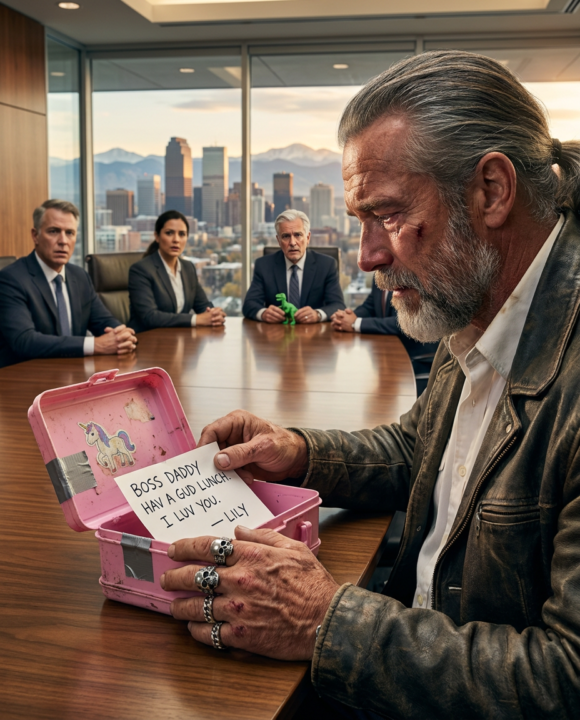
He opened it.
Everyone leaned. Twelve people who make seven figures a year leaned toward a pink plastic box like kids around a magic trick.
There was the sandwich. The goldfish. The brown apples.
And taped to the inside of the lid, a scrap of paper torn out of a spiral notebook.
Pencil. Big, crooked letters. Some backwards.
BOSS DADDY HAV A GUD LUNCH. I LUV YOU. — LILY
Under it, a drawing. A stick figure with a beard. A stick figure with pigtails. A sun with a face.
Cole looked at it for a long moment. His thumb rested on the corner of the paper. That big scarred thumb, the one with an F tattooed across the knuckle.
Then he looked up. At all twelve of us.
“I’ve been here eleven days,” he said.
Quiet. Even. Every word with weight on it.
“In eleven days, I’ve noticed something about this room.”
Nobody moved.
“We forgot why we work.”
Grant shifted in his chair.
“So I’m asking,” Cole said. “Every person at this table. Starting today. Bring one thing from your family to every big meeting. Put it on the table. Where you can see it.”
He tapped the lid.
“I work for her. Every decision I make in this building, I think about her first.”
He looked down the table. Slowly. At each of us.
“If you don’t have a reason,” he said, “you shouldn’t be sitting here.”
Silence.
Real silence. The kind that hums.
Then Grant laughed. Short. Ugly.
“With respect,” he said, “this is a fifty-million-dollar transaction. Not show-and-tell.”
Somebody else murmured agreement. Somebody else looked at their phone.
I looked at my own hands. I didn’t say anything. I’m not proud of that either.
Cole didn’t argue. Bikers, I’ve learned, don’t argue in rooms like that. He just closed the lid. Gently. Like the paper inside might tear.
And at the head of the table, Walter Haines stood up.
His chair rolled back and hit the glass wall behind him.
He didn’t look at Cole. He didn’t look at anyone. His jaw was locked. His knuckles were white around that little green dinosaur.
He walked out.
The glass door hissed shut behind him.
Twelve people sat frozen. You could hear the HVAC. You could hear traffic on 17th, forty-two stories down.
Grant said it out loud, so no one else would have to.
“Well. That’s it for him.”
And I believed it. I want to be honest. I sat there and thought: He just ended his career with a peanut-butter sandwich.
I thought that was the whole story. The biker who didn’t fit. The speech that went too far. Security in an hour. A severance package by Friday.
Cole sat still. His hands flat on either side of the lunchbox.
Eight minutes.
Nine.
He didn’t check his phone. He didn’t look at the door. He just sat there, very straight, like a man waiting outside a hospital room.
Ten.
Part 4
The door opened.
Walter came back in.
His eyes were red. Not watering. Red, like a man who’d been pressing the heels of his hands into them in a stairwell. His tie was loosened. I had never, in nine years, seen Walter Haines with a loose tie.
He was carrying a picture frame.
Small. Silver. The kind you’d keep on a desk, face down, so nobody asks.
He set it in the middle of the table. Next to the term sheet. Next to fifty million dollars.
A little boy. Six, maybe. Sandy hair. Front tooth missing. Grinning like he’d just gotten away with something.
He was holding a lunchbox.
A green one. With a stegosaurus on the front.
Walter set his keys down beside the frame. The little green dinosaur lay on its side on the walnut.
The same dinosaur.
Nobody in that room had known.
“This is Benjamin,” Walter said. His voice was steady. It cost him. “Benji. He died five years ago this April. Leukemia. He was six.”
Nine years. I’d worked for this man nine years.
“His mother packed his lunch every morning,” Walter said. “And she put a note in it. Every day. When he got sick, he took that box to the hospital. Kept his crayons in it.”
He touched the corner of the frame.
“The dinosaur came off the handle. I’ve carried it since.”
He didn’t sit down.
“I went back to work the week after the funeral. I’ve been here ever since. Every day. Every weekend. You’ve all seen it. You probably thought I was dedicated.”
He shook his head, slowly.
“I just didn’t want to go home.”
He looked down the table at Cole. At the pink lunchbox. At the duct tape.
“Today I decided something,” Walter said. “We are not selling Mesa to Corvane.”
Grant opened his mouth.
Walter didn’t look at him.
“I read the file this morning. The one Cole left on my chair at six a.m. Their site in Nevada. The wells. The elementary school.”
He picked up the term sheet. He didn’t tear it. Walter wouldn’t. He just turned it face down.
“My son isn’t alive,” he said. “But his daughter is.”
He nodded toward Cole.
“And I won’t sign a single thing that puts poison in the water under somebody else’s child.”
That was the whole speech.
He sat down.
The room didn’t stand up and cheer. That’s not how boardrooms work. What happened was quieter and stranger. One by one, people put their pens down.
Grant was the last.
And then I noticed the dust on Cole’s boots again.
Pale. Chalky. Alkali.
Part 5
It took me two weeks to get the rest. Some of it from Walter. Most of it from Cole, in the parking garage, sitting sideways on that Street Glide with the engine ticking.
The boxes.
Cole had read all twenty-two. On page 340 of an appendix nobody had flagged, there was a line about “remediation activities” at a Corvane leach site outside Battle Mountain, Nevada.
He’d spent twenty years cleaning up exactly that kind of “remediation.”
So that Friday at three o’clock, he went to look.
Denver to Battle Mountain is nine hundred miles. US-40 west, then I-80 across the salt flats. He did it in a day and a half. Slept two hours in a rest area outside Wendover with his jacket over his face.
That’s where the alkali came from. That’s why his cheeks were raw.
“What’d you find?” I asked.
He took his phone out and showed me a picture.
A chain-link fence with a white sign wired to it. DO NOT DRINK. WELL UNDER ADVISORY.
On the other side of the fence, sixty yards away, a swing set. A rusted slide. An elementary school.
“Kid in a pink jacket going down that slide,” he said. “About Lily’s size.”
That was all he said about it.
He printed the photo Sunday night. He wrote a one-page memo. And Monday — no, Thursday — at six in the morning, he left the whole thing on Walter’s chair in an envelope.
He didn’t know about Benji.
I want to be clear about that. He didn’t know. Nobody did. There was no strategy to it. No angle.
“So the lunchbox,” I said. “The speech. That wasn’t for Walter.”
“It was for me,” he said.
He was quiet a while.
“Nine houses,” he said. “Nobody ever packed me one. Lunch lady at Bessemer Elementary used to slip me a paper sack when nobody was looking. Peanut butter. No jelly. Every day for a year.”
He turned a key on the Harley. Didn’t start it. Just turned it.
“Now somebody packs mine,” he said. “Figured I’d better not waste it.”
And Walter.
I sat with Walter a month later, in his office, the one with the view of the Front Range. The silver frame wasn’t face down anymore.
“When he opened that lid,” Walter said, “and I saw the note taped inside — Ellen used to tape them exactly like that. Exactly. Same spot.”
He turned the dinosaur.
“I made it to the stairwell,” he said. “I sat down on the steps and I thought — I have been in this building five years, and I have not once asked myself who I’m doing it for.”
He looked out at the mountains.
“Ten minutes,” he said. “It took a man in a leather jacket ten minutes to give me back my son.”
Part 6
Halvorsen walked away from fifty million dollars.
The stock dropped four percent in a day. Two analysts downgraded us. Grant Sorensen resigned in June.
And then something nobody modeled happened.
In September, Walter announced a new policy. Every land sale, every water-rights transfer, every acquisition over ten million dollars would require an independent environmental and community-health review before a signature. Published. In full.
Inside the company, people called it the Lily Rule.
Within a year, three of our competitors adopted versions of it. Then an industry group did. Investors who’d downgraded us started calling it “risk leadership.”
Forbes ran the story in October. Somebody leaked the lunchbox. Of course they did.
The headline called Cole “The Biker Who Taught Corporate America To Lead With Its Heart.”
He hated it. He told the reporter four sentences and then said he had to go pick up his kid.
He wasn’t lying.
But that’s not the part I think about.
What I think about is the table.
Every big meeting on forty-two since that Thursday, there are things on the walnut that were never there before.
A baby shoe. A crayon drawing of a horse. A hockey puck signed by a fourth-grader. A rosary. A scuffed softball. A sonogram in a plastic sleeve.
Walter’s silver frame. The little green dinosaur lying beside it.
Mine is a Post-it note. My son wrote it when he was seven. It says MOM DON’T WORK TOO LATE. He’s twenty now. I’d kept it in my desk for thirteen years, face down.
And at the far end of the table, every time, a pink plastic lunchbox with a duct-taped hinge.
Every Monday through Friday, Lily packs it. The sandwich is still heart-shaped. The hearts have gotten better.
Every day there’s a note. Pencil. Taped to the inside of the lid.
He keeps them. All of them. In a shoebox on the shelf in his garage, next to a can of chain lube.
He told me there are three hundred and eleven so far.
Part 7
Last week, I left late. Old habits.
Level P3 of the parking garage was empty except for one matte-black Street Glide parked crooked across the yellow line.
Cole was sitting on it, helmet in his lap. The pink lunchbox was bungeed to the passenger seat behind him.
“She asked me what I did today,” he said, before I’d even said hello. He held up his phone. A voice message. “Asked if I ate the apples.”
“Did you?”
“Every one.”
I asked him if Lily knew. About Forbes. About Corvane. About the Lily Rule, the thing with her name on it that’s sitting in policy manuals at four Fortune 500 companies.
He looked at me like I’d asked him something in another language.
“She’s six,” he said. “She knows I ate lunch.”
He pulled his helmet on.
The engine caught. That deep, loose, uneven rumble filled the whole concrete level and came up through the soles of my shoes. He walked the bike back with his boots. Nodded once.
Then he rolled up the ramp toward 17th Street, and the sound climbed the floors above me, one level at a time, until it was out on the street and gone.
The taillight. The flash of pink behind the seat.
She’ll never know about the fifty million dollars.
She just wanted him to eat lunch.
👉 If this story stayed with you, follow our page for more stories from the road — and from the people the world almost judged too fast. 🏍️