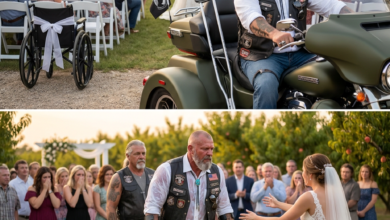
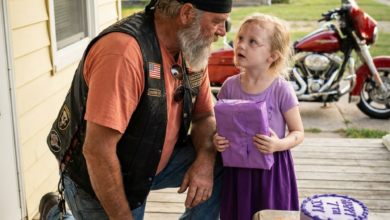
Part 2: A 6’4 Biker In Full Leather Bent Down On One Knee At A Pre-K Graduation — And What He Did Next Made An Entire School Auditorium Stand Up And Cry
To understand what happened next, you have to know about the calendar.
And the letters.
And a pink circle drawn in crayon that I almost threw away.
Maisie came to me that September with a backpack bigger than she was and an enrollment form her mother had filled out in a hurry. Under FATHER, Carla Calloway had written one name — Wade Calloway — and nothing else. No phone. No address. No employer.
I noticed. Teachers notice. I didn’t ask.
The calendar showed up the second week. Carla had circled the last week of May in black marker. Every single morning, before she hung up her backpack, Maisie crossed off one square. Red crayon. Big X.
“How many sleeps, Maisie?”
“Two hundred and fifty-four.”
Then two hundred and fifty-three. Then fifty-two.
She never missed a morning. Not once in nine months.
In October, she pressed a drawing into my hand during free play. The giant man again. But this time he was down on his knees, holding out something small and round. She’d colored it pink so hard the crayon tore the paper.
“What’s he giving you, sweetheart?”
“A promise,” she said, like it was obvious. “Daddy says when he comes home, he’s gonna give me a promise. A promise you can hold.”
I smiled the way you smile at five-year-olds. I put the drawing in her folder.
Remember that pink circle. I didn’t, for a long time.
I met Carla at conferences in November. Twenty-six years old. Purple scrubs. She worked doubles as an aide at Kingman Regional, and she nodded off for a second in that little plastic chair while I talked about letter recognition.
“Maisie talks about her father a lot,” I said carefully.
Carla looked at her hands.
“He’s away. He writes her every week. I read them at bedtime.”
That was all. I’d taught long enough to know what “away” means in a town like ours. I’d also taught long enough to watch a lot of “away” fathers never come back.
I’m not proud of what I assumed. I’m just telling you I assumed it.
Here’s what I didn’t know yet. I learned it later, from Carla, and from a man named Ray.
Every other Sunday that year, a motorcycle pulled up to Carla’s single-wide off Hualapai Mountain Road with grocery bags bungeed to the saddlebags. Milk. Cereal. The good peanut butter. The rider never came in. He set the bags on the step, knocked twice, and rode off.
At Christmas, eleven bikes came up that dirt road in a line. A neighbor called the sheriff. The deputy found eleven grown men in leather standing in the yard while one of them wheeled a pink bicycle with handlebar streamers out of a pickup bed. A note was taped to the seat.
Ride it till I get there. — Daddy
They didn’t stay ten minutes.
“His brothers,” Carla told me later. “From his club. They promised him nobody would ever knock on our door with bad news while he was gone. Nobody did.”
In March, Maisie brought one of the letters for show-and-tell. Lined paper. Block capitals pressed hard into the page, the handwriting of a man who didn’t write much and wanted to get it right. A crooked drawing of a horse across the top.
She couldn’t read yet. So she recited it from memory to the whole class. I only remember the end.
“I’ll be there. Love, Daddy.”
Every letter ended that way, Carla said. Every single one.
In April, Carla caught me in the parking lot.
“They’re saying maybe the week after graduation. Maybe. Please don’t let her get her hopes up, Mrs. Arroyo. If he doesn’t make it, I can’t have her up there watching the door.”
I promised I’d try.
You can’t stop a five-year-old from hoping. I know that now.
On graduation morning, Carla sat in the third row with an empty folding chair beside her and a program laid on the seat so nobody would take it. Maisie turned around so many times my aide stopped asking her to face front.
At 12:51, the engines came up Stockton Hill Road.
At 12:54, he walked through the door.
His hand came out of the vest.
Deputy Pruitt took one step forward.
I didn’t move.
Nobody breathed.
And then a sound tore through that auditorium that I will hear until the day I die.
“DADDY!”
Maisie came off the second row like she’d been fired out of something. Her chair went over with a bang. Her paper cap flew into the aisle. She went right past me — right under my arm — and threw herself at that man with everything a five-year-old body has.
He caught her.
He went down on both knees on the linoleum and wrapped those enormous inked arms around her so completely that all you could see was one pigtail and one small sneaker.
He put his face in her hair.
His shoulders shook. Once. Twice. Not one sound came out of him.
In the third row, Carla was on her feet with both hands over her mouth.
“Let him through, Denise.” Her voice broke right down the middle. “Please. That’s her daddy.”
Deputy Pruitt looked at Carla. Looked at the man on his knees. Then he sat back down, slowly, and took his hand off his belt.
The room exhaled.
Not all of it. Two rows behind me, a man whispered to his wife, “Look at his arms. That’s prison ink.” He wasn’t wrong. And from the way that big back went stiff for half a second, I knew the man on the floor had heard it too.
He didn’t turn around. He just held his daughter tighter.
I stood there with the microphone cord in my hand and thought, Well. There it is. The calendar was real. The father showed up. I was wrong. That’s the story.
It wasn’t even half of it.
After a long while, he stood with Maisie on his hip, both her arms locked around his neck, her face buried in his vest, hiccuping the way little kids do when they’ve held something in too long.
He looked at me. His eyes were wet. Not one tear had fallen. I got the feeling he’d had a lot of practice at that.
“Ma’am. Could I borrow your microphone? One minute. Then I’m out of your way.”
There was a schedule. There were twenty-two more names.
I handed him the microphone.
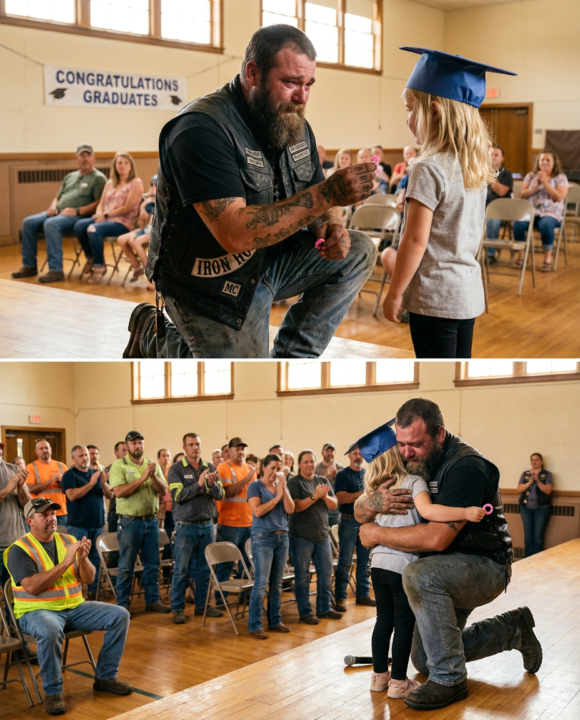
He carried her up the steps. The stage boards groaned under his boots. He set her down in the very center, under the paper banner that said CONGRATULATIONS GRADUATES in letters my class had colored themselves.
Then he got down on one knee.
Six-foot-four, and on one knee he was still eye to eye with her.
The microphone squealed when he raised it. He winced and held it farther away. He wasn’t a man who’d ever needed one.
He opened his other hand.
In the middle of that huge, scarred palm sat a ring.
A pink plastic ring. The kind that rattles out of a capsule machine for fifty cents. A fake heart-shaped jewel on top. The plastic still rough where it had been snapped off the mold.
I thought about a crayon drawing in a folder in my classroom.
He slid it onto her finger. Too big. She curled her fist to keep it on.
The room had gone so quiet you could hear the air conditioner tick.
“Baby girl,” he said. “Today you graduated pre-K.”
She nodded. Her chin was going.
“So Daddy wants to make you a promise. I’m gonna be there the day you graduate elementary school. And middle school. And high school. And college.”
He stopped. Swallowed.
“I’ll be there the day you get married — if you want me there. And I’ll be there any day you need me. Every day. Forever.”
He touched the ring with one thick fingertip.
“This is a promise ring. When you’re grown, somebody’s gonna give you a real one. But this one — you wear it today, and after today Daddy keeps it. Right in my wallet. And every time you need me, I’m gonna hold it up. So you know I remember.”
Maisie threw her arms around his neck so hard the microphone hit the stage, and the thump rolled through the speakers like thunder.
He let it lie there.
One tear came down his face and disappeared into his beard. He didn’t wipe it.
Then a folding chair scraped back.
Then another. Then a whole row.
I turned around. Two hundred parents were on their feet. Grandmothers. Rail-yard men in steel-toes. The mother from the fourth row with her toddler on her hip. Clapping, and most of them crying, and nobody embarrassed about either one.
The first man standing was the one who’d whispered about prison ink.
He was clapping hardest.
I didn’t learn the rest until the reception, in the hallway outside the cafeteria, over a Safeway sheet cake that said CONGRATS PRE-K in blue gel.
Carla found me by the punch bowl. Her mascara was gone. She looked ten years younger than she had at conferences.
“You’ve been so good to her, Mrs. Arroyo. You deserve the truth.”
I waited.
“Wade walked out of the state prison in Florence at 8:40 this morning.”
I set down my cup.
Florence is two hundred and seventy miles from Kingman.
“Four years, two months, nine days,” Carla said. “Meth. The night the police came, he was passed out on the couch and she was in her crib screaming, and he didn’t hear her. She was fourteen months old. She doesn’t remember his face. She only knows him from two hundred and nine letters.”
She said it flat. Like a woman who’d stopped making excuses for him a long time ago — and noticed he’d stopped making them too.
“He got clean inside. Never once asked me to say it wasn’t his fault.”
His release had been set for the week after graduation. Then on Tuesday, his counselor called. Earned credits. Friday morning. Six a.m., maybe noon — nobody would promise a time.
“I didn’t tell her,” Carla said. “If the paperwork sat on somebody’s desk, I couldn’t have her up there watching the door for nothing.”
She laughed. It came out wet.
“She watched it anyway.”
So I went out to the parking lot. I think I needed to see it with my own eyes.
Four Harleys sat along the curb by the bus loop, ticking as they cooled, grey with desert from front fender to plate. Three men in dusty cuts sat on the low wall eating sheet cake off paper plates. The biggest one after Wade — white goatee, reading glasses pushed up on his head — stood when I walked out.
“Ray,” he said. His hand was a catcher’s mitt.
Ray told me the rest while Wade sat on the curb with Maisie in his lap, letting her try on his aviators.
The vest had spent four years in a cedar chest in Ray’s back bedroom. Ray’s wife folded it the day Wade went in. Nobody touched it again. That’s where the square creases came from. That’s why a six-foot-four biker smelled like a grandmother’s closet.
Ray had ridden Wade’s own bike down to Florence — a black ’01 Road King that had sat under a tarp in Ray’s garage for four years, fired up once a month so the battery wouldn’t die.
“Man ought to ride home on his own iron,” Ray said. That was all he said about it.
Three of them sat outside that chain-link gate from five in the morning. Three hours and forty minutes. First in the dark. Then in the heat.
At 8:40, Wade came through with a mesh bag and fifty dollars of gate money.
He hadn’t touched handlebars in four years. Ray said he could see Wade’s hands shaking on the grips from behind, for the first hundred miles. That was the trembling I’d felt at the bottom of the stage steps. Not fear. Four years without holding on, and two hundred and seventy miles of holding on too tight.
The dust was a haboob that rolled across US-93 north of Wikieup. A brown wall, a mile high. Hutch wanted to pull over and wait it out.
“Wade looked at his watch,” Ray said. “Then he looked at me. Didn’t say a word. So we didn’t pull over.”
He didn’t tell it like a brag. He told it like a bad decision he’d make again tomorrow.
“And the ring?”
Ray laughed for the first time.
Wickenburg. The Circle K on the corner. They’d stopped for gas, and by the ice freezer stood a capsule machine — fifty cents a turn. Plastic eggs with bouncy balls and sticky hands and rings.
Wade broke a ten into quarters.
First turn, a rubber lizard. Then a bouncy ball. Then a sticky hand. Then a silver plastic skull ring — Hutch said that’d do, it’s a biker ring, she’ll love it. Wade put it in his pocket and kept turning.
“Brother,” Ray told him, “we’re gonna be late.”
“Then we ride faster,” Wade said. And turned the crank again.
Eleven turns. Five dollars and fifty cents out of the fifty the State of Arizona gave him to start over.
The eleventh capsule was pink.
I walked over to the curb. Maisie had fallen asleep against his chest, the way kids do when the crying wears them out. The ring had moved to her thumb. It fit her thumb.
I sat down beside him in my good church dress. I didn’t care.
“She told me in October you’d bring her a promise she could hold,” I said. “I thought she made it up.”
He nodded slowly.
“Wrote her that in a letter. Didn’t know what it meant when I wrote it. Just knew I owed her one.”
“Why on the stage? In front of everybody?”
He was quiet a long time. Looking at the bikes. At his brothers and their paper plates.
“Made her a lot of promises before she could talk,” he said. “Didn’t keep one.”
He brushed a pigtail off her cheek with one finger. His knuckles had letters on them, faded almost blue.
“This one, I wanted witnesses.”
He kept it.
The day after graduation, the ring came off Maisie’s thumb and went into the coin pocket of his wallet — black leather, on a steel chain clipped to his belt loop. Right beside a bronze coin that said ONE YEAR. Later it said FIVE. Later, TEN.
And he kept the other promise too.
Every graduation, Maisie mails me a photograph. I keep them in a shoebox in my hall closet.
Fifth-grade promotion, Hualapai Ridge cafeteria. A blurry picture of a big man in a leather vest standing in the back row, one hand over his head. Zoom in, and there’s a tiny pink dot between his fingers.
Eighth grade. Same picture. Beard a little greyer.
Kingman High, Class of 2022. A football stadium in a hot wind. Twelve hundred people in the bleachers. One hand up. Pink.
Those were the easy ones. Graduations come with dates.
The ones that mattered came without warning.
At nine, Maisie broke her arm and lay on a gurney at Kingman Regional, terrified. The curtain slid back, and her father was standing there with the ring held up before he’d said a word.
At sixteen, the first boy broke her heart. She came home to find him on the porch steps with two cans of root beer. He held up the ring. She sat down. They stayed out there until the coyotes started.
At nineteen, her Civic blew a tire on I-40 outside Seligman at two in the morning. Fifty-eight minutes later, a single headlight came out of the black. He climbed off and stepped into the beam so she could see the pink plastic in his hand before he’d even pulled his gloves off.
The jewel fell off in 2017. He glued it back with model cement. The pink has faded almost to white.
He still carries it.
And every year on May 22nd, at about 12:54 in the afternoon, I hear one Harley slow down in front of my house on Jagerson Avenue.
Two blips of the throttle.
Then gone.
I retired in 2019. He has never missed a year.
This past May, an envelope came with a ticket inside.
Northern Arizona University. Commencement. The Skydome in Flagstaff, eight thousand people under a wooden roof. Bachelor of Science in Nursing — like her mother, only further.
On the back she’d written: You were there for the first one. Come see the last one.
I sat in section 104. Wade sat three rows down. Fifty-two now. The beard gone white. A hearing aid in his left ear he pretends he doesn’t need. Same vest. The creases fell out of it a long time ago.
Carla sat beside him, holding his hand.
They read names for a long time.
Then: “Maisie Anne Calloway.”
She crossed the stage in her gown and white nursing stole, shook the dean’s hand, and turned to face eight thousand people.
She didn’t look at her diploma. She looked for him.
He stood up.
His arm went up over his head, slow, the way you’d raise a lantern. Between those thick tattooed fingers sat a faded speck of plastic nobody could have seen from that stage.
She saw it.
She came down those stairs and up the aisle in her cap and gown, and when an usher put out a hand, she went straight around it. Twenty-two years old and running like she was five.
He caught her.
Same arms. A lot more grey.
I was close enough to hear her say it into his vest.
“I remember, Daddy. I never forgot.”
He didn’t answer. He just held the ring up one more time, over her shoulder, where I could see it.
Later, out in the parking lot, a V-twin turned over and settled into that slow, loping idle. It rolled out toward Milton Road and down onto Route 66, and I stood in the cold Flagstaff air and listened until it was gone.
Seventeen years.
He was there.
Every single time.
👉 If this story moved you, follow our page for more stories from the road — and from the people the world almost judged too fast. 🏍️