Part 2: A Biker Missing Both Legs From An IED Blast Rode A Modified Trike To His Daughter’s Wedding — And Insisted On Walking The Last 10 Feet
Part 2
To understand those ten feet, you have to go back fifteen years.
Ray Kessler was a staff sergeant with the 2nd Engineer Battalion. Route clearance. That means his job, for eleven months in the Arghandab River Valley in Kandahar Province, was to drive slowly down roads looking for bombs so that other men wouldn’t find them the hard way.
On October 14th, 2010, he found one the hard way.
He doesn’t talk about it. His wife, Linda, told me some of it. Gus told me more.
Gus Navarro was the driver of the vehicle behind his. Gus pulled him out.
The name on the dog tags tattooed on Ray’s arm is Specialist Danny Ruiz. Danny was in Ray’s truck. Danny didn’t come home.
Ray lost his left leg above the knee. His right leg below it. He woke up at Landstuhl in Germany, then Walter Reed, then the Center for the Intrepid at Brooke Army Medical Center in San Antonio, where he spent most of the next two years.
Hannah was ten.
Linda told me about the first time Hannah saw him after.
She walked into that hospital room in San Antonio with a drawing of a horse and a balloon from the gift shop. She looked at the bed. At the place where the blanket went flat.
She didn’t cry. She didn’t run.
She climbed up on the bed, lay down next to him, and put her head on his chest.
After that she came every weekend. She learned to push his wheelchair down the long hallways of that hospital. She was too small, really. She had to lean her whole body into it. She’d make engine noises.
One day she stopped in the middle of the hallway, came around the front of the chair, and put her hands on his knees. What was left of them.
“Daddy,” she said. “When I get married, you have to walk me.”
She was ten. It was a ten-year-old thing to say.
Ray looked at her for a long time.
“Count on it,” he said.
Hannah forgot. She told me so, later, through tears. She had no memory of it at all.
Ray never forgot a single word.
He tried prosthetics. Everybody does.
The right one, below the knee, worked fine for a while. The left one, above the knee, was a nightmare. Blast injuries do strange things. Bone keeps growing where it shouldn’t. Doctors call it heterotopic ossification. Ray calls it “the rocks.”
The rocks pushed against the socket of his left prosthetic every time he put weight on it. Two minutes standing felt like standing on broken glass. Five felt like a knife.
By 2016, he’d mostly given up the legs. Wheelchair in the house. Wheelchair at the store.
And the trike.
That’s where the Iron Mission Riders came in.
It’s a veterans club. Forty-some members across Texas, mostly Army and Marines, a handful of Navy guys they give a hard time. Gus brought Ray to his first meeting in 2013. Ray didn’t want to go. Gus put him in the truck anyway.
Two years later, the club pooled money and bought a used Tri Glide. A shop in Kerrville rebuilt the controls so he could shift and brake with his hands.
Linda says the first time he rode it down Highway 16, he came home and sat in the driveway for twenty minutes with the engine off. Just sitting.
“That’s my legs,” he told her. “That’s the only legs I need.”
He rode it to Hannah’s high school graduation. To her nursing school pinning. To the ER on her first night shift, just to drop off a coffee.
He thought he’d ride it to her wedding, too, and roll down the aisle.
Then, last August, Hannah came home with a ring on her finger.
And Ray remembered a hallway in San Antonio.
Part 3
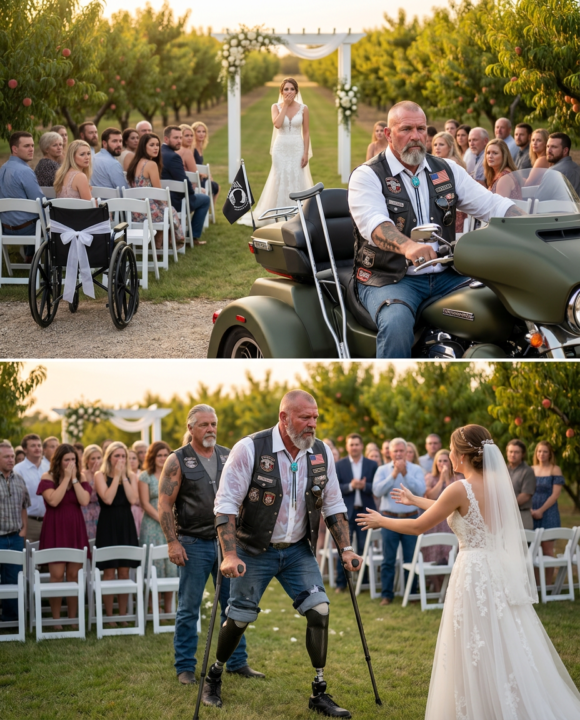
He killed the engine ten feet from the arbor.
A hundred and twenty people. Not one sound.
Gus reached the trike. Unbuckled the right leg from the rack. Then the left. Handed them up one at a time.
Ray didn’t look at anybody. He pulled up the pinned legs of his trousers, rolled the liners on, and locked the right prosthetic into place.
Click.
Then the left.
He set it against the socket. Pushed. His jaw went tight. Something in his face changed, the way a man’s face changes when he touches a hot stove and decides not to let go.
Click.
Gus pulled the crutches free and held them out.
Ray took them. Got the cuffs around his forearms. Swung one leg off the trike. Then the other.
He planted the crutches in the grass.
And he stood up.
Somebody in the third row gasped. Hannah’s mother, Linda, had both hands pressed flat over her heart.
He stood there, swaying. Six-foot-one again, for the first time in years. Every eye in that orchard on him.
Hannah took a step toward him.
He shook his head. Once.
She stopped.
The first step.
Crutches forward. Swing. The left leg landed and his whole body shuddered.
The second.
The third.
His breath went ragged. In through the nose. Out through his teeth.
The fourth.
Sweat was running down from his scalp into his beard. The back of his white shirt was soaked through. You could see it spreading dark under the leather of his vest.
The fifth.
The left leg buckled. Just for a second. His elbow locked on the crutch and held him there, hanging, and a hundred and twenty people made the same sound at once.
Gus took a step forward.
“Don’t,” Ray said. Through his teeth.
Gus stopped.
Ray hauled himself back up.
The sixth step.
I was shooting the whole time. He’d told me not to stop. My hands were shaking so badly that half those frames are blurry. I didn’t care. I kept shooting.
The seventh.
He was there.
He was standing in front of his daughter, ten feet from where he’d started, chest heaving, gray beard dripping, knuckles white on the grips.
Hannah threw herself at him.
He couldn’t hug her back. His arms were locked in the crutches. So he just leaned his whole body into her, and she wrapped both arms around his neck and held him up.
The orchard broke. People were standing. Crying. Somebody whistled.
I thought that was it. I really did. The soldier walked. The bride cried. The perfect ending.
Then I got close enough to hear what she said in his ear.
Part 4
“Daddy,” she whispered. “You didn’t have to do this.”
He put his forehead against hers.
“Yeah, I did.”
He took a breath. It shook.
“You deserved to see me walk to you,” he said. “Not get pushed.”
She pulled back. Looked at him. She was a nurse. She’d seen his face. She’d seen the sweat.
“How long?” she said.
He didn’t answer.
“How long have you been doing this, Daddy?”
From behind him, Gus said it. Quiet. Not to the crowd. Just to her.
“Eight months.”
Hannah stared at Gus.
“Three days a week,” Gus said. “San Antonio. Seventy miles each way. Since August.”
She looked back at her father.
“Dr. Alvarez told you to use the chair,” she said. Her voice cracked. “I was there when he said it. He said you can’t stand that long. He said the left leg—”
“I know what he said.”
“Daddy, it’s—”
“Hannah.”
He said her name the way you’d say it to a ten-year-old in a hospital hallway.
“I promised you.”
She didn’t know what he meant. I watched her not know.
He told her. Right there, under the arbor, with a hundred and twenty people waiting.
“You were ten. In the hallway at BAMC. You said when you get married, I have to walk you.”
Hannah’s face fell apart.
“I said count on it,” Ray said.
She put both hands on his face.
Behind them, the minister cleared his throat very gently.
“Who gives this woman to be married to this man?”
Ray looked at Linda in the front row. Then at Hannah.
“Her mother and I do.”
He let go of one crutch. It swung from the cuff on his forearm. He took Hannah’s hand, and he placed it in the hand of the young man who was about to marry her. Marcus Bell. Twenty-seven. An airman out of Lackland, crying so hard he couldn’t see.
Ray looked at Marcus for a long moment.
“She walked me down a lot of hallways,” he said. “Your turn.”
Then he turned on his crutches. One step. Two. To the front row.
He looked at the wheelchair with the white ribbon on it.
And he finally sat down.
He did it carefully. Gus held the chair steady. When he went down into it, the breath came out of him in a long, broken sound that nobody but the three of us heard.
He didn’t let go of Gus’s arm for almost a full minute.
Part 5
I didn’t learn the rest until the reception, out behind the barn, where Ray had asked Gus to take him while everyone else was eating brisket.
I’d gone looking for the father-of-the-bride portrait.
I found Gus kneeling in the gravel with a first-aid kit.
The left prosthetic was off. The liner was peeled halfway down. I won’t describe what was under it. It was raw, and there was blood. Not a lot. Enough.
A woman in a sundress was crouched beside Gus with gloves on. Short gray hair. Steady hands.
“Dana Whitfield,” she said, without looking up. “Physical therapist. Center for the Intrepid.”
She was the one he’d been training with. All eight months. He’d invited her to the wedding as “a friend from the VA.” She’d driven up from San Antonio that morning with a kit in her trunk because she knew exactly how this was going to end.
“He’s been bleeding through the liner since February,” she told me. “Every session.”
Ray looked at her.
“Dana.”
“She’s got a camera, Ray, she’s going to hear it from somebody.”
He looked at me. Then he nodded once.
So Dana told me.
The first session, last August, Ray stood between the parallel bars for ninety seconds and threw up into a trash can.
In October, he fell and split his chin open on the bars. Four stitches. He told Linda he caught it on the trike’s windscreen.
In November, he got a pressure sore on the left limb so deep he couldn’t put the leg on for three weeks. He spent those three weeks doing pull-ups and crutch drills in Gus’s garage, so his arms could take more of the weight.
In January, Gus wanted to tell Linda. Ray made him swear on Danny Ruiz’s name. Gus kept it.
“Hardest thing I ever did,” Gus said, still kneeling in the gravel. “Harder than pulling him out of that truck.”
The sweating I’d seen at the farmhouse. That was the pain. He’d skipped his medication that morning because it made him dizzy, and he couldn’t afford dizzy.
The rehearsal Friday night, when he said he’d “just watch.” He couldn’t risk spending a single walk on a practice run.
And the little black notebook.
Gus took it out of Ray’s vest pocket and handed it to me. Ray didn’t stop him.
The first page said: GOAL — 10 FT. 7 STEPS.
Then, in block capitals, one line a day.
AUG 12 — 1 STEP. FELL.
AUG 14 — 1 STEP.
AUG 21 — 2 STEPS.
OCT 3 — 4 STEPS. CHIN.
JAN 9 — 6 STEPS. HURTS.
MAR 28 — 7 STEPS. DONE IT.
APR 25 — 7 STEPS. TOMORROW.
I asked him why ten feet. Why not the whole aisle.
“Ten feet’s what I had,” he said. “Couldn’t get more than seven steps out of it. Measured it. Ten feet.”
He looked down at the bloody liner in Dana’s hands.
“Figured I’d ride the rest.”
Part 6
That was a year and a half ago.
Ray uses the wheelchair now. Mostly. He’s not ashamed of it. He never was. That’s the part people get wrong when they hear this story. He didn’t walk because the chair embarrassed him.
He walked because he promised.
The crutches hang on two hooks in his garage, above the trike, grips still wrapped in black handlebar tape. The notebook sits on the workbench under them. Linda wanted to frame it. He said no.
“It’s a logbook,” he said. “You don’t frame a logbook.”
The photo I took at step five, when his leg buckled and his elbow locked and the whole orchard gasped, hangs in Hannah’s living room in San Antonio. Over the couch. She says she looks at it every morning before she goes into the hospital.
The club put it on a patch. Small. Round. Just a pair of crutches crossed under a castle.
Every Iron Mission Rider wears one now. Forty-three of them.
And every year on April 26th, the anniversary, Ray rides the Tri Glide out to Willow Creek Orchard.
The owners leave the gate open for him.
He rides down that gravel lane between the peach trees at a walking pace. Stops ten feet from where the arbor stood. Kills the engine.
He doesn’t get off. He can’t, not without help, and he doesn’t bring any.
He just sits there in the quiet for a while. Then he starts the trike and rides home.
Gus told me he asked him once what he’s doing out there.
“Checking the distance,” Ray said.
Part 7
Last month, Hannah called her father on a Tuesday night.
She didn’t say hello. She just said, “Daddy, you’re going to be a grandpa.”
Linda told me Ray didn’t say anything for almost thirty seconds. Then he handed her the phone and rolled himself out to the garage.
She found him an hour later.
He’d taken the crutches down off their hooks. They were lying across his lap.
And he was sitting at the workbench with a brand-new spiral notebook in front of him. Black. Unopened.
He opened it while she watched. He wrote one line at the top of the first page.
Then he closed it, put it in his vest pocket, and asked her to call Dana in the morning.
Linda read me that line over the phone.
GOAL — PORCH STEPS. GRANDBABY’S FIRST WALK.
I asked her how many steps it is from the porch to the yard.
She said she counted.
Nine.
He started again last Monday.
Gus is driving.
👉 If this story stayed with you, follow our page for more stories from the road — and from the ones who never stop showing up. 🏍️🇺🇸