A Boy Tore the Only Photograph of a Biker’s Dead Wife From His Wallet—Then His Mother Recognized the Handwriting Hidden Behind It
My thirteen-year-old son tore the only photograph of a biker’s dead wife straight through her face, and two club members grabbed his shoulders—until I saw my own handwriting on the paper hidden behind it.
It happened outside a hospital donor-registration drive in Flagstaff, Arizona, on a Saturday morning warm enough to make the asphalt smell like sun-baked rubber.
My son, Evan, had been invited to speak about surviving leukemia. He hated the word survivor because adults used it before asking whether he wanted to discuss hospitals with strangers. He attended only because the event’s coordinator promised he could leave after ten minutes.
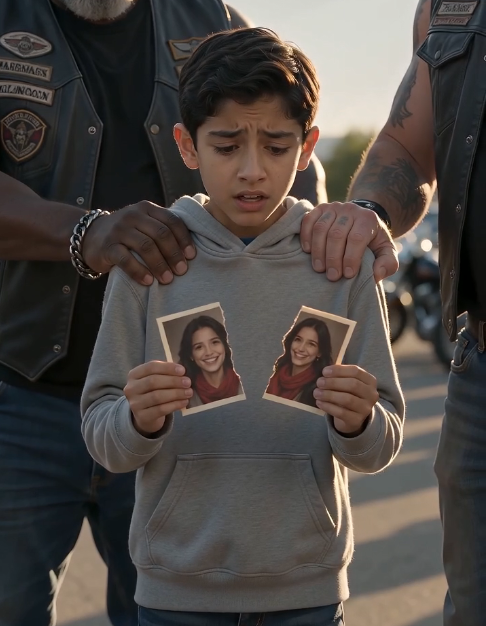
Forty-two motorcycles lined the curb.
At their center stood Ray “Hammer” Dawson.
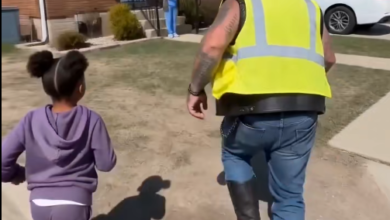
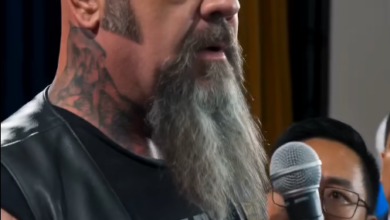
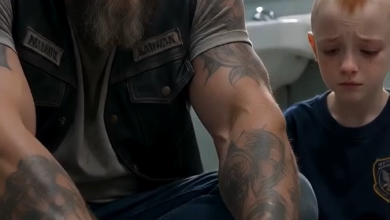
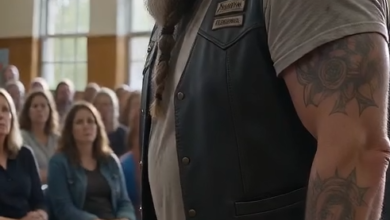
Hammer was fifty-six, six feet four, nearly 285 pounds, with a shaved head, thick black-and-gray beard, tattooed forearms, scarred knuckles, faded jeans, motorcycle boots, and a plain black leather cut worn pale around the seams.
He looked like a man hospital security should watch.
Instead, he was registering strangers for bone-marrow donation.
Four years earlier, Hammer had lost his wife, Anna, to a ruptured brain aneurysm. He carried her photograph inside his wallet and showed it to almost nobody. Every rider in his club knew the picture was untouchable.
Evan did not.
We were standing beside the food table when Hammer offered to buy him a sandwich. He opened an old brown wallet held together by black thread. Behind the clear photograph sleeve was Anna: thirty-nine, smiling into sunlight, her dark blond hair beneath a red scarf.
As Hammer removed a bill, a folded piece of paper shifted behind the picture.
Evan froze.
Only one corner showed—a curved blue line, part of a capital M, and a small red crayon sun.
“Where did you get that?” he asked.
Hammer did not understand. “Get what?”
“That paper.”
He reached for the wallet.
Hammer closed it.
Evan grabbed harder.
The photograph caught against the cracked plastic window. Paper tore. Anna’s face split from forehead to chin as Evan pulled half the picture free.
Everything stopped.
Leon Brooks, a broad Black biker standing behind Hammer, caught Evan’s left shoulder. Boone Mercer grabbed the right.
Students at the donor booth raised phones. A volunteer shouted for security. Someone called Evan a thief.
I lunged toward him.
Hammer moved first.
“Let the boy go.”
Boone stared at the torn photograph. “He ripped Anna’s picture.”
“I can see that.”
“He took your wallet.”
“Let him go.”
The riders released Evan.
My son stood trembling, clutching half of Anna’s face and the folded paper he had torn loose with it. Hammer took the wallet back, but he never reached for the note.
Evan opened it.
The handwriting crossed the page in purple ink. A red crayon sun filled one corner. Beneath it was the outline of a five-year-old hand traced in blue.
I knew every curve.
I had written that letter eight years earlier to an anonymous woman whose bone marrow entered my dying child’s body when no relative was a match.
The first sentence was still there.
To the stranger who gave my son back his mornings—
My knees weakened.
Hammer caught my elbow, but I pulled away and read the final line. It contained no names. The registry had forbidden identifying information. I had signed only with two words:
His mother.
“I wrote this,” I whispered.
Hammer looked from the letter to Evan.
“No,” he said.
I turned the paper toward him. “Where did Anna get it?”
His scarred fingers closed around the torn edge of the photograph.
For years, Hammer had known his wife entered the donor registry and later donated marrow anonymously. He knew she received one letter from the recipient’s family. He never knew the child’s name.
Anna never told us hers.
Hammer looked at Evan’s face and understood before I could say it.
“Your boy?” he asked.
I nodded.
The crowd surrounding us had watched a child destroy a dead woman’s photograph.
What they had not seen was the reason he recognized one corner of the letter—or why Anna had hidden my words behind the picture she told her husband to carry after she was gone.
But the final truth would require the donor registry, mutual consent, and a sealed file neither family had opened.
Want to know why Anna chose anonymity and what Hammer found inside her final letter? Drop PHOTO in the comments — I’ll share more soon.
Part 2 — The Stranger We Were Not Allowed to Name
Evan was five when his blood stopped behaving like a child’s blood.
He bruised easily, slept through breakfast, and developed fevers that disappeared before appointments. I blamed kindergarten germs until he became too tired to climb the stairs to our apartment.
The diagnosis arrived on a Tuesday.
Acute leukemia.
Doctors began treatment immediately. I learned to understand blood counts, infection precautions, infusion pumps, insurance denials, and the way medical professionals avoided promises while still helping families survive each hour.
Chemotherapy pushed the disease into remission.
Then it returned.
Evan needed a bone-marrow transplant.
His father had left before the diagnosis and could not be located. I was not a compatible match. Neither were my sister nor my parents. The transplant team searched the national registry.
Weeks passed.
Then a donor appeared.
We received no name, photograph, city, or occupation. We knew only that she was an adult woman, medically eligible, and willing to undergo the donation process for a child she had never met.
The registry protected both sides.
Anonymous letters were allowed, but identifying details were removed. Depending on program rules and jurisdiction, direct contact could become possible later only if both sides consented.
The donor never requested contact.
I wrote anyway.
The first letter sounded formal. I thanked her for registering, for answering the call, for completing medical testing, and for giving us a chance.
The coordinator returned it because I had accidentally included the hospital’s name.
I wrote a second version.
Evan added the red crayon sun. He traced his hand because he wanted the donor to know how large he had become. He drew five uneven fingers and colored three outside the lines.
At the top, I wrote:
To the stranger who gave my son back his mornings—
The transplant succeeded.
Recovery was not immediate. Evan spent months rebuilding strength. He celebrated his sixth birthday in a hospital room wearing a paper crown over hair just beginning to return.
Every morning he survived felt borrowed from someone we could not thank properly.
I sent one more letter at the first anniversary.
No reply came.
I assumed the donor wanted distance. I respected it.
What I did not know was that Anna Dawson had read every word.
Anna joined the marrow registry after organizing a donor drive at the community college where she taught bookkeeping. Two years later, she received notice that she might match a child.
Hammer opposed nothing, but he asked questions.
“Does it hurt?”
“Probably.”
“You know this kid?”
“No.”
“What if it doesn’t work?”
“Then somebody tried.”
That was Anna.
She spoke quietly, laughed loudly, and considered generosity ordinary enough to avoid mentioning. She did not want news coverage, photographs, or gratitude from strangers.
Hammer drove her to appointments.
He waited through the donation.
When she received my letter, she cried in the truck but refused to show him the page.
“That theirs?” he asked.
“His mother.”
“He okay?”
“He saw another birthday.”
Hammer asked whether she wanted to contact us when the confidentiality period ended.
Anna said no.
Not because she did not care.
Because she cared about the burden of gratitude.
“The boy doesn’t owe me a relationship because our cells matched,” she told him. “His mother doesn’t owe me a place in their family.”
She placed my letter behind the photograph in her wallet.
Four years later, Anna died suddenly from a brain aneurysm unrelated to the marrow donation.
While sorting her belongings, Hammer found the letter.
He did not read it immediately.
It remained folded behind the photograph for eleven months. When he finally opened it, he stopped at the red sun and traced hand.
Then he moved both items into his own wallet.
Photo in front.
Letter behind.
He carried a woman he had lost and a child he had never known in the same cracked plastic sleeve.
Part 3 — The Hands on My Son’s Shoulders
Evan did not intend to tear Anna’s face.
That mattered to Hammer.
It took me longer.
My son saw the red crayon sun before he saw the woman in the photograph. He remembered drawing it because I had kept a photocopy of the letter in his medical records. At thirteen, he was embarrassed by most things he made at five, but that traced hand represented a stranger whose existence shaped every birthday afterward.
When Hammer closed the wallet, Evan panicked.
He thought the paper might disappear again.
He grabbed.
The photograph tore.
Leon and Boone reacted from instinct. They knew Hammer had carried Anna’s picture through four years of funerals, winter rides, hospital visits, and nights sleeping in the clubhouse because home felt too empty.
Boone had once watched Hammer crawl beneath a collapsed workbench to recover the wallet after a shop accident.
So when Evan tore the photograph, the biker saw an attack on the last thing his road captain protected for himself.
His hand closed around the boy’s shoulder.
Not enough to injure him.
Enough to frighten me.
Hammer stopped it immediately.
“Let him go.”
Boone’s fingers released.
Leon followed.
Nobody argued again.
That was the test.
Brotherhood often means defending what another man loves. That morning, it meant trusting Hammer when he chose a frightened living child over the object preserving his dead wife’s face.
The crowd did not understand.
Phone videos showed only Evan grabbing the wallet, the photograph tearing, and two bikers restraining him. Online comments arrived before the donor coordinator reached us.
Some called Evan disrespectful.
Some called the bikers dangerous.
Others accused Hammer of inventing the donation story to excuse a confrontation.
Hammer refused interviews.
“We don’t know yet,” he said.
I held the original anonymous letter. “I wrote it.”
“You wrote a letter to a donor.”
“That donor was Anna.”
“Looks like.”
“You don’t believe me?”
Hammer looked at the torn photograph.
“Belief ain’t records.”
He was right.
The coincidence felt certain, but certainty involving protected medical information required more than matching paper. The donor-registration coordinator separated us, documented what had happened, and contacted the registry’s privacy team.
No records were opened casually.
Evan and I signed consent permitting confirmation and possible contact. As Anna had died, Hammer could provide only the documentation found among her belongings and consent to release information he was legally authorized to share. The registry reviewed its rules and consulted both families.
We waited.
During those days, Evan barely spoke.
He believed he had destroyed the only picture of the woman who saved him.
He wrote Hammer an apology but did not send it. Then he wrote another. The third filled six pages and said nothing about the donation.
It described what hospitals smelled like at night.
Hammer understood that one.
Before receiving official confirmation, he invited us to his garage.
Anna’s motorcycle stood beneath a cloth in the corner. She had ridden a small red cruiser, not Hammer’s Road King. Her helmet remained on the handlebar with a faded scarf tied around the chin strap.
Hammer placed the torn photo on his workbench.
One half showed Anna’s left eye and smile. The other showed her red scarf and shoulder.
Evan remained near the door.
“Come here,” Hammer said.
My son hesitated.
Hammer moved away from the workbench, giving him room.
Evan approached.
“I’m sorry.”
“Yeah.”
“I wasn’t trying to tear her.”
“I know.”
“How?”
Hammer pointed at the folded letter. “You went for that.”
Evan looked at the photograph. “Can it be fixed?”
“Not back to how it was.”
My son’s face fell.
Hammer added, “Different question.”
“What?”
“Can it be kept?”
Evan nodded.
“Then we keep it.”
Part 4 — The File Anna Never Opened
The registry confirmed the match eleven days later.
Anna Dawson had donated bone marrow anonymously eight years earlier.
Evan had received it.
The confirmation arrived through a scheduled call involving the registry coordinator, a hospital social worker, Hammer, Evan, and me. Nobody celebrated at first.
The fact was too large.
Hammer sat at the end of a conference table holding Anna’s torn photograph between both hands. Evan stared at his own fingers.
The coordinator explained that Anna had declined direct contact after the program’s waiting period. She requested only limited health updates available through the registry.
She did not want her full identity released.
Hammer lowered his eyes.
I asked whether our accidental meeting violated her wishes.
The coordinator answered carefully. Anna had chosen anonymity during life. The registry would not publicly release her records. What the families did with information discovered independently required privacy, sensitivity, and respect for the deceased donor’s documented preferences.
Hammer spoke before I could.
“No news.”
I agreed.
“No fundraising using her picture.”
“Agreed.”
“No school assemblies about them meeting.”
“Agreed.”
Evan looked up. “Can I know her?”
The question changed the room.
Hammer rubbed one thumb along the tear through Anna’s face.
“Some.”
Over the following months, he told Evan about the woman beyond the donation.
Anna hated raisins but kept buying oatmeal cookies containing them. She sang harmony even when a song had none. She balanced household accounts in purple ink and once drove seventy miles back to return twelve dollars a cashier gave her by mistake.
She also became angry, forgot appointments, and kept every empty gift box because she believed someone might need one.
Hammer refused to turn her into a saint.
That helped Evan more than perfection would have.
In return, I told Hammer about the child Anna saved.
Evan had once wanted to become an astronaut but abandoned the plan after learning astronauts could not bring dogs. He hid crackers beneath his hospital pillow. He pretended not to fear procedures because he heard me crying in the bathroom.
Hammer absorbed each detail without comment.
The deeper revelation came from a sealed envelope Anna had left inside a desk drawer marked for Hammer.
He had never opened it.
The envelope was not part of her legal documents. Hammer found it after her death and assumed it contained another letter he was not ready to read. After the registry confirmation, he brought it to our next meeting.
Inside was a note in Anna’s purple handwriting.
She wrote that anonymity did not mean indifference. She had declined contact because she feared entering a recovering family’s life as someone they had to thank forever.
Then she addressed Hammer.
If the boy ever finds us anyway, do not make him carry my absence for you. Let him have his own life.
Hammer read the line twice.
Evan sat across from him.
“I’m not replacing her,” my son said.
Hammer’s jaw tightened.
“I know.”
“I’m not her because I have her marrow.”
“I know.”
“You don’t have to take care of me.”
Hammer looked toward the garage floor.
“I know.”
“Then why are you crying?”
Hammer wiped his face with the heel of one scarred hand.
“Dust.”
Nobody challenged him.
Part 5 — The Photograph With a Visible Tear
Repairing the photograph became a debate.
Boone wanted a professional restoration. A photo lab could scan both halves, reconstruct the missing fibers digitally, and print a version where the tear disappeared.
Hammer refused.
Leon suggested placing the original halves side by side inside a sealed archival sleeve.
Hammer considered that.
Evan proposed joining them from the back with a narrow strip of red paper.
“Why red?” Boone asked.
“Her scarf.”
Hammer looked at my son.
“Do it.”
A conservator helped them use reversible archival materials rather than ordinary tape. The two pieces aligned, but the split remained visible across Anna’s face.
The red backing showed through by less than a millimeter.
Hammer placed the repaired photograph into a new wallet sleeve. My letter returned behind it, along with Anna’s final note.
The tear stayed.
Not as punishment.
As part of the route by which two families found each other.
Boone apologized to Evan for grabbing him. My son said he understood.
Hammer interrupted.
“Understanding doesn’t erase it.”
Boone nodded. “Then I’m still sorry.”
Evan accepted.
The club organized another marrow-registration drive the following spring. They did not use Anna’s name, photograph, or story in public advertising. The event focused on what registration involved, who might be eligible, and where people could receive accurate medical information.
Qualified healthcare staff handled questions.
The bikers handled tables, parking, coffee, and directions.
Evan attended without speaking onstage. He sat beside Hammer and folded information packets. When people asked why the giant biker kept checking a photograph in his wallet, neither answered.
I registered that day.
So did Leon.
Boone was medically ineligible because of a health condition, so he volunteered instead. He spent six hours directing cars and explaining that joining a registry did not guarantee someone would be called.
Hammer had registered years earlier but never matched.
He joked that his marrow probably had an attitude problem.
Evan laughed.
Their relationship developed in small, imperfect ways. Hammer taught him to change motorcycle oil but refused to let him ride until he completed a certified safety course and reached the legal age. Evan taught Hammer how to send photographs without covering half the camera lens with his thumb.
They did not call each other father and son.
They had their own names.
At Christmas, Evan gave Hammer a leather wallet he had stitched in the garage. The photograph window was wider than the old one, and the pocket behind it held both letters without folding them into smaller squares.
Hammer inspected every seam.
“Crooked.”
Evan took it back.
Hammer held on.
“Didn’t say bad.”
He transferred Anna’s photograph into the new wallet.
My letter went behind it.
Exactly where she had kept it.
Part 6 — Every Morning She Gave Back
Evan turned sixteen without leukemia returning.
Then seventeen.
Then eighteen.
Each birthday began with the same ritual. Before breakfast, I sent Hammer a photograph of Evan standing outside in morning light.
It began because of the first line in my anonymous letter.
To the stranger who gave my son back his mornings—
Hammer saved every picture inside a folder on his phone. He never posted them.
On Evan’s eighteenth birthday, we met at Anna’s grave.
Hammer had asked permission before bringing us. Her headstone made no mention of the donation. That was how she wanted it.
Evan placed a small red paper sun beneath the flower holder.
“I don’t know what to say,” he admitted.
Hammer stood beside him with both hands in his jacket pockets.
“She didn’t require anything.”
“I know.”
“Then don’t perform.”
Evan looked at the stone.
“Morning,” he said.
That was enough.
Later that year, Evan joined the marrow registry after completing the medical screening and informed-consent process. No one pressured him. Hammer asked three separate times whether he was registering because of Anna.
“Partly.”
“That’s a bad reason.”
“It’s one reason.”
“What are the others?”
Evan listed them.
Hammer listened.
“Okay.”
My son has not been called as a match. He may never be. Registration is not a promise that biology will cooperate.
It is only willingness placed on file.
Hammer understood that better than anyone.
The annual donor drive continued. Each year, one empty chair remained behind the registration tables. Anna’s name was not printed on it.
Her red scarf rested across the back.
People who knew understood.
People who did not asked no questions.
Part 7 — What the Wallet Carried Next
Nine years after Evan tore the photograph, Hammer replaced his wallet again.
The leather had softened, the corners had split, and the photograph window had clouded. Evan, now twenty-two and studying pediatric nursing, made the replacement at the same garage workbench.
Hammer sat opposite him cleaning a carburetor.
“You still keeping the tear?” Evan asked.
Hammer looked offended.
“You put it there.”
“I said I was sorry.”
“Didn’t say I hated it.”
Evan fitted Anna’s photograph into the clear sleeve. The thin red line still divided her face. Behind it went my anonymous letter and Anna’s final message.
A fourth item joined them.
It was Evan’s donor-registry card, with private identifying details covered inside the wallet.
Hammer raised an eyebrow.
“You need this.”
“I have another.”
“You trying to fill my wallet with paperwork?”
“It started that way.”
Hammer closed the leather cover.
The wallet now held a dead wife, a living recipient, two mothers’ words, and the possibility that one day Evan might answer the same call Anna had answered.
None of it belonged on social media.
None of it required applause.
Before leaving the garage, Evan asked Hammer to show him the photograph one more time. Hammer opened the wallet.
Sunlight from the bay door crossed Anna’s red scarf and the repaired split. The tear remained visible, but it no longer appeared to divide the image.
It appeared to point behind it.
Toward the letters.
Toward the traced hand.
Toward all the mornings one anonymous woman never asked to witness.
Hammer closed the wallet and placed it over his heart.
Then he started the Road King.
Evan followed him into the morning on his own motorcycle, two red taillights moving west beneath the Route 66 signs.
The photograph stayed torn.
The life did not.
Follow the page for more unforgettable biker stories about hidden kindness, tested brotherhood, and the strangers whose quiet choices continue long after they are gone.