Part 2: A Biker With Prison Tattoos Modeled Pink Tulle and Flower Hats for Three Hours — Then We Learned Why His Daughter Had No One Else
Part 2 — The Twelve Names Crossed From the Program
I had known Ivy for two school years before I understood how much of her life she concealed behind red glasses and a measuring tape.
She was not loud. She did not compete for attention, and she disliked explaining her drawings before they were finished. During art class, she worked in the far corner, building dresses from grocery bags, candy wrappers, old maps, and fabric scraps other children considered useless.
Her mother, Lena Maddox, taught her the first stitches.
Lena worked nights at a nursing home and altered clothes for neighbors at their kitchen table. She died after a collision on Interstate 44 when Ivy was six. Graves had been out of prison for only four months.
He became a widowed father before he had learned how to attend a parent conference.
Most adults expected failure.
Graves had no permanent home, no driver’s license, a parole schedule, and eleven years of missed birthdays behind him. Ivy had spent much of her childhood with Lena’s sister, Rachel, who petitioned for guardianship after the funeral.
Rachel did not hate Graves.
She distrusted time.
“You were a voice behind glass,” she told him during the custody hearing. “That doesn’t make you ready to raise her.”
Graves did not argue. He rented a two-bedroom apartment above Blacktop Customs, worked days repairing motorcycles, cleaned the shop at night, completed parenting classes, and attended every supervised visit.
He arrived early.
He left when asked.
After eight months, Rachel withdrew her petition.
Ivy moved into the apartment with two suitcases, a sewing machine, and a cardboard box containing her mother’s unfinished patterns.
That box became the center of their home.
Graves knew nothing about sewing. His hands were too large for tiny needles, and an old fracture kept his right index finger from bending fully. Still, he sat beside Ivy while she threaded the machine, read instructions aloud, and practiced straight seams on shop towels.
The first thing he made was a pillowcase.
It resembled a crooked sack.
Ivy slept on it for a year.
By the time she entered my class, she could look at discarded material and imagine what it might become. A torn motel curtain became a ball gown. Reflective motorcycle tape became a belt. A cracked leather glove became six flower petals.
Graves began visiting Hazel’s Alterations every Friday for scraps. Hazel Palmer, seventy-one, saved damaged zippers, odd buttons, lace ends, and fabric too small for paying customers.
The first time he entered her shop, she reached beneath the counter for pepper spray.
Graves noticed.
“Looking for pink,” he said.
Hazel kept one hand below the register. “Why?”
“My kid needs clouds.”
That became their arrangement. Graves arrived after work smelling of motor oil and road dust. Hazel filled a paper bag. He left five dollars even when she refused it.
The Iron Hounds discovered the habit by accident. Milo opened Graves’s saddlebag looking for a wrench and found satin ribbons beside a tire gauge.
For six months, nobody mentioned it.
Brotherhood sometimes means knowing which joke not to make.
The fashion showcase began with a flyer from the Kansas City Young Creators Program. Twelve students between nine and thirteen would receive a summer scholarship, professional sewing instruction, and a small equipment grant. Applications required sketches, photographs, a personal statement, and a three-minute video showing at least ten finished looks on a moving model.
Ivy had sketches.
She had thirty-two finished looks.
She had no model.
Graves volunteered before understanding what the word meant.
“You walk,” Ivy told him.
“Where?”
“Back and forth.”
“I do that.”
“In clothes.”
“I wear clothes.”
“Mine.”
Graves looked at a yellow skirt constructed from plastic tablecloths.
“How many?”
“Maybe ten.”
There were thirty-two.
I suggested turning the filming into a community showcase. Other children could design accessories, classmates could model, and parents could attend. Within a week, twelve families signed up.
Ivy glowed.
Graves stayed near the doorway at planning meetings. He never wore his club colors inside the school. He answered questions directly, disclosed his conviction before anyone else could, and left whenever a parent appeared uncomfortable.
For a while, it worked.
Then a local account reposted an old newspaper story about him.
The article included the worst photograph possible: twenty-seven-year-old Cole Maddox handcuffed, bleeding above one eye, with a liquor-store window shattered behind him. It described the gun, the stolen money, the injured clerk, and his prior fights.
It did not describe the man standing quietly outside our art room nineteen years later.
Parents began withdrawing.
The first said her son had a soccer tournament. The second claimed a family emergency. Three others sent nearly identical emails within an hour.
By Friday night, all twelve models were gone.
The community center board considered canceling the reservation. Graves offered to stay outside. Ivy said the outfits had been fitted to him anyway.
That was a lie.
They had been fitted to children.
At 1:14 Saturday morning, Graves and Ivy stood inside Blacktop Customs, opening seams and adding fabric panels so every outfit could fit his shoulders, chest, and waist. Anvil cut thread. Hazel worked the sewing machine. Milo drove twice to a twenty-four-hour store for elastic.
Rivet never appeared.
He believed Graves should postpone the show.
“Give people time to calm down,” he argued over the phone.
“The deadline is tomorrow,” Graves said.
“Then apply next year.”
“She’s nine this year.”
“She’ll still be designing.”
Graves looked toward Ivy, who was carefully widening a green cape on the cleanest workbench.
“I promised this year.”
That ended the call.
At sunrise, they loaded thirty-two outfits into the saddlebags of four motorcycles. Three club brothers helped carry everything into Riverside Hall, then left before Ivy noticed the missing audience.
Graves arranged sixty-four chairs anyway.
He poured lemonade.
He placed programs on every seat.
When Ivy asked where the models were, he told her the truth gently: people had become afraid and made other choices.
She went into the restroom and stayed there nineteen minutes.
Graves waited outside without knocking.
When she emerged, her face was dry.
“I still need a model,” she said.
He removed his leather cut.
“You got one.”
Part 3 — The Video That Turned a Father Into a Joke
The first clip lasted fifteen seconds.
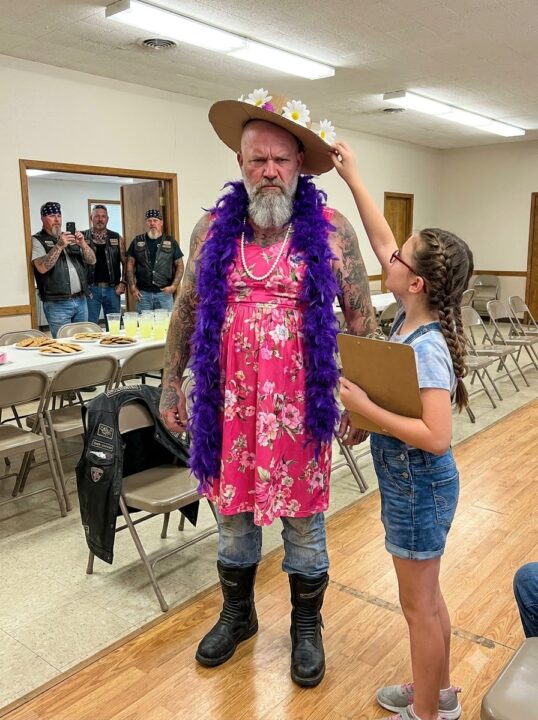
Milo had recorded Graves wearing the pink tulle skirt because he wanted to send it privately to Stone, a club brother recovering from surgery in Springfield. Ivy was outside the frame. The empty chairs were invisible. Nobody could see her designs, her clipboard, or the hand-painted runway.
All the internet saw was a giant former prisoner in a child-sized skirt.
Milo deleted the post within seven minutes.
It was already gone.
A comedy account reposted it with music. Another added prison bars. Someone placed Graves’s face beside a photograph from his arrest and called him “Miss Missouri State Penitentiary.”
By Sunday morning, the clip had 2.4 million views.
Graves did not react.
Ivy did.
She was old enough to search her father’s name and young enough to believe that every stranger laughing represented a person who knew the truth.
At school Monday, two boys bowed as she entered the cafeteria.
“Your mom is here,” one said, pointing at a screenshot of Graves in the dress.
Ivy threw her milk carton at him.
It missed.
She received detention.
Graves came to the office still wearing his mechanic’s shirt. Grease darkened his forearms around the prison ink. Principal Warren showed him the video, the comments, and Ivy’s disciplinary report.
“Her reaction was unacceptable,” the principal said.
“Yes.”
“We also have parents asking whether you were inside the community hall with children.”
“My child.”
“Were other children there?”
“No.”
The principal hesitated. “That may be fortunate.”
Graves looked at him.
The room cooled.
I stepped in before five words became the wrong five words. “The other families canceled because of the old article. Cole completed the show so Ivy could submit her scholarship application.”
Principal Warren removed his glasses. He had not known.
Most people had not.
Graves disliked explanations because explanations often sounded like requests for forgiveness. He had stopped asking strangers to separate the man he was from the crime he committed.
He had committed it.
At twenty-seven, desperate, addicted to pain pills after a construction accident, and convinced that fear made him powerful, Graves entered a liquor store with Rivet and a stolen handgun. The clerk resisted. Rivet struck him. Graves fired into the ceiling.
Nobody died.
That did not make it harmless.
The clerk suffered a fractured jaw, permanent hearing damage, and years of panic whenever a door opened after dark. Graves accepted a plea deal and served eleven years. Rivet received eighteen months after cooperating.
That difference lived between the brothers.
Online strangers found the court records. They posted the clerk’s name, Ivy’s school, the address of Blacktop Customs, and photographs of Iron Hounds members.
The shop owner, Earl Voss, called Graves into the office Monday afternoon.
“I know you didn’t hurt that girl,” Earl said.
“She’s my daughter.”
“I know. But customers don’t. Three canceled service appointments. Somebody threatened to break the windows.”
Graves looked through the office glass toward the repair bays. “You firing me?”
“I’m asking you to stay home until this settles.”
“No pay?”
Earl rubbed his mouth. “I can’t afford it.”
Graves removed his shop keys and placed them on the desk.
At the clubhouse that evening, the Iron Hounds argued for two hours.
Rivet wanted a public statement demanding the video be removed. Milo wanted to admit he filmed it. Anvil wanted to release the full recording from the hall, including Ivy describing every garment.
Graves said no.
“The application owns that video until judging ends.”
“Then tell people what happened,” Rivet said.
“Not using her.”
“They’re using you.”
“Let them.”
Rivet struck the table. “You always do this. You take the hit, then act like the rest of us are weak for wanting to swing back.”
Graves remained seated.
“That what you think happened before?”
The room became silent.
Everyone knew he meant the robbery.
Rivet stood. “Don’t.”
“You brought it.”
“I didn’t ask you to carry my time.”
“You were nineteen.”
“I was holding the gun when the clerk got hit.”
“And I brought you there.”
Rivet’s eyes filled, but he did not blink. “You told the prosecutor it was all your plan.”
“It was.”
“You added things.”
Graves rose slowly. The leather cut creaked across his shoulders. “Enough.”
“No. You lost eleven years. You missed Lena getting sick. You missed Ivy being born. Now you’re losing work because I told everybody the club looked weak with you in that dress.”
I had not known that.
Neither had Graves.
Rivet had called two participating parents before the show. He warned them the viral attention around his brother might bring reporters, police, or trouble to the hall. Those parents contacted the others.
Rivet had not ordered anyone to withdraw.
He had given fear a push.
Graves removed his leather cut and folded it on the table.
“Road captain doesn’t shame the club,” he said.
Anvil stood. “You didn’t.”
“Brother says I did.”
“I was angry,” Rivet muttered.
“Words still count.”
Graves placed the folded vest in front of our president.
Then he walked out.
We heard the Road King start beyond the metal door. The V-twin engine settled into a rough pulse, waited once, and faded toward Route 66.
Ivy was sitting on the back steps.
None of us had seen her arrive with Hazel.
She had heard everything.
“Did Uncle Dale make them leave?” she asked.
Rivet could not answer.
She removed the purple sewing-needle pin from her jacket and placed it on his palm.
Then she followed the sound of her father’s motorcycle.
That felt like the crisis.
It was not.
The scholarship program emailed the next morning. Ivy’s application had been disqualified because the model in her video was an adult, while the competition rules required youth participants.
Three hours.
Thirty-two outfits.
An empty hall.
All of it appeared to have meant nothing.
I found Graves sitting alone inside Blacktop Customs after Earl closed for the night. He was still suspended, but Earl allowed him to use the rear workbench. Pink thread lay beside carburetor parts.
Ivy’s rejected application remained open on his phone.
“She can apply next year,” I said.
“That’s what Rivet said.”
“She’ll be ten.”
“Was nine when she made these.”
He held up the final dress. It was the pink curtain gown, but the inside seam carried a strip of faded blue cotton printed with tiny white birds.
I recognized it from an old photograph of Lena.
The dress contained part of Ivy’s mother’s nursing uniform.
Graves folded it carefully.
“She made something this year,” he said. “Should count this year.”
“What are you going to do?”
He looked toward his Harley.
“Ask the rules.”
Part 4 — The Man Behind the Prison Ink
Graves did not demand that the scholarship committee reverse its decision.
He rode to Kansas City and asked to read the rule.
I went with him because Ivy needed an adult at school, and because Graves’s suspended license for a paperwork violation had been resolved only months earlier. He could legally drive, but crowded offices still made him restless.
Anvil followed on another Harley.
We arrived at the Young Creators building shortly after noon. Graves wore a clean white shirt beneath his leather jacket. The cuffs covered part of his tattoos, though the ink on his knuckles remained visible.
A receptionist stared at them.
“Appointment?”
“No.”
“Then I’m afraid the director may not be available.”
“We can wait.”
He did.
For four hours.
At 4:19, program director Nadine Price came into the lobby carrying Ivy’s application folder. She was in her early sixties, with silver hair, blue glasses, and the exhausted expression of someone expecting an angry parent.
Graves stood.
“Mr. Maddox, the rules are clear. Garments must be modeled by youth participants.”
“Show me.”
She opened the handbook.
The exact sentence said: Submitted designs must be presented in motion and scaled for the program’s youth division.
Nothing required a child model.
A volunteer reviewer had assumed it did.
Nadine read it twice.
“You altered children’s garments to fit yourself?”
“Yes.”
“And modeled all thirty-two?”
“Yes.”
“Why?”
“Everybody quit.”
Her eyes moved toward his hands. “Because of your conviction?”
“Yes.”
I expected him to explain more.
He did not.
Nadine took us upstairs to a viewing room and played the unedited recording. For three minutes, Graves crossed the silver tape wearing increasingly absurd combinations while Ivy’s voice explained shape, balance, movement, recycled material, and color.
The camera never mocked him.
That mattered.
In one look, he wore an orange lampshade as a shoulder piece. In another, he carried a handbag made from a motorcycle air-filter box. The pink curtain dress moved badly around his boots, but when he turned, the blue strip from Lena’s uniform flashed along the inner seam.
Nadine stopped the video.
“What is that fabric?”
“My wife’s.”
“Did Ivy know?”
“She chose it.”
Graves looked at the frozen image. “Her mom taught her.”
The director closed the laptop.
“The application should not have been rejected.”
Graves nodded once.
“However, there is another problem.”
The photographs showed garments on child-sized forms before Graves enlarged them, while the video showed adult proportions. Reviewers could not evaluate whether the original construction worked.
Anvil leaned toward the table. “So all that riding—”
Graves raised one finger.
Anvil stopped.
“What do you need?” Graves asked.
“A live presentation or a second video using appropriately sized models.”
“How many?”
“Ten looks minimum.”
“When?”
“The review panel meets Friday.”
It was Wednesday evening.
We returned to Joplin after dark.
Graves found Ivy asleep on the sofa with a sketchbook open beneath her hand. A new drawing filled the page: twelve empty chairs wearing outfits instead of people.
He carried her to bed without waking her.
Then he entered the garage and spread ten designs across the workbench.
At 10:46, the Iron Hounds arrived.
Not one or two.
Twenty-seven.
Rivet came last.
He wore no club cut. Ivy’s purple sewing-needle pin had been fastened to his plain black shirt.
“We heard you need models,” he said.
Graves examined the men filling the garage. The youngest weighed 190 pounds. The oldest had two artificial knees. None could fit a child-sized garment.
“No.”
Hazel pushed through them carrying fabric scissors. “Then make them fit.”
The next forty-one hours changed the club.
Men accustomed to rebuilding engines learned to pin hems. A tattooed Army veteran named Rooster operated a sewing machine with more precision than any of us expected because his grandmother had taught him upholstery. Stone welded rolling garment racks. Milo photographed every design and labeled the pieces.
Rivet worked on the smallest outfits alone.
Near midnight, I found him opening seams with a razor blade.
“You’ll cut the fabric,” I warned.
“I know.”
“Then use a seam ripper.”
“What’s that?”
I handed him one.
He stared at the tiny tool. “Looks useless.”
“So did the pink skirt.”
He accepted the point.
Graves worked without reclaiming his vest or title. He enlarged patterns, reinforced shoulders, and showed the men how to move without tearing paper panels. He knew more than anyone realized.
That was the next buried truth.
During his eleventh year in prison, Graves worked in the upholstery shop. An older inmate named Samuel Tate taught him to measure, cut, stitch, and repair industrial sewing machines. Graves originally learned because Lena mailed him photographs of Ivy’s first costumes.
He wanted to understand the words in her letters.
Hem.
Dart.
Bias.
Grain.
At night, he practiced stitching scraps into small squares. He was not permitted to send handmade clothing, so he mailed Ivy paper patterns instead.
Lena saved all of them.
After her death, Ivy found the patterns in the cardboard box.
Half her collection began with shapes her father drew inside prison.
The black marks tattooed across Graves’s right wrist were not simply years served. They covered the name of the prison crew he joined for protection during his first sentence. After Ivy asked what the symbol meant, he blacked it out.
Beside it, he added her sewing needle.
One past stayed visible.
Another past replaced its direction.
At three Thursday morning, Graves tested a cape made from reflective road material. It tore beneath his arm.
Nobody laughed.
Hazel repaired it.
At six, Rivet handed Graves the pink curtain dress. He had restored its original size and transferred the blue strip from Lena’s uniform without damaging a stitch.
Graves inspected the seam.
“Good.”
Rivet waited.
That one word was not forgiveness.
It was a door left unlocked.
By Thursday evening, ten club members could walk in the designs without breaking them. The garments still looked oversized, unconventional, and strange on tattooed men.
That became their strength.
Ivy came to the garage believing we were repairing one dress.
The metal door opened.
Twenty-seven bikers stood in two lines wearing flower hats, tablecloth capes, paper skirts, curtain dresses, oven-mitt gloves, bead necklaces, and cardboard wings.
Ivy did not speak.
Graves walked to the center wearing the pink tulle skirt from the first show.
“We need a designer,” he said.
Her lips parted.
“For what?”
“Second show.”
“I don’t have models.”
The bikers moved apart.
Behind them stood twelve children.
The original volunteers had returned with their parents.
Not all parents had changed their opinion of Graves. Some still did not trust him. But when the full recording was privately shared, they saw a father completing a promise after their fear emptied the room.
Their children had asked to come back.
Ivy looked at the bikers, the children, and Rivet wearing the purple pin.
“Who goes first?” she asked.
Graves lifted his chin.
“Designer decides.”
Part 5 — When the Iron Hounds Took the Runway
The second fashion show began Friday at 5:30 inside Blacktop Customs because Riverside Hall had another booking.
Earl closed the repair shop early. Engines were rolled against the walls. Oil stains were covered with canvas. Stone suspended work lights above a runway made from flattened cardboard boxes.
The air smelled of gasoline, hot metal, coffee, hairspray, and fabric glue.
Nobody would have mistaken it for Paris.
Ivy loved it.
The review panel watched through a live video connection from Kansas City. Nadine Price appeared on a laptop beside three designers, a youth-program coordinator, and the volunteer who had rejected Ivy’s application.
Sixty-four folding chairs faced the runway again.
This time, every chair was occupied.
Parents sat near the exit. Teachers gathered beside the tool cabinets. Mechanics washed grease from their hands and stood along the walls.
Even Earl’s three customers who canceled service returned.
Graves stayed behind the curtain.
“This is her show,” he said.
Ivy disagreed.
The first ten looks were modeled by children. She had adjusted each garment back to its original size, sometimes while a biker stood still wearing the enlarged version so she could compare movement.
The audience applauded.
Graves did not.
He watched the seams.
When a paper shoulder piece began slipping, he stepped forward with double-sided tape. When a boy forgot where to turn, Graves pointed at the silver mark without interrupting the music.
Ivy presented the tenth look: a blue-and-gold jacket constructed from nursing scrubs, discarded denim, and reflective motorcycle tape.
The blue fabric had belonged to Lena.
The reflective strips came from Graves’s damaged riding jacket.
Ivy stood before the laptop.
“My mom worked nights,” she said. “My dad rode to see me after work. This is for people who come home when it’s dark.”
Graves looked at the floor.
The panel asked about construction, material choices, and movement. Ivy answered every question until one reviewer asked why she used an adult man in the original recording.
“Because he was the model who stayed.”
The garage became still.
The reviewer glanced toward Graves. “Was he comfortable wearing the designs?”
Ivy considered the question. “No. Some of them itched.”
A few people laughed.
“He wore them anyway,” she continued. “A model’s job is to help the designer show the idea. Dad said my idea mattered more than how he looked.”
Graves rubbed one scarred thumb across the side of his hand.
Nadine asked to see the original model.
He shook his head.
Ivy folded her arms.
“Dad.”
The bikers moved before he did. Anvil lifted the pink tulle skirt. Rooster brought the cardboard flower hat. Hazel produced the purple scarf.
Graves stared at them.
Rivet carried the final piece: the plain black leather cut Graves had surrendered at the clubhouse.
Our president had returned it.
The road-captain patch remained attached.
“Club voted,” Rivet said.
Graves did not reach for it.
“On what?”
“Whether wearing your kid’s dress shamed the patch.”
“And?”
Anvil grinned. “Twenty-six said no.”
“Who said yes?”
Milo raised his hand. “I misunderstood the question.”
Graves looked at Rivet.
His brother held out the vest. “I emptied those chairs because I thought protecting the club meant protecting how we looked. You showed us what it actually means.”
That was the closest Rivet came to an apology in public.
Graves took the vest.
He did not put it on.
He draped it over the pink curtain dress, letting black leather, prison ink, blue nursing cloth, and cheap glitter occupy the same body.
Then he stepped onto the cardboard runway.
The phone speaker began playing the same thin instrumental beat from the empty hall.
Graves walked seriously.
No exaggerated hips. No comic face. No apology.
At the turn, he lifted the tiny glitter purse.
Ivy called from behind the curtain. “What are you carrying?”
Graves answered in the same flat voice as before.
“My confidence.”
This time, it did not feel light.
The audience stood.
He completed the walk and returned directly to Ivy. She adjusted one cardboard flower above his ear, then looked into the camera.
“My father is a biker,” she said. “He was also my only model for three hours. If my clothes can make him look like this, I think they work.”
Even the review panel laughed.
The volunteer who rejected her application leaned toward his camera. “I owe you an apology, Ivy.”
She glanced at Graves.
He gave one small nod.
“Okay,” she said.
That was all.
The scholarship decision arrived two weeks later.
Ivy was selected.
She did not rank first. She did not receive a special sympathy award, and the program did not pretend her construction was perfect. Reviewers praised her use of recycled materials, her understanding of movement, and the clear design identity visible across thirty-two mismatched looks.
She received tuition, a sewing machine, and six hundred dollars for materials.
Graves read the email twice.
Then he returned to rebuilding a carburetor.
“You going to say something?” Anvil asked.
“She earned it.”
“That’s something.”
The viral clip changed too. Milo released a longer version with Ivy’s permission. It showed the empty hall, her design instructions, Graves’s serious walks, and the crossed-out programs.
Millions watched again.
Reporters called.
Graves refused interviews that focused only on his prison sentence. Ivy accepted one local interview about recycled fashion. Before filming, she made the reporter agree that her father would be described as her model, not an ex-convict wearing a dress.
The reporter asked Graves for one sentence.
He gave her three.
“My kid is a designer. I’m her model. If she shines while I wear a pink dress and flower hat, then I’m a supermodel.”
The line traveled farther than the joke.
Earl offered Graves his job back with lost wages. Graves accepted the work but refused money for hours he had not worked. Earl placed the amount in a shop account for Ivy’s fabric.
The parents who withdrew did not all become his friends. Trust did not appear because of one tender video.
Some apologized.
Some remained cautious.
Graves accepted both.
He understood that changing required more than insisting other people notice.
The most unexpected visitor arrived one month later.
His name was Thomas Bell.
He was the liquor-store clerk injured during the robbery.
Part 6 — The Clerk Who Watched From the Last Chair
Thomas Bell entered Blacktop Customs on a Tuesday carrying a folded newspaper and an old photograph of Graves in handcuffs.
Every Iron Hound in the shop recognized him.
Rivet moved first.
Graves stopped him with one look.
Thomas was fifty-six now. A pale scar crossed his jaw, and a hearing device rested behind his left ear. He had watched Ivy’s runway video after his granddaughter showed it to him.
“I almost wrote something under it,” Thomas said.
Graves wiped his hands on a shop towel. “Why didn’t you?”
“Didn’t know which man I’d be writing about.”
“Same one.”
Thomas shook his head. “No. Same name.”
Graves did not accept the distinction. “I did it.”
“Yes.”
“I brought the gun.”
“Yes.”
“I don’t need you making it smaller because my kid likes dresses.”
Thomas’s mouth tightened.
“I didn’t come to make it smaller.”
He unfolded the newspaper photograph and placed it beside a printed image from the fashion show. In one, Graves was bleeding, handcuffed, and staring at the ground. In the other, he wore pink tulle while Ivy adjusted his flower hat.
Thomas tapped both pictures.
“I came because people keep using the second man to erase what the first one did. That isn’t fair to me.”
Graves nodded.
“Also,” Thomas continued, “people keep using the first man to say the second one cannot exist. That isn’t fair to your daughter.”
Nobody spoke.
Thomas had brought a sewing box that belonged to his late wife. His granddaughter wanted to attend Ivy’s new weekend design workshop, but he wished to ask Graves directly whether the garage would be safe.
Graves showed him the exits, first-aid kit, background-check policy for volunteers, security cameras, locked tool cabinets, and the section separated from the motorcycle bays.
Thomas inspected everything.
Then he asked the question that mattered.
“Will you be teaching?”
“No.”
“Why not?”
“Parents didn’t sign up for me.”
Thomas looked toward the industrial sewing machine.
“Didn’t ask what they signed up for.”
Graves demonstrated how to repair a jammed bobbin. His scarred hands moved slowly. Thomas watched the prison tattoos pass beneath the work light.
“You learned inside?”
“Yes.”
“Something useful came out of those years.”
Graves kept his attention on the thread. “A lot should’ve.”
Thomas enrolled his granddaughter.
He did not forgive Graves that day. Graves did not ask him to.
But when the first workshop opened, Thomas occupied the final folding chair near the exit. He stayed for two hours while eight children turned discarded fabric into capes and bags.
At the end, Ivy announced a runway practice.
No child wanted to model first.
Thomas lifted his hand.
Graves stared at him.
Thomas pointed toward a green cape covered with silver stars. “That one fit an old man?”
Hazel smiled. “We can make anything fit.”
Ten minutes later, the former liquor-store clerk walked between motorcycle lifts wearing the cape, a purple scarf, and a cardboard crown.
Graves stood beside the runway.
At the turn, Thomas lost his balance.
Graves caught his elbow.
For one second, the hand that once held a gun against him held him upright.
Thomas looked down at it.
“Got me?”
Graves released his arm slowly. “Got you.”
That was all either man could carry that day.
It was enough.
The workshop became monthly. Children brought sketches. Parents brought discarded clothes. Iron Hounds members became models whenever the young designers needed a body willing to look foolish.
The club established one rule.
Nobody laughed until the designer laughed first.
Rivet modeled a silver skirt made from emergency blankets. Anvil wore wings cut from road maps. Milo spent forty minutes inside a dress constructed from dog-food bags and claimed it was hotter than welding leather.
Graves remained the most requested model.
He never smiled on the runway.
That made every outfit better.
Part 7 — The Flower Hat Above His Harley
Three years after the empty fashion show, Ivy returned from the Kansas City program with a garment bag longer than she was tall.
She was twelve, had grown out of the red glasses, and now carried tailor’s chalk behind one ear the way Graves carried a carpenter’s pencil.
The Iron Hounds hosted her final presentation at Riverside Hall.
This time, the sixty-four chairs filled before the doors opened.
Hazel sat in front. Thomas occupied the last chair near the exit. Earl closed Blacktop Customs for the afternoon. Principal Warren brought several art students, while parents who once withdrew their children stood along the wall.
Rivet adjusted the lights.
Graves waited near the runway wearing jeans, boots, a faded black shirt, and his leather cut.
Ivy approached with the garment bag.
“No,” he said.
“You haven’t seen it.”
“Still no.”
“You promised to model whenever I needed you.”
“Three years ago.”
“I wrote it down.”
She opened her sketchbook.
Graves’s promise appeared beneath a drawing of the original pink skirt.
He read it.
“Lawyer trick.”
“Designer trick.”
The garment was not ridiculous.
It was a black riding coat made from reinforced denim, worn leather, reflective tape, blue nursing fabric, and small panels cut from the pink curtain dress.
The left sleeve carried a purple needle stitched through a heart.
Inside the collar, Ivy had sewn a label by hand:
MY FIRST MODEL.
Graves ran his thumb across the letters.
“Put it on,” she said.
The coat fitted his shoulders precisely. It covered some prison tattoos and left others visible. A thin blue line from Lena’s uniform ran beside the zipper. The pink panels appeared only when he moved.
Ivy handed him the flowerpot hat.
“That part’s not happening.”
The audience waited.
Thomas lifted the cardboard crown he had worn years earlier. Rivet placed artificial daisies behind both ears. Anvil wrapped himself in a feather boa.
Graves studied his club brothers.
“Traitors.”
“Models,” Anvil corrected.
Ivy placed the flower hat on her father.
The music began.
Graves stepped onto the runway with his shoulders back, chin raised, prison ink visible beneath the sleeves, and flowers trembling above his iron-gray beard.
The room did not see a joke.
It saw the first man who stayed.
At the turn, Ivy called to him.
“What are you carrying?”
Graves lifted the tiny glitter purse she had saved from the empty show.
“My confidence.”
He walked back through the applause, stopped before his daughter, and lowered his head so she could adjust the hat.
Afterward, they carried the garment bag outside. The late Missouri sun struck the chrome of twenty-seven Harleys parked along the old Route 66 spur.
Ivy secured the flower hat to the back of Graves’s motorcycle.
“You’re not riding with that.”
“It needs movement.”
He looked at the highway, then at the designer holding her phone ready to record.
Graves started the Road King.
The V-twin engine shook the plastic flowers. He rolled onto Route 66 with the ridiculous hat tied above his taillight and twenty-seven bikers following behind.
Ivy filmed until they disappeared.
Follow the page and leave GRAVES below for more stories about misunderstood bikers whose quiet promises matter more than appearances.