A Biker Rescued My Son and Me From a Colorado Snowstorm — Then His Patch Made My Boy Ask Why His Dead Father Had Been Sewing Again
I lowered the phone before the call connected.
Cal Mercer looked at my hand instead of my face. There was a pale crescent of skin where a wedding band had once sat on his finger, and a split across one knuckle sealed with something shiny.
“You need to explain that,” I said.
“I will. Not with your boy standing here.”
Noah moved behind my coat. He had heard enough adults use that sentence to know it usually meant something bad.
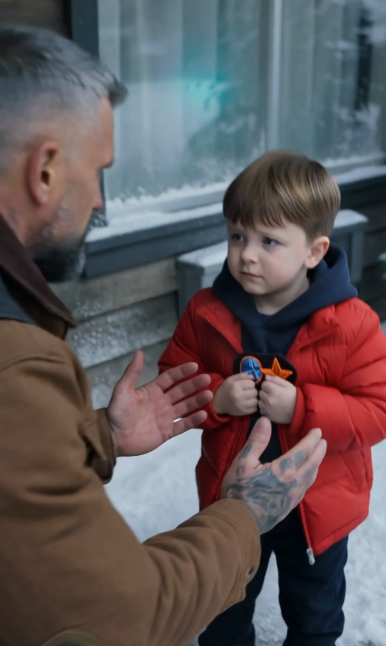
The motel clerk, a woman named Denise with reading glasses hanging from a cord, slid our key closer.
“Room six. Heater works better if you leave the bathroom door open.”
Such an ordinary thing to say. I nearly cried because of it.
Cal asked permission before picking up our bags. He left them inside the room, stayed outside the threshold, and gave me the number of the garage printed on his truck.
“I wasn’t looking for you,” he said. “Denise called about a stranded car. I was finishing a service job nearby.”
That explained the rescue.
It explained nothing else.
I locked the door and made Noah change his wet socks. While he struggled with a heel, I pulled up the photograph I kept in a hidden folder on my phone.
Eli beside a birthday cake. Noah asleep against his chest. The patch on his vest.
The mountains matched.
So did the tiny orange repair at the star’s lower point.
But the patch in my hand looked newer.
For a moment I felt foolish. Eli had made things for friends. There could be dozens.
Four winters of poor sleep could turn ordinary stitching into a resurrection.
I called Cal from the bathroom.
“Did you actually hear my husband?”
“Yes.”
“Or did somebody tell you—”
“He called my shop Tuesday. Asked whether I still had the letters.”
“What letters?”
Cal went quiet.
Then: “You never got any?”
Outside, a plow scraped through the parking lot. Noah called that the television remote didn’t work. I told him to try the other button, as if there were still two buttons in the world and one of them would fix this.
My father called back.
I stepped into the bathroom again.
“Where are you?” he asked.
Not Are you safe?
Not How’s Noah?
“Georgetown. We stopped.”
“I told you to leave tomorrow.”
“You told me the weather would hold.”
“It changed. These things happen.”
I looked at the patch on the sink.
“Do you know Cal Mercer?”
The silence lasted long enough for me to hear Dad set down a glass.
“He was associated with Eli. Don’t confuse familiarity with reliability.”
“Did you speak to my husband Tuesday?”
“Mara.”
He used the voice he had used when I was sixteen and backed his car into a mailbox.
“Answer me.”
“Let me send Mark. You’re frightened, and Noah needs someone thinking clearly.”
Mark Bell was my father’s former court clerk, now his personal assistant.
I had not told Dad which motel.
Ten minutes later, Denise knocked and said a man named Mark was asking which room we were in.
How had he found us before I’d decided whom to trust?
I left the security latch on.
Through the narrow opening, Mark held up a paper bag.
“Dry gloves. Your dad thought Noah might need them.”
He had driven from Idaho Springs, he said. Dad had called him after recognizing Cal’s garage name; Denise had confirmed we were guests but refused to give him our room number.
A reasonable explanation.
I hated how badly I wanted it.
“Tell him we’re asleep.”
Mark glanced past my shoulder.
“You should know Cal’s had trouble with the law.”
“So has half the family at Thanksgiving. Good night.”
I shut the door before he could make that sound like a symptom.
Later, with Noah asleep beneath both motel blankets, I remembered the last winter when all three of us had belonged to the same house.
Eli repaired school-district maintenance equipment. On Sundays he rode an old motorcycle with a few men who spent more time fixing strangers’ furnaces than riding anywhere.
One evening he sat at our kitchen table sewing two mountain patches. Noah, four, insisted every star needed orange thread because yellow was “too cold.”
At dinner, my father watched Noah spill milk across a stack of envelopes. Dad rescued his papers, folded the bottom-left corner outward, and set them aside.
His private little filing habit.
Then he lifted Noah from the puddle.
“Keep the weather outside, buddy.”
We laughed.
Eli didn’t.
He was looking at a blue envelope beneath Dad’s hand.
That was the whole memory. Less than a minute. For years, I had remembered only the milk.
Now I remembered Eli’s face.
I called Cal again.
He told me he had known Eli through roadside repair fundraisers. The second patch had been a thank-you for lending him welding equipment.
“When did you last see him?”
“Three weeks ago. Cheyenne.”
My knees touched the bed.
“Was he hurt?”
“Old injuries. He walks. Works. He knew your birthday.”
That nearly undid me.
“Then why didn’t he come home?”
“He thought you’d told him not to.”
I looked toward Noah’s sleeping shape.
“I buried him.”
Cal took a breath.
“Was there a body?”
No.
There had been a wrecked work truck below an embankment. A search. My father answering calls in another room. Then a memorial service after he told me the search team believed Eli could not have survived.
The stone said Beloved Husband and Father.
I had supplied the photograph.
Dad had supplied everything else.
Cal asked whether I still had the documents.
“In a box at my father’s house.”
“Tomorrow, get your own copies.”
I opened the email account I had barely used since moving into Dad’s guesthouse. Searches for Eli’s name brought condolences, bills, and the school’s emergency-contact form.
Then I found an old message from an insurance representative.
We still require documentation establishing death before we can assess this claim.
It had arrived six months after the memorial.
I had forwarded it to Dad.
His reply was three words.
Already handled, sweetheart.
If nothing had been settled, what exactly had my father handled?
By morning, the snow had stopped.
Cal arranged for another mechanic to bring our car down after the roads were cleared. He gave me the estimate before anyone touched it.
That small courtesy mattered more than his assurances.
At breakfast, Noah lined sugar packets along the table.
“Is Dad at a hospital?”
“I don’t know where he is yet.”
“But he’s somewhere?”
I put my hands flat around my coffee.
“I’m checking.”
It was the first honest answer I had given him about his father in four years.
Dad arrived before nine, wearing a wool coat over the navy suit he wore for newspaper photographs. He hugged Noah first.
Then he put a folder beside my plate.
“Before this man frightens you further.”
Inside were flight receipts, a hotel invoice, and a photograph of Dad at a judicial conference in Portland. The dates included the night Eli’s truck went off the road.
“You think I hurt him?” he asked quietly.
I hadn’t said that.
“I was a thousand miles away.”
Cal, standing by the counter, didn’t interrupt.
Dad turned a page. There was an email from Mark confirming he had handled contact with the search volunteers while Dad traveled home.
“I trusted people,” Dad said. “Perhaps I trusted the wrong ones.”
He looked tired.
For a second, he looked like a father whose daughter had accused him of something terrible over eggs going cold.
Then he gave me his phone.
“Call Mark. Ask him anything.”
I did.
Mark answered on the third ring. When I asked whether Eli had been found alive, he said, “Your father didn’t know about the rehabilitation placement until afterward.”
Dad’s face changed.
Not much.
Enough.
“What rehabilitation placement?” I asked.
Mark stopped speaking.
Dad took his phone back.
“We’re done for now.”
“No. We’re starting.”
Cal finally moved closer.
“Tell her about the facility outside Grand Junction.”
Dad stared at him.
“I was told Eli required distance from the family while he recovered. There were concerns about his behavior.”
“Whose concerns?”
“His employer’s. Mark’s. I was trying to protect you.”
The room seemed to tilt toward an explanation I could almost survive.
Mark had lied.
Mark had hidden Eli.
Dad had been away, then frightened, then misled.
It was possible.
He reached for my hand.
“I should have questioned more.”
I let him touch my fingers.
Then Noah, who had been quietly opening a sugar packet, asked, “Why didn’t you tell Mom the hospital part?”
Dad withdrew his hand.
He said children shouldn’t be involved in adult confusion.
Cal pulled out his phone and showed me a recent photograph: Eli outside a repair shop, thinner, gray at the temples, one shoulder lower than the other.
Alive.
My father looked at the picture.
He did not lean closer.
He did not ask when it had been taken.
After four years, wouldn’t a man seeing his supposedly dead son-in-law at least need another look?
I took Noah upstairs before I called anyone else.
Then I called Tessa Ruiz, an attorney whose daughter had once been in Noah’s preschool class. I told her I needed someone who had never worked for my father.
She listened without interrupting.
“Send me what you have,” she said. “Keep the originals. Don’t confront anybody alone.”
Cal gave her Eli’s number only after Eli agreed.
Their first conversation happened without me.
I resented that until Tessa said, “I need to know what he can prove before you have to hear what he regrets.”
By afternoon, she had spoken with a lawyer near Eli’s home and arranged to receive copies of records he had saved.
There was no convenient single document explaining our lives.
There were discharge papers. A work agreement. Checks. Letters returned in their envelopes.
And a blue folder Eli had carried between rented rooms.
He had survived the crash after another driver found him. During recovery, Mark approached him with bills, allegations about missing construction funds, and a proposal approved, the paperwork said, by my father.
Eli would take work in Wyoming.
Dad would cover outstanding treatment costs.
Eli would avoid direct contact with us.
The agreement claimed I had requested separation and wanted communication routed through Dad.
My signature appeared on a separate authorization.
I recognized it.
I had signed that page at Dad’s kitchen counter while Noah slept against my shoulder. Dad said it allowed him to deal with the insurer.
The page Eli received described something else.
Tessa laid both versions side by side on a video call.
“I can’t tell you yet who assembled this,” she said. “But these aren’t the same packet.”
Then she showed me checks from a housing-repair trust my father administered for an elderly aunt.
Eli’s employer had billed the trust for repairs that had never been completed.
My father approved the payments.
Eli signed completion sheets.
Some money went to the contractor.
Some covered expenses tied to a property Dad owned privately.
And eighteen thousand dollars had paid a hospital balance from my complicated delivery.
Our debt.
Our name.
My stomach turned.
Dad had not merely disliked the man who fixed engines and arrived at family dinners in a leather vest.
Eli could connect him to stolen money.
Keeping Eli discredited protected more than a family reputation.
It protected accounts, property, and the retirement celebration scheduled for Saturday.
Tessa asked whether I knew about a parcel Cal had recently requested from Mark: Eli’s original letters.
“No.”
“Mark’s lawyer contacted me twenty minutes ago.”
Mark had a lawyer already.
“He wants to provide records,” she said.
“Why now?”
“Because your father called him this morning and told him the rehabilitation arrangement had been entirely his idea.”
I looked at the photograph from Portland.
Dad had brought an alibi for the accident.
Nobody had accused him of causing the accident.
He had answered the question he could safely deny.
Then Tessa opened a scan of a payment ledger.
The approval page had a bottom-left corner folded outward.
Why was my father’s private filing mark on the money that had kept my husband away?
Dad called at six.
“I understand you’ve involved Tessa Ruiz.”
I hadn’t told him.
“Good,” he continued. “Someone sensible should examine this before you embarrass yourself.”
Behind him, I heard dishes. He was at home having dinner.
I was sitting on a motel bathroom floor because it was the only place Noah couldn’t see me shaking.
“Did you read Eli’s letters?”
“Your husband has a history of making promises he cannot keep.”
“That wasn’t my question.”
“You’re exhausted. Come home. We can discuss this after Noah’s asleep.”
Home.
My clothes were there. Noah’s schoolbooks. Our birth certificates. The spare inhaler in the kitchen drawer.
I had been calling Dad’s guesthouse home for four years.
When I checked my banking app, the card I used for household expenses had stopped working. It was an additional card on his account. My own checking balance was forty-three dollars.
The motel needed payment for another night.
Cal offered his card.
I refused too quickly.
Denise looked up from her paperwork.
“I can wait until morning.”
Then my phone filled with messages.
My sister asking whether I was having another breakdown.
An aunt telling me not to frighten Noah with stories about his father.
Dad had sent them a photograph from the roadside, one I had texted him when Cal first stopped to help.
His message described a distressed daughter traveling with a child and a man linked to Eli’s old troubles.
The picture showed Cal’s tattoos.
It didn’t show him kneeling in slush to get our heater working.
At seven, two officers came to the motel.
Dad had requested a welfare check.
My first instinct was to grab Noah and hide in the bathroom. Instead, I called Tessa and let the officers speak with me.
Noah showed one of them the patch.
“Mom’s checking something,” he said.
They asked questions. Looked around. Listened.
Nobody took my son.
One officer asked whether I wanted assistance collecting essentials from Dad’s property later.
That was when I understood I could ask for help without asking Dad.
After they left, Denise brought us grilled cheese wrapped in paper.
Cal waited outside our room until I opened the door.
“He’s trying to make you look unreliable before you talk,” he said.
“Did you know what Eli signed?”
“Some.”
“And you still helped him stay gone?”
Cal’s jaw worked.
“I believed him when he said you didn’t want contact. Then I saw the returned letters.”
“You could have called me.”
“Yes.”
He didn’t decorate it.
That made it harder to dismiss him.
Tessa arranged for my sister to hear directly from me. Beth arrived close to midnight, carrying Noah’s school backpack and the yellow sewing tin from our old house.
She had quietly collected them before Dad realized she was leaving.
At the bottom of the tin was an envelope.
Blue.
Unopened.
Beth said she had found it inside the desk where Dad kept our documents.
The return address was in Eli’s handwriting.
But why had my sister’s name been written across the back?
Beth read her own name twice.
“I never saw this.”
Inside was a letter asking her to make sure I received another enclosed letter.
Eli had tried going around Dad.
Dad had intercepted that, too.
But the enclosed pages contained something I could not place entirely at my father’s feet.
I signed the completion sheets. I knew the work wasn’t done.
I read the sentence until the words lost their shapes.
Then I called my husband.
For several seconds, neither of us spoke.
A television played somewhere behind him. He turned it off.
“Mara.”
His voice was older.
It was still the voice that used to ask whether I wanted the last piece of toast.
“Did you steal that money?”
“I signed papers that helped them take it.”
“Did you know what you were doing?”
“Yes.”
No excuses first.
That hurt in a way I hadn’t prepared for.
He said Dad offered to clear our hospital debt. Eli knew some repair reports were false. He told himself the contractor would finish later.
Then he discovered the wider transfers and copied records.
After the crash, Dad used those signatures to convince him he would be prosecuted, lose access to Noah, and pull me into the investigation.
“Why didn’t you call a lawyer?”
“I should have.”
“Why didn’t you call me?”
“He showed me your signature.”
“You believed paper over me?”
The silence after that answer was longer.
“I was ashamed enough to believe you’d be better off.”
I pressed the phone against my forehead.
Four years could fit inside that sentence.
Four Christmases.
Noah learning to ride a bicycle while I stood in a driveway crying behind my sunglasses.
Eli had written, he said. Tried through Mark. Tried through Beth. Each failure became another reason to believe the arrangement was what I wanted.
Then Cal saw a public photograph from a school fundraiser.
Noah beside me.
Still using Eli’s last name.
The caption called me a widow.
That was when Eli finally understood what I had been told.
He contacted Cal, who began asking Mark for the correspondence.
The questions reached Dad.
Then our car broke down on the way to Dad’s retirement weekend.
The rescue had been chance.
Everything after recognition had not.
“Have you been sending money?” I asked.
“To an account Mark said was for Noah.”
Tessa later confirmed deposits into an account Dad controlled. Very little had reached us.
Another theft.
But it did not erase Eli’s choices.
“I don’t know what we are now,” I told him.
“I know.”
“Noah gets the truth. You don’t get to decide how fast he forgives you.”
“I know that, too.”
The next morning, Eli arrived with his attorney.
He stayed across the motel courtyard until I agreed to see him.
Noah watched through the curtain.
“Can I be mad if he’s really Dad?”
“Yes.”
“Can I still hug him?”
“Yes.”
Eli took one step toward the room, then stopped and waited.
Watching him wait, I understood what my father had never allowed either of us: a choice.
But would Eli still tell the truth when telling it could cost him the reunion he had come for?
Noah did hug him.
Then he hit Eli’s coat once with the side of his fist.
“You missed my teeth.”
Eli crouched on the wet pavement.
“I did.”
“Both front ones.”
“I’m sorry.”
Noah backed away before Eli could hold him longer.
It was not the reunion people put music under.
It was ours.
For the next two days, Tessa worked with Eli’s attorney and the records Mark agreed to provide through his own counsel. Copies went to investigators outside my father’s circle. Originals stayed accounted for.
We did not wait for a public argument to begin that process.
But Dad’s retirement reception was still going ahead.
His invitation described forty years of integrity and service.
He had also sent me a message.
Attend with Noah. We can show everyone the family is fine.
I replied that I would attend alone and wanted a conversation with witnesses.
He agreed.
I think he still believed witnesses favored him.
Tessa came with me. Eli waited in a side room with his attorney. Beth kept Noah somewhere else entirely.
The reception occupied a hotel meeting room in Golden. There were trays of sliced fruit, a microphone that whistled when somebody adjusted it, and photographs of Dad shaking hands with people I had known all my life.
I asked him to speak at a table near the side doors.
He chose the front of the room.
“Let’s settle this confusion.”
Chairs turned.
I put an unopened blue envelope on the table.
Mark had preserved it with its contents after being instructed to intercept it. He had also preserved the message giving that instruction.
Tessa had already supplied copies through the proper channels.
I wanted one answer for myself.
“Did you stop my husband’s letters?”
Dad smiled at the people nearest us.
“Eli was unwell. Mara was grieving. Correspondence needed careful handling.”
“He was alive.”
“No one here disputes that now.”
“Did you tell me?”
“You were in no condition—”
“Did you tell me?”
His smile left.
I held up a copy of the intercepted letter, with the personal passage covered.
Dad glanced at it.
“Those pages could have been written yesterday.”
Then I took the original envelope from its protective sleeve.
The bottom-left corner was folded outward.
Without thinking, Dad reached across and pressed it flat.
The same small motion from our kitchen table.
He saw me watching.
Withdrew his hand.
“You had no right to make that decision,” I said.
“I had every right to protect my grandson.”
“From a letter?”
“From a man who thought he could put the boy on a bus to Cheyenne.”
The room went quiet.
I had not mentioned a bus.
The enclosed ticket had not been displayed.
Eli stepped out of the side room.
“There were two return tickets, Richard. I asked Mara to bring him for a Saturday.”
Dad turned so fast his chair struck the table.
“You were not taking him out of state.”
“Then you read it,” I said.
He looked at the envelope.
At the covered passage.
At everyone who had heard.
How could he call the letter a forgery after describing what he had hidden inside it?
Dad reached for the microphone.
Tessa moved the envelope out of his reach.
He spoke without amplification.
“You have no idea what I prevented.”
Nobody asked him to continue.
He did anyway.
Eli was weak. I was vulnerable. Mark had been instructed to hold the letters until I was stable. Money had been moved temporarily. There were explanations.
A woman near the fruit trays put down her plate.
Someone asked whether the retirement speeches were still happening.
That ordinary question ended the performance more completely than shouting could have.
Dad looked at me.
“Mara. Tell them.”
For most of my life, I had understood that instruction.
Tell them he meant well.
Tell them we were fine.
Tell them the weather belonged outside.
I picked up my coat.
“No.”
We left while he was still talking.
There was no arrest beside the dessert table. No single recording that repaired four years.
The investigation took months.
Account records supported the transfers. Mark’s retained messages supported the intercepted correspondence. The altered document packet required examination and more interviews than I could count.
My father eventually admitted to financial wrongdoing and directing the concealment of Eli’s communications as part of a negotiated resolution. His retirement did not protect his reputation or the money he had taken.
Eli faced consequences for the false completion sheets he had signed. Cooperation helped him; it did not make his signatures disappear.
I attended one meeting where he had to describe that choice aloud.
He did not look at me when he said he had known.
Afterward, I told him I appreciated the truth.
I did not tell him everything was forgiven.
We moved into a small rental where the kitchen drawer stuck unless you lifted it.
Beth helped paint Noah’s room. Denise sent back the twenty dollars I later tried to overpay her, with a note saying the room rate had been the room rate.
Cal repaired our car properly and sent an itemized bill.
I paid it in installments.
He never mentioned the sixty dollars from the motel.
Eli rented a room nearby. At first, his visits were short and planned. Sometimes Noah wanted him there. Sometimes he asked him to leave.
Once, Eli drove over to help with homework and spent the whole visit sitting on the porch because Noah had changed his mind.
He came back the next agreed day.
That mattered.
Spring arrived without asking whether we were ready.
One Saturday, Noah brought out the yellow sewing tin and both mountain patches.
The original had come home in Eli’s old vest. Cal had insisted Noah keep the newer one from the motel.
My son laid them side by side.
The orange stars were almost identical.
One lower point had come loose.
“Can we fix it?” Noah asked.
Eli reached for a needle, then stopped.
“Do you want me to?”
Noah considered that.
I stayed at the sink, washing the same spoon, giving him time.
Finally, he handed Eli the patch and climbed onto the chair beside him.
He threaded the needle himself.
Outside, a motorcycle passed on the main road. Noah glanced toward the window, then returned to the little copper star.
Eli waited with his hands open on the table.
Noah placed one edge of the patch between his father’s fingers.
“Can you hold this while I stitch?”