They Laughed When an Eight-Year-Old Called His Convicted Biker Father a Hero—Then a Retired Cop Stood Up and Asked His Teacher Where Her Daughter Had Been
Rachel Bennett’s first movement was toward the door.
Not toward my son.
That was what I remembered afterward: her hand finding the edge of her desk, her eyes checking the hallway, as if somebody outside had called her name.
“My daughter was in treatment,” she said.
Daniel Rourke remained standing.
“Yes.”
“She wasn’t a witness.”
“That’s what Richard told you.”
A father near the windows lowered his phone. Somebody whispered that this wasn’t appropriate around children.
They were right.
But nobody had said that when Rachel made my son small in front of thirty people.
I crossed to Ben and took the vest from his hands. His fingers stayed hooked around the zipper until I told him I wasn’t putting it away.
“Did I get it wrong?” he whispered.
That nearly finished me.
“Get what wrong?”
“About Dad.”
Behind us, Rachel was asking Rourke whether he had been drinking. He placed a folded bank statement on her desk, carefully, like a man setting down something hot.
I recognized the account holder’s name.
His.
Then I saw a second name printed in a transaction description.
Mercer.
Ours.
For one ugly second, I wondered whether Owen had lied to me about the money, too.
Principal Harris arrived with the school counselor. He asked parents to stop recording and moved the children into the library. Ben refused to leave until I promised his father wasn’t being arrested again.
“He’s outside,” I said. “He’s waiting for us.”
That was when Owen appeared in the doorway.
Someone had opened the hall door during the argument. He had heard enough.
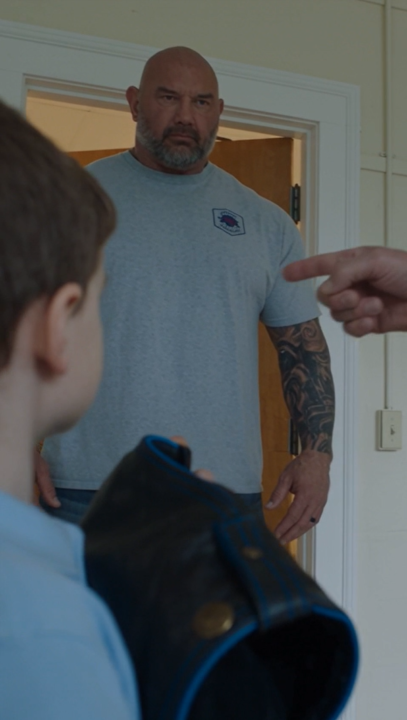
My husband was six-foot-four, broad through the shoulders, with gray in his beard and tattoos disappearing beneath his clean work shirt. He could make a doorway look narrow without trying.
But he stopped when he saw Ben.
He lowered himself onto one knee.
“Hey, Cricket.”
Ben touched his beard.
The way children check whether something is real.
“Did you do it?”
Owen looked at me before answering.
“No.”
“Then why did you say you did?”
Rourke took a breath behind us.
Owen didn’t look at him.
“Because somebody told me a girl would get hurt if I didn’t.”
Rachel made a sound that wasn’t quite a word.
Principal Harris asked us to continue in his office. Rourke agreed, but Owen stayed kneeling until Ben let go of his shirt.
The counselor, Ms. Alvarez, crouched beside them.
“I can sit with you while the grown-ups talk,” she told Ben. “You don’t have to explain your dad to anybody else today.”
He considered that.
Then he handed her his index cards.
Every card had been numbered in pencil.
In the office, Rourke said he had come because Ellie Bennett had asked him to. She was nineteen now. She had recently left her stepfather’s house and wanted her old statement found.
“She asked me to tell the truth before another kid paid for it.”
Owen stared at him.
“All of it?”
Rourke’s eyes dropped.
There it was.
The hesitation I remembered from the courthouse.
Before anybody could speak, Harris’s desk phone rang.
He checked the display.
Richard Bennett was calling.
How had he already known?
Before prison, Owen used to fix Ben’s toy cars on a towel beside whatever engine he was rebuilding.
Ben was three then. He believed his father’s workbench could repair anything, including a cracker broken in half.
One Sunday, rain kept us inside the garage.
Owen’s old vest had split along the inner pocket. I stitched it with blue upholstery thread because it was the only strong thread in the house.
My stitches leaned sideways.
“Looks like a ladder,” Owen said.
“Then don’t climb it.”
He laughed around the flashlight he was holding in his teeth.
The zipper pull had broken, too. He replaced it with a little brass washer from a coffee can, polished smooth so it wouldn’t scrape Ben.
That afternoon Richard Bennett came by with an envelope.
He was wearing a tan coat I worried about getting dirty. Owen made him coffee in our chipped Christmas mug.
I heard Richard say, “Just transportation expenses.”
Owen answered, “Then write what they’re for.”
Ben drove a red toy truck across my knee.
I remember thinking Richard looked uncomfortable in our garage.
That was the whole memory.
Nothing sinister.
Not then.
—
Five years later, Harris put the ringing phone on silent.
Rachel sat with her purse in her lap. Her thumbnail worried a loose thread on its handle.
“Ellie was fourteen,” she said. “She had nightmares. She stopped sleeping. Richard said the doctor recommended residential care.”
“Did you speak to the doctor?” I asked.
She looked up sharply.
“Yes. I took her there myself.”
Rourke nodded.
“The treatment was real.”
That changed the room.
I had begun to picture Rachel helping hide her own child. Now she pulled an old appointment email from her phone, followed by a photograph of herself beside Ellie outside a brick treatment center.
She had visited every Sunday she was allowed.
“I knew there had been an incident,” she said. “Richard said Ellie found a woman hurt near one of the foundation properties. He said the police had what they needed.”
Owen leaned forward.
“What did he say about me?”
“That you destroyed evidence.”
“Did you ever ask Ellie?”
Rachel’s eyes filled, but she didn’t cry.
“She wouldn’t talk about that night. The therapist told us not to force it.”
Later, we learned the therapist had never advised keeping Ellie from independent investigators. Richard had stretched a sensible instruction into a wall.
Rachel had been standing behind it.
But she had also chosen not to look around it.
Her phone buzzed.
She turned the screen over too late.
Do not discuss our daughter with Mercer. Call me now.
There was no affection in that message. No question about whether she was all right.
Rourke watched her read it again.
“Richard wasn’t protecting Ellie from Owen,” he said.
Owen’s boot scraped the carpet.
“Tell her whose car Ellie saw.”
Rourke rubbed both palms against his trousers.
“Mine.”
Why had the man claiming to clear my husband just placed himself at the center of the crime?
Principal Harris closed his office door.
“Before this goes further,” he said, “someone needs an attorney.”
“I already have one,” Owen answered.
I turned toward him.
He had called his former defense lawyer three weeks earlier, after Ben came home with a split backpack and said he had fallen.
Owen hadn’t believed him.
Neither had I.
But I had wanted to.
“The lawyer said we needed something new,” Owen told me. “Something somebody would sign.”
Rourke looked as though he might be sick.
Five years earlier, a foundation bookkeeper named Joan Keller had been found injured beside a service road behind a vacant warehouse. She survived, but the first weeks were uncertain.
Ellie had been walking home from a friend’s house.
She saw a car stop.
She heard an argument.
Then she saw the driver leave Joan on the ground.
“The car was assigned to me,” Rourke said. “But I wasn’t driving.”
He had lent it to Richard.
Not officially.
Not with a signed authorization.
Richard was a generous foundation donor, a friend of Rourke’s supervisor, a man accustomed to borrowing things that belonged to everybody.
Ellie recognized the car when Rourke arrived.
She told him before Richard knew she had seen anything.
Rourke drove her away.
He called Owen because Owen had a tow truck, a garage without a public waiting room, and a reputation for keeping other people’s troubles private.
“Owen put her in the office,” Rourke said. “Gave her his vest because she was shaking.”
That was why Ellie remembered it.
That was why Rourke couldn’t look at it now.
Richard called Rourke while Ellie was still there. He wanted to know where she was.
Rourke lied.
Then he asked Owen to remove the borrowed car’s damaged tracking unit before anybody could retrieve the trip history.
“He said someone in the department was giving Richard information,” Owen told me. “He said the unit could lead them to the garage.”
So Owen removed it.
Rourke took it away.
When investigators started asking questions, Rourke said Owen had acted alone to conceal evidence of a hit-and-run.
Owen’s lawyer had argued there were gaps. The prosecution had an officer’s statement, records showing the car in Owen’s garage, and eventually Owen’s own guilty plea.
“Why?” Rachel asked him.
Her voice had lost its classroom brightness.
Owen looked at the photograph of her daughter on her phone.
“Because Richard knew my boy’s daycare.”
He let that sit.
Then he explained the offer: a limited charge, a promised sentence recommendation, and silence about the girl’s location. He believed the officer who said a protected witness could disappear if Owen fought.
He served twenty-two months.
Rourke had let him.
“You could have told the judge,” I said.
“I know.”
It was the first answer he gave without protecting himself.
Rachel stood and walked to the window. For a moment I thought she was leaving.
Instead, she called her daughter.
Ellie answered on the fourth ring.
Rachel put her on speaker.
“Did Richard drive that car?”
A long silence.
Then Ellie said, “Mom, did he tell you Owen was paid?”
Paid for what—and by whom?
Ellie wouldn’t explain over the school’s speakerphone.
“Is Richard there?”
“No,” Rachel said.
“Is Dan?”
Rourke shut his eyes.
“Yes.”
“Then don’t let him leave.”
Harris called the district office to explain that a private family matter had interrupted the presentations. Owen called his attorney, Mara Chen, and put her on a separate line.
For the first time that morning, somebody began writing down names in the right order.
Ellie emailed three documents.
A foundation disbursement form.
A canceled check.
An invoice.
The form described emergency housing and transportation for a juvenile witness. The invoice carried Owen’s garage name.
Eighteen thousand dollars.
I knew our old business letterhead. Owen had designed it himself, with a crooked line beneath the phone number.
The invoice used the newer address.
We hadn’t moved there until seven months after the date printed at the top.
“That isn’t ours,” I said.
Mara asked us not to forward anything else until she had the original email with its attachments. She wanted the files preserved as received.
Rourke pushed his bank statement across the desk.
The check had gone into his account.
Rachel sat down slowly.
“Richard told the foundation board Owen handled the expenses,” he said. “Then he told me to distribute the money quietly.”
“How much reached Ellie?” Owen asked.
Rourke didn’t answer.
Ellie did.
“None of it paid for my treatment. Mom’s insurance covered that.”
The documents came from an old household laptop Ellie had used for school. Richard’s foundation account had once been connected to it. She found the downloaded files while collecting her school records before moving out.
She hadn’t understood them at fourteen.
At nineteen, the garage address caught her attention.
She had searched it.
Then she found Owen’s conviction.
Mara asked to speak with Ellie privately.
While they talked, Rachel stared at the invoice.
Her signature appeared beside approved.
“I signed a stack of these after a fundraiser,” she said. “Richard said they were reimbursements.”
Owen’s chair creaked.
“Did you read them?”
“No.”
That one word cost her.
I could see it.
But it had cost us more.
The foundation had raised money for families facing emergencies. Joan Keller, the bookkeeper, had started questioning payments to companies that did little work or didn’t exist.
Richard called those questions confusion.
Then Joan was injured.
Then a witness became a troubled teenager.
Then my husband became the man who destroyed the evidence.
Every explanation had pointed away from the same house.
Mara came back on the line.
She wanted Owen’s old case file, his garage records, and any contact Richard had made with us.
Owen looked at the vest across my knees.
“There’s a receipt,” he said.
I stopped breathing for a second.
“Where?”
“In the lining.”
Before I could reach for the blue stitches, Harris’s computer chimed.
A district message had arrived.
Owen was to leave school property immediately.
Who had turned a request for the truth into a warning about our son’s safety?
The message described Owen as an unauthorized visitor whose presence had caused distress during a student event.
It also mentioned “credible concerns” about threats toward a staff member’s family.
Rachel read it twice.
“He hasn’t threatened me.”
Harris picked up his phone.
“I’ll clarify that.”
Owen was already standing.
“No,” I said.
He looked toward the office door.
Ben was in the library, one hallway away. Owen had spent two years learning that staying calm wasn’t always enough to keep somebody from writing aggressive on a form.
“I’m not giving them a scene.”
He left through the front entrance.
Through the office window, I watched him sit on the low brick wall beside the flagpole. His hands rested open on his knees.
Richard’s car pulled into the lot four minutes later.
He didn’t come inside.
He walked straight to Owen.
I went out before Harris could stop me.
Richard wore a navy coat and the expression he used in foundation photographs: concerned, patient, faintly disappointed.
“Think about your family,” he said.
Owen stood.
Richard took a small step back.
I hated him for that calculated little movement. Anyone watching from a window would have seen a respectable man making room for a dangerous one.
“You’ve misunderstood some old paperwork,” Richard told me. “Dan has had problems. Financial problems. Drinking.”
“Then why is your foundation paying him?”
“It was a difficult situation.”
He looked at Owen.
“You agreed it was finished.”
Owen’s jaw moved once.
“My son didn’t.”
Richard glanced toward the school.
That frightened me more than shouting would have.
Mara called while we were still outside. I put her on speaker and told Richard she was our attorney.
His expression changed.
Only slightly.
“Any further contact goes through me,” she said.
Richard returned to his car.
He didn’t threaten us again.
He didn’t need to.
By lunch, a parents’ group had an old booking photograph of Owen.
Someone wrote that a convicted felon had disrupted Hero Day.
Someone else asked why the school had allowed him near children.
The post included a detail that wasn’t public: Ben’s teacher had supposedly been “cornered in an office.”
Rachel had never been cornered.
But by the time she corrected it, screenshots had traveled beyond the group.
Harris offered to send Ben home with us.
Ms. Alvarez suggested keeping his routine if he felt safe enough. She arranged lunch in her office with a friend Ben chose himself.
For once, an adult asked him.
He picked a quiet boy named Lucas.
Not the boys who had shoved him.
Not a classroom full of children ordered to be kind.
One friend.
Outside, Owen’s employer called. A customer had forwarded the booking photograph.
His boss said to take the afternoon, then come in tomorrow.
“I know who fixes my trucks,” the man said.
It was the first ordinary kindness of the day.
At Mara’s office, she photographed the vest before anyone touched the stitching.
Then Rourke arrived carrying a second bank statement.
His hands were shaking.
What else had the man who came to confess decided to leave out?
Mara made Rourke sit in the chair farthest from Owen.
Not because Owen had moved toward him.
Because she had read his face.
The second statement covered the month after the eighteen-thousand-dollar deposit. It showed debt payments, a cash withdrawal, and a transfer into savings.
No hotel.
No transportation service.
No payment to a treatment center.
“I kept six thousand,” Rourke said.
Owen watched him.
“You told me you were scared.”
“I was.”
“You told me you had nothing.”
Rourke swallowed.
“I lied about that.”
For years, I had imagined cowardice as something frantic. A bad decision made in a hallway. A man going along because he couldn’t find a way out.
This had bank balances.
Dates.
Time to reconsider.
Rourke said Richard had offered the money after learning Ellie had spoken to him. He could report the borrowed car, admit removing evidence, and face his own department.
Or he could accept Richard’s version.
The payment was called reimbursement.
Rourke used part of it to settle debts and returned the rest in cash, exactly as Richard instructed.
“You didn’t just fail to protect Owen,” Mara said. “You helped make him the explanation.”
“Yes.”
Owen stood and walked to the window.
He stayed there long enough for a delivery truck to finish backing into the alley below.
Then he turned.
“Tell her about the promises.”
Rourke had told Owen his family would be safe if he accepted the plea. He had implied there were people within the investigation who could expose Ellie’s location.
Some of that fear was real.
Some of it had been useful.
He admitted he had exaggerated what he knew, because Owen was already close to agreeing.
I put both hands flat on Mara’s table.
I needed the wood beneath them.
Ellie arrived with her aunt just after three. She had short brown hair, a canvas backpack, and a habit of watching the nearest exit.
Rachel followed a few minutes later.
Mother and daughter hugged awkwardly. Ellie’s arms stayed low at first.
Then they tightened.
“I thought you believed him,” Ellie said.
“I believed the parts that let me sleep.”
Rachel didn’t ask to be forgiven.
That helped.
With Ellie’s permission, Mara opened the lining.
Inside was a narrow fold of old paper, softened at the creases.
Owen’s carbon copy of the tow receipt.
It recorded the garage arrival time, the car identification, and the person who authorized moving it from the garage to a storage unit.
Richard Bennett.
The signature matched the check approval Ellie had brought.
Below it, in Owen’s handwriting, were the words:
Driver identified by passenger. D. Rourke present.
Richard had ordered Owen to write mechanical failure instead.
Owen hadn’t.
He kept the receipt because it was the only record he controlled. He hid it because Richard had searched his desk before police ever interviewed him.
Mara looked up.
“He came to the garage?”
I remembered the tan coat.
The coffee.
The envelope.
Owen nodded.
“And there’s somebody else you need to talk to.”
Who had survived long enough to challenge the story everyone had accepted?
Joan Keller answered Mara’s call herself.
She wasn’t dead.
She hadn’t moved away.
She lived twenty minutes from our house, in a duplex with a ramp beside the front steps.
That ordinary distance made me angry.
All those years, the truth had been close enough to drive to after dinner.
Joan had never identified the driver who struck her. She remembered Richard demanding a folder, a shove, then headlights.
Her first clear memory afterward was a hospital ceiling.
Her injuries had ended her bookkeeping work.
A civil settlement paid some bills. The foundation’s attorney described it as a resolution of unsafe property conditions.
Joan had signed.
“I needed the mortgage paid,” she told Mara. “I had a husband with Parkinson’s. I wasn’t trying to be brave.”
But she had kept her working records.
Not a perfect ledger of crimes.
Invoices she had questioned. Emails asking why checks were being issued before work began. A spreadsheet showing repeated payments to one address.
Richard’s rental property.
Mara arranged to collect them.
She also contacted an investigator outside the department that had handled Owen’s case. Nothing happened instantly. There were calls, declarations, copies certified where possible, and a long evening in which Ben needed help with spelling homework.
On Thursday, the foundation held its scheduled public meeting in the school cafeteria.
Richard was expected to announce a new family-assistance program.
Mara advised us not to turn it into an ambush. She had already sent the financial records to independent board members and requested that they preserve everything.
Two board members asked Richard to answer questions publicly.
He agreed.
That was his mistake.
He believed this was still a room he knew how to manage.
Owen wore his vest.
No club insignia. No show of force. Just the old leather over a clean shirt, the brass washer catching the cafeteria lights.
Ben stayed at his aunt’s house.
He had done enough public defending.
Richard began by calling the allegations a misunderstanding involving a former police officer and a disgruntled contractor.
Then Rachel stood.
“Did you use my signature to approve a payment I didn’t understand?”
“You approved it.”
“Did you tell me Owen was paid to protect Ellie?”
Richard spread his hands.
“There were expenses.”
Rourke read his prepared statement.
His voice almost failed at I falsely attributed my actions to Owen Mercer.
It held at I accepted money.
Then Ellie said what she had seen.
Richard started to interrupt.
The board chair stopped him.
Mara placed a copy of the tow receipt beside the foundation invoice.
Richard looked at Owen’s vest.
“You’ve taken that out of context,” he said.
Mara asked which document he meant.
“The slip he hid under those blue stitches.”
Silence moved through the room.
The receipt’s storage location hadn’t been included in the material sent to the board.
Mara had never mentioned the lining.
Owen touched the little brass washer.
“You told me you’d never seen that vest before the newspaper picture.”
Richard’s mouth opened.
Then closed.
Mara didn’t call it a confession. She asked the board secretary to record his exact words.
If Richard had only paid legitimate expenses, how did he know where Owen had hidden the receipt?
Richard asked for a private conversation.
The board chair refused.
He said the school was becoming unsafe. Harris, sitting near the back, answered that nobody had threatened him.
Then Richard said the receipt could have been altered.
Mara agreed that documents needed authentication.
She said that was why originals had been preserved and why the issue belonged with investigators.
He couldn’t argue with that without arguing against the careful process he usually demanded from everyone else.
So he looked at Rachel.
“Are you really going to do this to our family?”
Ellie lowered her eyes.
Rachel didn’t.
“You don’t get to call it our family only when you need cover.”
There was no applause.
A woman near the aisle began quietly gathering the foundation brochures from the empty seats beside her. One board member stared at the invoice as if rereading it could make his own signature disappear.
That felt truer than applause would have.
Richard left before the meeting ended.
Nobody blocked him.
The investigation took months.
Mara warned us that exposing a lie and undoing a conviction were separate jobs. Owen still had to explain his own statements, his plea, and his decision to remove the tracking unit.
He did.
Under oath.
Without calling himself noble.
“I was afraid,” he said. “I made a choice that helped the people lying about me.”
I sat behind him with my hands folded around a tissue I never used.
Rourke gave a sworn account. Ellie’s original interview notes were located in an archived file that hadn’t been provided to Owen’s defense. They identified Rourke’s car and recorded her concern about Richard.
Joan’s records supported the financial investigation.
The bank supplied its own copies.
The old receipt became one piece of a larger picture.
Not a miracle.
A piece.
The prosecutor reviewing Owen’s case eventually joined the request to set the conviction aside. The judge granted it after a hearing.
When Mara told Ben, he asked whether that meant the computer would stop calling his father bad.
“Some records take time to correct,” she said. “But the court has corrected this one.”
He nodded solemnly.
Then asked if Dad could come to school now.
Richard was charged in the financial case and faced additional allegations connected to Joan’s injuries and the concealment that followed. Rourke faced charges of his own.
Owen didn’t go to watch either man’s first appearance.
He went to work.
Rachel took leave while the district investigated her conduct in the classroom and the handling of Ben’s bullying reports.
Before she left, she asked to apologize to him.
We let Ben choose.
He agreed, provided Ms. Alvarez stayed.
Rachel told him she had been cruel. She didn’t say she had been stressed. She didn’t ask him to understand her marriage.
Ben listened.
Then he said, “You should’ve believed me before the policeman.”
Rachel put her hands in her lap.
“Yes,” she said.
That night, Owen laid the vest on our kitchen table.
The blue lining was open.
The receipt was gone.
What belonged in that pocket now?
For three days, the vest stayed on the back of a kitchen chair.
I kept meaning to repair it.
There was laundry, then work, then the strange exhaustion that came after something we had carried for years finally changed shape.
Owen didn’t hurry me.
He had stopped wearing the vest to the garage. Ben noticed before I did.
“Does it feel different?” he asked.
Owen looked at the chair.
“A little.”
“Because they cut it?”
“Maybe.”
Ben stood on a rung of the chair and inspected the opening. The lining hung loose where Mara had carefully removed my old stitches.
“Mom can fix that.”
“I know.”
“Then why aren’t you wearing it?”
Owen rubbed his beard.
Sometimes our son asked questions adults spent a lifetime arranging furniture around.
“Because I keep thinking about what was in there,” he said.
Ben considered the pocket.
“We could put something else in.”
The next morning, he brought home a folded sheet from school.
His new teacher had given the class time to finish the hero presentations they hadn’t completed. Children could speak, make a poster, record something privately, or choose a different assignment.
Ben had drawn.
He spread the picture on our kitchen table.
There was Owen beside a motorcycle. The motorcycle had six wheels, because perspective remained a problem.
There was me by the garage door.
There was Ben, very small, holding a red toy truck.
In the corner he had drawn a ladder.
Blue.
“What’s that?” I asked.
“The part that holds.”
Owen sat down.
He didn’t speak for a while.
Later, I resewed the lining with the same spool of thread. My stitches still leaned.
I left the pocket opening wide enough for a folded picture.
The original drawing went into a cheap frame above Owen’s workbench. A copy went inside the vest, where the receipt had been.
Ellie visited the garage that Saturday.
She brought Joan, who used a cane and complained about Owen’s coffee before she had even tasted it.
Rachel didn’t come.
There was work between her and her daughter that didn’t belong in our garage.
Ellie stayed for lunch.
At one point, she touched the repaired seam.
“I thought you’d hate me,” she told Owen.
He looked up from cutting Ben’s sandwich.
“For being fourteen?”
She pressed her lips together.
He slid a plate toward her.
“Eat.”
That was all.
That was enough for lunch.
On Monday, Owen drove Ben to school in the pickup. The motorcycle stayed home because rain was coming, and because ordinary decisions were finally allowed to be ordinary again.
At the entrance, Lucas waited beneath the awning.
Ben got out, then came back.
He put three fingers against the repaired seam.
Owen covered the little hand with his own.
Nobody was watching except me.
“Still got you, Cricket.”
And what more did a hero need to carry?