A Little Girl Handed a Biker Her Mother’s Beach Photo—Then the Man Everyone Trusted Started Taking Pictures of the Father He Claimed Had Never Come Back
Ethan looked through the diner windows. June’s silver hatchback wasn’t outside.
Mark’s chair scraped again.
“She misunderstood,” he said. “June had an appointment.”
Lucy’s fingers slipped from Ethan’s wrist. She rubbed them down the front of her cardigan as though she had touched something she wasn’t supposed to.
Ethan stayed crouched beside the booth.
For four months, every conversation about his daughter had come with instructions. Don’t surprise her. Don’t overwhelm her. Let the grief counselor guide the introduction.
He had followed them because he had already lost seven years and couldn’t bear being blamed for losing anything else.
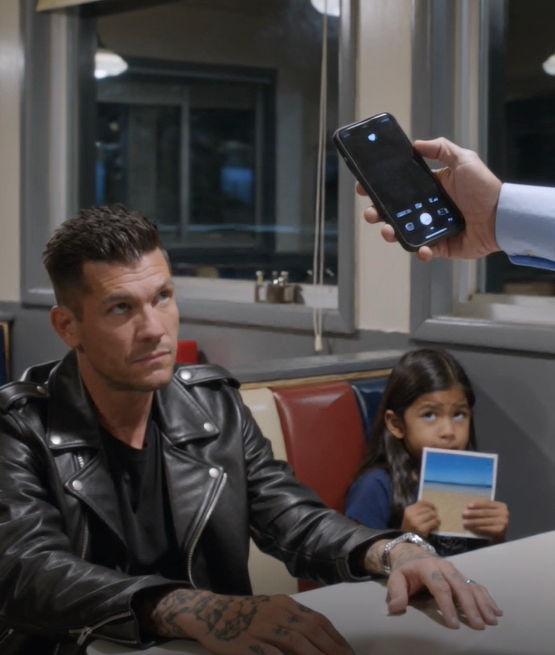
Now Lucy was staring at him.
“Did you cancel?”
“No.”
Mark put his phone facedown.
“Ethan, we agreed tomorrow.”
“The family center. Sunday,” Ethan said. “Tomorrow’s Saturday.”
Mark blinked.
Only once.
The waitress stopped beside them with a coffeepot. Her name tag said Donna. Ethan had eaten Friday breakfast here for eleven years, but she had never seen him kneeling beside a child.
“Everything okay?”
“We’re handling a family situation,” Mark said.
Donna looked at Lucy.
“Are you okay, honey?”
Lucy nodded, then shook her head.
Ethan moved back far enough to give her room.
He knew how he looked: six-foot-four, gray beard, black leather vest, hands covered in old ink. Mark wore a pale blue shirt and the funeral-home wristband he hadn’t removed.
A man could lose an argument before opening his mouth.
“Call June,” Ethan said.
“She’s working.”
“Then I’ll call her.”
He stood slowly and reached for his phone.
Mark’s camera came up again.
That was when Ethan understood he wasn’t recording a reunion.
He was waiting for a mistake.
Ethan placed his phone on the table and called his attorney on speaker. When it went to voicemail, he left the diner’s name, the time, and one sentence: “Lucy is here with Mark, and June isn’t.”
Lucy climbed onto the booth seat without being invited.
Mark took a step toward her.
Ethan moved aside.
“Don’t make her choose in a restaurant.”
The words surprised him. They sounded steadier than he felt.
His hands were shaking.
Twelve days earlier, Rachel had died. Four months earlier, a court had finally recognized the paternity a laboratory had established. A recent temporary order provided for Lucy to move into Ethan’s care, with a supported transition arranged for Sunday.
He carried a copy in his jacket.
He had also carried something uglier for years: the belief that Rachel had lost their baby before it was born.
Lucy turned the photograph over.
On the back, beneath the faded date, someone had written:
If the lighthouse goes dark, ask June.
Ethan recognized Rachel’s handwriting.
Mark recognized something too. His face changed before he covered it.
“What does that mean?” Ethan asked.
Mark held out his hand.
“Rachel wasn’t herself near the end.”
Lucy pulled the picture against her chest.
“Then why,” she asked, “did you try to wash the words off?”
Ethan remembered Rachel standing in the Gulf with her jeans rolled above her ankles, holding a plastic cooler with a yellow replacement handle.
The original handle had snapped. He had repaired it with a strip from a motorcycle tie-down, and she had laughed at his solemn insistence that it would outlast them both.
She had worked mornings at a dental office then. He repaired commercial refrigeration equipment and came home smelling of metal, coffee, and whatever restaurant kitchen had needed him.
They had very little money and an apartment air conditioner that rattled like loose change.
They had been happy in stretches.
That was the part he had learned to say honestly.
There had also been nights he drank too much, promises made over breakfast, and Rachel listening for his key.
On that beach, she had tapped his wrist twice.
You there?
He had answered once.
Always.
Later, when the wind threatened their sandwiches, she told him her grandmother’s old biscuit tin was her lighthouse.
“Important things go inside. When everything else gets stupid, I know where to look.”
He had teased her about putting a lighthouse under the kitchen sink.
“Above the refrigerator, genius.”
The photograph had been taken that afternoon.
That was the last summer he remembered without having to separate what happened from what he wished had happened.
Donna’s coffeepot clicked against a saucer, bringing him back.
Lucy was studying the pale patch on the photograph’s reverse.
“Water spilled,” Mark said.
“She said you were rubbing it.”
“I was drying it.”
Ethan didn’t challenge him. He asked Donna for a clean envelope instead.
Mark smiled without showing his teeth.
“You’re making this ugly.”
“No. I’m keeping a picture dry.”
His phone rang.
June.
He answered, and her first words were, “Where is she?”
“At Harbor Plate. With Mark.”
A pause.
“He told me you called it off.”
Ethan watched Mark’s thumb move across his phone.
“Did you send him a message asking him to keep me talking?”
June didn’t answer quickly enough.
“Yes.”
Donna set down an envelope.
Lucy slid the picture inside, leaving the handwritten side visible through the opening.
“Why?” Ethan asked.
“I needed to know whether you intended to take her before Sunday.”
“There’s an order.”
“I know there’s an order.”
“Then why are you helping him film me?”
June breathed sharply.
“I’m not helping him. I was afraid you’d both decide things and leave her in the middle.”
Ethan wanted to believe her.
He had wanted to believe Rachel when the hospital letter arrived eight years earlier. He had wanted to believe Mark when he said Lucy wasn’t ready.
Wanting had made him manageable.
“Come here,” Ethan said.
“I’m already in the car.”
Across the aisle, Mark buttoned his cuff, although it was already buttoned.
Lucy leaned toward Ethan.
“Mom said the lighthouse wasn’t a place.”
He looked at the envelope.
If June knew where Rachel kept her important things, what had she already taken from the tin?
June arrived in scrubs, with a hospital identification badge swinging from her pocket and one shoe untied.
Lucy slid out of the booth.
“Aunt Junie.”
June knelt and let the child fold into her. She didn’t look at Ethan until Lucy’s breathing settled.
Then she looked furious.
At Mark.
“You said she was at school.”
“It’s a staff development day.”
“You said school.”
“I meant her program.”
Donna quietly carried Lucy to the counter with an offer of toast and strawberry jam. The child went only after Ethan told her he would stay where she could see him.
June laid her phone between the adults.
The full conversation was less simple than the message banner.
June had asked Mark to keep Ethan talking because she wanted to arrive before anyone argued about taking Lucy away. Mark had told her Ethan was threatening to collect the child immediately and skip the supported introduction.
He had told Ethan that June agreed to delay everything.
He had told Lucy her father canceled.
Three conversations.
Three different men.
June scrolled farther.
There was also a photograph of Ethan outside his repair shop, taken the previous week, sent by Mark with the words: Is this really the environment Rachel wanted?
Behind Ethan stood two customers in motorcycle jackets.
One was a school bus mechanic.
The other taught middle-school math.
Ethan pushed the phone away.
June said, “I believed him when he said you were getting impatient.”
“I am impatient.”
“That’s different.”
Mark leaned back.
“You both know she’s grieving.”
“So do you,” June said. “That doesn’t let you rearrange people.”
For a moment, he looked tired rather than calculating. There were dark half-moons beneath his eyes. Rachel’s illness had swallowed savings, sleep, and the ordinary shape of their marriage.
“I’m the one who knows which light she needs on,” he said. “I’m the one she calls when she throws up.”
Ethan felt the sentence land exactly where Mark intended.
He knew none of those things.
June’s expression softened, and Ethan hated that he understood why.
Then his attorney called.
He stepped away from Lucy’s hearing and explained the encounter. Angela Ruiz asked whether there had been threats, whether the child was safe, and whether the transition arrangements were written down.
“Yes. Yes. And yes.”
“Then nobody improvises a handoff in a diner,” she said. “Keep it calm. Send me what you have.”
When Ethan returned, Mark was showing June a document on his phone.
A declaration bearing Rachel’s signature.
June read the first paragraph and went still.
“What?” Ethan asked.
She turned the screen.
Rachel supposedly described Ethan as a dangerous man she wanted kept away from her daughter. The statement was dated six weeks before her death.
After the DNA test.
After the court order recognizing him.
Ethan read it twice.
At the bottom was a witness’s name.
June Mercer.
“I didn’t sign that,” June said.
But if June hadn’t witnessed Rachel’s declaration, who had made it look as though she had?
Angela arranged a meeting at her office that afternoon. Lucy stayed with June under an agreement the adults put in writing, while the disputed transition went back before the judge.
Ethan hated leaving without her.
He also knew Lucy had spent enough time watching adults make sudden decisions.
At the curb, she asked whether he was coming back.
“Yes.”
“People say that.”
He crouched beside her yellow sneakers.
“I’ll call June at six. You don’t have to talk. You can just hear me say hello.”
Lucy considered that.
“Six exactly?”
“Exactly.”
At Angela’s office, Ethan learned Rachel’s declaration had already been submitted with Mark’s request to halt the transfer.
Mark hadn’t been improvising either.
Angela spread copies across a conference table, keeping the photograph in its envelope.
“The existing order matters,” she said. “So does what’s happened since. We’re going to answer the allegations with records.”
Not anger.
Not a picture of a man looking gentle with a child.
Records.
Ethan gave her his treatment history, proof of six years’ sobriety, employment information, and the correspondence documenting the gradual introduction he had agreed to.
Then June arrived carrying a reusable grocery bag.
Inside was a dented biscuit tin.
Blue lid. White flowers. A rust spot beside the hinge.
She had retrieved it from Rachel’s house before the locks were changed. She admitted that part reluctantly.
“I should have brought it sooner.”
Angela asked her not to handle anything else.
Inside were Lucy’s birth bracelet, a folded beach receipt, court correspondence, and a small notebook with elastic stretched around the cover.
There was also a thumb drive Rachel had given June before her final hospital admission.
June had thought it held photographs.
It held photographs.
And scanned bank statements.
And emails between Rachel and an estate accountant.
Rachel’s grandmother had left money intended for Lucy. Rachel had been reviewing household withdrawals and expenses charged against those funds.
Several invoices were for care Mark said he had provided or arranged.
One was from a home-care company.
June stared at it.
“That company never came.”
Another claimed payment for a replacement heating system.
Ethan looked at the attached equipment photograph.
“That’s the original furnace. I can tell from the patched return duct.”
Rachel’s notebook contained dates, questions, and a total circled so hard the pen had torn the paper.
More than forty thousand dollars.
Angela stopped turning pages.
“We’ll have the accountant explain the records. No guesses.”
Ethan nodded.
The custody fight suddenly had another shape.
If Lucy remained with Mark, so did his claim to be the responsible adult managing her daily needs. A transfer to Ethan meant questions, an accounting, and someone new reading bills.
June lifted an envelope from the bottom of the tin.
It was addressed to Ethan but had never been mailed.
Inside was a single sheet.
I need to tell you what I did before you find out what he did.
Ethan stared at Rachel’s handwriting.
How much of the life he had mourned had been taken from him—and how much had Rachel chosen to hide?
At six, Ethan called.
June answered on the second ring.
Lucy didn’t speak. He heard a television, a spoon touching a bowl, and the small rustle of someone moving closer to the phone.
“Hi, Lucy. It’s Ethan. I said I’d call.”
A pause.
Then two taps against the speaker.
He tapped once.
Afterward, he sat in his truck until the office parking lights switched on.
The next morning, a customer sent him a link.
Mark had posted eleven seconds of diner footage.
It began with Ethan rising beside Lucy.
It ended before he stepped aside.
The caption described a grieving child approached by a man who believed “a piece of paper” entitled him to take her.
The post didn’t name Ethan.
It didn’t need to.
His shop sign appeared in the next photograph.
By lunchtime, strangers were calling the business. One longtime restaurant customer postponed a service contract “until things settle down.” Another left a message saying he trusted Ethan but couldn’t have trouble near his staff.
Ethan’s friend Luis arrived with breakfast tacos and found them untouched at two.
“Give me your phone.”
“No.”
“Then stop reading it.”
Luis had ridden beside him for nine years. He knew Ethan’s temper before sobriety and the effort it took now to stand still inside it.
“We can come to the hearing,” Luis said.
“No jackets. No crowd.”
“I meant me and Nora.”
Nora kept the repair shop’s books. She had documented the afternoon appointments Ethan missed for counseling sessions and the Saturdays he spent assembling a child’s bedroom.
Ethan nodded.
That evening, Mark drove to the shop.
Ethan saw him through the security monitor and remained behind the locked office door.
Mark held up an envelope.
“Something you should read.”
“Send it to Angela.”
“You really want lawyers deciding every conversation?”
“Right now? Yes.”
Mark pushed the envelope through the mail slot.
It contained a proposed agreement: Ethan would postpone seeking Lucy’s placement and agree that Mark should remain in charge while the child “stabilized.”
A handwritten note offered to “stop the internet mess” once it was signed.
Ethan photographed everything where it fell and called Angela.
Outside, Mark waited.
Then he noticed the camera above the door.
He left without knocking again.
For the first time, Ethan could hear the bargain beneath the concern: surrender quietly, and the humiliation would stop.
On Sunday, the family center meeting went ahead in a different form. June brought Lucy. Mark stayed away. A counselor sat nearby while Ethan helped Lucy build a cardboard house with a roof that kept collapsing.
He didn’t ask her what Mark had said.
He didn’t ask whether she wanted to live with him.
He held the wall while she taped it.
When she left, she gave him a crooked paper key.
“For next time.”
June remained behind.
“There’s something in Rachel’s letter,” she said. “Before Monday, you need to hear it.”
Ethan looked down at the paper key.
What could June tell him now that would make opening a door feel worse than keeping it shut?
They sat in June’s kitchen after Lucy fell asleep.
Ethan had brought the letter unopened. He wanted someone alive in the room when he read it.
Rachel hadn’t lost the baby.
The hospital letter he received eight years earlier had been a lie.
She had written it after moving in with June, frightened by another broken promise and another night he couldn’t fully remember. There had been no assault, no secret criminal charge waiting beneath the story.
There had been drinking.
Unreliability.
A woman who could no longer picture leaving a newborn with him.
Ethan read that paragraph twice.
Then he set the page down.
“I wasn’t safe to count on,” he said.
June’s eyes filled.
“No.”
He appreciated that she didn’t soften it.
Rachel had intended to tell him after the birth. Then after he finished treatment. Then after she met Mark.
The dates kept moving because each delay made the truth harder to explain.
June had helped.
She had returned two letters unopened when Ethan tried to reach Rachel through her. She had told herself she was protecting her sister’s peace.
“What did you think happened to me?” he asked.
“I didn’t let myself think about it.”
The refrigerator hummed between them.
Ethan stood, walked to the sink, and held its edge.
For years he had imagined a tiny grave somewhere. He had stopped asking about it because every question seemed to reopen Rachel’s grief.
There had been no grave.
There had been birthdays.
First words.
A child tapping a secret knock against a kitchen table.
June said, “When Rachel got sick, she finally told him.”
“Mark?”
“Yes. He said telling you would tear Lucy’s world apart.”
Rachel had believed him until she saw the account statements.
Then she contacted Ethan herself.
He remembered that first call: her voice thin, his anger so immediate he had nearly hung up.
Instead, he took the DNA test.
He attended the appointments.
He signed the gradual introduction plan because Lucy wasn’t responsible for what any adult had done.
Rachel’s letter did not ask forgiveness.
It asked him not to make Lucy carry the cost of earning it.
At the bottom, she had written one last practical instruction.
The original is in the lighthouse. Mark only has the copy I let him see.
The photograph.
June opened the tin again.
Beneath its paper lining lay another beach print. This one was wider, with the yellow-handled cooler visible beside Rachel’s bare feet.
Behind it was a dated card from the photo shop and a sealed envelope containing Rachel’s handwritten notes about Mark’s withdrawals.
Angela had already arranged for the estate accountant to receive copies.
June picked up the supposedly witnessed declaration on the counter.
“He says she dictated this at home.”
Ethan read the line describing Rachel’s “green-handled cooler” and the “blue toolbox” where she kept her private papers.
He remembered Mark’s certainty at the diner.
Rachel had given him a version with deliberate mistakes.
But would those wrong details matter if the man who used them refused to explain where they came from?
The hearing began Monday morning with a broken microphone and a clerk asking everyone to move closer.
There were no motorcycles outside the courthouse in formation.
Luis came in a collared shirt.
Nora carried payroll records.
Donna waited in the hallway with a book she never opened.
Lucy wasn’t in the courtroom. She was with the counselor in an office down the hall, coloring a house with a crooked roof.
Mark arrived beside his attorney, holding a folder so tightly its cardboard edge had bent.
He looked smaller without the diner table between them.
Ethan almost felt sorry for him.
Then Mark’s attorney described the encounter as an attempted seizure of a bereaved child.
Angela played Donna’s full security footage.
Ethan kneeling.
Ethan stepping aside.
Ethan calling counsel.
Mark filming.
Nobody spoke when it ended.
Donna testified that Lucy had approached Ethan on her own and that the child had become distressed when the adults contradicted one another.
June acknowledged her messages, her mistakes, and her false claim that she hadn’t known how much contact Rachel was withholding years earlier.
Angela didn’t hide the ugly parts.
She put them where Mark’s attorney could question them.
Then came the declaration.
Mark said Rachel had dictated it while resting at home.
“She wanted it in her own words,” he said.
June denied witnessing the signature. The declaration’s preparation and submission would require further investigation; the judge made that clear.
Angela asked Mark where Rachel kept the papers she had shown him.
“In her toolbox.”
“What color?”
“Blue.”
“And the cooler she described?”
“Green handle.”
Ethan felt his shoulders tighten.
Angela placed two photographs before him.
The cropped copy Mark had received.
The original.
The cooler’s bright yellow strap lay across the sand.
“This isn’t a memory test,” Mark’s attorney said.
Angela agreed.
She introduced Rachel’s email to the estate accountant, sent before her final admission to hospital. Attached were two draft information sheets Rachel had prepared after noticing unauthorized access to her documents.
One contained the incorrect cooler color and the invented toolbox.
Rachel had sent that version only to Mark.
The accountant explained the email, its attachments, and the financial review already underway.
Mark shifted in his seat.
Angela asked, “Did Rachel dictate those details to you, or did you copy the document she sent?”
“She was confused.”
“Which is it?”
“She told me what she wanted.”
“Where was the biscuit tin?”
Mark’s face tightened.
“Above the refrigerator.”
A silence opened.
He had just located the real container he claimed not to know existed.
Angela let it remain quiet before producing the shop footage and the proposed agreement.
The judge read Mark’s handwritten offer to stop the online attacks.
Mark leaned toward his attorney.
But his microphone was working now.
“If she’d just left the accounts alone, none of this—”
His attorney touched his sleeve.
Too late.
Ethan kept his eyes on the table.
He had imagined satisfaction.
What he felt was a terrible weariness.
The judge looked toward the courtroom door, beyond which Lucy was waiting without knowing what any of them had said.
With every adult’s failure now on the record, where could she safely go next?
The judge didn’t settle every financial allegation that morning.
Those records would be examined separately. So would the disputed signatures and the statements submitted with them.
What the judge did was refuse Mark’s attempt to overturn the existing placement arrangement on the evidence he had presented.
A revised transition plan went into writing.
Lucy would move into Ethan’s home with the counselor’s support. June would help with the first evenings and school mornings. Contact with Mark would be considered through the proper process, with Lucy’s needs at the center.
Ethan listened without celebrating.
He had wanted someone to announce that the stolen years had been recognized.
Instead, the clerk asked him to check the spelling of his address.
He did.
In the hallway, Mark stood beside a vending machine.
For a moment, neither man spoke.
“She won’t eat peas if they touch anything,” Mark said.
Ethan looked at him.
“The night-light stays on. Closet door too.”
“I’ll remember.”
Mark rubbed his mouth.
“I did love her.”
Ethan had no answer that could make that sentence useful.
“Then don’t ask her to fix this for you.”
Three evenings later, Lucy stood in the bedroom Ethan had painted twice because the first yellow looked orange after sunset.
Her cardboard house sat on the dresser.
He had repaired its roof only after asking.
June helped put pajamas in the bottom drawer. When Lucy requested time alone, both adults left.
At seven-thirty, she called from the doorway.
“Where do I put Mom?”
Ethan’s chest tightened.
Lucy held the envelope containing the beach photograph.
He fetched a simple frame from the kitchen. The glass had been removed so Lucy could turn the picture over whenever she wanted.
“Wherever you can see her.”
She chose the bedside table.
Then she asked for Mark.
The name hurt.
Ethan sat on the floor, far enough away that she could decide whether to come closer.
“You can miss him.”
“Even if he lied?”
“Yes.”
“Can I be mad at Mom?”
He looked at Rachel laughing beside the water.
“Yes.”
Lucy pressed a finger against the frame.
“Are you?”
“Sometimes.”
That answer seemed to help more than anything else he had said.
Over the following months, other things moved at their own stubborn pace.
The estate recovered part of the missing money and pursued the rest. Mark’s explanations changed as records were checked. The diner video remained online in places Ethan couldn’t reach, but customers returned, and Donna kept his usual booth free when she could.
June apologized without asking him to hurry.
Ethan attended counseling.
Lucy learned which drawer held the forks.
Some nights she called him Ethan. Some nights she tried Dad so softly he pretended not to notice the effort it cost her.
In spring, they went to Galveston.
June took a photograph while Ethan held the repaired cooler and Lucy stood beside him with her shoes in one hand.
Afterward, Lucy turned the new print over.
“Can we leave room?”
“For what?”
“More.”
That night, she placed it behind her mother’s picture in the frame.
At bedtime, Ethan stopped outside her door.
There was always one more thing he could worry about, one more question no court order could answer: what would she need from him tomorrow?
Two taps came through the wood.
He answered once.
“Still here.”