A Biker Brought My Lost Five-Year-Old Back From the Beach—Then I Recognized the Husband I Had Buried, and the Man Beside Me Stopped Smiling
Grant’s hand stopped an inch above my shoulder. Around us, people continued shaking sand out of towels and arguing about parking meters. A little girl dropped a melting popsicle beside the lifeguard stand. Nothing in the ordinary afternoon seemed capable of holding what Daniel had just said.
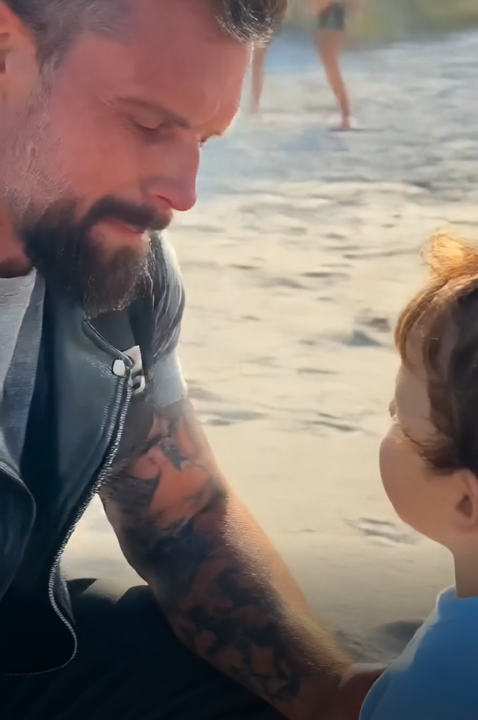
“He’s confused,” Grant told the lifeguard. “There was a serious head injury. My wife hasn’t seen him since.”
My wife.
He said it carefully, looking at Daniel instead of me.
The lifeguard asked whether I could sit up. I nodded, although my stomach rolled when I moved. Noah climbed against my side, his wet swim shirt cold through my dress. Daniel remained beyond arm’s reach, hands open, as if approaching us might frighten the boy.
“You told me there was a funeral,” I said.
“There was a memorial,” Grant answered.
The distinction landed harder than a denial.
Daniel looked older than forty. One shoulder sat lower beneath his leather vest, and a pale scar pulled at the edge of his beard. But I knew the broken little ridge in his left thumbnail. He had caught it in a vise the winter we bought our house.
Then I remembered the report.
The envelope with Noah’s name. The words excluding Daniel as his biological father. I had read those words so often that I could still see the crease across the page.
What if Grant was right about the head injury? What if grief was making two unrelated things fit together?
“Noah,” I said, keeping my voice level, “would you sit with the lifeguard while we talk? Right there. Where I can see you.”
He shook his head.
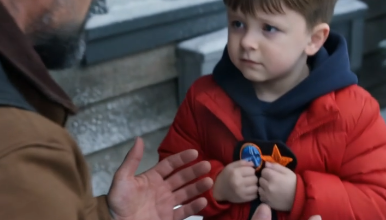
Daniel unhooked a small brass compass from the pouch at his belt and offered it on his palm. Noah took it without letting go of my dress.
“Hold this a minute,” Daniel said. “I’ll stay here.”
I recognized the dent in its lid.
My mother’s compass. The one I had given Daniel before our divorce, then tucked into his riding pouch during our brief, foolish attempt to begin again.
Grant stared at it.
“You kept that?”
Daniel looked up. “It was in the belongings you returned.”
Grant turned toward the parking lot. “This conversation needs to happen somewhere private.”
“No.”
The word surprised me. So did how much effort it took to say it.
A police officer arrived because someone had reported a missing child and a woman collapsing. He checked that Noah was safe, then asked us to separate while he wrote down what had happened.
Grant gave his name first. He mentioned his business, our address, his position on a local fundraising committee.
Daniel handed over his driver’s license.
The officer studied it, then asked him to confirm his date of birth. Grant watched the license come back across the officer’s notebook.
Later, I would remember that look.
At the time, I was watching Daniel’s thumb tremble against his trouser seam.
If he had always been alive enough to carry identification, who had needed me to believe he was dead?
Before the accident, happiness had usually smelled like burnt toast and the citrus cleaner Daniel used on his workbench.
Our marriage had ended over ordinary damage: money, racing weekends, promises stretched thin. But three weeks after the divorce, he came to fix my porch step and stayed for dinner. The next morning, he sewed my mother’s brass compass into a little riding pouch with orange upholstery thread because we had run out of blue.
The compass had a stubborn hidden latch. You pressed the stamped E on the rim before lifting the lid.
“East,” he told me. “For the person who can never find the ocean.”
“I found you.”
He smiled at that.
Those were the two things I remembered most clearly when the lifeguard gave me water: the orange stitches and Daniel placing my fingertip over that tiny letter.
Grant had not been part of that morning.
He worked as a contract bookkeeper for Daniel’s repair shop and sometimes handled billing at the physical therapy office where I worked. We had dated briefly during the separation. I had stopped seeing him when Daniel and I began talking again.
That was why I had doubted Noah’s paternity.
That was why the test had mattered.
At the beach, Daniel told the officer he had been riding with two friends to meet a man selling a used lift for his workshop. They had stopped for lunch. He found Noah crying beside the showers and took him to the lifeguard station.
Noah supplied the rest.
“I went around the wrong blue building.”
There was no attempted abduction. No stalking. Just a frightened child who had followed the wrong path back toward the sand.
Grant offered to take Noah home.
I asked the officer to stay while I called my sister.
Grant’s mouth tightened. “You’re making this worse.”
My sister, Beth, arrived carrying a booster seat and a grocery bag full of things Noah liked. She had brought crackers, an apple, and the stuffed rabbit he insisted was a dog.
Daniel’s eyes followed the rabbit.
“You had a baby,” he said.
I could barely hear him.
“Yes.”
“Grant sent a photograph of a hospital bracelet. He said you’d lost him.”
I turned toward my husband.
Grant pulled out his phone. “I still have the messages from his aunt. We were all trying to keep him stable.”
“His aunt?”
“Ruth. She handled things after he woke up.”
Daniel’s jaw worked once.
“You said Claire didn’t want calls.”
“That was what Ruth told me.”
It was the first explanation that sounded possible. Ruth had never liked me. She believed I had ruined Daniel’s confidence by leaving him, and she had told me so outside the courthouse.
Grant showed me a message from her number.
Don’t upset him. She has another life now.
For one weak, relieved second, I wanted that message to explain everything.
Then Daniel said, “Call her.”
And Grant locked his phone.
What would Ruth say if she heard both versions of the same six years?
Ruth answered from a grocery store in Richmond.
I recognized the impatient breath she took before saying hello. The sound had once made me feel nineteen years old and unwelcome at Christmas dinner.
“Daniel’s here,” I said.
The grocery store noises stopped moving around her.
“Where?”
“Wrightsville Beach. With me. And my son.”
Ruth asked me to repeat the last two words.
Grant stood close enough to hear. Daniel moved toward the railing so Noah, now eating crackers beside Beth, would not have to watch his face.
Ruth did not deny sending the message.
She had believed I had remarried, had a baby with Grant, and asked to be left alone. Grant had shown her a photograph from a courthouse wedding.
Our wedding.
Almost two years after the accident.
“He said you’d had enough of hospitals,” Ruth told me. “He said every call brought you back to the divorce.”
“Did you ever speak to me?”
A shopping cart rattled somewhere behind her.
“No.”
The messages had been real. Their meaning had been manufactured.
Grant shook his head. “She’s mixing up the sequence.”
Ruth heard him.
“No, Grant. I remember the sequence.”
She described Daniel waking after months of treatment, then struggling through rehabilitation. He could remember me. He could not button his own shirt. Grant was the emergency contact listed through the racing team and the person managing his business affairs.
Grant had told me Daniel died.
He had told Ruth I wanted no contact.
Two lies traveling in opposite directions.
“What hospital?” I asked.
Ruth named it.
Not a secret facility. Not an unidentified patient. A hospital I could have called if I had known where he was.
As Daniel’s ex-wife, I had never received official death paperwork. Grant told me the family wanted privacy. He arranged a small memorial and brought me a sealed keepsake box afterward.
I had been newly pregnant, sleeping in my sister’s spare room, and ashamed of how much I still loved a man I had divorced.
I had accepted his help.
That was all it had required.
Daniel returned from the railing.
“I didn’t know about Noah,” he said. “I need you to hear that.”
Grant slipped his phone into his pocket.
“We should do this with professionals.”
For once, he was right.
That evening, Beth drove Noah and me to her house. I took only my purse, the damp beach bag, and a photograph of the paternity report stored on my phone.
Grant called fourteen times.
Daniel called once.
He asked whether Noah had eaten.
The next morning, I requested another copy of the old report and made an appointment with an attorney named Elena Price. She asked me to describe exactly how the original samples had been collected.
“I swabbed Noah,” I said. “Grant handled Daniel’s sample.”
“What sample?”
“A toothbrush from his riding bag.”
Elena put down her pen.
The laboratory copy confirmed an exclusion. But under the adult sample description, two words appeared that I had never noticed.
Buccal swab.
Why had a toothbrush from a dead man become a cheek swab from someone alive?
Elena did not call the report fake.
She asked for the envelope, the payment receipt, and every message Grant had sent about it. She also asked me not to confront him with what we had found.
“The result may be perfectly accurate,” she said. “We need to know whose sample was tested.”
That sentence stayed with me.
I had imagined someone changing a percentage on a page. Instead, the page might have been telling the truth about the wrong man.
The testing had been a private home collection, arranged after Noah’s birth. Grant told me the laboratory could use Daniel’s toothbrush. I remembered handing over the baby’s swab while Noah cried against my shoulder. Grant had kissed my forehead and said he would take care of everything.
He had.
Daniel agreed to fresh testing through a documented collection process. So did I. Noah objected to the swab until the collector let him practice opening his mouth like a dinosaur.
Results would take time.
Other records arrived first.
Daniel still had access to an old business email account. With his permission, Elena’s office began sorting the correspondence he had been unable to face after rehabilitation.
There were invoices, supplier warnings, and a string of transfers from the repair shop’s account to a consulting company Grant owned.
Some had legitimate explanations.
Others carried Daniel’s approval during weeks when he was unconscious.
The total was more than sixty thousand dollars.
I sat beside Daniel while he looked at the ledger.
“That was the shop,” he said.
He did not mean the building. He meant the lift he had saved for, his apprentice’s wages, the parts supplier who had extended him credit.
Grant had explained the closure to me as debts following the accident.
He had explained it to Daniel as bills paid on his behalf.
Between those explanations sat a series of signatures Daniel said were not his.
A former office assistant agreed to speak with Elena. Her name was Marisol Vega. I remembered her bringing a casserole after the memorial.
“I should have called you,” she said.
She had seen Daniel’s hospital property bag in Grant’s office months after he supposedly died. Inside were the riding pouch, the compass, and a toothbrush in a clear sleeve.
Grant told her he was organizing things for me.
She also remembered a prepaid shipping label for the laboratory.
His consulting company had paid for it.
That was not proof of a substituted sample. Neither was the new report’s wording. But together they made the old certainty impossible to hold.
Then Marisol forwarded a message Grant had sent her after she asked about an unexplained transfer.
Claire needs stability. Don’t drag her back into his mess.
I read it twice.
The man who had brought groceries when I was pregnant had been moving money while Daniel learned to stand.
The man who held Noah during midnight fevers had chosen which version of our lives each of us was allowed to see.
That night, my phone stopped connecting to our shared mobile account.
A message appeared on Beth’s screen instead.
Grant was requesting that Noah be returned home.
How much of my life could he close before I found a door he did not control?
The school called Beth the following morning.
Grant was at the front office asking to collect Noah.
It was a summer kindergarten program. Noah had been there for less than an hour. I had packed crackers in the little side pocket of his backpack because he worried the snacks would be unfamiliar.
I drove barefoot in Beth’s spare sandals.
By the time I arrived, the principal had brought Noah into her office with a box of plastic animals. Grant stood at the counter holding identification and the enrollment forms we had completed together.
To the school, he was Noah’s father.
That was what the paperwork said.
“We had a disagreement,” he told the principal. “My wife is involving a man with a documented brain injury.”
I could hear Noah making a dinosaur roar through the half-open door.
“He doesn’t know this man,” Grant continued. “Now she’s taking him to appointments.”
The principal asked us to lower our voices.
Grant lowered his immediately.
I had to work at it.
Elena spoke with the school by phone while Beth came to collect Noah. The principal documented the dispute and asked us for updated instructions supported by the appropriate paperwork.
Nobody declared me right.
Nobody handed Grant my child.
We spent two hours in an office that smelled of dry-erase markers while Noah asked whether he had done something bad.
“No,” I told him. “You went to school.”
That afternoon, Grant sent Beth a photograph of Daniel.
It showed him outside a rehabilitation center, thinner than he was now, holding an envelope.
Underneath it, Grant had written:
Ask your sister what kind of father takes money to leave.
I called Daniel.
“Tell me it isn’t what it looks like.”
He did not answer quickly enough.
We met outside Elena’s office. He arrived in a pickup borrowed from a friend because his right leg was hurting too badly to ride. He climbed out slowly, one hand braced against the door.
“Yes,” he said. “I took money.”
The photograph had been taken almost two years after the crash.
By then, he could walk. He knew I had married Grant. He believed the baby from my pregnancy had died and the child in the photographs belonged to my new marriage.
Grant offered twenty-four thousand dollars to settle what he called Daniel’s remaining interest in the shop.
There had been another condition.
No contact with me.
“You signed that?”
Daniel stared at the pavement.
“Yes.”
The word stripped away the last easy version of him.
“I was tired,” he said. “I owed Ruth money. I couldn’t work a full day. He said you were finally happy.”
“So you let him decide what I wanted.”
“Yes.”
A delivery truck backed into the alley. Its warning beep filled the space between us.
I wanted to hit something. Instead, I pressed my keys into my palm until they hurt.
For years, I had mourned a man who had eventually learned I was alive and chosen to remain absent.
Grant had built the lie.
Daniel had accepted a room inside it.
If both men had helped keep that door closed, which one was my son supposed to trust?
Daniel brought the agreement to Elena the next morning.
He did not ask me to meet him first. He did not ask her to soften anything.
The document called the payment a business settlement. An accompanying email made Grant’s condition clear: Daniel was to stop trying to contact me and communicate only through Grant about remaining property.
It did not mention a living child.
That mattered.
It did not make what Daniel had done disappear.
“I thought staying away was the decent thing,” he told me later.
“You could have asked me.”
“I know.”
I waited for the explanation that would turn into an excuse.
He stopped there.
The fresh paternity results arrived twelve days after the beach.
Elena asked me to come in without Noah.
I knew before she turned the page. Still, when she said Daniel was Noah’s biological father, I held the edge of her desk as if the room had begun moving again.
Eight months after the accident.
Five birthdays.
The little boy who always pressed his tongue against his cheek while concentrating.
I had seen Daniel in him for years and trained myself to look away.
Daniel read the report standing up. Then he sat down badly, missing the chair’s arm with his hand.
“Does he know?” he asked.
“Not yet.”
He covered his mouth.
There was no speech. I could hear the office printer starting in the next room.
Elena helped us keep the immediate questions small. What would Noah be told? Where would he sleep? Who would collect him? The adult arguments had to stay outside those answers.
We told him together at Beth’s kitchen table.
Daniel was his biological father. Grant was the person he had known as Dad. Some grown-ups had told lies, and none of those lies were Noah’s fault.
Noah looked at Daniel.
“Did you know where I lived?”
Daniel’s eyes moved toward me.
Then back.
“Later, I did.”
“Why didn’t you come?”
“Because I believed something without asking your mom. And because I made a bad choice.”
Noah peeled the corner from a paper napkin.
“Are you coming Saturday?”
“If you want me to.”
He nodded.
For the first visit, Daniel brought sidewalk chalk instead of a toy motorcycle. He sat on Beth’s driveway while Noah drew an enormous parking space around his boots.
Grant, meanwhile, asked through his attorney to return to the family home and resume the previous arrangements. He described Daniel as an unstable former husband disrupting a settled household.
By then, investigators were examining the business transfers and disputed signatures. The old laboratory had preserved the adult genetic profile. Through the proceedings that followed, a verified sample from Grant became available for comparison.
The profile labeled Daniel matched Grant.
The original exclusion had been real.
The name on the sample had been the lie.
Elena placed the two reports beside each other.
Then she asked me to bring the compass to the hearing.
What could that little broken instrument tell a room full of people that the numbers had not already said?
The hearing took place nearly three months after the beach.
Noah spent the morning with Beth at the aquarium. He knew there was a meeting about grown-up decisions. He did not know that his old paternity report would be discussed beneath fluorescent lights while strangers took notes.
The gallery was half full.
Ruth sat beside Marisol. Daniel’s riding friends came in clean shirts and remained quiet. One held Daniel’s helmet on his knees because Daniel had forgotten to leave it in the truck.
Grant looked like himself.
That bothered me more than anything.
Navy jacket. Trimmed hair. The watch I had given him for our second anniversary. He greeted the clerk politely and moved his chair to let an older woman pass.
His attorney argued that the early confusion had begun with Daniel’s medical condition and the breakdown of our marriage.
Some of that was true.
Elena did not pretend otherwise.
She introduced Daniel’s settlement agreement herself. She asked him about the money, the silence, and the years he could not return.
He answered without looking toward me.
Then the records began.
Hospital dates beside business authorizations.
Transfers beside disputed invoices.
The laboratory’s original submission information beside the newly verified profiles.
Grant said he had relied on instructions from others. He said he might have misunderstood which collection materials had been used. He said the office assistant could not possibly remember a shipping envelope after so long.
Then Elena asked about Daniel’s belongings.
Grant testified that he had returned the property bag without examining its contents.
“The pouch was personal,” he said. “I respected that.”
Elena asked whether he had opened it.
“No.”
Handled the compass?
“No. Not until the beach.”
The compass rested inside a clear evidence bag. The orange stitches in the accompanying pouch had faded almost white along one edge.
Elena asked permission to have it shown to him.
Grant looked irritated.
When she demonstrated the lid for the court, she lifted at the ordinary seam. It resisted.
“Press the E,” Grant said.
Nobody moved.
He glanced at me, then at the compass.
Elena lowered her hand.
“How do you know that?”
“I must have seen—”
“You testified you had never handled it before the beach.”
Grant’s attorney rose.
The judge heard the objection, then permitted Elena to continue with a narrower question.
“When did you learn how this compass opens?”
Grant rubbed his watchband.
It was the smallest gesture. I had watched him do it while discussing mortgages, vacation deposits, Noah’s first dental bill.
“The toothbrush was underneath it,” he said.
Elena waited.
“In the pouch?” she asked.
“Yes.”
“The pouch you testified you never opened?”
His face changed.
That was the moment I recognized from the beach. The instant before he stopped trying to sound kind.
“She wouldn’t accept it,” he said.
Elena asked what he meant.
“That he was wrong for her. Even after the divorce.”
His attorney touched his sleeve.
Grant pulled away.
“I stayed. I was there when the baby cried. I paid for things. He took the money.”
Daniel looked down.
Nobody rescued either man from what was true.
Elena returned to the submission form.
“And whose cheek did you swab?”
Grant stared at the signature above his shipping account number.
For the first time, he had no different person left to blame.
If being there had made him Noah’s father, why had he needed to put another man’s name on his own blood?
Nothing ended in that courtroom.
The judge made temporary decisions about the household and contact arrangements. Other questions moved into other proceedings. There were more appointments, more records, and mornings when I could not remember which folder contained the document someone needed.
Grant’s admission did not repair the shop.
The paternity result did not give Daniel five birthdays.
And the truth did not make Noah stop asking for the man he had called Dad.
I learned to answer that without looking hurt.
Months later, the criminal case concerning the stolen business funds and forged records ended in guilty pleas. Restitution became a number on paperwork that would take years to collect.
The divorce took longer than I expected.
So did sleeping through the night.
I moved into a smaller rental with a porch barely wide enough for two chairs. Beth helped me carry boxes. Ruth sent a letter apologizing for believing a man who had made her resentment feel useful.
I read it twice.
Then I put it away.
Daniel opened a small repair bay with another mechanic. He worked fewer hours than he once had. On bad mornings, his leg stiffened and he leaned against the counter while customers pretended not to notice.
He came when he said he would.
At first, Noah wanted him only on Saturdays.
Then Wednesdays, too.
They built a birdhouse crooked enough that I expected it to fall apart before winter. Daniel let Noah measure the roof, which explained most of the problem.
I watched them from the porch.
Sometimes I still became angry without warning.
At the memorial box in my closet.
At a photograph from Noah’s first birthday.
At Daniel standing in my kitchen, knowing he might once have stood there much sooner.
He learned not to answer that anger with how much he had suffered.
Once, while Noah was washing paintbrushes, Daniel said, “I don’t expect us back.”
I knew what he meant.
The marriage. The porch-step dinner. The people we had been before six years came between us.
“I can’t promise that,” I said.
“I know.”
Noah called from the sink because the water had turned green.
Daniel went to help.
That was where we began.
Not with forgiveness arriving all at once, but with someone answering from the next room.
The compass came back to us after the proceedings. Its needle still caught against the damaged rim. Daniel offered to have it repaired, but Noah objected.
“It’s the one from the beach.”
So Daniel replaced only the worn cord.
He used orange thread to secure the little loop.
One Sunday, we returned to Wrightsville Beach. Beth came with us, carrying too many sandwiches. Daniel parked his motorcycle beside her car and waited while Noah fastened the compass around his own wrist.
We walked past the showers.
Noah stopped there.
I felt his hand tighten in mine.
“Is this where I got lost?”
“Yes.”
He looked at Daniel, then down at the scratched brass lid.
Daniel crouched beside him. This time, Noah pressed the stamped E himself.
The compass opened.
For a moment, all three of us watched the stubborn needle tremble. Then Noah closed the lid and reached for Daniel’s hand with his free one.
“Can we go home together?”